new complications for COVID vaccines in the US

(COVID Photo by Martin Sanchez on Unsplash)

Last week, after reading a newsletter from Your Local Epidemiologist founded by Dr. Katelyn Jetelina, I got a COVID vaccination. I will be going to my annual poetry residency with the Boiler House Poets Collective at The Studios at MASS MoCA in early October and wanted my immunity to be as strong as possible while I’m there.

The newsletter had warned that there might be label changes coming from the US Food and Drug Administration that would impact the availability of COVID vaccines and that it might be advisable to get the vaccine soon, especially for people younger than 65.

I’m glad I took action.

Yesterday, the Food and Drug Administration changed the guidelines, making it more difficult for people under 65 to qualify for COVID vaccines without consulting their doctor. In response, CVS and Walgreens, whose pharmacies are a major source for vaccinations to the public, suspended giving any COVID vaccines to anyone in sixteen states, including mine, unless you have a prescription from a health provider. Part of the confusion is that the Centers for Disease Control and Prevention has yet to issue its guidance and just suffered the loss of its top leadership through firing and resignations, grounded in the fact that they were being pressured to put forward recommendations not backed by scientific research.

That’s what happens when you have a Health and Human Services Secretary like Robert Kennedy, Jr., who does not have a background in medicine and disrespects rigorous scientific inquiry.

The fact is that COVID-19 vaccines have been rigorously tested and are safe and effective, cutting down on infection rates and keeping most people from becoming seriously ill and needing hospitalization. Serious side effects are very rare, so the benefits of receiving the vaccine outweigh the risks.

Tragically, vaccines have been politicized in the US, which has cost lives. The death rate from COVID-19 for Republicans is higher than for the population as a whole because of this.

I urge everyone with questions to talk to a trusted medical professional about the research and science behind vaccines. Don’t fall for the misinformation coming from Kennedy and the people he has put in place at the CDC and FDA who disregard valid scientific findings.

You can also look for recommendations from medical associations, such as the American Academy of Pediatrics.

Don’t let misinformation keep you from taking the best care possible of your and your family’s health.

No CO2 Fracking in NY!

I’m pleased to report that, over the weekend, New York Governor Kathy Hochul finally signed the bill adding carbon dioxide to the existing ban on hydraulic fracturing (fracking) in the state. We recently observed the tenth anniversary of the ban.

You can read more about the bill and how important it is to keeping us safe here.

A huge thank you to State Senator Lea Webb, sponsor of the bill in the Senate, and Assemblymember Anna Kelles, sponsor in the Assembly. Thanks also to Donna Lupardo, my Assemblymember, who was a co-sponsor. I will always be grateful to the large coalition of scientists, experts, Indigenous Nations, environmental organizations, and concerned individuals who have been at work for years on this issue for the good of our health, our environment, and our climate.

Broome County, where I live, would have been among the first targeted with this dangerous experiment to use supercritical carbon dioxide to extract methane. I’m grateful that our state will remain frack-free!

Celebrating ten years of the New York fracking ban

Ten years ago today, New York State announced an administrative ban on high-volume hydraulic fracturing (fracking) in the state. (in 2021, the legislature made it a law.)

To celebrate, Food & Water Watch, one of the lead organizations in fighting fracking, has compiled a free, commemorative e-book, which you can download here.

A large coalition of organizations, environmentalists, indigenous nations, scientists, engineers, and concerned citizens had spent years advocating for a ban, helped by many of our Pennsylvania neighbors who were suffering from the harms of fracking in their communities. There had been rallies, commentary in the press and at hearings, educational events, scientific papers and lectures, and showing up at public appearances by then-Governor Andrew Cuomo leading up to the ban, which occurred when the Dr. Howard Zucker, the Health Commissioner, said that fracking was too dangerous for New Yorkers’ health, ending what had been a very fraught battle over the SGEIS (Supplemental Generic Environmental Impact Statement) that would have allowed fracking without need for site-specific studies.

Yes, that sounds very wonky but we were lucky to have lawyers and other experts in the coalition who could break everything down for us into understandable, actionable bits.

My role in the efforts to ban fracking was as a member of the Rapid Response Team. We would receive links to articles about fracking in the media and write comments to bolster the truth and challenge misinformation. It was intense at times but it meant a lot when I would be at a rally or event and people from other parts of the state would recognize my name from comments I had written. It was good to know that my little part was helpful to the cause.

When the announcement came from Albany ten years ago, there was rejoicing from all parts of the coalition and a celebration here in Binghamton, which had been the epicenter of both the pro- and anti-fracking efforts. Unfortunately, I couldn’t attend because I was sick with shingles. I was very grateful, though, and as excited as I could manage to be.

We aren’t having a party on this tenth anniversary but we are all awaiting Governor Kathy Hochul signing a bill that will add carbon dioxide to the existing fracking ban. The bill was passed in March and we have been urging her to sign it ever since.

Many bills get signed in December so it could be any day now, although I’m hoping it will be today.

It would be a fitting tenth anniversary commemoration and a reminder to the nation that New York says NO to fracking!

Update: On Dec. 21, Governor Hochul finally signed the bill. You can read the press release from coalition members here.

Summer ’24 COVID wave

(COVID Photo by Martin Sanchez on Unsplash)

It’s become more difficult to keep track of COVID-19 cases here in the United States, as less data is being collected and shared with the public.

We do know that this summer’s wave has been substantial, mostly due to the Omicron subvariants known as FLiRT. While death rates have been lower than in previous waves, they have still been ranging in the 400s-700s per week this summer, which is upsetting. These figures may also be lower than the actual count because reporting is less robust than it was under the public health emergency protocols.

Last week, the US Food and Drug Administration approved the Pfizer and Moderna vaccines based on the KP.2 variant, one of the FLiRT family. Doses are already available from some pharmacies and are recommended for everyone ages 6 months and older. While some people will choose to wait until later in the fall to have the strongest protection possible going into the expected winter wave, I will be getting mine in mid-September so that my immunity will be strong when I go to North Adams for the annual Boiler House Poets Collective residency at MASS MoCA (Massachusetts Museum of Contemporary Arts). It looks as though the vaccine will be a good match for the strains that will likely be dominant in the coming months.

The FDA is also expected to approve the Novavax vaccine in the coming weeks. It is a more traditional protein-based vaccine rather than an mRNA one. Some people prefer it because it can cause fewer side effects.

Many people are choosing to ignore any news about COVID and vaccines but it is still a serious problem, here in the US and around the world. This is a reminder that some people are still getting very sick and dying from the SARS-CoV-2 virus. Updated vaccines are known to reduce the risk of hospitalization and death, so please get one if they are available to you. (Contact your health care provider for any special recommendations that may apply.)

Other measures can also help reduce your chances of getting COVID. Wearing a high quality mask, especially in crowded, indoor areas, dramatically decreases the rate of infection. Increasing indoor ventilation and air filtration and holding events outdoors are helpful in preventing the spread of COVID and other viruses. If you are sick, stay home and take precautions against spreading your illness to others in your household. Get adequate rest and nutrition to keep your immune system strong.

COVID-19 has not settled into a pattern like we see with flu and is still much more serious in terms of hospitalizations and deaths. It also impacts more systems in the body and can cause symptoms over a longer period of time, such as we see in cases of long COVID. Some people are willing to risk their own health but please remember that you are also putting your family and vulnerable community members at risk if you spread the illness to them.

Wishing everyone good health in the coming months.

One-Liner Wednesday: Project 2025 and NOAA

Project 2025, the lengthy document spearheaded by the Heritage Foundation to lay out plans for the “conservative president” they expect to be elected this year, calls for disbanding NOAA (National Oceanographic and Atmospheric Administration), the United States’ premier agency for weather, ocean, and climate data and research. (p. 664)

This public service message is brought to you through Linda’s One-Liner Wednesday series. Find out more here: https://lindaghill.com/2024/07/31/one-liner-wednesday-particularly-pretty/

No-Mow May

In the United Kingdom and parts of the United States, there is an initiative called No-Mow May, encouraging people not to mow lawns (or a portion thereof) during the month of May in order to encourage the blossoming of wildflowers which provide food for bees, butterflies, and other pollinators.

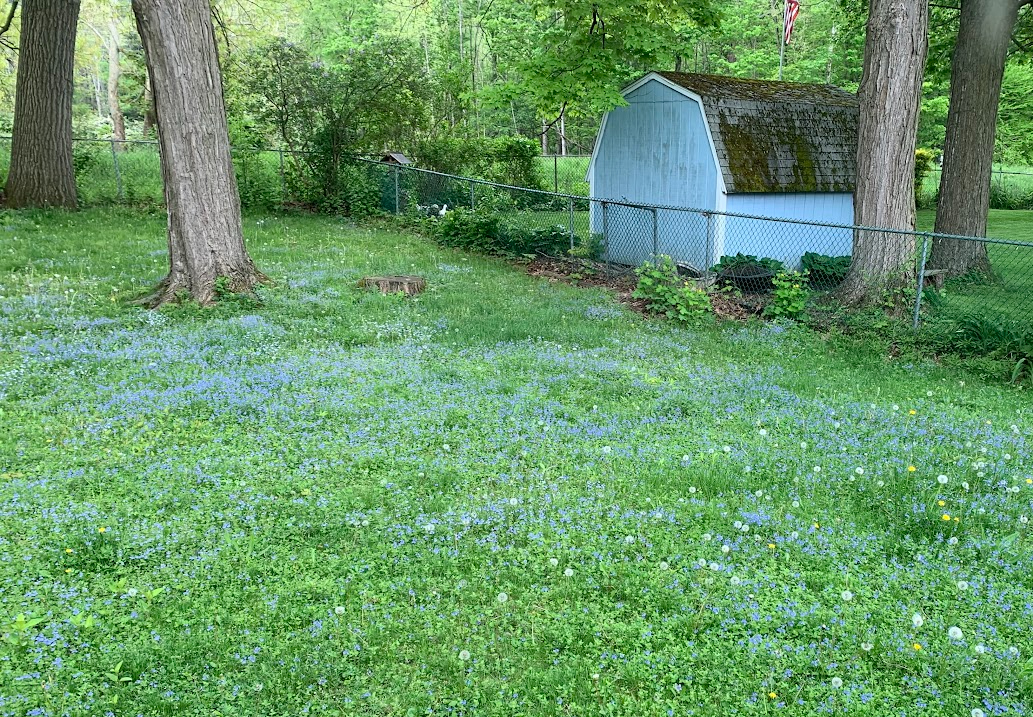
In the spirit of No-Mow May, we have limited our lawn mowing in our front yard and left most of the back yard to grow on its own. The front yard starts things off with dandelions, which we let blossom but then wind up having to mow for propriety’s sake. B leaves the lawnmower on the highest setting, though, so that the spent dandelion stems get cut while sparing the violets and white clover that follow. Even though white clover is not native, our bumblebees seem to enjoy it. It’s also helpful that we use a battery-powered mower so that the plants don’t have to contend with the heat and exhaust of burning gasoline.

Besides those, the backyard has waves of additional flowers, including wild strawberry, bluets, forget-me-nots, speedwell, buttercups, celandine, ground ivy, and fleabane. While these help our pollinators, they also provide food for other animals, including rabbits.

Besides the lawn, we have other spring-flowering plants, including bleeding hearts, PJM rhododendron, dwarf daffodils, lily-of-the-valley, brunnera, amsonia, and our heirloom rose bush.

Although not all the plants are native, our native pollinators frequently visit them, which is important to us, especially our bumblebees. When we had a landscape plan drawn up and planted in fall 2020, we requested native plants, but some of the plants that grow wild in our yard are non-native species that are now considered naturalized in our area, though not invasive. If we do find invasive species, such as garlic mustard, growing, we try to pull them out so that they don’t spread. It is also helpful that we have had wildflowers growing as part of our lawn for decades. We never use herbicides. The mix of plants and not mowing it too short also make our lawn drought-resistant. We never have to waste water by spraying it on our lawn.

We may stretch No-Mow May into early June in the backyard so that the daisies that have started to grow up but haven’t blossomed yet have a chance to do so. Perhaps, B will do what he has done in some past years and mow around the daisies until they have had a chance to flower.

Do people observe No-Mow May – or some variation better suited to your geography, like Low-Mow May or No-Mow April, where you live?

eclipse thoughts

(2017 Photo by Scott Szarapka on Unsplash)

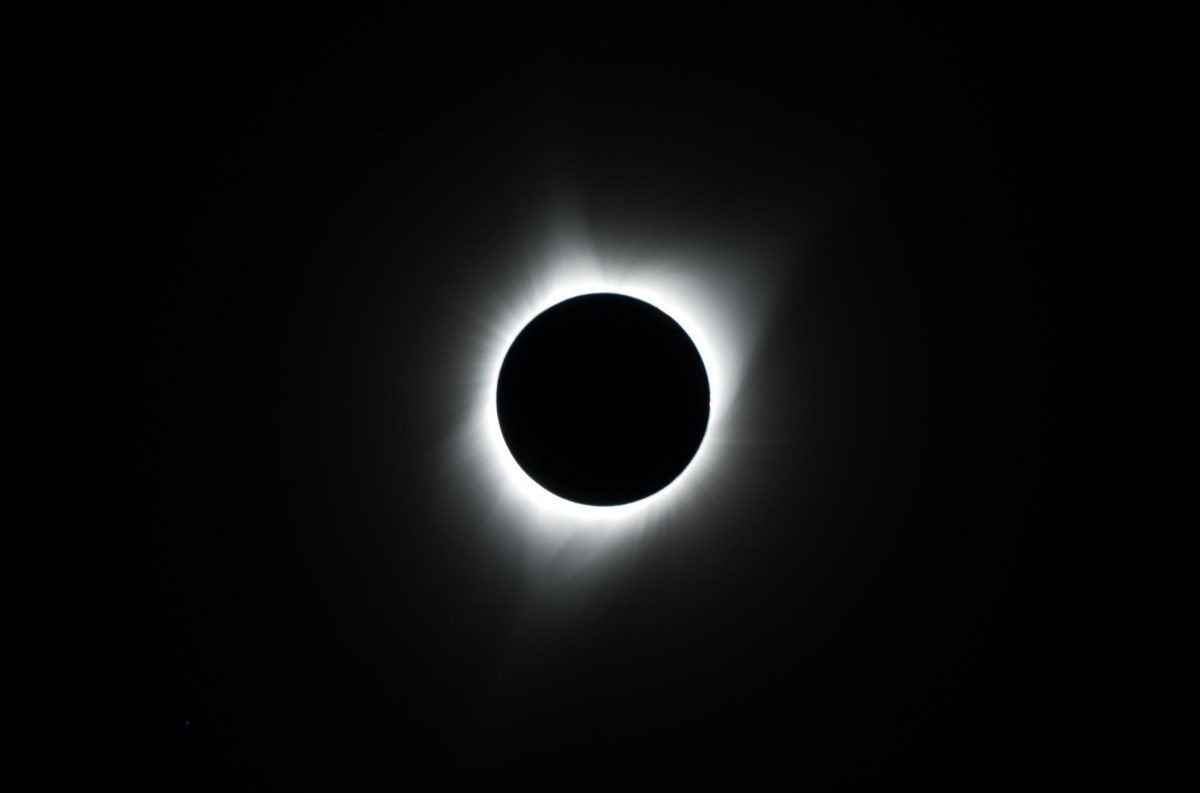
One Monday, April 8th, there was a solar eclipse over a wide swath of North America. At my home in central New York, we were close to the path of totality with 97% of the sun obscured.

We dutifully bought eclipse glasses but the afternoon was very cloudy. During the time of maximum coverage of the sun, we did notice that it became darker, darker than you expect from cloud cover, even from a thunderstorm. A few minutes after it lightened again, it began to rain.

Meanwhile, many people were expressing their awe and wonder at viewing the eclipse. Some had travelled many miles, even internationally, to see it. All were subject to the vagaries of weather, but most were lucky to have good conditions for viewing. Even people who weren’t able to see the eclipse expressed gratitude at being part of an excited crowd putting aside divisions to look up together.

As I’ve been reflecting on the eclipse experience, I find myself wondering if I would have felt the same mystical sense of awe that others have been describing. Perhaps it is my practical New England upbringing or my study of science or my overall sense of respect for creation but I have trouble separating the eclipse from other natural phenomena. Should I feel more wonder at an eclipse than I do for a broken, blue shell that recently sheltered a baby robin or a riot of forsythia blossoms or the ancient rocks worn smooth by the brook or the full moon?

While I do appreciate the effect that the eclipse had to bring people together, I had no desire to be part of a crowd. Granted, I am the type of introvert who is always uncomfortable in a crowd, however noble or friendly its purpose.

Did you experience this eclipse or one in a different time and place? Please share your thoughts in the comments section.

No to CO2 drilling in New York!

One of the things that has been occupying me over these last weeks is the unwelcome and unexpected need to return to the battle against unconventional gas drilling in my home region, New York’s Southern Tier (central NY along the border with Pennsylvania).

I was active with the coalition that successfully advocated for a ban on high-volume hydraulic fracturing in New York, which was first regulatory/executive in Dec. 2014 and made legislative in 2021.

In late summer/fall of 2023, a newly-formed, Texas-based company called Southern Tier CO2 to Clean Energy Solutions, Southern Tier Solutions or STS for short, began approaching landowners in Broome, Tioga, and Chemung counties with lease offers to use supercritical carbon dioxide to extract methane from the Marcellus and Utica shale formations thousands of feet under their land, claiming that it would also sequester the carbon. The scheme would involve thousands of miles of new CO2 and methane pipelines, plus ten or so new methane-burning power plants, which would burn the methane to produce carbon dioxide to use to extract more methane.

Mind you, this has never been done at scale anywhere in the world and does not have any solid scientific backing. The very real negative impacts of high-volume hydrofracking would be compounded by the dangers of carbon dioxide pipelines and injection, all at a time when New York State is implementing its landmark Climate Leadership and Community Protection Act to move us away from fossil fuels and toward renewable energy powering our lives efficiently.

When news of STS’s plans came to light, my New York State legislators, Assemblymember Donna Lupardo and Senator Lea Webb, began asking the Department of Environmental Conservation questions. I admit that I was alternating between fear and disbelief that the hard-won ban might be in jeopardy because it was predicated on the volume of water used and STS’s proposal plans to use supercritical carbon dioxide instead of water.

Fortunately, the coalition that had fought for years to win the hydrofracking ban quickly reconstituted and got to work. A coalition letter from over 90 organizations went out in December. Legislators got to work on legislation to add carbon dioxide to the existing ban with Dr. Anna Kelles as sponsor in the Assembly with Donna Lupardo as a prime co-sponsor and Lea Webb as sponsor in the Senate.

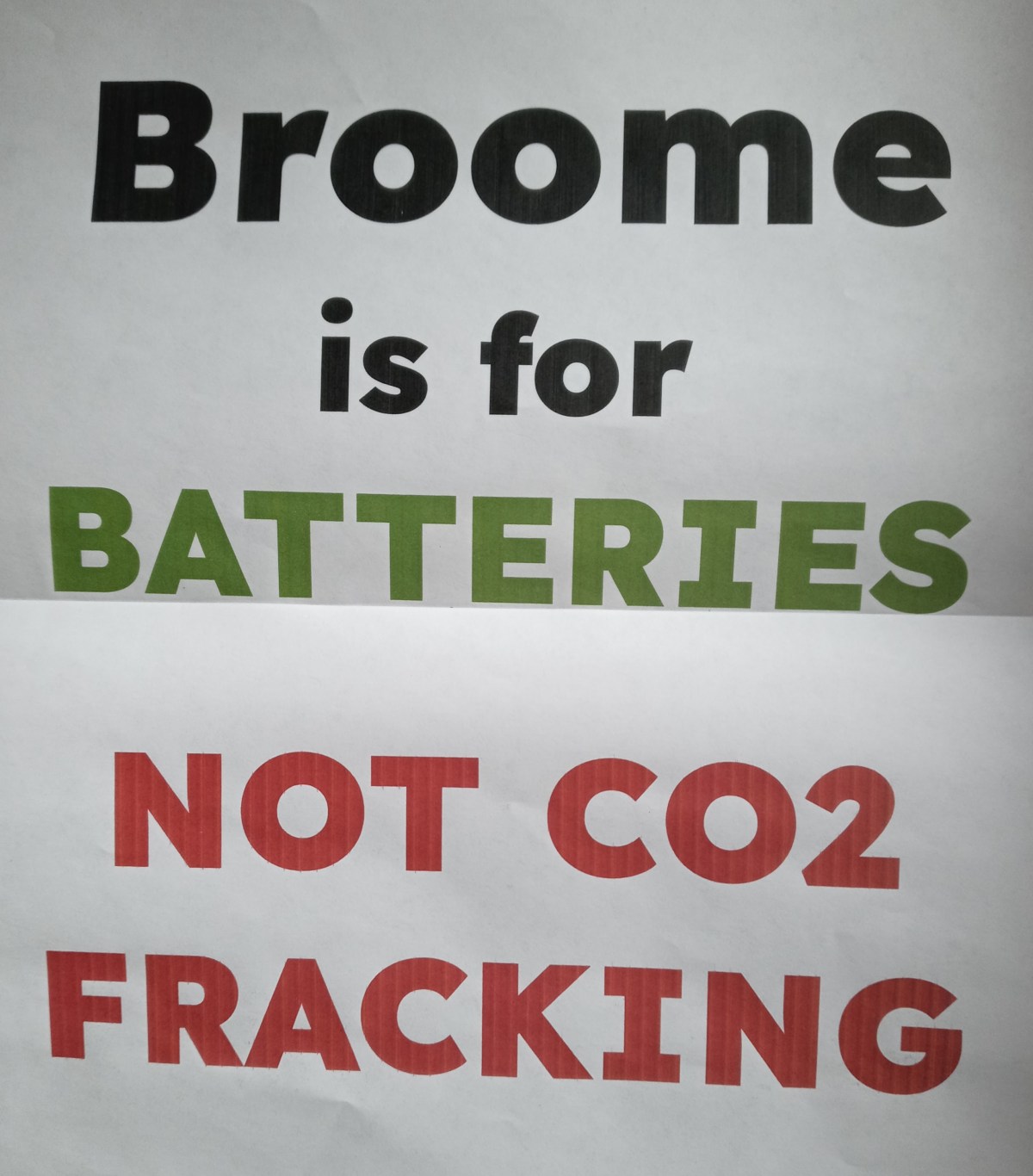
On March 5th, the coalition held a rally/lobby day in Albany. We had great speakers at the rally, including legislators, scientists, and leaders of organizations. I went local with my sign, emphasizing that the Broome County (Binghamton) area is part of the clean energy future as the center of a national technology hub for battery storage through the New Energy New York coalition and neither needs nor wants to be tied to dying fossil fuels. This was my first experience with in-person rallying and lobbying at the New York State Capitol. I was overwhelmed by the noise and busy-ness of it all but grateful to have been able to do my small part in the effort.

I’m thrilled to report that, on March 12th, the Assembly passed the bill with a vote of 97-50 and. on March 20th, the Senate followed with a vote of 45-17. Now, we are moving into the final phase, asking Governor Hochul to sign the bill quickly.

I’m shocked that the coalition was able to get this to move so quickly in Albany. As a Southern Tier resident, I’m immensely grateful to have support from around the state. In the original fight against hydrofracking, there were some very loud voices that were willing to use the Southern Tier as a sacrifice zone to get cheaper methane for their own use; this time, with the CLCPA in place, we didn’t encounter that sentiment as much. I’m also especially grateful to the Third Act Upstate NY working group, who jumped in as soon as I raised the alarm. Third Act is too new an organization to have been around for the original fracking battles but many members have extensive experience with climate activism and organizing and know how to get the word out.

While it seems that this is a local issue of a few counties in New York, the carbon dioxide drilling/sequestration scheme has global implications. Like plastics, it is an attempt by the fossil fuel industry to keep the world dependent on fossil fuels for decades to come, in defiance of the science that demonstrates the need to reduce atmospheric greenhouse gases as quickly as possible to keep the planet livable.

Part of the price to get fossil-fuel bro Joe Manchin’s vote in the US Senate on climate legislation was to include massive subsidies for carbon sequestration. It’s those subsidies that are behind STS’s proposed scheme to profit from the methane in the Marcellus and Utica shales, which is not economically viable to produce on its own. Using carbon dioxide from burning fossil fuels to extract even more fossil fuels is also inherently deleterious to environmental health and the climate. While there may be some instances where industrial carbon emissions can be collected and sequestered, the geology of the Southern Tier would not seem to support long-term sequestration. Sequestration would also be near-impossible in areas with a history of oil and gas wells because there would be too many pathways for injected carbon dioxide to escape.

My hope is that the example of New York banning this extraction/sequestration scheme will help other jurisdictions around the world see through the fossil fuels industry’s increasingly desperate attempts to keep the world burning their dirty products, even with the effects of climate change already causing damage and misery on a global scale.

Watch for news of these kinds of proposals near you. Don’t fall for the lies of the fossil fuel industry. Follow the science. Advocate for clean, renewable energy. Let elected officials know that we need and want protection from pollution and climate change. With so much damage already having been done, we need to act decisively now.

Together, we can move in a positive direction, as we are here in New York.
long COVID research summary

I realize I’ve done A LOT of COVID posts this month, but I had to share this post from Dr. Katelyn Jetelina, writing as “Your Local Epidemiologist.” She gathers together the major research advances in understanding long COVID from 2023, with lots of links to the original research.

One of the main takeaways, which I included in this post earlier in the week, is that vaccines help cut down on long COVID cases, with more doses contributing to lower risks.

Dr. Jetelina also suggests subscribing to The Sick Times newsletter, which is dedicated to sharing the latest information about long COVID weekly.

I’m grateful that the rate of long COVID has declined from early in the pandemic, but it is still affecting millions, some new cases and some months or years old. It’s important to learn more about it so treatments can be developed for long COVID and other post-infection syndromes.
*****
Join us for Linda’s Just Jot It January! You can use provided prompts or post whatever you like, even multiple posts about COVID. (Okay, that’s just me,) Find out more here: https://lindaghill.com/2024/01/19/daily-prompt-jusjojan-the-19th-2024/

JN.1

It’s been four years since the first cases of COVID-19 were confirmed in the US but it’s still a major health issue. While vaccines, treatments, and preventative measures have made the current situation less severe than the initial onslaught of SARS-CoV-2, people are still getting sick, with some needing to be hospitalized and some, unfortunately, succumbing to the disease, including the person I referenced in this post. In the week of Dec. 31, 2023-January 6, 2024, COVID caused 4% of all deaths in the United States.

The virus continues to mutate. The current strain that is dominant in the United States and globally is JN.1, which is related to the BA.2.86 variant of Omicron. The good news is that the most recent vaccine, which is based on the related XBB lineage, is a good match for JN.1, so the vaccine significantly reduces the risk of severe symptoms, hospitalization, and death while offering some protection against infection. The bad news is that, in the United States, only about 8% of children and 19% of adults are estimated to have received the newest vaccine, contributing to a surge of cases, amplified by holiday travel and gatherings.

More good vaccine news. This large study from Sweden concludes that vaccination reduces the risk of developing long COVID and that additional vaccine doses reduce risk even more. As someone who has particular concerns about long COVID, I appreciate that these studies are continuing to increase our understanding.

Another recent study shows that the Omicron variants don’t cause peak viral loads until day 3-4, much later than the earlier strains of the virus. The practical implication of this is that at-home COVID tests may not pick up a positive reading until several days into the illness, during which time the person could be infecting others. It also has implications for prescribing anti-virals, which need to begin within the first five days of symptoms to be effective. For me, this is a reminder to mask around other people whenever I have symptoms, as an early negative test might not be accurate.

A study published just a few days ago seems to put some science behind what we have all experienced, that SARS-CoV-2 doesn’t have a “season” in the way that some other viruses, like influenza, do. Changes in temperature and humidity don’t appear to have significant influence in transmission. This seems to go along with what we have experienced in the United States, with major waves happening in different seasons of the year. We’ve had waves in the heat of summer as well as the cold of winter. This suggests that our current winter wave is due more to low vaccination rates and holiday travel and gatherings than to the fact that it is winter. It also highlights the importance of increasing ventilation and using masks in crowded indoor spaces, as both summer heat and winter cold tend to drive people to gather indoors.

Four years in, I’ve written a lot of COVID-19 posts. From my days as part of the Pfizer/BioNTech vaccine trials through the present, I’ve always tried to give the most updated information and public health guidance available. It’s frustrating that there is less information from the Centers for Disease Control and Prevention than when the state of emergency was still in effect but some useful recent data can be found here. A lot of the information in this post came to my attention through this post from Dr. Katelyn Jetelina, writing as “Your Local Epidemiologist” and this post from Those Nerdy Girls.

Through all these challenges, especially when spouse B had the first case of COVID in our house in November, I’ve managed to avoid infection, unless I had a totally asymptomatic case at some point. I use my research to make decisions about vaccination, masking, crowd avoidance, etc. that are right for me and my family. I don’t think that advocating for health measures ought to be seen as controversial or political. There are, though, forces in the US that have warped disease prevention into a political test. It’s very sad that Republicans are more likely to die from COVID than non-Republicans. Please, don’t put your health and the health of your family and neighbors at risk over politics. COVID-19 is still out there. Take care of your health and your loved ones.
*****
Join us for Linda’s Just Jot It January! Find out more here: https://lindaghill.com/2024/01/15/daily-prompt-jusjojan-the-15th-2024/