Saying good-bye to Anita

This morning, I sang for the funeral of Anita Alkinburg Shipway. She was a member of the music ministry at a church that I attended for a number of years, but our primary connection was through poetry.

When I joined the Binghamton Poetry Project in 2014, Anita was already involved. I got to know her better when we were both invited to join Sappho’s Circle, a women’s poetry workshop convened by Heather Dorn. We later also participated in some workshops with the Broome County Arts Council.

I always admired Anita’s storytelling ability both in conversation and in writing. She often used the tools of narrative poetry to reveal the truth – and quirks – of human nature. She smiled and laughed easily while also being very sympathetic when we most needed it. I appreciated the depth of her wisdom as an elder.

When the pandemic moved the Binghamton Poetry Project to Zoom, Anita joined us as often as she could, despite some technical challenges. We often joked with her about the cuckoo clocks in her home that would add their voices to ours. She shared a poem about them here. You can find more of her poems in the Binghamton Poetry Project online anthologies.

Originally, Anita was scheduled to participate with me in a Zoom reading for National Poetry Month in 2021, sponsored by the Broome County Arts Council and WordPlace. Unfortunately, she got trapped in the Zoom waiting room and wasn’t able to be recorded. I sincerely regret not being able to share any video of her reading her work.

Anita died at Mercy House, a residence for those near the end of life. Anita had volunteered at Mercy House and it’s a comfort to know that she was in such a familiar and peaceful place in her last days.

I was upset to learn that COVID played a part in her death. Apparently, a COVID infection interacted with other medical conditions and Anita could not recover. It reminded me again to remain cautious. I know that, despite my best efforts, I may someday contract COVID and could infect someone else, but I don’t know if I could forgive myself if I was being cavalier about infection and passed the virus on to someone who suffered grave consequences.

Anita visited Top of JC’s Mind and would occasionally comment on posts. More often, she would write to me directly. I remember having a discussion with her about what it means for something to be “top of mind.” Apparently, her Midwestern upbringing a generation before my New England one resulted in a different interpretation of the phrase.

No matter.

Today, Anita is at the top of JC’s Mind.

Rest in peace and eternal joy, Anita. May choirs of angels greet you and lead you to paradise.
*****
Join us for Linda’s Just Jot It January. Find out more here: https://lindaghill.com/2023/01/10/daily-prompt-jusjojan-the-10th-2023/

a quiet Christmas

Spouse B, daughter T, and I were on our own this Christmas. While we had originally hoped that daughter E, son-in-law L, and granddaughters ABC and JG were going to be able to join us from London, UK, circumstances prevented that, probably a blessing in disguise given the travel disruptions caused by the extreme weather here in the US.

We here in Broome County, New York, were spared the worst of the storm. While it was cold and windy, we didn’t get a lot of snow and ice. Our hearts go out to places that suffered flooding or blizzard conditions. Erie County, about 200 miles to our west, has reported 25 deaths so far from the intense blizzard.

I did change my plan for when I went to church, in deference to the cold. I decided to attend the 4 PM vigil rather than the 10 PM. We had a prelude program from a wonderful brass quintet from Southern Tier Brass. I especially appreciated their rendition of “Lo, How a Rose” which was arranged from the Brahms organ chorale prelude that I learned when I was in college and which has always been a favorite of mine.

I also loved the introduction to the liturgy, which welcomed everyone whatever their state in life. It meant a lot to me to hear such an explicit statement of universality. The word catholic means universal but the Church has often strayed from that concept. I appreciated hearing this all-encompassing welcome at Christmas-time when people who aren’t members are often in attendance while visiting family or friends.

In the evening, B, T, and I watched Miracle on 34th Street, which is celebrating its 75th anniversary this year. T had never seen it and it had been many years since B and I had watched it. It was a sweet way to spend Christmas Eve.

In the morning, we enjoyed cranberry and date nut bread so breakfast, made by B who does a lot of the cooking and baking, especially over the holidays. We opened stockings and gifts. I was especially pleased to receive a 10th generation iPad from B; our current one is 2nd generation, so definitely a step up!

We had a chance to video chat with our London family when it was mid-morning here and mid-afternoon there. The energy of a two- and a five-year-old was palpable, even five time zones away. B and I were also lucky to have phone conversations with our siblings.

When E and T were young, celebrating Christmas was a days-long endeavor. Christmas Day would be spent with my parents who lived nearby. In the following days, my sisters would arrive with their families for a couple of days and then we would travel to B’s parents’ home in Vermont, which usually involved a celebration with his extended family. Days and days of gifts, socializing, and eating.

With just the three of us, we scaled back on the extent of our traditional holiday fare. B did make lasagna for Christmas dinner, using Nana’s recipe. He also made fresh, artisanal bread and sauteed asparagus, followed by tiramisu for dessert. On Christmas Day, we used to have a variety of homemade Christmas cookies for dessert; we would make eight or so types, sometimes supplemented by homemade dried-fruit fruitcake and chocolate fudge. At the moment, we only have two kinds of cookies, pecan puffs from B’s family recipe and cranberry-pistachio biscotti.

Although our celebration was scaled down this year, it felt right, homey and comfortable and mostly low-stress.

I don’t know if we will ever return to a predictable pattern for Christmas celebrations. With all our elder generation now passed on, it’s unlikely that we will have big, extended family gatherings as we were accustomed. Last year, the first Christmas after Paco passed away, we went to London for three weeks over the holidays, just as the first wave of Omicron was cresting. It was complicated.

The pandemic has reinforced the lesson to expect the unexpected and to be open to change. It’s difficult because we often carve certainty and routine. The parlance you often hear is “return to normal.” For me, there is no way for that to happen – for holidays or for much of the rest of life.

So, this year I will be content with a quiet Christmas, having no idea what next year will bring but hoping I will have the grace and support to handle it.

moving toward Christmas

I’m managing to do more Christmas preparation than I have in the last several years.

I have over half my holiday cards sent.

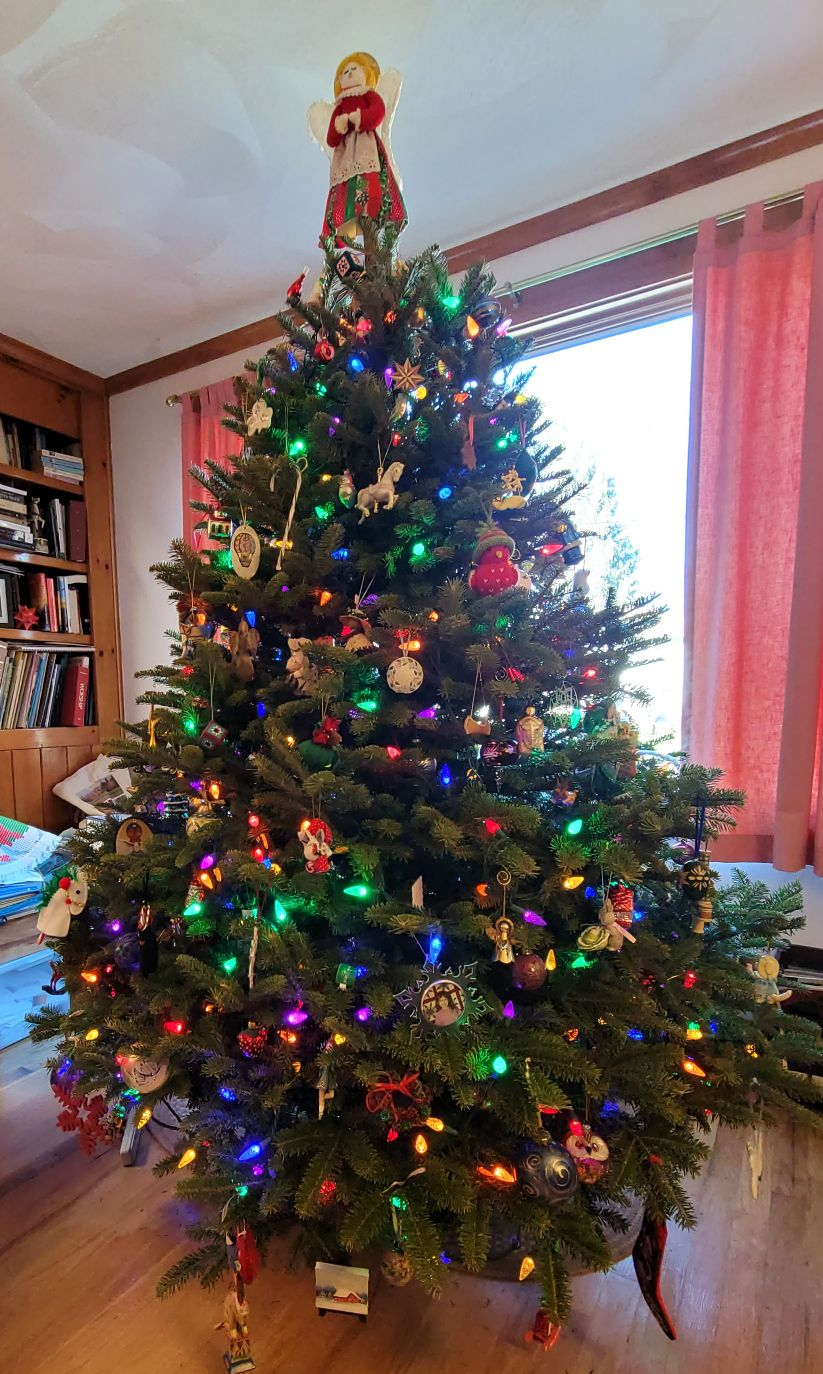
Yesterday, B and I went to the tree farm to buy our Christmas tree and wreath. Today, along with daughter T, we decorated the tree.

I love our Christmas ornament collection. There are ornaments that belonged to our parents. Ones we have bought on our travels over the years. Ones we received as gifts. Home-made ones by my grandmother, B’s mom, B as a child, our children. Handcrafted ones made by artists on four continents, including my friend Yvonne Lucia. Ornaments made of cloth, yarn, wood, birch bark, wax, corn husks, glass, paper, teasels, metal, ceramic, plastic, even eggshell. The angel on top of the tree is one I made from a kit with the help of a friend shortly after B and I married. The latch-hooked tree skirt featuring candy canes was made by my mother.

If our home suffered a disaster and our ornament collection was lost, it would be impossible to re-create.

Still, during the years when I was caring for my parents and in the immediate aftermath of their passing, as much as I cherish these ornaments, I couldn’t being myself to unwrap them, touch them, place them on the tree. Even when others had done so, I could only manage a few glances at them.

Dealing with grief and loss is an individual and unpredictable endeavor. Last Christmas, our first since the death of my father, known here as Paco, we traveled to visit daughter E and her family in London, so we didn’t have our usual Christmas decorations. I really wasn’t sure how much of the usual Christmas routine I would be able to resume this year, so I am grateful that I felt up to participating in some decorating.

Granted, Christmas this year will be quieter than usual. It will be just B, T, and I celebrating at home. I will be going to church on my own. There will be stockings and some presents to open. (I admit my Christmas enthusiasm has not yet extended to shopping.) We will have a nice dinner and dessert although we haven’t settled on the menu yet. We have decided not to make our usual number of cookies, most years dozens of cookies in at least a half dozen varieties. It just doesn’t make sense for three people.

I think one of the factors in my feeling some Christmas spirit this year was singing Lessons and Carols with the Madrigal Choir of Binghamton last weekend. Given that I spent so many years doing liturgy planning and music in Catholic churches, I’m not accustomed to singing Christmas music publicly during Advent, but I think this year doing so boosted my anticipation for Christmas and helped me to feel up to helping with decorating.

If I’m lucky, it will carry me through finishing the cards next week.

If not, I will try to remember to take the advice that I offer to others who are dealing with loss: Be gentle with yourself.

Maybe the fragrance of the Canaan fir, the rainbow-hued lights, the meaningful ornaments will help lift my spirit if it flags.

Christmas trees are beautiful, even through misty eyes.

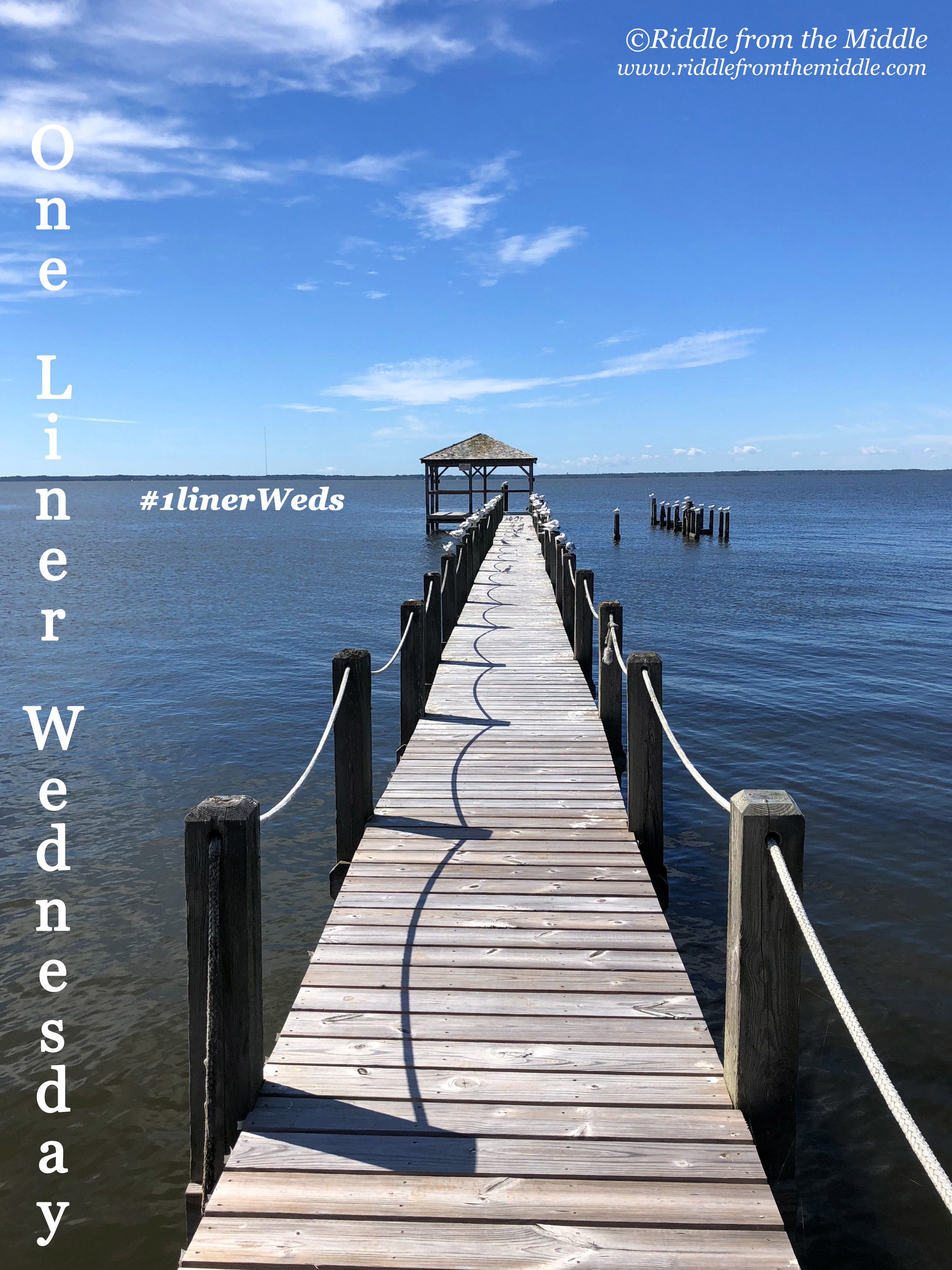
One-Liner Wednesday: compassion

The whole idea of compassion is based on a keen awareness of the interdependence of all these living beings which are all part of one another and all involved in one another.

Thomas Merton

Join us for Linda’s One-Liner Wednesdays! Find out more here: https://lindaghill.com/2022/11/30/one-liner-wednesday-ha/

Review: The Letter

At the Vatican on October 4, 2022, the feast day of St. Francis of Assisi, a new film premiered, entitled The Letter.

The Letter in the title refers to Laudato Si’: On Care for our Common Home, Pope Francis’s 2015 papal encyclical which was addressed not only to Catholics around the world but also to all people of good will. Its release in May helped to build momentum for the Paris climate talks that fall that resulted in 196 countries signing onto the landmark agreement on climate change.

Laudato Si’ espouses integral ecology, which involves both care for the earth and care for all people, especially those most vulnerable. The encyclical cites science and various faith traditions to build a framework for fighting climate change and for lifting up those dealing with hunger, poverty, dislocation, water scarcity, and other challenges.

The film’s title has a second meaning, as the first part of the film shows five people around the world receiving a letter from Pope Francis, inviting them to the Vatican to discuss the issues of Laudato Si’ with him. Together, they represent both “the cry of the earth and the cry of the poor.” It is these five people and the communities they represent that form the bulk of the film.

They are:
~ Cacique Dadá, an indigenous leader of the Borarí people from the Maró Indigenous Territory of Brazil, representing indigenous communities
~ Arouna Kandé, a climate refugee from Senegal, representing the impoverished
~ Ridhima Pandey, a teen-aged climate justice activist from India, representing young people who are inheriting a world that has been damaged by prior generations
~ Greg Asner and Robin Martin, a married couple from Hawai’i in the United States, who are both marine biologists studying the impacts of climate change on ocean ecosystems, representing the voice of nature

The stories of their native places are stunningly conveyed by director Nicolas Brown and the team of Off The Fence Originals, in conjunction with The Laudato Si’ Movement. I especially appreciated the segments from the Amazonian rain forest and the Pacific marine environments.

I also appreciated the diversity of age, race, gender, country of origin, and faith portrayed in the film. While Pope Francis and the Vatican officials are, of course, Catholic, we see participants who follow other faiths, including Islam and indigenous traditions. It is a true reflection of the encyclical being addressed to “all people of good will.”

In keeping with that diversity, people in the film speak in their native languages with subtitles and narration available in English, French, Spanish, Italian, and Portuguese. There are also subtitles available for the entire film in many other languages. You may watch the film free of charge at the link in the first paragraph of this post or on the YouTube Originals channel. Details about offering a free screening for groups can be found here.

My hope is that many people around the world will view the film and take action on social and environmental justice issues. We are one human family and we must together care for each other and our common home.

voting and violence

I try to keep up-to-date on the news, particularly in the US, and often blog about what is happening with politics and public policy.

I admit it has been daunting to write about the upcoming midterm elections next week. There has been so much disheartening rhetoric that I haven’t been able to make myself post about it but I feel compelled to post today after watching the continuing aftermath of the horrific attack against Paul Pelosi, spouse of House Speaker Nancy Pelosi.

For those of you not in the US, early Friday morning, a 42-year-old man broke into the San Francisco home of Paul and Nancy Pelosi. He had zip ties and duct tape with him and asked where Nancy was. (She was in Washington, DC.) He attacked the 82-year-old Paul Pelosi with a hammer, fracturing his skull and injuring his hands and arms. Pelosi is still in intensive care following surgery and is expected to recover over time from his physical injuries. The suspect is in police custody and will be charged soon, most likely for attempted murder among other charges.

The suspect had posted on social media his belief in a number of conspiracy theories, including those that demonize the Democrats as child abusers. While Democrats have been vocal and universal in the condemnation of the attack, Republicans have been much less so. Instead of recognizing this as political violence, some are saying it is just another example of increasing crime. They also fail to acknowledge that their political advertising, posts, and speeches featuring weapons and demonizing Speaker Pelosi and other prominent Democrats have any role in the increase in political violence.

The Republicans do a lot of “what-about-ism” in which they try to create false equivalencies and fear-monger on their talking points, all while conveniently dismissing any responsibility. In this case, they ignore things like the fact that most of the rise in crime is occurring in Republican-controlled areas that have relaxed regulations on guns. It’s likely that one of the reasons that Mr. Pelosi was attacked with a hammer rather than a gun is that California has a more rigorous system of allowing gun permits than Republican-led states, such as Texas. Republicans, including those in New York, blame bail reform for the increase in violent crime, even though the data show this isn’t true. There is also a much higher level of violent extremism on the far right than on the left. And, of course, we have recent and ongoing trials and convictions of perpetrators of political violence on January 6, 2021 at the US Capitol and the thwarted kidnapping of Michigan governor Gretchen Whitmer.

My usual way of determining for whom to vote is to look at the stand of the candidate and their party on a range of issues. Given my personal background, I place the highest priority on environmental and social justice issues. This is in keeping with the principles of Catholic social justice doctrine and with the call in the Preamble to the US Constitution to “promote the general welfare.”

I look at the candidates’ character, personal behavior, and integrity. I also look at their personal experience and intelligence. I want to vote for candidates who are smarter and more experienced than I. I don’t choose candidates on the basis of “who I want to have a beer with!” That comment may sound strange to those outside the US but there is recurring theme about this question as a gauge for likability/authenticity since about the year 2000.

In this election, there is an additional factor that I honestly never thought would be an election issue here in the United States. Do you believe in democracy? So many of the Republican candidates seem to be embracing anti-democratic, even autocratic, leadership and policies. They don’t believe in the outcome of free and fair elections, such as the 2020 election, even though they have no evidence to the contrary. They won’t say that they will accept the outcome of their own election if they lose. They won’t say that Biden was legitimately elected president. They have tried and sometimes succeeded in making it more difficult for minorities, elders, young people, and lower-income people to vote. They have broken up likely Democratic voters who live in a community into different voting districts to dilute the power of their vote.

What is most destructive is that they continue to support and perpetrate the lie that Donald Trump won the 2020 election and that he is not responsible for the January 6 insurrection, for illegal possession of presidential documents (including sensitive national security information), for obstruction of justice, and for other crimes for which there is ample, publicly available evidence.

Apparently, Republicans are into wielding governmental power for their own benefit – and the benefit of the wealthy people and corporations who underwrite them – rather than being public servants.

I won’t be voting for any of them.

I will vote for candidates who uphold our American values and who are serious about enacting and executing laws that improve our lives and communities, that try to heal our planet and climate, and that work with all people of good will to end conflict and disease.

I hope millions of others will join in this cause and remember that democracy is on the ballot.

US education

In the United States, some school districts have already started the new school year and the rest will follow over the next couple of weeks.

In many places, the situation is fraught.

First, an organizational primer for those outside the US. The United States, unlike many countries, does not have a national education system. The various states exercise control over the curriculum and policies to greater or lesser degrees, depending on the state. The greatest degree of control usually rests with local school boards.

It’s a mixed blessing.

In some districts, the local school boards have bought into the notion that something as simple as having a book that includes a gay character in the library is akin to “grooming” students to be gay. Or that it isn’t permissible to discuss racism because it might make white students feel bad or guilty. This puts teachers in the uncomfortable position of being afraid to teach history, civics, literature, science, etc. in the way that they were trained to do as educators.

Some of these issues are even more pronounced when they become a state policy. The most prominent example of this at the moment is Florida. This school year marks the beginning of enforcement of the Parental Rights in Education Act, informally known as the “Don’t Say Gay” law. The most prominent provision of the law is that there must be no classroom instruction on sexual orientation or gender identity in kindergarten through third grade. The reasoning is that these topics should be totally controlled by (heterosexual) parents.

But, here’s the thing. We use gendered language ALL THE TIME. Some of the first sight words that children learn – mother, father, boy, girl, man, woman, he, she – are all gendered terms. Are teachers supposed to use gender-neutral words at all times, referring to students, parents, and siblings rather than using such common terms as boys and girls, moms and dads, and brothers and sisters? What if a student asks why the family picture a classmate drew has two moms or two dads? Will the teacher be sued if they say anything beyond “ask your parents”?

Florida is also facing what has been termed a “critical teacher shortage.” It’s hard to say how much is due to curriculum concerns versus low pay, lack of administrative support, large class sizes, contract provisions, etc. Teacher shortages are fairly common in the United States, especially in math and science. To fill gaps, some states allow people to teach subjects in which they are not certified or even allow people to teach who are not certified at all.

Meanwhile, teachers and schools are under COVID-related pressures. Although almost all students, teachers, and staff are eligible, many remain unvaccinated, raising the risk of illness. During the pandemic, some students fell far behind academically during the period of remote instruction and need highly qualified teachers and extra tutoring to help them catch up to grade level. Teachers are also struggling with the mental health and developmental needs of students who faced fear, uncertainty, and isolation for months and now struggle with inattention, misbehavior, and lack of age-appropriate social skills. Some teachers are opting to retire as soon as they are eligible rather than continue under these stresses.

In some areas, schools are dealing with church/state issues, as well. Because of the First Amendment to the United States Constitution, the government may not establish a religion. However, a couple of recent decisions by the conservative majority of the Supreme Court have poked holes in what had been termed the wall of separation between church and state. Both cases benefit the expression of Christianity; I wonder if the decisions would have been the same if they had been about public prayer by Muslims, for example. In some localities or states, there are even instances of (white) Christian nationalism creeping into school curricula, such as teaching that the United States was founded as a Christian nation, which it was not, and downplaying the role of enslavement and indigenous land theft/genocide in our national history.

A lot of this is supposedly done in the name of parental rights, that is, that parents are the ones who should determine what their children learn in public school. I don’t agree with that. I look upon public education as a public good. I want free, high-quality education for every student so they can grow into responsible, mature members of our communities. They need to learn wide-ranging skills in communication, quantitative and scientific skills, technology, social studies and civics, and the arts. Having a broad base helps to develop critical and creative thinking and to identify where a student’s interests lie. Learning in community teaches how to work together and solve problems in a civil way. That was my expectation when I chose to send my children to public school. If my priority had been to control what they were exposed to, I would have opted to home school them. If I wanted them to have learn through a faith-based approach, I would have sent them to a religious school.

I don’t believe that a subgroup of parents should be able to dictate the learning environment of all children in our public schools. If a parent thinks that a certain assignment is inappropriate for their child, the vast majority of schools have a mechanism to assign an alternative. However, that parent should not have the power to say that the other students can’t undertake the original assignment. If those parents don’t understand that in terms of community values, they should at least understand that the parents of the other students have the same right to direct their child’s education as they do. If a parent thinks that all/most of the assignments are inappropriate for their child, it’s time to either homeschool or send their child to a private or religious school that meets their needs.

With my daughters in their thirties and my grandchildren abroad, I admit that I am grateful to have been spared the personal pressures of education during the pandemic. There is a lot of ground to make up for students in the US. Let’s concentrate on that for the good of their future and our country.

SoCS: meetings

Earlier this year, I joined the Madrigal Choir of Binghamton and was somewhat shocked but definitely honored to be offered a seat on their board.

I’ve never been on a board before, although I’ve been on lots of committees. Even though I don’t think being on committees is my strong suit, I did accept.

I haven’t had enough time to figure out yet if it was a mistake.

It’s not that I don’t have ideas to contribute. It’s more the incredible stress of trying to get them out.

I’m an introvert who finds talking to more than two people at a time really stressful. So a board meeting where I know almost no one is daunting. Add in being thrown into the midst of discussions that had been ongoing and for which I have limited background and the stress level goes up exponentially.

I am, however, determined and dogged and faithful, so I will try to do my best to contribute and be a good board member.

At least, for now.

We are coming up on the one year anniversary of my father’s death. After the months of having to deal with all the paperwork and estate settling, I had been trying to re-prioritize my commitments. I thought that I would be doing mostly solitary activities, other than poetry workshopping. Well, and rehearsing with Madrigal Choir.

It hasn’t quite worked out that way.

Besides Madrigal Choir Board, I’ve been involved with the Creation Care Team at my church, which has now also morphed into involvement with the diocesan creation care task force. Dealing with anything on the diocesan level is fraught for me for more complex reasons than I could possibly tackle in SoC.

For sanity’s sake, I know I should scale back, but will I?

Probably not.

Well, not at the moment, anyway…
*****
Linda’s prompt for Stream of Consciousness Saturday this week is “board/bored.” Join us! Find out more here: https://lindaghill.com/2022/08/26/the-friday-reminder-and-prompt-for-socs-aug-27-2022/

JC’s Confessions #24

In the first few seasons of The Late Show, Stephen Colbert did a recurring skit, then a best-selling book, called Midnight Confessions, in which he “confesses” to his audience with the disclaimer that he isn’t sure these things are really sins but that he does “feel bad about them.” While Stephen and his writers are famously funny, I am not, so my JC’s Confessions will be somewhat more serious reflections, but they will be things that I feel bad about. Stephen’s audience always forgives him at the end of the segment; I’m not expecting that – and these aren’t really sins – but comments are always welcome.

JC

Over the many years of caregiving and volunteering I have done, people have often advised (admonished) me to “take care of myself.”

I don’t think it is something that I do very well.

I do try. I eat well (usually) and sleep (generally not so well, but not for lack of trying). I do my physical therapy exercises most days and speak with my counselor on a regular basis. (I love getting massages but the pandemic and other complications have interfered with what used to be a regular part of my self-care plan.)

I admit that the amount of stress, grief, and loss has been high for a lot of years. I would sometimes joke in recent years that it was too late for whatever stressor to give me gray hairs, although I notice that my eyebrows are beginning to turn silver and that my facial lines seem to be more indicative of sadness, unless I am actively smiling. (Or maybe this is straight-up aging, rather than stress-induced?)

(Hmmm…wonder if my extensive use of parentheses in this post is a form of denial, distancing, or hedging?)

But here’s the thing. When people want you to “take care of yourself,” the subtext is often to put yourself first, which is not my nature as an HSP (Highly Sensitive Person). I will always care about what people close to me are experiencing and try to do whatever is in my power (and sometimes attempt what is not really in my power) to help. I also feel compelled to serve my neighbors, whether near or far, which, given the state of the US and the world, is a huge task, but I try to shoulder my tiny sliver of it as best I can.

It’s a lot.

I can hear some people’s brains clicking with (totally valid) thoughts about boundaries and such…

And maybe I’ll manage that wisdom if I am gifted with enough years.

Or maybe I will always be “guilty” of prioritizing the needs of others before my own.

Or maybe that is just who I authentically am.

the aftermath of Dobbs

When I wrote this post after the leak of US Supreme Court Justice Alito’s draft opinion on an abortion law in Mississippi, we weren’t sure if there would be changes before the decision was announced.

When the decision was announced on June 24, it was little changed from the draft. The majority signed on to the opinion that Roe v. Wade had been “wrongly decided” and threw the matter of the legality of abortion to each state’s legislature.

It’s not that long-standing Supreme Court precedents have never been overturned or declared “wrongly decided” – the Dred Scott decision springs to mind – but the Dobbs case was the first time that such a reversal came at the expense of a recognized right.

Many lawyers and Constitutional scholars have faulted the majority’s decision on historical and legal grounds, as Alito seems to cherry-pick sources in support of his view while ignoring the mainstream history and scholarship to the contrary. For example, while it is true that the Constitution does not specify a right to an abortion, it also never uses the word “woman” or “family.” There are many rights that have been recognized by the courts over the centuries that are not specifically cited in the Constitution under the Ninth Amendment which states “The enumeration in the Constitution, of certain rights, shall not be construed to deny or disparage others retained by the people.” The right to privacy and to bodily autonomy belong to each person and should not be under the jurisdiction of the government at any level. The Alito opinion also seems to violate the Thirteenth Amendment against involuntary servitude and the Fourteenth Amendment which promises “equal protection of the laws.”

While Alito said that abortion was a unique situation in terms of privacy protections, Justice Clarence Thomas wrote a concurrence that openly questions other rulings, such as those allowing contraception and marriage equality in all states. Somehow, he didn’t suggest that the Loving case, which forced all states to allow interracial marriage, had been wrongly decided, one assumes because he is a partner in one.

It’s now a little less than a month since the decision was handed down and there is upheaval. There have been many protests and public demonstrations. Some states moved to ban all abortions or all after six weeks of pregnancy. Some states are even trying to prevent people from crossing state lines to receive care, as though being a resident of a state gave them ownership over you. While the House has passed legislation to codify abortion rights similarly to Roe and to allow interstate travel for medical care, the Senate Republicans have blocked both measures from coming to a vote.

Some states are protecting and codifying the Roe framework. My home state, New York, had done this previously and is now beginning the years-long process to amend the equal rights protections of the state constitution to include “sex, including sexual orientation, gender identity, gender expression, pregnancy, pregnancy outcomes, and reproductive health care and autonomy”. Bonus: this will protect marriage rights and stand against all gender-related discrimination, as well as returning reproductive health rights to each individual.

Before the decision was handed down, those of us warning of the dangers to the health and well-being of pregnant people were scolded for being alarmist, but we were being realistic. Every day, there are stories in the news of delayed care for miscarriages that threatens the health and life of the mother. There are stories of rape victims having to go to another state for an abortion. The most heart-breaking of these is the case of a ten-year-old rape victim who had to travel from Ohio to Indiana to receive an abortion at six and a half weeks pregnancy. This child has had to endure not only rape and the severe threat to her health that pregnancy at such a young age entails but also the trauma of some politicians and commentators questioning the veracity of her story.

These cases show the dangers of trying to legislate what should be private medical decisions. While some are contending that it’s not really an abortion if a child is pregnant and her life is endangered or if there is an ectopic pregnancy or if there is an incomplete miscarriage, medically speaking, all pregnancies end either in live birth or an abortion. Miscarriage is not a medical term; on medical records, it is termed a spontaneous abortion. Health care providers are being put in the impossible situation to provide the best care to their patients or to be forced by lawyers to wait until their patients are clearly dying themselves before intervening to remove a doomed fetus. When the federal government reminded hospital emergency rooms that they are required to treat any endangered pregnant person to save their life, the state of Texas filed suit, saying that their state law against abortion should take precedence.

Some states are making moves not only against abortion but also against contraceptives, even though these are not abortifacient. They are trying to prevent people from crossing state lines to receive care. As I mentioned previously, while the US House of Representatives has passed legislation to codify abortion rights and to affirm the right to interstate travel, the Senate is not taking these up because of obstruction by Republicans. Chillingly, there is talk of the Republicans passing a national abortion ban if they regain the Congressional majority. Meanwhile, Republicans fail to pass legislation that would uphold the health and dignity of each person, such as universal health care, living wages, social welfare support, etc.

As a Catholic woman, I knew this was coming. Alito was parroting the arguments that Catholic bishops have made against abortion and Thomas went even further down that road in his calls against contraception. I have struggled for years against a church that denies my full personhood as a woman, despite their lip service to the concept of human dignity. I did not expect my country to follow suit.

Like most women my age, I didn’t think we would still be fighting these kinds of equality battles, but we will. I can’t predict the manner or timing of victory, but we will not be demoted to second class citizenship by a skewed Supreme Court.