SoCS: social justice

During the struggle against fracking in New York, one of my roles was writing comments on related articles. I was part of the rapid response team, so I spent a lot of time doing it, so much so that if I was at an in-person event that drew people from around the state, people recognized my name if we were introduced. I had done a lot of research, so I was able to present my point of view on many different aspects of the effects.

What I seldom wrote of was the personal basis of my views, which was Catholic social justice doctrine, which was always in my heart, even as my mind was filled with science and statistics and personal stories from our neighbors in Pennsylvania.

As time has gone on and my public role has lessened, I have more often spoken of the role of social justice in my life. This became easier when Pope Francis published his encyclical Laudato’ Si. While people knew that it would be about climate change, they didn’t realize how much of it would center around human relationships with each other. Francis calls this approach “integral ecology” and it demonstrates one of the basic tenets of social justice doctrine, care for creation, and another, care for other people, especially those most vulnerable. These are viewpoints that many people of good will hold and there are many routes to them; I just want to acknowledge the impact of Catholic social doctrine for me, which combined with other influences to bring me to this point.

(The link above has the entire text of the encyclical with the option to read it in about a dozen languages. It was written prior to the Paris climate change meetings which led to the accord signed by over 190 nations. Francis addressed it to “all people of good will” because climate change affects everyone on earth.)
*****
Linda’s prompt for Stream of Consciousness Saturday this week is “social.” Join us! Find out how here:  https://lindaghill.com/2019/06/14/the-friday-reminder-and-prompt-for-socs-june-15-19/

SoCS badge by Pamela, at https://achronicalofhope.com/

One-Liner Wednesday: Pentecost

Pentecost

Because I posted Lent and Easter pictures from church, I thought I’d post the Pentecost photo with its liturgical color red and themes of wind and flame.
*****
Join us for Linda’s One-Liner Wednesday! Find out how here:  https://lindaghill.com/2019/06/12/one-liner-wednesday-its-true/

SoCS: after

Silence takes on new meaning after the death of a loved one. Perhaps it is in that silence that we can still hear our loved one in our hearts.
*****
Linda’s prompt for Stream of Consciousness Saturday this week is “silent/silence.” Learn more about SoCS here:  https://lindaghill.com/2019/05/31/the-friday-reminder-and-prompt-for-socs-june-1-19/

Nana

I have often written posts about my parents, known here as Nana and Paco. I’m sad to tell you that Nana passed away last week. After months of declining health due to congestive heart failure, she had a few days of rapid decline and died peacefully with my older sister with her and the rest of the family able to gather quickly for some final time together with her.

Over these last few days, my sisters have been staying at Paco’s apartment and taking care of him, while my spouse B and I have been tending to preparations for the funeral, which will take place mid-week.

We are very fortunate that this week is a week off for my son-in-law L, who was able to fly here from London to be with daughter E, granddaughter ABC, and all of us.

I admit that my mind has been richoting from one subject to another. Now that the funeral plans are all in place, I’m hoping I can calm my mind a bit, but it remains to be seen.

With so much happening, I’m not online very much, so I may not be able to keep up with responding to comments. Please know that I appreciate all the thoughts and prayers that you send on behalf of Nana and our family.

In peace,
Joanne

Moses Hogan concert

Amazingly enough, I got to attend another concert this past weekend with my daughter T at Trinity Church where we heard the St. John Passion in April. This was also a concert with the Madrigal Choir of Binghamton and Trinity Church Choir, along with Tabernacle United Methodist Choir and members of the Binghamton High School Choir. They were joined by countertenor Derek Lee Ragin and pianist Pej Reitz for “A Moses Hogan Celebration.”

Moses Hogan (1957-2003) was a multifaceted musician who is most well known for his stunning arrangements of Negro spirituals and most of the program was given to performances of these arrangements. Derek Lee Ragin met Moses Hogan at Oberlin College Conservatory and, while pursuing a career in opera, also performed and recorded with the Moses Hogan Chorale and Moses Hogan Singers. Also, Moses’ younger sister, Dr. Ava Hogan-Chapman, and her daughter were in attendance. It was wonderful to have people who knew him so well there to tell us more about him, and, of course, to hear Derek Lee Ragin sing.

I had sung a couple of Moses Hogan arrangements and had heard a number of them when E and T were singing in high school and college choirs. These tended to be the more up-tempo songs such as “Elijah Rock” and “Ride on, King Jesus”. While I loved hearing these familiar arrangements in the concert, I was especially moved by some of the pieces that were unfamiliar to me.

Among these was “His Light Still Shines”, a choral medley in honor of Dr. Martin Luther King, Jr. The piece is a blend of narrative and spirituals. Sharon Ball offered very powerful narration in alternation with the choral pieces. I knew Sharon Ball as the retired director of the Broome County Arts Council and as a candidate for New York State Senate in our district. I hadn’t realized that earlier in her career she had been a broadcast journalist, professional singer, and White House staffer in the Carter administration. She brought all of these skills together to speak so clearly and movingly about Dr. King’s work and legacy. Last year marked the 50th anniversary of Dr. King’s assassination; it saddens me that we still have so far to go in social justice and peacemaking in the United States all these decades later.

The piece, though, that had both T and me on the verge of tears was “There’s a Man Goin’ Round”, which is a piece about the death of a parent. With my mom in hospice care and the recent death of my college roommate’s mother, that piece was especially meaningful and heart-rending.

It’s a testament to the power of the spirituals, born as they were under the weight of slavery, oppression, and suffering, that they transcend and bring hope, even in difficult times centuries later.

Easter altar

Because I had shared a photo of our church during Lent, I thought I’d share an Easter view:
Easter altar

65

Today is 65th wedding anniversary of my parents, known as Nana and Paco here on the blog.

As people who read regularly or know me IRL will know, Nana is currently in skilled nursing under hospice care with congestive heart failure. My father still lives in their apartment in the independent living section of the senior community and visits her several times a day.

She isn’t eating much these days, so I couldn’t arrange to bring in a celebratory dinner. Instead, I brought in creme brulee for Nana and a slice of apple pie for Paco. At lunchtime, Nana ate some of her treat and some cottage cheese, mashed potatoes, and fruit cocktail. Paco put the rest of the creme brulee in the refrigerator in the leisure room for later.

I found a 65th anniversary card at the Hallmark store from us and bought them cards to exchange. Fortunately, they both liked the cards I picked out.

It was really hard for Nana to stay awake for very long but I was grateful that Nana and Paco had some time to celebrate together.

They have been such a great example for all of us of love, togetherness, and caring. I’m very grateful that they made it to this milestone.

In 1954, April 19 was Easter Monday. Weddings were not held during Lent, so Easter Monday was a good day for a spring wedding. It was also Patriots’ Day in Massachusetts, so my father had the day off from work. They thought that they would always have a holiday for their anniversary, but the Monday Holiday Bill intervened so that Patriots’ Day was always on a Monday rather than on the anniversary of the Battles of Lexington and Concord in 1775, which began the Revolutionary War in what became the United States.

This year, April 19 was Good Friday, the most somber day of the Catholic calendar.

It felt appropriate.

St. John Passion

Over the weekend, daughters E and T accompanied me to a concert of Bach’s Passion According to St. John. The Binghamton Madrigal Choir was joined by the choir of Trinity Memorial Episcopal Church, soloists, and an 18-piece orchestra for the performance.

Trinity Church was filled to capacity for the concert. I worked at Trinity for a couple of years in the mid-1980s and sometimes visited there afterward for concerts and services, as my friend Peter Browne served as organist and choirmaster there for many years. The choir stalls had been removed and the organ console moved to the center, a reminder that the organ had recently been extensively rebuilt, as the console used to be fixed in place. The accompanist of madrigal choir played the organ while Peter’s successor played the harpsichord.

Bruce Borton, under whose direction I sang for many years with the Binghamton University Chorus until his retirement, directs the Madrigal Choir and conducted this performance. It was great to see him conducting, even though we could only see him from behind.

The concert was very moving. I especially enjoyed the choral movements. I had had the opportunity to sing the St. John Passion with University Chorus in the ’80s, when we were still under the direction of founding director David Buttolph. I love to sing Bach and was remembering many passages as the choir sang, including how many (terrifying) times the choir has to begin a movement with no introduction, finding their pitches from the prior cadence.

In order to make the concert more easily understood, especially as it was just before Holy Week, the original German had been translated into English. The English translation was occasionally awkward, but it did allow the audience to join the chorus in singing the chorales that appear among the recitatives, arias, and choruses. When the director invited us to sing the chorales, which were printed in the extensive program, some people laughed as though they thought he was joking, but that is how the congregation in Bach’s time would have participated in the Passion.

My daughters and I thoroughly enjoyed singing the chorales. After the concert, the man who had been sitting in front of us turned around and said that someone behind him had a lovely voice. I told him that it was E and T.

As we were putting on our coats, the woman next to me told me that I had a nice voice, too. I know that I will never have as nice a voice as my daughters, especially E who had sung the soprano arias when she was in school, but it was a sweet gesture.

I want to thank all the musicians who made the performance of the Passion possible. It was also special to be able to attend a concert with my daughters. Because the last few years have been so intensive on the caretaking front, I haven’t been able to get out to cultural events very often, so it was extraspecial to be able to experience this together.

JC’s Confessions #3

On The Late Show, Stephen Colbert does a recurring skit, now a best-selling book, called Midnight Confessions, in which he “confesses” to his audience with the disclaimer that he isn’t sure these things are really sins but that he does “feel bad about them.” While Stephen and his writers are famously funny, I am not, so my JC’s Confessions will be somewhat more serious reflections, but they will be things that I feel bad about. Stephen’s audience always forgives him at the end of the segment; I’m not expecting that – and these aren’t really sins – but comments are always welcome.
~ JC

When Stephen does Midnight Confessions, in his lead-up he often says that he doesn’t get to go to church as often as he would like and he misses one of his favorite things, going to confession. At which point, I usually think, “Said no Catholic ever!” Everyone with whom I have ever spoken about it feels that it is a stressful situation, even with a good confessor (and downright terrifying with a poor one).

For the last several years, our diocese has had a day during which every church is open for the Sacrament of Reconciliation, as confession is more properly called. I confess that I find it very creepy that they advertise this on television and with billboards, as though mercy and forgiveness are commodities.

It also makes it seem as though forgiveness is only available through this sacrament, even though the church recognizes many other routes for this, such as the penitential rite during liturgy, asking for forgiveness from someone whom you have hurt, prayer, making reparations, and receiving the Eucharist. Indeed, individual confession is only required in the case of serious sin, one which fractures the relationship of the person with God.

I admit, not confess, that I haven’t gone to individual confession in years. This is partly due to a priest from my past who was so unstable I was afraid to be alone with him. Even though he is no longer a threat to me, it makes the thought of going to confession even more fraught.

What is even more difficult is figuring out how to confess my own part in social sin. I grieve that the United States is participating in violence and injustice, degrading the environment and the climate, and lacking in compassion and assistance for those most in need. We are called in our Constitution to “promote the general welfare”; my faith tells me to love and serve my neighbors near and far. Even though I try to oppose what is unjust and to help those in need, I still bear guilt for being part of an unjust system. Seeking forgiveness for these social sins feels hollow, because I am no less a part of the social system after confession than I was before it.

Wow! When I said in my standard introduction to this series that my reflections would be “more serious,” I didn’t mean to make it quite this serious.  Still, we are living in very serious times with many very serious problems confronting us daily. I can only hope that my trying to do my part in repairing the damage will join with the efforts of other people of good will to improve our country and our world.

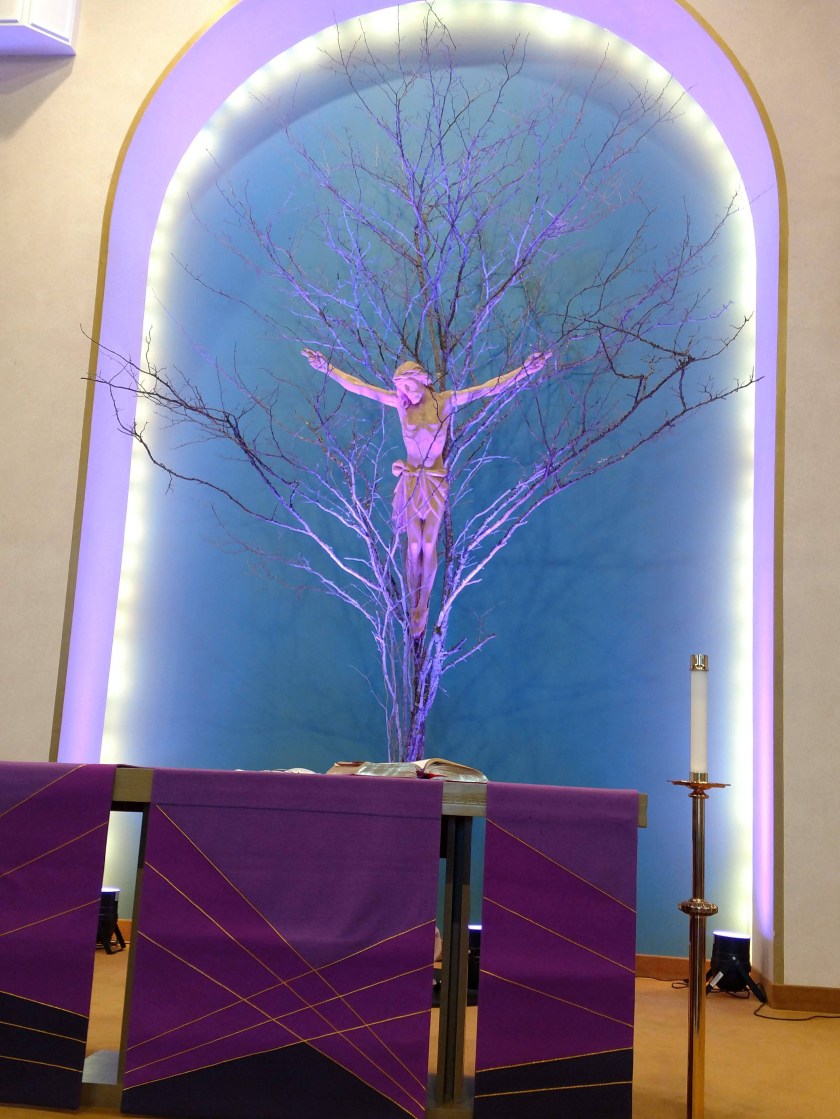
Lent in my church

Many Catholic churches use bare branches instead of flowers during Lent. In recent years, my church has used small trees instead of branches. This Lent, the church environment committee went one step further.

img_20190309_165820503.jpg
It’s the first time I can recall seeing the corpus removed from the cross.

I find it very striking. It reminds me of some of the Lenten hymns that speak of Jesus being hung on or nailed to “a tree.”

Some people may find this too unusual a presentation.

Feel free to share your comments below.