I’ll be saying good-bye to an old decade and beginning a new one.
I guess the bigger question is “is sixty old?”
Well, if not old, I think it’s at least getting there…
I’m not a big “numbers” person. We all get older one day at a time, so I don’t usually fret about my age, which is always one day older than the day before. I admit that I had established sixty as the date by which I hoped to have a book of poetry published, but that isn’t happening. A friend told me she thought I should give myself an additional year on my goal because I have been a chapbook contest finalist, so I guess I’ll go with that. I also have several poet-friends who didn’t publish a book until 60+ so I am in happy and comforting company if I do manage to publish my chapbook or something else in my 60s. Right now, my chapbook is still out in five places and I have three more prospects lined up for submission, so working on it…
Birthdays and anniversaries, especially milestone ones, do remind me to consider how blest I am to have gotten here. I think about my friend Angie who died when she was 54. We used to dream about our respective, then unborn, not-even-dreamt-of-by-our-children grandchildren meeting up at the lake for summer vacations. She does now have grandchildren, whom she never got to hold.
This will probably sound morbid, but, even in my twenties, I made big decisions in my life using the lens of “if I knew I were going to die soon/young, what would I want to have done?” In my case, this has often meant setting aside a personal ambition or accomplishment in favor of taking care of people and doing volunteer work. I’m privileged to have had a choice to make.
It has meant that there have been opportunities that I passed up and that were not able to be retrieved at a later time, especially when it came to my role as a church musician and liturgist. Much too long and complicated a story to stream of conscious-ness.
My hope is that, when I am old, if that grace is to be mine, I will be able to look back with equanimity and not regret.
On August 18, 1920, the 19th Amendment to the United States Constitution was ratified, recognizing women’s right to vote. It reads: “The right of citizens of the United States to vote shall not be denied or abridged by the United States or by any State on account of sex. Congress shall have power to enforce this article by appropriate legislation.”
It had taken many decades to pass the amendment. Generations of women who had worked toward it died before they were able to legally cast a ballot. Many black women continued to be denied voting rights until the Voting Rights Act of 1965. Shamefully, part of the Congressional enforcement of the Voting Rights Act was struck down by the Supreme Court in 2013 and some states have enacted discriminatory practices. The House of Representatives has passed the John R. Lewis Voting Rights Advancement Act to address these issues, but Sen. Mitch McConnell has not brought it up to a vote in the Senate. A brief overview of the bill can be found here.
Because of the centennial, there have been a number of documentaries and news features about women’s suffrage in the United States, as well as articles and editorials. We have seen striking visual reminders of the struggle, such as the women in Congress wearing white for the State of the Union address, because white was the color that many suffragists wore during their marches and demonstrations. [A side note on wearing white: When I was a member of the Smith College Glee Club, we wore white when we performed. I don’t know if this tradition sprang from the suffrage movement or not. After I graduated in 1982, the Glee Club moved to wearing all black, but I admit that I still miss the striking sight of a group of young women blazing onto the stage wearing white.]
Because of the pandemic and the current civil and voting rights struggles, the commemorations of the ratification of the 19th amendment will be somewhat muted. I’m remembering, though, the 75th anniversary, which was a special event for me.
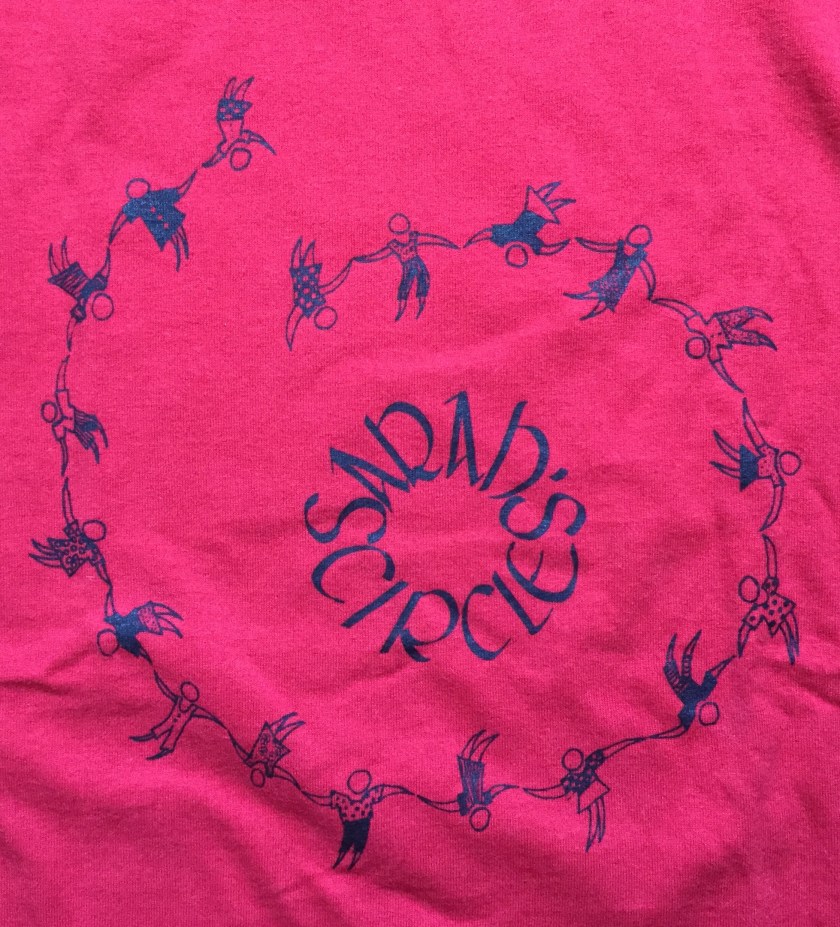
I live in upstate New York, a couple of hours drive from Seneca Falls, home of the National Women’s Hall of Fame and the Women’s Rights National Historical Park. Twenty-five years ago, I was a member of a mostly female, mostly Catholic group called Sarah’s Circle. We met for prayer and discussion on a regular basis and occasionally took part in public events. We decided to take part in the parade and other events in Seneca Falls. We marched wearing matching shirts with our logo, designed by one of our members, on the front:
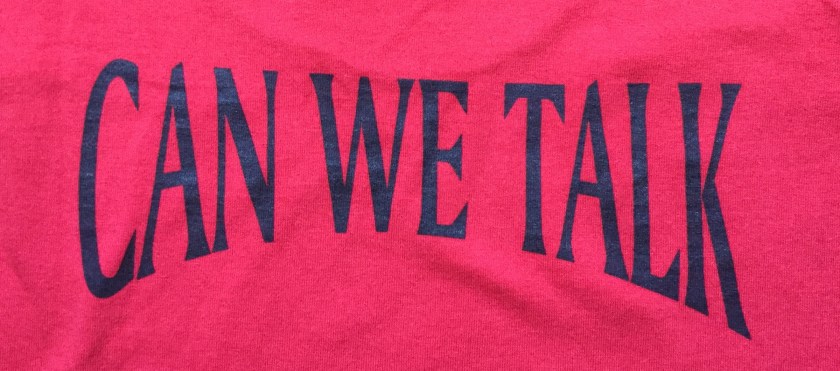
The back read “Can We Talk” because, at that time, an instruction had come down from the Vatican forbidding even the discussion of women’s ordination.
This did not deter the members of Sarah’s Circle from still speaking up about women’s ordination, but we were trying to appeal to members of the hierarchy to speak with us about it. A number of the our members who felt called to ordination wore Roman collars with their shirts. At the time, I did not feel that call personally so I did not add the collar. As we marched, we sang women’s suffrage verses that one of our members had written to familiar hymn tunes.
It was an inspiring day, filled with joy, hope, and thanksgiving. We had no idea that, twenty-five years later, there would still be such a struggle for fair voting and for equal rights and opportunity. May this centennial commemoration energize us to continue to speak out and vote for those who will uphold the voting and civil rights and the dignity of every person. May we also defend vice-presidential nominee Kamala Harris from sexist and racist attacks.
We’ve come a long way in one hundred years, but not nearly as far as we should have.
Earlier this month, I wrote about June birthdays and mentioned B and my 38th wedding anniversary while writing for Stream of Consciousness Saturday here.
Our celebration of our anniversary was different this year. We usually try to go away for a couple of days, usually to a small inn in an historic, picturesque location where there are nice places to stroll and good restaurants.
This year, B did get to take most of the day off from his now-working-from-home job. We did go out briefly for a couple of socially distanced errands and an afternoon visit to the walk-up window at a favorite local ice cream shop, but we made dinner at home with T and had a quiet evening in. All of which seemed right for this somber time.
Thirty-eight years is a respectable amount of time for a marriage and gives me hope that, if we can keep life-threatening disease at bay, we will be able to celebrate our fiftieth anniversary, as we were able to do with our own parents.
Perhaps because we are hearing so much about people changing the date or plans for their weddings, I find myself thinking about B and my wedding, the changes in plan that it entailed, and how it was perceived.
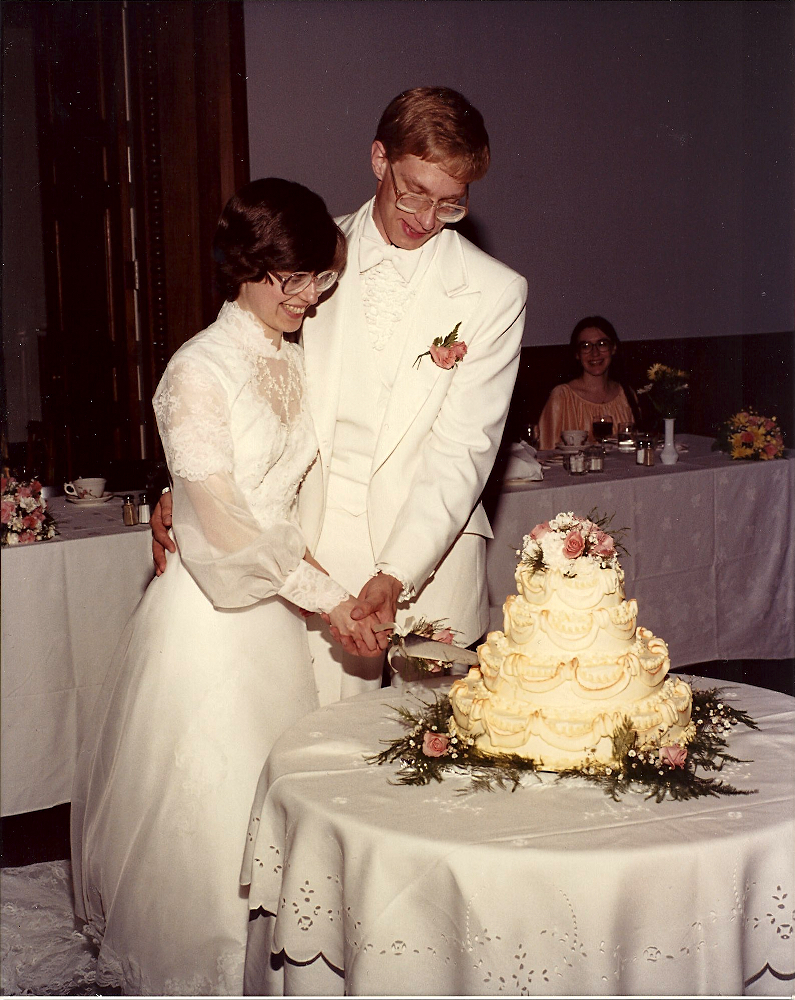
Because B and I were planning to marry shortly after I graduated from Smith College, my mother and I did most of the planning the summer before my senior year. Those were still the days where the tradition of the bride and her family doing most of the wedding arrangements (and paying the costs) was still observed, especially when the bride was young and not established in a career. I chose to be married at Helen Hills Hills chapel on the Smith campus. I had been involved in the life of the chapel throughout my years at Smth, as an organist, choir member, and accompanist and was close to Sister Judith, the Catholic chaplain. The reception would be at the Alumnae House, a short walk down Elm Street from the chapel.
There was no resident priest on campus, so an associate from one of the Northampton parishes presided at mass on Saturdays. I asked him to preside at our wedding ceremony and he agreed. In January, he was re-assigned to a nearby city and decided that he would not come to the wedding. A young priest who was assigned to the University of Massachusetts-Amherst was filling in at Smith for the spring semester became the default priest for our wedding.
This turned out to be very problematic.
He didn’t know me – that I had been serving as a Catholic church musician for over seven years, that I took my faith seriously, and that I had also studied the history of Christianity in the United States and around the world. He also didn’t trust me, which was hurtful. When I met with him to do the questionnaire that is required, he made me swear on a bible to tell him the truth, as though I was going to lie to a priest.
In May, during the reading period before my last-ever final exams, the priest and I were taking a walk on the Smith campus to finalize some of the details. Because B is not Catholic, we were having a ceremony, not a mass, which should have made things more flexible. The priest, however, would not allow any changes in wording, would not allow Sister Judith to read the gospel or offer a reflection, which should have been allowed outside a mass. As we were finishing the walk, he said to me that he thought I would be more comfortable being married in a non-Catholic ceremony.
I was devastated. It was six weeks before the wedding and I didn’t have a member of clergy to preside. I went to the chapel offices in tears. Sister Judith wasn’t there, but Rev. John, the ecumenical Protestant chaplain was. He immediately offered to preside and gave me some different prayer books to look through to find a new ceremony to follow. We had to file dispensations of place and form so that the Catholic church would recognize the marriage and the priest would still read the vows, although they would be from the Episcopal Book of Common Prayer. The best outcome was that Sister Judith delivered a beautiful reflection.
People often say that their wedding days are perfect and they wouldn’t change a thing, but there are some things I would change if I could. I would have made a recording of the ceremony because Sister Judith spoke without notes, so I have only memories and not a record of what she said. I also would have ignored the advice of the wedding gown shop and not worn heels and a headpiece that stood up on my head. Because B is about ten inches (25cm) taller than I, they were trying to make me look taller, which seemed silly at the time and even sillier now. Most of all, I would change the trauma and drama of the clericalism that led to my not having a Catholic wedding, the clericalism that still infects the church and causes so much damage.
Our wedding and reception were designed to be an adult affair, so we didn’t invite children. This wasn’t unusual at the time, but didn’t set well with a family member who wanted their grandchildren to be invited. I’m still sorry that those young cousins had a very boring day.
Some of the adults were bored and upset, too, although I, thankfully, was not aware of it at the time. The Alumnae House could serve wine but not liquor, which upset some people who somehow thought they were owed an open bar. We also did not have dancing; neither B nor I enjoy dancing and Alumnae House is not set up for it. After dinner and our delicious spice cake with buttercream icing, a break from the super-sweet white cake with white frosting that was traditional at the time, B and I went from table to table, visiting with our guests. Strangely, after we talked to people at a table, most left, so that, by the time, I changed to leave for our honeymoon, only immediate family and a few close friends were left to wave good-bye.
I don’t regret our reception choices, which reflected our personal style and preferences. I was sad that some guests gave my mother grief, although I didn’t realize that was happening at the time; it was very rude. I was also sad that people were putting their expectations over our true-to-ourselves choices.
My biggest take-away in looking back on the not-entirely-perfect wedding day that B and I had 38 years ago and in hearing so many stories of couples re-defining their own weddings due to the pandemic is that, while weddings are important days in our lives, they are just one day in a marriage. The accumulation of those days, each presenting joys and challenges, is what is most important.
In the first few seasons of The Late Show, Stephen Colbert did a recurring skit, now a best-selling book, called Midnight Confessions, in which he “confesses” to his audience with the disclaimer that he isn’t sure these things are really sins but that he does “feel bad about them.” While Stephen and his writers are famously funny, I am not, so my JC’s Confessions will be somewhat more serious reflections, but they will be things that I feel bad about. Stephen’s audience always forgives him at the end of the segment; I’m not expecting that – and these aren’t really sins – but comments are always welcome.
JC
After all the safer-at-home pandemic protocols, I’m afraid that it will be difficult for me to resume going back out to church, meetings, events, etc.
The truth is that I am both introverted and shy. It takes a lot of energy for me to be in a group setting and even more for me to actively participate. I much prefer one-on-one interaction, the exception being among family.
I wrote yesterday about the explosion of Zoom and other virtual meetings. I’m finding that these are also very draining and even more difficult to navigate than in-person meetings, because it is harder to gauge how/when to break into the conversation when we are each in our own little box.
I wonder if some of the group activities I used to do will even exist after a vaccine makes social interaction relatively safe again. While I had been mourning my lack of a chorus with whom to sing, now no one has a chorus available and may not for a long time, given that singing in a group is an especially dangerous virus-spreader. The spirituality group that I have facilitated for years at church is almost entirely people in high-risk groups and we don’t have the option to go virtual due to technical limitations.
Some organizations, like the Binghamton Poetry Project, will eventually have to decide if they go back to in-person meetings or stay in Zoom, which allows people who don’t have transportation or who live outside the area to participate.
It’s possible that there won’t be many groups expecting my physical presence when we get to the post-pandemic world, but there will no doubt be some. Will I be able to muster the energy to venture back out on a regular basis or will I just stay home?
Over the past several years of spending a lot of time as a caregiver, I’ve valiantly tried to cut down the size of my email inbox, which is often overflowing with news, newsletters, and calls to action from various charitable, social justice, and environmental causes, along with personal and poetry-related emails. Even with my diligent attempts, I routinely handle over a hundred emails a day, which is still a lot, so I am unsubscribing from even more email lists and trying to avoid signing too many petitions which lead to my being on even more lists.
Paradoxically, as we have been avoiding in-person meetings over these last months, my inbox is full of invitations to connect via Zoom or Go to Webinar or some other platform. Instead of having fewer demands on my time, there seem to be more.
I can’t keep up.
In order to create some semblance of order, I’ve decided to narrow the selection of online events that I will accept. Of course, I will continue with my local poetry circle, which I call the Grapevine Group after the cafe where we used to meet pre-pandemic. I am also looking forward to the five-week summer session of the Binghamton Poetry Project, which, for the first time, is breaking into a beginner and a more experienced section. I am also signed up for six summer sessions with a local spirituality center that has had to re-convene virtually rather than offering in-person programs and retreats.
Beyond that, I plan to accept a very limited number of educational/advocacy meetings on social/environmental justice to keep informed and to take directed action. I am heartened by the increasing convergence of climate/environmental justice with racial/economic justice and want to advocate for effective change.
Beyond that, I hope to say “No” and continue to unsubscribe so that I have more time to accomplish what I need to and respond to ever-shifting circumstances.
(She writes, hoping she can actually manage to do so.)
Already this month, my younger daughter T turned 30 and my granddaughter ABC turned 3.
This is simultaneously wonderful and terrifying.
I am very concerned for their future, the future of all young people, and the planet.
When I was thirty, I was at a home that we owned with two young daughters and a spouse whose job supported us all comfortably and enabled us to save for the future. T and her Millennial friends do not have anything approaching that kind of economic security. Even if they are well-educated and skilled workers, most available jobs don’t pay enough to live on, even as a single person, much less a family. The pandemic and ensuing economic collapse have made matters worse and it is unlikely that recovery will be rapid. The best case I can hope for is that this economic and health catastrophe will re-set priorities and policies so that economies and governments serve the common good and recognize human dignity.
The pandemic taught us an important lesson. Those who were hit hardest – people of color, low-income communities, the elderly, and those with complicating medical issues – were also those who were already being ignored or discriminated against. The death of George Floyd, the killing of yet another unarmed black man by police, underscored the racism still in evidence in the United States, a message that has resonated around the world, as white people have been examining their behavior toward people of other races in their countries, too.
Women who are my age (almost 60) shake our heads in disbelief that so much discrimination and harassment and belittling of women and girls still exists. I am sad that our fight for equal rights is not yet won and now falls onto the younger generations as well.
Over all of this, lies an atmosphere so polluted with excess carbon dioxide, methane, and other greenhouse gases that the levels are higher than they have been at any time in human history. The consequences of that are far reaching and serious, the efforts thus far to address it wholly inadequate.
While I have been in stay-at-home mode because of the pandemic, I have been deluged with opportunities for webinars, a number of which are looking at a path forward from the current massive disruption of “business as usual.” It is heartening that so many are looking to #BuildBackBetter, looking at structural change that addresses climate change, pollution, racism, income inequality, sexism, all manner of discrimination, and the call to honor human dignity. I have become accustomed to linking human welfare with planetary welfare, articulated so well five years ago in Pope Francis’s encyclical Laudato Si’: On Care for Our Common Home. This follows the tenets of Catholic social justice doctrine and has been my basis for activism, looking for systemic ways to address problems and injustice holistically, rather than trying to rectify a problem narrowly, which could inadvertently cause adverse effects. (There are specific instances that can be addressed with a narrow solution, but systemic change can solve many smaller problems more completely and rapidly.)
If this truly is a pivot point in human history, perhaps we can work together and construct a new way of living which respects all life and the planet, as well. That would give me hope for T’s generation, for ABC’s generation, and for the generations to come. The work will be difficult, but it is what is called for at this critical moment in history.
In the first few seasons of The Late Show, Stephen Colbert did a recurring skit, now a best-selling book, called Midnight Confessions, in which he “confesses” to his audience with the disclaimer that he isn’t sure these things are really sins but that he does “feel bad about them.” While Stephen and his writers are famously funny, I am not, so my JC’s Confessions will be somewhat more serious reflections, but they will be things that I feel bad about. Stephen’s audience always forgives him at the end of the segment; I’m not expecting that – and these aren’t really sins – but comments are always welcome.
JC
I haven’t gone to a march or demonstration against racism since the murder of George Floyd.
This is something I absolutely would have done pre-pandemic. I know many at-risk people have chosen to participate because of the importance of the cause and the present moment’s possibilities for progress on human rights, trying to fulfill the call for justice that has been so long denied.
Still, I can’t bring myself to attend a public gathering, knowing that I will be seeing my 95-year-old dad and possibly some of his senior-community neighbors in the coming days. I always wear a mask, but I’m not comfortable having any more exposure to people than I absolutely must in order to function as a household.
On the day of George Floyd’s funeral, there was a brief ecumenical gathering to kneel for 8 minutes, 46 seconds in his memory. While I stayed at home, T attended, so our household was represented. The gathering was outdoors, it was sunny and windy, T wore her mask, and people spread out as best they could, so it’s unlikely she was exposed.
Still, it feels odd to not have a physical presence myself at this crucial time. I will try to be content with my efforts to educate myself and keep updated online and through the media, as well as to pursue lobbying and advocacy opportunities with the social justice organizations with whom I have relationships.
I also have my platform, however small, here at Top of JC’s Mind. Every voice, every action, adds something to what must, finally, this time, be permanent changes in the US and the world.
Yesterday, June 1, 2020, was one of the darkest and most frightening days of my almost sixty years as a citizen of the United States.
President Trump is pressuring governors to use the US military against protesters in their states and is threatening to use the military, beyond the National Guard which is under the jurisdiction of each governor, within the states if the governors refuse. To do this, he would have to invoke the Insurrection Act, which, in the rare instances in which it has been used, has only been applied to a small, specific area for particular isolated incident. If the president tries to invoke this act across different states and regions, is he surmising that a widespread insurrection is underway? The Cambridge Dictionary defines insurrection as “an organized attempt by a group of people to defeat their government and take control of their country, usually by violence.” This is not at all what is happening. Even if you add civil unrest as a possible cause, the vast majority of the country is seeing non-violent protests, which are within our rights to free speech and assembly. The limited amount of violence and destruction/theft of property are matters for local law enforcement, sometimes aided by the state’s National Guard, if the governor sees fit to use them.
The president seems to think that his bravado makes him look strong, but the opposite is true. His resorting to such threats shows how weak he is as a leader that he cannot talk to the nation to calm the situation and take effective action to address the injustices that have so many millions across the country taking to the streets.
The most horrifying part of yesterday was that the area near the White House was cleared of protesters so that the president could go to a nearby church for a photo op. These protesters were non-violent and the curfew had not yet taken effect when they were attacked with teargas, concussion grenades, rubber bullets, and physical violence. Clergy and volunteers who had been offering water, snacks, and assistance to the protesters throughout the day were also driven from the area.
These actions ordered by the president violated the free speech and freedom of assembly rights from our Constitution, as well as interfering with the religious expression of those who were there to serve others to fulfill the calling of their faith. The president also did not inform the clergy of St. John’s or the Episcopal Bishop Mariann Budde that he would be clearing the church grounds and using their sacred space for a photo op. Rev. Budde and other Christian faith leaders have objected to the president’s actions and rhetoric, pointing out that he is espousing views antithetically opposed to the tenets of Christianity.
Donald Trump has no moral authority whatsoever. He says that he wants “law and order” while himself violating the Constitution that he has sworn to uphold.
I am afraid of what will come next. I don’t have a vivid enough imagination to envision what will happen beyond the pandemic, injustice, and widespread suffering we have all around us.
We need competent and compassionate national leadership as soon as possible. There are millions of us all over the country ready to embark on the gargantuan task of building back a country worthy of our highest ideals of equality, unity, peace, and community.







 Joanne Corey