Although you can’t tell from the count of my recent blog posts, I have been carving out some writing time.
Unfortunately, you can’t tell that from my poetry output either, although I do have one recently written and accepted piece that I will share when it is published. I have had to compose a fair number of cover letters as I have done quite a few chapbook and full-length submissions, as well as some individual poems. I’ve gotten a number of rejections, but currently have the chapbook manuscript under consideration in four places and the collection in nine. I can hear my fellow poets saying that’s not enough, but I’m hoping to get a few more in later this week.
I spent a major amount of time thinking about, writing, and editing comments for a listening session with our bishop in preparation for a diocesan synod and the World Synod of Bishops called by Pope Francis to discern the future path of the church. The official title in English is “For a Synodal Church: Communion, Participation, and Mission”. In keeping with this, individuals were asked to share our hopes, dreams, and experiences with the church and our visions for the future. I chose to focus on the voices that have been marginalized in the church, concentrating on the voices of women. I prepared written remarks and then a shorter version that I could read aloud at the session within our three minute time limit. I do not like speaking in public but, inspired by others, especially some teens and young adults, I managed to do it. There was a lot of “speaking truth to power” at our session, one of at least twenty planned for our diocese, which is doing a credible job in reaching out to the people. Some diocese around the world are not doing much outreach, which could limit the effectiveness of the process when the bishops convene in 2023.
I have also been doing some holiday-related writing. My first priority was to write a letter to people on my parents’ Christmas card list who may not have heard about Paco’s death in September or even Nana’s in May 2019. It was difficult to write but I’m glad that I made myself do it because I heard back from several people who expressed their sympathies and shared memories with me. I also had the opportunity to do some reflective writing about this in conjunction with a support group I have been attending on preparing for the holidays after the loss of loved ones.
After sending out the letter to my parents’ friends, I tackled my own list, which was a bit more complicated. I did a family newsletter, still a difficult thing when having to report a death, that went in some cards, while others got a handwritten note or just a signed brief greeting, depending on how regularly I have been in contact with the recipient. All the addressing, stuffing, and stamping of envelopes adds to the time involved but most of them are in the mail now. A few are set aside for other members of the family to complete.
Now, there is, finally, this blog post. I’d like to say that I will post regularly from now on but I know that would be more wishful thinking than promise. B, T, and I are preparing for an extended holiday trip, which could create more leisure time for writing or be a total whirlwind with too little sleep to be cogent.
We are not loved because we are so beautiful and good. We are beautiful and good because we are loved. —Jürgen Moltmann, Theology of Joy (video interview, 2014)
Because I announced my father’s death in this One-Liner Wednesday post, I’m linking the promised tribute to him with thanks to him and to all my friends and readers who have been sending out prayers and good thoughts on our behalf over the years.
My 96-year-old father, known here as Paco, died in mid-September, but I have been struggling to write about him. A good share of that is that the writing/analytical/organizational part of my brain has been too busy with all the phone calling and notes and paperwork that follow a death, which are by turns taxing and emotional and fraught. I’ve also been trying to find peace after so many months of complex medical and care situations which I found both exhausting and traumatic. I’ve also taken a week to attend a reunion residency with the Boiler House Poets Collective at MASS MoCA, which has been helpful both in reconnecting with family history as we are from the North Adams MA area and reconnecting with myself as a poet after so many months of sneaking in poetry time only intermittently.
But in this post, I will try to tell you more about Paco and our family.
People have asked me how my Irish-American father came to be known as Paco, which sounds more Spanish. My firstborn daughter E was the first grandchild on both sides of the family. As she was learning to talk, she couldn’t manage to say “Grandpa” and – after a few instances of calling him “Bucco” – settled on Paco as his name. This became his name with all the other grandchildren and often for other family members. It was natural for me to use it here on the blog.
It was a revelation for me seeing Paco interact with his grandchildren. Because my younger sister and I are only two years apart, I didn’t remember my father as a dad to young children. Unlike so many men of his generation, he reveled in playing with very young children and singing to them. One of the great blessings of our family life is that Nana and Paco retired near us when E was three and before T was born. Having them be so close by all those years was wonderful with walks and outings and school events and concerts, theater, and dance recitals, games and carousel rides and countless volleys of ping pong in the basement. Nana and Paco gave us so much love, care, and support for so many years; it was natural that we would provide the same to them as they grew older and developed health problems.
Paco had served in the US Navy as a SeaBee in World War II and Korea. The SeaBees were the Construction Battalion – CBs, get it? – and Paco was drafted before he could finish high school. Most of the SeaBees were older men, already established in various trades, who took Paco under their wing and taught him what they knew. The skills he developed there in electrical work set the stage for his career. Paco didn’t talk much about his service when we were growing up but, in his later years, he got some SeaBee caps which he would wear out in public. I was always amazed at how many people would comment, thank him for his service, and share their own stories of service by themselves or family members. Those tributes continued into his last days. One of the first things Hospice did after admitting him was to bring a certificate and a memorial quilt square to him. We are also applying for a service medallion to be added to his memorial in the mausoleum.
Paco worked for 43 years for New England Power Company, the last 23 as Superintendent of the Upper Deerfield River in southern Vermont/western Massachusetts. I wrote the poem “Hydro Superintendent” about him for his 90th birthday. We lived in a house that was owned by the company and often visited the powerplants and reservoirs. One of his biggest accomplishments as superintendent was overseeing the construction of Bear Swamp, a pumped storage plant built inside a mountain. Paco knew every detail of that project, which brought in contractors from as far away as Japan and Switzerland. It was so much fun walking through a giant tunnel to get to the huge powerhouse with its two turbines that could generate electricity and then reverse to pump water back to the upper reservoir. I started my interest in renewable electricity and energy storage technology young, thanks to Paco.
One of the things I admired about Paco was his work ethic. He always worked hard to get the job done right but he was also part of the team, even when he was the leader. He would help the crews do emergency work rather than just ordering them to come in. He hired the first Black and the first woman into his stations which had previously been staffed entirely by white males. (Point of information: Rural New England was not very racially diverse at the time. Some areas still are not diverse now, decades later.) He was always compassionate and understanding when employees encountered personal or family difficulties. He was also not one to “toot his own horn.” I found out how well-regarded he was by his staff through others, not from him.
We admired Paco even more when we discovered he had accomplished so much with undiagnosed dyslexia. When his youngest granddaughter S was diagnosed with an inherited form of dyslexia, Paco discovered at age 80 why he had always secretly struggled with reading and writing. S and her family launched the Paco Project to raise funds for Learning Ally to help others with print or visual disabilities access the world of books. We are proud to direct donations to Learning Ally in memory of Paco.
Paco was also proud to finally become a high school graduate. I applied for his diploma through Operation Recognition, a program which awards diplomas to veterans who left school before completing their course of study. In 2008, the same year that eldest granddaughter E graduated from high school, Paco received his diploma from Drury High School in North Adams, Massachusetts, the school that he and Nana, as well as I and my sisters, had attended.
Paco’s ancestors came to the United States from Ireland but he had never visited. Nana was too claustrophobic to consider flying, but after her death in spring 2019, my two sisters took Paco to Ireland to visit.
Paco and an Irish rainbow
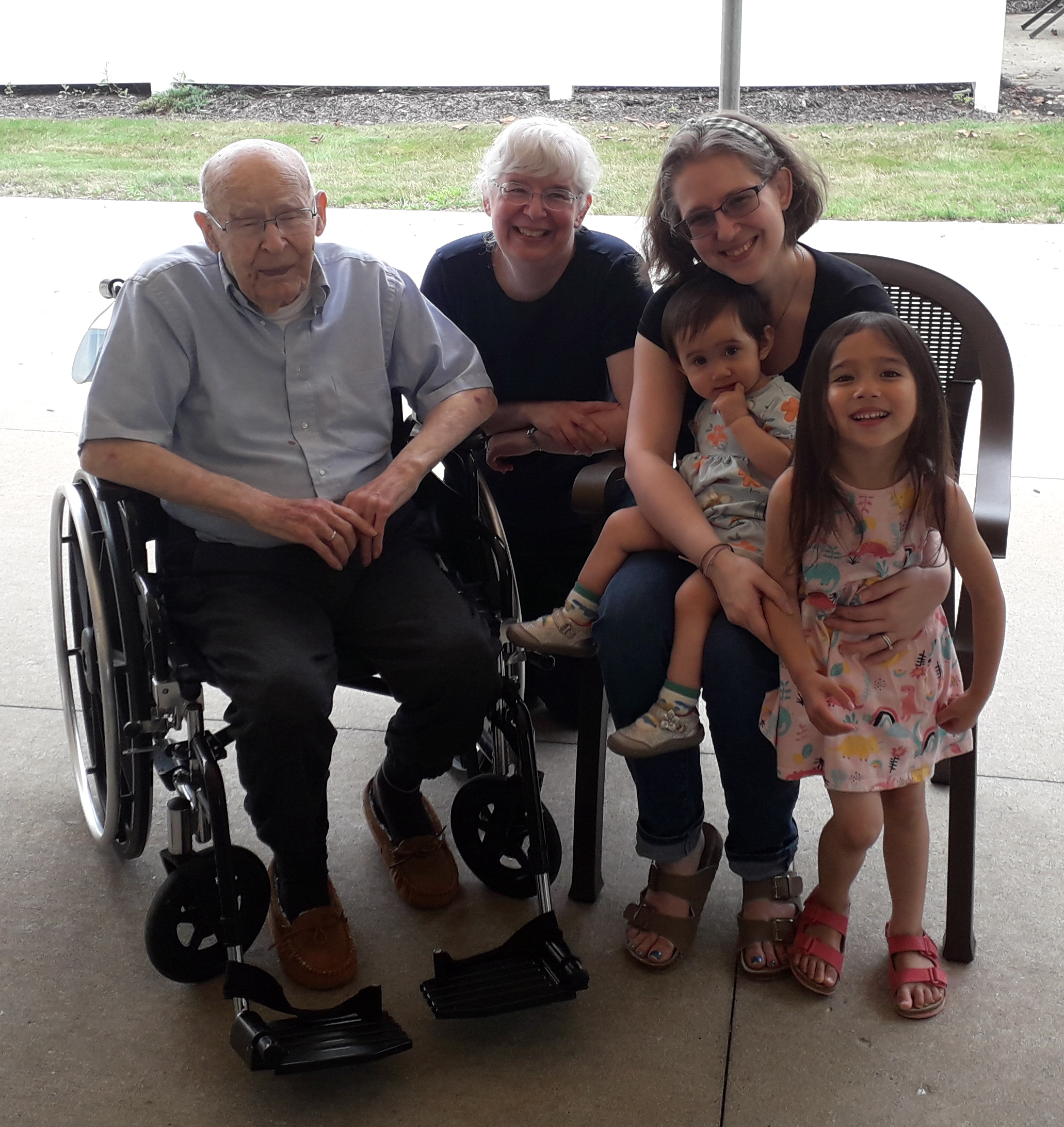
We were blest that all four of his grandchildren got to see Paco over the summer. We were especially grateful that granddaughter E with spouse L and great-granddaughters ABC and JG were able to visit from London UK. Because of the pandemic, we had not been able to see each other, but in August, just before the final and more precipitous portion of Paco’s decline, they were able to make the trip.
four generations with Paco, Joanne, granddaughter E, and great-grands JG and ABC
There were a few days during Paco’s last week where he was very agitated but we were fortunate to have some calmer moments. T was the only one of the grandchildren nearby enough for one final visit, which wound up being the day before he died. It was one of the most heartbreakingly tender encounters I have ever seen. T sang Irish songs to Paco and held his hands, which were still a bit restless from a medication side effect. She talked to him and I know that he could hear her because he was able to respond a bit. I admit that I couldn’t help but cry and that I am crying now as I try – and fail – to find the words to convey how special that last hour between them was.
It also happened that all three of Paco’s daughters got to spend time with him, both alone and in various pairings, on the day of his death. It was not clear that this would be his final day, so it was not that it had been planned, but I’m grateful that it turned out that way. I’m also grateful that in his last few days, I was finally able to sing to my father, something that my sisters had been doing but that I struggled to do. I sang both verses of “Over the River and through the Woods” to get to Paco’s favorite lines, “Hurrah for the fun! Is the pudding done? Hurrah for the pumpkin pie!” (Paco loved all kinds of pie.) I sang the Shaker hymn “Simple Gifts” because it is comforting to me and several beautiful Irish hymn tunes. Occasionally, I would get too choked up to continue singing but I usually managed to get through. On that last day, Paco could not respond but Hospice told us that the sense of hearing tends to remain and can even sharpen as the other senses are shutting down. My younger sister was alone with Paco when he died but I arrived soon after for my very last good-bye.
I have been so moved by the many people who have reached out to me during Paco’s decline and since his death. There have been so many kind words, both written and spoken – remembrances, prayers, thoughts, stories, expressions of gratitude for a long life well-lived. I was very touched when a friend that I made through Facebook but whom I have never met in person added my father to her Kaddish prayer on Yom Kippur. It has been the love I first learned from my parents but now experience through so many family and friends that has kept me going through all of this, even during the most difficult times. I thank all of you.
Last week, I went to the hair salon for a haircut with Diane, who has been my stylist since 1983. I told her about Paco’s death and she gave me a hug and told me that she had something to show me. It was her new puppy, who was sweetly asleep in his crate. She told me his name was Leo.
When I saw that Linda’s prompt for Stream of Consciousness Saturday this week was “up/down”, I knew that I needed to write a follow-up to last week’s SoCS in which I talked about my father (Paco) and his recent fall, hospitalization, and move to a rehab facility.
When I wrote last Saturday, it seemed that, though there was a long way to go, things were trending up.
Everything changed on Sunday when new complications arose. For various reasons, I will not even attempt to elaborate.
Let’s just say it has been a very “down” week.
We are working hard at untangling a mass of symptoms and trying to keep him safe and comfortable, but it’s an uphill battle. I know he is 96 and so, very vulnerable and prone to complicating factors but it is still so hard to deal with.
And to watch.
I know intellectually that I am doing all that is possible for me to help him and his care team, but my heart aches because I can’t make it better.
We have no idea what the outcome will be. It’s not just one day at a time, which is Paco’s favorite saying. It’s one hour at a time. One moment. One more early morning phone call telling me that he fell again during the night.
There are up moments here and there. When Paco easily remembers my name. When he gets to enjoy a slice of blueberry pie for dessert at lunch. When he manages to make a little joke with his aides.
I had planned to go to vigil mass today at a friend’s church, but was too tired to make the drive, so I went to a nearby church instead. I was blessed to see Sister A. there. She had been one of the stalwart visitors during my mother’s final illness, a span that stretched over two years. Because of the pandemic and other circumstances, I had not seen her in months. I was able to fill her in on Paco’s condition and she assured me that she has been lifting him up in prayer.
After such a “down” week, that assurance was a much-needed balm.
Today is the Sunday after Pentecost which is celebrated in the Roman Catholic tradition as Trinity Sunday. It is also the name day of a close family member, so it holds additional significance for me.
While I had attended mass in person a few times during Lent and Holy Week after I was fully vaccinated, I had not attended since because space was so limited and advance reservations were required. Now, though, with the new guidance from the CDC and our diocese, fully vaccinated people may attend unmasked and capacity restrictions have been eased, so I decided to attend to celebrate Trinity Sunday in person instead of via broadcast.
We still had temperature checks as we entered, but the ropes that had blocked every other pew have been removed. People still maintained some distance from each other, especially important for families with children too young to be vaccinated or teens who haven’t had time to complete their vaccination series yet. Some adults were masked because they haven’t yet been fully vaccinated or because they chose to wear masks because they are medically vulnerable or feel safer masked while indoors in close quarters. People are also masked when fulfilling certain roles in the liturgy, such as distributing communion. It was nice to see the octet able to stand unmasked in pairs singing the same voice part, rather than scattered about by household as they had to be under full pandemic protocol.
This week, we still used the pandemic protocol of distributing communion after the concluding rite, so that people were distanced as they exited immediately after receiving, avoiding large crowds in the gathering space. Next week, though, when we celebrate Corpus Christi, communion will be distributed at the normal time before the concluding rite, so we will get to have a proper closing hymn again. Our bishop has also rescinded the dispensation of the obligation to attend mass in person as of next week, although, as always, people who are too frail or medically vulnerable are exempt.
I’m not sure what will happen. Many churches, including the one I attend, cut back on the number of masses each weekend due to cleaning protocols. Will there now be too many people trying to fit into fewer masses? Will some people who have been accustomed to participating virtually continue to do so because it feels safer or easier or more convenient?
I admit that, for me, being back in person is difficult and saddening. Perhaps, it will be less so as we are able to resume talking to other congregants; it’s lonelier to me being in the midst of people with whom I can’t interact than being alone participating in mass via television. The bigger problem, though, is my discomfort with many of the clergy and bishops in the United States over the last several years. Too many of them are mired in clericalism that fails to acknowledge the decades/centuries of abuse, misogyny, racism, and injustice in which the hierarchy was either perpetrating or complicit. Too many of them are more enamored with their personal power over others than with following the servant-leadership of Christ. Somehow, for me, it feels safer with a priest on a screen than a priest in the same room, even a large room like a church.
I was just looking back at this post, which I wrote after my first Lenten mass in person. At the end of it, I write about the struggles of living through a lot of pain to remain in the church and questioning if I can go back to being confronted with that every week.
The answer may well become evident in the coming weeks.
Postscript: One of the online resources that I use is catholicwomenpreach.org. Their Trinity Sunday 2021 homily is powerful. If this was the preaching I heard in person at mass, it would be a cause for joy rather than pain.