
Last week, I attended my fortieth reunion at Smith College in Northampton, Massachusetts. For those who may not be familiar, Smith is a women’s liberal arts college, chartered in 1871, one of the traditional Seven Sisters, five of whom remain as women’s colleges.
I came into town a day early in order to meet up with an alumna friend who lives in Northampton and graduated a year before me. Her sister was a member of my class and passed away in fall 2020. I was honored to be able to commemorate her at the Service of Remembrance during our reunion. My ’81 friend and I enjoyed hours of conversation on her front porch, followed by dinner on the porch at Mulino’s, an Italian restaurant that did not exist back in my student days.
I stayed at the historic Hotel Northampton, which has fun features like a mail slot near the elevators on each floor that connects to a large brass mailbox on the main floor for pick-up by the postal service every morning. I also got to do a bit of shopping at Thorne’s Marketplace, a collection of local shops and restaurants housed in a grand historic building. Thorne’s was a fairly new undertaking back in my undergrad days and I’m glad to see that it continues to thrive. I bought some cards and gifts and books and made two trips to Herrell’s ice cream shop. I got a sampler each time, so I got to enjoy eight – count ’em, eight! – of their delicious homemade flavors. This will surprise no one that knows me. I also got to have lunch at Fitzwilly’s, a restaurant/bar that was also relatively new during my student days. I had mac ‘n cheese that featured fresh asparagus from a farm in nearby Hadley. I love asparagus, which is one of the glories of spring in New England; it reminds me of going with my parents to harvest a patch near my father’s hydro station, a remnant of a garden from an old company-owned house that had been torn down.
On Thursday afternoon, I went up to campus for the duration of reunion. Because of the pandemic, everyone had to have proof of vaccination and boosting to register and many of the meals and events were held outdoors. Indoor events were masked, except while eating and drinking. I immediately met up with some of my ’82 friends and the celebration began!
One of the things about Smith reunions – and Smith alums in general – is that we somehow manage to have meaningful conversations with each other at the drop of a hat. Perhaps because of our shared liberal arts background, we are engaged with a broad range of topics across current affairs, public policy, arts and culture, and on and on. Of course, the deepest conversations happen with our close friends but there is a lot of sharing of ideas with acquaintances, too. In retrospect, I wish I had prepared a succinct answer to the question “What do you do?” Lacking a shorthand reply, like “I’m a lawyer, working for this government agency” or “I teach at such-and-such school”, I found myself stumbling to explain forty years of my life in any brief, comprehensible way.
Unlike the vast majority of my classmates, I’ve done little paid work in my life. I’ve devoted many years to being a caregiver of both elder and younger generations, with more than our share of medical issues. I’ve volunteered in church music and liturgical ministry and facilitated a spiritual book study group. During my daughters’ years in public school I served on curriculum committees and shared decision making teams and helped design the honors program at the high school. I joined NETWORK, a national Catholic social justice lobby, in 2000 to advocate for social justice. I was part of the anti-fracking movement in New York which finally achieved an administrative and later legislative ban in our state; this led to ongoing involvement in the fight for climate and environmental justice. There is my writing life, as a blogger and poet.
This does not condense into an easy answer to “What do you do?” but it does constitute the bulk of my adult life, which would not have been as rich and varied were it not for my Smith education. The ideal of a liberal arts education is that you “learn how to learn.” By studying across the spectrum of academic disciplines, one absorbs different approaches to real-life issues, enabling critically sound and creative solutions that promote well-being for ourselves and others and for our environment.
Maybe I should have replied, “Just forty years of being liberal-artsy.”
The other thing that I hadn’t quite prepared myself for was the flood of family memories. Because it was only an hour-ish drive to campus, my parents visited often for concerts and events. They were there for my recitals in Helen Hills Hills Chapel and John M. Greene Hall. They visited at Haven House where I lived all four of my years on campus. There were there, of course, at B and my wedding, a few weeks after commencement with the reception at the Alumnae House. This reunion was the first time since their deaths that I was back on campus and missing them added another layer to the strange mix of familiarity and difference that the passage of forty years brings. For example, I thought about my parents when we were attending the remembrance service, sitting in rows of chairs where the pews had once stood. The pews were removed years ago to allow for more flexible use of the space but their absence felt strangely current when I remembered B and my parents there in the front pews on either side for our wedding.
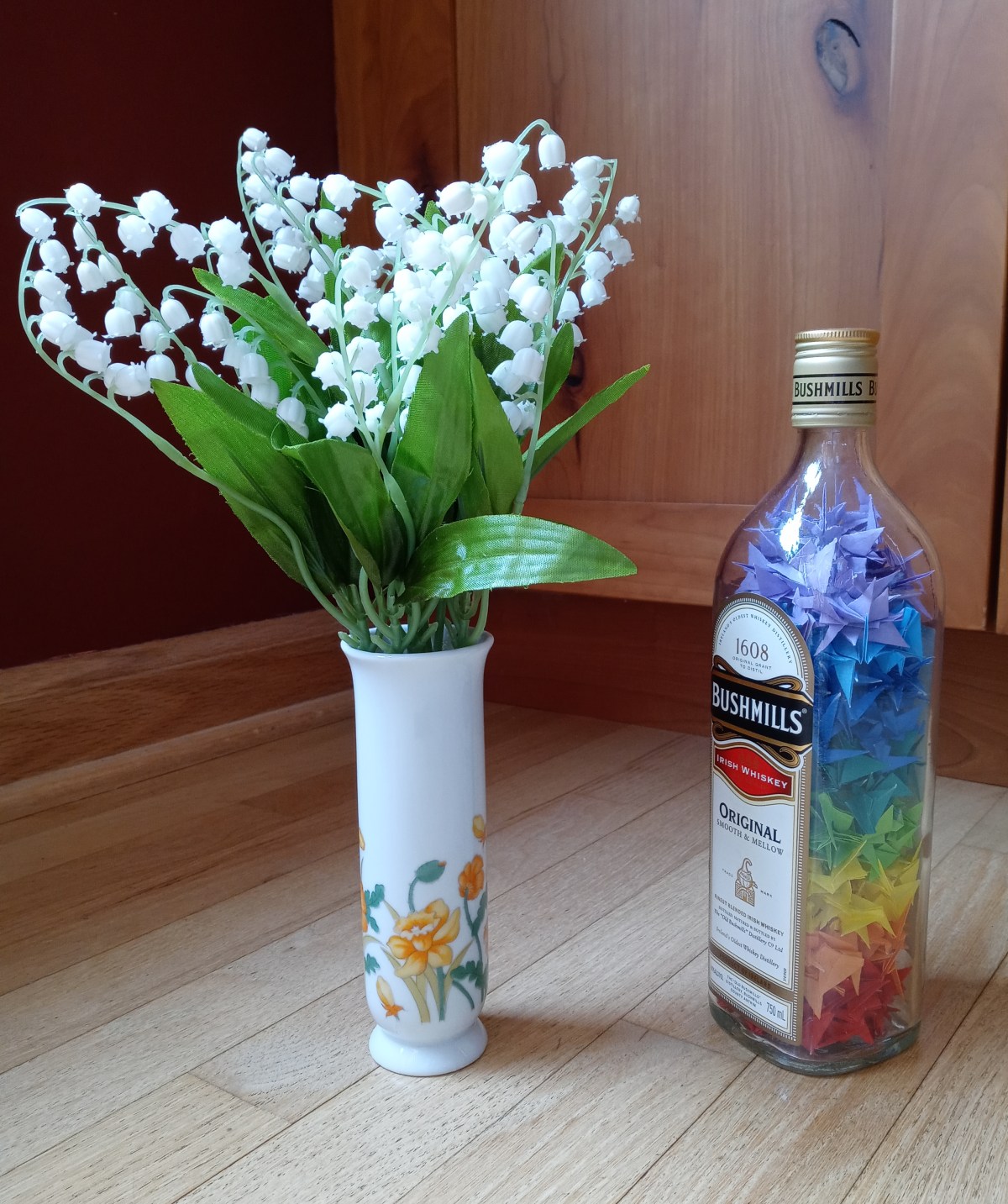
I also found myself missing my mother in particular among the spring flowers. We were blessed with unusually warm weather for mid-May and the flowers and trees were blooming simultaneously and profusely in response. The scent of the lilacs between the President’s House and the Quad, where we were staying, was so overwhelming I nearly choked. There were lily-of-the valley in bloom, which are Nana’s birth flower. What would have been her 90th birthday was the day after reunion and the third anniversary of her death is a few days from now.
I’m grateful to have been among friends who could support me with this grief aspect. Many of us have lost our parents now, with some still in the phase of dealing with their final years and indeterminate endpoint. As classmates, we were also dealing with the deaths of more of our ’82ers, adding to the list that, sadly, began during our senior year when we lost one classmate in a plane accident and a second to cancer. That’s why I and some friends always make a point to attend the service of remembrance during reunion. We want to honor our departed ones and their importance in our lives, even if they left us long ago. After the service, we visited the memorial tree planted beside the chapel in honor of our classmate Beth. We took a photo which we will send to her mother, who I know finds comfort that we remember her all these decades after her death.
While the central activity in reunion is visiting friends, there are plenty of other things to keep us busy. Some are long-standing traditions, such as Ivy Day when the alums, wearing white, parade between rows of the graduating seniors, also wearing white and carrying red roses, welcoming them into the community of alumnae. The night before commencement, the central campus is illuminated with Japanese lanterns. People stroll among them with live music in several locations.
There are also a number of lectures, receptions, and concerts. The President gave an update on the state of the college. Everyone is very excited that grants are replacing loans in financial aid packages at Smith, making an education possible without graduating in debt. Smith also highlights its accessibility for students who are the first generation in their family to attend college. That was my situation forty years ago but it was not recognized in the way it is today. I also attended two lectures of interest. One was how the Botanic Gardens are being re-imagined in keeping with the UN Sustainable Development Goals and best practices for preserving species in the face of climate change, all with an eye toward education and social/environmental justice. The other was about the transition of campus to ground-source heating and cooling, which will be a major contributor to Smith being carbon-neutral by 2030 without making extensive use of purchased off-sets. I was particularly interested in this because of the projects we have done at our home to reduce our carbon footprint and because my church is in the process of drawing up a strategic plan to reduce or eliminate our use of fossil fuels.
Besides college activities, we had a few opportunities just for our class. I alluded to one in this post – an open mic event to read something from our college years. I chose a passage from my adult psychology course journal about my experience coming from a tiny town to Smith. A few of us had brought something with us but we had time to do additional sharing which was fun. Our class theme for Reunion was “Writing Our Next Chapter” and I appreciated that our futures also came into that discussion.
We were also honored to have a preview screening of Where I Became, a documentary about South African students who came to Smith during apartheid. Our classmate Jane Dawson Shang is co-producer and shared some of her experiences making the film. When it becomes publicly available, I will surely share that information here at Top of JC’s Mind so everyone can see the remarkable story of these women.
Reunions at Smith are always exhilarating but exhausting. I had originally planned to attend commencement on Sunday morning but opted for quiet conversation with friends. Walking 17-20,ooo steps a day for three days straight in hot. humid weather proved to be a bit much for my feet and ankles, which swelled rather impressively.
It also meant that my reunion experience ended with what is always most important, sharing with friends in a place that was instrumental to our lives. I hope to see some of them and return to campus before our next reunion.
Five years seems too long to wait.






 Joanne Corey