Hospice month

November is National Hospice and Palliative Care Month in the United States. Some people don’t realize that palliative care exists outside of the context of hospice. Palliative care addresses pain that affects someone from any cause. People who are dealing with chronic or severe pain can consult with a palliative care specialist, who will put together a pain management plan for them. Hospice care involves palliative care for those in their final weeks/months of life.

While the alleviation of pain is an important part of hospice care, hospice is meant to serve other needs for the person who is dying and their loved ones. There are social workers and chaplains for help with personal, social, and spiritual needs. Aides help with physical care and companionship. Volunteers come to keep the patient company or offer special skills, such as massage, to relieve pain and stress. Nurses are the driving force that coordinates care. They visit as often as needed as circumstances change.

Hospice as a philosophy is meant to unfold over the final weeks and months, but sometimes is only called in for the very last days. For decades, hospice care providers have been advocating for referrals to be made enough in advance that there is time to develop a relationship with the patient and their loved ones, so that they can provide services while the patient is still able to interact. There are, of course, instances in which that is not possible, when an accident or final illness occurs without notice, but it is still unfortunately common for primary care physicians and specialists to delay hospice referrals.

We experienced such a delay with a family member, so that hospice was only called in for the final day. Even though time was brief, the experienced nurses were able to give us the tools we needed to relieve pain and recognize the progression of symptoms when our loved one was near death.

Our experience with Nana was on the other end of the spectrum. She was under hospice care for fifteen months, was decertified and off hospice for four and a half months, and back on for her final ten weeks. Some people commented to us that we had called hospice in too early, but that wasn’t really the case. Without hospice care, Nana would have died much sooner. At least twice, they were able to treat symptoms that would have caused fatal repercussions, had the hospice nurses not been able to get them under control.

It is true, however, that there are a lot of rules, especially with insurance, about hospice care. Those rules are set up for people who have a fairly accurate life expectancy estimate, such as someone with late stage cancer or kidney failure. With something more unpredictable, like certain types of congestive heart failure or pulmonary disorder, the hospice rules requiring a certain amount of decline over a given time don’t fit very well. I hope that, over time, the rules will be changed to make hospice care more accessible.

As National Hospice and Palliative Care month comes to a close, I salute all the compassionate nurses, aides, volunteers, social workers, chaplains, and administrators of hospice. You help people at one of their most vulnerable times. I wish you the strength and peace needed to continue in such important work.

Thanksgiving

The fourth Thursday of November is celebrated as Thanksgiving Day in the United States.

With so many changes in our family in the past few months, our Thanksgiving was quiet, with just spouse B, daughter T, and my dad Paco here for dinner. B did all the cooking – turkey, two kinds of dressing, mashed potatoes, rutabaga, acorn squash wedges, baked onions, and cranberry orange relish, with apple and pumpkin pies for dessert. It was a lot of food for four people, but we all enjoy having the leftovers. We are in the process of making turkey stock with the carcass and vegetables, something I learned from Nana growing up which has recently come back into food-fashion.

We ate midday here and, at almost the same time, daughter E was eating a Thanksgiving dinner, five time zones away, in London. She had made turkey and trimmings and pies for her daughter ABC, spouse L, and his parents with whom they are making their home. It’s nice that E and L want to keep some United States traditions to pass on to ABC, along with British ones. She is a dual citizen, at least until adulthood. It will depend on the rules in place when she turns 18, whether she will have to renounce her US citizenship to remain in the UK.

Still, she will always be able to celebrate Thanksgiving and remember the Thanksgiving celebrations of her childhood.

attack of the woodpeckers

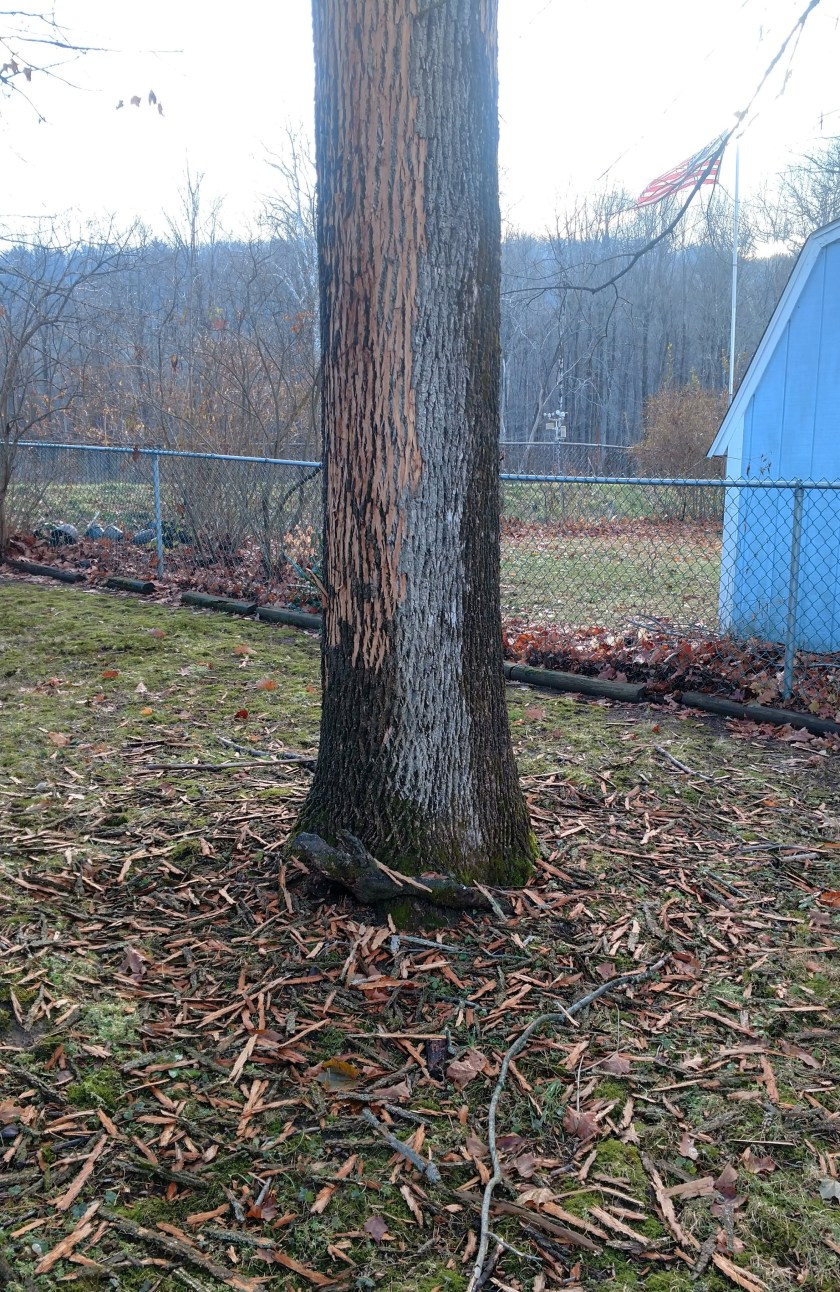
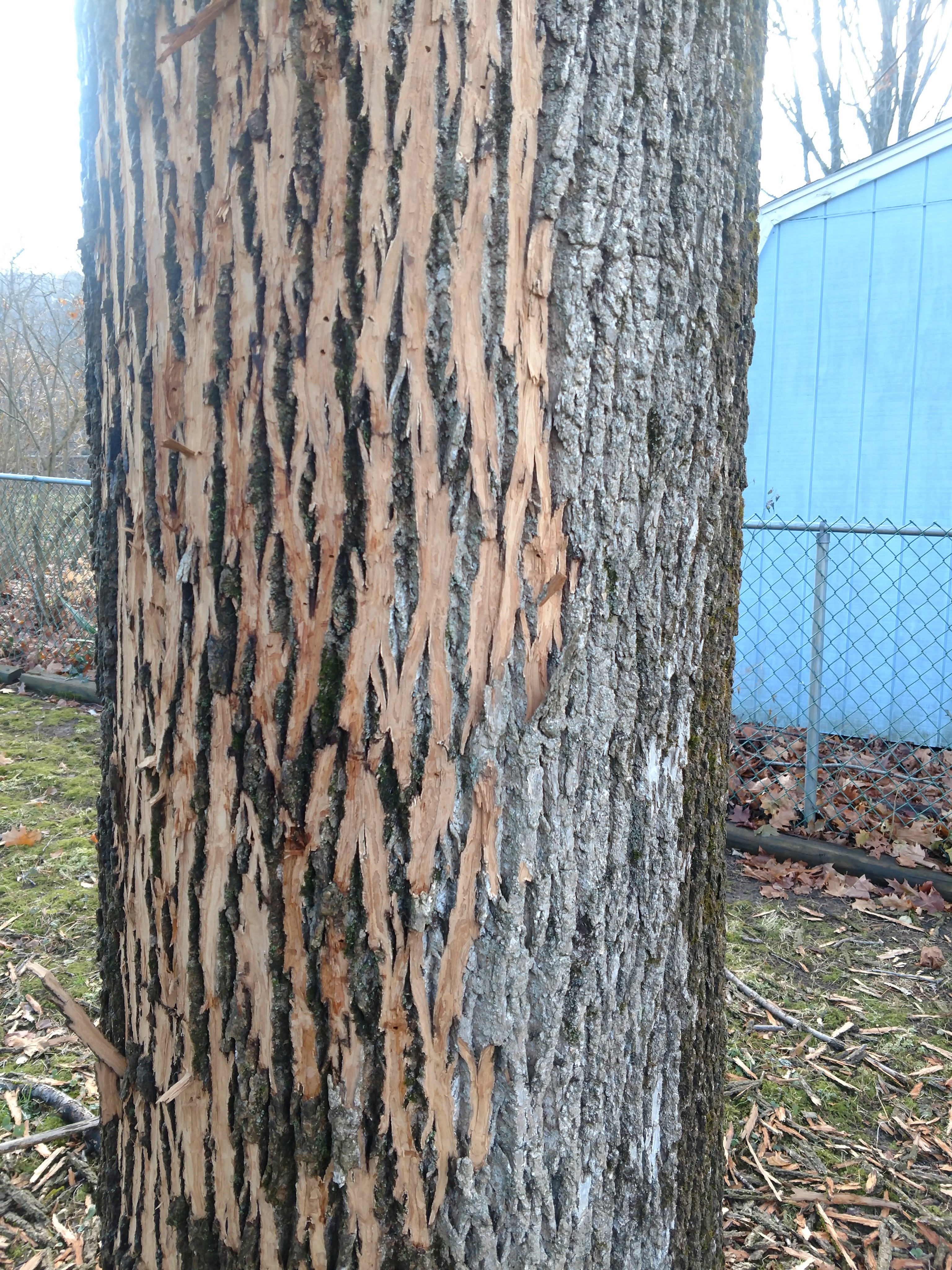
We have an ash tree in our backyard. When we looked out the window the other day, some of the bark on either side was badly scraped. At first, we thought maybe a bear had been climbing it.

Then, a piece of bark dropped down from higher up the trunk and we saw a pileated woodpecker, pecking assiduously and creating more places with almost no bark left. Although the pileated woodpeckers are far and away the largest, there are hairy and downy woodpeckers joining the party, too, creating an ever-growing patch of stripped bark on the ground.

Obviously, the tree is very sick. The wood underneath is spongy instead of hard and woodpeckers generally can’t strip bark like they have been here. We have called a tree service to evaluate, but it seems to fit the signs of infestation by emerald ash borer.

ash tree
the base of the tree with bark shards on the ground
img_20191124_153209832
Close-up of the damage

We had hoped the tree would be spared because the immediately surrounding trees are not ash, but adult insects can travel about half a mile from their source, so it was probably inevitable.

Ironically, we were getting ready to call the tree service to look at one of our maples, which seems to be dying back and may have verticillium wilt, which is caused by a soil fungus. There is a second maple that is very close to the ash tree which may need to be removed as well. It’s possible that all three of the mature trees closest to our house on the south side may be cut down, which is not good news on the air conditioning front, although our new heat pump will decrease our cooling costs a lot compared to our old central air unit. It may mean though, that we can get enough sun to grow small trees, shrubs, and flowers. We used to have a vegetable garden in the backyard, but it became too shaded. (It also got eaten by groundhogs who could easily climb the fence around the garden, but that is another story.) We may also have less moss in the yard, although I prefer more wildflowers instead of more grass.

It could also mean that we have to re-landscape on all sides of our house, given that our front and side yards are torn up from the drilling and burying of the outdoor part of our geothermal system. Given that we have had cold weather earlier than usual this year, we may have to wait for spring.

testimony

I have spent (a lot of) hours over the past two weeks listening to testimony in the Trump impeachment inquiry.

I was particularly impressed with Ambassador Marie Yovanovitch, Lt. Col. Alexander Vindman, and Dr. Fiona Hill. They were all knowledgeable and forthright, despite attacks on them personally by the president and his allies. The White House instructed nearly all the witnesses not to testify, even though they were under Congressional subpoenas. It was brave of them to appear, first in closed door depositions and later in public testimony.

Some of the Republicans complained about the closed door depositions, but they proved to be very valuable. It meant that each witness could share what they knew without being influenced by another person’s testimony. As it turned out, most of the witnesses’ recollections jibed with all the others, except for EU Ambassador Sondland, who amended his deposition after reading some of the others’ when they were released publicly. For the record, it is not true that Republicans were shut out of the depositions. There were three committees involved and the Republican members and their legal counsel had equal opportunity to question the witnesses. Some also complained that the White House lawyers were not involved, but their role will come later, if there is a trial in the Senate. The House is investigating possible articles of impeachment, which are like an indictment in the courts. The House committees are, essentially, acting as a grand jury would in gathering evidence and deciding to bring charges or not. Defense lawyers do not take part in grand jury proceedings.

Because the (hours and hours of) deposition transcripts were released prior to the public hearings, it was assumed that the hearings would be pretty routine, highlighting certain aspects of the depositions. However, new information emerged. One noteworthy incidence of this was when Ambassador Bill Taylor testified that a member of his staff had told him that he had overheard a phone call dealing with Ukraine between Ambassador Sondland and President Trump. This led to the staff member, David Holmes, flying from Kyiv to Washington to give a deposition and public testimony about it.

Another big surprise was when Ambassador Sondland acknowledged very plainly that there had been a quid pro quo; the administration in the US had withheld military aid and a promised White House meeting for the new Ukrainian president in order to get him to announce in public that he was launching an investigation of former US vice-president Joe Biden and his son Hunter, as well as an investigation of Ukrainian interference in the 2016 US presidential election, despite abundant evidence and indictments of Russian, not Ukrainian, operatives. The president and many of his allies have been saying for weeks that there was no quid pro quo, so such a frank admission from Sondland was startling.

Sondland was full of surprises. Another big one was that he implicated President Trump, Vice-president Pence, acting chief of staff Mick Mulvaney, and Secretary of State Mike Pompeo as all being “in the loop” about the situation. He also said that the president was directing their actions, which demolished the theory that some individuals were doing these things as rogue elements.

It would be helpful if documents, such as memos, contemporaneous notes, and call records, were available to the committees, but the White House is refusing all requests for documents, as well as blocking witnesses from testifying. This is bad. It seem like a coverup and obstruction of Congress/justice. Obstruction appeared in articles of impeachment for presidents Nixon and Clinton.

I was also perturbed by some of the statements and questions from the Republican members of the committee. They sometimes listed as facts things that are not. They kept asking about things that are not relevant to the impeachment inquiry and already debunked conspiracy theories.  They also insulted some of the witnesses by asking questions about unpatriotic behavior without any basis in fact. I remember during the Watergate hearings that there were Republican members of Congress who took their responsibilities very seriously, even though Nixon was also a Republican. In particular, I remember Senator Howard Baker.

Interestingly, Intelligence Committee chair Representative Adam Schiff in his at times impassioned closing remarks asked “Where is Howard Baker?” At the moment, no Republican members of Congress appear to be fulfilling their Constitutional role to discover and act on the truth, as Howard Baker did. Rep. Schiff concludes his remarks invoking the recently deceased Representative Elijah Cummings, “We are better than that.”

I hope we, as a country, are still able to uphold the Constitution and our highest ethical principles. If Republicans can’t imagine themselves as above partisanship, perhaps they can imagine how they would have reacted had President Obama acted the way President Trump has and then lied about it. During the eight different Congressional investigations into what happened in Benghazi, the Obama administration provided documents and testimony over and over, even after it was clear there was no conspiracy or crime involved. How would Congressional Republicans have acted if the Obama administration had stopped cooperating? Are they treating the Trump administration’s lack of cooperation in the same way? If the answer is no, they need to look at their duties to the country and their oath of office and consider if they are fulfilling them.

Capturing the moments.

Tric is a blogger from Ireland who writes beautifully about the full spectrum of life. I was especially moved by this post today and want to share it with you.

tric's avatarMy thoughts on a page.

Growing up most of our photographs were of holidays, birthdays, gatherings or special occasions. If I were to have taken a ‘selfie’ as a teenager, people would have questioned my sanity. Nowadays, I rarely pose or share photos of myself and often forget to take my camera out during special occasions, but that doesn’t mean, I don’t like photos. I do, and rarely a day goes by without my taking at least one. You might be surprised to know, I don’t use a camera to take these photos nor in fact do I tell anyone I am taking them. I do it with the blink of an eye, capturing the moment and filing it away in one of my many albums in the far recess of my mind.

I began to take these photos twenty years ago, when a lovely friend of mine was facing the sad reality that her…

View original post 644 more words

writing, singing, etc.

I had been trying to post more regularly – and have now proceeded not to post for a week and a half. I’m sure that isn’t a shock to regular readers. As much as I hope to create a even a semblance of a schedule, I haven’t managed to get there yet.

Even though I haven’t been posting here, I’ve been doing a bit of writing. A letter to the editor at NCR online. A short piece that may appear as a Small Earth Story at NCR. A bio to accompany a poem that is going to be published soon. This will be in the mini-anthology that will be a companion to the winning chapbook from QuillsEdge Press; all the finalists will have a poem printed. This was also exciting because I had to approve the proof and sign a contract. It was a needed reminder that I am still a poet, even though I haven’t published much lately – or even submitted. Maybe, after the first of the year, I can concentrate on a revised version of the chapbook to send out…

I don’t have a choir with which to sing on a regular basis this fall, but have sung with the combined music ministry at church for three funerals over the last three weeks. All the funerals have been for family members of music ministers, the last being the brother of my friend, who has been director of music for decades. Sadly, she has had to play and direct for the funerals of both her parents and, now, her eldest brother. Another staff member described it as “her last gift to him.” Perhaps that, along with her professionalism and faith, is the way she can manage to keep her focus in such difficult circumstances.

At the luncheon after the funeral, I was sitting with people who I met years ago at our former parish. It’s been fourteen years since we were all together there. Even after so much time belonging to other parishes, we still miss it.

That our sense of connection remains strong is a testament to how special and loving the community was. It had a part in forming our identities and that is a lasting gift.

One-Liner Wednesday: fear and understanding

“Nothing in life is to be feared, only understood.  Now is the time to understand more so that we may fear less.”
~~~ Marie Curie
*****
Please join us for Linda’s One-Liner Wednesday! Find out how here:  https://lindaghill.com/2019/11/06/one-liner-wednesday-essential/

Badge by Laura @ riddlefromthemiddle.com

mostly fossil-free home!

A project that B and I have been working on for years is finally complete. With the installation of a geothermal heating/cooling system, we are able to disconnect our home from the methane infrastructure, which in our area means that we are no longer burning fracked gas from neighboring Pennsylvania in our home. Because we had previously installed a hybrid electric/heat pump hot water heater, our furnace had been the only thing still attached to the gas lines. Now that it is gone, we won’t have to pay for methane, which is relatively low-priced at the moment, or the delivery charges, which are relatively expensive in New York. Those savings will help with our electric bill, which will go up, although our panels in a community solar array generate a good chunk of our electricity. In our region of New York, changing from methane to geothermal for heating is considered a wash in terms of cost, but our air conditioning costs will be much lower with the heat pump than with our outdoor compressor unit.

We have done other projects to make our home more efficient, such as changing to LED lighting and adding more insulation. We use a rechargeable battery-operated lawn mower and electric leaf blower. The only two household things that will still use fossil fuels are our propane grill and our gasoline-powered snowblower, which is only needed a handful of times a year, if that.

We have also cut way back on our use of gasoline for transportation, driving an all-electric Chevy Bolt and a plug-in hybrid electric Chrysler Pacifica. We only use gasoline when we take the Pacifica on longer trips. It gets 30ish miles on battery. When it is running on gas, some of the engine power re-charges the battery, so even when we have no plug-in charge remaining, a quarter to a third of our miles will still be battery powered. It could be even more than that if we are driving on roads with terrain or lots of stop signs/lights because the braking is regenerative, meaning the energy from slowing the car goes toward charging the battery. It’s possible that, as rapid charging stations become more available, we may be able to take longer trips in our Bolt, which would cut our gasoline usage even further. (I know some of you urbanites are wondering why we don’t use mass transit. Unfortunately, our area has almost no mass transit available.)

We have tried to cut down our fossil fuel usage and control our total energy usage as much as is practicable, but I know there is one sector where our carbon footprint will become heavier rather than lighter. I have not been a frequent flyer in my first almost-six decades, but I am likely to be flying several times a year for the foreseeable future. With daughter E and granddaughter ABC’s recent move to London, I see a fair number of airplane flights coming.

The first one will be next month.

silver linings

There are some silver linings of not having a 2-year-old in the house.

  • Not crashing into the gate at the bottom of the stairs while trying to navigate at night
  • Being able to open cabinets without fiddling with a latch
  • Fewer smudges on the windows
  • Not having to juggle vehicles to make sure one with a car seat was available at home for outings
  • Cutting back on energy usage with fewer laundry loads, lights, electronics, etc.
  • Not having to wrestle with doorknob guards on the basement and linen closet doors – they were hard for little hands to open but also for my petite grown-up hands
  • The opportunity to sleep more, although this is only theoretical
  • More flexibility to travel, write, exercise, etc., although this, too, is theoretical
  • A break from watching some part of Moana, which ABC called “Ocean”, and/or Frozen, which ABC called “Snowman”, every day, although I might sneak a peek at them now and then because I appreciate the theme of love of family, especially grandmother/granddaughter and sisters

Of course, I would trade it all in a moment, if I could, although I know ABC is where she needs to be, settling in with her mom and dad and London grandparents and enjoying the amenities that only a big, historic city can provide. We had a chance to videochat with E and ABC over the weekend and to make arrangements to visit in December. It will be exciting to see everyone and all the places they go! It might be a bit too exciting, though, as we will be there for the election on the 12th…


All Souls

In the Catholic tradition, early November is dedicated to remembering those who have died. November first is All Saints Day and November second is All Souls Day. Our parish does a special commemoration for All Souls Day of all the people whose funerals were held at the church since All Souls Day of the prior year. Family members loan the church a picture of the deceased and they are displayed on tables with name cards and candles for the whole month of November.

This year, my mom, known here on the blog as Nana, was one of those commemorated. I printed an enlargement of a favorite photo of her; Nana was not fond of having her picture taken, so photos of her alone are pretty rare. I bought a Shaker-style wooden frame for it. I admit that the liturgy was emotional for me, but it was also comforting. It also felt fitting that the handbell choir played at the mass. Nana always loved to hear E and T ring.

In the evening, I attended a concert for all souls by the Southern Tier Singers Collective (STSC). I know a number of the members, including one whom I met in University Chorus and with whom I have been close for years. The founder and director of the group is Bill Culverhouse, the current choral director at Binghamton University. The concert was beautiful, although the music was emotional for me, given that the loss of my mom is still very much in my mind and heart. Thankfully, I was able to join some friends from University Chorus in the audience, which helped me to feel supported during the performance.

The concert took place at Saint Patrick’s Church, Binghamton, which is considered the mother church in our county. The building is old, high-ceilinged, and has lots of hard surfaces, so the acoustics are good for choral singing, especially a capella, which is what STSC does. St. Patrick’s was the boyhood parish of my retired pastor, who sang there, in Latin, as an altar server. After his retirement from our parish, members of our music ministry came together there to participate in a mass celebrating his 50th anniversary of ordination. It was a large group with instrumentalists, so I helped out by conducting. Several years later, we came together again to sing for his wake service and funeral, so thoughts of him were also present in my mind.

The most moving piece in the concert for me was Dale Trumbore’s How to Go On (2017). She chose to set texts from 21st century women poets Barbara Crooker, Laura Foley, and Amy Fleury. The passages speak more to acceptance of mortality than to mourning. I loved the language of the poems and the often haunting, often meditative, way they were set. The piece begins with a question from Barbara Crooker’s poem “Some Fine Day”:  “How can we go on, knowing the end of the story?” I could feel my own answer to that question working its way through my mind in response to the poetry and music – and could imagine my mother’s.

There was a third woman that I could also imagine, a woman my age who died recently. I had sung in the choir for her funeral on Wednesday. She was a beloved member of our community, who used all her skills and gifts in service to her family, her work, and charitable causes. She died at our local hospice residence, where she had been serving as president of the board of directors. I know that she must have found her own answer.

A passage from the movement “Sometimes peace comes” from Laura Foley’s poem “Syringa” speaks to part of my answer at this point in my life.

and you have stepped into
a place beyond time,
beyond sadness and form.
A wide, high plain
where in the endless, deep silence
you find out what it is, what it is,
and your part in it.