When I read Linda’s prompt yesterday, the first thing I thought about was fingers. And poetry, which is probably a good sign as I am trying mightily to get back to thinking more about poetry.
I am working on editing a poem in which fingers play a prominent role.
I have an older (unpublished) poem about how I still have a pianist’s mentality about my hands, even though I can no longer play.
And, of course, I am using my fingers now to write this. I know that there are lots of tools now that are talk to text, but I feel very oddly about talking to machines. Perhaps I will get over that one day, but, for now, I’ll let my fingers do the talking. ***** Linda’s prompt for Stream of Consciousness Saturday this week was to write about a body part. Join us! Find out more here: https://lindaghill.com/2021/10/22/the-friday-reminder-and-prompt-for-socs-october-23-2021/
In the first few seasons of The Late Show, Stephen Colbert did a recurring skit, now a best-selling book, called Midnight Confessions, in which he “confesses” to his audience with the disclaimer that he isn’t sure these things are really sins but that he does “feel bad about them.” While Stephen and his writers are famously funny, I am not, so my JC’s Confessions will be somewhat more serious reflections, but they will be things that I feel bad about. Stephen’s audience always forgives him at the end of the segment; I’m not expecting that – and these aren’t really sins – but comments are always welcome.
JC
I am still on Facebook and feel guilty about it.
I’m confessing this now because it is top of mind after reflecting on Ellen Morris Prewitt’s post on leaving Facebook. Ellen is an amazing author, blogger, community volunteer, and former lawyer from the American South. She shares her insights on a range of topics and has recently published a number of powerful posts about race and racism. I urge everyone to visit her blog and subscribe.
I confess that, despite my dismay over Facebook spreading false information, their exploitative business model, and the vagaries of their newsfeed algorithms, I am staying with the platform for now.
I’ve tried to make my own Facebook experience as insulated from harm as possible. I use Social Fixer, which allows me to hide sponsored posts, political posts, and other parts of the page that I don’t want to see. I spend almost no time scrolling through my newsfeed and do not use Facebook as a news source. I do automatically send posts to my blog page and then link them to my personal timeline for added visibility, although I remain annoyed at how few people can actually see my posts due to the aforementioned vagaries of Facebook algorithms.
I admit that part of the reason I stay with Facebook is that there are people with whom I am connected only via Facebook and don’t want to lose touch with them. I also am one of the administrators for a private Facebook group for my college class and don’t want to abandon that responsibility.
I know those are personal excuses that in no way forgive my responsibility in participating with a platform that causes harm. I do favor policies and regulations that will make Facebook a safe, honest cyberplace.
I’m probably hopelessly naïve to think that that is possible.
But that is, perhaps, a confession for another day…
is something I have been saying to myself off and on for years.
The truth is that most of my adult life has been spent as a caregiver, some of it in very challenging situations dealing with long-term illnesses.
Not the kind of life that lends itself to following a daily schedule. If you ever think you know what is happening on a given day, chances are the phone will ring in the morning and you will be off dealing with some need that has arisen.
Let me be clear that none of this is a complaint. Rather it’s just a statement of fact – and evidence that I was privileged enough to be able to choose a life of unpaid caregiving instead of needing to take paid work and cramming in the caregiving around my employer’s schedule.
The day after Paco’s death, the hospice social worker said to me that now I could figure out what I wanted to do. We had first met during my mother’s illness, so she had some idea of what my life has been like over at least the last few years, if not decades.
While it’s true that I have spouse B and daughter T at home, we are able to collaborate on taking care of the house and each other, so the years of intensive caregiving are probably over for a while, as long as we all remain reasonably healthy.
So, I’m starting to piece together how I want to spend my time in the coming months. Admittedly, right now I am necessarily busy with settling Paco’s estate and final bills and insurance claims and such, which takes a lot more time and energy than you might think if you have never had to do this for a loved one.
I’m trying to keep from jumping back into everything I have put on hold in the past because I think there is a danger of over-committing and exhaustion. I do know that I want to spend more time with writing, so, perhaps, finally regularly posting here again.
I also need to return to spending serious amounts of time with my poetry. During the recent Boiler House Poets Collective residency, I was able to re-connect with my full-length manuscript that revolves around that area and my family’s connections with it. I am going to do a review of it with the Grapevine Group, my local poetry circle, later this month and then do revisions and look for submissions opportunities. I also need to look for more opportunities for my chapbook, as the rejections have been rolling in over these last months so it is only out at a few places at the moment.
I am considering auditioning for a local chorus, although that might not be until after the holidays. I expect that, for the first time in many years, we may travel for both Thanksgiving and Christmas.
I am staying in the loop but not spending a ton of time on environmental and political issues. I still send letters and do public comment on social justice and environmental causes and send emails to my elected representatives but I am trying not to spend hours every day on it, as I did for years during the height of the anti-fracking fight in New York. I admire the energy and commitment of today’s younger activists and support their efforts as best I can.
Church volunteering is still on hold. Eventually, the book study I facilitate may return but only if we can meet safely indoors unmasked. We aren’t there yet.
So, can I do this? Can I re-organize my life and have it stick?
As part of my ongoing participation in the Pfizer/BioNTech COVID-19 vaccine phase III trial, yesterday I received a third vaccine injection, seven and a half months after my second. There was a blood draw to test levels of antibodies, T cells, etc. and the blood work will be repeated in a year. I will continue a weekly symptom check through a phone app and have a couple of phone appointments over the next year, too. The data collected will be used to inform on-going decisions about how often boosters may be needed in the future.
I’m fortunate that my side effects have been milder than they were with the second injection. I have a very sore arm, which is obviously from the shot. I’m tired and have a bit of a headache, which could be side effect and could be just life in general these days. Today is the one-month anniversary of Paco’s death, so how I am feeling could be attributable to that rather than to vaccine side effects. When spouse B and daughter T, who are also study participants, received their third doses, they both lost a day to fever, body aches, and fatigue; because I had had a similar reaction to my second dose, I was expecting a similar experience, but apparently have lucked out.
In the United States, a third dose of the Pfizer vaccine is approved for those aged 65 and up, people who have medical risk, and those in certain professions that have close contact with vulnerable populations. It’s possible that the third dose will be recommended more generally in the future as more data become available. It’s also likely that emergency use authorization for children aged 5-11 will come soon, with shots in arms starting in early November.
Recommendations on booster doses for Moderna and Johnson & Johnson are expected soon, as well as the possibility of mixing manufacturers, for example, someone who had the J&J vaccine having a booster from Pfizer. All the companies are continuing to study the vaccines for long-term efficacy and side effects, as well as safety, efficacy, and dosage for children six months through seventeen years. Currently, in the United States, only Pfizer is approved for ages 12-17.
Another helpful development is that Merck has applied for emergency use authorization of molnupiravir, an oral anti-viral to combat COVID. It would be given to patients in the early stages in hopes of keeping their illness from becoming severe. While it is already possible to give treatments by injection or infusion, such as monoclonal antibodies, this medication would be easy to prescribe and administer for home use. A decision by the FDA is expected within weeks.
Meanwhile, over the summer, COVID cases were devastating parts of the US, especially states with low vaccination rates. Total fatalities are over 700,000 with over 44 million cases recorded. In some areas, hospitals were so overwhelmed that they had to send patients out of state to receive care. This applied to COVID patients and also to patients suffering from other serious conditions. Two states, Idaho and Alaska, had to implement crisis standards of care, which means that whether or not an individual receives treatment beyond comfort care is determined by the likelihood of survival as there is not enough capacity to treat everyone that needs help. This resulted in non-COVID deaths from heart attack, stroke, etc. – patients who ordinarily would have been treated successfully but who died because there were not personnel, equipment, and space available to treat them due to intensive care units being filled with COVID patients.
The delta variant was the power behind the summer surge, but, at least, the fear of it encouraged more people to seek vaccination. The increase in vaccination rates is helping the case numbers to fall at this point. Still, the current rate of fully vaccinated people is only 57% with 66% receiving at least one dose. I am hopeful that the Pfizer vaccine being approved for elementary age children in the coming weeks will add significantly to our vaccination totals, at least in states where the vaccination rate among adults is higher.
There are still terrifying amounts of misinformation floating around about the vaccines that are keeping some people from taking them. Unfortunately, this is keeping the pandemic alive, resulting in illness, death, lack of access to medical care, and the possibility of even more dangerous new variants developing.
We are all in this together. Please, everyone, get vaccinated if you are eligible and follow reputable public health guidelines on masking, avoiding crowds, handwashing, etc. Your choices affect your family, friends, neighbors and community directly and your nation and the world, as well. We can’t truly end this pandemic until there’s no population anywhere still vulnerable to COVID-19.
If you won’t do it for yourself, do it for someone you love.
The United States is marking the end of the nearly twenty years of war in Afghanistan, part of the wider “War on Terror” which began after the attacks of September 11, 2001.
Although there were those of us who opposed a military response at the time – I vividly recall our group standing near the perimeter of the traffic circle beside our church with signs against war and people driving by honking in agreement – the war began, followed later by the war in Iraq which took a lot of attention and resources away from Afghanistan, which is I think part of the reason the war there went on for twenty years.
I am saddened by so much loss of life, injury, and damage incurred, especially among civilians. I am grateful that many Afghans, especially ethnic minorities, women, and girls, were able to enjoy more freedom and access education, sports, and jobs due to the presence of the United States and allied forces. Unfortunately, many of those gains are being lost because the Afghan government was not strong enough to stand on its own. With the Taliban back in charge, many of the gains and protections for women and minorities have dissolved. I must admit to being perplexed with people who thought that the final withdrawal from Kabul was like the fall of Saigon at the end of the Vietnam War. I am old enough to remember that, when the military evacuated from Saigon, they did not take Vietnamese civilian partners, translators, and related personnel and their families with them. They did not even try to evacuate the children of US service members who faced hardship because there were mixed race. Over a period of years, some of these former South Vietnamese allies were able to flee the country and re-settle in the United States but it was not because they were evacuated by the US. They made their own way to refugee camps or set out to escape by boat.
In contrast, the United States was able to evacuate over 65,000 Afghan civilians with thousands more evacuated by other countries. While this is by no means all the people who were in need of evacuation, it is much better than the situation in Vietnam in 1975. The US State Department is continuing to work at getting more people out of Afghanistan, as others work on getting people processed and re-settled in the US and other countries.
We will never know what might have happened if the United States had tried to deal with the aftermath of 9/11 through diplomatic rather than military means. Perhaps so much of the weight of response would not have fallen on Afghanistan, where Osama bin Laden was thought to be hiding, and more on Saudi Arabia, whence fifteen of the nineteen hijackers came. None of the hijackers were Afghanis.
I don’t know what will become of Afghanistan. It has been a place of turmoil for centuries. I do hope that the money that has been previously used to make war will be re-allocated to peaceful purposes to help people and the planet survive and thrive.
Because I announced my father’s death in this One-Liner Wednesday post, I’m linking the promised tribute to him with thanks to him and to all my friends and readers who have been sending out prayers and good thoughts on our behalf over the years.
Today is the last full day of the Boiler House Poets Collective reunion residency for 2021. It’s always amazing to be back here at MASS MoCA together but the experience is heightened after having to cancel because of COVID last year.
I am in the same studio as I was in the Tupelo Press workshop/residency that first brought us together in 2015. As I was looking back at my blog to get the exact dates of that residency, I decided to re-visit all the posts from back then. I was surprised that I processed as much as I did at the time, while realizing how much I had downplayed the amount of confusion and fear I was feeling.
If anyone is so moved to join me in this walk down memory lane, the posts start here.
My 96-year-old father, known here as Paco, died in mid-September, but I have been struggling to write about him. A good share of that is that the writing/analytical/organizational part of my brain has been too busy with all the phone calling and notes and paperwork that follow a death, which are by turns taxing and emotional and fraught. I’ve also been trying to find peace after so many months of complex medical and care situations which I found both exhausting and traumatic. I’ve also taken a week to attend a reunion residency with the Boiler House Poets Collective at MASS MoCA, which has been helpful both in reconnecting with family history as we are from the North Adams MA area and reconnecting with myself as a poet after so many months of sneaking in poetry time only intermittently.
But in this post, I will try to tell you more about Paco and our family.
People have asked me how my Irish-American father came to be known as Paco, which sounds more Spanish. My firstborn daughter E was the first grandchild on both sides of the family. As she was learning to talk, she couldn’t manage to say “Grandpa” and – after a few instances of calling him “Bucco” – settled on Paco as his name. This became his name with all the other grandchildren and often for other family members. It was natural for me to use it here on the blog.
It was a revelation for me seeing Paco interact with his grandchildren. Because my younger sister and I are only two years apart, I didn’t remember my father as a dad to young children. Unlike so many men of his generation, he reveled in playing with very young children and singing to them. One of the great blessings of our family life is that Nana and Paco retired near us when E was three and before T was born. Having them be so close by all those years was wonderful with walks and outings and school events and concerts, theater, and dance recitals, games and carousel rides and countless volleys of ping pong in the basement. Nana and Paco gave us so much love, care, and support for so many years; it was natural that we would provide the same to them as they grew older and developed health problems.
Paco had served in the US Navy as a SeaBee in World War II and Korea. The SeaBees were the Construction Battalion – CBs, get it? – and Paco was drafted before he could finish high school. Most of the SeaBees were older men, already established in various trades, who took Paco under their wing and taught him what they knew. The skills he developed there in electrical work set the stage for his career. Paco didn’t talk much about his service when we were growing up but, in his later years, he got some SeaBee caps which he would wear out in public. I was always amazed at how many people would comment, thank him for his service, and share their own stories of service by themselves or family members. Those tributes continued into his last days. One of the first things Hospice did after admitting him was to bring a certificate and a memorial quilt square to him. We are also applying for a service medallion to be added to his memorial in the mausoleum.
Paco worked for 43 years for New England Power Company, the last 23 as Superintendent of the Upper Deerfield River in southern Vermont/western Massachusetts. I wrote the poem “Hydro Superintendent” about him for his 90th birthday. We lived in a house that was owned by the company and often visited the powerplants and reservoirs. One of his biggest accomplishments as superintendent was overseeing the construction of Bear Swamp, a pumped storage plant built inside a mountain. Paco knew every detail of that project, which brought in contractors from as far away as Japan and Switzerland. It was so much fun walking through a giant tunnel to get to the huge powerhouse with its two turbines that could generate electricity and then reverse to pump water back to the upper reservoir. I started my interest in renewable electricity and energy storage technology young, thanks to Paco.
One of the things I admired about Paco was his work ethic. He always worked hard to get the job done right but he was also part of the team, even when he was the leader. He would help the crews do emergency work rather than just ordering them to come in. He hired the first Black and the first woman into his stations which had previously been staffed entirely by white males. (Point of information: Rural New England was not very racially diverse at the time. Some areas still are not diverse now, decades later.) He was always compassionate and understanding when employees encountered personal or family difficulties. He was also not one to “toot his own horn.” I found out how well-regarded he was by his staff through others, not from him.
We admired Paco even more when we discovered he had accomplished so much with undiagnosed dyslexia. When his youngest granddaughter S was diagnosed with an inherited form of dyslexia, Paco discovered at age 80 why he had always secretly struggled with reading and writing. S and her family launched the Paco Project to raise funds for Learning Ally to help others with print or visual disabilities access the world of books. We are proud to direct donations to Learning Ally in memory of Paco.
Paco was also proud to finally become a high school graduate. I applied for his diploma through Operation Recognition, a program which awards diplomas to veterans who left school before completing their course of study. In 2008, the same year that eldest granddaughter E graduated from high school, Paco received his diploma from Drury High School in North Adams, Massachusetts, the school that he and Nana, as well as I and my sisters, had attended.
Paco’s ancestors came to the United States from Ireland but he had never visited. Nana was too claustrophobic to consider flying, but after her death in spring 2019, my two sisters took Paco to Ireland to visit.
Paco and an Irish rainbow
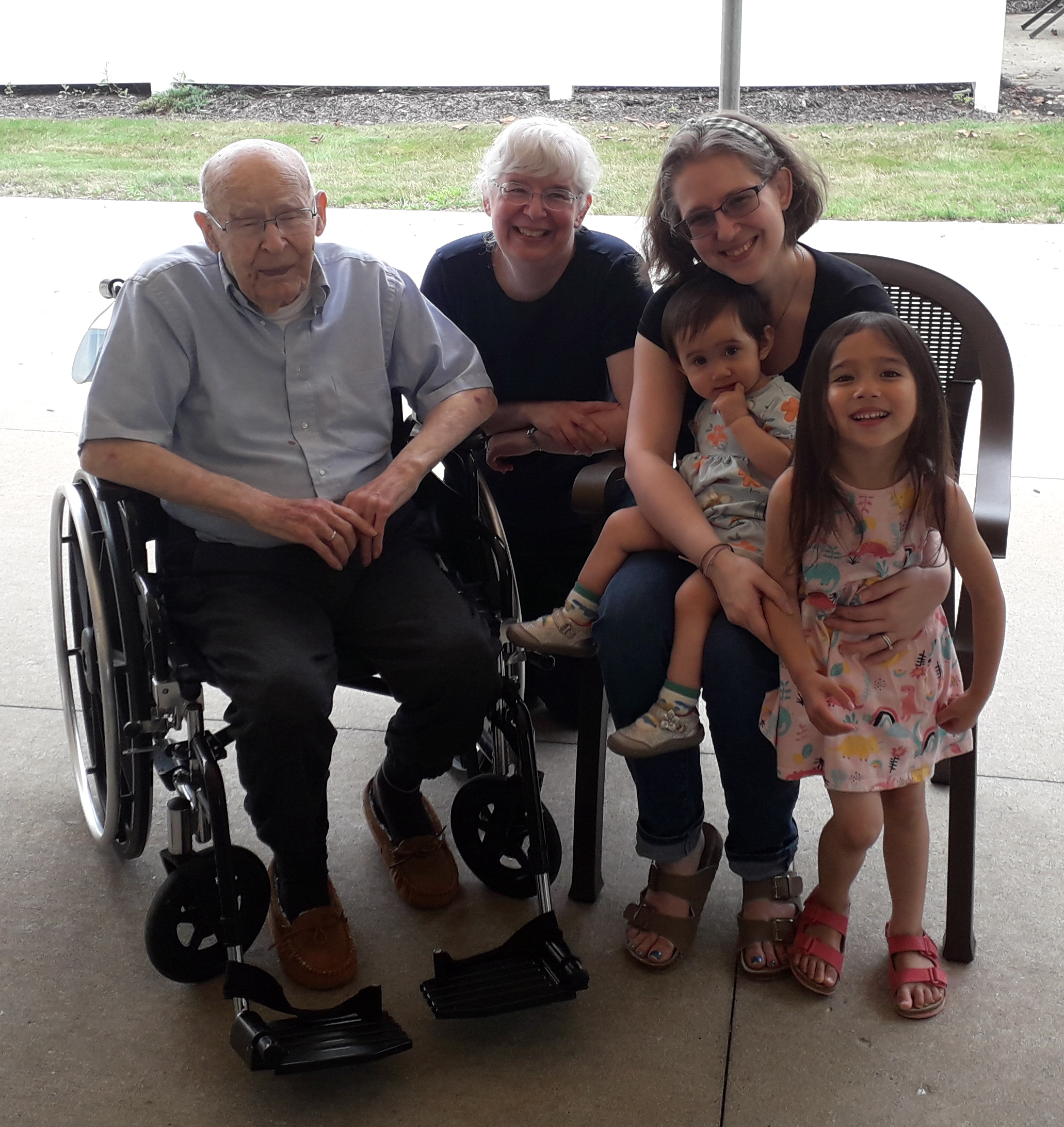
We were blest that all four of his grandchildren got to see Paco over the summer. We were especially grateful that granddaughter E with spouse L and great-granddaughters ABC and JG were able to visit from London UK. Because of the pandemic, we had not been able to see each other, but in August, just before the final and more precipitous portion of Paco’s decline, they were able to make the trip.
four generations with Paco, Joanne, granddaughter E, and great-grands JG and ABC
There were a few days during Paco’s last week where he was very agitated but we were fortunate to have some calmer moments. T was the only one of the grandchildren nearby enough for one final visit, which wound up being the day before he died. It was one of the most heartbreakingly tender encounters I have ever seen. T sang Irish songs to Paco and held his hands, which were still a bit restless from a medication side effect. She talked to him and I know that he could hear her because he was able to respond a bit. I admit that I couldn’t help but cry and that I am crying now as I try – and fail – to find the words to convey how special that last hour between them was.
It also happened that all three of Paco’s daughters got to spend time with him, both alone and in various pairings, on the day of his death. It was not clear that this would be his final day, so it was not that it had been planned, but I’m grateful that it turned out that way. I’m also grateful that in his last few days, I was finally able to sing to my father, something that my sisters had been doing but that I struggled to do. I sang both verses of “Over the River and through the Woods” to get to Paco’s favorite lines, “Hurrah for the fun! Is the pudding done? Hurrah for the pumpkin pie!” (Paco loved all kinds of pie.) I sang the Shaker hymn “Simple Gifts” because it is comforting to me and several beautiful Irish hymn tunes. Occasionally, I would get too choked up to continue singing but I usually managed to get through. On that last day, Paco could not respond but Hospice told us that the sense of hearing tends to remain and can even sharpen as the other senses are shutting down. My younger sister was alone with Paco when he died but I arrived soon after for my very last good-bye.
I have been so moved by the many people who have reached out to me during Paco’s decline and since his death. There have been so many kind words, both written and spoken – remembrances, prayers, thoughts, stories, expressions of gratitude for a long life well-lived. I was very touched when a friend that I made through Facebook but whom I have never met in person added my father to her Kaddish prayer on Yom Kippur. It has been the love I first learned from my parents but now experience through so many family and friends that has kept me going through all of this, even during the most difficult times. I thank all of you.
Last week, I went to the hair salon for a haircut with Diane, who has been my stylist since 1983. I told her about Paco’s death and she gave me a hug and told me that she had something to show me. It was her new puppy, who was sweetly asleep in his crate. She told me his name was Leo.
After having announced Paco’s death on One-Liner Wednesday this week, I had thought I wouldn’t post again until I had time and mental space to put together a proper tribute post or, perhaps, a post about last days and good-byes.
Then, the SoCS prompt arrived and it was puzzle and I knew I needed to post for it.
Until these last few months when he was too ill, Paco worked puzzles as part of the routine of his day. He still got the daily newspaper in print and did their wordsearch, which had the added twist that the remaining letters could be unscrambled to solve a question that was posted with the puzzle. Paco also had wordsearch books that he would work on. Wordsearches seemed like an unlikely type of puzzle for Paco to enjoy because he was dyslexic, something that he did not discover until his youngest granddaughter was diagnosed as a child with an inherited form of dyslexia. This led to a number of fundraisers organized by first Paco’s grandson and later his aforementioned granddaughter to raise money for Learning Ally, which helps people with visual impairment or print disabilities to access written language. These fundraisers came to be known as the Paco Project in his honor.
Another word puzzle that was part of Paco’s day was watching Wheel of Fortune in the evening. It came on right after the national news. My older sister would often call him at the time and they would watch part of the show together, even though they were hundreds of miles away from each other.
Paco’s other puzzle passion was jigsaws. When he was in his apartment in independent living, there was a card table in the corner of the living room with a puzzle on it for him, Nana, and visitors to work on whenever the mood struck them. For many years, he made 500 piece puzzles, with the occasional 750 piece thrown in. However, over his last couple of years as some dementia developed, he cut back to 300 piece puzzles. He worked on those until he fell in June and never recovered his ability to be up and about and clear enough mentally for puzzles.
At some point, after we get through this initial period of busy-ness with paperwork and bureaucracy following a death, we will find a home for the several shopping bags’ worth of Paco’s jigsaw puzzles that we brought home with us. I expect we will keep a few special ones as mementoes for ourselves and donate the rest for others, who we hope will enjoy them as much as he did.







 Joanne Corey