learning civics and history

Earlier this week, I was listening to a discussion around Richard Haass’ new book, The Bill of Obligations: The Ten Habits of Good Citizens.

The discussion centered around the dearth of knowledge among many in the United States on the basics of civics and history. The root of this lies seems to lie in our educational system.

Unlike most countries, the United States does not have a national educational system. Schools are controlled by local school boards with a greater or lesser role played by state education boards, depending on the state. This leads to a wide range of what students learn in school and the depth of that learning.

I went to public schools in western Massachusetts in the mid-1960s through the 1970s. Civics and history were an important part of our schooling. I remember in the later grades of grammar school reading the US Constitution and summaries of landmark Supreme Court cases. We were expected to apply what we had learned from history to current events, such as deciding for whom we would vote for president in a mock election. This being small-town New England, we would attend town meeting day with our families, showing democracy in action.

Having already learned the basics of US and world history in our younger years, in high school, our coursework was designed to delve more deeply into particular areas of social studies. One of the best courses I took was one on minorities in America. I learned about such important historical events as the Chinese Exclusion Act and the internment of Japanese-Americans during the Second World War. We studied the Black experience in the US, from enslavement and Jim Crow through the civil rights movement, which was, of course, ongoing. I learned for the first time about the discrimination that had affected my own Italian grandparents and Irish great-grandparents. By the time I turned 18 and could register to vote, I had a good understanding of the complexities of our past and of how to evaluate issues of the present and future.

My daughters went to school in New York, where the State Board of Regents is the main driver of curriculum. The Regents set the required courses and use statewide exams in high school to ensure that the students are fulfilling the goals of the curriculum. While the State is fond of survey courses, they do expect students to do much more than memorize historical facts. A major component of history exams is a document-based essay, where the student is given primary source material, such as political cartoons, government documents, and newspaper articles, and asked to use them to write an essay expressing support or opposition to a given proposition. It demonstrates the kind of decision-making that voters need to do to evaluate candidates or stances on current issues. High school students, usually in their final year, also take a semester course on participation in government, which is considered the capstone of their civics education. This New York State framework, which my daughters used in the 1990s-early 2000s, remains in place today.

Some other states and localities do a poor job of educating their students in history and civics. Some even boast about the limitations they place on what is taught in their schools. A current egregious example of this is the state of Florida, which passed a law last year severely limiting teaching about race and identity. This led Florida to reject a pilot of the new Advanced Placement African American Studies course because it includes materials about current topics such as intersectionality, the reparations movement, and Black feminist literary critique. They also objected to students reading works by such well-known Black scholars and writers as bell hooks, Angela Davis, and Kimberlé Crenshaw. Florida officials claimed the course was more indoctrination than education, failing to realize that one needs to learn deeply through the full spectrum of a field of study to be truly educated and able to make judgments. Perhaps, their own education was too limited for them to appreciate the complexities we all now face.

At this point, we have a lot of catching up to do, with adults needing more education in civics, as well as many younger students. Part of this effort must be to emphasize our responsibilities to each other as citizens, or, as Richard Haass calls them, our “obligations.” (I haven’t had the opportunity to read his book, which was just released this week, so the following thoughts are mine and not from his work.)

For example, the First Amendment states that the federal government cannot establish a religion or prevent anyone from practicing their religion. I have the right to practice a religion or not, as I choose. However, I have a responsibility to not impose my religious tenets on anyone else. The First Amendment also says that laws can’t be made to abridge freedom of speech, but I am responsible for what I say and should take care that it is truthful and appropriate.

There is some tendency in the US for people to be hyper-individualistic, crowing about their individual rights, viewpoints, possessions, etc. while ignoring that we all exist in community and relationships, with people who are similar to us and those who are different in some way. Part of the reason that education in civics is so important is to increase the realization that we are responsible to each other as members of the community and the nation.

We are responsible for finding out the facts on an issue, forming a reasoned opinion, and taking action. We need to be respectful of others and set a good example. We need to keep listening and keep learning, as new information and discoveries come to light every day.

We need to be civil.
*****
Join us for Linda’s Just Jot It January! Find out more here: https://lindaghill.com/2023/01/26/daily-prompt-jusjojan-the-26th-2023/

One-Liner Wednesday: learning

“It’s up to each individual to make learning fun.”
~~~Trenton Doyle Hancock

Join us for Linda’s One-Liner Wednesdays and/or Just Jot It January! Find out more here:  https://lindaghill.com/2023/01/25/one-liner-wednesday-jusjojan-the-25th-2023-how-i-know/

B

implicit bias

Yesterday, I reported for jury duty, although I wasn’t chosen to be a juror.

After some initial paperwork, all the prospective jurors watched two short videos. One was the basics of court cases, which had been digitized from an older film version, making the audio and visual quality mediocre at best. The other was a very good video about implicit bias.

Implicit bias is the phenomenon of having unconscious thoughts or feelings about something or someone. The video pointed out that most of what our brains do every day is unconscious, ingrained from prior experience. For example, we don’t have to consciously reason out that you pour coffee into a cup rather than a shoe. Our unconscious mind knows what we need to do in most of our daily activities and can handle millions of details while our conscious mind can only handle a few dozen. However, our unconscious mind may also be the home of stereotypes of people of a certain race, gender, religion, occupation, socioeconomic group, etc.

The video was a very helpful reminder that we do need to consciously consider the influence our unconscious mind has on our thoughts and decisions, especially when dealing with new people and situations. During a trial, there are bound to be many instances of potential implicit bias. Do you trust a witness of the same race as you more than one of another race? Do you believe or disbelieve every word from a police officer because of the way you unconsciously react to authority figures?

I thought that the video did a good job of pointing out that everyone has implicit biases because everyone has an unconscious mind that is making it possible to function. The thing that is needed, during a trial and in everyday life, is to bring your conscious mind to bear on a situation and to ask yourself if your initial reactions are influenced by unconscious bias. The hope is that the recognition will make your judgments and actions fairer.

While I’m not acting as a juror this week, I will try to be more conscious of my own implicit bias in my daily life.

It will always be a work-in-progress.
*****
Join us for Linda’s Just Jot It January! Find out more here: https://lindaghill.com/2023/01/24/daily-prompt-jusjojan-the-24th-2023/

Jury duty

Today, I did my civic duty and reported for jury duty at the county court.

I was there most of the day but was not seated on the jury.

I will post a bit more about the experience later in the week, being careful not to say anything about the case itself, as that would be wrong.
*****
Join us for Linda’s Just Jot It January! Find out more here: https://lindaghill.com/2023/01/23/daily-prompt-jusjojan-the-23rd-2023/

Monterey Park

I’m sad to say that I woke up this morning to news of another mass shooting, this time in Monterey Park, California, near Los Angeles. Ten people are dead with ten more wounded and hospitalized.

The shooting occurred at a ballroom dance club, after an evening Lunar New Year celebration. Monterey Park is a predominantly Chinese-American suburb which hosts one of the largest Lunar New Year celebrations in the area. Today’s activities have been cancelled in the wake of the shooting.

As I write this, there is no suspect in custody and no idea if this attack was motivated by racial hatred.

It certainly casts a sorrowful shadow over the start of the Year of the Rabbit. May the year bring healing to all who mourn.
*****
Join us for Linda’s Just Jot It January! Find out more here: https://lindaghill.com/2023/01/22/daily-prompt-jusjojan-the-22nd-2023/

SoCS: count on it

Linda posts the prompt for Stream of Consciousness Saturday on Friday so that people have a chance to mull the prompt before writing the post, which is stream of consciousness so no editing allowed.

Confession: Sometimes, I write the post on Friday and just schedule it to come out on Saturday.

Second Confession: Sometimes, I plan the post in my head more than I probably should to be true stream of consciousness.

I usually do, though, manage to have some thoughts about the prompt or I just don’t participate that week.

Because it’s Just Jot It January and because I already didn’t do Stream of Consciousness one week because I had a post of my own I wanted to get out, I really wanted to do SoCS this week.

The prompt is to use “count on it” in the post.

When I read it Friday morning, I thought that it would be pretty straightforward. Something would pop into my head as the focus for the post.

But that didn’t happen.

A lot of things that I can no longer count on came into my head, but it seemed too unsettling to write about that.

I think the combination of personal losses, the pandemic, the divisiveness of the United States, and the feeling that I’m always waiting for the next shoe to drop – and it does – have left me unsure that there is anything I can count on.

It’s probably more feeling than fact.

It’s cold and grey today.

The sun will rise tomorrow.

I can count on it.

Yes, let’s go with that.
*****
Join us for Linda’s Stream of Consciousness Saturday and/or Just Jot It January! Find out more here: https://lindaghill.com/2023/01/20/the-friday-reminder-for-socs-jusjojan-2023-daily-prompt-jan-21st/

One-Liner Wednesday: MLK quote

“The ultimate measure of a man is not where he stands in moments of comfort and convenience, but where he stands at times of challenge and controversy.”
~~~Martin Luther King, Jr., who might have turned 94 this year if he hadn’t been assassinated at the age of 39

Join us for Linda’s One-Liner Wednesday and/or Just Jot It January! Find out more here:  https://lindaghill.com/2023/01/18/one-liner-wednesday-jusjojan-the-18th-2023-stained-by-the-sun/

Hyphens

Today has gotten away from me, so I’ve decided to use the prompt from Linda’s Just Jot It January for a quick post.Today’s prompt from Sally is “hyphenated.”

I love to use hyphenated words. I find hyphens useful in visually clarifying words, which, no doubt, means that I overuse them.

For example, I’m inclined to write non-fiction rather than nonfiction. Somehow, including the hyphen makes it easier for my brain to process the word.

Does anyone else share this quirk?

taking down the tree

Yesterday, we took down our Christmas tree.

It’s a necessary task, but always a bit sad.

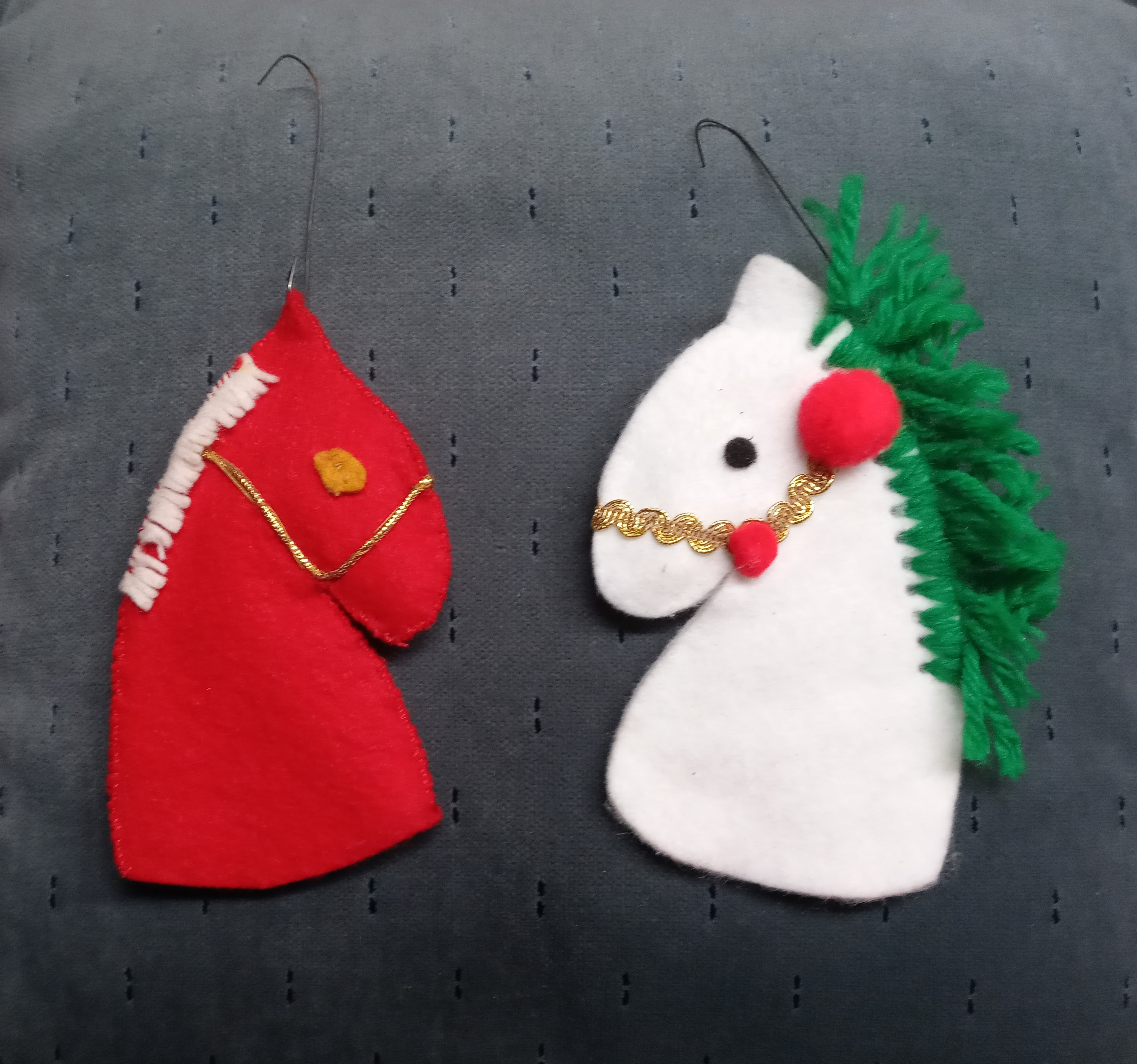
It’s also very nostalgic. This time, I was struck by these ornaments in particular.

These ornaments double as candy cane holders, so that they look like hobby horses when they hang on the tree. The red one was made over fifty years ago by my spouse B when he was in elementary school. The white one was made about thirty years ago by B’s mom, when she was teaching in elementary school and would lead her students in creating a holiday gift for their parents. She would always make extras to give to family members. I’m sure hers were prettier than her students, although all are equally treasured.

These and all the other ornaments are safely stowed now, waiting for next Christmas – or maybe the one after that, if we decide to spend the holidays in London this year.

Fortunately, the memories are easily accessible at any time.
*****
Join us for Linda’s Just Jot It January! Find out more here: https://lindaghill.com/2023/01/16/daily-prompt-jusjojan-the-16th-2023/

remembering Paul

Yesterday, for the second time in a week, I attended a memorial service. My spouse B and I attended services for Paul Everett. Paul and B had been co-workers at IBM for many years before Paul had to leave work for health reasons.

While Anita’s had been a Catholic funeral, Paul’s service was in the Reformed Protestant tradition. Because it was in non-liturgical form, the service was more easily molded to reflect Paul’s life and gifts, which, if you read the obituary linked above, you will realize were many and varied.

For example, all the music in the service was arranged by Paul for folk instruments. Paul had hosted a weekly folk session for many years and compiled his beginner-friendly arrangements in the Wednesday Night Jam Canonical Tune Book. B and I had chosen seats near the ensemble, which included guitars, piano, accordion, tin whistle, fiddle, and hammered dulcimer, an instrument that Paul had both constructed and played. The gathering music took place at the beginning of the service rather than before it so that we could listen and reflect instead of being distracted by conversation.

The homily was given by Paul’s son Isaac, who inherited his father’s love of music and theology, studied them, and became both a professional musician and an ordained minister. Isaac used his father’s love for the Book of Jonah as a lens to relate who his father was. It was moving and heart-felt and beautifully crafted. I’m sure Paul, who had served as a deacon and lay preacher himself, would have been proud. Isaac also played guitar and piano during the service.

During fellowship time after the service, B was able to connect with some retired IBMers who were in attendance and reminisce about Paul, including his adventures and misadventures building boats and taking them out on the waters. Fortunately, Paul’s nautical journeys went better than Jonah’s!

Later in the afternoon, I went to vigil mass at my home parish. The opening hymn was “Here I Am, Lord” which was the gathering song for Anita’s funeral. At communion, we sang “Precious Lord, Take My Hand” which we had sung at Paul’s memorial service. The echo of these songs calls me to reflect on what my call is at this time of my life, increasingly cognizant that I am much closer to the end of my life than the beginning.

Rest in peace, Anita. Rest in peace, Paul. Thank you for your example of how to live fully until the end.
*****
Join us for Linda’s Just Jot It January! Find out more here: https://lindaghill.com/2023/01/15/daily-prompt-jusjojan-the-15th-2023/