Forsaken of Man

Yesterday, for the first time since the Smith College Alumnae Chorus concerts in Slovenia in July 2019, I sang in a choral concert. This ends the longest drought in choral performances since I was a teenager. While the pandemic was a major factor in this break, the other complication was that the Binghamton University Chorus, which I joined in fall of 1982 after moving to the area, may have been permanently disbanded, something that I suspected at our last concert in May, 2019.

Last fall, I attended the first in-person concert since the onset of the pandemic by The Madrigal Choir of Binghamton. I have long had friends who sang with Madrigal Choir, but always assumed that I would not be the most qualified person they could find to fill a rare opening in the soprano section. At the concert, they announced, though, that they were looking for new members in all voice parts. Bolstered by the fact that Bruce Borton, professor emeritus from Binghamton University under whose direction I sang with University Chorus throughout his tenure, is now the director of Madrigal Choir, I inquired about joining and was accepted. Due to our family trip to London for the holidays and the omicron spike, the concert yesterday was my first opportunity to perform as a member of Madrigal Choir.

We joined with the choir of Trinity Memorial Episcopal Church to present Leo Sowerby’s Lenten cantata, Forsaken of Man, under the direction of Trinity’s music director Timothy Smith. While I had been familiar with some of Sowerby’s work, I had not previously heard this powerful and dramatic piece. With passages from the gospels, including some of Jesus’s hopeful teachings, and additional text by Edward Borgers, Forsaken of Man concentrates on the betrayal and abandonment of Jesus in his final days.

As often happens in Passion settings, the story is proclaimed by The Evangelist, for us tenor Kevin Bryant. Brian Mummert portrayed Jesus and bass John Shelhart chillingly sang the roles of Caiaphas, Judas, and Peter. They were all magnificent as were the other soloists with smaller parts, including Dr. Borton as Pilate.

What I appreciate as a member of the chorus is the role that Sowerby chose for us. Sometimes, we were participants in the narrative, becoming the disciples, or the crowd calling for crucifixion, or the soldiers mocking Jesus. At other times, we set the scene or offer commentary, as in the choral prologue and epilogue.

Unlike many Passion settings, the soloists and chorus unfold the story in a series of four parts, rather than a succession of short solo arias and choral movements. This is part of the drama of the piece, as there are many sudden shifts in mood, voicing, and tempo.

Another major driver of the dramatic expression of the story is the incredibly demanding organ part, played masterfully by the William K. Trafka on Trinity’s Casavant organ, which was expanded in 2018. Sowerby was himself an organist, as is evident from the complexity and expressive nuance of the score. It was a thrill for me to be singing in the chancel at Trinity. I had served there as an assistant back in the mid-’80s and this concert brought back many memories of that time, including some choir members who are still serving.

The sad news is that this is the last public performance of the season for the Madrigal Choir but I am looking forward to the announcement of the next season. I’m grateful to have a new choral home! Stay tuned for more about Madrigal Choir in the fall when we resume – or perhaps before…

Review: Encanto

When we went to the UK to visit our family for the holidays, four-year-old granddaughter ABC watched the Disney film Encanto frequently. I was impressed with it but hadn’t realized how popular it had become until after we returned to the US and it seems that I run into commentary on it several times a week, including news that the soundtrack and individual songs from Encanto have been appearing in high positions in the Billboard charts.

For the few of you who may not know, Encanto tells the story of the Madrigal family from Columbia who use their magical gifts to help their community. Granddaughter Mirabel appears not to have been given a magical gift but her strong love for her family and their home powers the story.

Much of the commentary that I’ve seen concentrates on how important it is to have this portrayal of a Latinx family and story, along with inclusion of Spanish in the dialogue and songs. I agree with this point but want to note some other ways that this film feels inclusive to me. As someone whose family is racially diverse, I appreciate that the Madrigals have Indigenous and Black roots, as well as (presumably) European. As someone who wore glasses from a young age, I love that Mirabel wears glasses. I could get all metaphorical about clarity of vision, but I won’t. It’s just nice to see a positive portrayal of a girl who wears glasses in an animated movie.

The biggest point of inclusivity for me is the complexities of the family relationship. The most popular song in the soundtrack, the ensemble piece “We Don’t Talk about Bruno”, reminds me that my own family had an uncle that was seldom mentioned for mysterious reasons. We see Mirabel and her non-magical father struggle with finding their place within the family, which is a familiar issue in many families, for example, when a very sports-oriented family has a member who would rather be singing in the chorus than out on the field with a ball.

We also see the double-edged sword of trying to live up to family expectations. While it’s admirable that members of the family want to use their gifts to serve the family and the community, it’s all too easy to see each only for that one gift and not for the complex being that they are. This leads to feeling that it is only that gift that makes you valuable or loved. The clearest expression of this is “Surface Pressure”, the song that Mirabel’s sister Luisa sings. Luisa’s gift is that she is very strong, so she is much in demand at home and in the village. The song shows how difficult it is to deal with the pressure of those demands and her own worries and insecurities. She sings, “Under the surface/I’m pretty sure I’m worthless if I can’t be of service.” Ouch. How often in our families do we pigeonhole someone in a specific role, overlooking other attributes and gifts they bring? How often do we take for granted the work that someone does or make it seem that they are only valuable in what they can do, not in who they are as a person?

To me, among Mirabel’s gifts are love, thoughtfulness, insight, curiosity, caring, and truthfulness. None of them are “magical” but the results of them can be miraculous.

They can be for our own families and communities, too, if we honor those gifts and each other as Mirabel does.
*****
Join us for Linda’s Just Jot It January! Find out more here: https://lindaghill.com/2022/01/21/daily-prompt-jusjojan-the-21st-2022/

making up for lost time

As I wrote about here, we are visiting the London branch of our family for the holidays.

The last time we were here was a bit over two years ago, shortly after E’s spousal visa came through and she and then-two-year-old ABC were able to locate from our home in the US to rejoin spouse L in London. During that visit, we were happy to learn that E was newly pregnant and started planning for spring and summer visits.

Then, the pandemic arrived.

We couldn’t travel to the UK for spring birthdays or the arrival of granddaughter JG in August. Our plan to come for the month of November 2020 was cancelled at the last minute when the UK went into full lockdown. Quarantine and travel restrictions made it impossible for us to go to the UK, but E, L, ABC, and JG were able to visit us in the US in August. We were all thrilled to meet JG in person and blessed that they were able to visit Paco just before the last, steep period of illness before his death.

I titled this post “making up for lost time” which is an impossibility, but I do feel as though a few things that I had missed with our granddaughters are being re-captured. JG was an early walker, so I hadn’t really had babe-in-arms cuddle time with her. When they visited us in the States, she was too much on the move and too unsettled by the new surroundings to want to cuddle with the grandparents she had just met. Here, in her familiar home, she has become comfortable enough to sleep nestled in my arms – at least when her mother is unavailable.

We’ve played games with ABC. It’s been endearing watching her play hide-and-seek with Auntie T with requisite giggling and improvised singing, a skill that both ABC and T share. We’ve also been able to read to ABC with the added pleasure of having her read to us. She is learning a lot of phonics in Reception this year (for US folks, think the UK equivalent of kindergarten but with predominantly four- instead of five-year-olds) and is already able to read primer books.

Last night, ABC slept over at our Airbnb. This morning, B made us all pancakes, one of ABC’s favorite foods. She also helped her grandpa bake some gingerbread cookies.

2021 has certainly been a challenging year, but I’m grateful that it is ending on a high note.

40+ years of “A Christmas Carol”

On Sunday, T and I went to see a production of A Christmas Carol at Cider Mill Stage. This particular staging of the Charles Dickens classic was first conceived and produced in 1979 by Binghamton University professor John Bielenberg and the original cast as a play within a play, with the actors performing the story in the bedroom of a child who is recovering from an illness and must avoid crowds, something that seems even more ominous in our current pandemic days. Fortunately for the actors, there is an adjacent (and oddly well-stocked) attic that affords costumes and props for the impromptu performance, although one of the charms of the show has always been seeing a few caps and scarves and capes re-purposed to accommodate a range of characters and uses. A scarf is not just a piece of clothing but can also be a leash for a dog or the reins for a shaggy pony.

When T and I arrived, we were surprised and pleased to find a poster listing all the known cast and crew members of A Christmas Carol over the decades. This included T and her sister E who played the sick child, which also involves portraying Tiny Tim, for nineteen performances each in the late 1990s-early 2000s. E was in the cast the last year that John Bielenberg played Scrooge before his retirement. T’s Scrooge was Bill Gorman, who was also a member of the original 1979 cast. Their productions were directed by Tom Kremer and Carol Hanscom, also original cast members.

Because of our familiarity and past experience, the Cider Mill production of A Christmas Carol has continued to be close to our hearts but the performance Sunday was even more emotional. Tom Kremer, who is now portraying Scrooge, came out before the play began to dedicate the performance to Claus Evans, original and long-time cast member who had recently passed away. Claus had played the Ghost of Christmas Present, Mr. Fezziwig, and other ensemble characters for most of the first forty years. He had a commanding stage presence and a powerful voice, especially when singing. This version of A Christmas Carol, while not a musical in the traditional sense, does involve a fair amount of incidental music, both traditional pieces and new music composed by original cast member Susan J. Peters and current cast member Ken Martinak. I admit that I teared up during the Fezziwig party scene, remembering the brio with which Claus sang “Wassail! Wassail! All Over the Town”.

While not able to match Claus’s singing prowess, Brad Morgan did a fine job with Fezziwig and Ghost of Christmas Present. His first year in the cast was the year that E was in the production when he was quite a young man. I remember him struggling in rehearsal to accurately deliver the Dickensian language of the ghost of Jacob Marley. I was particularly impressed with his portrayal now, which has a chilling depth and pathos. Brad also deserves a lot of credit for keeping the production alive during some years of upheaval at the Cider Mill after the original Cider Mill Playhouse closed. Thankfully, the play is now back in the space for which it was designed under the name Cider Mill Stage. And yes, there is a cider mill in the front of the building, active in the late summer through early fall. The theater area was originally a storage space for apples.

I hope that A Christmas Carol will continue to grace the Cider Mill and the Binghamton area for decades to come, spreading its message of the importance for caring for one another, regardless of the season of the year.

“And, as Tiny Tim observed, ‘God bless us, every one!'”

Sondheim

Because of the recent death of Stephen Sondheim, we have been graced with a lot of his music, lyrics, and interviews, which have been poignant, searing, and heart-breaking, in turns. He was instrumental in opening the possibilities into what musicals could be. For example, Lin-Manuel Miranda has acknowledged that there would not have been Hamilton had it not been for Sondheim paving the way.

I remember singing a choral medley from Sondheim’s Company when I was in high school and seeing a community theater production of it, which was pretty amazing for a small-town girl. Even then, I could appreciate his incredible way of melding lyrics, melody, and story.

Most of my Sondheim memories, though, are in relation to my daughters E and T.

E’s favorite Sondheim musical as a child was Into the Woods. She especially enjoyed singing Little Red’s songs. When T, who is four years younger, got to be old enough to watch, we initially only let her watch the first act, which follows the fairy tales up to the “happily ever after” bit. We thought that the second act, which gets pretty grim, would be too much for her, but E, ever the big sister, told her what happened, so, soon, she too was watching the whole play. E and T later got to see a revival of Into the Woods on Broadway, courtesy of their NYC aunt.

T’s favorite Sondheim musical was Sunday in the Park with George. She used to sing along – and then sing parts of the score a cappella around the house. If you know the work at all, you know that it is incredibly difficult to sing, but no one told T that, so she just went along and did it.

My most poignant personal memory of a Sondheim song, though, involves a musical which is too disturbing for me to cope with, Sweeney Todd. In the summer of 2001, then teenaged daughter E sang “Not While I’m Around” during a summer theater workshop performance. A few weeks later, after the 9/11 attacks, I found it strangely comforting to remember her singing,

No one’s gonna hurt you
No one’s gonna dare
Others can desert you
Not to worry, whistle I’ll be there
Demons’ll charm you with a smile
For a while
But in time
Nothing’s gonna harm you
Not while I’m around

It wasn’t that I felt personally under threat from terrorists, but, somehow, a young voice singing protection from evil was comforting and hopeful in a way that rational thought was not.

It’s part of the power of music.

Thank you, Stephen Sondheim, for all the music and story and power and pathos and humanity you gave us over the decades. We will continue learning from you for many years to come.

SoCS: camaraderie

One thing I could use more of in my life is camaraderie.

At first, I was thinking that it was another victim of the pandemic, making it difficult for people to gather safely, but, in truth, the trends started earlier than that.

Personally, one of the losses of camaraderie for me was losing my long-time regular choral gig. For decades, University Chorus met every semester, but, when our long-time director retired, the group became an auxiliary group which only met in semesters where the student groups needed additional singers to perform with an orchestra. Even though choral groups at the University are back performing in person again, we have heard nothing about the continued existence of University Chorus in any form, so I think we are probably permanently disbanded at this point. I miss the camaraderie of being with my fellow members, some of whom I have sung with for decades. I am taking steps to heal this gap a bit with a plan to join a community choral group in the spring that will have some familiar faces from University Chorus days.

In a larger context, it seems that our sense of camaraderie is diminished lately in the US. Some people have chosen to be less neighborly unless you happen to agree with them politically. It really puts a chill on camaraderie when a neighbor flies a flag with an assault weapon on it and another cursing at our current president.

The pandemic did, though, make a sense of camaraderie more difficult to maintain. While I am grateful that video conferencing made some poetry workshopping and readings possible, it’s difficult to feel as supported over video as it is in person. Perhaps that is because I am not a digital native and the technology can be frustrating for me to work with.

As a few more things are possible to be done in person, I’m hoping to re-establish more of a sense of camaraderie in my life. I have extra appreciation on those occasions when I do get to see people in person and am trying to schedule more of those occasions.

How about you? Do you feel you have enough camaraderie in your life?

*****
Linda’s prompt for Stream of Consciousness Saturday this week is to use “cam” in some form. Join us! Find out more here: https://lindaghill.com/2021/11/12/the-friday-reminder-and-prompt-for-socs-nov-13-2021/

SoCS: fingers

When I read Linda’s prompt yesterday, the first thing I thought about was fingers. And poetry, which is probably a good sign as I am trying mightily to get back to thinking more about poetry.

I am working on editing a poem in which fingers play a prominent role.

I have an older (unpublished) poem about how I still have a pianist’s mentality about my hands, even though I can no longer play.

And, of course, I am using my fingers now to write this. I know that there are lots of tools now that are talk to text, but I feel very oddly about talking to machines. Perhaps I will get over that one day, but, for now, I’ll let my fingers do the talking.
*****
Linda’s prompt for Stream of Consciousness Saturday this week was to write about a body part. Join us! Find out more here: https://lindaghill.com/2021/10/22/the-friday-reminder-and-prompt-for-socs-october-23-2021/

a momentous visit

While my blogging has been haphazard for months due to my father’s declining health, I wanted to share a post about the recent visit of our daughter E, her spouse L, and their daughters, four-year-old ABC and one-year-old JG. As people who check in here at TJCM periodically may recall, they live in London UK and the pandemic left us unable to visit each other. This meant that when they arrived in the US, it was our first chance to meet JG in person.

All the adults are fully vaccinated, but the children are too young to qualify. While our area of upstate New York is not a COVID hot zone, the transmission rate is still high enough due to the delta variant that we were very cautious about taking the girls to indoor public spaces. While I had scaled back my expectations for the visit a lot, I hadn’t scaled them back quite as much as I should have. For example, I had hoped to see a few more friends than we were able to. Unfortunately, Paco, my 96-year-old father, had more health challenges appear and his unit at the nursing home had to go into lockdown due to a couple of COVID cases among vaccinated staff.

In a way, though, it was nice to have them in our home, doing normal, everyday things like we had when E and ABC lived with us for over two years while waiting for E’s spousal visa to be accomplished.

B, with an assist from ABC, got to bake yummy treats for breakfast.

Everyone enjoyed watching the birds at the birdfeeders. ABC especially liked the tufted titmouse and goldfinches, while others were partial to the cardinals.

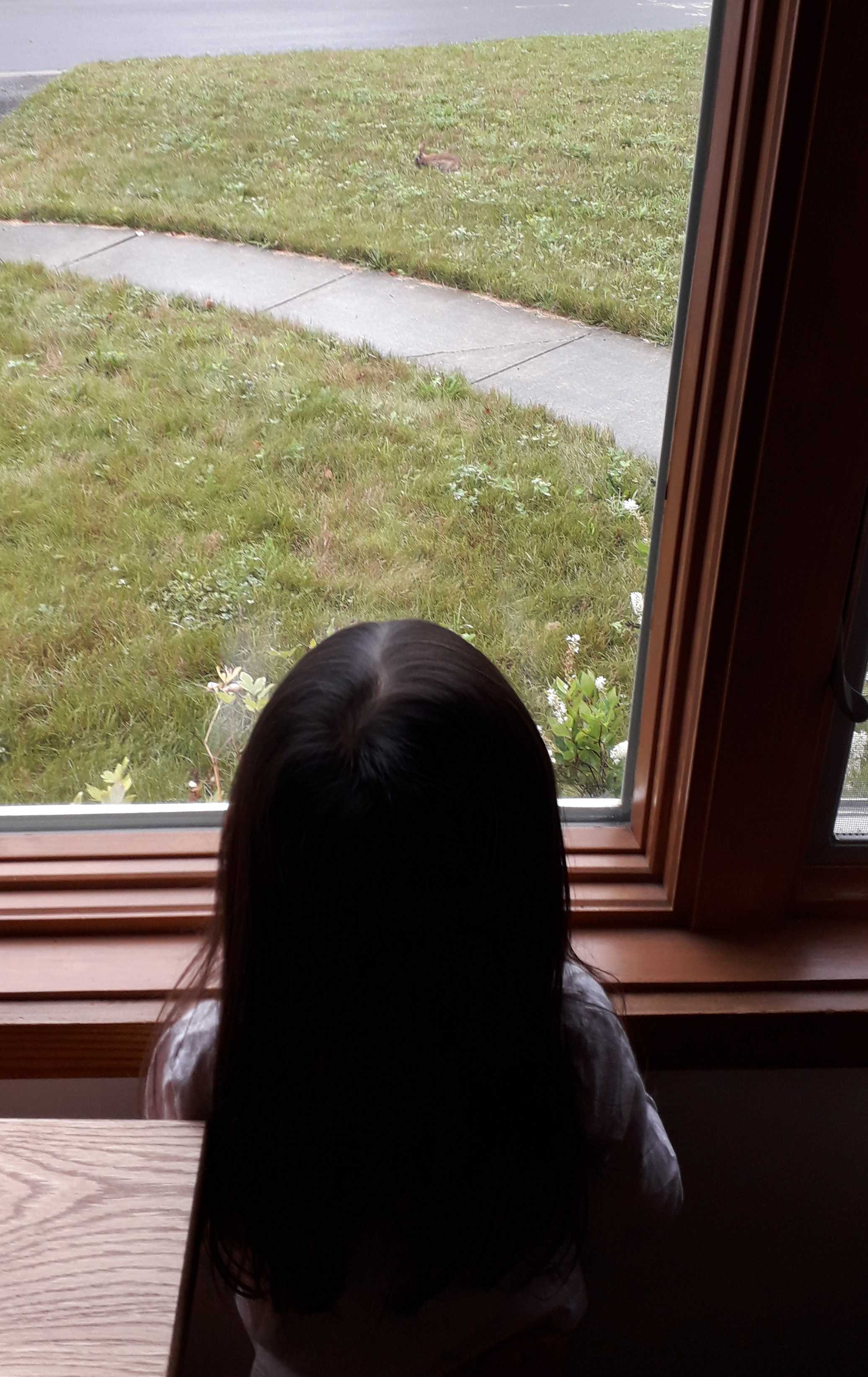
We enjoyed watching other wildlife, too. ABC even spotted some deer near the back fence. We also spent a lot of time watching the bunnies eating various leaves and flowers in the lawn.

You probably can’t see the bunny, but – trust me – it’s there.

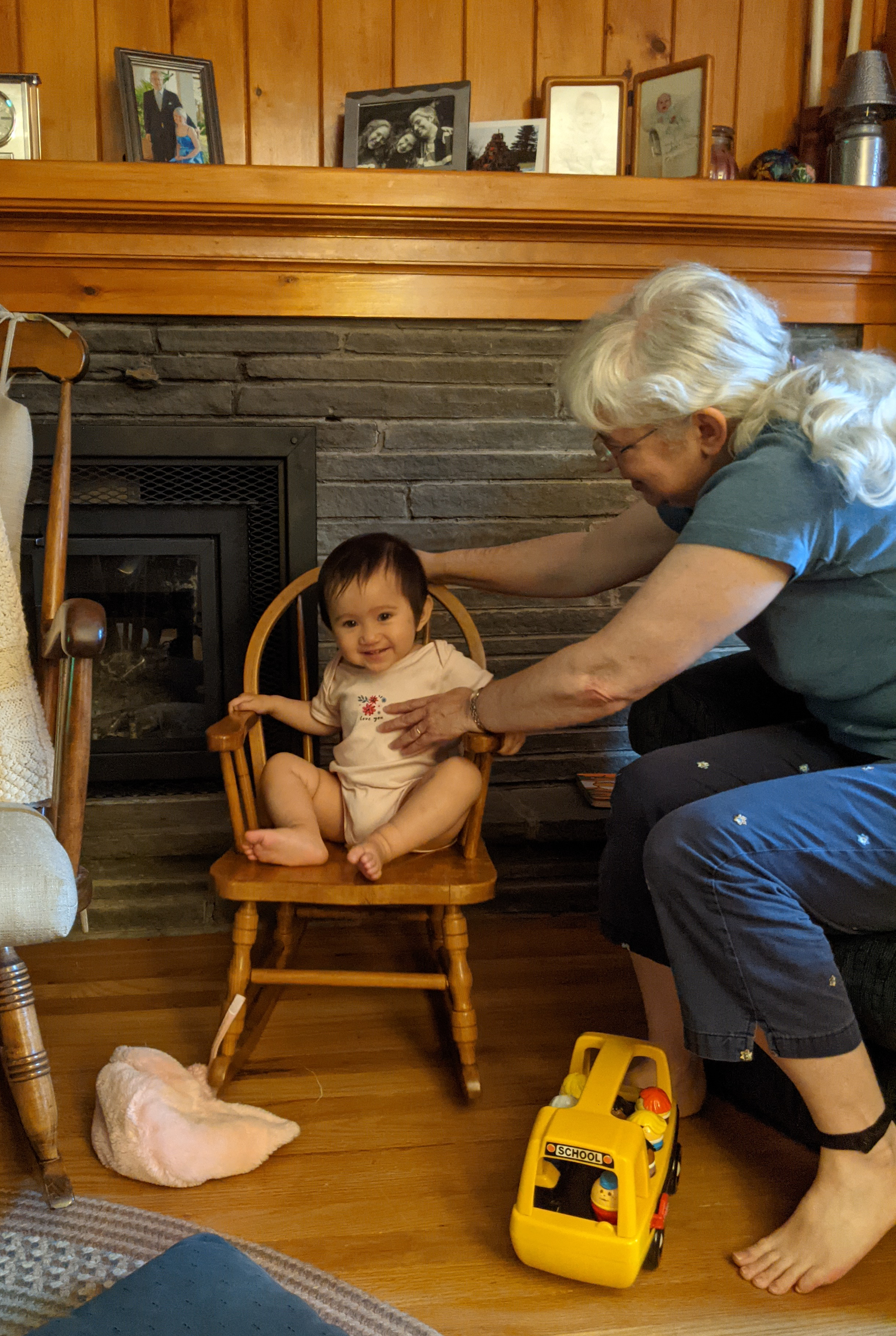
One thing that they don’t have at home in London is rocking chairs. JG especially loved the one that was her size!

JG was an early walker so we missed her being a babe-in-arms, but Auntie T did get a taste of what that phase was like when JG got so tired she actually fell asleep in her arms.

L took the girls on walks. Here is ABC at the 1 mile – or is it 1 smile? – mark on the Rail Trail. Our area, like many others in the US, has re-purposed places where there used to be railroad tracks into recreational trails.

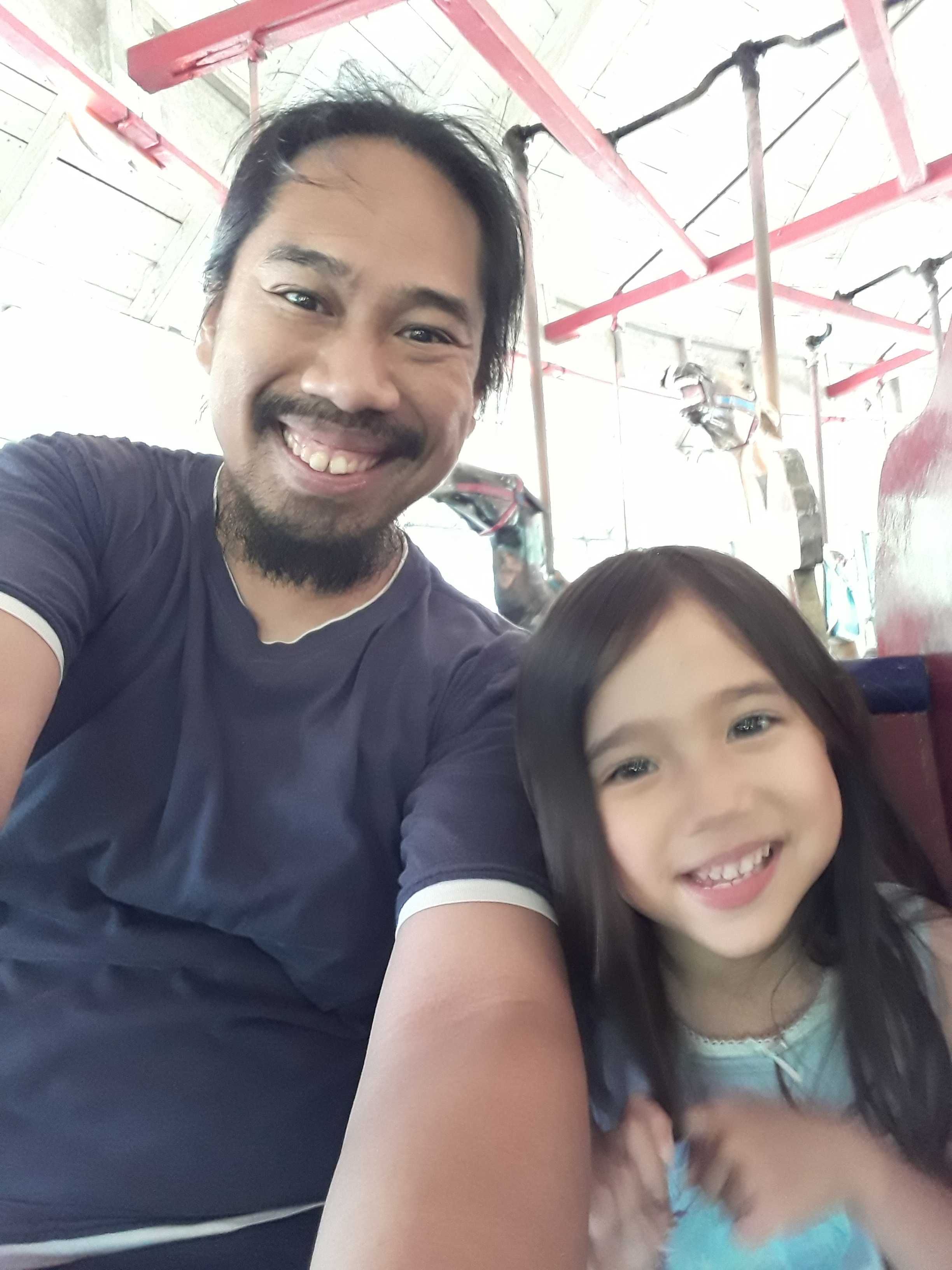
We also got to visit the parks and carousels. Broome County has six vintage carousels and it was very nostalgic to revisit them with ABC and introduce them to JG. ABC made friends everywhere she went.

L and ABC enjoyed rides in the carousel chariot
JG loves being on the swings!
JG also enjoys being on the move!

We got to enjoy a lot of playtime with the girls. ABC, at four, has a great imagination and enjoys making elaborate scenarios. She is also quite operatic! Besides singing songs that she knows, often from Frozen I and II, she likes to make up songs while she is playing. With both her parents being accomplished singers and instrumentalists, she appears to come by music naturally. She is learning to play the piano, so we got to experience her lessons with her daddy.

ABC is also a beginning reader, so sometimes she would read to us and other times we would read to her. It was an honor to be chosen as the final bedtime story reader. Of course, she also requested a bedtime song before going to sleep.

The most important event of the trip, though, was the one visit we were able to make with Paco in the outdoor courtyard of the nursing home. ABC was being her charming self, singing and dancing and clapping for Paco.

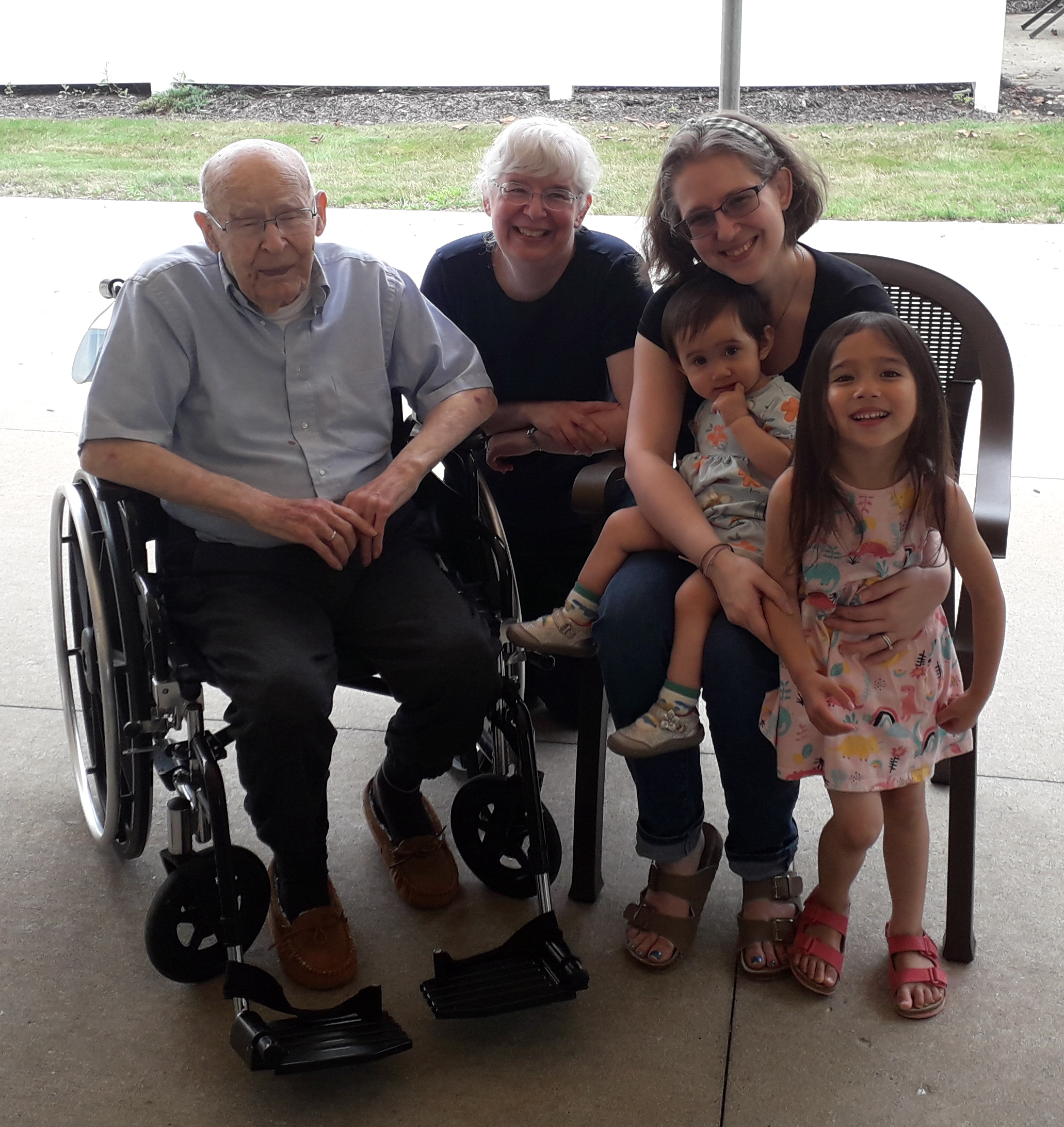
The most precious photo is this one of the four generations.

Paco’s health has declined so much in the weeks since we had this visit that he has now been admitted to hospice care. I will be forever grateful that Paco had the opportunity to meet his second great-granddaughter who won’t remember that day and to see his first granddaughter E and first great-granddaughter ABC who certainly will.

Triduum

This year, for the first time in a while, I actually made it to all three main liturgies of the Triduum, which, in Catholic parlance, is Holy Thursday, Good Friday, and Holy Saturday.

Back in the days when I served on liturgy committee and I and my daughters served in music ministry, I would be at all the Holy Week liturgies plus the children’s liturgy on Easter morning, but, after my long-time parish disintegrated in 2005, I couldn’t bring myself to attend all the services. The situation got even more complicated when my elder care responsibilities grew.

Then came 2020 and the pandemic and no one could attend services in person for Holy Week.

I didn’t attend mass in person for over a year. I wrote here about my first time back a dew weeks ago. I noted in that post that I wouldn’t try to attend every week yet due to space constraints at church. I was able to get a reservation to attend Easter Vigil on Saturday evening and decided to attend on Holy Thursday evening and Good Friday afternoon because the church made those open without reservations, although we did have to sign in and leave contact information in case a COVID case was verified and they needed to do tracing. We also had temperature checks and single-use programs so there were no hymnals or prayer books that subsequent worshippers would be touching.

Holy Thursday had long been my favorite liturgy of the year. Its focus is the Eucharist, as it commemorates the Last Supper. In an ordinary year, there would be significant involvement from the laity. The priest would wash the feet of twelve parish members and another group of people, often a family, would dress the altar. There would be a large choir to lead the congregation in sung prayer. Because of the pandemic, everything had to be pared down. Footwashing was eliminated globally to reduce risk. There were two lay lectors, appropriately distanced from the clergy in the sanctuary, but they were both men, so there were no women’s voices in any of the spoken prayers, which added to the sense of distance for me.

The music was beautiful, though. The music director put together an octet from the music ministry, which included some married couples so that the spacing would work as they could stand right next to each other instead of having to be feet apart. With masks, spacing, and good choral microphones, they were able to lead the sung prayer very meaningfully.

Because so much of the Holy Thursday liturgy revolves around a meal, there are many references to food. Because we are living in a time of increased hunger in the United States, these passages were particularly meaningful to me this year. For example, the gathering song was “Table of Plenty” by Dan Schutte, which contains the lyrics, “O come and eat without money; come to drink without price.” and “My bread will ever sustain you through days of sorrow and woe.” Those familiar lines resonated differently knowing that many people do not have enough to eat.

The service on Good Friday afternoon is, by its nature, quite stark. It’s the one day of the church year when there is no mass with Eucharist. Instead, there is a liturgy of the word, veneration of the cross, and distribution of communion with previously consecrated hosts. Without having the liturgy of the Eucharist, the emphasis shifts to the liturgy of the word, which includes reading the passion narrative from the gospel of John.

Paradoxically, Good Friday felt less stark to me than the Lenten and Holy Thursday masses I attended. I think this was due, at least in part, to the fact that there were more lay voices and, in particular, women’s voices included. The first reading, the suffering servant passage from Isaiah, was proclaimed as a choral reading, alternating between a woman lector and the music ministers. The gospel is presented with different people reading narration, the voice of Christ, and the voice of others in dialogue, with the congregation participating as the crowd. Even though we are assigned to proclaim a lot of challenging verses – we have to say, “Crucify him!” multiple times – it is good to feel that we have a part in telling the story.

Another element of the liturgy of the word that gets more emphasis on Good Friday is the intercessions that follow the homily. They were chanted by two cantors, a woman and a man, who alternated between them, with a sung response from the congregation and a prayer by the priest after each. This year, there was an added petition specifically for the pandemic, which was both moving and sobering to hear.

The veneration of the cross was much simpler than in usual years. It’s been the custom for each person to come forward in procession to kiss the cross but that isn’t possible under pandemic protocol. Instead, the assembly knelt and venerated the cross from our places in the pews. In truth, I preferred this to the processing and kissing because it felt more solemn.

For the Easter Vigil on Saturday night, we begin in a mostly darkened church. The time is set to be after sundown so it will be dark so that the first part of the mass, the service of light, begins in darkness. Usually, a new fire is lit and blessed outside the church, the new Paschal candle is blessed and embedded with incense, then lit and carried through the church in procession with music and sung responses, as each person holds a candle which is lit and passed to the next until the church is filled with candlelight for the singing of the the Exsultet (Easter Proclamation).

However, this was rather drastically abbreviated this year. We heard the blessing of the fire and the Paschal candle was brought into the church but the congregation had no candles of their own and most of the lights remained off in the body of the church. The Exsultet was chanted by a cantor whom I have had the privilege to hear sing for many years; it was very moving and brought back memories of hearing the priest chant this prayer when I was the teenage organist in my childhood church.

The liturgy of the word that follows the service of light begins with three readings from the Hebrew Scriptures, each followed by a psalm and prayer. Unfortunately, the lights in the body of the church were still off, which made it a bit difficult for the assembly to sing the psalm responses which were printed in our programs. I happened to know the pieces fairly well so I could sing, but I could tell that some others were not familiar enough with them to join in. Admittedly, it was dramatic to have the lights turned on as we were singing the Gloria, but I missed the growing candlelight followed by the lights being turned on as we extinguished our candles and began the liturgy of the word.

I admit that I struggled with the homily. While it was meant to be a unifying message, the way it was conveyed reminded me too much of how many instances of division there are within our society and the church. It saddened me.

The Easter Vigil is traditionally the time when new adult members enter the church, so there are often baptisms, professions of faith, confirmations, and first Eucharists included. This year, though, there was just one candidate for confirmation, most likely because the pandemic prevented the usual series of liturgies and classes for new members that take place in the months leading up to Easter.

The liturgy of the Eucharist unfolded in almost normal fashion. I was again very appreciative of my organist-friend and the octet she had assembled. The mass that we sang is one that I know well and that we had used often. In my mind, I was adding in the sound of the handbell accompaniment and larger choir that we used on festive occasions like Easter. I wonder when or even if such large and close gatherings will again be possible.

Perhaps I should say that the liturgy of the Eucharist proceeded in pandemic-normal. There is no sharing of a sign of peace, although people do wave or nod to others across the empty pews between occupied-but-spaced ones. We also do the formal dismissal before communion is distributed, so that people receive the host and then exit, all while keeping their distance.

I was just re-reading this post to edit and I’m sure, if you have made it this far, that you realize I’m a bit of a Catholic liturgy wonk. I want to convey my wishes for Easter blessings to those celebrating and my universal wishes for peace, love, respect, and care to all.

Choirs in the time of COVID

I often participate in Linda Hill‘s Stream of Consciousness Saturdays. Her last prompt was “song.” The instruction was to “find a picture–the closest one to you. Your prompt is the title and/or the lyrics of the first song that comes to mind when you look at the picture.”

I couldn’t manage to follow the instruction – my brain doesn’t work that way – but thoughts about song have been flooding my consciousness for the last couple of days.

I can’t remember the first song I sang, but singing has been an important part of my life, especially choral singing. Decades of it. Most of it has been associated with schools or church. It has been my privilege to sing some of the great choral works of Western music. I love singing Bach; my background as an organist probably influences that. My favorite large work to sing is Brahms’ Requiem, in German, of course.

I’ve written sorrowfully of the probable demise of University Chorus due to a re-organization of the choral program at Binghamton. At the time, I never dreamed that choral singing itself would be on indefinite pause.

It turns out that singing is a high-risk activity to spread coronavirus. A choir rehearsal, with lots of people singing in close quarters indoors, can easily become a super-spreader event. While some churches have begun re-opening, they cannot safely have their choirs sing. They can’t even have their congregations sing. The thought of returning to church but having to stay silent is more than I can bear.

Nine years ago, I made my first trip to Europe as part of the Smith College Alumnae Chorus. We sang the Mozart Requiem in Sicily. I have sung with the SCAC in several on-campus events, as well as last year’s tour of Slovenia. Any planning for future events is on hold, not knowing what conditions we will be facing over the next couple of years.

Someday, some year, there will be widespread vaccine and/or effective treatment for COVID-19 and singing in groups will again be reasonably safe. I hope that choral organizations manage to survive so that they can reconvene and make music together again. I hope that I, then in my sixties, will be considered young enough, healthy enough, and mellifluous enough to join in.