Paco on the move!

October is a heavy-duty travel month for my family. It began with my trip to North Adams for the Boiler House Poets Collective’s fifth fall residency at MASS MoCA. (There are several posts about it earlier this month.)

On Sunday, my father, known here as Paco, and my two sisters flew to Ireland! Apparently, on Grandparents’ Day in September, Paco had been talking by phone with his grandson L and they talked a lot about Ireland, which is where Paco’s grandparents were from. L then called his mom (my younger sister) and said, “You need to take Paco to Ireland – now.”

In short order, she arranged for an expedited passport for Paco, made reservations for flights, accomodations, and a driver, and made lots of lists so everything would go smoothly. My older sister joined in to help and they jetted from JFK Airport to Shannon. It was the first time Paco had flown on a jet. His last plane flight had been coming home from the Korean Conflict! (He had also served in World War II.)

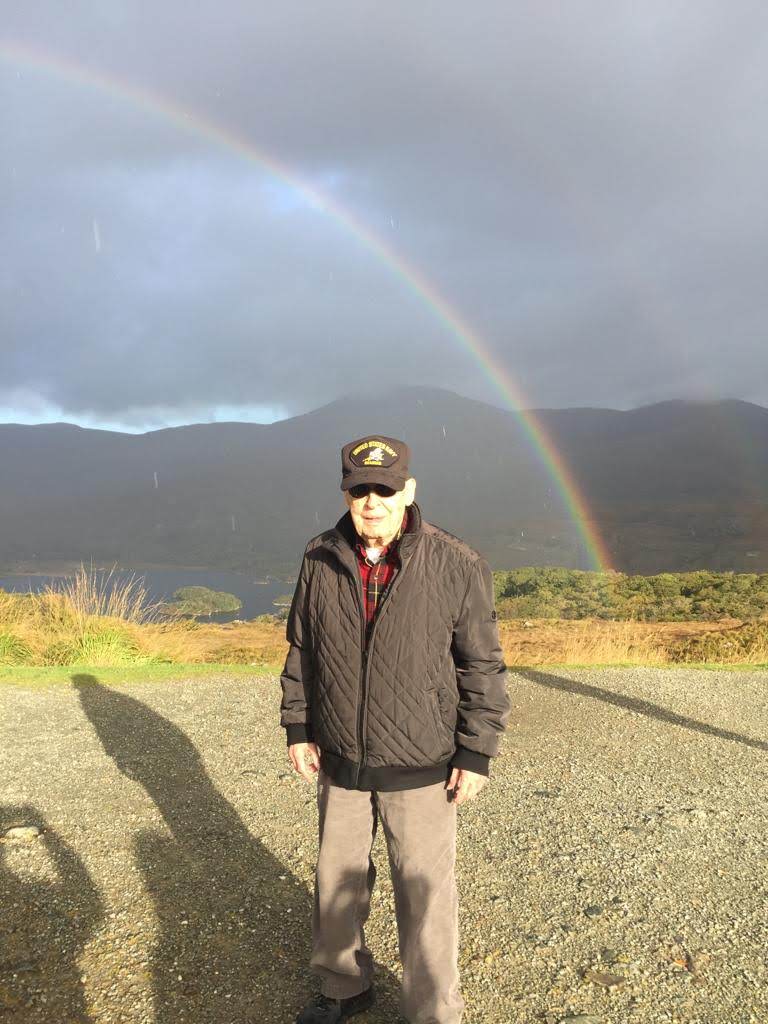
The three of them are now in the middle of a week in Killarney. They have a driver to take them out to see the sights. They have been sending us some photos and updates. Here is my favorite one of Paco so far:
img-20191016-wa0000

This evening, they were at a pub with a singer/guitarist performing. My sister requested “Danny Boy” for my father and it seems that everyone in the pub fell in love with Paco. One woman even came over and danced with him for a bit! Of course, what’s not to love about a 94-year-old man in a US Navy SeaBee cap, who is visiting Ireland for the first time?

JC Confessions #6

On The Late Show, Stephen Colbert does a recurring skit, now a best-selling book, called Midnight Confessions, in which he “confesses” to his audience with the disclaimer that he isn’t sure these things are really sins but that he does “feel bad about them.” While Stephen and his writers are famously funny, I am not, so my JC’s Confessions will be somewhat more serious reflections, but they will be things that I feel bad about. Stephen’s audience always forgives him at the end of the segment; I’m not expecting that – and these aren’t really sins – but comments are always welcome.
~ JC

I am mostly oblivious to pop culture. If I read the Grammy nominations, chances are I don’t know any of the songs and haven’t heard of the majority of the artists. I haven’t ever seen Titanic or Avatar or Jurassic movies or the vast majority of superhero movies. I don’t stream and binge watch series from Hulu, Amazon Prime, etc. and I don’t have premium television packages, which means that I also haven’t seen many of the shows nominated for Emmys, although I think it is good that I haven’t seen Game of Thrones or The Handmaid’s Tale because I would probably have nightmares. I don’t watch collegiate or professional sports, except an occasional baseball game. I don’t vacation at theme parks.

I am involved with a few popular things, the most notable being the Harry Potter books and movies. For the most part, though, if you want to discuss a pop culture topic with me, you’ll likely have to explain it to me first.

Some people might say that I am elitist and they are entitled to that opinion. I would like to say in my defense that I grew up in a tiny town in New England, have never lived in a large city, and have never had a high-powered career. Even though I am now a poet, I am a community-educated one and most people find my poetry accessible rather than esoteric. But, the fact remains that I am a poet, so maybe I am guilty as charged…

Two-year-old ABC

Having our granddaughter ABC living in our home has been a privilege.

Now 26 months old, she is energetic and tall enough to climb onto furniture that used to be out of reach. She is still petite for her age, but she is similar to her mom in that regard.

Her bangs are almost long enough to tuck behind her ears.

She loves imaginative play. Lately, she has been running a pretend ice cream shop. She also has been loving eating ice cream, sometimes with sprinkles on top!

She is adding more and more words to her vocabulary and making longer sentences. She will also now address each person in the room when she is saying hello or good-bye.

It’s still a wonderful feeling when she snuggles near you, although if she suspects you are trying to get her to settle down to sleep, she is more likely to squirm to get down and starting running and jumping around in order to stay awake. Her mother used to do the same thing!

She has a new appreciation for books and will sit long enough for you to read each page, instead of just zooming through looking at pictures.

She loves to sing. She takes after her parents, who are both accomplished musicians. She sometimes devises her own codas to songs that she knows or comes up with her own little tunes. It is incredibly cute!

Among her new obsessions this summer, besides the aforementioned ice cream, are sidewalk chalk, bubbles, and riding the carousels. Our county has several historic – and free – carousels in our parks. Sometimes she will ask for dog – pig – cow, because one of her favorite carousels has a dog and a boar among the horses. The “cow” is actually a black and white paint horse that does resemble the dairy cows around here. Another park has all horses, but still has its original organ rather than using recorded music all the time as the other carousels do. This park also has a more accessible playground, which is easier for a small 2-year-old to navigate. Her favorite horse there is a palomino she has dubbed “yellow horse.”  When she asks for dog-pig-cow-yellow-horse, we take it to mean that any carousel will do!

And this will all end soon, and not just because summer will come to an end.

Some time in the coming weeks, E’s spousal visa will finally come through and she and ABC will move permanently to London to join their spouse and father L.

We know they will be happy to finally live together full-time, instead of just transoceanic visits.

But it will be so hard to have them so far away after having them so close for so long.

Remembering Nana in Slovenia

Our Smith College Alumnae Chorus tour of Slovenia was only a few weeks after the death of my mother, known here at Top of JC’s Mind as Nana. One of the things that was comforting to me was saying prayers for my mom at the various churches we visited. Sometimes, I was even able to light a candle in her memory.

In prior tour posts, I have shared some photos from some of the churches we visited, but I wanted to share a few more. The ceiling from the chapel of Ljubljana Castle:
img_0137

Most of the churches we saw on our trip had kneelers that were built into the wooden seats. I loved the curves of these pews from the Ljubljana castle chapel:
Ljubljana castle chapel pews

A cross silhouetted against Lake Bled in the entrance to the Mary of the Assumption:
img_0172

The beautifully painted Stations of the Cross there:
Stations of the Cross at Lake Bled

In Trieste, the organ and a bit of the rose window, which was a later addition to Saint Just, when technology had progressed enough to have that large an opening in the wall:

img_0236

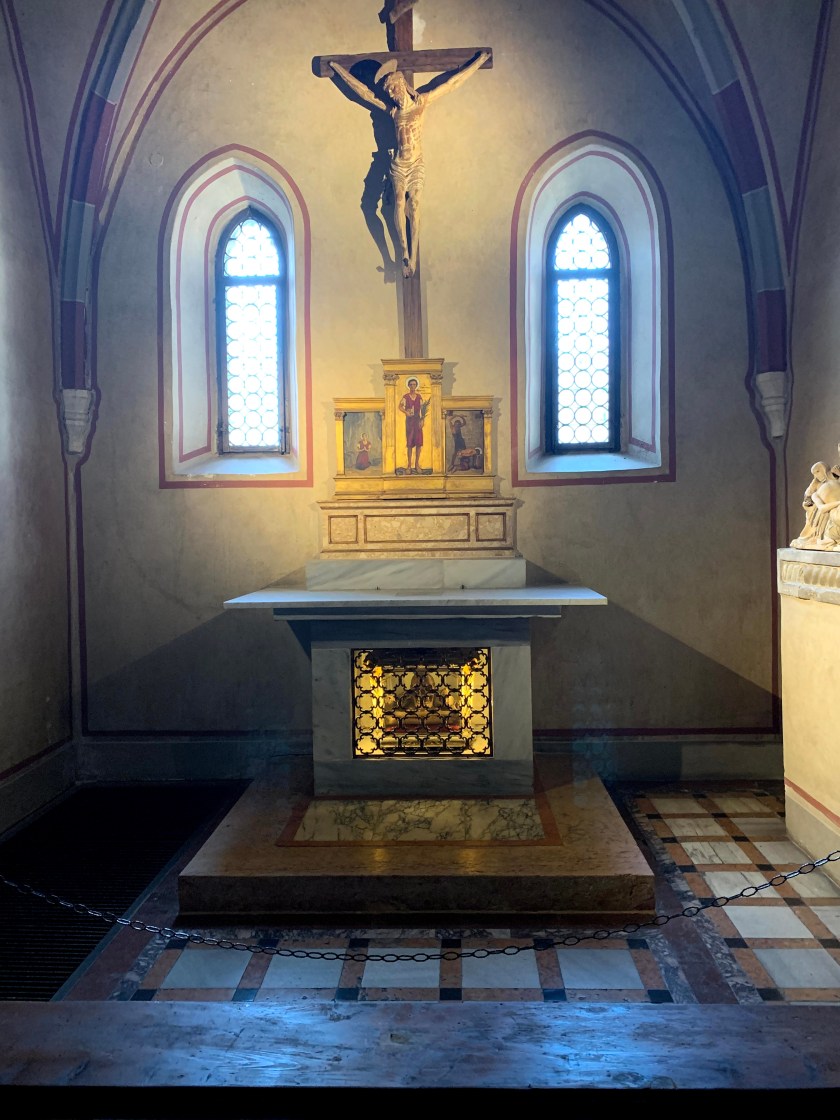
Catholic altars contain relics, but one seldom sees them in such a conspicuous way:img_0233

A crucifix at St. George in Piran that had been restored from one of the older iterations of the church. I was struck by how contemporary designers have recalled this centuries-old style in their own work:
img_0300

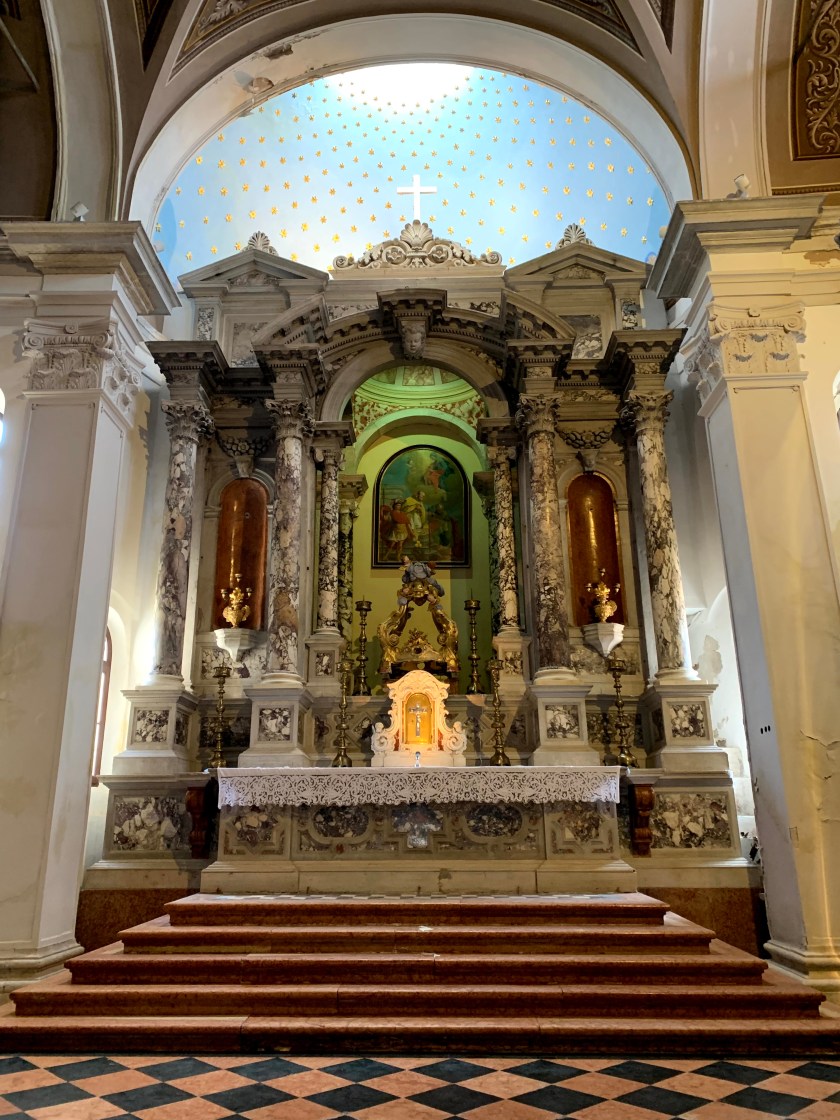
The main altar:
img_0296

And the ceiling above the chancel:
chancel ceiling - St.George, Piran

There were two churches that I visited that were not part of the official tour. Because I was there as a pray-er rather than a tourist, I don’t have photos inside the churches, but they remain close to my heart. One was in Trieste, near the amphitheater ruins. Nana’s ethnic heritage was northern Italian, so it was special to be able to spend some quiet time in the church there. The other was when I went to Mass on our last morning in Ljubljana. It was comforting to be there as part of the congregation, even though they were speaking a language I didn’t know. All the same, I felt that the prayers in my heart were understood.

Besides my private prayer pilgrimage, I also silently dedicated my performances of the Duruflé Requiem to my mother.  This requiem is based on chants from the early church and is sung in Latin, as it would have been before the Second Vatican Council. Much of it is spare and meditative, beautiful but difficult to perform because the individual vocal lines are often exposed.

The most moving of these text for me is the “In Paradisum”, which is the final commendation of the deceased to God at the end of the funeral rite. The text translates:

May the Angels lead you into paradise:
may the martyrs receive you at your coming,
and lead you into the holy city, Jerusalem.

May the choir of Angels receive you,
and with Lazarus, who once was poor,
may you have everlasting rest.

At my mother’s funeral, this was the point at which I was most emotional, so I worried that I might have difficulty singing through it, especially as Duruflé sets the first stanza for sopranos only. I found, though, that it was comforting for me to bring my mother to mind at that moment, making the traditional prayer even more meaningful. In the powerful silence after we very quietly finished the piece, I could find peace.

Our last full day in Slovenia

After collapsing into bed after our bus ride back from our Koper concert, we were gifted with a (mostly) free morning. B and I took the opportunity to finish shopping for gifts and remembrances to bring back. We shopped for honey, as Slovenia is home to a long-standing tradition of bee-keeping. We bought two Christmas ornaments, one of handmade lace and one of wood, both crafts that are important culturally. We bought sea salt from Piran. A cute, artist-designed Ljubljana dress with a dragon on it for ABC. Chocolate because they had interesting flavors, including a lot of white chocolate products, which I appreciated as I need to avoid dark chocolate.

Then, we started a string of official Smith College Alumnae Chorus events. We had a meeting to hear from our officers and take care of some organizational tasks. We went to a local restaurant for our farewell luncheon.  We proceeded to St. Jakob Church for our last rehearsal.
img_0344

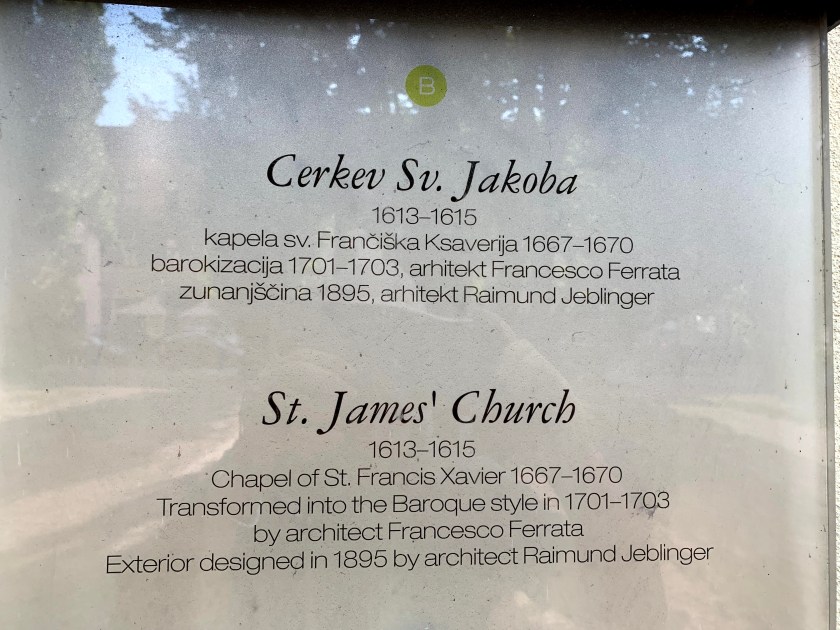
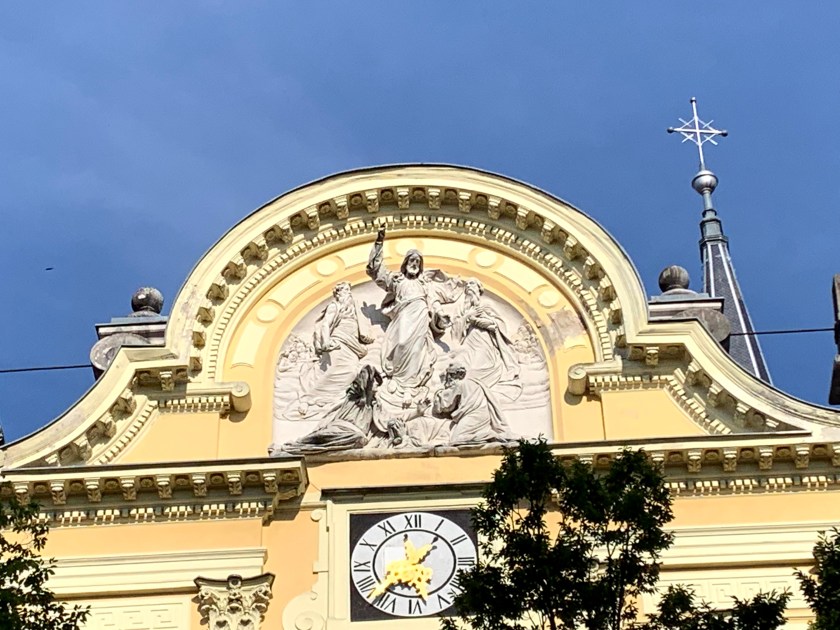
LIke many other churches we visited, it had been renovated and changed styles as the centuries went on. Also, like other churches, some of the renovations had been necessitated by earthquakes.
img_0353

We were surprised to see a vehicle from the Slovenian version of public broadcasting. They were setting up to record the concert for broadcast. Our rehearsal in the church was quite short; we couldn’t run long because we needed to clear out for vigil mass. While we rehearsed, B took some more photos.
img_0355

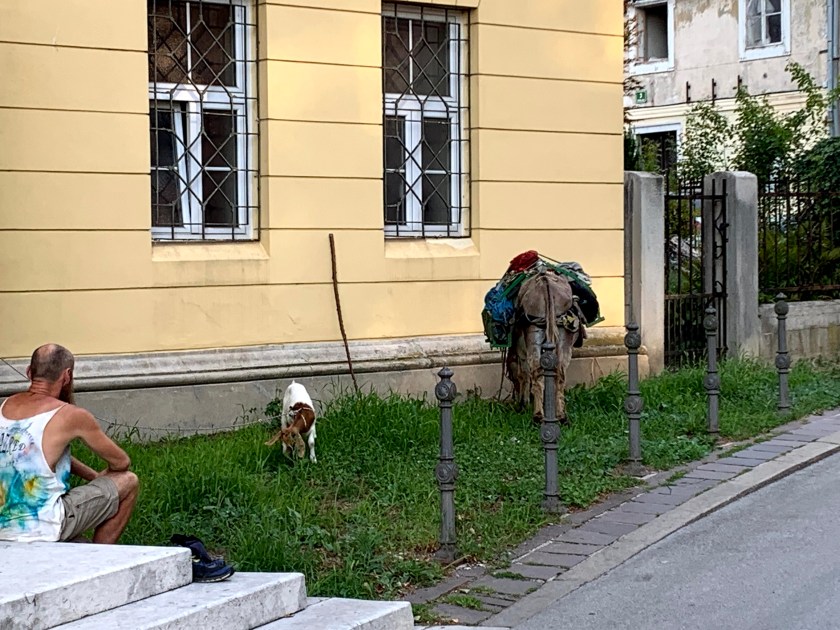
For some reason, there was a donkey grazing beside the church…
img_0359

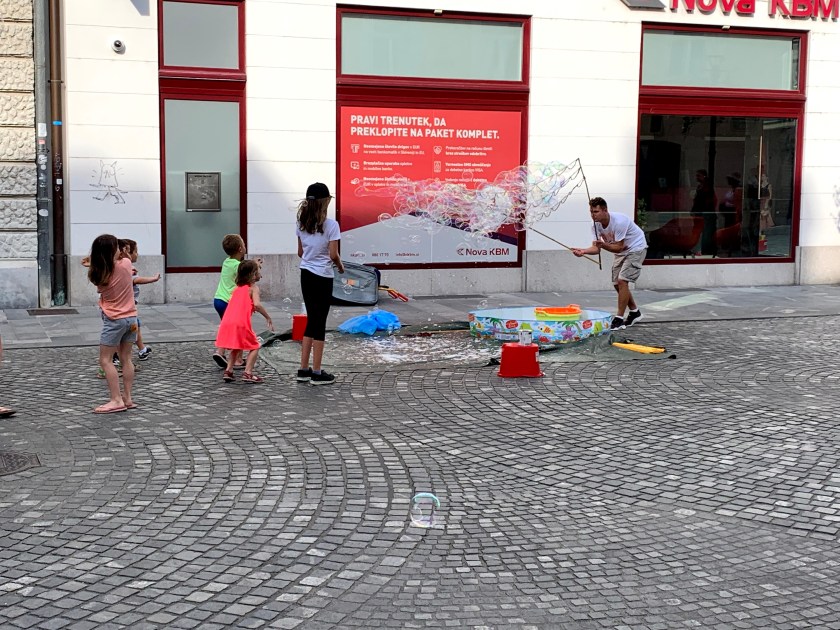
Street performers were amusing the children with giant bubbles.
img_0352

After rehearsal, B and I grabbed a quick salad from an al fresco restaurant before returning to the church to get ready for the concert. We were honored by a visit from a representative of the US embassy, who wanted to meet us before the concert.

The concert went very well. We again had a full house and the audience was very appreciative.
concert in Ljubljana

We had a reception back at our hotel, a last chance to talk and laugh together – and to compare which sections of the Haydn and Duruflé kept playing over and over in our heads.

And to eat cake, because, I, for one, always have room for a good piece of cake.


Koper

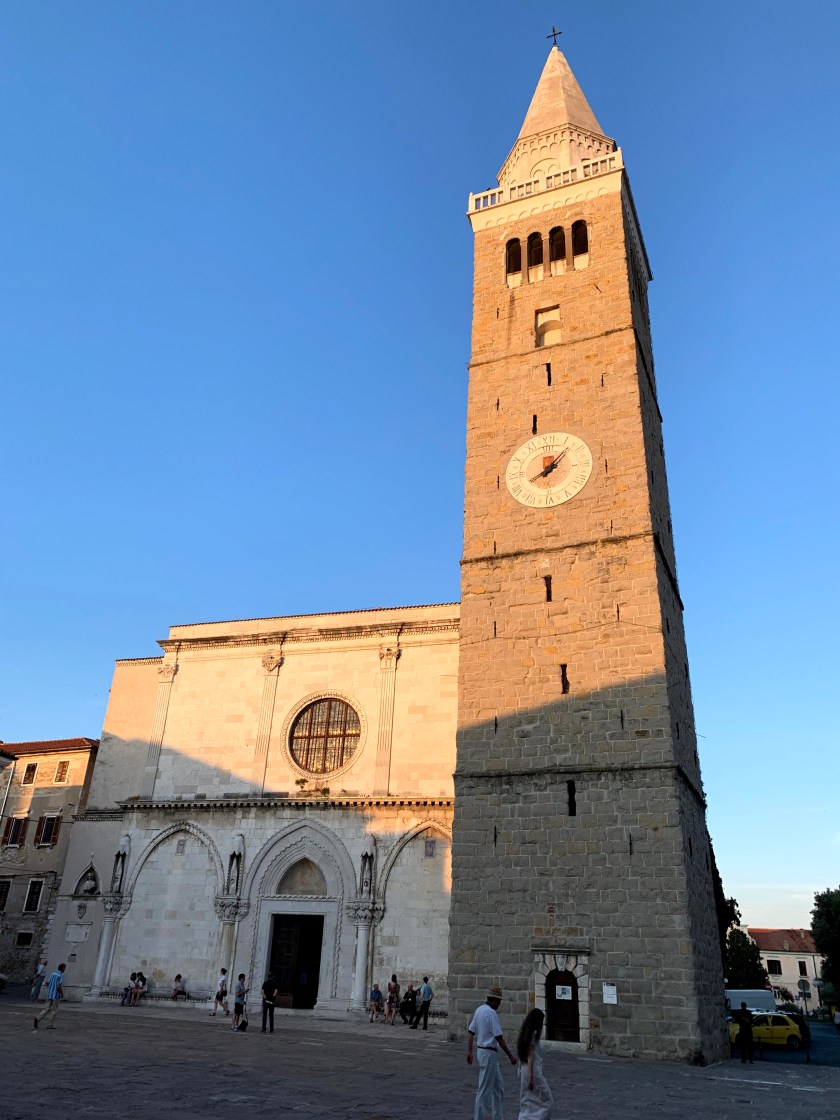
After a few hours in Piran, we boarded our bus for a late lunch in Koper and then went to the cathedral to rehearse for our concert that evening.
img_0339
The cathedral is dedicated to the Assumption of Mary. Our Slovenian guide told us that about half of the churches in Slovenia are dedicated to Mary under one or another of her many titles. Originally built in the 12th century, the cathedral evolved over the centuries to incorporate elements of later styles. Interestingly, the bell tower was originally a Roman watchtower, which explains why the stonework is so different from the rest of the cathedral. You can see some beautiful photos of the cathedral, including its impressive artwork, here.

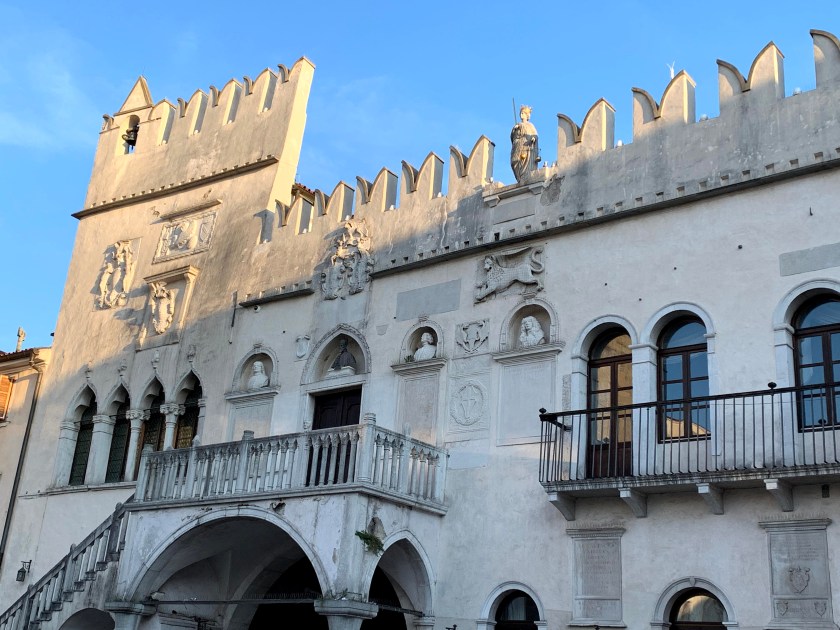
As we saw often in Slovenia, locations tend to be a mix of styles over its long history, most of it spent dominated by other entities. The square where the cathedral is located is named Tito Square, after the president-for-life of Yugoslavia. The City Hall, which is on another side of the square, is a 15th century Venetian palace.
img_0337

After rehearsal, we had a bit of time to get something to eat before we had to dress for the concert. Given that our lunch had been both late and large, B and I decided to visit a gelato shop down near the port. We ate quite a lot of gelato in Slovenia, as there were shops or stands selling it wherever we had free time, perhaps a nod to the Italian influence in at least the southern part of Slovenia. Fortunately for B, who is lactose intolerant, most of the shops had a nice selection of sorbets and vegan gelato. On this evening, I chose a yummy vegan peach gelato.

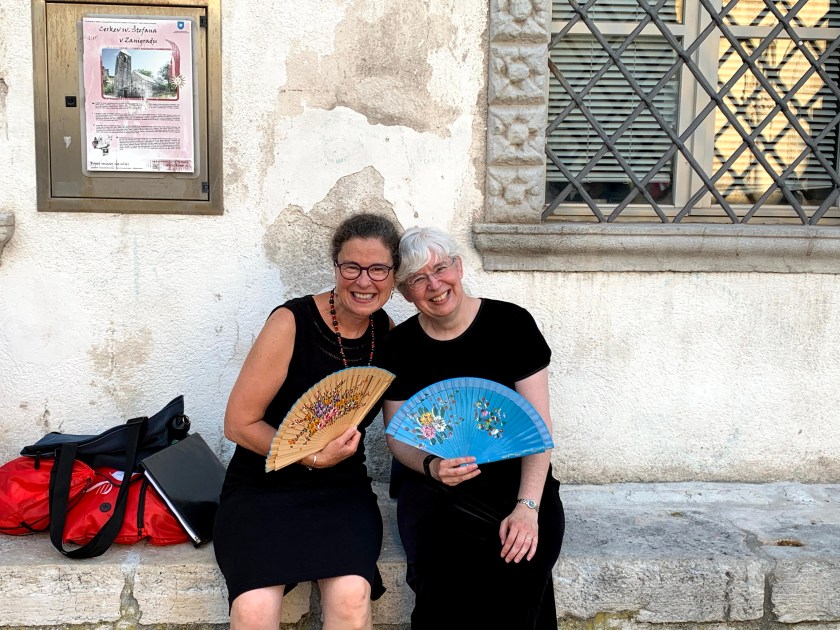
After we dressed in our black concert attire, we waited outdoors until it was time to file into the cathedral. Here, my roommate at Smith and my first Smith friend are sitting and waiting, utilizing the fans that she brought for us. The sitting was important because we would be spending a lot of time standing on stone floors. The fans were important because it was July and quite warm. We were lucky, however, to have been in Slovenia in the time between two major European heat waves that set many all-time high temperature records. (I’m the one on the right with the silver hair and blue fan.)
img_0336

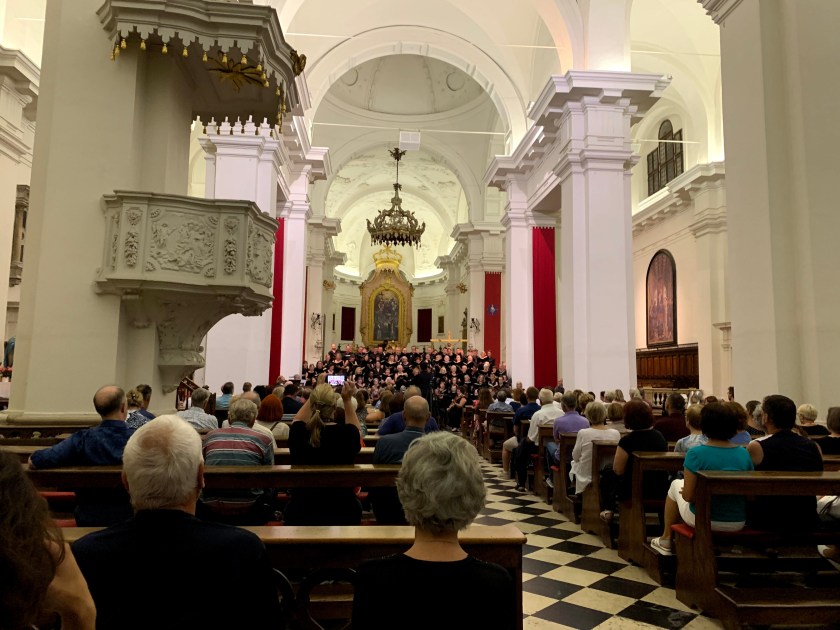
The concert was well-attended and well-received. It was so much fun to sing in that acoustical environment. You can read more about the music and concerts here.
img_0340


Why we went to Slovenia

I have done a couple of posts on Slovenia here and here, but am hoping to do a series of posts on different things that we did and saw there. I thought I’d start on the reason we travelled to Slovenia.

I am a member of the Smith College Alumnae Chorus. We sing at occasional events on campus in Northampton, Massachusetts, and every other year or so, go on an international tour. This year, we spent a week in Slovenia. We sang the Haydn Missa in Angustiis, also known as the Lord Nelson Mass, and the Duruflé Requiem, in conjunction with orchestra, tenors, and basses from Slovenia. We did have a few tenors and basses of our own along, mostly spouses of alumnae, but, as a women’s college, the vast majority of our chorus is sopranos and altos.

We performed two concerts under the direction of our conductor Jonathan Hirsh on our last two evenings in Slovenia. Our Friday night performance was at the cathedral in Koper.
Koper cathedral performance

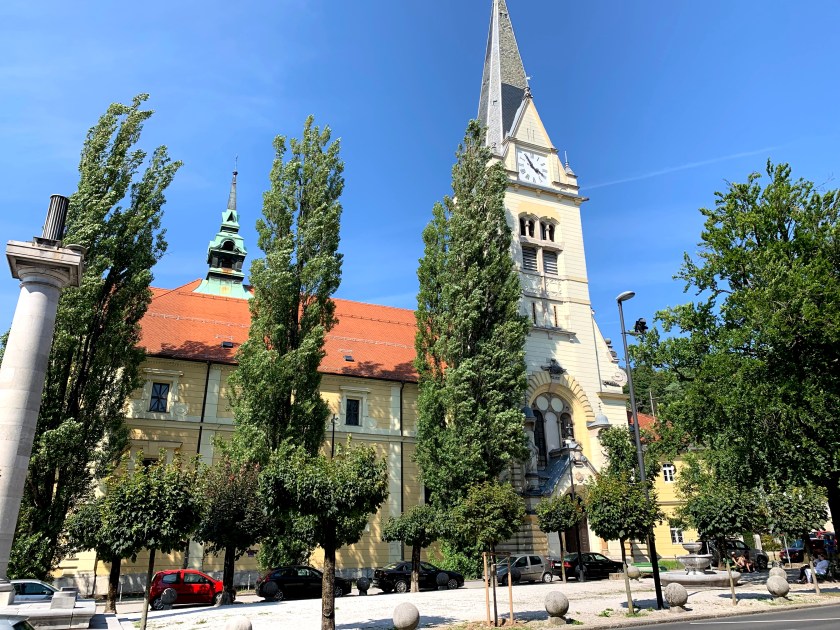
On Saturday night, we performed at Saint James’ Church in Ljubljana. To our surprise, a representative from the United States Embassy came to greet us and the performance was recorded by the Slovenian public broadcasting service.
St. James Ljubljana performance

To the delight of the audience, Maestro Hirsh addressed them in Slovene before each concert. He told them a bit about our chorus’s mission to collaborate with local musicians when we toured and a bit about each piece. Both were written in times of strife and uncertainty. The Haydn, which was the first half of the concert, ends with a forceful plea for peace. The Duruflé, however, is much more meditative and ends very quietly with the “In Paradisum” as the soul enters into paradise. Mr. Hirsh asked the audience to take a few moments to reflect before applauding.

Those moments of silence, after the last chord had finished reverberating in those magnificent spaces, were incredibly moving, illustrating the power of music to reach across language, social differences, and time to touch hearts and minds.

One-Liner Wednesday: in case you’ve been wondering where I’ve been…

Taken by my spouse B in the “Old City” of Ljubljana, Slovenia, where I was singing with the Smith College Alumnae Chorus in Ljubljana and Koper; blog posts will be trickling in over the coming days.
*****
Join us for Linda’s One-Liner Wednesdays! Find out how here:  https://lindaghill.com/2019/07/24/one-liner-wednesday-creepy/

Badge by Laura @ riddlefromthemiddle.com

Moses Hogan concert

Amazingly enough, I got to attend another concert this past weekend with my daughter T at Trinity Church where we heard the St. John Passion in April. This was also a concert with the Madrigal Choir of Binghamton and Trinity Church Choir, along with Tabernacle United Methodist Choir and members of the Binghamton High School Choir. They were joined by countertenor Derek Lee Ragin and pianist Pej Reitz for “A Moses Hogan Celebration.”

Moses Hogan (1957-2003) was a multifaceted musician who is most well known for his stunning arrangements of Negro spirituals and most of the program was given to performances of these arrangements. Derek Lee Ragin met Moses Hogan at Oberlin College Conservatory and, while pursuing a career in opera, also performed and recorded with the Moses Hogan Chorale and Moses Hogan Singers. Also, Moses’ younger sister, Dr. Ava Hogan-Chapman, and her daughter were in attendance. It was wonderful to have people who knew him so well there to tell us more about him, and, of course, to hear Derek Lee Ragin sing.

I had sung a couple of Moses Hogan arrangements and had heard a number of them when E and T were singing in high school and college choirs. These tended to be the more up-tempo songs such as “Elijah Rock” and “Ride on, King Jesus”. While I loved hearing these familiar arrangements in the concert, I was especially moved by some of the pieces that were unfamiliar to me.

Among these was “His Light Still Shines”, a choral medley in honor of Dr. Martin Luther King, Jr. The piece is a blend of narrative and spirituals. Sharon Ball offered very powerful narration in alternation with the choral pieces. I knew Sharon Ball as the retired director of the Broome County Arts Council and as a candidate for New York State Senate in our district. I hadn’t realized that earlier in her career she had been a broadcast journalist, professional singer, and White House staffer in the Carter administration. She brought all of these skills together to speak so clearly and movingly about Dr. King’s work and legacy. Last year marked the 50th anniversary of Dr. King’s assassination; it saddens me that we still have so far to go in social justice and peacemaking in the United States all these decades later.

The piece, though, that had both T and me on the verge of tears was “There’s a Man Goin’ Round”, which is a piece about the death of a parent. With my mom in hospice care and the recent death of my college roommate’s mother, that piece was especially meaningful and heart-rending.

It’s a testament to the power of the spirituals, born as they were under the weight of slavery, oppression, and suffering, that they transcend and bring hope, even in difficult times centuries later.

another farewell concert

Two years ago, I wrote about the final concert with the long-time director of the Binghamton University Chorus.

Last Sunday, we sang in the final concert of another faculty member, Timothy Perry, who had conducted the orchestra and various other instrumental ensembles and taught clarinet for the past 33 years. Members from University Chorus, Harpur Chorale, the Southern Tier Singers’ Collective, and VOCI combined to sing Ralph Vaughn Williams’ Dona Nobis Pacem. Dr. Perry had conducted a performance of it fifteen years ago with the University Symphony and Chorus with soloists Professors Mary Burgess and Timothy LeFebrve, who joined us again for this performance.

The University Symphony Orchestra, along with some members of the Binghamton Community Orchestra which Dr. Perry also conducts, and all the singers wanted to make his last concert a memorable one.

And we succeeded.

The singers, most of whom were prepared for the concert by Binghamton University Professor Dr. William Culverhouse, worked very hard to develop uniform and precise diction  while also attending to all the musical elements that Vaughn Williams had incorporated into the score. The singers were in so many different ensembles that we only were able to rehearse together in the final week, but we had been so thoroughly prepared by Dr. Culverhouse that things fell into place without too much angst. (I realize that sounds a bit strange, but anyone who has ever had to perform with only limited rehearsal time for all the players and singers together knows how daunting it can be when all the different groups finally get together.)

It was very important to us that the audience could understand the text, which is a plea for peace, something that the whole world needed when Vaughn Williams wrote the piece in the aftermath of The Great War and in fear of what would soon become an even larger-scale war. We feel that same need for peace in our current world.

The bulk of the text is from the United States poet, Walt Whitman. This year is the bicentennial of his birth. Whitman spent a lot of time during the American Civil War visiting the wounded of both sides of the conflict in the hospitals in Washington, DC. He wrote extensively about the war and its human toll in the free verse style of poetry. Because he was an early champion of free verse in the United States and because that is the style of poetry I most often use in my own work, I consider Walt Whitman to be one of my important poetic forebears. It was important to us that the audience could readily understand what we were saying and I’m happy to report that they did indeed understand us.

Because of Dr. Culverhouse’s meticulous attention to detail, we were able to really express the text and the music to the audience and to follow Dr. Perry’s nuanced interpretation to make the performance truly memorable, one of the peak experiences of my decades of choral singing. We knew from our own internal sense and from the enthusiastic and extended standing ovation from the audience that we had really communicated what we had hoped to them.

At the reception after the concert, I was able to speak with Dr. Perry a bit. He was very pleased with the performance and told me that some of his favorite concerts that he had conducted in Binghamton were collaborations between his Symphony and University Chorus. He also told me that he appreciated seeing some familiar faces in the chorus, as a number of us were members of University Chorus even before he arrived on campus.

It was a poignant moment for me. For my first 35 years with University Chorus, we met and sang a concert every semester. In these last two years, we have only met one semester in the academic year and have become an adjunct group to the Harpur Chorale, the main student choral ensemble. There were understandable reasons for this, but it still saddens me not to have a place to sing every semester.

University Chorus was accustomed to finding out at our spring concert what the plans were for the next academic year. Given that there will be a brand new conductor of the University Symphony next year, the scheduling is being left open until that person has arrived and gotten the lay of the land. It’s possible that University Chorus may not meet at all in the 2019-2020 academic year. It’s even possible that we may not fit into the evolving music department and cease to exist. Or that it may become so selective that I won’t make it through the audition.

If this concert was my last, I’m thankful that it was so meaningful and memorable. In giving Dr. Perry a beautiful gift for his final concert, we also gave a gift to ourselves.