over COVID?

Over the last few weeks, many people here in the United States have said publicly that they are “over COVID” or “through with the pandemic” and are going to “go back to normal” which means living like they did before SARS-CoV-2 appeared.

Guess what? Pandemics don’t disappear just because we are tired or frustrated or in denial. There were 3,622 COVID deaths reported in the US yesterday, adding to the almost 900,000 deaths in the US since the start of the pandemic and 5.7 million deaths worldwide. These staggering totals are almost certainly undercounted, as some regions don’t have the will or capacity to track and report. Also, some deaths result from lasting heart, lung, or neurological damage from COVID rather than from the active infection itself and so may not be identified as COVID related.

Some people are saying we just have to live with COVID, as we do with flu and other viruses. Thus, they are saying that it is now endemic, but here is the problem. There is a specific definition of pandemic, “(of a disease) prevalent over a whole country or the world” (Oxford Languages). Looking at case numbers in the US and around the world, it’s obvious this is still a pandemic. We will get to a point where it is endemic, someday, through a mix of vaccination and immunity from having been infected, although no one yet knows how long immunity acquired through either route will last. Dictionary.com has a handy non-epidemiologist explainer of pandemic, epidemic, and endemic.

The subtext of being “over COVID” seems to be more along the lines of I’m tired of masking and distancing and avoiding crowds, so I’m just going to get back out there because a) I’m vaccinated/boosted so I don’t think I’ll get sick or at least not seriously so; b) I am young/strong/take vitamins/exercise so I’m not going to get sick; c) I don’t believe there is such a thing as this virus; d) you can’t tell me what to do; or e) we have to ease up on restrictions now so that we can re-institute them when the next variant or spike in cases occurs.

The thing is that a virus doesn’t care about your age or status or location. It’s only mission is to live and replicate and it will adapt to make that happen as easily and widely as possible. Exhibit A: the Omicron variant, which is wildly contagious and somewhat able to cause breakthrough infections in the vaccinated.

As regular readers here may recall, spouse B, daughter T, and I are all part of the Pfizer/BioNTech phase three vaccine trial. We are all vaccinated and boosted, although we were boosted on the early side of the curve, B and T as part of the trial that is contributing efficacy data that we see reported out in the news, and I who received a booster through the trial as soon as it was authorized for public use but before most people in my age range were eligible. I am also contributing data for the study, but I’m not on the leading edge like B and T. Therefore, while many of the boosted can get comfort from knowing that their immunity is likely still strong because the data from the trials is showing that, I don’t know if B and T might be showing a decline because there hasn’t been enough time to collect and analyze that data. I’m sure we would all love to know that booster immunity lasts a year or longer but it’s only been about seven months so far, so we can’t know. Likewise, we don’t know how long immunity lasts after infection.

I know that I am unlikely to become seriously ill, to be hospitalized, or to die if I contract COVID, but that doesn’t mean that I’m ready to be cavalier about it. I don’t want to be sick if I can prevent it by continuing with masking, distancing, and avoiding crowds. Even mild cases of COVID can result in months of symptoms, which is termed “long COVID.” As someone who has lived with a person suffering from FM/ME, which causes similar symptoms, I find the prospect of long COVID frightening.

What frightens me even more is the danger of spreading COVID to someone else. I have many friends who are older than I and at higher risk, as well as friends who are immunocompromised. Young children still are not eligible for immunization, although Pfizer/BioNTech has just applied for emergency use authorization for children 6 months-4 years of age, so perhaps that will begin in the coming weeks. I’m sure I also happen upon unvaccinated people because the fully vaccinated rate in my county is 62% and the boosted rate is only 33%. Some of the fully vaccinated are not yet booster eligible but we know that boosted people have the best chance against Omicron, so, if I am out in public, chances are that only 1 in 3 people I encounter will be a similar status to me.

Those are not great odds, especially with a variant as contagious as Omicron accounting for 99% of US cases. I have recently upped my mask protection to N95s, as I wrote about here. I’m learning how to deal with them as someone who needs progressive lenses in her glasses. The tighter fit of the N95 masks makes it difficult for my glasses to be in the correct position, so I can get a headache from eyestrain if I try to do close work for any length of time. Still, I’m trying to wear the N95s when I have to go out with a surgical mask/good quality cloth mask combo if I have to take the N95 off.

I used this site, https://covidactnow.org/us/new_york-ny/county/broome_county/?s=28791756, to find today’s Broome County statistics. (You can use it to find statistics in your area in the US. International data may be found here: https://coronavirus.jhu.edu/.) It rates our risk level as “Extremely High.” While other may be “over COVID,” I am not ready to take that much risk for myself, my family, and my community.

As conditions change, I will re-evaluate and adjust my behavior as I see fit. Until then, I hope that those I meet will respect my viewpoint.

I’m not “over COVID” yet.

SoCS: JC’s Confessions #21

[Non-stream of consciousness introduction. Linda’s prompt for Stream of Consciousness Saturday this week is to write about the first thing that come to mind from the phrase “let go.” I drew a blank at first but then this topic floated to the surface, probably because it was on my list of things to write about in my series, JC’s Confessions, so what follows is the very dangerous intersection of writing stream of consciousness on a difficult topic. I do use a standard opening to explain JC’s Confessions, which will follow as a block quote before launching into the SoC portion of the post.]

In the first few seasons of The Late Show, Stephen Colbert did a recurring skit, now a best-selling book, called Midnight Confessions, in which he “confesses” to his audience with the disclaimer that he isn’t sure these things are really sins but that he does “feel bad about them.” While Stephen and his writers are famously funny, I am not, so my JC’s Confessions will be somewhat more serious reflections, but they will be things that I feel bad about. Stephen’s audience always forgives him at the end of the segment; I’m not expecting that – and these aren’t really sins – but comments are always welcome.

JC

I have trouble letting go of guilt.

Even when I’m feeling guilty about something that is not my fault.

Even when it’s something I couldn’t possibly have known. Or remedied.

I’ve had family members diagnosed with conditions which took years to figure out, yet I’m the one who feels guilty/responsible for not having figured it out sooner, even though I am not a trained health professional, just a family member and caregiver.

It would have taken asking totally implausible questions to figure some of these diagnoses out. For example, it turned out years later that one of my daughters’ migraines had started as a child with visual migraines, which manifested as things changing colors. Who would think to point out to their child that, in almost all instances, color is a fixed attribute of an object? Yet, I feel guilty for not having realized this problem before the more serious later intractable migraine that took six months to diagnose, two more to break, cost her a semester of high school, and would later prove to be only a small part of a larger diagnosis of fibromyalgia, now known as ME, and chronic fatigue syndrome.

Never mind that it took the doctors ten years to figure it out from the time symptoms first appeared. As a mother, I thought I should have known and been able to alleviate her suffering and help her.

I know that this guilt is totally irrational. I know that my family doesn’t hold me responsible for not being a super-doctor or God or some all-knowing being and getting them help sooner, but still, as hard as I try, there is a vestige of guilt that I can’t shake.

(I can hear those of you who were raised Catholic thinking that this is par for the course of Catholic guilt, although I think it is probably not only that.)

One of my more recent struggles with this problem is the fact that it took months of suffering before my father, known here as Paco, was diagnosed with heart failure, only days before his death. I tried and tried to get the health professionals at his facility to figure things out and treat him appropriately but I failed, robbing him of the peace, comfort, and dignity he deserved in his final months.

It hurts.

I know that I shouldn’t feel guilt on top of the pain, that I’m not at fault, but I still can’t shake the underlying sense of responsibility, failure, and guilt.

Maybe, eventually, I’ll be able to let it go.
*****
Join us for Linda’s Just Jot It January and/or Stream of Consciousness Saturday! (I promise it does not have to be as fraught as this post unfortunately is.) Find out more here: https://lindaghill.com/2022/01/28/the-friday-reminder-for-socs-jusjojan-2022-daily-prompt-jan-29th/

a long haul

I’ve been thinking a lot about my late father, known here as Paco, recently.

I wish I could say that I am browsing old photos or remembering family holidays but, instead, I am mired in dealing with trying to settle insurance claims and begin the work needed to file his final tax returns and other estate sort of things.

Unfortunately, some of the issues are medical and it is bringing me back to a place of feeling helpless to alleviate Paco’s symptoms and not being able to get timely and accurate information about his condition.

It’s difficult and energy-draining and makes me feel like crawling into bed and pulling the covers over my head.

I’m not doing that.

I am trying to shepherd my energy and steel myself to chip away at all the work. It’s going to take a long time to get through it all.

It remains to be seen whether I can get the sadness to abate somewhat before I finish or not.
*****
Join us for Linda’s Just Jot It January! Find out more here: https://lindaghill.com/2022/01/24/daily-prompt-jusjojan-the-24th-2022/

N95s

With the immensely transmissible Omicron variant so prevalent, I’ve decided to try to get N95 masks to wear when I have to go out in public. I have been double-masking with a surgical mask under a very good quality cloth mask made by medicalwear producer Jaanuu but thought that I should probably go to an N95 mask which is designed to fit more closely and filter out 95% of particles under NIOSH standards. (NIOSH is the US National Institute for Occupational Safety and Health.)

It’s somewhat difficult to find N95 masks in stores here. We did get a few from a home improvement store which stocks them because they are protective against dust and other particles for people doing construction or renovating. The problem is that they only carry one size which is too large for my petite face. I was able to find N95s in a size small online and a second fold-flat style that people complained about in the comments as running small, so I have ordered some. They won’t arrive until late this week or early next but I think I’ll be safe with my current mask set-up until then.

Or safe enough…

Masking is just one piece of our strategy. The three doses of Pfizer/BioNTech vaccine is my primary protection. The masks, avoiding crowds, distancing, etc. are additional measures to stay as safe as possible but, especially with Omicron, there are no guarantees.
*****
Join us for Linda’s Just Jot It January! Find out more here: https://lindaghill.com/2022/01/23/daily-prompt-jusjojan-the-23rd-2022/

JC’s Confessions #20

In the first few seasons of The Late Show, Stephen Colbert did a recurring skit, now a best-selling book, called Midnight Confessions, in which he “confesses” to his audience with the disclaimer that he isn’t sure these things are really sins but that he does “feel bad about them.” While Stephen and his writers are famously funny, I am not, so my JC’s Confessions will be somewhat more serious reflections, but they will be things that I feel bad about. Stephen’s audience always forgives him at the end of the segment; I’m not expecting that – and these aren’t really sins – but comments are always welcome.

JC

I hate exercising.

I can almost hear people saying that I haven’t found the right activity or I will feel better once I’m doing it or it will give me more energy or some other positive thing about exercise that I’ve heard before, but no.

While I do enjoying walking with someone in pleasant surroundings, I do it for the conversation or the setting, not because walking is good for me or inherently pleasurable. I don’t find that I feel accomplished or energized after exercising, just more tired, although that doesn’t translate into sleeping better. I am not a very kinesthetic person. I’m more cerebral and am happiest in quiet, calm places.

There have been long periods of my life where I have made myself exercise nearly every day, so it’s not that I can’t do. I just have never been able to get above the “barely tolerable” feeling about it.

I admit that, since my father’s passing last September, I’ve been less active. I’m a bit out of condition, as I could tell by how difficult it was for me to keep up with everyone else on our recent trip to the UK. I’m not sure how much I could improve through a concerted attempt to exercise more or how much is that, at 61, I can’t expect to be as strong as I was two or three decades ago. I have an appointment with my doctor next week and will ask what she thinks.

Meanwhile, I am back in physical therapy for a recurring health problem. I’m trying to be good about doing my at-home exercises, but that may actually compromise any attempts to try to do even more exercise, as there are limits to how many things I can make myself do, as I confessed here.

I don’t expect, though, that, somehow, I’m going to suddenly find joy in exercise, which, in a culture obsessed with sports and fitness, is something close to a sin.

I will, though, dislike aside, try to do what I must to keep going for as many years as I am able.
*****
Join us for Linda’s Just Jot It January! Find out more here: https://lindaghill.com/2022/01/14/the-friday-reminder-for-socs-jusjojan-2022-daily-prompt-jan-15th/

the pandemic – year 3

My first post about the pandemic was February 29, 2020, a Stream of Consciousness Saturday post, no less! COVID-19, the illness caused by the SARS-CoV-2 virus, was already killing people in China, other parts of Asia, and Europe but had just begun to sicken and kill people in the United States, where I live.

I’ve written dozens of posts since then about the impact of the pandemic on our lives and about spouse B, daughter T, and my participation in the Pfizer/BioNTech vaccine trial. Yesterday, B and T, who are being followed currently on the efficacy of the third dose, had an appointment for blood work to add to the data on the longevity of antibodies and other immune markers six months after their third dose. I am also boosted and remain part of the trial, although, as someone who was in the placebo group initially, I am now part of the group who received their third dose later, so I am not on the leading edge in terms of data. There is a possibility that, when Pfizer/BioNTech develop an Omicron-specific booster, we may be asked to participate in that phase of the trial as well. Meanwhile, we continue to do weekly check-ins via app and do testing if symptoms that could be COVID appear.

I am grateful that we are able to help advance the science on the vaccines which have averted millions of hospitalizations and deaths. Even though the Omicron variant causes more breakthrough cases among vaccinated and boosted individuals than earlier variants, the vast majority are still protected from serious complications and death. I’m just sad that so many people around the world, by personal choice or by lack of availability, remain unprotected.

While Omicron tends to cause less severe symptoms than some of the earlier variants, it can still be deadly. The case numbers in the US, almost all caused by Omicron at this point, are staggering, reaching record numbers. On January 11, the US reported 1.35 million new cases with 136,604 hospitalizations, both records. The case count is somewhat elevated by the fact that some states don’t report new cases over the weekend, making the Monday numbers higher, but the seven-day average is over 700,000, so there are extraordinary levels of infection in evidence. Some hospital systems are overwhelmed, especially because staffing is a challenge. Many health care workers are exhausted by the sheer volume of patients and length of the pandemic and some have left the field. Right now, there are also a lot of vaccinated and boosted staff who have developed breakthrough cases; even if they are asymptomatic, they could still be contagious, so they have to isolate until they test clear of the virus.

The difficult thing for me to accept is that so many people in the US have chosen not to be vaccinated, despite the risks to themselves, their families, and their communities. Because Omicron is so transmissible, the safest course of action is to be vaccinated and boosted, while continuing to mask in indoor public spaces, to distance from non-household members, to avoid crowds, to sanitize appropriately, and to test before (small) social gatherings. By combining all those measures, B, T, and I were able to travel to London, where Omicron was running rampant, and get home virus-free.

Yes, going into year three of this, we are all tired of having to think about COVID safety all the time, but the virus doesn’t get “tired” of mutating and infecting people. We need to do everything we can to promote public health and to protect those who because of age or health condition can’t develop vaccine protection. We have to continue to study the virus, including all variants, to assess their impacts, including how long and strong immunity is from vaccines and from infection. Unfortunately, many viruses don’t tend to confer long-lasting immunity. If they did, we wouldn’t continue to get common colds repeatedly. Current research on SARS-CoV-2 shows immunity extending to about eight months. Some suggest that immunity could stretch to five years but we can’t know that yet, as this virus hasn’t been around that long. It also looks like some of the variants, like Omicron, are better at evading immunity, whether from prior infection or vaccines. We also have to be prepared for further variants that could be even more transmissible and/or cause more severe disease.

We are still in the pandemic phase with COVID-19. The world is unlikely to be able to rid itself of the virus totally. At some point, we will reach an endemic phase, where the virus is in circulation but not causing widespread serious illness/deaths through some combination of vaccines, natural immunity, and treatments. Will year three be the final year of this pandemic? No one knows for sure, but I am trying to hang onto hope that it will be.
*****
Join us for Linda’s Just Jot It January! Find out more here: https://lindaghill.com/2022/01/13/daily-prompt-jusjojan-the-13th-2022/

travel in Omicron time

In October, we made plans to visit daughter E, son-in-law L, granddaughters ABC and JG, and L’s parents with whom they live in London, UK for the holidays. I hadn’t shared much about our plans here for fear that we would have to cancel, as we did with a planned visit in November 2020. At the time we made our plans, vaccination rates and COVID rates looked amenable for travel for three people who had had three doses of Pfizer vaccine, due to our participation in the clinical trials.

And then, in November, the Omicron variant appeared.

Travel and testing policies changed. Everyone wanted to know how virulent it is, if vaccines are protective, how severe it is, where it is spreading – and they wanted to know right away. Unfortunately, science doesn’t work that way. It takes time to gather and analyze data.

It actually was to our advantage that there were several weeks before our trip for some preliminary conclusions to be discerned. Yes, Omicron is more transmissible than the very contagious Delta but tends to cause less severe disease and to run a shorter course. Vaccines were less effective than against other variants but having a booster greatly increased protection.

And Omicron was rapidly spreading almost everywhere.

My home state of New York in the US was experiencing a spike in Omicron on top of a spike in Delta. In London, Omicron was taking over with over 90% of new COVID cases caused by it.

Still, travel was open for vaccinated people to enter the UK, we had our required testing scheduled both in the US and the UK, and the UK had not imposed restrictions on gatherings in private homes, so we were good to go, scheduled to fly out of Newark on Monday night, Dec. 20.

On Thursday, Dec. 16, L tested positive for COVID. He had been testing at home every day before going to work in the schools and didn’t have symptoms. He immediately had a follow-up test with a medical facility to confirm, then went into isolation in a bedroom. He developed symptoms which were like having a bad cold, which seems more typical with Omicron. In accord with UK protocol, the adults in the house tested themselves every morning. If they were negative, they could go out for the day. The children would only need to be tested if they had symptoms.

Obviously, this was scary news a few days before our trip, but, being used to uncertainty by now, we decided to go ahead with our plans.

On Saturday morning, we did COVID tests at the local pharmacy. The results were supposed to be available by noon on Monday and our flights wasn’t until 10 PM, so no problem, right?

Except that they didn’t come. We headed to Newark airport, which is about three hours away, hoping to get a rapid test there, but the testing center closed early, so we waited for our results to come in. As it turned out, only mine came through in time, so I flew to Heathrow by myself. This was the first time I had ever flown internationally without being part of a group, but I managed, admittedly with a lot of helpful staff and fellow travellers who could probably tell that this silver-haired woman wasn’t quite up to snuff, especially after a sleepless night on a plane. E met me at the train station and helped me get settled – and do my COVID test that the UK required. I needed to stay in isolation until I got a negative result.

Meanwhile, B and T re-booked their flight for the next evening, stayed at a hotel overnight, and went to the airport bright and early to go to the rapid test center. They had finally gotten their negative results from the Saturday tests but, because they were now flying on Tuesday, that test was too old to meet the requirements. Fortunately, I was already checked in to the hotel so they could start their UK isolation/testing bit, too. I’m happy to say that the UK results came much more quickly, so we were out of isolation by the time we moved to our Airbnb in E’s neighborhood on Thursday.

When you are browsing through Airbnb’s site, you can’t see the exact address. We knew we were in the neighborhood, but were pleased to find out we are only about three blocks from their house. Given that we are trying to limit our exposure to crowds, it’s nice to just have a short walk between the two places. It’s also nice to have our own kitchen. We even have an enclosed back garden, although it’s been too rainy to use it.

We benefited from a change in UK policy. Instead of having to isolate for ten days, people are allowed to leave isolation sooner if they have two negative test 24 hours apart. This meant that L was able to get out of isolation in time to have Christmas Day together. (You can read about the menu here.)

In deference to the wild spread of Omicron, we are not going to church or other kinds of crowded venues, like museums, during this visit. We are pretty much going back and forth between the two houses. While B, T, and I and L’s parents were all boosted, E and L were scheduled to get their boosters on Sunday, three days after Larry tested positive. E’s COVID exposure delayed her getting a booster until Dec. 24; L can get his in several weeks. For the record, E and L were not negligent in scheduling their boosters. Rather, they were following the UK protocols, which are different than the US ones.

All of us are trying to be protective of ABC and JG, who are too young to be vaccinated. Realistically, B, T, and I also need to stay COVID-free to be able to travel back to the US in January. Fingers crossed that the travel and visiting policies stay stable so that there are no more glitches, delays, or restrictions.

But, hey, we’ve already shown we are flexible, if need be.

Pfizer booster

As part of my ongoing participation in the Pfizer/BioNTech COVID-19 vaccine phase III trial, yesterday I received a third vaccine injection, seven and a half months after my second. There was a blood draw to test levels of antibodies, T cells, etc. and the blood work will be repeated in a year. I will continue a weekly symptom check through a phone app and have a couple of phone appointments over the next year, too. The data collected will be used to inform on-going decisions about how often boosters may be needed in the future.

I’m fortunate that my side effects have been milder than they were with the second injection. I have a very sore arm, which is obviously from the shot. I’m tired and have a bit of a headache, which could be side effect and could be just life in general these days. Today is the one-month anniversary of Paco’s death, so how I am feeling could be attributable to that rather than to vaccine side effects. When spouse B and daughter T, who are also study participants, received their third doses, they both lost a day to fever, body aches, and fatigue; because I had had a similar reaction to my second dose, I was expecting a similar experience, but apparently have lucked out.

In the United States, a third dose of the Pfizer vaccine is approved for those aged 65 and up, people who have medical risk, and those in certain professions that have close contact with vulnerable populations. It’s possible that the third dose will be recommended more generally in the future as more data become available. It’s also likely that emergency use authorization for children aged 5-11 will come soon, with shots in arms starting in early November.

Recommendations on booster doses for Moderna and Johnson & Johnson are expected soon, as well as the possibility of mixing manufacturers, for example, someone who had the J&J vaccine having a booster from Pfizer. All the companies are continuing to study the vaccines for long-term efficacy and side effects, as well as safety, efficacy, and dosage for children six months through seventeen years. Currently, in the United States, only Pfizer is approved for ages 12-17.

Another helpful development is that Merck has applied for emergency use authorization of molnupiravir, an oral anti-viral to combat COVID. It would be given to patients in the early stages in hopes of keeping their illness from becoming severe. While it is already possible to give treatments by injection or infusion, such as monoclonal antibodies, this medication would be easy to prescribe and administer for home use. A decision by the FDA is expected within weeks.

Meanwhile, over the summer, COVID cases were devastating parts of the US, especially states with low vaccination rates. Total fatalities are over 700,000 with over 44 million cases recorded. In some areas, hospitals were so overwhelmed that they had to send patients out of state to receive care. This applied to COVID patients and also to patients suffering from other serious conditions. Two states, Idaho and Alaska, had to implement crisis standards of care, which means that whether or not an individual receives treatment beyond comfort care is determined by the likelihood of survival as there is not enough capacity to treat everyone that needs help. This resulted in non-COVID deaths from heart attack, stroke, etc. – patients who ordinarily would have been treated successfully but who died because there were not personnel, equipment, and space available to treat them due to intensive care units being filled with COVID patients.

The delta variant was the power behind the summer surge, but, at least, the fear of it encouraged more people to seek vaccination. The increase in vaccination rates is helping the case numbers to fall at this point. Still, the current rate of fully vaccinated people is only 57% with 66% receiving at least one dose. I am hopeful that the Pfizer vaccine being approved for elementary age children in the coming weeks will add significantly to our vaccination totals, at least in states where the vaccination rate among adults is higher.

There are still terrifying amounts of misinformation floating around about the vaccines that are keeping some people from taking them. Unfortunately, this is keeping the pandemic alive, resulting in illness, death, lack of access to medical care, and the possibility of even more dangerous new variants developing.

We are all in this together. Please, everyone, get vaccinated if you are eligible and follow reputable public health guidelines on masking, avoiding crowds, handwashing, etc. Your choices affect your family, friends, neighbors and community directly and your nation and the world, as well. We can’t truly end this pandemic until there’s no population anywhere still vulnerable to COVID-19.

If you won’t do it for yourself, do it for someone you love.

tribute to Paco

My 96-year-old father, known here as Paco, died in mid-September, but I have been struggling to write about him. A good share of that is that the writing/analytical/organizational part of my brain has been too busy with all the phone calling and notes and paperwork that follow a death, which are by turns taxing and emotional and fraught. I’ve also been trying to find peace after so many months of complex medical and care situations which I found both exhausting and traumatic. I’ve also taken a week to attend a reunion residency with the Boiler House Poets Collective at MASS MoCA, which has been helpful both in reconnecting with family history as we are from the North Adams MA area and reconnecting with myself as a poet after so many months of sneaking in poetry time only intermittently.

But in this post, I will try to tell you more about Paco and our family.

People have asked me how my Irish-American father came to be known as Paco, which sounds more Spanish. My firstborn daughter E was the first grandchild on both sides of the family. As she was learning to talk, she couldn’t manage to say “Grandpa” and – after a few instances of calling him “Bucco” – settled on Paco as his name. This became his name with all the other grandchildren and often for other family members. It was natural for me to use it here on the blog.

It was a revelation for me seeing Paco interact with his grandchildren. Because my younger sister and I are only two years apart, I didn’t remember my father as a dad to young children. Unlike so many men of his generation, he reveled in playing with very young children and singing to them. One of the great blessings of our family life is that Nana and Paco retired near us when E was three and before T was born. Having them be so close by all those years was wonderful with walks and outings and school events and concerts, theater, and dance recitals, games and carousel rides and countless volleys of ping pong in the basement. Nana and Paco gave us so much love, care, and support for so many years; it was natural that we would provide the same to them as they grew older and developed health problems.

Paco had served in the US Navy as a SeaBee in World War II and Korea. The SeaBees were the Construction Battalion – CBs, get it? – and Paco was drafted before he could finish high school. Most of the SeaBees were older men, already established in various trades, who took Paco under their wing and taught him what they knew. The skills he developed there in electrical work set the stage for his career. Paco didn’t talk much about his service when we were growing up but, in his later years, he got some SeaBee caps which he would wear out in public. I was always amazed at how many people would comment, thank him for his service, and share their own stories of service by themselves or family members. Those tributes continued into his last days. One of the first things Hospice did after admitting him was to bring a certificate and a memorial quilt square to him. We are also applying for a service medallion to be added to his memorial in the mausoleum.

Paco worked for 43 years for New England Power Company, the last 23 as Superintendent of the Upper Deerfield River in southern Vermont/western Massachusetts. I wrote the poem “Hydro Superintendent” about him for his 90th birthday. We lived in a house that was owned by the company and often visited the powerplants and reservoirs. One of his biggest accomplishments as superintendent was overseeing the construction of Bear Swamp, a pumped storage plant built inside a mountain. Paco knew every detail of that project, which brought in contractors from as far away as Japan and Switzerland. It was so much fun walking through a giant tunnel to get to the huge powerhouse with its two turbines that could generate electricity and then reverse to pump water back to the upper reservoir. I started my interest in renewable electricity and energy storage technology young, thanks to Paco.

One of the things I admired about Paco was his work ethic. He always worked hard to get the job done right but he was also part of the team, even when he was the leader. He would help the crews do emergency work rather than just ordering them to come in. He hired the first Black and the first woman into his stations which had previously been staffed entirely by white males. (Point of information: Rural New England was not very racially diverse at the time. Some areas still are not diverse now, decades later.) He was always compassionate and understanding when employees encountered personal or family difficulties. He was also not one to “toot his own horn.” I found out how well-regarded he was by his staff through others, not from him.

We admired Paco even more when we discovered he had accomplished so much with undiagnosed dyslexia. When his youngest granddaughter S was diagnosed with an inherited form of dyslexia, Paco discovered at age 80 why he had always secretly struggled with reading and writing. S and her family launched the Paco Project to raise funds for Learning Ally to help others with print or visual disabilities access the world of books. We are proud to direct donations to Learning Ally in memory of Paco.

Paco was also proud to finally become a high school graduate. I applied for his diploma through Operation Recognition, a program which awards diplomas to veterans who left school before completing their course of study. In 2008, the same year that eldest granddaughter E graduated from high school, Paco received his diploma from Drury High School in North Adams, Massachusetts, the school that he and Nana, as well as I and my sisters, had attended.

Paco’s ancestors came to the United States from Ireland but he had never visited. Nana was too claustrophobic to consider flying, but after her death in spring 2019, my two sisters took Paco to Ireland to visit.

Paco and an Irish rainbow

We were blest that all four of his grandchildren got to see Paco over the summer. We were especially grateful that granddaughter E with spouse L and great-granddaughters ABC and JG were able to visit from London UK. Because of the pandemic, we had not been able to see each other, but in August, just before the final and more precipitous portion of Paco’s decline, they were able to make the trip.

four generations with Paco, Joanne, granddaughter E, and great-grands JG and ABC

There were a few days during Paco’s last week where he was very agitated but we were fortunate to have some calmer moments. T was the only one of the grandchildren nearby enough for one final visit, which wound up being the day before he died. It was one of the most heartbreakingly tender encounters I have ever seen. T sang Irish songs to Paco and held his hands, which were still a bit restless from a medication side effect. She talked to him and I know that he could hear her because he was able to respond a bit. I admit that I couldn’t help but cry and that I am crying now as I try – and fail – to find the words to convey how special that last hour between them was.

It also happened that all three of Paco’s daughters got to spend time with him, both alone and in various pairings, on the day of his death. It was not clear that this would be his final day, so it was not that it had been planned, but I’m grateful that it turned out that way. I’m also grateful that in his last few days, I was finally able to sing to my father, something that my sisters had been doing but that I struggled to do. I sang both verses of “Over the River and through the Woods” to get to Paco’s favorite lines, “Hurrah for the fun! Is the pudding done? Hurrah for the pumpkin pie!” (Paco loved all kinds of pie.) I sang the Shaker hymn “Simple Gifts” because it is comforting to me and several beautiful Irish hymn tunes. Occasionally, I would get too choked up to continue singing but I usually managed to get through. On that last day, Paco could not respond but Hospice told us that the sense of hearing tends to remain and can even sharpen as the other senses are shutting down. My younger sister was alone with Paco when he died but I arrived soon after for my very last good-bye.

I have been so moved by the many people who have reached out to me during Paco’s decline and since his death. There have been so many kind words, both written and spoken – remembrances, prayers, thoughts, stories, expressions of gratitude for a long life well-lived. I was very touched when a friend that I made through Facebook but whom I have never met in person added my father to her Kaddish prayer on Yom Kippur. It has been the love I first learned from my parents but now experience through so many family and friends that has kept me going through all of this, even during the most difficult times. I thank all of you.

Last week, I went to the hair salon for a haircut with Diane, who has been my stylist since 1983. I told her about Paco’s death and she gave me a hug and told me that she had something to show me. It was her new puppy, who was sweetly asleep in his crate. She told me his name was Leo.

Leo was my father’s name.

a momentous visit

While my blogging has been haphazard for months due to my father’s declining health, I wanted to share a post about the recent visit of our daughter E, her spouse L, and their daughters, four-year-old ABC and one-year-old JG. As people who check in here at TJCM periodically may recall, they live in London UK and the pandemic left us unable to visit each other. This meant that when they arrived in the US, it was our first chance to meet JG in person.

All the adults are fully vaccinated, but the children are too young to qualify. While our area of upstate New York is not a COVID hot zone, the transmission rate is still high enough due to the delta variant that we were very cautious about taking the girls to indoor public spaces. While I had scaled back my expectations for the visit a lot, I hadn’t scaled them back quite as much as I should have. For example, I had hoped to see a few more friends than we were able to. Unfortunately, Paco, my 96-year-old father, had more health challenges appear and his unit at the nursing home had to go into lockdown due to a couple of COVID cases among vaccinated staff.

In a way, though, it was nice to have them in our home, doing normal, everyday things like we had when E and ABC lived with us for over two years while waiting for E’s spousal visa to be accomplished.

B, with an assist from ABC, got to bake yummy treats for breakfast.

Everyone enjoyed watching the birds at the birdfeeders. ABC especially liked the tufted titmouse and goldfinches, while others were partial to the cardinals.

We enjoyed watching other wildlife, too. ABC even spotted some deer near the back fence. We also spent a lot of time watching the bunnies eating various leaves and flowers in the lawn.

You probably can’t see the bunny, but – trust me – it’s there.

One thing that they don’t have at home in London is rocking chairs. JG especially loved the one that was her size!

JG was an early walker so we missed her being a babe-in-arms, but Auntie T did get a taste of what that phase was like when JG got so tired she actually fell asleep in her arms.

L took the girls on walks. Here is ABC at the 1 mile – or is it 1 smile? – mark on the Rail Trail. Our area, like many others in the US, has re-purposed places where there used to be railroad tracks into recreational trails.

We also got to visit the parks and carousels. Broome County has six vintage carousels and it was very nostalgic to revisit them with ABC and introduce them to JG. ABC made friends everywhere she went.

L and ABC enjoyed rides in the carousel chariot
JG loves being on the swings!
JG also enjoys being on the move!

We got to enjoy a lot of playtime with the girls. ABC, at four, has a great imagination and enjoys making elaborate scenarios. She is also quite operatic! Besides singing songs that she knows, often from Frozen I and II, she likes to make up songs while she is playing. With both her parents being accomplished singers and instrumentalists, she appears to come by music naturally. She is learning to play the piano, so we got to experience her lessons with her daddy.

ABC is also a beginning reader, so sometimes she would read to us and other times we would read to her. It was an honor to be chosen as the final bedtime story reader. Of course, she also requested a bedtime song before going to sleep.

The most important event of the trip, though, was the one visit we were able to make with Paco in the outdoor courtyard of the nursing home. ABC was being her charming self, singing and dancing and clapping for Paco.

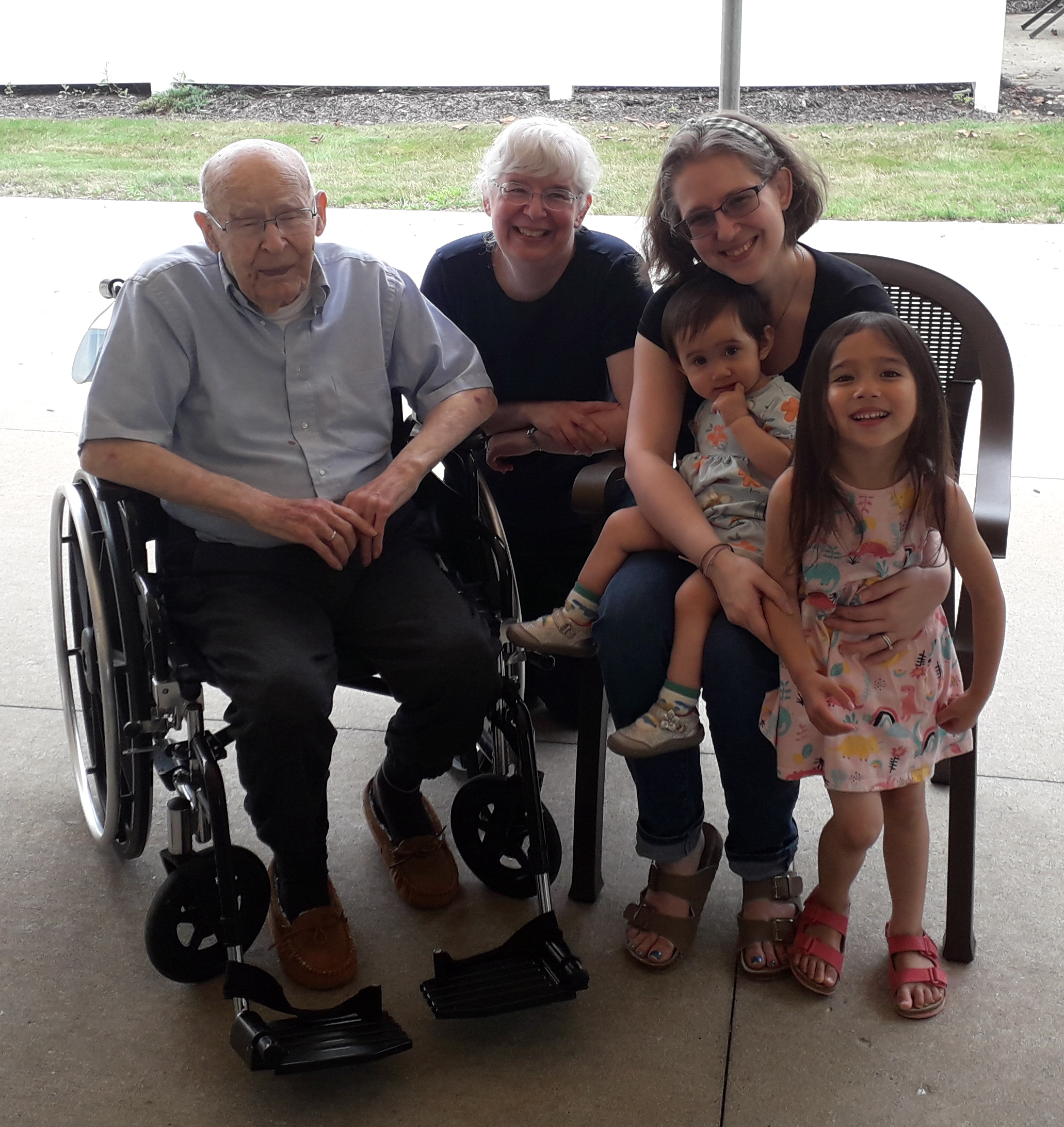
The most precious photo is this one of the four generations.

Paco’s health has declined so much in the weeks since we had this visit that he has now been admitted to hospice care. I will be forever grateful that Paco had the opportunity to meet his second great-granddaughter who won’t remember that day and to see his first granddaughter E and first great-granddaughter ABC who certainly will.