While it has been flying under the radar a bit in this cataclysmic year, 2020 is the centennial of the passage of the 19th amendment to the United States Constitution, recognizing women’s right to vote.
B, T, and I recently watched a four-hour documentary on PBS, entitled TheVote. (At the moment, you can stream it for free by following the link.) It was a reminder to me of the long struggle to secure the vote for all women in the US and how interwoven it was with issues of religion, abolition, temperance, racism, property rights, wealth, war, and social mores. The derisive and/or violent reaction to the nearly always peaceful demonstrations that the women undertook seems frighteningly current.
T and I also saw Gloria: A Life, a docu-play based on the life of Gloria Steinem. The performance was filmed with the audience there, the first act as a play and the second act a discussion with the audience featuring Gloria Steinem herself. Like Steinem and Betty Friedan, I am an alumna of Smith College; while there I had taken an early women’s studies course, before the formation of an academic department of women/gender studies. By the time I was a teen, the Second Wave of feminism was well underway, so I recognized many of the names of Steinem’s feminist activist-colleagues. Early on in the play, there is a tribute to the many women of color who were leaders in the movement. One of the strange phenomenon that happened was that, even early on, the press would disproportionately cover and feature Steinem, marginalizing other leaders, especially those of color. This has led to the enduring false impression that Second Wave feminism was a white middle-class movement, when it was in reality what would now be termed “intersectional.” It drew together women’s rights with issues of race, immigration, sexual orientation, gender expression, union/labor rights, violence, medical care, and more.
This was particularly striking at this time when we see activists who had been working on issues in isolation now drawing together in this time of pandemic and outcry for social and racial justice. We see them supporting each other and crafting policy proposals to address the common good. I am so encouraged to see the #BuildBackBetter movement put forward plans that take into account historic racism, marginalization, discrimination, oppression, environmental degradation, unfair wages, etc. and take steps to redress the wrongs and put in place an equitable, fair, safe, and comprehensive system.
2020 has been immeasurably difficult, but we all have the opportunity to make a better future. Let’s go! The United States needs to live up to its highest ideals and join with the world community to heal the planet and all its inhabitants.
The pandemic has heightened awareness of a number of social problems in the United States.
One revolves around the care and education of children. Political and business leadership often spout platitudes about how important children are and how much they care about them, but they seldom back up their words with meaningful policies that help children and the people who love, care for, and educate them.
Before the pandemic, American families often cobbled together child care with parent(s), school, relatives, neighbors, and paid caregivers, who often had to charge more than the family could afford to pay even though their own salaries were so low it was hard for them to get by. When schools and most day-care centers closed due to the pandemic, parents were suddenly trying to do paid work themselves from home while simultaneously trying to care for and educate their children or were forced to quit a job outside the home to be at home for their children.
It’s not a sustainable situation for many families.
There is a big push by the president and some state and national leaders to re-open schools full-time and full-capacity in the fall, even though that is against the recommendations of public health experts, in order for adults to return to jobs outside the home or so they can work from home without interruptions, but, besides being a huge health risk for children and adults, it fails to address the root of the issue.
Somehow, caring for children in exchange for a salary is considered “work” but caring for children without a salary is not considered work. Hazel Henderson calls this non-monetized part of our system the “love economy.”
The United States lags far behind other countries with advanced economies in acknowledging the love economy. We don’t offer mandatory paid sick leave, parental leave, or caregiving leave. People who do get paid as caregivers, whether for children, elders, or other vulnerable people, often earn shockingly low wages. For that matter, many people working in other kinds of jobs also don’t make a living wage, making it impossible to fully care for their family. Other countries also have a must more robust system of social services, so that people have access to adequate clothes, shelter, food, medical care, and education regardless of their income level.
As part of our efforts to #BuildBackBetter, the United States should reform our economic, health, educational, and social systems so that every person has adequate resources to lead a life of dignity. Some components of such a system that have proven successful in other countries have been single-payer universal health care, required living wages for workers, a graduated tax system that raises enough revenue from the top of the income spectrum that those in the lower end can afford their tax bill without compromising the needs of their household, free public education, paid leave for sickness, caregiving, and vacation, and a robust social safety net so that no one goes without food, housing, and other basic necessities. I would also like to see more social recognition and financial support for caretaking that is currently part of the “love economy.” A possible way to address this would be through a program of universal basic income or a stipend for those caring for a child, elder, or person with a long-term illness or disabling condition.
Obviously, crafting systemic change will take time and new national leadership. For the moment, I think it is foolish to implement a national school opening policy. Historically, education has been the province of local districts within the framework of state policy, allowing the system to adapt to local conditions. The wisdom of that flexibility is even more evident during the pandemic. Areas with low rates of illness may plan to implement hybrid systems where students attend in person part-time and online part-time so that physical distancing can be used to keep the virus in check. Areas with very high infection rates may need to keep students at home learning virtually until their infection rate is under control, when they could begin to phase in in-person attendance. All schools will need plans for dealing with changing circumstances; as there have been school closing plans to deal with severe flu outbreaks or natural disasters, there will need to be COVID plans to try to keep the school community and the general public as protected as possible.
Everyone wants students to be back to in-person classrooms, but only if it is safe for them, the school staff, their families, and the community. Pretending we can go back to the pre-pandemic system without grave public health consequences is foolhardy. Instead of wishful thinking, we need to use data, science, expertise, care, and intelligence to adapt to our changed and changing circumstances.
It’s what our children and youth need and deserve.
As I was posting about yesterday, things are pretty distressing in the United States these days.
I am, though, finding support and reasons to hope.
Although I wish it hadn’t taken such a dire convergence of events to do, I find hope in the millions of people around the world who are drawing the fights against injustice, inequity, climate change, oppression, inequality, poverty, violence, and lack of education, opportunity, health care, affordable housing, etc. into a new vision for the common good, for care of each person and community, and for the planet. The massive disruption that we are experiencing from the pandemic and the resulting social and economic impacts gives us the opportunity to re-build in a positive, sustainable way. The House Select Committee on the Climate Crisis has just released a major “Congressional Action Plan for a Clean Energy Economy and a Healthy, Resilient, and Just America.” This is the kind of thinking envisioned by many long-time social justice advocates and by Pope Francis’s encyclical Laudato Si’. While there will be obstacles to enacting such large-scale change, there finally seems to be momentum toward adopting and implementing meaningful reforms, which gives me hope.
There are personal signs of hope, as well.
Sometime this summer, a new grandchild will arrive, a sibling for ABC. While we have no idea when it will be either allowed or advisable to travel to London, both ABC and the new little one are signs of hope for the future, as well as powerful motivation to makes things better for them.
Earlier this week, a lovely surprise appeared in my mailbox, a card with a beautiful photograph of a mother wood duck swimming with two ducklings. It was from two Smith college friends who are twin sisters, vacationing together on a lake in New Hampshire. They were thinking about me awaiting our new far-away grandchild “across the pond” and sharing their own family stories, filling my heart with love and joy.
They both mentioned my writing, which I appreciated. I’ve also recently received a couple of emails from a poet-friend in reaction to my posts here at Top of JC’s Mind. I enjoy reading and responding to comments here, on the TJCM Facebook page, and on my personal page, too. Sometimes, it seems as though I write and publish posts – and have no idea if they are actually reaching anyone. I don’t often look at my blog stats, but, even when I do, a visit doesn’t necessarily equal a read. My visit stats also don’t reflect people who receive posts via email. I sometimes find myself surprised that friends know certain stories or viewpoints from me when I know we haven’t discussed it, forgetting that I had posted about it. (Conversely, I sometimes think that everyone knows a certain thing because I’ve written about it, forgetting that many friends and family members don’t read my blog.)
Perhaps, hope is not the proper word, but I do so appreciate the sense of connection that comes through sharing our words and thoughts and emotions with each other. When I do have the privilege of interaction, it reminds me that I am not just scrawling words into cyberspace without purpose.
There is always the hope that someone is reading, mulling, and reacting.
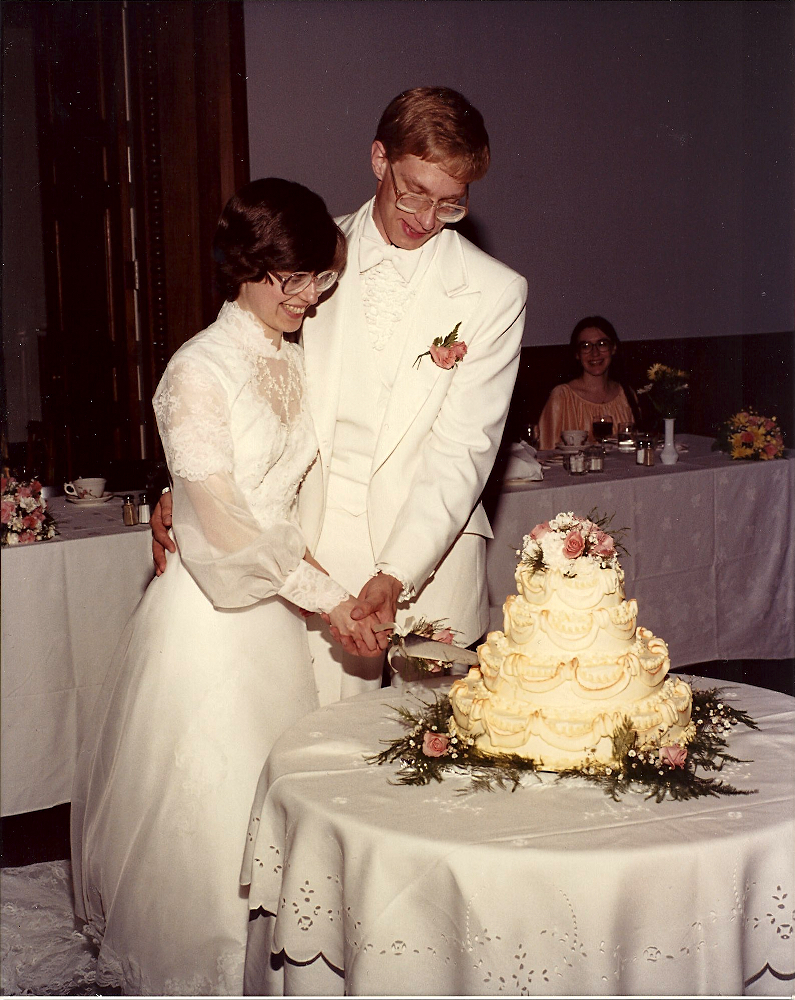
Earlier this month, I wrote about June birthdays and mentioned B and my 38th wedding anniversary while writing for Stream of Consciousness Saturday here.
Our celebration of our anniversary was different this year. We usually try to go away for a couple of days, usually to a small inn in an historic, picturesque location where there are nice places to stroll and good restaurants.
This year, B did get to take most of the day off from his now-working-from-home job. We did go out briefly for a couple of socially distanced errands and an afternoon visit to the walk-up window at a favorite local ice cream shop, but we made dinner at home with T and had a quiet evening in. All of which seemed right for this somber time.
Thirty-eight years is a respectable amount of time for a marriage and gives me hope that, if we can keep life-threatening disease at bay, we will be able to celebrate our fiftieth anniversary, as we were able to do with our own parents.
Perhaps because we are hearing so much about people changing the date or plans for their weddings, I find myself thinking about B and my wedding, the changes in plan that it entailed, and how it was perceived.
Because B and I were planning to marry shortly after I graduated from Smith College, my mother and I did most of the planning the summer before my senior year. Those were still the days where the tradition of the bride and her family doing most of the wedding arrangements (and paying the costs) was still observed, especially when the bride was young and not established in a career. I chose to be married at Helen Hills Hills chapel on the Smith campus. I had been involved in the life of the chapel throughout my years at Smth, as an organist, choir member, and accompanist and was close to Sister Judith, the Catholic chaplain. The reception would be at the Alumnae House, a short walk down Elm Street from the chapel.
There was no resident priest on campus, so an associate from one of the Northampton parishes presided at mass on Saturdays. I asked him to preside at our wedding ceremony and he agreed. In January, he was re-assigned to a nearby city and decided that he would not come to the wedding. A young priest who was assigned to the University of Massachusetts-Amherst was filling in at Smith for the spring semester became the default priest for our wedding.
This turned out to be very problematic.
He didn’t know me – that I had been serving as a Catholic church musician for over seven years, that I took my faith seriously, and that I had also studied the history of Christianity in the United States and around the world. He also didn’t trust me, which was hurtful. When I met with him to do the questionnaire that is required, he made me swear on a bible to tell him the truth, as though I was going to lie to a priest.
In May, during the reading period before my last-ever final exams, the priest and I were taking a walk on the Smith campus to finalize some of the details. Because B is not Catholic, we were having a ceremony, not a mass, which should have made things more flexible. The priest, however, would not allow any changes in wording, would not allow Sister Judith to read the gospel or offer a reflection, which should have been allowed outside a mass. As we were finishing the walk, he said to me that he thought I would be more comfortable being married in a non-Catholic ceremony.
I was devastated. It was six weeks before the wedding and I didn’t have a member of clergy to preside. I went to the chapel offices in tears. Sister Judith wasn’t there, but Rev. John, the ecumenical Protestant chaplain was. He immediately offered to preside and gave me some different prayer books to look through to find a new ceremony to follow. We had to file dispensations of place and form so that the Catholic church would recognize the marriage and the priest would still read the vows, although they would be from the Episcopal Book of Common Prayer. The best outcome was that Sister Judith delivered a beautiful reflection.
People often say that their wedding days are perfect and they wouldn’t change a thing, but there are some things I would change if I could. I would have made a recording of the ceremony because Sister Judith spoke without notes, so I have only memories and not a record of what she said. I also would have ignored the advice of the wedding gown shop and not worn heels and a headpiece that stood up on my head. Because B is about ten inches (25cm) taller than I, they were trying to make me look taller, which seemed silly at the time and even sillier now. Most of all, I would change the trauma and drama of the clericalism that led to my not having a Catholic wedding, the clericalism that still infects the church and causes so much damage.
Our wedding and reception were designed to be an adult affair, so we didn’t invite children. This wasn’t unusual at the time, but didn’t set well with a family member who wanted their grandchildren to be invited. I’m still sorry that those young cousins had a very boring day.
Some of the adults were bored and upset, too, although I, thankfully, was not aware of it at the time. The Alumnae House could serve wine but not liquor, which upset some people who somehow thought they were owed an open bar. We also did not have dancing; neither B nor I enjoy dancing and Alumnae House is not set up for it. After dinner and our delicious spice cake with buttercream icing, a break from the super-sweet white cake with white frosting that was traditional at the time, B and I went from table to table, visiting with our guests. Strangely, after we talked to people at a table, most left, so that, by the time, I changed to leave for our honeymoon, only immediate family and a few close friends were left to wave good-bye.
I don’t regret our reception choices, which reflected our personal style and preferences. I was sad that some guests gave my mother grief, although I didn’t realize that was happening at the time; it was very rude. I was also sad that people were putting their expectations over our true-to-ourselves choices.
My biggest take-away in looking back on the not-entirely-perfect wedding day that B and I had 38 years ago and in hearing so many stories of couples re-defining their own weddings due to the pandemic is that, while weddings are important days in our lives, they are just one day in a marriage. The accumulation of those days, each presenting joys and challenges, is what is most important.
Linda’s prompt for Stream of Consciousness Saturday this week is “Coffee, tea, or me?” or some other flirty phrase.
And I’ve got nothing….
On the flirtiness scale, I’m right down around zero.
This could be because B and I were high school sweethearts and just celebrated our 38th wedding anniversary, so I never learned to flirt.
It’s hard for me to even go on about the coffee or tea part, because I never learned how to drink adult beverages, which is just as well because my body doesn’t do well with acidic things.
So, I guess, this time around, I’m an SoCS fail. *****
We are almost at the end of strawberry season here in upstate New York.
When I was growing up in rural New England, we always went strawberrying every spring and made lots of recipes with the fresh, flavorful berries. Back then, you only had access to fresh strawberries when they were available locally. Now you can buy them in the grocery store year-round grown somewhere far away, but we seldom buy them because they are never as good as local ones.
For many years, I picked my own from nearby farms, but now I buy them from the farmstands and embark on the annual strawberry binge.
This year, we had some of our old favorites – strawberry shortcake, fresh strawberry pie, strawberry-rhubarb pie, strawberry salad, strawberry sundaes, strawberries with yogurt, and strawberries on pancakes. We also tried some new recipes – strawberry spoon cake, strawberry-rhubarb muffins, fresh strawberry tarts, and strawberry bread pudding.
Wow! That looks like a lot when it is all written out.
I think it will tide us over until next spring, when I’m sure we’ll be ready to dive into strawberry season once again.
Our family physicians’ practice has a research department that works in conjunction with national trials. I have done several studies with them in the past, including vaccines for seasonal flu and adult RSV (respiratory syncytial virus).
I got a call the other day because they are signing people up for a SARS-CoV-2 vaccine trial. This is the virus that causes COVID-19. It will be a two-year study looking at the effectiveness of the study vaccine. I qualified and enrolled in the study, as did spouse B and daughter T.
We don’t know whether this vaccine will prove to be effective or for how long, but we are committed to being part of the process to find out. Even if it isn’t protective, that information will be helpful in the search for finding a vaccine that is.
They are looking for more participants. If you are in the Binghamton NY area and are interested, please contact me for a referral to the researchers who can provide full information about the study. You may leave a message in the comments so we can work out how to communicate privately or contact me through Facebook Messenger or email if we are already connected.
Sleep has not been one of my better skills for, um, more years than I care to count. There have been lots of reasons for this, some of which I can identify and some of which I can’t.
The last few weeks, though, I’ve slept better than I have for quite a while. I think a large part of it is having gotten through several months’ worth of firsts since Nana’s death last year, including the first anniversary of her death.
I’m sure that some of it is also that the COVID infection rate in my state (New York) and especially my region (Southern Tier) is under control and we are able to carefully progress with opening more stores and services. The vast majority of people realize that we have to continue to wear masks and maintain physical distancing and not have large gatherings, so there is hope that we can keep our case number very low, using extensive testing and contact tracing to keep any cases from becoming outbreaks.
I will admit that, although I’m sleeping better than I have been, I’m still not up to seven hours a night, which is – or, at least, was long ago – the amount of sleep that seemed to work best for me. Will I get there eventually or revert to more severe insomnia? I don’t know.
For now, I’m just grateful to be catching some more zzzz’s. *****
Already this month, my younger daughter T turned 30 and my granddaughter ABC turned 3.
This is simultaneously wonderful and terrifying.
I am very concerned for their future, the future of all young people, and the planet.
When I was thirty, I was at a home that we owned with two young daughters and a spouse whose job supported us all comfortably and enabled us to save for the future. T and her Millennial friends do not have anything approaching that kind of economic security. Even if they are well-educated and skilled workers, most available jobs don’t pay enough to live on, even as a single person, much less a family. The pandemic and ensuing economic collapse have made matters worse and it is unlikely that recovery will be rapid. The best case I can hope for is that this economic and health catastrophe will re-set priorities and policies so that economies and governments serve the common good and recognize human dignity.
The pandemic taught us an important lesson. Those who were hit hardest – people of color, low-income communities, the elderly, and those with complicating medical issues – were also those who were already being ignored or discriminated against. The death of George Floyd, the killing of yet another unarmed black man by police, underscored the racism still in evidence in the United States, a message that has resonated around the world, as white people have been examining their behavior toward people of other races in their countries, too.
Women who are my age (almost 60) shake our heads in disbelief that so much discrimination and harassment and belittling of women and girls still exists. I am sad that our fight for equal rights is not yet won and now falls onto the younger generations as well.
Over all of this, lies an atmosphere so polluted with excess carbon dioxide, methane, and other greenhouse gases that the levels are higher than they have been at any time in human history. The consequences of that are far reaching and serious, the efforts thus far to address it wholly inadequate.
While I have been in stay-at-home mode because of the pandemic, I have been deluged with opportunities for webinars, a number of which are looking at a path forward from the current massive disruption of “business as usual.” It is heartening that so many are looking to #BuildBackBetter, looking at structural change that addresses climate change, pollution, racism, income inequality, sexism, all manner of discrimination, and the call to honor human dignity. I have become accustomed to linking human welfare with planetary welfare, articulated so well five years ago in Pope Francis’s encyclical Laudato Si’: On Care for Our Common Home. This follows the tenets of Catholic social justice doctrine and has been my basis for activism, looking for systemic ways to address problems and injustice holistically, rather than trying to rectify a problem narrowly, which could inadvertently cause adverse effects. (There are specific instances that can be addressed with a narrow solution, but systemic change can solve many smaller problems more completely and rapidly.)
If this truly is a pivot point in human history, perhaps we can work together and construct a new way of living which respects all life and the planet, as well. That would give me hope for T’s generation, for ABC’s generation, and for the generations to come. The work will be difficult, but it is what is called for at this critical moment in history.





 Joanne Corey