personal energy independence

With the burgeoning war in Ukraine, which is totally unacceptable and reprehensible on Russia’s part, people around the world expect fossil fuel prices to rise. While this is unfortunate, especially for those in lower socioeconomic circumstances, it will have much less impact on my family than most.

We will be paying higher prices for goods due to increased transportation costs but won’t see much impact on our personal transportation and household costs, due to our years-long efforts to reduce our carbon footprint.

Around town, we usually drive our all-electric Chevy Bolt or our plug-in hybrid Chrysler Pacifica, which only switches to its gasoline engine on the rare occasions that we take longer trips and even then gets much better mileage than a regular minivan. Our home heating system is a geothermal heat pump and our hot water is a hybrid electric/air source heat pump which is nearly always in heat pump only mode. Our appliances are electric. We use a rechargeable electric lawn mower. Only our 50+ year old snowblower which is used a few times a year and our outdoor propane grill run on fossil fuels.

The electricity that powers our homes and cars is from renewable sources. The majority is from solar panels that we own in a community solar installation with the balance bought from a 100% renewable energy supplier. I get a great deal of satisfaction from producing and using clean energy, continuing the legacy of my father and several other members of our family who worked in the hydroelectric sector for many years.

While the driving force for me to move to renewable energy was moral, I do also appreciate the economic impact on our family. Our energy costs as B heads toward eventual retirement will stay relatively low and stable. At the time we installed our geothermal heat pump, the cost of methane was near historic lows, making the number of years that it would take cost savings to make up for the installation cost quite high, partially offset by significant savings in our cooling costs. With the price of methane doubled even before the impact of sanctions against Russia, our investment in our heat pump looks to be an even better economic move, in addition to being best for the climate.

From a moral/ethical standpoint, I also appreciate that my energy dollars are not being used to prop up a fossil fuel system that enables injustice. Certainly, Russian proceeds from fossil fuels go largely to a few oligarchs and government officials, not for the benefit of the public. Saudi Arabia uses its fossil fuel wealth in oppressive ways and is not held to account for fear of cutting off supply. In the US, profits land with oil and gas companies while rural folks and disadvantaged communities bear the brunt of the health and safety problems caused by extraction, processing, and transport. While the entire ecosystem is impacted by fossil fuel use, the heaviest burden falls on vulnerable communities who often did little to contribute to the problem.

I know that the example of my family’s transition away from fossil fuels is a miniscule piece of the solution to help heal the planet, but I hope that we early adopters will show people that it’s possible – and even more economical – to make the switch to renewable energy. Political leaders can develop programs to help lower income households join in and benefit, as well as train workers for weatherization and other energy efficiency projects, for renewable energy jobs, and for the environmental restoration and resiliency work before us.

Real energy independence cannot be pumped out of the ground but can come from the sun, wind, and water that are our common gifts. Let’s use them to create a more stable, just world where fossil fuel supplies aren’t used as a weapon.

SoCS: dinner?

“Whatever” is usually my first thought when the question is “What’s for dinner?”

Not that that is what I say…

For almost forty years, I’ve been the frontline person in the house for shopping and deciding what is for dinner.

It’s not one of my favorite tasks. I’ve tried at various points to enlist help and can sometimes get an answer if I give people a few choices of what is on hand. There have also been stretches of time when I did hand off meal planning to other household adults, especially during the illnesses of Nana and Paco when I was too overwhelmed to deal with such things – or even to care much about food.

While I have been trying to be better about menu planning and execution recently, I’m still struggling. I think part of it is that I’m still alternating between not feeling like eating or even thinking about food and just wanting to eat anything in sight but not caring much about what that is. It’s likely related to grieving and part of the more general problem of still having limited energy and decision-making capabilities. It’s still difficult to make myself do things.

Or maybe that’s just an excuse or rationalization.

Whatever…
*****
Linda’s prompt for Stream of Consciousness Saturday this week is “whatever.” Join us! Find out more here: https://lindaghill.com/2022/02/18/the-friday-reminder-and-prompt-for-socs-feb-19-2022/

(not) a party weekend

Here in the US, this past weekend was a major event for lots of folks. Sunday was the Super Bowl, which football fans watch for the game and lots of others watch for the innovative commercials and the halftime show. It’s a long period of time so there tends to be be lots of snacking with chips and dip and wings and pizza and beer and such. Some people are binging on winter Olympic viewing, instead of or in addition to the Super Bowl. Many people also moved their celebration of Valentine’s Day to the weekend, encouraged by restaurants who are still trying to re-build their business as the pandemic (maybe) winds down or, at least, this most recent wave.

Things were pretty quiet at our house, though.

We aren’t big football fans. We have only been watching limited amounts of the Olympics, mostly figure skating, and often via DVR so we can watch the events without all the ads and commentary. I admit that I usually watch more Olympic coverage but the complications of Chinese politics and the bizarre participation of Russia with the doping problem still hanging over them make me less enthused about these particular games. The threat of Russia to Ukraine is also casting a pall, especially since Russia has previously used the time of the Olympics to take military action, hoping the world was too preoccupied to notice.

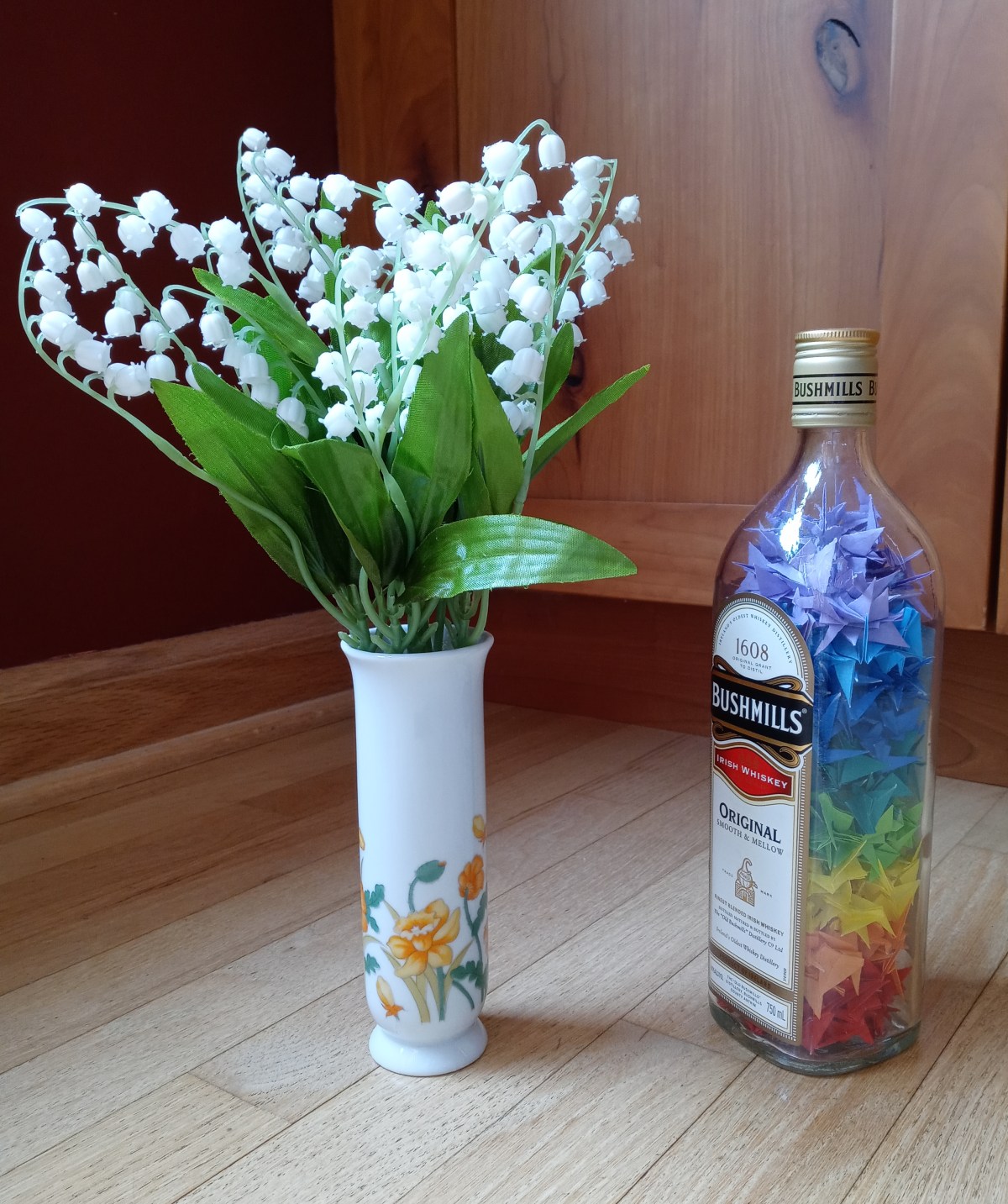
We did observe Valentine’s Day, but quietly at home and on Monday instead of over the weekend. As I am at a point in my grief process where planning celebrations is still difficult, spouse B did the lion’s share of the work, with daughter T contributing thoughtful cards and candles for the table. I did bring home a pot of mini-daffodils and some dairy-free chocolate for B and T, a token nod to the tradition of flowers and chocolate for Valentine’s Day.

B planned and executed a lovely dinner for the three of us. He made individual Beef Wellington with mushrooms rather pâté, served with fresh sautéed green beans. For dessert, he made white chocolate mousse, which was rich and delicious. He chose that because I can no longer eat cocoa but still enjoy the luxurious melt-in-your-mouth-ness of cocoa butter.

A sweet and quiet Valentine’s Day suits me.

Thanks to B, it was what we were able to celebrate.

over COVID?

Over the last few weeks, many people here in the United States have said publicly that they are “over COVID” or “through with the pandemic” and are going to “go back to normal” which means living like they did before SARS-CoV-2 appeared.

Guess what? Pandemics don’t disappear just because we are tired or frustrated or in denial. There were 3,622 COVID deaths reported in the US yesterday, adding to the almost 900,000 deaths in the US since the start of the pandemic and 5.7 million deaths worldwide. These staggering totals are almost certainly undercounted, as some regions don’t have the will or capacity to track and report. Also, some deaths result from lasting heart, lung, or neurological damage from COVID rather than from the active infection itself and so may not be identified as COVID related.

Some people are saying we just have to live with COVID, as we do with flu and other viruses. Thus, they are saying that it is now endemic, but here is the problem. There is a specific definition of pandemic, “(of a disease) prevalent over a whole country or the world” (Oxford Languages). Looking at case numbers in the US and around the world, it’s obvious this is still a pandemic. We will get to a point where it is endemic, someday, through a mix of vaccination and immunity from having been infected, although no one yet knows how long immunity acquired through either route will last. Dictionary.com has a handy non-epidemiologist explainer of pandemic, epidemic, and endemic.

The subtext of being “over COVID” seems to be more along the lines of I’m tired of masking and distancing and avoiding crowds, so I’m just going to get back out there because a) I’m vaccinated/boosted so I don’t think I’ll get sick or at least not seriously so; b) I am young/strong/take vitamins/exercise so I’m not going to get sick; c) I don’t believe there is such a thing as this virus; d) you can’t tell me what to do; or e) we have to ease up on restrictions now so that we can re-institute them when the next variant or spike in cases occurs.

The thing is that a virus doesn’t care about your age or status or location. It’s only mission is to live and replicate and it will adapt to make that happen as easily and widely as possible. Exhibit A: the Omicron variant, which is wildly contagious and somewhat able to cause breakthrough infections in the vaccinated.

As regular readers here may recall, spouse B, daughter T, and I are all part of the Pfizer/BioNTech phase three vaccine trial. We are all vaccinated and boosted, although we were boosted on the early side of the curve, B and T as part of the trial that is contributing efficacy data that we see reported out in the news, and I who received a booster through the trial as soon as it was authorized for public use but before most people in my age range were eligible. I am also contributing data for the study, but I’m not on the leading edge like B and T. Therefore, while many of the boosted can get comfort from knowing that their immunity is likely still strong because the data from the trials is showing that, I don’t know if B and T might be showing a decline because there hasn’t been enough time to collect and analyze that data. I’m sure we would all love to know that booster immunity lasts a year or longer but it’s only been about seven months so far, so we can’t know. Likewise, we don’t know how long immunity lasts after infection.

I know that I am unlikely to become seriously ill, to be hospitalized, or to die if I contract COVID, but that doesn’t mean that I’m ready to be cavalier about it. I don’t want to be sick if I can prevent it by continuing with masking, distancing, and avoiding crowds. Even mild cases of COVID can result in months of symptoms, which is termed “long COVID.” As someone who has lived with a person suffering from FM/ME, which causes similar symptoms, I find the prospect of long COVID frightening.

What frightens me even more is the danger of spreading COVID to someone else. I have many friends who are older than I and at higher risk, as well as friends who are immunocompromised. Young children still are not eligible for immunization, although Pfizer/BioNTech has just applied for emergency use authorization for children 6 months-4 years of age, so perhaps that will begin in the coming weeks. I’m sure I also happen upon unvaccinated people because the fully vaccinated rate in my county is 62% and the boosted rate is only 33%. Some of the fully vaccinated are not yet booster eligible but we know that boosted people have the best chance against Omicron, so, if I am out in public, chances are that only 1 in 3 people I encounter will be a similar status to me.

Those are not great odds, especially with a variant as contagious as Omicron accounting for 99% of US cases. I have recently upped my mask protection to N95s, as I wrote about here. I’m learning how to deal with them as someone who needs progressive lenses in her glasses. The tighter fit of the N95 masks makes it difficult for my glasses to be in the correct position, so I can get a headache from eyestrain if I try to do close work for any length of time. Still, I’m trying to wear the N95s when I have to go out with a surgical mask/good quality cloth mask combo if I have to take the N95 off.

I used this site, https://covidactnow.org/us/new_york-ny/county/broome_county/?s=28791756, to find today’s Broome County statistics. (You can use it to find statistics in your area in the US. International data may be found here: https://coronavirus.jhu.edu/.) It rates our risk level as “Extremely High.” While other may be “over COVID,” I am not ready to take that much risk for myself, my family, and my community.

As conditions change, I will re-evaluate and adjust my behavior as I see fit. Until then, I hope that those I meet will respect my viewpoint.

I’m not “over COVID” yet.

SoCS: JC’s Confessions #21

[Non-stream of consciousness introduction. Linda’s prompt for Stream of Consciousness Saturday this week is to write about the first thing that come to mind from the phrase “let go.” I drew a blank at first but then this topic floated to the surface, probably because it was on my list of things to write about in my series, JC’s Confessions, so what follows is the very dangerous intersection of writing stream of consciousness on a difficult topic. I do use a standard opening to explain JC’s Confessions, which will follow as a block quote before launching into the SoC portion of the post.]

In the first few seasons of The Late Show, Stephen Colbert did a recurring skit, now a best-selling book, called Midnight Confessions, in which he “confesses” to his audience with the disclaimer that he isn’t sure these things are really sins but that he does “feel bad about them.” While Stephen and his writers are famously funny, I am not, so my JC’s Confessions will be somewhat more serious reflections, but they will be things that I feel bad about. Stephen’s audience always forgives him at the end of the segment; I’m not expecting that – and these aren’t really sins – but comments are always welcome.

JC

I have trouble letting go of guilt.

Even when I’m feeling guilty about something that is not my fault.

Even when it’s something I couldn’t possibly have known. Or remedied.

I’ve had family members diagnosed with conditions which took years to figure out, yet I’m the one who feels guilty/responsible for not having figured it out sooner, even though I am not a trained health professional, just a family member and caregiver.

It would have taken asking totally implausible questions to figure some of these diagnoses out. For example, it turned out years later that one of my daughters’ migraines had started as a child with visual migraines, which manifested as things changing colors. Who would think to point out to their child that, in almost all instances, color is a fixed attribute of an object? Yet, I feel guilty for not having realized this problem before the more serious later intractable migraine that took six months to diagnose, two more to break, cost her a semester of high school, and would later prove to be only a small part of a larger diagnosis of fibromyalgia, now known as ME, and chronic fatigue syndrome.

Never mind that it took the doctors ten years to figure it out from the time symptoms first appeared. As a mother, I thought I should have known and been able to alleviate her suffering and help her.

I know that this guilt is totally irrational. I know that my family doesn’t hold me responsible for not being a super-doctor or God or some all-knowing being and getting them help sooner, but still, as hard as I try, there is a vestige of guilt that I can’t shake.

(I can hear those of you who were raised Catholic thinking that this is par for the course of Catholic guilt, although I think it is probably not only that.)

One of my more recent struggles with this problem is the fact that it took months of suffering before my father, known here as Paco, was diagnosed with heart failure, only days before his death. I tried and tried to get the health professionals at his facility to figure things out and treat him appropriately but I failed, robbing him of the peace, comfort, and dignity he deserved in his final months.

It hurts.

I know that I shouldn’t feel guilt on top of the pain, that I’m not at fault, but I still can’t shake the underlying sense of responsibility, failure, and guilt.

Maybe, eventually, I’ll be able to let it go.
*****
Join us for Linda’s Just Jot It January and/or Stream of Consciousness Saturday! (I promise it does not have to be as fraught as this post unfortunately is.) Find out more here: https://lindaghill.com/2022/01/28/the-friday-reminder-for-socs-jusjojan-2022-daily-prompt-jan-29th/

a long haul

I’ve been thinking a lot about my late father, known here as Paco, recently.

I wish I could say that I am browsing old photos or remembering family holidays but, instead, I am mired in dealing with trying to settle insurance claims and begin the work needed to file his final tax returns and other estate sort of things.

Unfortunately, some of the issues are medical and it is bringing me back to a place of feeling helpless to alleviate Paco’s symptoms and not being able to get timely and accurate information about his condition.

It’s difficult and energy-draining and makes me feel like crawling into bed and pulling the covers over my head.

I’m not doing that.

I am trying to shepherd my energy and steel myself to chip away at all the work. It’s going to take a long time to get through it all.

It remains to be seen whether I can get the sadness to abate somewhat before I finish or not.
*****
Join us for Linda’s Just Jot It January! Find out more here: https://lindaghill.com/2022/01/24/daily-prompt-jusjojan-the-24th-2022/

Review: Encanto

When we went to the UK to visit our family for the holidays, four-year-old granddaughter ABC watched the Disney film Encanto frequently. I was impressed with it but hadn’t realized how popular it had become until after we returned to the US and it seems that I run into commentary on it several times a week, including news that the soundtrack and individual songs from Encanto have been appearing in high positions in the Billboard charts.

For the few of you who may not know, Encanto tells the story of the Madrigal family from Columbia who use their magical gifts to help their community. Granddaughter Mirabel appears not to have been given a magical gift but her strong love for her family and their home powers the story.

Much of the commentary that I’ve seen concentrates on how important it is to have this portrayal of a Latinx family and story, along with inclusion of Spanish in the dialogue and songs. I agree with this point but want to note some other ways that this film feels inclusive to me. As someone whose family is racially diverse, I appreciate that the Madrigals have Indigenous and Black roots, as well as (presumably) European. As someone who wore glasses from a young age, I love that Mirabel wears glasses. I could get all metaphorical about clarity of vision, but I won’t. It’s just nice to see a positive portrayal of a girl who wears glasses in an animated movie.

The biggest point of inclusivity for me is the complexities of the family relationship. The most popular song in the soundtrack, the ensemble piece “We Don’t Talk about Bruno”, reminds me that my own family had an uncle that was seldom mentioned for mysterious reasons. We see Mirabel and her non-magical father struggle with finding their place within the family, which is a familiar issue in many families, for example, when a very sports-oriented family has a member who would rather be singing in the chorus than out on the field with a ball.

We also see the double-edged sword of trying to live up to family expectations. While it’s admirable that members of the family want to use their gifts to serve the family and the community, it’s all too easy to see each only for that one gift and not for the complex being that they are. This leads to feeling that it is only that gift that makes you valuable or loved. The clearest expression of this is “Surface Pressure”, the song that Mirabel’s sister Luisa sings. Luisa’s gift is that she is very strong, so she is much in demand at home and in the village. The song shows how difficult it is to deal with the pressure of those demands and her own worries and insecurities. She sings, “Under the surface/I’m pretty sure I’m worthless if I can’t be of service.” Ouch. How often in our families do we pigeonhole someone in a specific role, overlooking other attributes and gifts they bring? How often do we take for granted the work that someone does or make it seem that they are only valuable in what they can do, not in who they are as a person?

To me, among Mirabel’s gifts are love, thoughtfulness, insight, curiosity, caring, and truthfulness. None of them are “magical” but the results of them can be miraculous.

They can be for our own families and communities, too, if we honor those gifts and each other as Mirabel does.
*****
Join us for Linda’s Just Jot It January! Find out more here: https://lindaghill.com/2022/01/21/daily-prompt-jusjojan-the-21st-2022/

the pandemic – year 3

My first post about the pandemic was February 29, 2020, a Stream of Consciousness Saturday post, no less! COVID-19, the illness caused by the SARS-CoV-2 virus, was already killing people in China, other parts of Asia, and Europe but had just begun to sicken and kill people in the United States, where I live.

I’ve written dozens of posts since then about the impact of the pandemic on our lives and about spouse B, daughter T, and my participation in the Pfizer/BioNTech vaccine trial. Yesterday, B and T, who are being followed currently on the efficacy of the third dose, had an appointment for blood work to add to the data on the longevity of antibodies and other immune markers six months after their third dose. I am also boosted and remain part of the trial, although, as someone who was in the placebo group initially, I am now part of the group who received their third dose later, so I am not on the leading edge in terms of data. There is a possibility that, when Pfizer/BioNTech develop an Omicron-specific booster, we may be asked to participate in that phase of the trial as well. Meanwhile, we continue to do weekly check-ins via app and do testing if symptoms that could be COVID appear.

I am grateful that we are able to help advance the science on the vaccines which have averted millions of hospitalizations and deaths. Even though the Omicron variant causes more breakthrough cases among vaccinated and boosted individuals than earlier variants, the vast majority are still protected from serious complications and death. I’m just sad that so many people around the world, by personal choice or by lack of availability, remain unprotected.

While Omicron tends to cause less severe symptoms than some of the earlier variants, it can still be deadly. The case numbers in the US, almost all caused by Omicron at this point, are staggering, reaching record numbers. On January 11, the US reported 1.35 million new cases with 136,604 hospitalizations, both records. The case count is somewhat elevated by the fact that some states don’t report new cases over the weekend, making the Monday numbers higher, but the seven-day average is over 700,000, so there are extraordinary levels of infection in evidence. Some hospital systems are overwhelmed, especially because staffing is a challenge. Many health care workers are exhausted by the sheer volume of patients and length of the pandemic and some have left the field. Right now, there are also a lot of vaccinated and boosted staff who have developed breakthrough cases; even if they are asymptomatic, they could still be contagious, so they have to isolate until they test clear of the virus.

The difficult thing for me to accept is that so many people in the US have chosen not to be vaccinated, despite the risks to themselves, their families, and their communities. Because Omicron is so transmissible, the safest course of action is to be vaccinated and boosted, while continuing to mask in indoor public spaces, to distance from non-household members, to avoid crowds, to sanitize appropriately, and to test before (small) social gatherings. By combining all those measures, B, T, and I were able to travel to London, where Omicron was running rampant, and get home virus-free.

Yes, going into year three of this, we are all tired of having to think about COVID safety all the time, but the virus doesn’t get “tired” of mutating and infecting people. We need to do everything we can to promote public health and to protect those who because of age or health condition can’t develop vaccine protection. We have to continue to study the virus, including all variants, to assess their impacts, including how long and strong immunity is from vaccines and from infection. Unfortunately, many viruses don’t tend to confer long-lasting immunity. If they did, we wouldn’t continue to get common colds repeatedly. Current research on SARS-CoV-2 shows immunity extending to about eight months. Some suggest that immunity could stretch to five years but we can’t know that yet, as this virus hasn’t been around that long. It also looks like some of the variants, like Omicron, are better at evading immunity, whether from prior infection or vaccines. We also have to be prepared for further variants that could be even more transmissible and/or cause more severe disease.

We are still in the pandemic phase with COVID-19. The world is unlikely to be able to rid itself of the virus totally. At some point, we will reach an endemic phase, where the virus is in circulation but not causing widespread serious illness/deaths through some combination of vaccines, natural immunity, and treatments. Will year three be the final year of this pandemic? No one knows for sure, but I am trying to hang onto hope that it will be.
*****
Join us for Linda’s Just Jot It January! Find out more here: https://lindaghill.com/2022/01/13/daily-prompt-jusjojan-the-13th-2022/

trip reflections

Over the past three weeks, I’ve posted frequently about the trip spouse B, daughter T, and I took to London to visit daughter E, her spouse L, our granddaughters ABC and JG, and L’s parents, with whom they live.

Here at Top of JC’s Mind, I always try to be truthful, so I must say that the best word to describe the trip as a whole is complicated.

It featured: L’s bout with Omicron that began several days before we arrived; delayed COVID test results that kept B and T in Newark overnight while I flew alone to London; bad colds for B and me; flares of chronic health conditions among several of us; a couple of bad backs; booster shot side effects; a lot of restless nights without adequate sleep; teething; upset tummies; a couple of strained backs; the news of the death of a friend back home; a badly swollen nose from JG throwing her head back into the person holding her, as toddlers are wont to do; a dearth of alone time for the introverts among us; the inadvisability of going to church for Christmas, Sundays, and Epiphany; JG’s reluctance to let us hold her if her mom was in the building; and a dead battery in our van after we flew back into Newark.

Despite all that there are many thing for which I am grateful:

That we were able to go at all, despite Omicron running rampant on both sides of the pond, and that the UK didn’t impose restrictions on private gatherings as they had done earlier in the pandemic. We appreciated the high level of compliance with masking and distancing and avoided crowds. I credit that, along with being triple vaxed with Pfizer/BioNTech and testing, for keeping us COVID-free.

Our Airbnb in E’s neighborhood, only a couple of blocks from their house. Being so close meant we didn’t need to go on public transport to visit. It also gave us the opportunity to have sleepovers, including having E, JG, and ABC overnight on Christmas Eve, just as L was able to finish up his COVID isolation period. It was fun to have Christmas stockings and breakfast with them at our place before going over to their house for Christmas dinner and presents. Four-year-old ABC was also thrilled to have some solo sleepovers with her Nana, Grandpa, and Auntie T, including our last night in town. ABC even got to help with making some Christmas cookies in our kitchen, reminding us of her days helping Grandpa in our kitchen back home in New York when she and E lived with us for over two years before E’s spousal visa came through.

Getting to have a lot of family meals together. Most were cooked at home, but we also were able to do some by delivery, including some yummy London fish and chips.

Walks in the neighborhood, in the parks, and to ABC’s school. She was on break most of the time we were there, but did have three days of school during our last week there. E and T even got to have a special sisters outing to a botanic garden. It was strange, though, to see some flowers still blooming, including roses. London was having an oddly warm spell. We did see quite a lot of holly and ivy, though, bringing to mind the traditional British Christmas carols.

Television and Internet. While we couldn’t go to church in person for fear of Omicron, we were able to watch Lessons and Carols live on Christmas Eve. I was able to watch recordings of liturgies from my local parishes back home on my laptop. We were also able to enjoy some children’s programming with ABC and JG. I especially like Bluey, an Australian series which is part of the CBeebies (BBC’s children’s television channel) line-up. ABC was also watching Frozen II and Encanto quite frequently, both of which were new to us.

The chance to renew bonds with ABC, who can remember us from when she lived with us. The opportunity to re-introduce ourselves to JG, who we met for the first time when she came to the States last August, just after she turned one. We are hoping that she will be able to realize who we are now when we videochat so that we aren’t starting from scratch again as strangers when next we meet, but it’s difficult to know if that is possible. A few months between visits is a significant chunk of a lifetime to a toddler.

Seeing E. Even though we were both tired and stressed, I appreciated the snatches of conversation we were able to have. I remember what it was like to be responsible for two little girls under five, with a lot of that time being solo. I sincerely wish I could be there more to help but that isn’t in the cards right now. The ocean is a big barrier, except for my love, sympathy, and empathy.

E will always have my heart.
*****
Join us for Linda’s Just Jot It January! Find out more here: https://lindaghill.com/2022/01/11/daily-prompt-jusjojan-the-11th-2022/

white chocolate

I had intended to write a summary post about our trip today, but I don’t have the brainpower to do it, so I am actually writing on the Just Jot It January prompt today, which is “chocolate”!

I like chocolate and used to eat it on a regular basis. One of my favorite things to make was spiced hot cocoa, especially on cold winter days.

Unfortunately, I’ve discovered that cocoa aggravates my interstitial cystitis, so I’ve had to stop eating chocolate. I can, however, still eat white chocolate, which I’ve learned to enjoy. I’ve discovered that it is important to read labels because some products that look like white chocolate are not, being made with various oils rather than cocoa butter. Real white chocolate is lovely and delicate and melts in your mouth.

Sometimes, I even forget to miss not eating regular chocolate.

On our trip, I acquired some white chocolate treats. B and T found some shaved white chocolate to use to make white hot chocolate and E spotted a huge white chocolate with nougat Toblerone.

That should keep me happy for a while!
*****
Join us for Linda’s Just Jot It January! Find out more here: https://lindaghill.com/2022/01/10/daily-prompt-jusjojan-the-10th-2022/