No CO2 Fracking in NY!

I’m pleased to report that, over the weekend, New York Governor Kathy Hochul finally signed the bill adding carbon dioxide to the existing ban on hydraulic fracturing (fracking) in the state. We recently observed the tenth anniversary of the ban.

You can read more about the bill and how important it is to keeping us safe here.

A huge thank you to State Senator Lea Webb, sponsor of the bill in the Senate, and Assemblymember Anna Kelles, sponsor in the Assembly. Thanks also to Donna Lupardo, my Assemblymember, who was a co-sponsor. I will always be grateful to the large coalition of scientists, experts, Indigenous Nations, environmental organizations, and concerned individuals who have been at work for years on this issue for the good of our health, our environment, and our climate.

Broome County, where I live, would have been among the first targeted with this dangerous experiment to use supercritical carbon dioxide to extract methane. I’m grateful that our state will remain frack-free!

Celebrating ten years of the New York fracking ban

Ten years ago today, New York State announced an administrative ban on high-volume hydraulic fracturing (fracking) in the state. (in 2021, the legislature made it a law.)

To celebrate, Food & Water Watch, one of the lead organizations in fighting fracking, has compiled a free, commemorative e-book, which you can download here.

A large coalition of organizations, environmentalists, indigenous nations, scientists, engineers, and concerned citizens had spent years advocating for a ban, helped by many of our Pennsylvania neighbors who were suffering from the harms of fracking in their communities. There had been rallies, commentary in the press and at hearings, educational events, scientific papers and lectures, and showing up at public appearances by then-Governor Andrew Cuomo leading up to the ban, which occurred when the Dr. Howard Zucker, the Health Commissioner, said that fracking was too dangerous for New Yorkers’ health, ending what had been a very fraught battle over the SGEIS (Supplemental Generic Environmental Impact Statement) that would have allowed fracking without need for site-specific studies.

Yes, that sounds very wonky but we were lucky to have lawyers and other experts in the coalition who could break everything down for us into understandable, actionable bits.

My role in the efforts to ban fracking was as a member of the Rapid Response Team. We would receive links to articles about fracking in the media and write comments to bolster the truth and challenge misinformation. It was intense at times but it meant a lot when I would be at a rally or event and people from other parts of the state would recognize my name from comments I had written. It was good to know that my little part was helpful to the cause.

When the announcement came from Albany ten years ago, there was rejoicing from all parts of the coalition and a celebration here in Binghamton, which had been the epicenter of both the pro- and anti-fracking efforts. Unfortunately, I couldn’t attend because I was sick with shingles. I was very grateful, though, and as excited as I could manage to be.

We aren’t having a party on this tenth anniversary but we are all awaiting Governor Kathy Hochul signing a bill that will add carbon dioxide to the existing fracking ban. The bill was passed in March and we have been urging her to sign it ever since.

Many bills get signed in December so it could be any day now, although I’m hoping it will be today.

It would be a fitting tenth anniversary commemoration and a reminder to the nation that New York says NO to fracking!

Update: On Dec. 21, Governor Hochul finally signed the bill. You can read the press release from coalition members here.

SoCS: my new piece!

I’ve had a new piece published!

It’s a personal essay rather than my usual poetry.

I posted about it earlier and, yes, this is a way to get more views for Generations Today, who published this story of my relationship with nature and how that lead to my climate activism.

Enjoy!
*****
Linda’s prompt for Stream of Consciousness Saturday this week is to build the post around a word that has “i before e.” Join us! Find out more here: https://lindaghill.com/2024/09/27/the-friday-reminder-and-prompt-for-socs-sept-28-2024/

Article in Generations Today!

I am thrilled to announce that I have an article in the September/October issue of Generations Today, the online magazine of American Society on Aging. Many thanks to Alison Biggar, editorial director, for the invitation to contribute and for the editorial assistance, titling, and attention to all the other little details that go into publication.

The theme of the issue is the relationship with nature and volunteerism among elders. My piece is “One Woman’s Evolution Into a Climate Warrior” – not a term that I would claim on my own, but one that I gratefully accept as bestowed by Alison.

The article traces my involvement with the natural world and renewable energy from my childhood up to the present time with shout-outs to the anti-fracking movement in New York, the Creation Care Team at St. Francis of Assisi Catholic Church in Binghamton, and Third Act.

There is even a link to Silver Birch Press, who first published my poem “How I Help Heal the Earth from Upstate New York” as part of their HOW TO HEAL THE EARTH series. The poem is reprinted in the article.

When Alison first approached me to contribute to this issue, she said they were looking for someon who could “wax poetic” about nature and volunteering for a climate change organization. I’m not sure she expected an actual poem to appear in the article but this “late-blooming” poet could not resist!

I hope you enjoy the article and the others in this issue of Generations Today and that they inspire you to reflect on your own relationship with nature and to volunteer if you are able, whatever your age, location, or circumstance. Together, we can make a difference!

(Photo credit: Brent Boivert)

SoCS: time

“Tick-tock. Time’s a-wasting.”

I remember that saying from when I was young, although I haven’t heard it for a long time now.

But, yeah, time is rushing by with so much pressure these days.

My inbox is filled with urgent messages about the upcoming election, the climate crisis, closing submission calls for poetry and manuscripts, important meetings and webinars, pleas for donations. (I probably should have said inboxes, as I have several email addresses that I have to maintain.)

And I have very limited energy to respond.

While we continue to rule out reasons for my health issues, we haven’t been able to track down the underlying cause. We are addressing the symptoms that we can but the most upsetting ones, the fatigue and brain fog, aren’t able to be improved at this point. I’m working around them as best I can by listening to my body and trying to be gentle with myself.

But, tick-tock, time is rushing by with all its demands and things that can’t/won’t wait.

And I’m only able to do a sliver of what I wish I could.

I do try to remind myself that I’m only a very, very, very tiny entity in this world and in all these efforts and that others are taking up the slack. It won’t be my fault if the election goes to the Republicans and they crash the country and trash the climate (except that I know I share the guilt of social sin, but I can’t stream-of-consciousness an explanation of Catholic social justice doctrine and our responsibilities to humanity and the world. And you’re welcome that I’m not trying to.)

The more personal side of dealing with my health right now is that I have a ton of work to do with my poetry and it is taking a loooong time to do it, if I can do it at all. There is also the sinking feeling that it isn’t as good as it could/should be. There is also the fear that I won’t be able to recover fully from this and will face yet another instance in my life where I set aside my own work to deal with other pressing concerns and then lost the ability to go back to it. I am content with those past choices I made and would not change them, but this feels different because it is my own health that is the obstacle this time.

The biggest regret, though, is that another family member is dealing with a bigger health issue and I’m not as able to help as I would like to be.

Tick-tock. Time’s a-wasting…
*****
Linda’s prompt for Stream of Consciousness Saturday this week is “tack/tech/tick/tock/tuck.” Join us! Find out more here: https://lindaghill.com/2024/09/06/the-friday-reminder-and-prompt-for-socs-sept-7-2024/

One-Liner Wednesday: no CO2 fracking in NY!

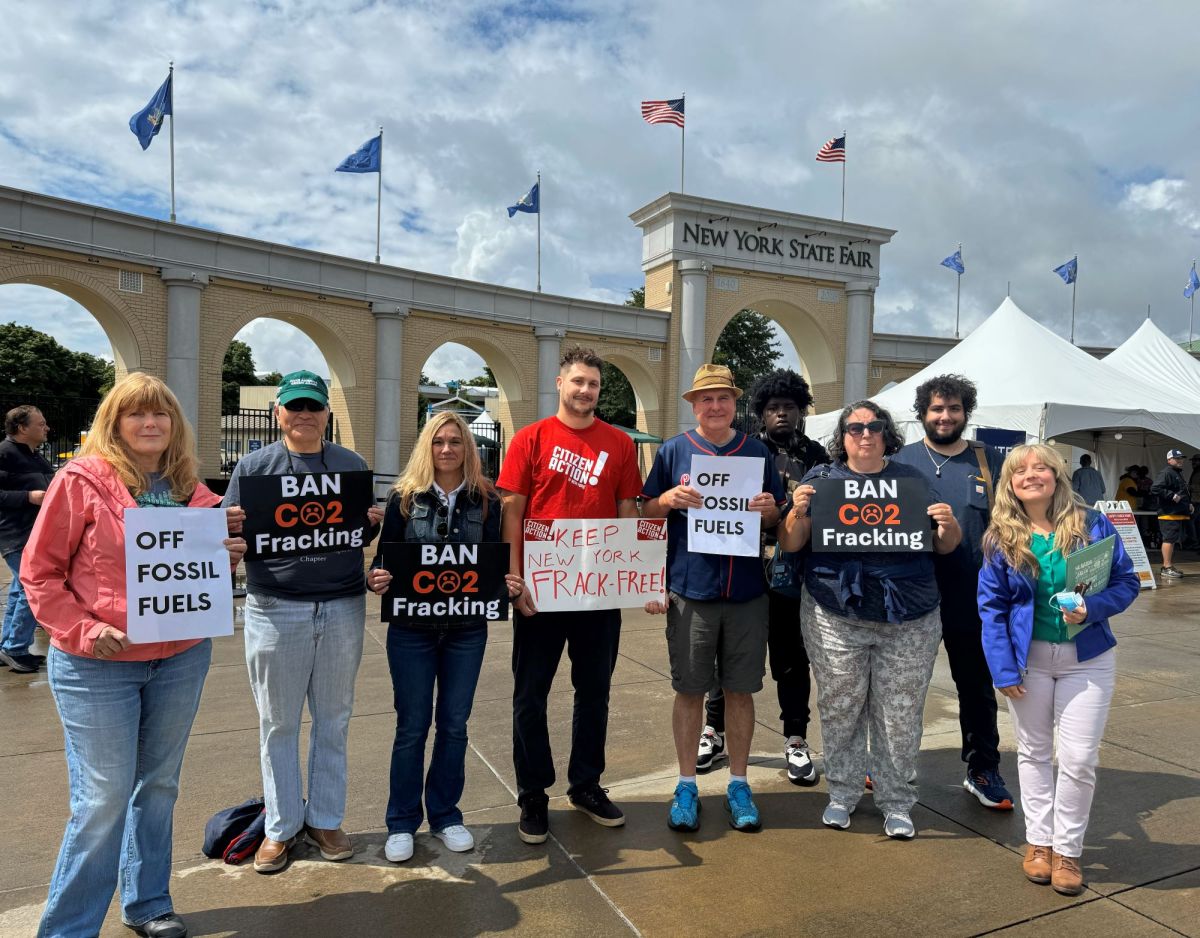
On the first day of the New York State Fair, we call on Governor Kathy Hochul to sign the bill adding carbon dioxide to our state’s fracking ban for the good of our health, environment, and climate.

Join us for Linda’s One-Liner Wednesdays! Find out more here: https://lindaghill.com/2024/08/21/one-liner-wednesday-are-you-allergic-to-anything/

One-Liner Wednesday: Project 2025 and NOAA

Project 2025, the lengthy document spearheaded by the Heritage Foundation to lay out plans for the “conservative president” they expect to be elected this year, calls for disbanding NOAA (National Oceanographic and Atmospheric Administration), the United States’ premier agency for weather, ocean, and climate data and research. (p. 664)

This public service message is brought to you through Linda’s One-Liner Wednesday series. Find out more here: https://lindaghill.com/2024/07/31/one-liner-wednesday-particularly-pretty/

One-Liner Wednesday: Project 2025 and the EPA

Project 2025, the lengthy document spearheaded by the Heritage Foundation to lay out plans for the “conservative president” they expect to be elected this year, would gut the Environmental Protection Agency, sending most of those responsibilities to state and local governments who could then ignore the impacts of their industries on the public and the planet, starting with a Day One Executive Order and political appointees (pp. 422-3).

Join us for Linda’s One-Liner Wednesdays! Find out more here: https://lindaghill.com/2024/07/24/one-liner-wednesday-why-did-my-chicken-explode/

No-Mow May

In the United Kingdom and parts of the United States, there is an initiative called No-Mow May, encouraging people not to mow lawns (or a portion thereof) during the month of May in order to encourage the blossoming of wildflowers which provide food for bees, butterflies, and other pollinators.

In the spirit of No-Mow May, we have limited our lawn mowing in our front yard and left most of the back yard to grow on its own. The front yard starts things off with dandelions, which we let blossom but then wind up having to mow for propriety’s sake. B leaves the lawnmower on the highest setting, though, so that the spent dandelion stems get cut while sparing the violets and white clover that follow. Even though white clover is not native, our bumblebees seem to enjoy it. It’s also helpful that we use a battery-powered mower so that the plants don’t have to contend with the heat and exhaust of burning gasoline.

Besides those, the backyard has waves of additional flowers, including wild strawberry, bluets, forget-me-nots, speedwell, buttercups, celandine, ground ivy, and fleabane. While these help our pollinators, they also provide food for other animals, including rabbits.

Besides the lawn, we have other spring-flowering plants, including bleeding hearts, PJM rhododendron, dwarf daffodils, lily-of-the-valley, brunnera, amsonia, and our heirloom rose bush.

Although not all the plants are native, our native pollinators frequently visit them, which is important to us, especially our bumblebees. When we had a landscape plan drawn up and planted in fall 2020, we requested native plants, but some of the plants that grow wild in our yard are non-native species that are now considered naturalized in our area, though not invasive. If we do find invasive species, such as garlic mustard, growing, we try to pull them out so that they don’t spread. It is also helpful that we have had wildflowers growing as part of our lawn for decades. We never use herbicides. The mix of plants and not mowing it too short also make our lawn drought-resistant. We never have to waste water by spraying it on our lawn.

We may stretch No-Mow May into early June in the backyard so that the daisies that have started to grow up but haven’t blossomed yet have a chance to do so. Perhaps, B will do what he has done in some past years and mow around the daisies until they have had a chance to flower.

Do people observe No-Mow May – or some variation better suited to your geography, like Low-Mow May or No-Mow April, where you live?

Ada Limón at Smith College

About the featured image: Ada Limón, as poet laureate, has begun an initiative called Poetry in Parks in conjunction with the National Parks Service. To complement this project, she invited poets to write new work centered on our relationship with nature. In April, Milkweed Editions published You Are Here: Poetry in the Natural World as a testament to that enduring relationship.

Ada Limón, 24th poet laureate of the United States, gave an amazing reading at my alma mater, Smith College, on the last day of National Poetry Month, April 30, 2024, followed by a conversation with Matt Donovan, director of the Boutelle-Day Poetry Center at Smith.


So many things struck me about the reading, many of which resonate with my own poetic sensibilities. The sense of place and relationship with the natural world. The vast possibilities for poems that surrounds us. The exquisiteness of short poems, just long enough to offer what needs to be said. The way the mind seeks myriad connections. That there are poems written for oneself that may never be shared with others. The interest in received forms without the compulsion to write them for public consumption. The honesty and authenticity of her work and of her speaking between poems and responding to questions.

I was not able to be there in person but I know John M. Greene Hall, where the reading took place, well, having spent many hours there as a student rehearsing and performing with choral groups and practicing the organ. It’s a cavernous space, which seats about 2,000 people. I was awed at the intimacy that Ada Limón was able to project, as though she were reading and talking with a small circle of friends in a living room after dinner.

I wish I had been able to be there.

Maybe, someday, I will hear her read in person.