SoCS: time

“Tick-tock. Time’s a-wasting.”

I remember that saying from when I was young, although I haven’t heard it for a long time now.

But, yeah, time is rushing by with so much pressure these days.

My inbox is filled with urgent messages about the upcoming election, the climate crisis, closing submission calls for poetry and manuscripts, important meetings and webinars, pleas for donations. (I probably should have said inboxes, as I have several email addresses that I have to maintain.)

And I have very limited energy to respond.

While we continue to rule out reasons for my health issues, we haven’t been able to track down the underlying cause. We are addressing the symptoms that we can but the most upsetting ones, the fatigue and brain fog, aren’t able to be improved at this point. I’m working around them as best I can by listening to my body and trying to be gentle with myself.

But, tick-tock, time is rushing by with all its demands and things that can’t/won’t wait.

And I’m only able to do a sliver of what I wish I could.

I do try to remind myself that I’m only a very, very, very tiny entity in this world and in all these efforts and that others are taking up the slack. It won’t be my fault if the election goes to the Republicans and they crash the country and trash the climate (except that I know I share the guilt of social sin, but I can’t stream-of-consciousness an explanation of Catholic social justice doctrine and our responsibilities to humanity and the world. And you’re welcome that I’m not trying to.)

The more personal side of dealing with my health right now is that I have a ton of work to do with my poetry and it is taking a loooong time to do it, if I can do it at all. There is also the sinking feeling that it isn’t as good as it could/should be. There is also the fear that I won’t be able to recover fully from this and will face yet another instance in my life where I set aside my own work to deal with other pressing concerns and then lost the ability to go back to it. I am content with those past choices I made and would not change them, but this feels different because it is my own health that is the obstacle this time.

The biggest regret, though, is that another family member is dealing with a bigger health issue and I’m not as able to help as I would like to be.

Tick-tock. Time’s a-wasting…
*****
Linda’s prompt for Stream of Consciousness Saturday this week is “tack/tech/tick/tock/tuck.” Join us! Find out more here: https://lindaghill.com/2024/09/06/the-friday-reminder-and-prompt-for-socs-sept-7-2024/

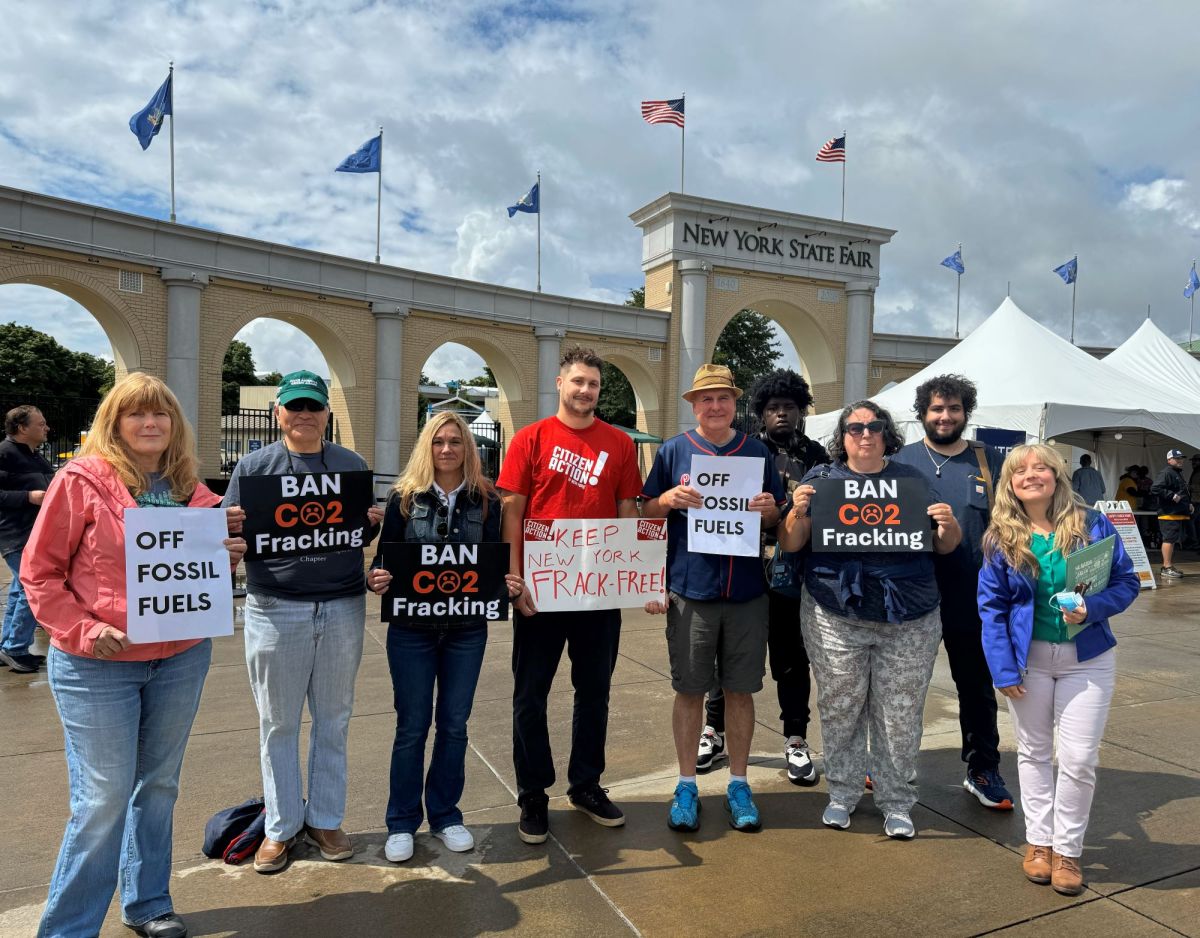
One-Liner Wednesday: no CO2 fracking in NY!

On the first day of the New York State Fair, we call on Governor Kathy Hochul to sign the bill adding carbon dioxide to our state’s fracking ban for the good of our health, environment, and climate.

Join us for Linda’s One-Liner Wednesdays! Find out more here: https://lindaghill.com/2024/08/21/one-liner-wednesday-are-you-allergic-to-anything/

One-Liner Wednesday: Project 2025 and NOAA

Project 2025, the lengthy document spearheaded by the Heritage Foundation to lay out plans for the “conservative president” they expect to be elected this year, calls for disbanding NOAA (National Oceanographic and Atmospheric Administration), the United States’ premier agency for weather, ocean, and climate data and research. (p. 664)

This public service message is brought to you through Linda’s One-Liner Wednesday series. Find out more here: https://lindaghill.com/2024/07/31/one-liner-wednesday-particularly-pretty/

One-Liner Wednesday: Project 2025 and the EPA

Project 2025, the lengthy document spearheaded by the Heritage Foundation to lay out plans for the “conservative president” they expect to be elected this year, would gut the Environmental Protection Agency, sending most of those responsibilities to state and local governments who could then ignore the impacts of their industries on the public and the planet, starting with a Day One Executive Order and political appointees (pp. 422-3).

Join us for Linda’s One-Liner Wednesdays! Find out more here: https://lindaghill.com/2024/07/24/one-liner-wednesday-why-did-my-chicken-explode/

No-Mow May

In the United Kingdom and parts of the United States, there is an initiative called No-Mow May, encouraging people not to mow lawns (or a portion thereof) during the month of May in order to encourage the blossoming of wildflowers which provide food for bees, butterflies, and other pollinators.

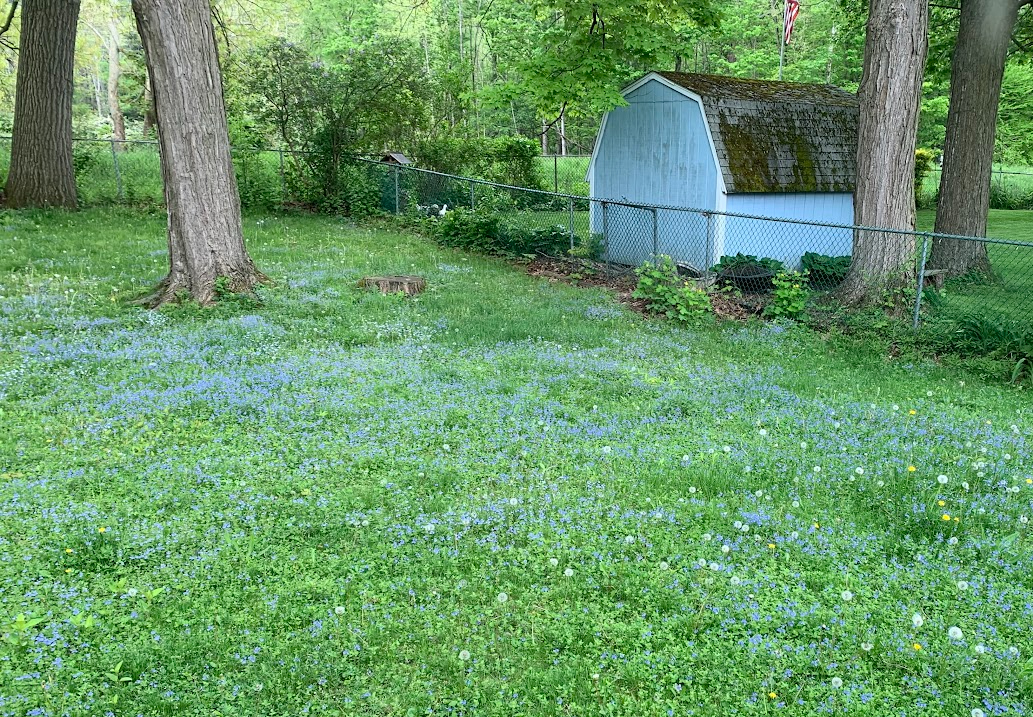
In the spirit of No-Mow May, we have limited our lawn mowing in our front yard and left most of the back yard to grow on its own. The front yard starts things off with dandelions, which we let blossom but then wind up having to mow for propriety’s sake. B leaves the lawnmower on the highest setting, though, so that the spent dandelion stems get cut while sparing the violets and white clover that follow. Even though white clover is not native, our bumblebees seem to enjoy it. It’s also helpful that we use a battery-powered mower so that the plants don’t have to contend with the heat and exhaust of burning gasoline.

Besides those, the backyard has waves of additional flowers, including wild strawberry, bluets, forget-me-nots, speedwell, buttercups, celandine, ground ivy, and fleabane. While these help our pollinators, they also provide food for other animals, including rabbits.

Besides the lawn, we have other spring-flowering plants, including bleeding hearts, PJM rhododendron, dwarf daffodils, lily-of-the-valley, brunnera, amsonia, and our heirloom rose bush.

Although not all the plants are native, our native pollinators frequently visit them, which is important to us, especially our bumblebees. When we had a landscape plan drawn up and planted in fall 2020, we requested native plants, but some of the plants that grow wild in our yard are non-native species that are now considered naturalized in our area, though not invasive. If we do find invasive species, such as garlic mustard, growing, we try to pull them out so that they don’t spread. It is also helpful that we have had wildflowers growing as part of our lawn for decades. We never use herbicides. The mix of plants and not mowing it too short also make our lawn drought-resistant. We never have to waste water by spraying it on our lawn.

We may stretch No-Mow May into early June in the backyard so that the daisies that have started to grow up but haven’t blossomed yet have a chance to do so. Perhaps, B will do what he has done in some past years and mow around the daisies until they have had a chance to flower.

Do people observe No-Mow May – or some variation better suited to your geography, like Low-Mow May or No-Mow April, where you live?

Ada Limón at Smith College

About the featured image: Ada Limón, as poet laureate, has begun an initiative called Poetry in Parks in conjunction with the National Parks Service. To complement this project, she invited poets to write new work centered on our relationship with nature. In April, Milkweed Editions published You Are Here: Poetry in the Natural World as a testament to that enduring relationship.

Ada Limón, 24th poet laureate of the United States, gave an amazing reading at my alma mater, Smith College, on the last day of National Poetry Month, April 30, 2024, followed by a conversation with Matt Donovan, director of the Boutelle-Day Poetry Center at Smith.


So many things struck me about the reading, many of which resonate with my own poetic sensibilities. The sense of place and relationship with the natural world. The vast possibilities for poems that surrounds us. The exquisiteness of short poems, just long enough to offer what needs to be said. The way the mind seeks myriad connections. That there are poems written for oneself that may never be shared with others. The interest in received forms without the compulsion to write them for public consumption. The honesty and authenticity of her work and of her speaking between poems and responding to questions.

I was not able to be there in person but I know John M. Greene Hall, where the reading took place, well, having spent many hours there as a student rehearsing and performing with choral groups and practicing the organ. It’s a cavernous space, which seats about 2,000 people. I was awed at the intimacy that Ada Limón was able to project, as though she were reading and talking with a small circle of friends in a living room after dinner.

I wish I had been able to be there.

Maybe, someday, I will hear her read in person.

No to CO2 drilling in New York!

One of the things that has been occupying me over these last weeks is the unwelcome and unexpected need to return to the battle against unconventional gas drilling in my home region, New York’s Southern Tier (central NY along the border with Pennsylvania).

I was active with the coalition that successfully advocated for a ban on high-volume hydraulic fracturing in New York, which was first regulatory/executive in Dec. 2014 and made legislative in 2021.

In late summer/fall of 2023, a newly-formed, Texas-based company called Southern Tier CO2 to Clean Energy Solutions, Southern Tier Solutions or STS for short, began approaching landowners in Broome, Tioga, and Chemung counties with lease offers to use supercritical carbon dioxide to extract methane from the Marcellus and Utica shale formations thousands of feet under their land, claiming that it would also sequester the carbon. The scheme would involve thousands of miles of new CO2 and methane pipelines, plus ten or so new methane-burning power plants, which would burn the methane to produce carbon dioxide to use to extract more methane.

Mind you, this has never been done at scale anywhere in the world and does not have any solid scientific backing. The very real negative impacts of high-volume hydrofracking would be compounded by the dangers of carbon dioxide pipelines and injection, all at a time when New York State is implementing its landmark Climate Leadership and Community Protection Act to move us away from fossil fuels and toward renewable energy powering our lives efficiently.

When news of STS’s plans came to light, my New York State legislators, Assemblymember Donna Lupardo and Senator Lea Webb, began asking the Department of Environmental Conservation questions. I admit that I was alternating between fear and disbelief that the hard-won ban might be in jeopardy because it was predicated on the volume of water used and STS’s proposal plans to use supercritical carbon dioxide instead of water.

Fortunately, the coalition that had fought for years to win the hydrofracking ban quickly reconstituted and got to work. A coalition letter from over 90 organizations went out in December. Legislators got to work on legislation to add carbon dioxide to the existing ban with Dr. Anna Kelles as sponsor in the Assembly with Donna Lupardo as a prime co-sponsor and Lea Webb as sponsor in the Senate.

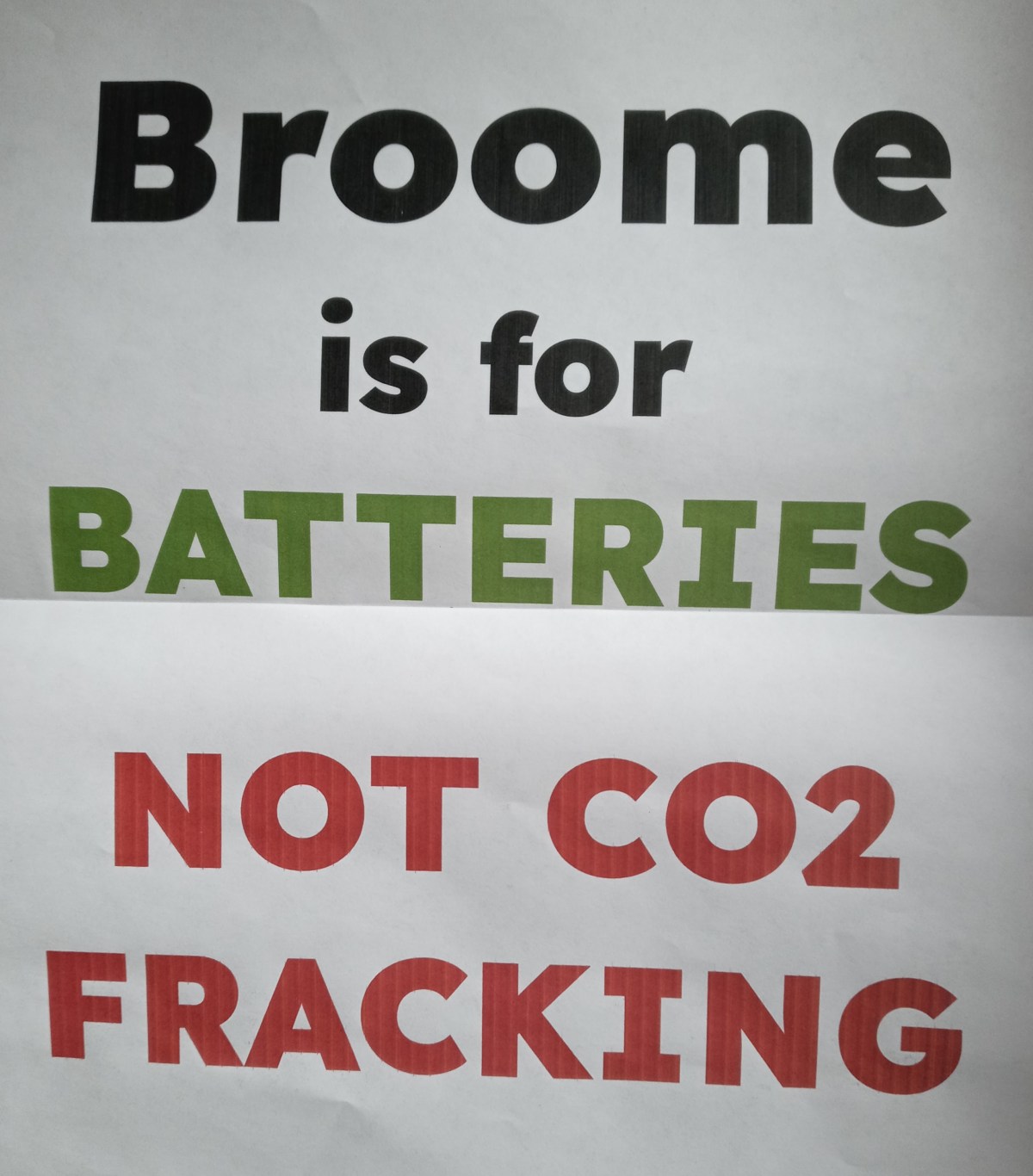
On March 5th, the coalition held a rally/lobby day in Albany. We had great speakers at the rally, including legislators, scientists, and leaders of organizations. I went local with my sign, emphasizing that the Broome County (Binghamton) area is part of the clean energy future as the center of a national technology hub for battery storage through the New Energy New York coalition and neither needs nor wants to be tied to dying fossil fuels. This was my first experience with in-person rallying and lobbying at the New York State Capitol. I was overwhelmed by the noise and busy-ness of it all but grateful to have been able to do my small part in the effort.

I’m thrilled to report that, on March 12th, the Assembly passed the bill with a vote of 97-50 and. on March 20th, the Senate followed with a vote of 45-17. Now, we are moving into the final phase, asking Governor Hochul to sign the bill quickly.

I’m shocked that the coalition was able to get this to move so quickly in Albany. As a Southern Tier resident, I’m immensely grateful to have support from around the state. In the original fight against hydrofracking, there were some very loud voices that were willing to use the Southern Tier as a sacrifice zone to get cheaper methane for their own use; this time, with the CLCPA in place, we didn’t encounter that sentiment as much. I’m also especially grateful to the Third Act Upstate NY working group, who jumped in as soon as I raised the alarm. Third Act is too new an organization to have been around for the original fracking battles but many members have extensive experience with climate activism and organizing and know how to get the word out.

While it seems that this is a local issue of a few counties in New York, the carbon dioxide drilling/sequestration scheme has global implications. Like plastics, it is an attempt by the fossil fuel industry to keep the world dependent on fossil fuels for decades to come, in defiance of the science that demonstrates the need to reduce atmospheric greenhouse gases as quickly as possible to keep the planet livable.

Part of the price to get fossil-fuel bro Joe Manchin’s vote in the US Senate on climate legislation was to include massive subsidies for carbon sequestration. It’s those subsidies that are behind STS’s proposed scheme to profit from the methane in the Marcellus and Utica shales, which is not economically viable to produce on its own. Using carbon dioxide from burning fossil fuels to extract even more fossil fuels is also inherently deleterious to environmental health and the climate. While there may be some instances where industrial carbon emissions can be collected and sequestered, the geology of the Southern Tier would not seem to support long-term sequestration. Sequestration would also be near-impossible in areas with a history of oil and gas wells because there would be too many pathways for injected carbon dioxide to escape.

My hope is that the example of New York banning this extraction/sequestration scheme will help other jurisdictions around the world see through the fossil fuels industry’s increasingly desperate attempts to keep the world burning their dirty products, even with the effects of climate change already causing damage and misery on a global scale.

Watch for news of these kinds of proposals near you. Don’t fall for the lies of the fossil fuel industry. Follow the science. Advocate for clean, renewable energy. Let elected officials know that we need and want protection from pollution and climate change. With so much damage already having been done, we need to act decisively now.

Together, we can move in a positive direction, as we are here in New York.

One-Liner Wednesday: Senate debate

This afternoon in Albany, Senator Lea Webb will lead the effort to add carbon dioxide to New York State’s existing high-volume hydraulic fracturing ban, all of which I will explain in a post at some point…

This (somewhat informative) post is part of Linda’s One-Liner Wednesdays. Join us! Find out more here: https://lindaghill.com/2024/03/20/one-liner-wednesday-technology/

for the love of plants

My daughter T loves plants.

She loves them so much that she has a master’s degree in conservation biology of plants. One of her favorite things to do is remove invasive species so that native species can thrive. She can expound at length on the topic of relocating plant species to different elevations and latitudes to help them survive the effects of climate change.

At the moment, it’s winter here and she is recovering from shoulder surgery, so no eradicating of invasive species allowed in the near future.

She has to content herself with tending our indoor plants.

Under her care, the African violets and kalanchoe are in bloom.
*****
I shockingly used the prompt “plants” from J-Dub of J-Dub’s Grin and Bear It as part of Linda’s Just Jot It January. (It’s only shocking because I seldom use the prompts and usually meander off in my own direction.) Whether you want to use prompts or not, please join us! Find out more here: https://lindaghill.com/2024/01/21/daily-prompt-jusjojan-the-21st-2024/

One-Liner Wednesday: Ban CO2 fracking!

Yesterday, 90+ New York State organizations sent a letter to NYS officials, did a press release through Food & Water Watch, and held a press event, requesting that New York ban using carbon dioxide to fracture underground shale formations to extract methane and attempt to sequester carbon dioxide; this is important not only regionally in the Southern Tier of NY where it is being proposed (and where I live) but also nationally and internationally because fossil fuel companies are using this unproven, dangerous, and most likely ineffective scheme for extraction/carbon sequestration to justify their continued drilling for decades to come, despite the gravity and acceleration of climate change impacts.

This long, informative One-Liner is part of Linda’s One-Liner Wednesdays series. Join us! Find out more here:  https://lindaghill.com/2023/12/20/one-liner-wednesday-a-more-honest-version/