mostly fossil-free home!

A project that B and I have been working on for years is finally complete. With the installation of a geothermal heating/cooling system, we are able to disconnect our home from the methane infrastructure, which in our area means that we are no longer burning fracked gas from neighboring Pennsylvania in our home. Because we had previously installed a hybrid electric/heat pump hot water heater, our furnace had been the only thing still attached to the gas lines. Now that it is gone, we won’t have to pay for methane, which is relatively low-priced at the moment, or the delivery charges, which are relatively expensive in New York. Those savings will help with our electric bill, which will go up, although our panels in a community solar array generate a good chunk of our electricity. In our region of New York, changing from methane to geothermal for heating is considered a wash in terms of cost, but our air conditioning costs will be much lower with the heat pump than with our outdoor compressor unit.

We have done other projects to make our home more efficient, such as changing to LED lighting and adding more insulation. We use a rechargeable battery-operated lawn mower and electric leaf blower. The only two household things that will still use fossil fuels are our propane grill and our gasoline-powered snowblower, which is only needed a handful of times a year, if that.

We have also cut way back on our use of gasoline for transportation, driving an all-electric Chevy Bolt and a plug-in hybrid electric Chrysler Pacifica. We only use gasoline when we take the Pacifica on longer trips. It gets 30ish miles on battery. When it is running on gas, some of the engine power re-charges the battery, so even when we have no plug-in charge remaining, a quarter to a third of our miles will still be battery powered. It could be even more than that if we are driving on roads with terrain or lots of stop signs/lights because the braking is regenerative, meaning the energy from slowing the car goes toward charging the battery. It’s possible that, as rapid charging stations become more available, we may be able to take longer trips in our Bolt, which would cut our gasoline usage even further. (I know some of you urbanites are wondering why we don’t use mass transit. Unfortunately, our area has almost no mass transit available.)

We have tried to cut down our fossil fuel usage and control our total energy usage as much as is practicable, but I know there is one sector where our carbon footprint will become heavier rather than lighter. I have not been a frequent flyer in my first almost-six decades, but I am likely to be flying several times a year for the foreseeable future. With daughter E and granddaughter ABC’s recent move to London, I see a fair number of airplane flights coming.

The first one will be next month.

SoCS: hole in the ground

For the last three days, there has been a crew in our front yard drilling a 500-foot hole in the ground. That’s about 150 meters for all you people who live in the metric world, which is almost everyone except the US…

The reason for this is not to find water, which happened well before they hit rock at 80 feet. Instead, this very deep hole is to install a geothermal heating and cooling system.

I’m excited because, after the new system is in, we will be able to permanently disconnect our house from the methane supply system. Our cooling costs will also be much lower because geothermal systems are much more efficient than the typical central air conditioning unit.

I will be glad not to be using any fracked gas which has caused so much trouble for our PA (Pennsylvania) neighbors and the climate. We will also helping to support the New York State version of a “Green New Deal”, moving to renewable energy in a way that is supportive of impacted workers and communities.

At the moment, though, we just have a very deep hole in the ground with two tubes coming out of it – and a very, very muddy, messy yard.
*****
Linda’s prompt for Stream of Consciousness Saturday this week is “ground.” Join us! Find out how here:  https://lindaghill.com/2019/10/11/the-friday-reminder-and-prompt-for-socs-oct-12-19/

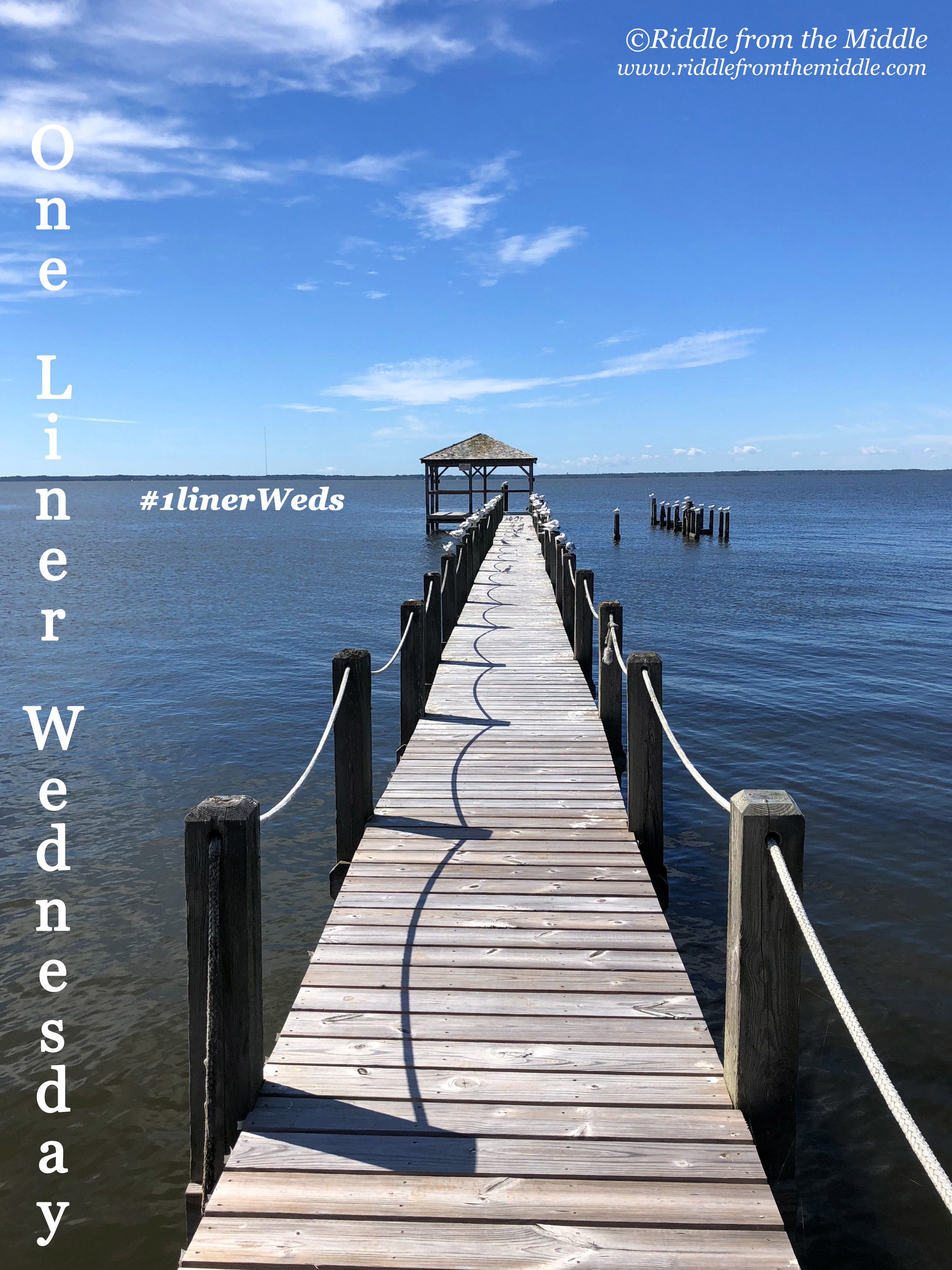
One-Liner Wednesday: presence

The biggest gift you can give is to be absolutely present, and when you’re worrying about whether you’re hopeful or hopeless or pessimistic or optimistic, who cares? The main thing is that you’re showing up, that you’re here and that you’re finding ever more capacity to love this world because it will not be healed without that.
~~~ Joanna Macy
*****
Join us for Linda’s One-Liner Wednesday! Find out how here: https://lindaghill.com/2019/10/02/one-liner-wednesday-sorry/ 

Badge by Laura @ riddlefromthemiddle.com

Climate strike – part two

Friday, September 27th was the last day of the Climate Action Week that featured youth-led marches, rallies, and work/school strikes around the world. As happened around the world, there was an opening event last Friday in Binghamton, with a larger event scheduled for the closing day.

This event was held at the Peacemaker’s Stage near the confluence of the Chenango and Susquehanna Rivers. We began with a welcome from the University student-organizers, who recalled that we were on land of the Onondoga Nation, who have endured centuries of broken treaties and environmental assault. This continued the emphasis on social/environmental justice as an integral component of climate action.

The climate movement in the United States is being energized by youth and indigenous leadership. At the Binghamton rally on Friday, there were speakers from the local high school and university, as well as young adults from Citizen Action and local government, either as city council members or candidates. There were people on hand to register new voters or process address changes for those who have moved to be ready for the local elections coming up in November.

Some of the speakers were people of color. Amber, from Citizen Action, reminded us that we bring our personal and community heritage with us, as well as our efforts toward treating everyone with equal dignity. It reminded me of what Pope Francis in the encyclical Laudato Si’ calls “integral ecology” and what I personally experience.

While I am following the science on climate change, I am also taking into account the ethics involved. Because of my Catholic faith, I see the situation in terms of social justice doctrine, which calls for care of creation and of others, especially the most vulnerable. People of color, people of lower socioeconomic standing, indigenous peoples, women, the elderly, babies and children, and people with illnesses are more affected by environmental degradation and climate change, so they merit special support in our efforts.

Amber and other speakers reminded us that all our efforts are connected. You don’t leave your efforts toward combating racism, sexism, poverty, violence, etc. when you are talking about climate and other environmental problems. All of these are justice issues; they are interconnected and the solutions need to take the whole spectrum of humanity and nature into account.

Besides the speakers, the event featured tables set up by different organizations. It was good to have a space for the youth organizations to meet up with the older, established local organizations. It will make it easier to coordinate efforts and initiatives. Next Sunday, there will be a planning meeting open to everyone to keep the momentum going.

There is a lot of work to do. Let’s get to it!


Climate Strike!

The day after I wrote this post lamenting the lack of a local climate strike action, I got an email from a local climate champion saying that there would be an event in Binghamton on Friday, the day that millions of people took part in thousands of actions around the world.

We met in front of the building that houses Senator Schumer’s office. As Senate minority leader, he is our most influential representative in Washington. In keeping with the youth leadership of climate strikes, this was organized by local university students, with lots of energy coming from the students who gathered. There were also a number of allies, many of whom were veterans of the fight against fracking in New York State.

I was pleased to be able to attend and lend support and happy to be part of three generations in my family there. Daughters E and T were both there; granddaughter ABC, at two years old, was the youngest attendee. Several people commented that we were gathered there for climate action for her and her generation, so that they will have a livable planet.

Our climate strike event on Friday was very grassroots, with the co-organizers speaking and then offering the mike to anyone that wanted to speak. Next Friday, September 27th, will be a larger and more formal event with several local organizations as sponsors, featuring speakers, music, tabling, and food. I hope to be able to attend that, too.

There is a lot of work to do in order to keep global temperature rise in check, so much that it often seems impossible, but I am more hopeful than I have been for a while. With young people around the world rallying and demanding action, maybe national leaders will finally find the political will to make a rapid and just transition to a sustainable, though still damaged, world.

One-Liner Wednesday: saving the world

“If we can save the banks, we can save the world.”
~~~ Greta Thunberg
*****
Please join us for Linda’s One-Liner Wednesdays! Find out more here: https://lindaghill.com/2019/09/18/one-liner-wednesday-same-thing/


in uncertain times

I’m feeling increasingly unnerved.

I’m trying to be a good national and global citizen and keep up with the news, but things just seem more and more unmoored.

It’s not as though I haven’t felt this way, albeit to a lesser degree, before; it just feels now that there is no certainty left anywhere.

I heard someone say recently that people who are living with the stress of uncertainty just want to know what is going to happen.

Of course, this is impossible.

Because the international climate strike is coming in a few days, on September 20th, perhaps I can muster a little comfort in the energy and resilience of youth committed to positive change in the world. The world’s youth are proving that they are not only the planet’s future but also its present. They are rallying people of all ages to their cause.

I sincerely wish I could be an active participant in the events being held around the world that day, but there are no events in my immediate area. It would be great to travel a few hours to New York City, where the largest gathering is likely to be, in recognition of the UN climate summit which begins soon after the strike. However, an all-day event with hundreds of thousands of people is an impossibility for me. People who have a school or workplace can show solidarity by walking out, but I don’t have either of those.

I will try to do some advocacy work that day and follow the coverage of the NYC event. I can, at least, take a moment to recognize the work I have done both as an advocate and as a consumer over the last several years to bring attention to climate change and try to reduce my own environmental impact.

And re-commit to working in a positive way, moving forward through uncertainty.

Sixth Blogiversary!

(I enjoy the way spellcheck corrects my spelling of blogiversary, as though it were a real word.)

WordPress helpfully reminded me that I started Top of JC’s Mind six years ago today.

Six years ago feels like a different world, in ways both small- and large-scale.

Six years ago, B and I both still had our moms.

L and daughter E were in Hawai’i, still in their first year of marriage, never dreaming that the first two years of their daughter’s life would be spent at our home in upstate New York while L worked in London toward getting a spousal visa for E. The visa should be arriving soon. B and I will have an eerily quiet home when E and ABC leave at whatever point in the coming weeks…

During the last six years, daughter T has completed a master’s in conservation biology of plants – and has faced an administration that has ignored her field of study at a time when it is most needed.

Six years ago, Barack Obama was president of the United States. Even though the Republicans in Congress blocked a lot of things that would have been helpful for the country, we, at least, had a sense of pride in our nation on the world stage and an absence of scandal. With Donald Trump as president, there is a general sense of fear and apprehension and the United States has lost its leadership position; there seem to be multiple scandals every week.

Six years ago, we were fighting in New York for a ban on shale fracking. Amazingly enough, New York instituted a regulatory ban, which is still holding. Given that New York has just recently enacted the Climate Leadership and Community Protection Act, it would fly in the face of our climate goals to begin fracking, even under a future governor.

Meanwhile, the global climate situation is becoming more and more dire. While I was encouraged by the Paris climate accord, the time since has been difficult, with DT ready to pull the US out of the accord in November, 2020. Many states, cities, companies, and individuals have stepped up to continue working toward net zero carbon goals. Our family is doing its part by changing to LED lighting, increasing our insulation, buying panels in a community solar installation, and driving a fully electric Chevy Bolt and a plug-in hybrid Chrysler Pacifica.

Some things have stayed constant over these six years, though. I am grateful for my loving family and safe home, for a faith that remains despite challenges, for music and poetry, and for the opportunity to share my thoughts here.

My hope is that I will be able to continue writing – and that, at least, a few of you will continue to visit me here at Top of JC’s Mind.

Fire in the Amazon

Large swaths of the Amazon rainforest are on fire. Media tends to call these wildfires, but the vast majority of them are intentionally set. I think of wildfires as being caused by lightning strike or an accidental spark. When fires are set intentionally, they should be called arson.

While the current scale of the fires is new, the problem is not. For years, farmers and ranchers have burned parts of the Amazon rainforest to clear land for themselves. They have been opposed by indigenous people and their allies, some of whom have been killed trying to defend the forest.

The fires are devastating for the plants, animals, and people who live there, but the scale of the destruction now threatens the very mechanism that makes the rainforest possible. The vegetation, especially the large, tall trees, transpire large quantities of water, which form clouds and help to keep the rainforest green. If too much land is burned, the amount of rainfall will decrease so much that it would be impossible to sustain a rainforest ecosystem.

Plants also take in carbon dioxide and release oxygen. It is estimated that 20% of the world’s atmospheric oxygen is produced in the Amazon. As more and more of the rainforest is destroyed, the level of oxygen in the air that all people and animals need to breathe could diminish, while the level of carbon dioxide, already at record highs, could become even higher, accelerating global warming and increasing drought, which diminishes plant growth and causes a downward spiral.

The government of Brazil is making only half-hearted measures to control the fires and has refused the assistance of other nations. President Bolsonaro is a climate change denier, who sees this issue as being solely about the economic development of Brazil. His short-sighted actions may cause world-wide suffering for decades.

It highlights to me how interconnected we are as a planet. At this point in human history, we can’t afford countries being isolationist and concerned only with making their rich citizens even richer.

Money can’t buy oxygen or make more rainfall or change the temperature.

Fracking update

I spent a lot of time involved with the eventually successful efforts to ban high-volume hydraulic fracturing (fracking) for fossil fuels in New York State. Meanwhile, from my town on the NY/PA border, we have watched a host of negative consequences unfold for some of our PA neighbors. I am also only an hour or so from Cornell University, home to some of the leading researchers on fracking. I was privileged to see these professors speak a number of times, both on campus and at community events.

One of these researchers, Dr. Robert Howarth, has just published a new paper in the journal Biogeosciences about one of the most unfortunate environmental effects of the fracking boom, the release of methane to the atmosphere. Global atmospheric levels of methane are at all-time highs since recording began. The levels started a steep rise in 2006, just as the fracking boom in the United States was picking up.

Having heard and seen so much evidence of methane leakage from fracking, I had already assumed that the two were related, but, in this paper, Dr. Howarth explains the evidence by measuring the amount of 13C present, allowing him to determine the part of the global rise in methane related to fracking, most of which was emitted in the United States. The industry tries to tell us that they are controlling methane emissions through detecting and fixing leaks on the wellpads, but there are many other ways in which methane is released, including venting and flaring at the site, especially in areas where the methane is released when the company is primarily drilling for oil; well leakage that develops over time as casings fail; methane that seeps through the ground to the surface, similar to the way radon reaches basements when it originated thousands of feet below; abandoned wells when fractures intersect with them; compressor station leaks and releases; leakage from transmission and delivery pipes, some of which are over 100 years old; and the production, transport, and use of LNG.

Methane is a much more powerful greenhouse gas than carbon dioxide but is relatively short-lived in the atmosphere. This makes reducing it quickly imperative in the effort to limit global temperature rise to 1.5 degrees Celsius.

It is also why the more ambitious climate plans in the United States, such as those of Gov. Jay Inslee and Sen. Bernie Sanders, call for a ban on fracking.

The sooner this happens, the better. The economics of fracking are already poor, with a number of companies going bankrupt because of it. In many markets, renewable energy is cheaper than fossil fuel energy already and energy storage technology is progressing rapidly while falling in price. It’s time to ban fracking and new fossil fuel infrastructure and go all in for renewable energy, energy storage, and energy efficiency.

We need to do all we can to keep the planet livable for people and all other life forms. Banning fracking would be a great step in the right direction.