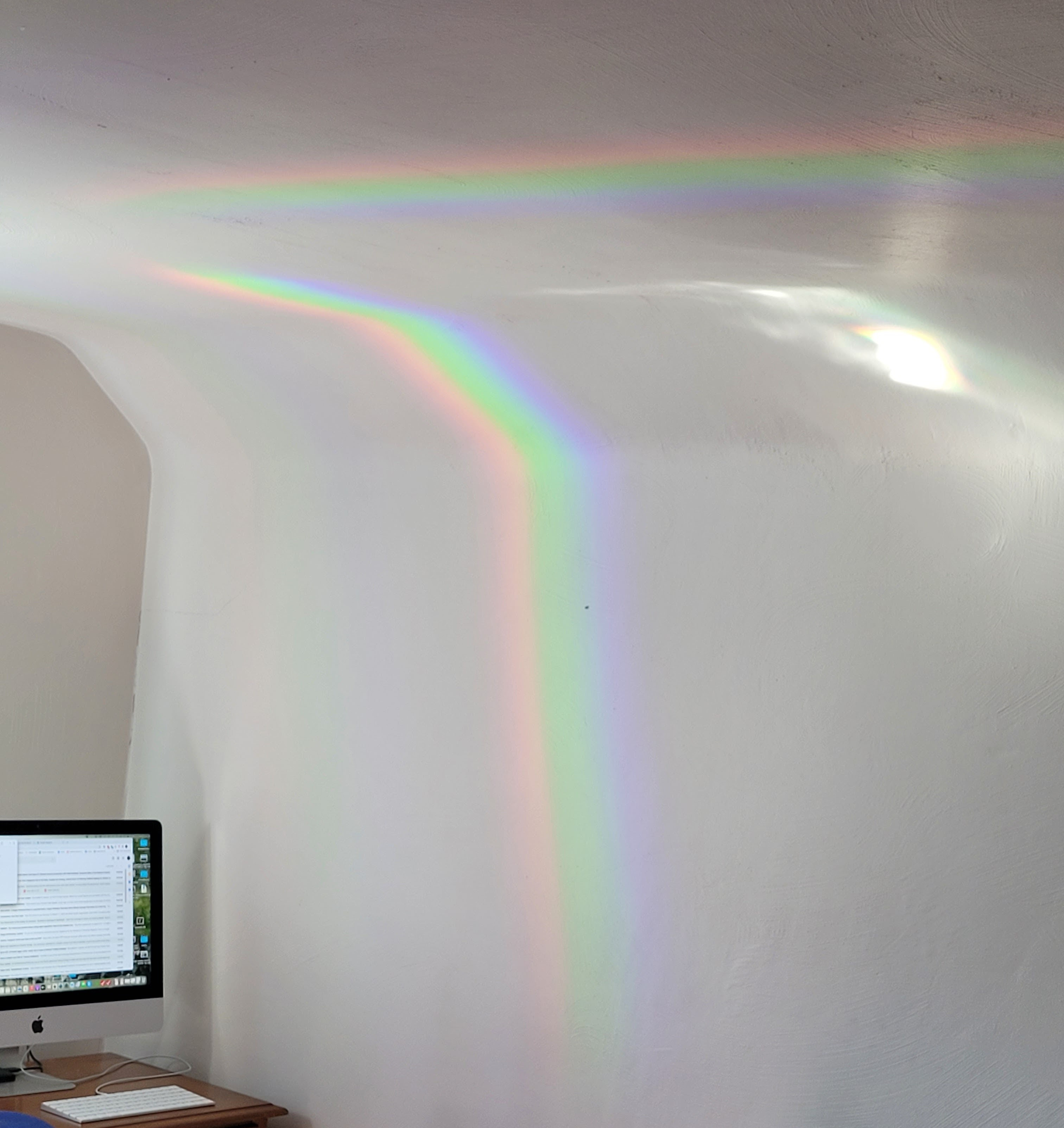
No pot of gold at the end of this rainbow, but happy Saint Patrick’s Day nonetheless!
Join us for Linda’s One-Liner Wednesdays! Find out more here: https://lindaghill.com/2021/03/17/one-liner-wednesday-nothing-lasts-forever/
No pot of gold at the end of this rainbow, but happy Saint Patrick’s Day nonetheless!
Join us for Linda’s One-Liner Wednesdays! Find out more here: https://lindaghill.com/2021/03/17/one-liner-wednesday-nothing-lasts-forever/

I had planned to post about the pandemic anniversary today, so it was fortuitous that Linda took the occasion to have us write about our past year. She also gave us permission to edit if we chose, so this post will be only stream-of-conscious-ish. I’m hoping to only need to do light editing.
So, compared to most other people in the US, I have been fortunate over this pandemic year. My spouse B has been working from home so we didn’t take a financial hit. He and I and daughter T have been safe in our home. My state, New York, was initially hit very hard by the pandemic, although not as much so in my home region of the Southern Tier. While we did have a period of time as a local COVID “hot spot,” we followed the precautions on masking, avoiding gatherings, handwashing, etc. and stayed safe.
This is not to say that we didn’t have to make changes in our lives. T’s job search has been on indefinite hold. Grocery shopping and meal planning became a major endeavor for me, due to shortages and restrictions. Some of my poetry activities moved online, but the year hasn’t been as productive as I had hoped. The Boiler House Poets Collective annual residency at MASS MoCA was cancelled due to COVID, although I did craft my own writing retreat in North Adams in late summer which turned out to be a perfect time, given the sooner than expected fall surge. (Additional posts from that time are here and here.)
There are two big personal impacts for me as a result of the pandemic. The first is the separation from daughter E and her family, who live in London, UK. We visited in December, 2019, with plans for several 2020 trips, including a visit to meet our new grandchild, and a plan for them to visit us here in the States in December 2020. None of that happened, due to COVID. While we have been in touch virtually, we have all been largely confined to our respective homes. It’s been hard watching from a distance as they dealt with likely cases of COVID in their household at a time when there wasn’t even testing available unless one needed hospitalization. We missed granddaughter ABC’s third birthday and the birth of granddaughter JG. We missed ABC starting nursery school, which has been variously in person and virtual depending on how viciously the virus was spreading in London at any given time. JG is now seven months old and we have no idea when we will be able to visit. She may be a toddler by the time we get to meet in person.
The second personal difficulty has been trying to care for my almost-96-year-old father, known here as Paco. Before the pandemic, we visited him every day in his apartment in the independent living building of his senior community. His memory was poor, but we were able to keep him safe and on an even keel. Once the pandemic began, though, we needed to limit contact, so we reverted to handling most things by phone with screened staff handling some tasks that had to be in person. This proved to be difficult but when Paco developed a medical problem that required a few days in the hospital, it became impossible for him to be safe in his apartment. In December, he moved to the health care building, first for three weeks of rehab in the skilled unit and then permanently to the assisted living unit. This is where he needs to be at this point, but due to state COVID rules, it was very difficult to visit in person. I am happy to report, though, that yesterday and today we had our first visits to his new apartment; before that, we had to meet in the visitors room or do window visits where we spoke by phone on either side of a window. We still have to mask and distance, but we could at least organize and tidy his rooms for him.
The greatest difficulty that is more universal is the sorrow at the immense cost the pandemic has exacted. So much illness. So much death. So many without even the most basic essentials for a secure existence. So much social isolation. So many who risked their own health to meet the needs of others. In the United States, the bewildering politicization of the crisis.
As we have been commemorating this first anniversary of the pandemic, though, I am feeling hopeful. We are about seven and a half weeks into the Biden administration and vaccine distribution has seen a big boost. Although the number of cases, hospitalizations, and deaths is still much too high, it is lower than it has been in months. In New York State, we are able to continue our gradual, science-and-metrics-driven increase in public activities. I went to church in person for the first time in a year today. It feels like we are making real progress toward ending the pandemic.
Real hope after a year of fear.
I’m very grateful for the vaccines and the people who are being diligent in observing public health measures. I’m grateful that B, T, and I were able to be of public service as participants in the Pfizer vaccine trial, which I’ve written about frequently here at TJCM.
I admit the fear isn’t totally gone. It’s upsetting to see people who are ignoring public health advice still. Especially with so many variants of the virus active and so many people unwilling to be vaccinated, it’s possible the virus will start to surge again.
Still, for the first time, the hope outweighs the fear in my mind.
Please, everyone, be careful. Stay safe. Protect yourself and your neighbors. We can end the pandemic after this awful year.
Together.
*****
Linda’s prompt this week was to write about our experiences over this last pandemic year, stream of consciousness style or not, or “day/week/month/year.” I chose the first option. Join us! Find out more here: https://lindaghill.com/2021/03/12/the-friday-reminder-and-prompt-for-socs-march-13-2021/


In the first few seasons of The Late Show, Stephen Colbert did a recurring skit, now a best-selling book, called Midnight Confessions, in which he “confesses” to his audience with the disclaimer that he isn’t sure these things are really sins but that he does “feel bad about them.” While Stephen and his writers are famously funny, I am not, so my JC’s Confessions will be somewhat more serious reflections, but they will be things that I feel bad about. Stephen’s audience always forgives him at the end of the segment; I’m not expecting that – and these aren’t really sins – but comments are always welcome.
JC
I do not know how to apply make-up.
Other than the fact that I couldn’t teach my daughters how to do it, this has not been a hardship in my life. I’m comfortable with my natural look.
My main experience with make-up dates back to high school, when I was in some musicals. We had to wear make-up so that we didn’t appear washed out by the harsh lights and distance to the audience. This generally meant very heavy eyeliner and some blush, which looked good from far away and comical up close. Once, when I was playing Sister Sophia, one of the older nuns in The Sound of Music, I sported black lines on my face to make me look older. I remember getting comments that I looked good that way, which I chose to take as compliments of how I would look as I aged rather than criticism of how I looked at seventeen.
The thing about not wearing make-up that does bother me sometimes though is the association that many people make that if a woman does not wear make-up, she is “letting herself go.” While it’s true that I don’t wear make-up, I am not unkempt. While I understand that many women will not go out in public or attend video meetings without wearing make-up, it doesn’t mean that those of us who choose to present our natural skin to the world are less competent, committed, or caring than they.
Make-up is also touted as a way to “look younger.” I prefer to look, well, how I look. Admittedly, I am not good at guessing how old people are. I’m now sixty, so this is what 60 looks like for me.
I wonder if my long-ago teen classmates would think that Sister Sophia was sixty and I look like her now…

Our brains prefer a simple falsehood to a complex truth.
Brian McClaren describing complexity bias in an insightful post
Join us for Linda’s One-Liner Wednesdays! Find out more here: https://lindaghill.com/2021/03/10/one-liner-wednesday-thief/

There was a long period in the US where the dietary advice was to avoid fat, especially animal fat, in our diets. During that time, I didn’t each much butter.
This was sad!
More recently, the recommendations have changed somewhat, so I do use more butter now.
I especially like homemade bread with butter. The usual butter that I use for spreading is a spread made of grass-fed cow-milk butter and a bit of oil to keep it from being too hard.
We also keep both salted and unsalted butter for cooking and baking. B has recently discovered that his family’s shortbread recipe comes out much better using unsalted butter. I ran across an article that explained why; it has to do with the moisture content difference between salted and unsalted butter. The recipe is so old that it didn’t specify the type of butter, but may have gone back to the day when people made their own butter, which likely would have been unsalted. The recipe does call for a bit of salt. Other than that, the only ingredients are flour and a small amount of sugar.
Shortbreads are basically an excuse to eat butter, and a very delicious excuse at that!
*****
Linda’s prompt for Stream of Consciousness Saturday this week is “butter.” Join us! Find out more here: https://lindaghill.com/2021/03/05/the-friday-reminder-and-prompt-for-socs-march-6-2021/

An update to my last post on coronavirus vaccines in the United States:
The Johnson & Johnson vaccine did receive emergency use authorization over the weekend and is currently being distributed. Because the company had manufactured some doses in advance through Operation Warp Speed, there will be some large shipments going out followed by a lag as Johnson & Johnson ramps up their manufacturing operations.
President Biden announced on Tuesday that another large pharmaceutical company with vaccine expertise, Merck, will be helping Johnson & Johnson to manufacture its vaccine. Merck ended a couple of vaccine trials it was conducting due to ineffectiveness and will be aiding the country in manufacturing its rival’s vaccine under the Defense Production Act. This Act is also being used to increase production of other needed items, such as vials.
Unlike the Pfizer/BioNTech and Moderna mRNA vaccines, the J&J vaccine is a more conventional vaccine, using inactive adenovirus to carry the vaccine into the body and activate the immune system. It only requires one dose and can be stored at refrigerator temperatures, so it is much easier to distribute to more rural areas.
While President Biden had previously said that any adult who wanted to be vaccinated would be able to be by the end of July, he now expects that to be possible by the end of May. This would allow most of us to resume what we have been calling “normal life,” although I think that some changes from our old ways of doing things will probably be in evidence indefinitely.
However, there are some big ifs. The first is that individuals would need to almost universally accept the vaccine to prevent it spreading in the community and to minimize the impact of new, possibly more dangerous variants. This would need to happen in every state – and in every country, if unrestricted international travel is allowed to resume. The second is that people would need to continue masking, distancing, limiting gathering size, etc. until most of the adults in the community were immunized or could be rapid-tested to show they were not likely currently infectious. New York is currently piloting holding sporting events using technology to screen for immunization/negative tests to allow higher occupancy for fans.
Another consideration is teens and children. Currently, only the Pfizer vaccine is authorized for use in 16- and 17-year-olds; it is currently being tested in 12-15-year-olds with plans to test in younger children after that. Other companies are also now beginning to study their vaccines in children and teens. Wide adoption of the vaccine among adults is the quickest route to protecting children, given that widespread vaccine use is unlikely for them until 2022.
The wild card continues to be how long-lasting vaccine effects are and how well they prevent serious illness from current and future variants. To that end, spouse B and daughter T are having blood draws this week to evaluate how their immunity is holding up as part of the Pfizer Phase III trial. They received their immunizations in August 2020 and will continue as part of the study into 2022. It’s also possible that Pfizer will be piloting the use of booster shots or of new vaccine formulations to better deal with variants, using the subjects already enrolled in Phase III. They have begun some of this research with Phase I/II participants.
Other vaccine researchers are continuing to study boosters and new vaccines, as well as longevity of immunity. Part of the story about Merck helping to produce the J&J vaccine and other similar partnerships around the world is that the extra doses may be needed as boosters in the future. If not, the surplus vaccines can be distributed through the COVAX initiative internationally to reach underserved populations.
All in all, it’s a hopeful time, but only if people are informed, thoughtful, and community-minded. Please, observe safety measures, get vaccinated when it is your turn, and be kind. We can end the pandemic sooner if we all work together.

Yesterday, I got my second dose of the Pfizer/BioNTech coronavirus vaccine as part of their ongoing Phase III trial. As I have written about previously, spouse B, daughter T, and I are all participants but they both received the vaccine last August, while I was in the placebo group. After the vaccine received emergency use authorization, Pfizer unmasked the study so that placebo group folks could receive the vaccine as well, which I gladly did.
B and T both had a day after their second vaccination that they didn’t feel very well, so I planned today as a down day for me. I do have a sore arm, headache, some body aches, fatigue, and a low-grade fever, but ibuprofen and rest are helping somewhat. Only a small minority of people have this level of side effects, but I am more than willing to not feel well for a day in order to have as much protection as I can from the severe form of COVID-19. While the science is not yet clear if the vaccine prevents asymptomatic or mild disease, the data show that moderate and severe cases that lead to hospitalization and/or death are rare.
I am grateful that Paco was among the first at the Health Center in his senior residential facility to receive the vaccine. Two weeks from now, when I will be considered to have peak immunity, it will ease my mind when I am allowed to meet with him indoors to know we are both fully vaccinated. We will still need to wear our masks and keep some distance, but it will feel safer than it has over this past year.
More good news on the vaccine front is that Pfizer and Moderna have been able to ship more doses of their vaccines than they had previously and that the Biden administration has improved distribution in conjunction with the states and local pharmacies and health centers. Pfizer has applied for permission to store its vaccine at regular, rather than ultra-cold, freezer temperatures for up to two weeks, which will make distribution easier. Another positive development is that the Johnson & Johnson vaccine candidate may receive emergency use authorization as early as this weekend. It is a one-dose vaccine that can be stored in the refrigerator, which will make distribution in rural areas and neighborhoods without good transportation options much more effective.
The worry, though, is that more variants of the virus are appearing. Some of them are more easily transmitted and may cause more severe disease. It’s not clear how well some of the vaccines work against some of these variants. It’s also not always apparent which variants will become widespread. For example, a new variant has been identified in New York City, but no one knows if it will become dominant, cause greater sickness, or be prevented by the vaccine.
To combat this, both Pfizer and Moderna are looking at changing their mRNA vaccines to account for new variants, as well as studying if a third dose – or even an annual booster – might be necessary to tame the coronavirus and keep it at bay. It’s part of the reason that it is so important for the Phase III trials to continue collecting data, so we can keep immunity levels in the populations as high as possible.
For now, I’m resting, cuddled under a black fleece throw that the clinical research center gave me, with their name embroidered on it, of course. While study participants do receive a stipend, they also occasionally receive little gifts and it’s nice to have this throw to keep me warm today. The best thing, though, is knowing that the vaccines are helping people and that, despite the uncertainties, we are gaining ground in the battle to end the pandemic.
There is still a long way to go and I beg people to continue to wear masks, keep appropriate distance, wash their hands, and avoid large gatherings. Get whatever vaccine is available to you when it is your turn. Check on vulnerable people in your community to see if they need help to stay safe. Support efforts to get the vaccine to vulnerable people around the world.
It takes all of us working together to end the pandemic and rebuild our communities.

I would not give a fig for the simplicity on this side of complexity, but I would give my life for the simplicity on the other side of complexity.
Oliver Wendell Holmes
*****
Join us for Linda’s One-Liner Wednesdays! Find out more here: https://lindaghill.com/2021/02/24/one-liner-wednesday-art/

It has just been announced that the United States has reached 500,000 deaths from COVID-19.
A half a million deaths among the 28 million confirmed cases. About 30% of those infected continue to have symptoms for weeks/months.
All of this in about a year’s time.
I had been watching a recording of mass for the first Sunday of Lent. When it finished, I tuned to a news channel. One of the frequent medical contributors, herself a physician, was speaking about the deaths and was struggling to keep from crying. The host noted how appropriate it was to react emotionally, as she herself was.
Such enormous loss. So much suffering. A reminder that, despite medical advances, we are nearing the death toll of the 1918 flu pandemic.
My eyes are filling with tears as I write this, both from the huge losses in our country and the world and from the losses of each one. Just recently added to the list a friend of my sister’s, the father of B’s co-worker, a resident in the apartments of Paco’s senior community.
Even with the vaccines becoming available, there will be many more illnesses and deaths. There will be uncertainty from the new variants’ effects, how long immunity will last after infection or vaccination, how people will behave as recommendations and policies change.
But today is overwhelmingly sad.
Again.

For months/years, I have threatened/promised to write about how I got to be who I am today and what shaped me along the way. This sporadic series will try to unpack my personal history and influences and, I hope, set people to thinking about their own.
So, I seem to have developed a bad habit of starting a new series here at Top of JC’s Mind at the (almost) worst possible time, as I did when starting JC’s Confessions. (Shameless plug. See link to those posts in my main menu.)
Some readers have expressed interest in knowing how I evolved into the creature I currently am and, particularly during these fraught times, there seems to be new impetus for examining our viewpoints and how we came to hold them, so I thought I’d try to break open some of that for readers.
It seems logical to start with one of the early, fundamental parts of my life, which is that I have rural roots.
And I mean, really rural.
I grew up in a town along the Massachusetts/Vermont border with a population of about 200. We had our own grammar school, grades one through eight when I entered, expanding to kindergarten through eighth when Massachusetts mandated kindergarten when I was in fifth grade or so, housed in three classroom in a WPA-built building that also had the town office, small public library, and a gym that was used by the school and for town meetings and events. There was a small general store that included a post office, which we visited every day to get our mail, but we usually shopped in North Adams, which was twenty miles away and offered more grocery selections at lower prices. We also attended high school in North Adams. It’s where my spouse B and I met, although that is definitely another story.
Although the town was small, it had two distinct sections. Down in “The Bridge” lived the people who worked in the mill, which made specialty paper products, like the wrappers for Necco wafers. They were mostly European immigrant stock, drawn to the area to work in the mill. Up on “The Hill” were the older Yankee stock, some of whom farmed or worked for the town itself, doing roadwork, plowing, etc. They also got Rural Free Delivery of their mail, so they didn’t need to come down to the post office every day, which was a blessing especially in the winter when the unpaved road from The Hill to The Bridge shut down for months and could only be traversed by snowmobile.
My family did not live in either section. Our house was about a mile from The Bridge and was owned by New England Power Company, for whom my father, known here as Paco, worked. It was located near an unmanned hydroelectric station so Paco could reach it quickly if needed. It, an observation stand, and one of the first commercial nuclear power plants in the United States which shared the hydro reservoir with the much older station were our closest neighbors.
Like other small New England towns, everyone knew everyone else and co-operated in running the school and the town. For the most part, people took care of themselves and their families, although everyone kept an eye out for a few townfolks who had special challenges due to age or health.
Then, the mill closed.
A few people re-located to Georgia where the company had another mill, but most lost their jobs and, because the whole area was having similar closures in the manufacturing sector which was the backbone of the economy, many moved away. Certainly, people in my generation moved to other places where they could get work. The population dropped to under a hundred. The school closed when they had only seven students in K-8.
Last August, I was back in the area and wrote this post, which includes some photos from the town and a bit of additional backstory.
So, what does all of this have to do with who I am today?
Growing up in the country gave me an appreciation of the natural world, its beauty, and power. I knew the names of the trees and plants and birds in the woods around our house and knew to respect the bears that sunned themselves on the rocks on the hill opposite our house, the deer that came down to drink from the reservoir, and the porcupines, that, for some reason, liked to chew on our back steps. Especially because Paco worked in hydro, we payed attention to the weather; it was important to know how much water was in the snowpack to handle the spring runoff and how high the winds might be with a storm, in case they threatened the power lines. Also, when it is twenty miles and over a mountain to get to a doctor or store or other services, you have to know how much snow is coming and when.
Like most rural folks, we gardened and bought food from local farmers. We did some of our own canning, including making bread-and-better pickles, and freezing fruits and vegetables. We always had a well-stocked pantry and freezer because you couldn’t easily run to the store if you were out of something. We did most of our cooking and baking from scratch and, like most rural New Englanders, made sure to use everything, like making stock from poultry carcasses. A lot of these skills have come in handy during the pandemic when shopping has been difficult and supply chains unreliable.
Living in such a small town gave me an appreciation of community, of working together to accomplish a task with people who hold a range of opinions and viewpoints, and to always watch out for the needs of our most vulnerable neighbors. While there was seldom overt reference to it, you usually knew what struggles families were facing and were respectful of them.
I admit that I also learned what it feels like to be an outsider. I didn’t live in The Bridge or on The Hill. Because my family was Irish-Italian, instead of just having one ethnic background, I didn’t fit in a category, not that this was a detriment because it averted the “dumb (insert ethnicity here) jokes” and what would now be heard as ethnic slurs from getting lobbed my way. I guess I also learned that people can make divisions among what would look to some observers to be a racially and economically homogeneous group. My grade in grammar school was relatively large. Although we had a couple of people move in and out, our core was four girls. The other three were all cousins who lived on The Hill, so I was destined to be an outsider. This was compounded by some academic decisions of our teachers that sometimes had me working with the grade above ours or on my own. I see this tension between community and solitary pursuits continue to play out in my life over time.
Because of what happened to my town when the mill closed and because I have continued to live in an area with a similar loss of long-standing industries, jobs, and population, I can sympathize with other folks who face similar situations in their towns. In my days of frequent interaction over issues around fracking and other energy/climate issues, I would often run into people with fears of what was happening with jobs in their towns. I could certainly sympathize with the issues, but I think where I differed was that they expected that their children and grandchildren would stay in town and have the same jobs with the same company as they, their parents, and perhaps even their grandparents had had. I, on the other hand, always knew that I would need to leave my town and make a life elsewhere.
Some people growing up in small towns dream of big-city life, but I am not one of them. Large, busy cities are overwhelming for me. The traffic makes me so nervous I don’t even like to look out the windows of the vehicle. I’m uncomfortable being in crowds and feel hemmed in with large buildings adjoining each other on both sides of the street. Still, I like the opportunities for shopping, restaurants, medical services, and cultural activities that a city can provide.
I think that is why I am content with the Binghamton NY area, where I have lived for close to forty years. There are small city opportunities nearby, but also rural landscapes, hills, trees, and wildlife. Given where I grew up, I don’t think of this area as “small town” but that is a matter of perspective. People that grew up in or near New York City talk about Binghamton as though it is “the country” but, for me, an actual small town girl, it’s plenty big.
How about you? Do you see your environment while growing up as impacting your life and decisions now? Comments are always welcome here at Top of JC’s Mind.

 Joanne Corey