Blog – Top of JC’s Mind

a non-reunion

In fall of 2015, I took a frightening leap of faith and attended my first-ever poetry residency/workshop. It was a collaboration between Tupelo Press and The Studios at MASS MoCA (Massachusetts Museum of Contemporary Art). As a relatively inexperienced poet, the only reason I was emboldened to apply was that it was in North Adams, the small city in the Berkshires where I had gone to high school. I grew up in the tiny town of Monroe Bridge, about twenty miles away, so North Adams had been a second hometown to me, with at least weekly visits to relatives and stores.

The residency was, well, complicated. It was daunting and terrifying at times and I was perpetually in over my head, but I learned a lot and met wonderful poets. I blogged about the experience and just re-read all the posts. This post contains links to the residency week’s posts, which convey things fairly well, except for downplaying the terror just a tad.

In those 2015 posts, I mentioned the possibility of a reunion residency and I’m pleased to say that the Boiler House Poets Collective has met every year since in early fall for a week at MASS MoCA.

Until this year.

Because of the pandemic protocols and travel restrictions, our 2020 reunion is cancelled. We are all sad, but we are on the schedule for fall 2021, so we know we will return.

In one of the 2015 posts, I mention my plan to put together a poetry collection about my personal and family ties to the North Adams area and that it might take a long time to put it together.

This turned out to be true.

While I have completed a different manuscript in the intervening years – and two major iterations of the North Adams collection, I am nowhere near finished with the collection I envisioned in 2015. I had planned to spend a major chunk of our 2020 residency hammering out more poems and a new version of the manuscript.

I get emails from MASS MoCA and The Studios, so I knew that a deadline was coming up to apply for individual residencies for winter/spring 2021 and I began pondering if that was something I should try to do. It’s a bit complicated because 1) it’s very competitive; 2) the minimum block is two weeks, which makes things trickier in terms of being away from home; 3) no one can project what kinds of virus levels, travel restrictions, closures, capacity limits, etc. may be in place in 2021, so cancellations could still occur; 4) the application would have been quite a chore, especially because I don’t have a cv prepared.

In discussing this with my spouse B and resident daughter T, an alternate solution came up – that I could go to North Adams on a self-styled writing retreat, staying in a local hotel/inn, visiting the museum with my membership pass, and writing in my room or some other socially distanced space that may present itself. If I do this, I could choose the dates myself and could wander about the area as I wished. Importantly, I could also go sooner rather than later, while both New York and Massachusetts have good control on virus levels and no travel restrictions between them. I would be able to maintain good social distancing, so my risks would not be any higher there than here.

So, I might make it to North Adams to write for a week after all. Of course, it won’t be as rich an experience as I am used to when being officially in residence with my inestimable Boiler House poet-friends, but the time away to work on the collection in the place where it is centered would still, I hope, be fruitful.

Stay tuned for future developments.

baby ash

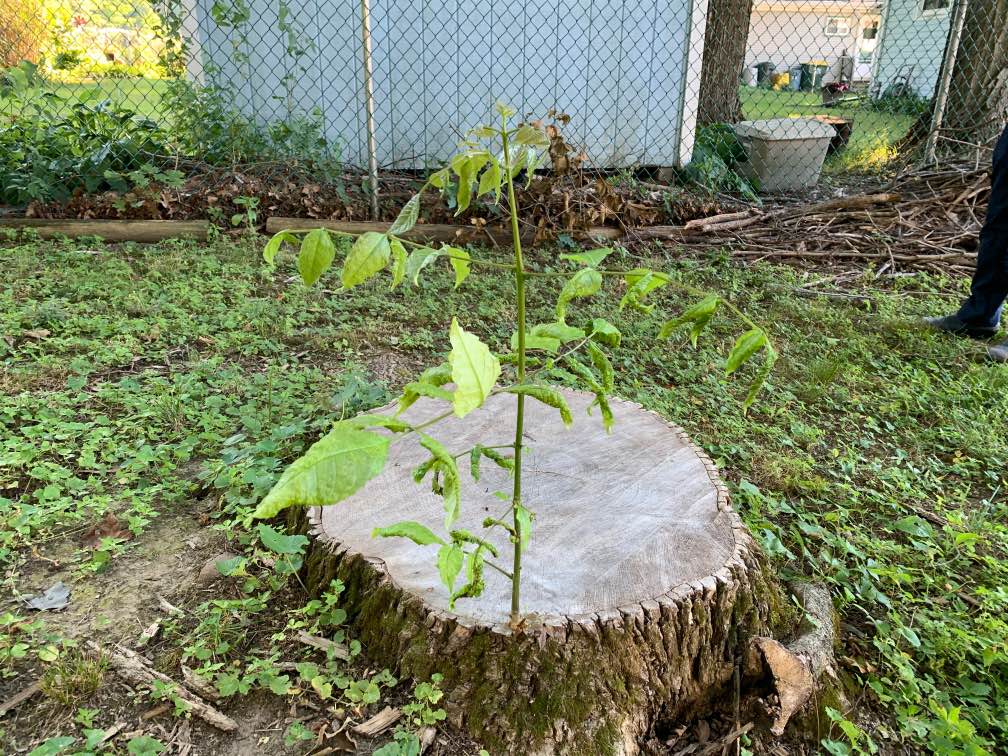
I wrote in January about having to take down the ash tree in our backyard because it had been infested with emerald ash borer.

This week, we noticed something growing near the stump.

It’s a new ash tree!

It’s growing very quickly. It certainly has a very large root structure, given that it is growing directly from where the bark meets the wood of the stump. Given its position, we aren’t sure it will survive long-term, but it is nice to see nature trying to come back from a plague.

A little hope is a good thing to have right now.

SoCS: on conditions in the US

I don’t know how much more of this we can take.

“We” refers here to the United States.

This past week, we surpassed 150,000 COVID deaths and the virus is out of control in a number of states, including our three most populous. California has now passed the half million mark for cases – and the real number infected is, no doubt, much higher because mild or asymptomatic cases are unlikely to be found. There is some hope on the vaccine front with some Phase III trials beginning – the one I’m signed up for will start in August, I hope – but, even if one or more are successful, it will take months and months for enough doses to be available globally to quash the pandemic. Meanwhile, here in the US, there is still no national strategy and people are suffering because of it. Even states like mine (New York) who worked hard to get out case numbers way down are under threat of resurgence from infected people visiting our state, returning home from traveling, or coming back to our many colleges and universities. It’s terrifying.

On Thursday, the nation had an opportunity to reflect on love and justice and service. Rep. John Lewis, a central figure in the civil rights movement who went on to champion the rights of all people who suffered discrimination and prejudice – and the planet itself – was honored with a truly beautiful funeral service. Reflections were offered by clergy, family, friends, staff, colleagues, and all four former presidents, Jimmy Carter in writing and Presidents Clinton, Bush, and Obama in person. President Obama gave the main eulogy, which was also a call to action for justice and for voting rights, a cause which John Lewis literally bled for, was jailed for, and supported passionately for decades. The House of Representatives voted unanimously to re-name a voting rights bill that they had passed earlier after John Lewis. (OK, Mitch McConnell. Time to get it to the Senate and pass it into law.) Sadly, this law is needed after the Supreme Court struck down provisions of the Voting Rights Act originally passed in the 1960s, reasoning (wrongly) that the country was past discriminatory voting practices. Since then, many states have re-implemented practices that limit ballot access for citizens based on age, race, income level, location, and other factors.

To point out the threat to voting and election integrity – yes, there is also evidence of foreign election interference, as if the domestic problems weren’t bad enough – the same day as the funeral, the president floated the idea via Twitter that our November 3rd national election should be postponed. The date of the election is set by Congressional law, though, so the president can’t change it. Fortunately, even the Republicans in Congress said that the election date will not be changed. I also think there would be civil unrest if it was tried.

Still, the election is under threat from forces within the government. Each state is responsible for running its own election, but the pandemic has made in-person voting more complicated and dangerous. States are moving to make greater use of their absentee voting systems, but these usually rely on the postal service, which the president is undermining through inadequate funding and a new crony leading the postal service who is changing policy to slow service. The House of Representatives has passed legislation to allocate funds to the states and the postal service so that our election can be fair, free, and safe, but Sen. McConnell has refused to bring the bill to the Senate for a vote. His own proposal doesn’t address election integrity at all. It also doesn’t address aid to states – and it was over two months after the House passed their bill before he even put out his proposal.

During the impeachment and trial, Republicans kept saying that “the people should decide the fate of the president at the ballot box.” They should be ensuring that we can do that safely, securely, and freely, not putting up roadblocks. If they are confident in their positions on the issues, they should be eager to have the vote. This looks like they know they have failed in their obligations to protect and defend the people and the Constitution and realize they can only hold onto power by cheating and deceiving.

As if all of that wasn’t bad enough, there is more bad news on the economic front. The GDP declined at its highest rate since such things started to be calculated over 150 years ago. (GDP=Gross Domestic Product) Because the pandemic is so bad, many businesses are needing to close or scale back, so many more people are unemployed. Some who had thought they were temporarily unemployed are now permanently unemployed because their businesses that they owned or worked for are closing for good. Because the federal government isn’t helping the states, we are also facing a wave of layoffs of state and local workers. Unlike the federal government, most states are required to have balanced budgets. Their tax revenues are way down, so their budgets are broken. This can mean layoffs for police, public hospital workers, teachers, public works employees, and other essential workers that are needed even more now. This will make unemployment worse and cause more demand for anti-poverty programs – for which there is already inadequate funding. Oh, and the additional federal funds of $600/week that were added to state unemployment checks in the CARES Act this spring end this week. The House bill that passed in mid-May would extend them until January; McConnell’s new proposal cuts them way down.

Most economists advocate the federal government injecting much more money into the economy to keep it afloat until the pandemic ends. The very real fear is that what is happening now – with the CARES Act programs ending with nothing to replace them (or next to nothing) – that the steep recession will turn into an economic depression. Evictions and foreclosures, many of which had been forestalled by prior legislation, will likely accelerate, leading to an increase is homelessness and, possibly, bankruptcy for landlords who no longer have tenants. People may have even more problems finding food. There are already strains on both public and charitable food resources. Our health care system, which was already broken, will be even more overwhelmed.

I try to be realistic.

It’s hard, though, not to think that we are going to see more and more and more suffering in the months ahead.

As a nation, we need to summon more courage, more intelligence, more compassion, more reason to chart a path to restore peace, justice, and good health. I guess “restore” is the wrong word. We need to establish those things for everyone.

And we need to have the freedom to vote.

***** Linda’s prompt for Stream of Consciousness Saturday this week is “more.” Join us! Find out how here: https://lindaghill.com/2020/07/31/the-friday-reminder-and-prompt-for-socs-aug-1-2020/

2019-2020 SoCS Badge by Shelley!

chapbook update

In a too-rare burst of energy in the late-winter/early spring, I finished, workshopped, edited, and submitted to contests an expanded version of the chapbook that had been a finalist in a 2017/18 contest with QuillsEdge Press. By the way, part of being a finalist was inclusion in an anthology, IN TRANSITION, which was published in conjunction with the winning chapbook, Skin Gin, which is available here.

The rejections from that batch of submissions have started to roll in. I’ve received two so far, although I did make semi-finalist in the CutBank/University of Montana contest. While being named a finalist or semi-finalist is still a loss in real terms, it is encouraging to know that your entry has been well-received by some part of the reading team. I have six contests from which I am awaiting notification, but, the odds are that they will be rejections, so I am gearing up for another batch of submissions.

A dear and generous poet-friend recently did a close reading of the manuscript and I have done another round of revisions. There is one poem that has changed significantly enough that I’m workshopping it with my local poetry circle. After those revisions, I’ll be looking for more contests and open reading periods for the next batch of submissions.

Back when I was starting to think about the possibility of publishing a book, I set the age of sixty as a goal. I will turn sixty in October, so I’m definitely not going to have a book in print by my sixtieth birthday.

For now, I’ll hold out hope for the book while I’m sixty, although maybe I should make the mental move to in my sixties, so there is less chance of being disappointed.

If I do get an acceptance, you can read all about it here, although it’s possible that you may hear my excited screams first!

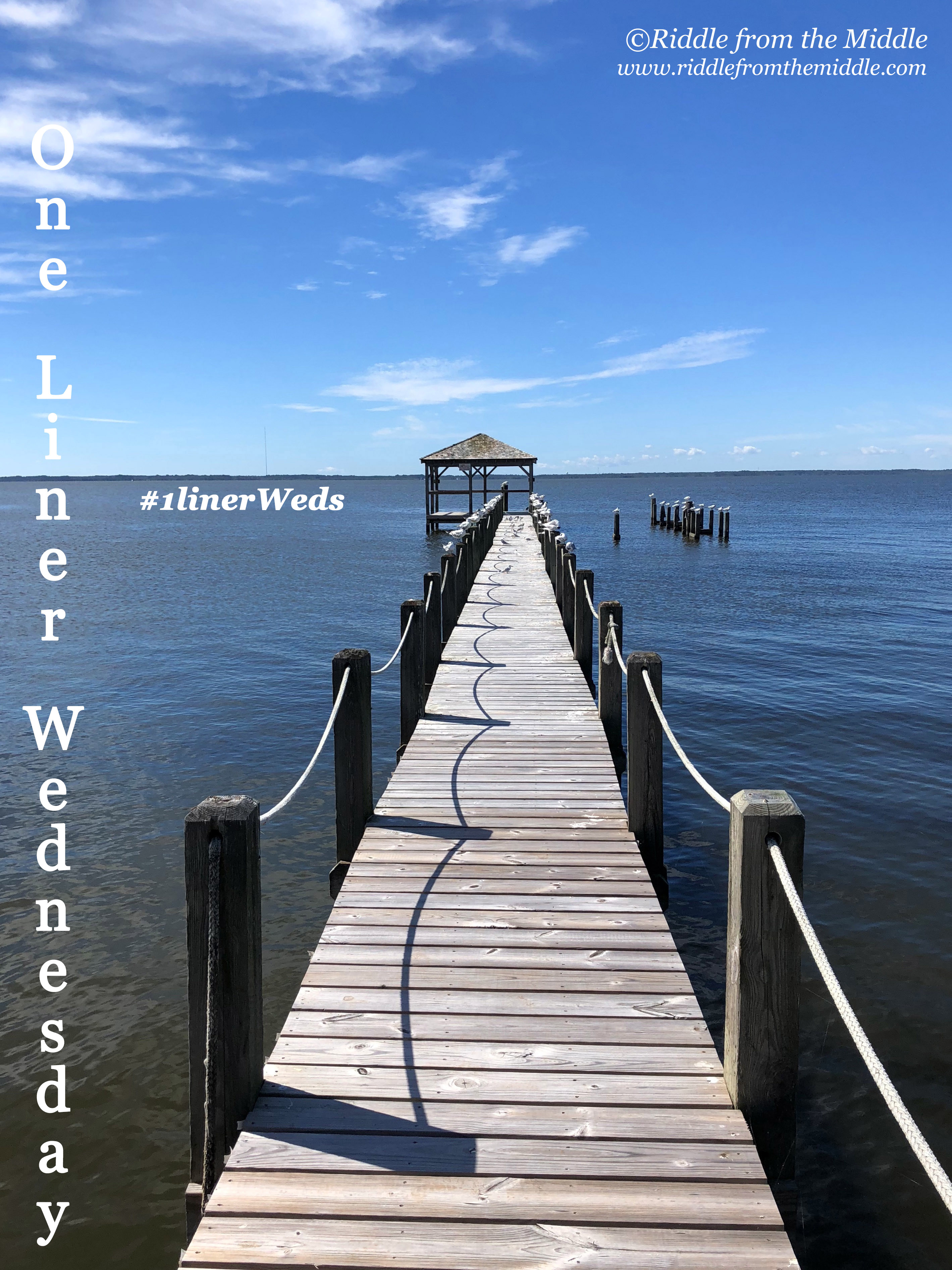
One-Liner Wednesday: Peace

Before you speak of peace, you must first have it in your heart. 

Francis of Assisi

Join us for Linda’s One-Liner Wednesdays! Find out more here: https://lindaghill.com/2020/07/29/one-liner-wednesday-july-29th-ill-take-that/

Badge by Laura

Karens

Lately, some people in the US have taken to referring to a white woman who calls 911 on a black person without cause as a “Karen.” Sometimes, this broadens to any white woman who tries to leverage her white privilege.

While I think it is legitimate to call out destructive behavior, I wish people would do it directly, not by name-calling. If one is referring to a specific incident, use the name of the person involved. If it is a more general comment about white privilege or entitlement, call it that.

There are lots of people named Karen and they don’t deserve a negative connotation being attached to their names. Some of them are men. Some of them, like Congressmember and potential vice-presidential nominee Karen Bass, are black. Karens are our neighbors, teachers, business owners, and friends. Karens are beloved members of families, including mine.

So, please, think twice about turning a name into an insult. Use a few more words and say what you intend without resorting to name-calling.

JC’s Confessions #15

In the first few seasons of The Late Show, Stephen Colbert did a recurring skit, now a best-selling book, called Midnight Confessions, in which he “confesses” to his audience with the disclaimer that he isn’t sure these things are really sins but that he does “feel bad about them.” While Stephen and his writers are famously funny, I am not, so my JC’s Confessions will be somewhat more serious reflections, but they will be things that I feel bad about. Stephen’s audience always forgives him at the end of the segment; I’m not expecting that – and these aren’t really sins – but comments are always welcome.

JC

I’m not a vegan.

I’m also not likely to become one.

I know that eating a vegan diet is gentlest on the planet and its resources and I have made a lot of lifestyle changes to address climate change and other environmental threats, but I can’t manage going vegan.

I try to be mindful of what we eat and where it comes from. We eat a number of vegetarian meals during each week and utilize local, in-season produce when available. You can read my paean to the 2020 strawberry season here. I often have access to organic produce and meats, which are less stressful on the ecosystem than large-scale conventional farming. I have tried to experiment with some of the plant-based substitutes for ground meat, but the smell, taste, and digestibility caused a number of issues within our family.

I enjoy lots of vegetables, fruits, grains, and nuts.

The problem is that I have a couple of medical issues that limit or eliminate quite a few vegan sources of important nutrients and there are times when symptoms are acting up that it is already difficult to figure out what I can safely eat without throwing in the additional strictures of veganism.

So, I will keep on, in my less-than-perfect way, eating not as bad-for-the-planet as I could be, but not as good-for-the-planet as I could be, either…

federal force

Here in the United States, we are facing such a crush of problems that it is hard to give each the attention it deserves.

I do want to highlight one especially dangerous and disturbing action by the president. He is deploying federal employees into US cities to act as law enforcement without the permission of the mayors and governors who have legal jurisdiction. By law, policing is a matter for local and state governments. The National Guard, which is a branch of the US Military though its roots go all the way back to 1660’s Massachusetts militias, is sometimes mobilized to deal with a disaster or civil unrest, but it is the governor of the state who usually orders it, not the president. As I have discussed before, the president can use the Insurrection Act to use federal forces over the objections of governors, but there is no basis to declare that an insurrection is underway.

Federal forces have been deployed to Portland, Oregon, ostensibly to protect federal buildings. Disturbingly, these federal officers have been on the streets without wearing insignia identifying them and have detained people who are not causing harm. They have also teargassed peaceful protestors. According to local officials, the presence of these federal forces has worsened the situation, not calmed it. The president is also sending or planning to send federal agents to other US cities.

While the president says he needs to establish “law and order” in these Democrat-led cities, the real motivation may be to project a “tough guy” image to shore up his base of supporters. His poll numbers have been dropping, even in states where he won by large margins in 2016.

I think it is possible that some of the president’s supporters are disturbed that he is using federal forces within US cities. The tenth amendment to the Constitution recognizes policing as a state function; many Trump supporters are not fans of the federal government and prefer state/local control as much as possible. Some would rather not have government involved in their lives at all.

There are already inspectors general investigations into the use of federal forces in Washington, DC and Portland. If there are deployments in other cities, there will surely be court cases brought, as well.

Meanwhile, voters need to remember that unidentified, armed federal personnel do not belong on the streets in US cities and towns. It’s the kind of authoritarian tactic that the United States has often decried in other countries.

SoCS: check-up

One of the many things that got deferred in 2019 while we were dealing with the final months of my mom’s life and the first months without her was going to the doctor for a check-up. I wasn’t being totally health-delinquent as I had other reasons to visit the doctor’s office, but I didn’t have the standard wellness exam that someone my age would usually have every year.

Next month, I am going to have a check-up, though, preceded by lab work so we can go over the results at my appointment. I may also need to have a bone density scan. I have crossed over into a diagnosis of osteopenia, which isn’t surprising. At 59, I don’t expect to have the same bone density as a woman in her twenties. I’m hoping that I can avoid taking Fosamax or some other bone-builder medication, at least for now. I prefer to save that until I actually develop osteoporosis, if I ever do. One can only take those types of medications for a limited amount of time and I don’t want to use up my quota too soon.

I also know that I should be thinking about getting a new shingles vaccine. I have had a bout of shingles and have had the older vaccine, but the new one is supposed to be much, much more effective. I will probably need to wait longer to get it, though, because, in the next few weeks, B, T, and I are all scheduled to participate in a coronavirus vaccine trial. The trial is supposed to last for two years, but I’m sure there will be a window for me to get the shingles vaccine at a time when it won’t interfere with the trial.

I’m sure I’ll be posting about the trial when it begins.

2019-2020 SoCS Badge by Shelley

Linda’s prompt for Stream of Consciousness Saturday this week is “check/cheque/Czech.” Join us! Find out more here: https://lindaghill.com/2020/07/24/the-friday-reminder-and-prompt-for-socs-july-25-2020/

Sad stats

The horror show that is the United States and coronavirus continues.

My state, New York, was the world epicenter in the early spring. Through good leadership informed by science and metrics and residents who took the policies seriously, we were able to get the pandemic under control. Through a careful, phased, and data-driven process, we have also been able to keep our transmission rate low as we have opened more of our economy.

Still, when the map of case numbers would be released every day, New York, the fourth most populous state, showed the highest number of total cases, over 400,000, because our initial outbreak had been so severe.

Until this week.

California, which is the most populous state, passed New York this week on confirmed COVID case numbers. (All the public health experts agree that the actual case numbers are much higher, but the official count uses only testing results and death certificates.) While California had had early success in containing the virus, it re-opened businesses too quickly and many people abandoned needed precautions like masks. Hence, their caseload is soaring. I’m hoping that New York will continue to keep the virus from resurging so that we never again reach the top number of cases, but Texas and Florida, second and third most populous states, are also in the midst of major outbreaks and might surpass California’s numbers in the coming weeks.

It’s appalling.

What saddens me is that it didn’t have to happen this way. New York and some of our partner states in the Northeast learned a lot of lessons through our experiences this spring and, in the absence of a national program, have been offering to help other states deal with the virus and the economic/social fallout. This has resulted in some positive news in the states being hard-hit now, for example, the mortality rate is lower, in part because of improved treatments for the severely ill. Most of the news, though, is bad: overwhelmed hospitals, people not wearing masks and attending large gatherings, bodies being stored in refrigerated trucks because mortuaries are backlogged, more and more states where the number of cases is rising.

Meanwhile, there is still no national plan. The House of Representatives, led by the Democrats and Speaker Nancy Pelosi, passed the Health and Economic Recovery Omnibus Emergency Solutions Act or the HEROES Act in mid-May, which would address some of the current problems with testing, contact tracing, and treatment of COVID, as well as a host of economic and social impacts on individuals, families, businesses, agencies, and state and local governments. The Senate, under the leadership of Republican Majority Leader Mitch McConnell, didn’t act on the bill this spring and just returned from a three-week break without their own version of a bill and, after a week’s work, they still don’t have a Republican proposal, much less a bill that has been negotiated with the Democratic and Independent senators so that it is ready for debate and vote.

Meanwhile, people are sick and dying, out of work, not knowing how they are going to be able to pay their bills, scared, and bewildered about their country’s dysfunctional state. The United States has become an object of pity around the world.

I’m disappointed that, even when the crisis is monumental, the Republican leadership can’t muster the will and/or competence to do their job and govern for the good of the people. If they had integrity, they would resign to make way for leaders who can and will serve the people and the Constitution. Resignations would be less disruptive than the current inaction.