We went on a classic week-off-from-school outing with our granddaughters as part of our visit to their home in London. We navigated a series of bus and Tube routes to tour the Cutty Sark, a clipper ship built in 1869 to carry tea from China to London as quickly as possible.
While it was built to carry tea, it also carried lots of other cargo, exports from Britain and imports, including wool from Australia. (A reminder that jumpers are called sweaters in the US.)
The Cutty Sark is not afloat these days, but still takes lots of maintenance. It’s hard to see, but there is a person near the top of this mast.
This lifeboat was getting a fresh coat of paint.
February is LGBT+ History Month in the UK and the Cutty Sark was participating by flying the Pride flag.
After lunch in a nearby pub, we went to the National Maritime Museum. I was interested to see how some of the exhibits were bringing in indigenous perspectives, such as this map showing language groups from the colonial period in the current US and Canada.
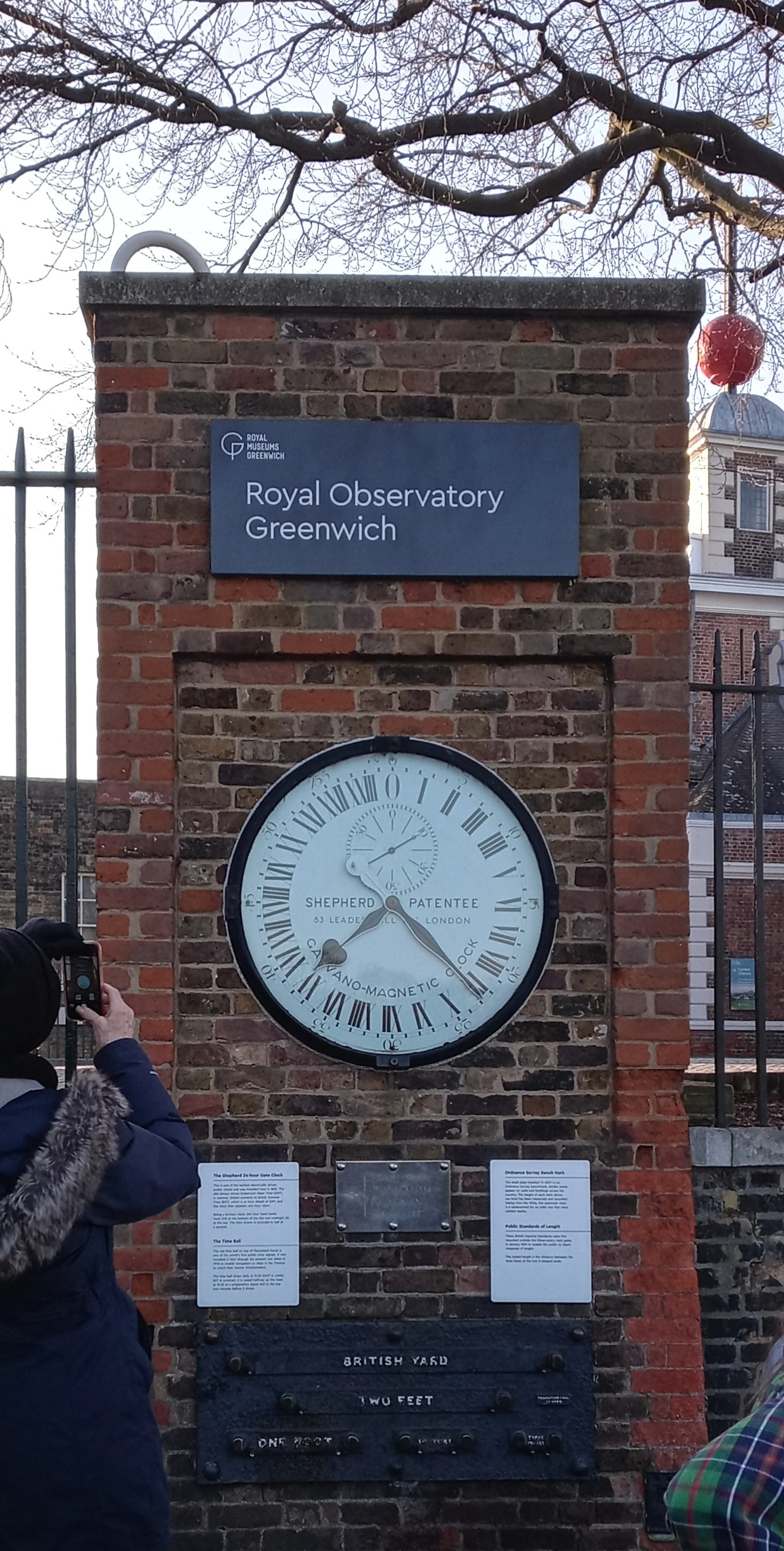
We finished our Greenwich tour by walking up to the Royal Observatory, through which the Prime Meridian runs. It’s the reason we have Greenwich Mean Time.
Before we started our trek back downhill and onto the bus, we enjoyed the view of London from the heights!
Spouse B, Daughter T, and I are in London, UK, visiting Daughter E, Son-in-law L, and Granddaughters ABC and JG. Yesterday, we made a trip to the Battersea Power Station.
Battersea Power Station as seen from the Tube station
Having grown up around power stations, I am geeky about them and would like to tour them, but the Battersea Power Station after decades of use as a coal-fired power station, designation as a historic landmark, and decades of disuse and deterioration, has been transformed into a shopping mall, apartments, offices, restaurant, and entertainment complex. The mall only opened a few months ago and more shops will be opening later this year.
On our way to the main entrance, we passed this sign. Of course, I had to take a photo of it as a shoutout to my friends of the Boiler House Poets Collective!
The main part of the old Art Deco-style power station that has been transformed into shops and restaurants is massive. Here is a view as you look down one of the main galleries that once housed multiple turbines:
The amount of detail that went into the restoration is staggering. Here you can see some of the Art Deco elements and part of one of the old control room through the windows.
There are lots of fun elements that play off the power station theme, such as the Control Room B cocktail bar, which features lots of dials and gauges as part of the decor.
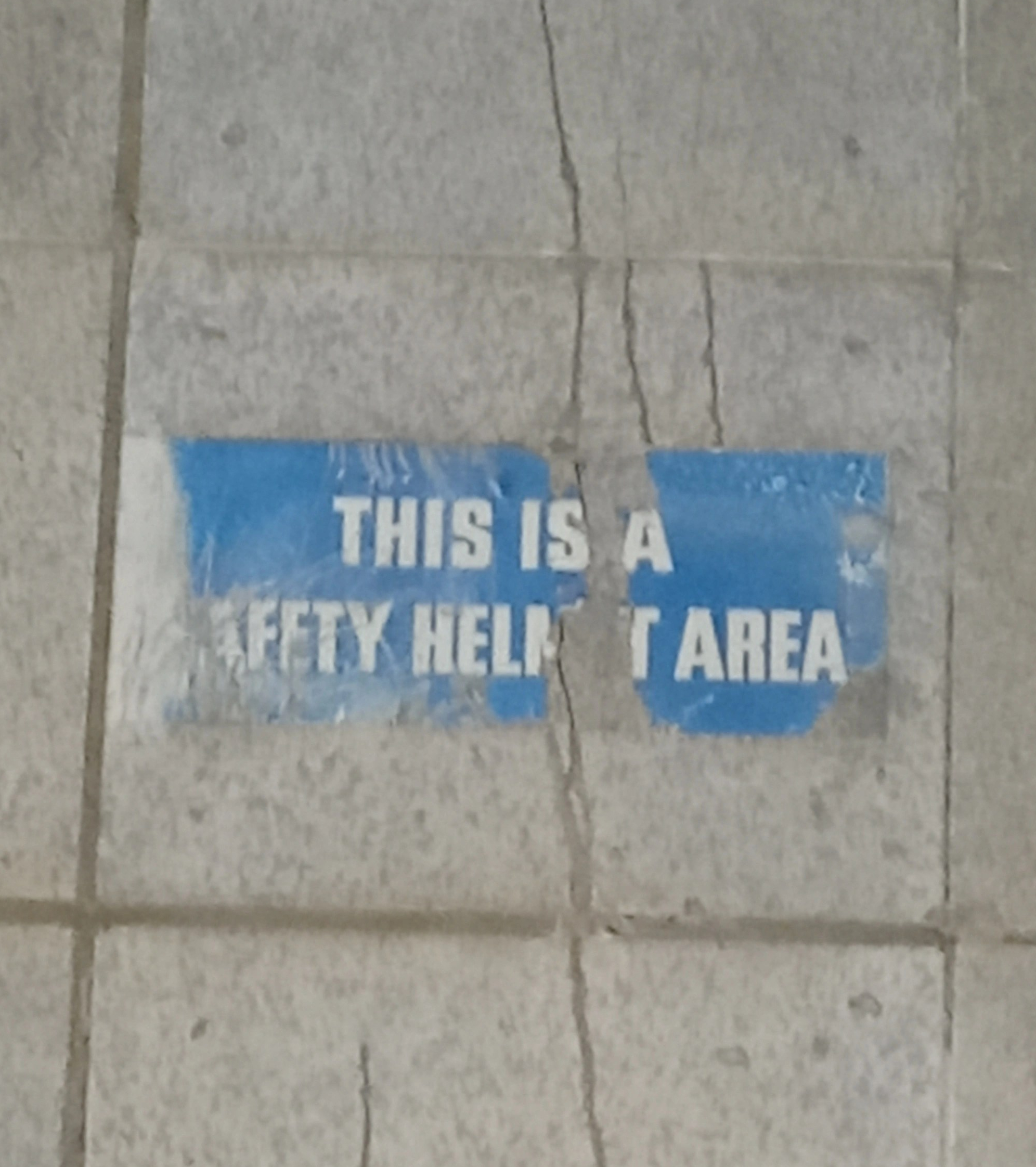
I loved seeing the remnant of this safety helmet sign. When we used to go to the hydro stations with Paco, this would have been termed a “hard hat area.” (Yes, I am just that geeky about these things, as anyone who has heard me going on about the industrial roots of the MASS MoCA complex will know.)
There are, of course, many distinctly modern features. For example, one of the old smokestacks now houses an elevator to take people up to the top to look out over London and the Thames. Not being particular fans of heights, although it is glass encased at the top, we did not go up in Lift 109, so called because the top of the stack is 109 meters from the ground, but it’s there for those with the inclination and pounds to do so.
At the moment, there are a number of light installations scattered around the complex. JG was especially taken with these hearts and kept hopping from one to another, while saying “another heart” over and over in an enthusiastic, two-year-old voice. I suppose it’s possible that this was more of a valentine feature than part of the light installations, but it was fun, none the less.
So, Happy Valentine’s Day from London for those celebrating!
To my Republican friends, if we could work together in the last Congress, there is no reason we can’t work together in this new Congress. The people sent us a clear message. Fighting for the sake of fighting, power for the sake of power, conflict for the sake of conflict, gets us nowhere.
US President Joe Biden in the State of the Union address before Congress last night
Linda’s prompt for Stream of Consciousness Saturday this week is “perfection.”
Not my favorite concept.
When I was young, I was taught to do the best I could…
Which is a lovely thought and a worthy goal but it made it easy to think that the best I could do should be perfect, so I became a bit of a perfectionist.
It’s exhausting.
And futile.
As I matured, I began to expect that perfection was a chimera, that there was really no such thing.
When my first child was born, I was convinced of that.
Well, not immediately.
I had dutifully followed all the advice from my medical team and from What to Expect When You Are Expecting, which was a hot title at the time. Still, somehow, my membranes ruptured at 36 weeks, so my precious daughter arrived early, officially classified as premature, although only by a few days, and, after being home for a couple of days had to be re-admitted to the hospital for light therapy for jaundice.
It was not perfect and I was scared and blamed myself, figuring that I must have done something wrong.
It took a while – well, maybe even a long while – to realize that, sometimes, things just happen without a discernible cause.
I then realized that there was not ever going to be a perfect way to do something as complex as raising a child – and then realized that there wasn’t really a perfect way to do much of anything.
I did still try to do the best I could, though, which often means things turn out pretty well.
So, it’s late afternoon on January 31st and I’m just getting the chance to write my final post for Linda’s Just Jot It January.
Linda’s prompt for today is “write” and my original intent had been to write about the end of Just Jot It January, so two birds with one stone.
I had been trying for the month to prepare my posts a day ahead in order to get them out in the morning, but I didn’t manage it today. I didn’t even check my blog this morning, as I had decided to do some more work on the final layout for my chapbook manuscript, Hearts, to send to Kelsay Books, my publisher.
Of course, I got distracted and wound up sending out a submission of three ekphrastic poems for a contest, which meant writing a more-involved-than-usual cover letter. (I did get some manuscript work done, too.)
I also wound up contributing to a couple of “poetry business” email threads, one for the Grapevine Poets and one for the Boiler House Poets Collective.
I wrote a birthday card and note to a friend – longhand and everything!
And now, finally, this post.
I am happy and relieved to have managed to post every day this month for #JusJoJan. I wrote more “heavy” posts than I intended, but it’s been that kind of month.
I’m not planning to post every day in February, though.
I need to spend some time on other projects and to get ready for a trip to the UK to visit our family there.
I try to keep yogurt in my refrigerator. Because B and T are lactose intolerant, I keep a large tub of Green Valley Creamery lactose-free plain yogurt, which they eat with various mix-ins and which we use in lieu of sour cream in recipes.
I had been eating Greek-style yogurt, usually Chobani or Fage, both of which are made here in upstate New York.
Lately, I’ve become a fan of skyr from Icelandic Provisions. It is also made with milk from our local dairies but uses heirloom Icelandic microbes to make a super-thick and creamy yogurt which is high in protein. They also use less added sugar than most commercial yogurts.
Sometimes, I’ll eat skyr as part of a meal but, more often, I’ll eat it as dessert, especially some of the flavors, such as cold brew coffee and key lime. It’s great to have a treat that is indulgent but nutritious.
I’ve been buying Icelandic Provisions most often at Wegmans because they have the best selection. I wish I could find some of the flavors listed on the brand website that feature mix-ins, but I’ve yet to see them in stores here.
I have, though, eaten some kinds of fruit that I hadn’t known existed, such as cloudberry and bilberry, which grow in Iceland. I’d love to travel to Iceland in person someday, see where they grow, and try them. Until then, I’ll content myself with eating delicious skyr in upstate New York. ***** It’s not too late to join in with Linda’s Just Jot It January! Find out more here: https://lindaghill.com/2023/01/30/daily-prompt-jusjojan-the-30th-2023/
This is a sobering weekend here in the United States.
The country is reeling from at least 49 mass shootings this month, as recorded by the Gun Violence Archive. I have to say “at least” because it could be more by the time I hit publish. This is in addition to all the shooting incidents with less than four victims and all the self-inflicted shootings, sometimes accidental but, sadly, most often deliberate. In the US, suicides have, for many years, constituted the majority of gun deaths. (If you are struggling with thoughts of suicide or any other mental health crisis, please reach out for help. In the US, you can call or text 988 or visit this website: https://988lifeline.org/ any day/any time.)
As I’ve written about before, the United States needs to deal with gun safety issues, especially when it comes to military-style assault weapons, high-capacity magazines, gun trafficking, poor licensing and training requirements in some states, and lack of comprehensive universal background checks. We need to vastly improve access to mental health care, on both humanitarian and violence-prevention grounds.
One of the stories that illustrates this need is the shooting of a first-grade teacher in Newport News, Virginia by one of her six-year-old students. She was seriously wounded but has survived. The boy was known to have been diagnosed with what has been termed by his family as an “acute disability” and is now being treated in a hospital. While this is a particularly stark example, many shootings, including mass shootings and suicides, are linked to mental health problems.
While guns are highly visible as a means of violence, videos released to the media on Friday illustrate that other means can be just as severe in causing injury, trauma, and death.
The country is also reacting to the shocking video of the police beating of Tyre Nichols in Memphis, Tennessee, which led to his death in the hospital three days later. Five officers were fired soon after the beating and have just been charged with several counts, including second degree murder. Two additional officers have been suspended while the investigation continues. Yesterday, the Memphis Police Department announced that the Scorpion Unit that had included the officers who carried out the attack has been permanently disbanded. The public gatherings in the wake of this horror have been almost exclusively non-violent, as Tyre’s family has urged.
Sadly, there are a vocal few who use their power in the media to sow confusion – or even show support for those who perpetrate violence. Even with the release of the video, there were some still insinuating that Paul Pelosi knew his attacker and invited him into his home. Mind you, there is video of the attacker repeatedly bashing a glass door with a hammer in the middle of the night but these conspiracy-theory followers don’t let facts get in the way of their twisted beliefs. In so doing, they multiply the violence and harm.
What can we do?
Some of the things I try to do are live a non-violent life, seek out facts and relay them accurately, respectfully enter into dialogue, and advocate for public policy to reduce violence. Even though I am only one person, I know there are millions of others doing the same.
My hope is that more people will realize that both victims and perpetrators of violence could be their own family member, friend, or neighbor.
I’ve spent decades now advocating for change on a whole raft of social justice and environmental issues.
There has been some progress in some areas, but I admit that there are times when I get tired, times when I realize that a change we’ve been working on for decades still hasn’t happened or where there’s been backsliding on a right that we thought had been secured.
Some days, I want to just throw in the towel.
But then I think about it and realize that a lot has been accomplished by so many people working together. The progress is often slow and incremental. When a change seems sudden, it’s usually the result of years of groundwork laying the foundation.
When I get discouraged, it’s often a comment from a friend that helps me realize the importance of the work, even when it seems we aren’t getting anywhere and even when the hoped-for change is unlikely in my lifetime. (This especially applies to my work on gender equality in the Catholic Church. The Catholic Church tends to think in centuries.)
So, at least so far, though I do change the issues I concentrate on from time to time, I keep at it.
In the first few seasons of The Late Show, Stephen Colbert did a recurring skit, then a best-selling book, called Midnight Confessions, in which he “confesses” to his audience with the disclaimer that he isn’t sure these things are really sins but that he does “feel bad about them.” While Stephen and his writers are famously funny, I am not, so my JC’s Confessions will be somewhat more serious reflections, but they will be things that I feel bad about. Stephen’s audience always forgives him at the end of the segment; I’m not expecting that – and these aren’t really sins – but comments are always welcome.
Ugh.
Folks who have been reading my blog regularly (thank you!) know that I have been dealing with a lot of loss and stress in recent years. I’ve been struggling to find energy to accomplish things and often feel like I can’t concentrate.
I’ve taken a lot of steps to cut down on what I’m trying to do in a day/week but there are still days that nothing of import gets started, much less done. I’ve tried to reach out for additional support but there are times when I can’t even manage to gather the energy needed to reach out and arrange to meet. Granted, the pandemic waves aren’t helpful, either.
I recognize from friends who study such things and from my reading that I am still grieving and that my brain is quite literally rewiring itself in line with my new reality.
A few weeks ago, I decided to try to shift my perspective. I decided to set aside some things I had been trying to do/worrying about and to give myself more grace/space to wait out the brain changes.
My doctor warned me it would be difficult and it is.
There have been little glimmers of hope. I’ve been able to arrange for some self-care appointments that I need. I’ve managed to post every day this month so far for Just Jot It January, although I confess I’m looking forward to February when that pressure I’ve put on myself will be off. I’ve made progress on preparing my chapbook manuscript for publication.
Overall, though, I am still struggling and struggling to accept that I’m still struggling, which is a large part of what I was hoping to do.














 Joanne Corey