vaccine update

Here in the United States, we are continuing to roll out coronavirus vaccines as quickly as possible, although there are a few snags.

The biggest is that the one-shot Johnson & Johnson vaccine is on temporary pause, due to six cases of a rare blood clotting problem that have been reported among women aged 18-48 within two weeks after vaccination. Given that over six million doses have been administered, the percentage affected is tiny, but the two agencies in charge are being cautious, especially as a small number of similar cases have been reported in Europe in connection with the Oxford/AstraZeneca vaccine, which, like the J&J, is an adenovirus-based vaccine. The pause is allowing them to gather and assess data. Additional cases may surface because of the attention this is receiving in the media. It also lets physicians know to ask about vaccine status when a patient presents with blood clot symptoms. This is important because vaccine-related blood clots call for a different treatment regimen. The hope is that the J&J vaccine will again be cleared for distribution within the next two weeks.

The public reaction has been mixed. Some people say that this pause shows how closely public health officials are tracking the various vaccines and their effects, which raises their confidence level. Others are worried that this means the vaccines weren’t sufficiently tested. A few who have received the J&J vaccine are panicking.

As someone who has been involved in vaccine trials, currently the Pfizer/BioNTech coronavirus vaccine but previously trials for flu, adult RSV, and pneumonia vaccines, I can attest that researchers are very careful in how they conduct trials. However, when you have a side effect that seems to appear in such a small number of people, you are unlikely to find it in a trial of thirty thousand people. If it turns out that the blood clot complication does occur, a person is more likely to be struck by lightning than to develop a blood clot after J&J vaccination. I hope this would calm anyone who is panicking, although people often fear rare events while ignoring those that are much more likely to impact them.

I admit that it boggles my mind that, with over thirty-one million known COVID cases in the US and over 565,000 deaths, people would fear an extremely rare side effect more than the virus itself. There are still about 25% of adults who say they will not get vaccinated, which raises the prospect that we won’t be able to stop community spread and end the pandemic because the pool of susceptible people will remain too large. Also, remember that some people who have been vaccinated may still be infected, but their chances of being severely ill are greatly diminished. Still, the way to end the pandemic is to have 85-90% of people vaccinated so that cases of the virus can be contained rather than spreading throughout the community.

It will help when those younger than 16 can be vaccinated. Pfizer has currently asked for permission to add 12-15-year-olds to those eligible after conducting a trial with that age group. Pfizer, Moderna, and others are also conducting research on the best dosages for younger children.

Meanwhile, research is continuing into how long immunity from the vaccine will remain strong. Spouse B and daughter T who received the Pfizer vaccine last August as part of the phase III trial are part of the effort to answer that question. The six month figures showed that immunity remained strong but they will be followed for at least two years to see how that may change with time. The Pfizer CEO Albert Bourla has said that he thinks a yearly booster is a possibility; they have begun studying this with phase I trial participants. We’ll see when B and T have their one-year follow-up in August whether or not they will have extended the booster dose study to phase III participants.

It is my sincere hope that by then we will have been able to fly to the UK to visit our family there and to meet granddaughter JG in person. While we are doing all we can to make that safely possible, it is frustrating to still see so many people not willing to cooperate with public health measures to keep themselves, their loved ones, and their communities safe using masks, distancing, limits on gatherings, vaccines, etc. to end the pandemic.

Yesterday, there was a Congressional hearing at which Dr. Anthony Fauci, one of the leading health officials in the country, was testifying. Rep. Jim Jordan illustrates the dynamic that has resulted in the unfortunate and dangerous politicization of the pandemic. This is a public health issue, not a “freedom” issue. Living in a free society does not mean that everyone is free to do or say whatever they want; we each have a corresponding responsibility not to cause harm to others or damage their rights and human dignity.

This brings me to my last point. The pandemic affects the whole world. Under the prior administration, the United States suffered terrible losses and did not contain the spread of the virus. Under the Biden administration, the US is making progress and has taken some steps to help the rest of the world in the fight against COVID. The US is now part of the COVAX initiative to help distribute vaccines to lower-wealth countries, although this is just getting underway. It has also sent some of its stockpile of the AstraZeneca vaccine, which has not yet been approved for emergency use in the US, to Canada and Mexico where it has been. While I expect the US to retain doses of approved vaccines as boosters, I’m hoping that once everyone who will accept the vaccine in the US has been vaccinated that we will distribute all the other doses to countries that need them, along with whatever other logistical and medical help is needed.

We can never end the pandemic until the virus has nowhere on the globe where it can run rampant. To me, this is a moral imperative. Others may be motivated by economic self-interest. Whatever the reason, it needs to happen.

One-Liner Wednesday: mini-daffodils

mini-daffodils from the supermarket that we will be able to plant in our yard this fall to bloom again next spring

Join us for Linda’s One-Liner Wednesdays! Find out more here: https://lindaghill.com/2021/04/14/one-liner-wednesday-ive-been-shot/

Nat’l Poetry Month Part 2

The second installment of the Broome County (NY) Arts Council (BCAC) series to celebrate National Poetry Month is now available here. This week features readings and discussion with Nicole Santalucia, Wendy Stewart, Mike Foldes, and Joshua Lindebaum.

I owe two of these poets a particular debt of gratitude.

When Nicole Santalucia, who is a Broome County native, returned to do graduate work at the state university, she founded the Binghamton Poetry Project (BPP). I first heard about BPP when Nicole read at a 2013 National Poetry Month episode of Off the Page, a radio program hosted by Bill Jaker on WSKG, our local public broadcasting radio station. Off the Page invited listeners to send in poems to their website and I was thrilled when they chose to read mine on the air! I began attending BPP’s free community poetry workshops for the general public, led by Binghamton University graduate students, in spring 2014. The connections I made there, particularly with Heather Dorn who has been a workshop leader, assistant director, and director of BPP, led to my joining the Grapevine Group, my local poetry critique group which you will hear more about shortly, and Sappho’s Circle, a women’s poetry circle which is, sadly, not currently active. The BCAC supports BPP through grants, so I was able to connect with them, as well. I was even invited to contribute a poem to BCAC’s Heart of the Arts award dinner in 2016. (Video here and text here.) I don’t think any of that would have happened without Nicole Santalucia and the Binghamton Poetry Project, so I owe her a huge thank you.

A shout-out also to Wendy Stewart, who is a member of the aforementioned Grapevine Group. Wendy always offers thoughtful advice on my poems and is supportive of me when I am being insecure, which happens with some frequency. Sometimes, we joke that she is just being Canadian!

I love the way Wendy uses language. I’ve learned a lot of new vocabulary from her. She is also masterful in the way she juxtaposes seemingly unrelated things so that we are invited to make connections we otherwise would not. She often uses her sly wit and penchant for understatement, both in her writing and in conversation, in a way that I admire, although cannot emulate.

Thank you, Wendy!

I hope you enjoy the recording. I’ll be back next week when I will be one of the featured poets.

Review: A Secret Love

I grew up in a rural area where television was purely by antenna, although we received NBC, ABC, and CBS, the three major networks at the time, which was a luxury. I’ve never been able to keep up with the increasingly complicated media landscape of cable, premium channels, satellite, and streaming options. I’ve gotten used to reading lists of Emmy nominees of shows I have never seen and to which I don’t have access. I usually can’t even keep track of what show or movie is being offered on which platform.

I do occasionally happen upon a recommendation that I can follow through on viewing. I was reading a list of awards geared for older adults from AARP which included the 2020 documentary A Secret Love. It is available through Netflix, the one streaming service to which we are currently subscribed, so spouse B, daughter T, and I settled in one evening to watch it.

A Secret Love is the story of Pat Henschel and Terry Donohue, two Canadian women who fell in love and made a life together in the United States where Terry had played baseball with the Peoria Redwings of the All-American Girls Professional Baseball League. While family back in Canada knew the two were close friends who shared a home, they did not know that they were life partners for many decades. While the film does give us their remarkable personal history, the documentary concentrates on their later years, as they face Pat’s illness and decisions about where to live.

Having dealt with the issues of serious illness, financial and legal complications, and housing decisions with B and my parents, I found much of what Pat and Terry were facing relatable. The complexity of the family dynamic, the cross-border legal issues, and the fact that, while Pat and Terry had been a couple since 1947, they did not have the protection of marriage when it came to things like hospital visitation added even more poignancy to an already daunting situation.

What comes through most clearly, though, is the depth of their love for one another. I am always moved by couples whose bond is so strong that it weathers decades of life together and Pat and Terry’s story is such a beautiful example of that. I will warn you that if you, like me, are inclined to teariness, you may want to have your handkerchief handy.

I will also say that, while the story is about elders, it also holds meaning for younger adults. T loved the film as much as I.

SoCS: last year and the year before

There is an old song “What a Difference a Day Makes” but today I’m thinking about what a difference a year makes.

Or two.

Two years ago this spring, my mom, known here as Nana, was living in the skilled nursing section of the senior community where she and my father, Paco, had lived for ten years. She was under hospice care as she was nearing the end of her battle with heart failure. My father and I visited every day for hours with frequent visits from my daughters and granddaughter ABC, who were living with us at the time. My out-of-town sisters were able to come to visit often, too.

Nana passed away in May 2019, a few days after her 87th birthday. We were able to hold her funeral in her parish church with a visiting hour before with friends coming to comfort us. There was also a gathering at her and Paco’s senior community.

Last spring, we were all in COVID lockdown. Visiting nursing homes was totally shut down with very limited exceptions for end-of-life situations. I often thought of what that would have looked like for us, if Nana had been facing death in spring 2020 rather than 2019. We would have lost those last few weeks with her, which were painful but also filled with precious moments. We were able to bring her flowers, including her beloved lilies-of-the-valley which blossom in May, just in time for Mother’s Day and her birthday. One of the last things she was able to eat was a little fruit tart I had brought for her birthday. I helped her by cutting it and fed her as she had me when I was a baby…

In 2020, we would likely not have been allowed to visit until the very end when she was unconscious. The church was totally closed, so there would have been no funeral, not even for family.

It was hard last spring, too, because we could no longer visit Paco every day in his apartment. Although visits to independent living apartments were not totally forbidden, they were supposed to be limited, with some masked outdoor visits preferred over anything indoors. My sisters had planned to visit for Paco’s 95th birthday in March but that had to be postponed. Little did we realize at the time that that postponement would turn into cancellation.

That brings us to this spring, which is just getting underway here with some of the early bulbs flowering and the first trees starting to bud. Paco is now living in assisted living which is part of the health care center. While visiting and gathering there are still limited, my younger sister and I were able to visit him for half an hour in his apartment on his birthday and he was able to share a large birthday cake we provided with the other residents and staff on his unit later in the day. Later this month, my elder sister will be able to visit in person for the first time since last summer. She lives out-of-state so hasn’t been able to travel to New York without prohibitively lengthy quarantine, but now, with vaccines available and changes in state policy, she will finally be able to see Paco again.

We have no idea, though, if or when daughter E and granddaughter ABC will be able to visit. They moved permanently to the UK in fall 2019, joining son-in-law L in London. They have since been joined by granddaughter JG, who recently had her first tooth break through.

Spouse B, daughter T, and I would love to think that this spring we could jet off to London to meet JG in person for the first time, but it isn’t possible. Maybe this summer? It depends on conditions with the pandemic and travel restrictions.

Will we get to hold her while she is still a baby or will she be an on-the-move toddler by that time?

Will Paco ever get to meet her in person? For the UK family branch to visit the US is much more complicated and we have no idea when that will be feasible. We also, sadly, don’t know how things will go with Paco’s cognitive decline. While sometimes he remembers names of family members, sometimes he forgets them.

Sometimes, he forgets that he has great-grandchildren at all.

In 2019, I knew that spring 2020 would be very different because my mother would not be there. I could not have imagined how different 2020 would turn out to be.

Or 2021.

I dare not project to spring 2022.

*****
Linda’s prompt for Stream of Consciousness Saturday this week is “difference.” Join us! Find out more here: https://lindaghill.com/2021/04/09/the-friday-reminder-and-prompt-for-socs-april-10-2021/

New York State update

As you may recall, I post occasionally on New York State government and politics, especially as it relates to the pandemic. This has necessarily led to some reference to the investigations into Governor Cuomo. Many New York politicians of both parties have called on the governor to resign, claiming he can’t govern effectively under a cloud of suspicion, while the majority of New York voters say in public opinion polls that he should remain in office while the investigations continue.

Given Governor Cuomo’s high profile nationally, both as a leader on pandemic policy and as the chair of the National Governors Association, there has been national coverage on the allegations and investigations, although this waxes and wanes depending on what else is happening. When there is a lot of coverage of a mass shooting or trial or a major piece of federal legislation, we don’t hear about Governor Cuomo for a few days until things calm down and we are back to the question of how can he govern under these circumstances.

Meanwhile, he has been governing. There have been numerous speaking engagements at vaccination sites, especially those in high-need neighborhoods, in the continuing efforts to get as many people vaccinated as quickly as possible without leaving any demographic groups behind. This week, there was the announcement of a monument dedicated to essential workers who continued to serve the public while most people were encouraged to stay safe at home. Updates to COVID policies have been rolled out as data and conditions warrant.

Most significantly from the political standpoint, our state budget has passed. Unlike most states, the New York fiscal year starts April first, so the budget was a few days late being passed. While the governor’s office is heavily involved in budget process, the delay was due more to timing of the American Rescue Plan passage in Washington, which established how much federal aid was coming to New York, and to COVID, which complicated the negotiation process which usually happens in person. Unfortunately, the Speaker of the Assembly, our lower house in the legislature, tested positive for COVID during the negotiation process but continued to serve from home.

So, our state government continues to function, which is good as we are facing yet another critical time period with the pandemic. While the overall infection rate is still quite low, cases on average are rising with sizeable presence of the B.1.1.7 variant and another variant that first appeared in New York City. We are giving out the vaccine as quickly as we can get doses. Thirty-five percent of NYers have received at least one vaccine dose, with twenty-two percent fully vaccinated. That still leaves millions of people, especially younger adults, teens, and children vulnerable to infection, so we have to continue to be cautious with masking, distancing, and gathering size and conditions.

The newly passed state budget has money to help with public health efforts, in addition to rent assistance, increase education aid, and small business programs to help everyone in our pandemic recovery. It will take time and effort, but we will build back better, a phrase that Governor Cuomo was using before President Biden and that others in the environmental and social justice movement were using before the governor took it up.

Celebrate National Poetry Month!

In the United States, April is National Poetry month.

Broome County Arts Council (BCAC) is joining the celebration by hosting a series of virtual poetry readings by poets with ties to our area. The first reading, featuring Elizabeth Cohen, Dante Di Stefano, and Andrei Guruianu is available here.

Enjoy!

I’ll be back with additional posts as the celebration continues, including a more extensive post the week that I am featured along with other poets from the Binghamton Poetry Project.

Triduum

This year, for the first time in a while, I actually made it to all three main liturgies of the Triduum, which, in Catholic parlance, is Holy Thursday, Good Friday, and Holy Saturday.

Back in the days when I served on liturgy committee and I and my daughters served in music ministry, I would be at all the Holy Week liturgies plus the children’s liturgy on Easter morning, but, after my long-time parish disintegrated in 2005, I couldn’t bring myself to attend all the services. The situation got even more complicated when my elder care responsibilities grew.

Then came 2020 and the pandemic and no one could attend services in person for Holy Week.

I didn’t attend mass in person for over a year. I wrote here about my first time back a dew weeks ago. I noted in that post that I wouldn’t try to attend every week yet due to space constraints at church. I was able to get a reservation to attend Easter Vigil on Saturday evening and decided to attend on Holy Thursday evening and Good Friday afternoon because the church made those open without reservations, although we did have to sign in and leave contact information in case a COVID case was verified and they needed to do tracing. We also had temperature checks and single-use programs so there were no hymnals or prayer books that subsequent worshippers would be touching.

Holy Thursday had long been my favorite liturgy of the year. Its focus is the Eucharist, as it commemorates the Last Supper. In an ordinary year, there would be significant involvement from the laity. The priest would wash the feet of twelve parish members and another group of people, often a family, would dress the altar. There would be a large choir to lead the congregation in sung prayer. Because of the pandemic, everything had to be pared down. Footwashing was eliminated globally to reduce risk. There were two lay lectors, appropriately distanced from the clergy in the sanctuary, but they were both men, so there were no women’s voices in any of the spoken prayers, which added to the sense of distance for me.

The music was beautiful, though. The music director put together an octet from the music ministry, which included some married couples so that the spacing would work as they could stand right next to each other instead of having to be feet apart. With masks, spacing, and good choral microphones, they were able to lead the sung prayer very meaningfully.

Because so much of the Holy Thursday liturgy revolves around a meal, there are many references to food. Because we are living in a time of increased hunger in the United States, these passages were particularly meaningful to me this year. For example, the gathering song was “Table of Plenty” by Dan Schutte, which contains the lyrics, “O come and eat without money; come to drink without price.” and “My bread will ever sustain you through days of sorrow and woe.” Those familiar lines resonated differently knowing that many people do not have enough to eat.

The service on Good Friday afternoon is, by its nature, quite stark. It’s the one day of the church year when there is no mass with Eucharist. Instead, there is a liturgy of the word, veneration of the cross, and distribution of communion with previously consecrated hosts. Without having the liturgy of the Eucharist, the emphasis shifts to the liturgy of the word, which includes reading the passion narrative from the gospel of John.

Paradoxically, Good Friday felt less stark to me than the Lenten and Holy Thursday masses I attended. I think this was due, at least in part, to the fact that there were more lay voices and, in particular, women’s voices included. The first reading, the suffering servant passage from Isaiah, was proclaimed as a choral reading, alternating between a woman lector and the music ministers. The gospel is presented with different people reading narration, the voice of Christ, and the voice of others in dialogue, with the congregation participating as the crowd. Even though we are assigned to proclaim a lot of challenging verses – we have to say, “Crucify him!” multiple times – it is good to feel that we have a part in telling the story.

Another element of the liturgy of the word that gets more emphasis on Good Friday is the intercessions that follow the homily. They were chanted by two cantors, a woman and a man, who alternated between them, with a sung response from the congregation and a prayer by the priest after each. This year, there was an added petition specifically for the pandemic, which was both moving and sobering to hear.

The veneration of the cross was much simpler than in usual years. It’s been the custom for each person to come forward in procession to kiss the cross but that isn’t possible under pandemic protocol. Instead, the assembly knelt and venerated the cross from our places in the pews. In truth, I preferred this to the processing and kissing because it felt more solemn.

For the Easter Vigil on Saturday night, we begin in a mostly darkened church. The time is set to be after sundown so it will be dark so that the first part of the mass, the service of light, begins in darkness. Usually, a new fire is lit and blessed outside the church, the new Paschal candle is blessed and embedded with incense, then lit and carried through the church in procession with music and sung responses, as each person holds a candle which is lit and passed to the next until the church is filled with candlelight for the singing of the the Exsultet (Easter Proclamation).

However, this was rather drastically abbreviated this year. We heard the blessing of the fire and the Paschal candle was brought into the church but the congregation had no candles of their own and most of the lights remained off in the body of the church. The Exsultet was chanted by a cantor whom I have had the privilege to hear sing for many years; it was very moving and brought back memories of hearing the priest chant this prayer when I was the teenage organist in my childhood church.

The liturgy of the word that follows the service of light begins with three readings from the Hebrew Scriptures, each followed by a psalm and prayer. Unfortunately, the lights in the body of the church were still off, which made it a bit difficult for the assembly to sing the psalm responses which were printed in our programs. I happened to know the pieces fairly well so I could sing, but I could tell that some others were not familiar enough with them to join in. Admittedly, it was dramatic to have the lights turned on as we were singing the Gloria, but I missed the growing candlelight followed by the lights being turned on as we extinguished our candles and began the liturgy of the word.

I admit that I struggled with the homily. While it was meant to be a unifying message, the way it was conveyed reminded me too much of how many instances of division there are within our society and the church. It saddened me.

The Easter Vigil is traditionally the time when new adult members enter the church, so there are often baptisms, professions of faith, confirmations, and first Eucharists included. This year, though, there was just one candidate for confirmation, most likely because the pandemic prevented the usual series of liturgies and classes for new members that take place in the months leading up to Easter.

The liturgy of the Eucharist unfolded in almost normal fashion. I was again very appreciative of my organist-friend and the octet she had assembled. The mass that we sang is one that I know well and that we had used often. In my mind, I was adding in the sound of the handbell accompaniment and larger choir that we used on festive occasions like Easter. I wonder when or even if such large and close gatherings will again be possible.

Perhaps I should say that the liturgy of the Eucharist proceeded in pandemic-normal. There is no sharing of a sign of peace, although people do wave or nod to others across the empty pews between occupied-but-spaced ones. We also do the formal dismissal before communion is distributed, so that people receive the host and then exit, all while keeping their distance.

I was just re-reading this post to edit and I’m sure, if you have made it this far, that you realize I’m a bit of a Catholic liturgy wonk. I want to convey my wishes for Easter blessings to those celebrating and my universal wishes for peace, love, respect, and care to all.

SoCS: Who knows?

Who knows?

These days, seemingly no one.

I guess that is a bit overbroad. It depends on the context and what comes after the “who knows” bit.

If someone asks, who knows what the dinner plan is for tonight, there’s a pretty good chance that I would have an answer. I couldn’t tell you if the plan would have follow through, but I could at least tell you the plan…

The hardest questions are the “who knows why” variety.

Yesterday, the Capitol Police, who are the ones who guard the Congress in Washington, DC, lost another officer in the line of duty. A second officer is hospitalized and expected to recover.

The man who attacked the police with his car and a knife is dead and the news reports are full of questions about why he did this.

So, who does know why?

Perhaps, no one knows. Even if he were alive, he might not be able to articulate a reason, especially if he was suffering from mental illness.

Even without knowing, I hope that everyone will offer support to all the impacted families and work together to reach out to those who are suffering. I also hope that Congress will honor the service of the Capitol police who protect them and their families by expanding the number of officers and giving them more resources for training, equipment, and protection. Of course, we should also expand medical care, including mental health care, so that every person always has access to it.

We may not know why this happened, but we can work to make it less likely to happen in the future.

*****
Linda’s prompt for Stream of Consciousness Saturday this week is to begin a post with who or whom. Join us! Find out more here: https://lindaghill.com/2021/04/02/the-friday-reminder-and-prompt-for-socs-april-3-2021/

2019-2020 SoCS Badge by Shelley!

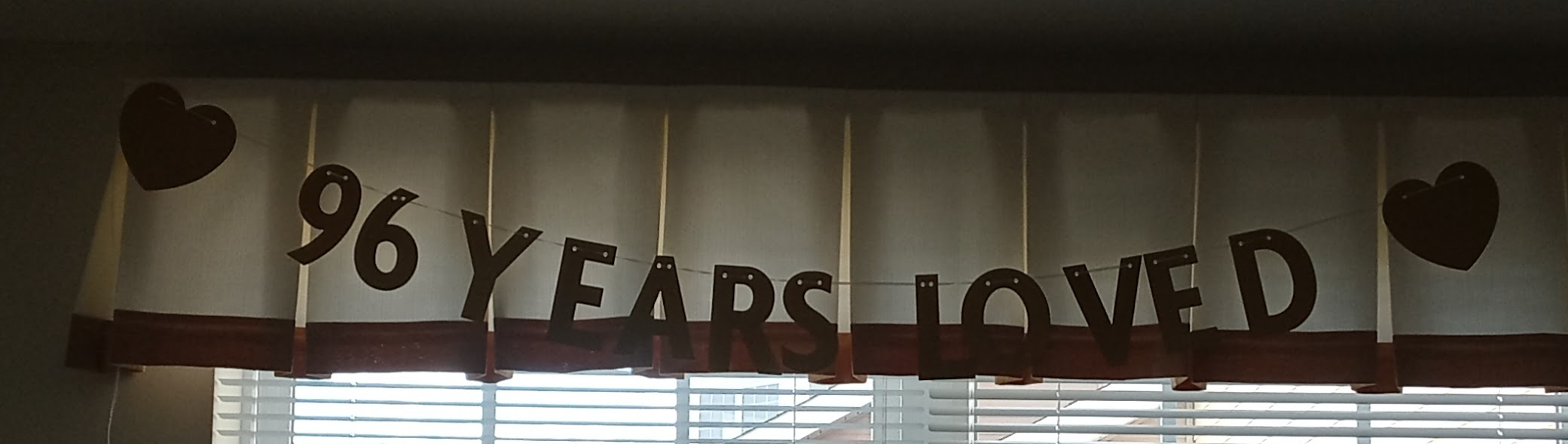
One-Liner Wednesday: Happy 96th!

banner with two hearts saying 96 YEARS LOVED

A gift from my sister to honor our dad, known here as Paco, on his 96th birthday last week. ❤

Join us for Linda’s One-Liner Wednesdays! Find out more here: https://lindaghill.com/2021/03/31/one-liner-wednesday-had-to-run/