
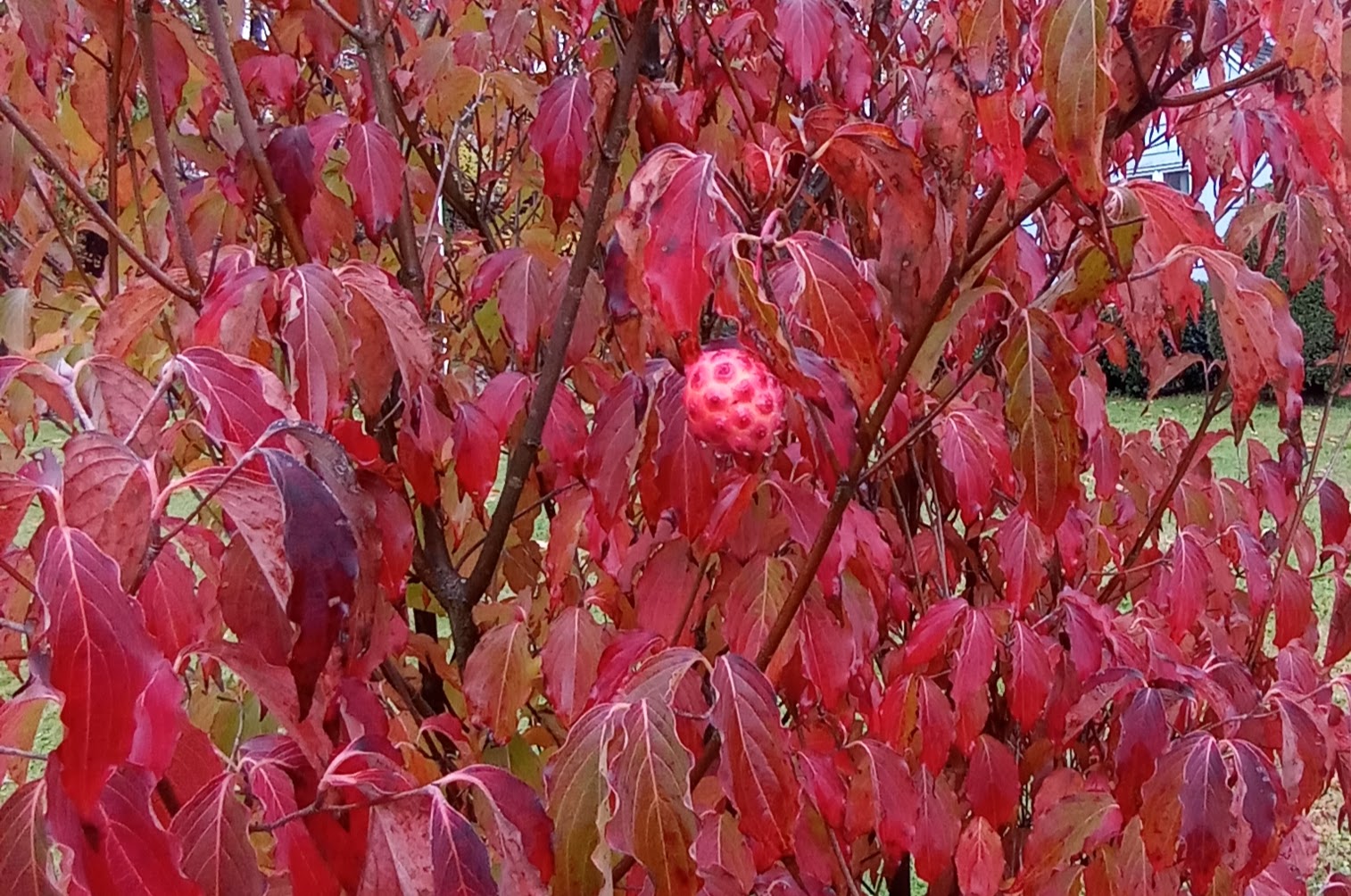
Thought I’d share fall photos of the Kousa dogwood at our house and its fruit, after showing its greenery earlier.
Join us for Linda’s One-Liner Wednesdays! Find out more here: https://lindaghill.com/2025/11/05/one-liner-wednesday-this-is-why/
Thought I’d share fall photos of the Kousa dogwood at our house and its fruit, after showing its greenery earlier.
Join us for Linda’s One-Liner Wednesdays! Find out more here: https://lindaghill.com/2025/11/05/one-liner-wednesday-this-is-why/

After sharing that we have a new Kousa dogwood in our yard last Wednesday, I though I’d share a picture from this week with it flowering alongside the peonies.
Join us for Linda’s One-Liner Wednesdays! Find out more here: https://lindaghill.com/2025/06/11/one-liner-wednesday-better/

Our landscapers just brought us a new Kousa dogwood for our front yard to replace one that was dying.
Join us for Linda’s One-Liner Wednesdays! Find out more here: https://lindaghill.com/2025/06/04/one-liner-wednesday-what-day-was-it-yesterday-anyway-edition/

Our new yard sign to send the message to preserve our health programs in the United States.
Join us for Linda’s One-Liner Wednesdays! Find out more here: https://lindaghill.com/2025/05/07/one-liner-wednesday-this-wont-do/

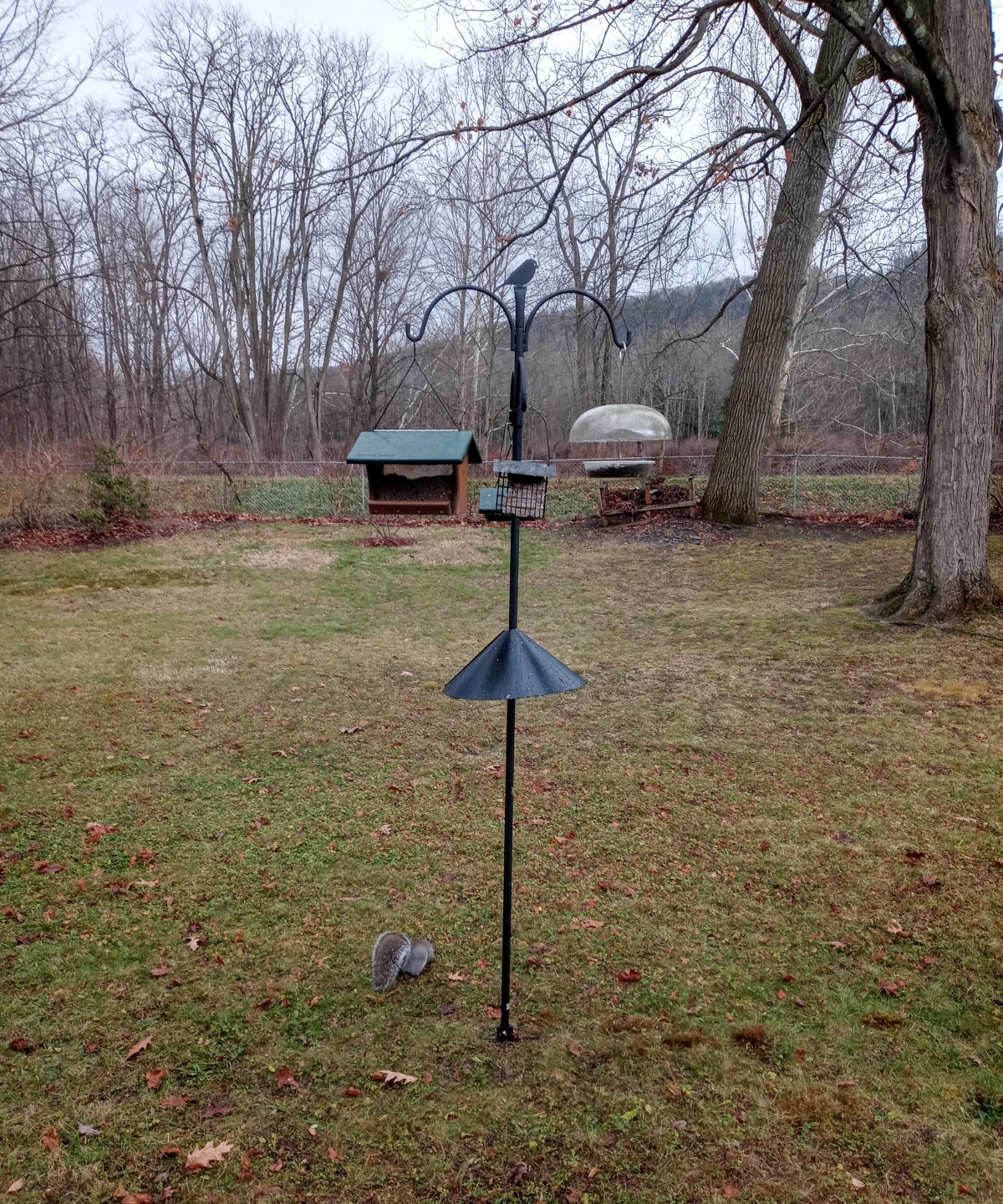
We are finally able to go back to feeding the birds in our backyard, although putting out just seed and not suet in hopes of not attracting bears. (Photo is from a few years ago.)
Join us for Linda’s One-Liner Wednesdays! Find out more here: https://lindaghill.com/2024/11/13/one-liner-wednesday-motherhood/


B took this in our backyard last month, just as the fog was lifting. I wanted to share some rays of sunshine with all of you.

In the United Kingdom and parts of the United States, there is an initiative called No-Mow May, encouraging people not to mow lawns (or a portion thereof) during the month of May in order to encourage the blossoming of wildflowers which provide food for bees, butterflies, and other pollinators.
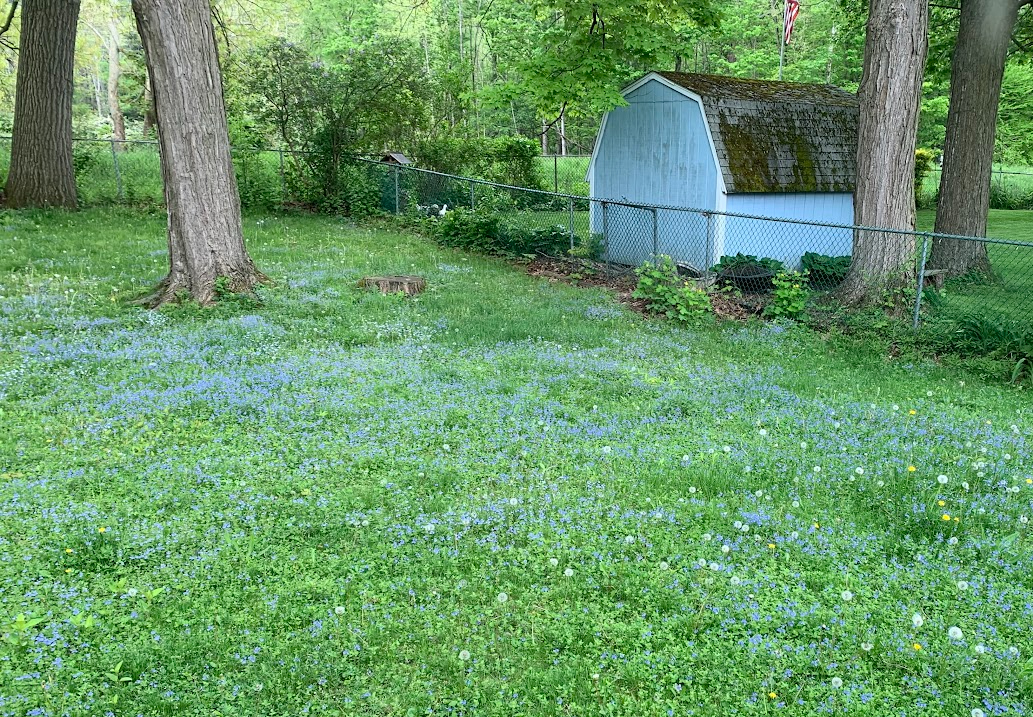
In the spirit of No-Mow May, we have limited our lawn mowing in our front yard and left most of the back yard to grow on its own. The front yard starts things off with dandelions, which we let blossom but then wind up having to mow for propriety’s sake. B leaves the lawnmower on the highest setting, though, so that the spent dandelion stems get cut while sparing the violets and white clover that follow. Even though white clover is not native, our bumblebees seem to enjoy it. It’s also helpful that we use a battery-powered mower so that the plants don’t have to contend with the heat and exhaust of burning gasoline.
Besides those, the backyard has waves of additional flowers, including wild strawberry, bluets, forget-me-nots, speedwell, buttercups, celandine, ground ivy, and fleabane. While these help our pollinators, they also provide food for other animals, including rabbits.
Besides the lawn, we have other spring-flowering plants, including bleeding hearts, PJM rhododendron, dwarf daffodils, lily-of-the-valley, brunnera, amsonia, and our heirloom rose bush.
Although not all the plants are native, our native pollinators frequently visit them, which is important to us, especially our bumblebees. When we had a landscape plan drawn up and planted in fall 2020, we requested native plants, but some of the plants that grow wild in our yard are non-native species that are now considered naturalized in our area, though not invasive. If we do find invasive species, such as garlic mustard, growing, we try to pull them out so that they don’t spread. It is also helpful that we have had wildflowers growing as part of our lawn for decades. We never use herbicides. The mix of plants and not mowing it too short also make our lawn drought-resistant. We never have to waste water by spraying it on our lawn.
We may stretch No-Mow May into early June in the backyard so that the daisies that have started to grow up but haven’t blossomed yet have a chance to do so. Perhaps, B will do what he has done in some past years and mow around the daisies until they have had a chance to flower.
Do people observe No-Mow May – or some variation better suited to your geography, like Low-Mow May or No-Mow April, where you live?


These (very) mini-daffodils grew from bulbs we salvaged from a pot we bought at the supermarket to add some color to the kitchen winter before last.

Join us for Linda’s One-Liner Wednesdays! Find out more here: https://lindaghill.com/2023/04/19/one-liner-wednesday-a-battle-to-the-finish/

One of the things I’ve enjoyed most about the location of our house is that our back yard abuts a natural area with a state-owned fence giving us a barrier to large wildlife. We’ve used this relative protection to feed birds year-round, watching them swooping down for seeds and suet and then back into our trees.

That sense of protection was shattered last week when we awoke to find the central pole snapped and the mostly empty feeders on the ground. The plexiglass of the hopper feeder was broken, making it unusable. The copper suet feeder was bent and had been taken across the yard to one of the large trees.
Our assumption is that a bear had come around the end of the fence and entered our neighborhood and used our feeder station to fatten up for hibernation.
Although it wasn’t the first time a bear had been sited near us, it was the first time we had ever had our feeders raided. Because our local Wild Birds Unlimited store recently closed, B and I trekked up to the store in Fayetteville on Saturday to get the supplies we needed to repair our system.
I had thought that, given the rarity of bears in our neighborhood, we were safe to resume feeding the birds who need the food even more as the weather gets colder and the growing season ends.
I was wrong.
Sunday morning, we awoke to find our new pole broken and empty feeders scattered around its base. Fortunately, this time, the damage to the feeders is repairable without needing to get new parts.
Unfortunately, we won’t be able to put them back out until winter is setting in and the bears are hibernating.
The back yard seems empty without the feeders there and the cardinals, woodpeckers, blue jays, nuthatches, finches, juncos, titmouses, and my favorite chickadees flying in and out, especially at dawn, midday, and before sundown. I know, as wild things, they will be okay without our seeds and suet set out for them but I feel badly withdrawing a food source they have relied on for so long.
Maybe in a few weeks…

From the time I was very young, I have loved trees. When I was growing up, our house was in the woods, so I spent a lot of time playing and daydreaming among the trees – white and yellow birches, sugar and striped maples, hemlocks and spruce. Our grammar school had a naturalist who visited every week and I remember compiling a book of different trees with pressings of their leaves.
Today, I enjoy the trees in our yard. We have two maples, two cherries, and an oak. We used to have an ash tree but it was killed by the emerald ash borer and had to be cut down. I’m pleased to say that we did add a new tree last year, a dogwood which we chose because it is the flower for the birth month of our daughter E. (We already have an heirloom rose which is the birth flower of daughter T.)
T also loves trees and all plants so much that she has a master’s degree in conservation biology of plants. I don’t think that love of trees is genetic, but I’m very proud of her advocacy and caretaking for our environment here in the Northeast US.
*****
Linda’s prompt for Stream of Consciousness Saturday this week is “tree.” Join us! Find out more here: https://lindaghill.com/2021/12/10/the-friday-reminder-and-prompt-for-socs-dec-11-2021/



 Joanne Corey