One-Liner Wednesday: the wise and the fools

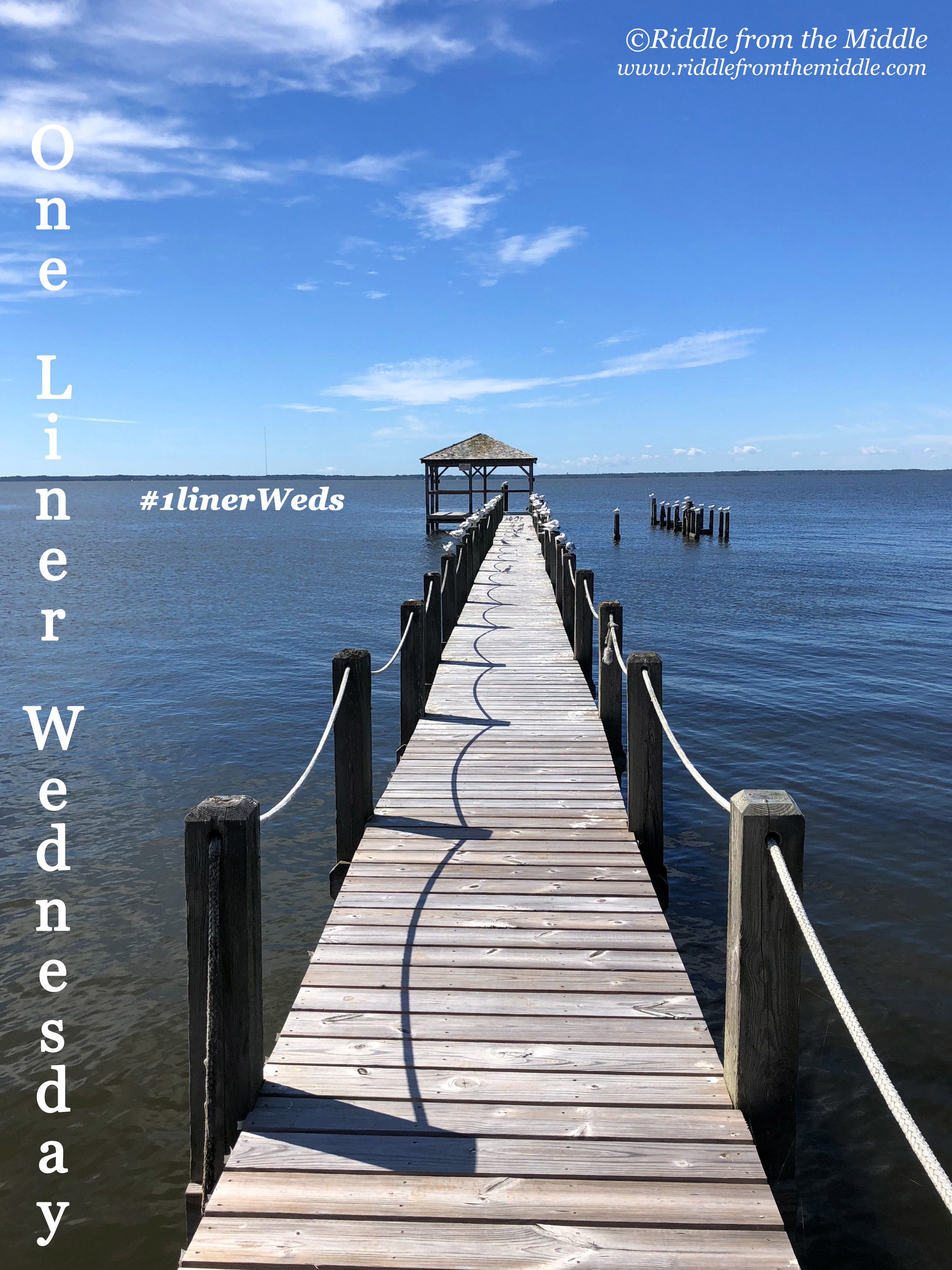
“The wise speak because they have something to say; fools speak because they have to say something.”
~ ~ ~ Plato
*****
Join us for Linda’s One-Liner Wednesdays and/or Just Jot It January!  Find out how here: https://lindaghill.com/2020/01/22/one-liner-wednesday-jusjojan-the-15th-2020-aesthetic/

Badge by Laura @ riddlefromthemiddle.com

sense of humor (or lack thereof)

I often joke about my lack of a sense of humor.

Wait! That doesn’t sound right…

I enjoy certain kinds of humor – irony, satire, political, word play, parody – but don’t like humor that is cruel, crude, or aimed at personal or group identity. For example, when I was young in my tiny, tiny town, other kids would often tell Polish or Italian or “dumb blonde” jokes. I didn’t find them funny then and still do not.

I can’t really tell jokes. Maybe it is a matter of timing.

I am sometimes inadvertently funny. Occasionally, I’ll fall into a double entendre without meaning to. Once in a great while, I won’t catch a joke and say something that the other people in the room find hilarious.

What bothers me is when people find something funny that I mean to be serious. This usually happens when I have written something. When it happens here at Top of JC’s Mind, it’s no harm, no foul. (I almost typed “no harm, no fowl,” which would be a humorous mistake.)

When it happens while workshopping a poem, however, I get discouraged. Sometimes, I can choose different words to clarify, but, other times, it seems that I am too earnest/unsophisticated/serious to even find the humor to address it.

Sigh. It’s really not funny.
*****
Join us for Linda’s Just Jot It January! Today’s prompt is “humor” but you can post about anything you like. I often do my own thing. Find out all about it here:  https://lindaghill.com/2020/01/20/daily-prompt-jusjojan-the-20th-2020/

One-Liner Wednesday: lying

“Lying is done with words and also with silence.”
~~~ Adrienne Rich
*****
Join us for Linda’s One-Liner Wednesdays! Find out how here:  https://lindaghill.com/2019/10/23/one-liner-wednesday-sunset-serenity/ 

Badge by Laura @ riddlefromthemiddle.com

SoCS: Steph’s blog

I knew Linda’s prompt this week was “pretty” and I wasn’t sure I would write a post, but this morning, this link: http://wordwomanpartialellipsisofthesun.blogspot.com/2016/11/the-corundum-conundrum-sapphires-rubies.html landed in my inbox.

Steph writes a blog that is a cross between science, often geology, and wordplay. She often has pretty photos of rocks, electron microscope patterns, geologic formations, and today, some very pretty gems.

Her blog is not on WordPress, so it is hard to re-blog other than by link, but I hope people will pop over to Steph’s blog and see some beautiful corundum in various colors.

Thank you, Steph, for sharing pretty pictures and words with us!
*****
Join us for Linda’s Stream of Consciousness Saturday! Find out how here:  https://lindaghill.com/2016/11/25/the-friday-reminder-and-prompt-for-socs-nov-2616/


Smith-Corona

While re-organizing the basement, B ran across the Smith-Corona manual typewriter he had used in college and brought it upstairs to show to daughter T.

There was still a sheet of corrasable bond paper in it.

The ribbon, which featured both black and red bands, was a bit dried out after 30-odd years of storage, but he was able to advance it enough to find a functional stretch of it.

We proceeded to show T the features. How to set the single, double, or triple space. The unmarked shift lock. That you used a lower case l for the numeral one. How to release the margin if you couldn’t hyphenate the word at the end of the line and needed a bit more space. The “ding” that signaled it was time to return the carriage – and that had us humming Leroy Anderson’s “The Typewriter.” How easy it was to do superscripts and subscripts, in case you were typing a paper with chemical formulas or footnotes. How to set and release the tabs. How you had to be careful not to type too fast or the type hammers would jamb into each other. How much force you needed to type and how it was helpful to have strong fingers so that some of the letters were not lighter than others.

T, who loves plants and elegant simplicity, was enamored and tried it out, typing stream-of-consciousness style, enjoying the physicality of using a mechanical device.

Although she is a child of the digital age, she has the soul of someone from an earlier era, when the rhythms of the natural world and of simple machines like levers were the most satisfying.

One-Liner(ish) Wednesday: Mary Oliver on poetry

“Poetry is a life-cherishing force, for poems are not words, after all, but fires for the coal, ropes let down to the lost, something as necessary as bread for the hungry.”
— Mary Oliver

I love this quote on poetry. One of the greatest compliments I have received as a poet was being told that one of my poems reminded someone of Mary Oliver.

Join us for Linda’s One-Liner Wednesdays! Find out how here:  http://lindaghill.com/2016/01/20/one-liner-wednesday-its-not-what-you-think-2/

I am double-dipping this week with Linda’s Just Jot It January, hence, the uncharacteristic commentary on the one-liner quote. Find out more here:  http://lindaghill.com/2016/01/20/just-jot-it-january-20th-surreptitiously/

JJJ 2016

To find the rules for Just Jot It January, click here and join in today.

One-Liner Wednesday: Words

“Words are a path to the mind; poetry is a drug for the soul.” 
– J. T. Carlton
http://jtcarlton.com/2015/08/09/words-vs-poetry/

This post is part of Linda’s One-Liner Wednesdays. Come join us! Find out how here:  http://lindaghill.com/2015/10/14/one-liner-wednesday-im-driving-here/

One-Liner Wednesday: Long Words

Things are so busy right now, I missed doing One-Liner Wednesday this week, so I am sharing one from Mathemagical in honor of my younger daughter T who has long owned a favorite T-shirt with this word. Have fun listening to the companion song!

One-Liner Wednesday: Words

“I am by nature a dealer in words, and words are the most powerful drug known to humanity.”
– Rudyard Kipling

This post is part of Linda’s One-Liner Wednesdays. Join us! Details here:  http://lindaghill.com/2015/03/18/one-liner-wednesday-on-editing/

What I meant to say was…

“You keep using that word. I do not think it means what you think it means.” – Inigo Montoya in The Princess Bride

I try to be clear when I write prose – poetry is not as straightforward by design – but I am running into a problem. I tend to use words assuming readers will apply standard dictionary definitions, but I am finding myself increasingly having to explain at length what I mean by a certain term, so as not to be misinterpreted, as I did in my recent post My (Feminist) Story.

I do understand the difference between connotation and denotation, but it is a pity that many words that usefully describe philosophical or political views have become so skewed from their dictionary definition as to be unusable in practical terms. For example, the words “liberal” and “progressive” are heard more often as epithets than as accurate descriptors of actual policies. Past conservative presidents like Richard Nixon would now be considered liberal, given the positions of those who now describe themselves as conservative.

The word whose misuse most disturbs me is “science.” Science is about data, evidence, observation, reason, leading to conclusions consistent with facts and repeatable by other scientists. In order for papers to be published in scientific journals, they first must be reviewed by peers with knowledge of the field to ensure that the study’s procedures and conclusions meet research standards. Yes, there are studies that later need to be withdrawn when errors are found after publication, but that is rare.

I frequently write comments on news articles about unconventional fossil fuel extraction including “fracking,” renewable energy, and climate change. In my home state of New York, we are in a continuing battle over whether or not high volume hydraulic fracturing will be permitted. The governor has said that science will be the determining factor. The problem is that both sides say they have the science on their side.

The pro-fracking side has industry studies, which are almost never subject to peer review, bold pronouncements from the industry and their allies that fracking is safe, exemptions from key environmental provisions that apply to other industries, gag orders on court settlements of damage claims, and regulatory agencies that are a revolving door to the industry and that use subcontractors that also work with the industry to draft environmental review documents and regulations.

What we on the anti-fracking side have is – well – science. There was a trickle of studies at first, because scientific study takes time with additional time needed for peer review, but there have been more and more studies, especially in the last eighteen months, documenting environmental impacts on air, water, biosphere, climate, and public health. There is a new compendium of research on fracking here. (I can’t resist posting the link to the compendium at every available opportunity.)

Anyone who knows the definition of science should be able to tell which side is using science in their argument. I can understand that some people who are hoping to profit from fracking might delude themselves into believing the industry over the scientists. I don’t understand the press giving equivalency to the remarks of a peer-reviewed independent scientist and an industry spokesperson/propagandist.

The press should be clear with the definition of science. I know it has become common for politicians at all levels of government to say “I am not a scientist” as an excuse not to understand issues such as climate change. Frankly, people do not need to understand all the intricacies of scientific inquiry to believe a strong scientific consensus. They do need to understand the definition of science and to discern what meets the standards of science and what does not.