

It’s Sun Day!

Today, September 21, 2025, is being celebrated as Sun Day in multiple locations in the United States, with a few locations in other countries joining in.

The brainchild of Bill McKibben, long-time climate evangelist, Sun Day is taking place around the time of the equinox and celebrates solar power, which is now the cheapest source of power on earth. And, yes, you can power your town with solar even at night, thanks to batteries and other energy storage mechanisms. Also, giving a shout-out to wind power, which is sun -related because it’s the sun’s differential warming of the earth’s surface that gives rise to wind. Wind energy is another way to provide power when the sun isn’t shining.

There are events organized by many partners in hundreds of locations, including concerts, e-bike and EV rallies, marches, speakers, technology tours and information booths, and art exhibits. I want to give a special shout-out to the event in my state capital, Albany, organized by my beloved Third Act Upstate New York working group. I wish that I could be joining them in person, but distance and my health situation are keeping me close to home.

My observance of Sun Day is confined to this post, but my celebration of solar power is ongoing! After a several years’ transition, our home and most of our transportation is powered by the sun. We weatherized our 70-ish-year-old house and adopted energy-efficient lighting and appliances. We installed a hybrid heat pump hot water heater and a geothermal heating and cooling system, enabling our disconnecting from the methane system, which had been delivering fracked gas that has caused so much pollution and sickness for our Pennsylvania neighbors. We drive a 2017 fully electric Chevy Bolt and a plug-in hybrid Chrysler Pacifica minivan, so we only use gasoline when we need to take the van on a long trip.

Because we have large shade trees on the south side of our home, we weren’t candidates for rooftop solar, so we own panels at a solar farm. Over the course of the year, we generate enough kilowatt-hours to cover our needs. Currently, we pay about $20/month to the power company for distribution and about $28/month to the company that rents the land for the solar farm and maintains our panels. It’s really great to have such low energy costs and it’s thanks to the sun!

I was happy to see solar power expanding, thanks, in part, to the energy provisions of the Inflation Reduction Act passed under President Joe Biden and New York’s Climate Leadership & Community Protection Act. The implementation of programs under these laws were helping to expand access to solar energy, especially for lower-income folks. Unfortunately, President Trump has curtailed many of those programs and Governor Hochul and her administration are way behind schedule in implementing the CLCPA.

Even without subsidies, solar energy is still cheaper to install than fossil fuel energy, even though fossil fuels are still heavily subsidized, so the hope is that economic factors will prevail and solar will continue to expand. In some countries, like Germany, it’s become common to have solar panels that can be hung from a balcony railing and plugged into the electrical system of the home. Utah recently became the first state in the US to allow this. If more states adopt this approach, solar will be able to spread more quickly because it would available to renters and homeowners who don’t have an appropriate rooftop. Granted, you can’t power your home with a small panel like these, but you can reduce your bills and help reduce strain on the grid.

The expansion of cheap solar power is also a boon in places that don’t have a reliable electric grid available. For example, Pakistan has seen a huge uptick in solar power. In the United States, solar is an opportunity to provide power to remote locations, such as some reservations, that currently don’t have any electricity available. As we saw during the pandemic, these locations also did not typically have a source of clean, safe drinking water. Solar power can be used to power pumps for water wells, leading to much better health and quality of life for residents.

So, hurrah for Sun Day and for the sun powering our lives! I’m grateful that every day is Sun Day at our home and want to thank all that are working to make solar power available to ever more people around the world.

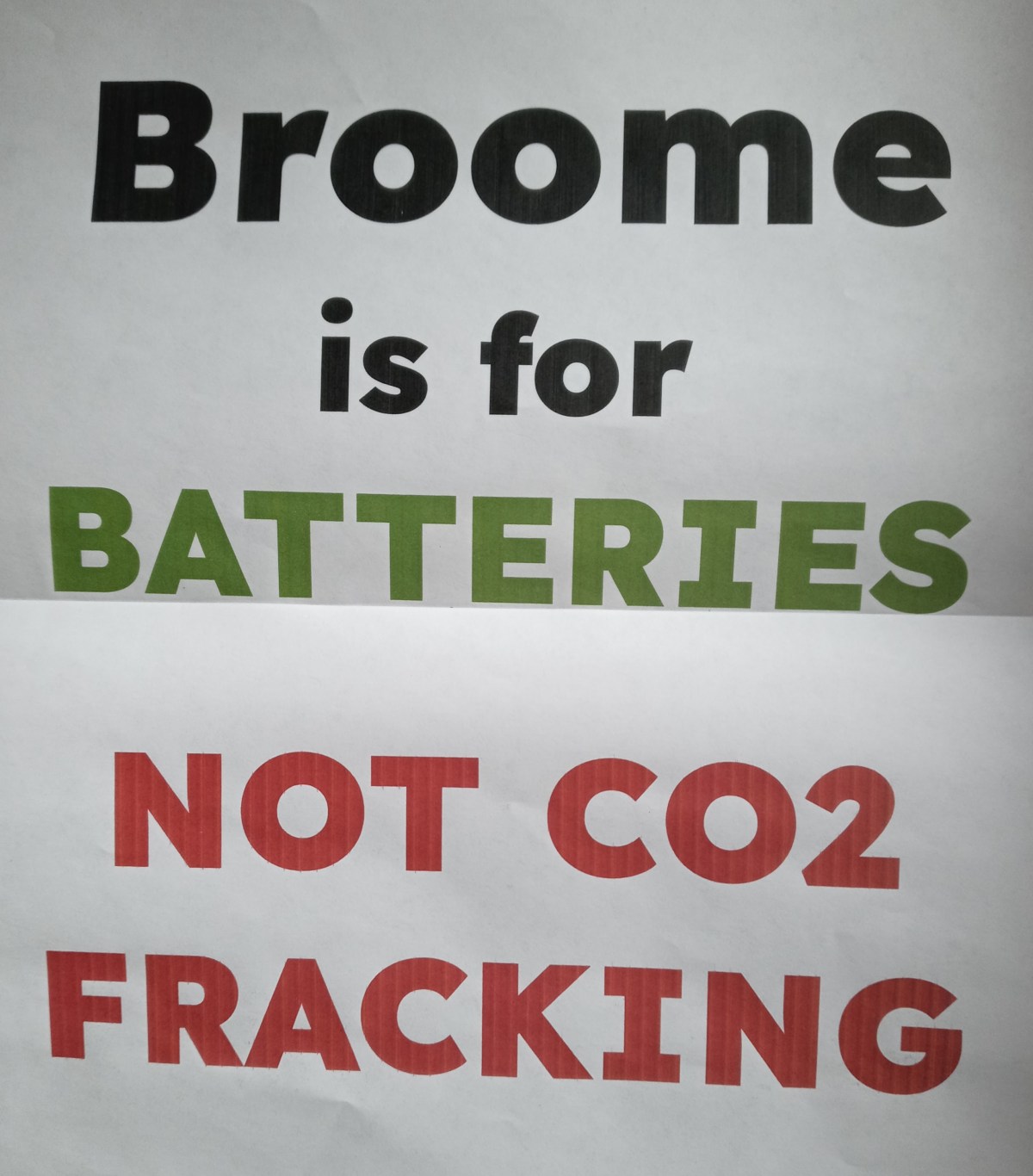
No to CO2 drilling in New York!

One of the things that has been occupying me over these last weeks is the unwelcome and unexpected need to return to the battle against unconventional gas drilling in my home region, New York’s Southern Tier (central NY along the border with Pennsylvania).

I was active with the coalition that successfully advocated for a ban on high-volume hydraulic fracturing in New York, which was first regulatory/executive in Dec. 2014 and made legislative in 2021.

In late summer/fall of 2023, a newly-formed, Texas-based company called Southern Tier CO2 to Clean Energy Solutions, Southern Tier Solutions or STS for short, began approaching landowners in Broome, Tioga, and Chemung counties with lease offers to use supercritical carbon dioxide to extract methane from the Marcellus and Utica shale formations thousands of feet under their land, claiming that it would also sequester the carbon. The scheme would involve thousands of miles of new CO2 and methane pipelines, plus ten or so new methane-burning power plants, which would burn the methane to produce carbon dioxide to use to extract more methane.

Mind you, this has never been done at scale anywhere in the world and does not have any solid scientific backing. The very real negative impacts of high-volume hydrofracking would be compounded by the dangers of carbon dioxide pipelines and injection, all at a time when New York State is implementing its landmark Climate Leadership and Community Protection Act to move us away from fossil fuels and toward renewable energy powering our lives efficiently.

When news of STS’s plans came to light, my New York State legislators, Assemblymember Donna Lupardo and Senator Lea Webb, began asking the Department of Environmental Conservation questions. I admit that I was alternating between fear and disbelief that the hard-won ban might be in jeopardy because it was predicated on the volume of water used and STS’s proposal plans to use supercritical carbon dioxide instead of water.

Fortunately, the coalition that had fought for years to win the hydrofracking ban quickly reconstituted and got to work. A coalition letter from over 90 organizations went out in December. Legislators got to work on legislation to add carbon dioxide to the existing ban with Dr. Anna Kelles as sponsor in the Assembly with Donna Lupardo as a prime co-sponsor and Lea Webb as sponsor in the Senate.

On March 5th, the coalition held a rally/lobby day in Albany. We had great speakers at the rally, including legislators, scientists, and leaders of organizations. I went local with my sign, emphasizing that the Broome County (Binghamton) area is part of the clean energy future as the center of a national technology hub for battery storage through the New Energy New York coalition and neither needs nor wants to be tied to dying fossil fuels. This was my first experience with in-person rallying and lobbying at the New York State Capitol. I was overwhelmed by the noise and busy-ness of it all but grateful to have been able to do my small part in the effort.

I’m thrilled to report that, on March 12th, the Assembly passed the bill with a vote of 97-50 and. on March 20th, the Senate followed with a vote of 45-17. Now, we are moving into the final phase, asking Governor Hochul to sign the bill quickly.

I’m shocked that the coalition was able to get this to move so quickly in Albany. As a Southern Tier resident, I’m immensely grateful to have support from around the state. In the original fight against hydrofracking, there were some very loud voices that were willing to use the Southern Tier as a sacrifice zone to get cheaper methane for their own use; this time, with the CLCPA in place, we didn’t encounter that sentiment as much. I’m also especially grateful to the Third Act Upstate NY working group, who jumped in as soon as I raised the alarm. Third Act is too new an organization to have been around for the original fracking battles but many members have extensive experience with climate activism and organizing and know how to get the word out.

While it seems that this is a local issue of a few counties in New York, the carbon dioxide drilling/sequestration scheme has global implications. Like plastics, it is an attempt by the fossil fuel industry to keep the world dependent on fossil fuels for decades to come, in defiance of the science that demonstrates the need to reduce atmospheric greenhouse gases as quickly as possible to keep the planet livable.

Part of the price to get fossil-fuel bro Joe Manchin’s vote in the US Senate on climate legislation was to include massive subsidies for carbon sequestration. It’s those subsidies that are behind STS’s proposed scheme to profit from the methane in the Marcellus and Utica shales, which is not economically viable to produce on its own. Using carbon dioxide from burning fossil fuels to extract even more fossil fuels is also inherently deleterious to environmental health and the climate. While there may be some instances where industrial carbon emissions can be collected and sequestered, the geology of the Southern Tier would not seem to support long-term sequestration. Sequestration would also be near-impossible in areas with a history of oil and gas wells because there would be too many pathways for injected carbon dioxide to escape.

My hope is that the example of New York banning this extraction/sequestration scheme will help other jurisdictions around the world see through the fossil fuels industry’s increasingly desperate attempts to keep the world burning their dirty products, even with the effects of climate change already causing damage and misery on a global scale.

Watch for news of these kinds of proposals near you. Don’t fall for the lies of the fossil fuel industry. Follow the science. Advocate for clean, renewable energy. Let elected officials know that we need and want protection from pollution and climate change. With so much damage already having been done, we need to act decisively now.

Together, we can move in a positive direction, as we are here in New York.

SoCS: “yes, and” and “no”

When you are doing improvisation exercises in theater, there is an understanding that you will do “yes, and” to build on whatever came before you. It’s the way that you keep the improvisation going.

I have found, though, that saying “yes, and” on a regular basis in life quickly leads to being overwhelmed.

Sometimes, you need to say “no” – no matter how worthy the cause. Or, at least, “not right now.”

I managed to illustrate this lesson over these last few months. I had planned to spend them concentrating on poetry, learning to market my first chapbook, Hearts, and preparing for the Boiler House Poets Collective residency in late September-early October.

What happened was that I wound up heavily involved with the launch of the Third Act Upstate New York working group and needed to devote extra time to my activities with the Madrigal Choir of Binghamton, where I sing and also sit on the Board.

I’m not sorry that I did these things; they were valuable and I gained new skills and friendships. They were also all expressions of things that are close to my heart and ways to serve others. It was just that saying “yes, and” a bit too much led to a lot of stress and was unsustainable for more than a few months. It also, unfortunately, meant that something had to give, which turned out being my efforts at book marketing, which was the only thing I could give up without having to sacrifice a group goal.

Realizing all of this, I was able to say “no, at least for now” to being on the Communications Committee for Third Act Upstate NY after our successful launch. The Boiler House Poets Collective residency was a great experience, with the BHPC members coming together to divvy up the work to prepare for next year that had largely fallen to me this year. (I really do need to get to a wrap-up post for the BHPC residency. Coming soon…) Madrigal Choir made it through our first concert of the season with flying colors. The next few weeks will be busy as we prepare and present our annual Lessons & Carols concerts the first weekend in December; there will also be Board work ongoing.

Still, things will be calmer and more manageable than the last few months have been.

I’m excited – and a bit nervous – about an upcoming manuscript consultation for my full-length collection, which I’m hoping will clarify where to seek publication for it. I have a bit more editing to do in advance of that. I’m getting some writing done with the fall season of Binghamton Poetry Project up now and have some more editing and possible new work following up from the BHPC residency.

Oh, and Top of JC’s Mind! Although I’m perpetually behind where I would like to be, I was able to celebrate the tenth anniversary of the blog in September, including the launch of joannecorey.com as an author site with access to TJCM as a feature. No worries if you continue to visit here at topofjcsmind.wordpress.com. That is the permanent address of the blog for all time – or while we still use this technology.

There are some other projects waiting in the wings and, of course, Thanksgiving, Christmas, and New Year’s are coming and I have done literally no planning for them so far.

I don’t know if I can find the impetus to go back to trying to learn book marketing or not. I may have used up my energy for learning new things and being outside my comfort zone for the year.

Maybe if I manage a few months of “no, not now” instead of “yes, and” I’ll be able to recharge…
*****
Linda’s prompt for Stream of Consciousness Saturday this week was “no” used alone or as part of another word. Join us! Find out more here: https://lindaghill.com/2023/10/27/the-friday-reminder-and-prompt-for-socs-oct-28-2023/