One-Liner Wednesday: FDR on economic progress

“the test of our progress is not whether we add more to the abundance of those who have much; it is whether we provide enough for those who have too little.”
~~~ Franklin Roosevelt, second inaugural address

Join us for Linda’s One-Liner Wednesdays! Find out more here: https://lindaghill.com/2025/12/03/one-liner-wednesday-i-dont-think-this-is-mathing/

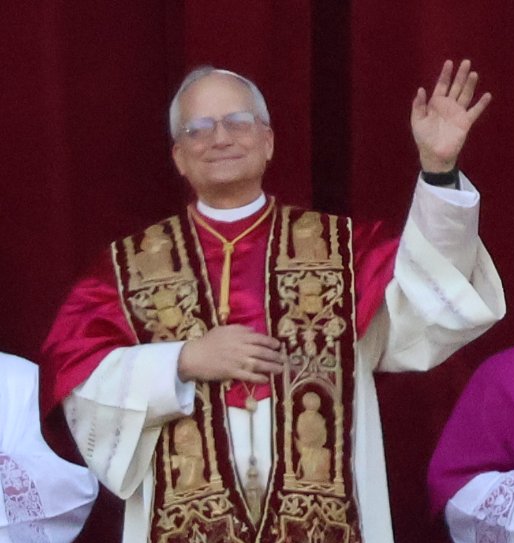
Welcome, Pope Leo XIV!

(By Edgar Beltrán / The Pillar – https://x.com/edgarjbb_/status/1920590815472108021, CC BY-SA 4.0, https://commons.wikimedia.org/w/index.php?curid=164970023)

When I wrote about Pope Francis right before the conclave, I didn’t expect that the conclave would end on the second day. As a reader of NCR (National Catholic Reporter), though, I was delighted but not shocked by the selection of Cardinal Robert Prevost as the next Pontiff. Although he was born in Chicago and educated in the United States (with an additional degree from the Pontifical University of St. Thomas Aquinas in Rome), most of his ministry has been outside the US. Fluent in several languages, including Spanish and Italian, he spent over twenty years in Peru as a pastor and, later, Francis-appointed bishop. He is well-known in church circles internationally because he visited close to fifty countries as prior general of the Augustinian order and, for the last two years, had been in Rome serving as head of the Dicastery for Bishops, which advises the Pope on the appointment of bishops world-wide. He was chosen as a cardinal on assuming this prominent role in the Curia, which is the Catholic Church’s bureaucracy.

While many had felt that it was impossible for anyone from the US to be chosen as Pope because the United States is such a powerful country, Cardinal Prevost was seen as more of an international figure. He is a citizen of Peru as well as the United States and has lived in Rome for over a dozen years. He understands the workings of the Vatican but retains the skills of a pastor. He supports Francis’s efforts to make the church more synodal in its approach, which broadens those with input into church matters instead of everything being concentrated in the power of the bishops, led by the Pope, who is given primacy as the bishop of Rome. I think that his skills and resume, as well as his familiarity in so many countries, made him a natural choice for the cardinal-electors.

I was struck that the name he chose was Leo XIV. This immediately brought to mind Leo XIII, whose 1891 encyclical Rerum Novarum (Of New Things) is the bedrock of Catholic social justice doctrine. That encyclical is subtitled Rights and Duties of Capital and Labor; it brought moral teaching to bear in response to the challenges of the industrial revolution. This choice of name signals that the new pope hopes to bring social justice doctrine to bear on the current challenges of the digital age. He also will continue the work of Francis’s 2015 encyclical Laudato Si’: On Care for Our Common Home, which emphasizes working to address “the cry of the earth and the cry of the poor.”

I was struck by his age. Born in 1955, Leo XIV is the first pope who was raised in the post-Vatican II church from childhood. My hope is that his papacy will continue the reforms of Vatican II which place the Catholic Church in the modern context rather than trying to isolate itself. This is the first time that a pope feels like a brother to me because he is actually close in age to my older sister. Being from the United States, I also understand better the environment in which he grew up. It lends a feeling of closeness that was not possible with the prior popes in my lifetime.

Leo XIV’s age also opens the possibility of a long pontificate. Leo XIII had one of the longest pontificates in history at 25 years; Leo XIV may not match that length but could remain pope for over two decades if his health holds.

I also have a personal attachment to the name Leo, which was my father’s name. He was named after his own father, although not a Junior as they had different middle names. Family lore is that my great-grandparents, after suffering the loss of several children, started to name them after popes, so my grandfather was literally named after Pope Leo XIII, who was serving at the time of his birth. All their sons who were named for popes survived into adulthood.

Welcome, Leo XIV! May God bless your pontificate and all the work you do for peace, justice, the world, and all peoples.

Vote for Democracy #22

how being a Catholic woman serves as preparation for the incoming administration

(Photo by Lucas Sankey on Unsplash)

I’ve written before about the intersection of how the conservatives in the Catholic Church treat women and issues such as abortion. I’ve also posted more specifically how Leonard Leo and Opus Dei have impacted the Supreme Court and broader governance issues.

While many in the contemporary Catholic church have come to embrace the radical inclusiveness of Jesus, especially for those who are oppressed, others cling to the misogyny, racism, and bigotry that held for centuries when the Church engaged in empire and building of worldly rather than spiritual power. Even into modern times, this has resulted in women not being treated as equals in the Church and in society, along with discrimination against people due to their race, religion, sexual identity, place of origin, and economic status.

While I am blessed to know many in the Catholic church who do recognize my dignity and gifts, there are a number of powerful bishops and laity who do not. These, including an out-sized number of Supreme Court justices, governors such as Texas’s Abbott and Florida’s DeSantis, and the incoming vice-president, JD Vance, are loudly proclaiming and taking action that restrict the rights and freedoms of women and girls. Besides restrictions on abortion that have resulted in permanent injury or death to women, there are also moves to restrict contraception and recognize any fertilized egg as a person, all the while denying personhood rights to any pregnant person.

We are even hearing calls for women, especially mothers, to give up paid employment in order to be at home full-time. Shockingly, some are even calling for the repeal of the 19h Amendment of 1920 which recognized women’s right to vote everywhere in the United States.

While I am sadly accustomed to being recognized as less than a full and equal person in the Catholic church, it is frightening to see these same calls in the context of the United States’ government.

I commit to continuing to fight for equal rights for women and girls, as well as for those of all faith traditions or none, those of all races, ethnicities, and places of origin, all genders and sexual orientations, and all ages and health circumstances, to be treated with equal dignity and protection in the United States. This is also in keeping with Catholic social justice doctrine.

I know millions of others are already at work and will never back down on these human right issues. That we will have to fight for these rights that had been considered settled is disconcerting but I know we will prevail in the long run.

I mourn, though, for those who have been harmed and who will be harmed in the meantime.

One-Liner Wednesday: contrasting Project 2025 and social justice doctrine

NETWORK has assembled a non-partisan, educational resource contrasting Project 2025 and the tenets of Catholic social justice doctrine, which are shared by millions of Americans, whether or not they themselves follow a faith tradition.

Join us for Linda’s One-Liner Wednesdays! Find out more here: https://lindaghill.com/2024/09/18/one-liner-wednesday-you-know-you-need-coffee-when/

One-Liner Wednesday: debate checklist

This non-partisan checklist (from NETWORK, based on Catholic social justice principles which are shared by many people of faith, as well as totally secular people) will assist viewers of the US presidential debate between Joe Biden and Donald Trump tomorrow (Thursday, June 27 at 9 PM EDT) in tracking the candidates’ views on a range of issues.

This public service announcement comes to you as part of Linda’s One-Liner Wednesday series. Join us! Find out more here: https://lindaghill.com/2024/06/26/one-liner-wednesday-have-you-ever/

SoCS: causes

I’ve spent decades now advocating for change on a whole raft of social justice and environmental issues.

There has been some progress in some areas, but I admit that there are times when I get tired, times when I realize that a change we’ve been working on for decades still hasn’t happened or where there’s been backsliding on a right that we thought had been secured.

Some days, I want to just throw in the towel.

But then I think about it and realize that a lot has been accomplished by so many people working together. The progress is often slow and incremental. When a change seems sudden, it’s usually the result of years of groundwork laying the foundation.

When I get discouraged, it’s often a comment from a friend that helps me realize the importance of the work, even when it seems we aren’t getting anywhere and even when the hoped-for change is unlikely in my lifetime. (This especially applies to my work on gender equality in the Catholic Church. The Catholic Church tends to think in centuries.)

So, at least so far, though I do change the issues I concentrate on from time to time, I keep at it.

Keep on keeping on.
*****
Linda’s Prompt for Stream of Consciousness Saturday this week is to use “throw in the towel” at some point in the post. Join us for Linda’s Stream of Consciousness Saturday and/or Just Jot It January! Find our more here: https://lindaghill.com/2023/01/27/the-friday-reminder-for-socs-jusjojan-2023-daily-prompt-jan-28th/

Applying the past to 2020

While it has been flying under the radar a bit in this cataclysmic year, 2020 is the centennial of the passage of the 19th amendment to the United States Constitution, recognizing women’s right to vote.

B, T, and I recently watched a four-hour documentary on PBS, entitled The Vote. (At the moment, you can stream it for free by following the link.) It was a reminder to me of the long struggle to secure the vote for all women in the US and how interwoven it was with issues of religion, abolition, temperance, racism, property rights, wealth, war, and social mores. The derisive and/or violent reaction to the nearly always peaceful demonstrations that the women undertook seems frighteningly current.

T and I also saw Gloria: A Life, a docu-play based on the life of Gloria Steinem. The performance was filmed with the audience there, the first act as a play and the second act a discussion with the audience featuring Gloria Steinem herself. Like Steinem and Betty Friedan, I am an alumna of Smith College; while there I had taken an early women’s studies course, before the formation of an academic department of women/gender studies. By the time I was a teen, the Second Wave of feminism was well underway, so I recognized many of the names of Steinem’s feminist activist-colleagues. Early on in the play, there is a tribute to the many women of color who were leaders in the movement. One of the strange phenomenon that happened was that, even early on, the press would disproportionately cover and feature Steinem, marginalizing other leaders, especially those of color. This has led to the enduring false impression that Second Wave feminism was a white middle-class movement, when it was in reality what would now be termed “intersectional.” It drew together women’s rights with issues of race, immigration, sexual orientation, gender expression, union/labor rights, violence, medical care, and more.

This was particularly striking at this time when we see activists who had been working on issues in isolation now drawing together in this time of pandemic and outcry for social and racial justice. We see them supporting each other and crafting policy proposals to address the common good. I am so encouraged to see the #BuildBackBetter movement put forward plans that take into account historic racism, marginalization, discrimination, oppression, environmental degradation, unfair wages, etc. and take steps to redress the wrongs and put in place an equitable, fair, safe, and comprehensive system.

2020 has been immeasurably difficult, but we all have the opportunity to make a better future. Let’s go! The United States needs to live up to its highest ideals and join with the world community to heal the planet and all its inhabitants.

a pandemic paradox

Over the past several years of spending a lot of time as a caregiver, I’ve valiantly tried to cut down the size of my email inbox, which is often overflowing with news, newsletters, and calls to action from various charitable, social justice, and environmental causes, along with personal and poetry-related emails. Even with my diligent attempts, I routinely handle over a hundred emails a day, which is still a lot, so I am unsubscribing from even more email lists and trying to avoid signing too many petitions which lead to my being on even more lists.

Paradoxically, as we have been avoiding in-person meetings over these last months, my inbox is full of invitations to connect via Zoom or Go to Webinar or some other platform. Instead of having fewer demands on my time, there seem to be more.

I can’t keep up.

In order to create some semblance of order, I’ve decided to narrow the selection of online events that I will accept. Of course, I will continue with my local poetry circle, which I call the Grapevine Group after the cafe where we used to meet pre-pandemic. I am also looking forward to the five-week summer session of the Binghamton Poetry Project, which, for the first time, is breaking into a beginner and a more experienced section. I am also signed up for six summer sessions with a local spirituality center that has had to re-convene virtually rather than offering in-person programs and retreats.

Beyond that, I plan to accept a very limited number of educational/advocacy meetings on social/environmental justice to keep informed and to take directed action. I am heartened by the increasing convergence of climate/environmental justice with racial/economic justice and want to advocate for effective change.

Beyond that, I hope to say “No” and continue to unsubscribe so that I have more time to accomplish what I need to and respond to ever-shifting circumstances.

(She writes, hoping she can actually manage to do so.)

JC’s Confession #13

In the first few seasons of The Late Show, Stephen Colbert did a recurring skit, now a best-selling book, called Midnight Confessions, in which he “confesses” to his audience with the disclaimer that he isn’t sure these things are really sins but that he does “feel bad about them.” While Stephen and his writers are famously funny, I am not, so my JC’s Confessions will be somewhat more serious reflections, but they will be things that I feel bad about. Stephen’s audience always forgives him at the end of the segment; I’m not expecting that – and these aren’t really sins – but comments are always welcome.

JC

I haven’t gone to a march or demonstration against racism since the murder of George Floyd.

This is something I absolutely would have done pre-pandemic. I know many at-risk people have chosen to participate because of the importance of the cause and the present moment’s possibilities for progress on human rights, trying to fulfill the call for justice that has been so long denied.

Still, I can’t bring myself to attend a public gathering, knowing that I will be seeing my 95-year-old dad and possibly some of his senior-community neighbors in the coming days. I always wear a mask, but I’m not comfortable having any more exposure to people than I absolutely must in order to function as a household.

On the day of George Floyd’s funeral, there was a brief ecumenical gathering to kneel for 8 minutes, 46 seconds in his memory. While I stayed at home, T attended, so our household was represented. The gathering was outdoors, it was sunny and windy, T wore her mask, and people spread out as best they could, so it’s unlikely she was exposed.

Still, it feels odd to not have a physical presence myself at this crucial time. I will try to be content with my efforts to educate myself and keep updated online and through the media, as well as to pursue lobbying and advocacy opportunities with the social justice organizations with whom I have relationships.

I also have my platform, however small, here at Top of JC’s Mind. Every voice, every action, adds something to what must, finally, this time, be permanent changes in the US and the world.

time slips by

I know some people who are under shelter in place or stay home orders are struggling with finding ways to fill time, but I am having the opposite problem. There always seems to be more to do than time/energy/brainpower permits.

Part of this is the continuation of dealing with grief. A year ago at this time, we were in the last few weeks of my mother’s life, so there is sadness with the coming of spring. My heart goes out to all those who are currently in nursing homes and hospitals who are not allowed to have visitors. While those last weeks with Nana were difficult, it would have been even more difficult not being there to bring her ice water and chat between naps.

This personal grief is enveloped by the global grief of dealing with the pandemic, its toll on people, and its laying bare all the inequities of society. The pandemic is bringing out the selfishness and greed of some, the suffering of most, and the generosity and community spirit of many. While some just want to “get back to normal” and are willing to risk public health to do it, more and more are talking about “building back better.”

The #BuildBackBetter movement is encouraging. It calls on us to examine the past and present so that we can build a better future. Here in the United States, the problem of lack of access to quality, affordable health care has been made even more apparent, especially for black and brown folks, immigrants, people living in poverty, those without homes, and elders. So many losing their jobs and their health insurance along with it also illustrates the inherent weakness in our current healthcare system.

Many of our essential workers, including caregivers and transit, food service, janitorial, grocery, and agricultural workers, are also our lowest-paid. These people are risking their lives to keep basic services going for less money than they would make if they were collecting enhanced unemployment and too many have contracted, or even succumbed to, COVID-19. My hope is that the new-found appreciation many feel for these essential workers will lead to living wages for all jobs, benefits for those who are without paid work that reflect human dignity and care, and a realization that wealth is created by the society, not just the business owners.

While grief and fear can be mind-numbing, it is a comfort to hear about all those who are serving others, dispensing accurate information, and planning for a responsible path forward. I admit that I watch or listen to a lot of coronavirus coverage. I want to stay up to date with the science and the demographics, which is especially important here in New York State, which has the largest number of cases in the country. I listen to our governor, Andrew Cuomo, give his daily briefings because he is very truthful, forthright, and compassionate. It is comforting to know where we are, even when the statistics are unnerving, because there are plans unfolding that are modified as the circumstances change. As our caseload in the state starts to come down, Governor Cuomo is talking more about how we will move into the next phase. He is a big proponent of building back better, socially, economically, justly, and in accord with the best science available for human, environmental, and climate health. This gives me hope that some good will come out of a horrifying situation. Most of the time, I see the Governor through Facebook Live, so there are comments coming in; it’s amazing how many in other states and countries tune in to his briefings for the facts and for a practical, compassionate response to our current challenges. Sadly, the same cannot be said for White House briefings, which I avoid.

I am fortunate that things in my household are on an even keel. I am sad, though, to have family and friends who are suffering because of the lockdown or the virus itself. It’s hard not to be able to go to them and help, though I try to do what I can by phone or online.

I am not struggling with staying at home, though. I am pretty high on the introversion scale, so I am content to be at home with my family. I don’t know how I would react, though, if I lived alone, which is something I have never done.

I do spend more time on shopping and meal planning/preparation than I used to. We are still having significant shortages in our area, so weekly shopping has turned into several hours in several stores to find basic items. There are more meals to plan for because we can’t go out to dinner and because everyone is here for all their meals every day. We do sometimes get takeout from a local restaurant, but there is definitely more cooking going on at home.

I’ve been trying to keep up with my social and environmental justice activities online and have taken the opportunity to attend some webinars. The Binghamton Poetry Project and my local poetry-workshop group have been meeting via Zoom. I’ve also finished revisions of my chapbook and have been slogging through the time-consuming and anxiety-producing process of finding contests to enter. Seven and counting…

I do write blog posts now and then…

I wish I could say that I was reading more. I admit that, most days, I don’t even get through my email. By evening, I find that my brain can only handle watching television while playing not-too-taxing computer games. As I’ve been saying for years now, it’s often not so much about time as brainpower.

How are you all doing wherever you find yourselves during this pandemic?