Pope Francis’s core message of his first full day in Cuba has been “Serve other people, not ideology.”
People in the United States could very well receive the same core message when Francis arrives here later in the week.

I heard this morning that Pope Francis is en route to Cuba, where he will spend a few days before arriving in the US.
His route here will take him to Washington, New York City, and Philadelphia. There will be high profile speeches to the US Congress, UN General Assembly, and at a conference on the family in Philadelphia. There will also be several public Masses with attendance in the thousands for the indoors ones and hundreds of thousands when outdoors.
I have been eagerly anticipating his arrival and plan to watch the coverage, including a group “watch party” for the Congressional address.
I was reading an article by Father Tom Reese in NCR the other day, asking if people would really hear what Francis has to say while he is in the US. I know that I will be listening carefully. I also know that, while I will agree with many of the Pope’s points, I will disagree with others. For example, Francis, though he means well, does not understand women’s lives. While he is wonderful about acknowledging social justice issues with those in poverty or on the margins, he fails to notice that this group is disproportionately female and that sexism and sexual violence/exploitation play a large role in their plight.
I am especially interested in how the Congress, many of whose leaders are Catholic, will react to what is sure to be a challenging speech to them, probably on the grounds of climate change, militarism, lack of care for the country’s and the world’s most vulnerable, rampant consumerism, and greed.
I am hopeful that Pope Francis’s voice on environmental issues and systemic marginalization of those with the least economic resources, especially in the global South, will spark conversation that will lead to a strong US voice for the climate and environment and for justice, for “integral ecology” as the Pope terms it, so that there will be a strong international accord coming out to the Paris climate talks at the end of the year with full US participation in the implementation.
That sounds like I’m asking for a miracle.
Maybe I am.
But I think there is hope through Francis, who speaks not only to Catholics but to “all those of good will” and maybe even may reach those who are not especially “of good will.”
Godspeed, Francis. May you have a safe and fruitful journey.
*****
This is part of Linda’s Stream of Consciousness Saturdays. This week’s prompt is route/root. Join us! Find out how here: http://lindaghill.com/2015/09/18/the-friday-reminder-and-prompt-for-socs-sept-1915/ 

This week, the Islamic Declaration on Global Climate Change was announced, calling for Muslims around the world to phase out use of fossil fuels and switch to renewable forms of energy.
This follows on the heels of the June release of Laudato Si’, the encyclical issued by Pope Francis on the environment, climate change, and care of creation, including humanity. The encyclical draws deeply not only on climate science but also on the tenets of peace, love, mercy, caring, and justice that underlie many different world religions and philosophies. Francis intended this document for the world’s Catholics and “all people of good will” whether or not they follow a religious/spiritual practice.
Faith leaders from other spiritual and religious traditions, including the Dalai Lama, have also voiced their concerns on combatting climate change and environmental degradation. The People’s Climate March on September 21, 2014 brought people from all corners of the globe together in solidarity to demand action on measures to reign in the greenhouse gases that are already wreaking havoc on our climate and people’s lives. Various governments have made pledges to cut emissions and convert to renewable energy sources, all as a lead-up to the United Nations Climate Change Conference in Paris, November 30-December 11, 2015.
Past conferences have been disappointing, as countries could not demonstrate the political will needed for the huge change in energy systems required, but, this time, finally, there is hope, due in large measure to the diverse voices demanding or pleading for change.
I have spent years in the grassroots movement to ban high volume hydrofracking in New York State, which drew me into the fight against fracking in other states, as well as promoting the rapid expansion of renewable energy in order to stop using fossil fuels as soon as possible. This led me to not only being involved in the climate movement but also to being more open to expressing calls for climate justice, environmental justice, and social justice in keeping with my Catholic faith.
There were many times when I thought we had lost the fight against fracking here in New York (and we are still involved in some issues with it, despite the current regulatory situation). There were even times when I had no hope left, but we did ultimately prevail.
There have been times when I had no hope that meaningful action against global climate change would materialize, but, seeing so many disparate groups of people come together to demand climate action gives me hope.
The years of inaction have put us in a precarious situation. Demand climate action now! Contact the government agency in your country and tell them they must reach an effective accord in Paris.
The world can’t afford to wait.

I’ve recently joined a new organization, the Catholic Peace Community of the Southern Tier. There are people from several different parishes and we are hoping to build peace through working on different social justice areas.
Our first activities are dealing with the environment and climate change. One of the main tenets of Catholic social justice teaching is care of creation. Also involved are other tenets, such as the protection of the most vulnerable. Those who are living in poverty are much more likely to be subjected to pollutants and also more likely to be impacted by severe weather and sea level rise, as they live in vulnerable areas without strong shelter and do not have the means to relocate out of harm’s way.
We are looking forward to Pope Francis’s upcoming encyclical on the environment and will study the document when it is released in the late spring or early summer. Then we hope to get the word out about the encyclical not only to Catholic parishes but also to the general public in advance of the Paris climate summit in December.
Our first public event is on the 25th of this month when we will have a table at EarthFest. Pope Paul VI said, “If you want peace, work for justice.” We hope to build peace by working on various justice issues, but I am glad that we are starting with this timely work for ecojustice.
*****
Linda’s prompt for Stream of Consciousness this Saturday is: “piece/peace.” To join in the fun, visit here: http://lindaghill.com/2015/04/17/the-friday-reminder-and-prompt-for-socs-april-1815/


Where Pope Francis stands when it comes to women | National Catholic Reporter.
I commend Father Tom Reese for writing this column. He makes a lot of good points, but I felt compelled to make the following comment: “I don’t think that women are upset with Francis calling for a theology of women because they prefer to think of a theology of person. Rather, what upsets me and other women that I know is that there a decades of profound writings in feminist theology that Francis does not seem to even know exists. While we all welcome further work on this theology, we must acknowledge that a lot has already been accomplished, whether or not the clergy and other men of the church have been reading and studying it. Another instance of the men of the church not listening to the women’s viewpoint?”

Yesterday for SoCS I wrote about whether my chorus would “gird” or “put” on the armour of light. This morning at church the theme was light overcoming darkness, progressing to the concept of Jubilee and the upcoming Jubilee of mercy which Pope Francis announced on Friday.
The deacon who preached spoke about how this Jubilee calls us to welcome everyone without exception – and to not wait for the official start of the Jubilee on December 8, 2015 to do so.
My mind turned to how Jesus welcomed in the most profound way those who were marginalized in his society and faith – those who were ill or disabled, those without financial resources, foreigners, women, all those who were looked down on by the powers that be of his day.
As a woman who is a feminist and has chosen to stay within the church, knowing that it fails so often to fully reflect the radical gospel call of Jesus, this jubilee call is both an opportunity and a potential source of disappointment. While Francis has spoken often of a poor church for the poor and has championed causes of peace and social justice, he does not understand the profound ways in which the Catholic church has marginalized women and failed to challenge temporal powers that oppress them. Many other clergy in the church are openly dismissive of women’s gifts to the church and the world, unless those gifts are motherhood, domestic pursuits, or vowed religious life, preferably contained by convent walls.
Will this be the year when the church finally realizes that the call of jubilee to set the captive free applies to women both in its midst and in the world? Will the men of the church finally recognize that women are made in the divine image as much as they are?

I wasn’t sure what I would write about using the prompt of including the letter T until I read this: http://ncronline.org/blogs/ncr-today/2014s-runner-person-year about how Stephen Colbert was the runner-up to Pope Francis to be National Catholic Reporter’s Person of the Year.
We are fans of Stephen Colbert and his just-completed nine-year run of The Colbert Report. I wrote about it here.
When I told my family about the NCR piece, our daughter T immediately began to concoct a segment of “Who’s Not Honoring Me Now?” about how Stephen (in character) didn’t much care for this pope but that now it was personal.
In real life, Stephen Colbert is a practicing Catholic and I’m sure is fond of Pope Francis. That would be the Stephen who pronounces the T at the end of his last name.
From the first promos of The Colbert Report, it was pointed out that both the T at the end of Colbert and the T at the end of Report are silent. It was how you could tell that someone was familiar with the show or not. Fans would never have pronounced those Ts.
Stephen, being runner-up to Pope Francis is still a great gig!
This post is part of Linda’s Stream of Consciousness Saturday, with the prompt being the letter T: http://lindaghill.com/2015/01/02/the-friday-reminder-and-prompt-for-socs-january-315/ . It is also part of Linda’s Just Jot It January: http://lindaghill.com/2015/01/01/just-jot-it-january-pingback-post-and-rules/ . Come join in the fun!


Badge by Doobster @Mindful Digressions

At vigil Mass on Saturday, while we were praying the Nicene Creed, a thought flashed into my head at the second filioque – and the Son – wondering if it will be removed when the Orthodox and Catholic churches are reunited. Its insertion in the creed was one of the reasons given for the schism in 1054 – and one in which the Catholic side was almost assuredly in error. I certainly have no problems with dropping it…
What is more enlightening for me than the thought itself this weekend but that it coincided with Francis’s visit to Turkey. I hadn’t had the chance to keep up with news from the visit over the weekend but was catching up on some of the coverage through NCR today, reading about how Pope Francis and Ecumenical Patriarch Bartholomew had both spoken very strongly in favor of unity in the immediate future. Talks between the two churches have been ongoing for decades and I share in the hope that this unity will come soon.
Francis made very clear that all the various churches that make up the Catholic and Orthodox communions would retain their own identities, that unity is only in profession of faith together. Bartholomew spoke poignantly about how unity among Christians is already evident in the lives of those being persecuted for being Christian, whatever their denomination.
So, I guess the Catholics would not have to drop the second filioque, but I think it would be a nice gesture.

This morning’s service was one of the most inclusive I have attended in a long time. I won’t name the church or the priest, who was a visitor, for his protection, as the freedom with which he treated the mass texts would land him in hot water with the bishop, although, interestingly, I doubt Pope Francis would bat an eye.
The gospel story (Mathew 15:21-28) was about the Canaanite woman who begs Jesus to save her daughter who is tormented by a demon. At first, Jesus ignores her and the disciples want her to be sent away, yet she persists in her request. Jesus finally says that he has come only for the children of Israel, that it isn’t right to throw the children’s food to the dogs. She answers that even the dogs eat the scraps from the master’s table and Jesus says that her daughter will be healed because of her faith.
I think, though, that what the woman exhibited more strongly than faith was maternal love. I’ve been in the situation of having a sick daughter and know what it feels like to pursue anyone or anything to help your child, even if you have to go against society’s norms to do so. A woman in that culture would not be permitted to approach and talk to a Jewish man, much less follow after him, calling out and begging, but she did it to save her beloved daughter.
In Matthew’s account of the story, even Jesus is a bit slow to recognize that God’s love is universal, that this woman and her daughter are as precious and valuable as Jewish persons are. The priest made this point clear, not only through his homily but also throughout all the prayers of the mass, weaving in references to God’s love for all beings and our own call to love and care for every person without regard to any difference of belief, ethnicity, race, body size, ability, or any other characteristic.
I so appreciated the message and the elegantly consistent way in which it was woven into the mass. That I knew that he, like the Canaanite woman, was bending the rules to do so, was a satisfying delight.

From an Italian blog that I follow. I hope that Francis will find the wherewithal to follow the example of John XXIII. It is said that, had he been elected instead of Benedict after John Paul II’s death, he would have chosen the name John. Perhaps that is a sign of things to come.
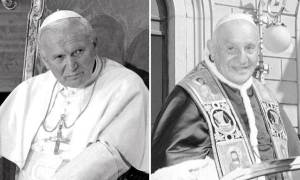 http://www.Ansamed.info
The canonization of both John XXIII and John Paul II will take place this Sunday, April 27, in Rome, and the event is expected to attract million of people to the epicenter of Catholicism.
Though both popes will be elevated to sainthood on the same day, their impacts on the Catholic Church and its more than a billion followers worldwide could not be more different.
I am not sure many people remember John XXIII, who after all, died in 1963. He was a stocky little man with a prominent nose and a gentle voice. he was considered a “transitional pope”, being 76 years old when he was elevated after eleven ballots to the Throne of Peter.
Regardless, during his short-lived papacy (just under five years), he did much to open the Church not only to the world but also to the future. In calling the Second Vatican Council…
View original post 382 more words


 Joanne Corey