the later verses

For some reason, yesterday the topic of the later verses of songs to which many know only the first verse well came up a couple of times. In a Binghamton Poetry Project session, we read Ada Limón’s poem “A New National Anthem” which quotes from and asks why we don’t sing the third verse of the “Star-Spangled Banner”. Last night, I was discussing the hymn “Amazing Grace” with a friend; I relate much better theologically with the ending verses than the opening ones, which are the ones most people recognize.

Although I am Catholic, much of my training as an organist was in a Protestant context. Unlike most Catholic churches, which often sing only two or three verses of a hymn, Protestant churches usually sing all the verses, which, as a poet and a liturgist, I find more proper. I sometimes choose a hymn specifically for a message in a later verse. I did this in choosing hymns for my father-in-law’s funeral, only to have the substitute organist truncate the hymn so we never got to verses that were connected to the occasion. I noticed the pastor giving a sidelong glance at the organist, but he didn’t take the hint.

Some of my favorite verses of hymns are later ones. In Katharine Lee Bates’ “America the Beautiful”, I especially like the end of the second verse/stanza: 
America! America!
God mend thine every flaw,
Confirm thy soul in self-control,
Thy liberty in law!
We could really use some of that self-control these days. Interestingly, in researching the poem, I found that the version most of us know is the 1911 revision. The original 1893 version ends the third stanza with:
America! America!
God shed His grace on thee
Till selfish gain no longer stain,
The banner of the free!
We could really use that message now, too.

Sometimes, later verses are just fun because you get to sing words that your would not otherwise. For example, the second verse of the standard version of the United Kingdom National Anthem “God Save the Queen” which deals with the Queen’s enemies contains the lines “Confound their politics, Frustrate their knavish tricks”. It’s not often one gets to sing about “knavish tricks”!

Sometimes, especially in folk/protest songs, verses are included, excluded, or altered due to political circumstances or the audience. Woodie Guthrie’s original lyric of “The Land Is Your Land” contains a verse about private property and ends with a verse about hunger that closes “As they stood hungry, I stood there wondering if this land was made for you and me.” Most people are familiar only with the verses that are a US travelogue, not these more challenging ones.

There are some hymns, such as “Sing a New Church” by Delores Dufner, OSB, that I love all the verses so much that I will sing omitted verses to myself if we don’t get to sing them all during the service.

My first college choral conductor, Rob Kolb, taught us that the hymn is the poem which is the text, as opposed to the tune, which is interchangeable with another of the same metric form. Because the hymn is the poem, you sing it as you would recite it, with its punctuation and word emphasis intact. You also honor the hymn as an entity, so you sing all the verses, as you would read or recite all the stanzas of a poem.

Some lessons stick with you for life.

A timely poem from Anne Harding Woodworth

As we are all dealing with COVID-19 in some way, I wanted to share a topical poem with you.

Anne Harding Woodworth is an accomplished poet who I met through the Smith College Alumnae Chorus. We have sung together for several concerts, including three performances of Mozart Requiem on tour in Sicily. This poem brilliantly references the Requiem in the context of an audience-less performance held recently due to COVID-19 caution.

The site where it appears is New Verse News, which publishes poems on current topics of interest. I appreciate that they make it possible for poets to publish work about recent or ongoing situations without having to wait months for journal publications.

You can find “Mozart Requiem Streamed in a Time of COVID-19” here:  https://newversenews.blogspot.com/2020/03/mozart-requiem-streamed-in-time-of.html

Angelus poem published!

I am happy to announce that I have a new poem available online. I mentioned in this post that I had written and submitted a poem to The Ekphrastic Review in response to their biweekly challenge, a painting by Jean-Francois Millet titled “The Angelus”. For those who are unfamiliar with the term, ekphrastic poetry or prose is a piece based on another work of art, most often a piece of visual art. I have written a number of ekphrastic poems, due in large part to my experiences in residence at the Massachusetts Museum of Contemporary Art with the Boiler House Poets Collective.

The poems that Lorette C. Luzajic, the editor and founder of The Ekphrastic Review, selected are now available online here. It’s always amazing to see the creative and unique approach that each writer takes from the same prompt. There are certain elements that weave among the poems. I’m especially pleased that Kyle Laws, my poet-friend from Boiler House, also has a poem chosen for this challenge. Kyle writes ekphrastic poetry on a regular basis and was recently nominated for a Pushcart Prize by The Ekphrastic Review. It’s her eighth Pushcart nomination! It is an honor for me to be included with such distinguished poets and writers.

A note on my poem: The italicized lines are parts of the English translation of the Angelus prayer. The Catholic church I attended as a child observed the tradition of ringing the bells in a distinctive pattern three times a day to encourage people to pray the Angelus. The painting and the prayer inspired me to construct a narrative around the woman who appears in the painting.

If you are so moved, you may comment here or on the Top of JC’s Mind Facebook page.

sense of humor (or lack thereof)

I often joke about my lack of a sense of humor.

Wait! That doesn’t sound right…

I enjoy certain kinds of humor – irony, satire, political, word play, parody – but don’t like humor that is cruel, crude, or aimed at personal or group identity. For example, when I was young in my tiny, tiny town, other kids would often tell Polish or Italian or “dumb blonde” jokes. I didn’t find them funny then and still do not.

I can’t really tell jokes. Maybe it is a matter of timing.

I am sometimes inadvertently funny. Occasionally, I’ll fall into a double entendre without meaning to. Once in a great while, I won’t catch a joke and say something that the other people in the room find hilarious.

What bothers me is when people find something funny that I mean to be serious. This usually happens when I have written something. When it happens here at Top of JC’s Mind, it’s no harm, no foul. (I almost typed “no harm, no fowl,” which would be a humorous mistake.)

When it happens while workshopping a poem, however, I get discouraged. Sometimes, I can choose different words to clarify, but, other times, it seems that I am too earnest/unsophisticated/serious to even find the humor to address it.

Sigh. It’s really not funny.
*****
Join us for Linda’s Just Jot It January! Today’s prompt is “humor” but you can post about anything you like. I often do my own thing. Find out all about it here:  https://lindaghill.com/2020/01/20/daily-prompt-jusjojan-the-20th-2020/

“Moonrise” by Kyle Laws

My friend, fellow Boiler House Poet, and Pushcart Prize nominee for 2019, Kyle Laws, has a new poem up on Amethyst Review. For some reason, I couldn’t get the reblog to work, but you can find the poem here:  https://amethystmagazine.org/2019/12/21/moonrise-a-poem-by-kyle-laws/
This is the photograph by Barbara Jabaily on which the poem is based.
photograph by Barbara Jabaily

Enjoy!

a parade and complexities

On Sunday morning, I went to early mass at St. Elizabeth of Hungary, just across from MASS MoCA. It’s the building I knew as St. Anthony’s – and the church where we held the funerals of my mom’s parents. At that time, it was mostly people who, like my grandparents, were ethnically Italian. At the time, North Adams had five Catholic churches; over the years, they have combined into a single parish, which took a new name. Vestiges of the original churches are represented by statues and such taken from the other churches, but it always strikes me, when I look at the dedications of the windows and the pews as I walk to communion, that the building is still centered in Italian heritage.

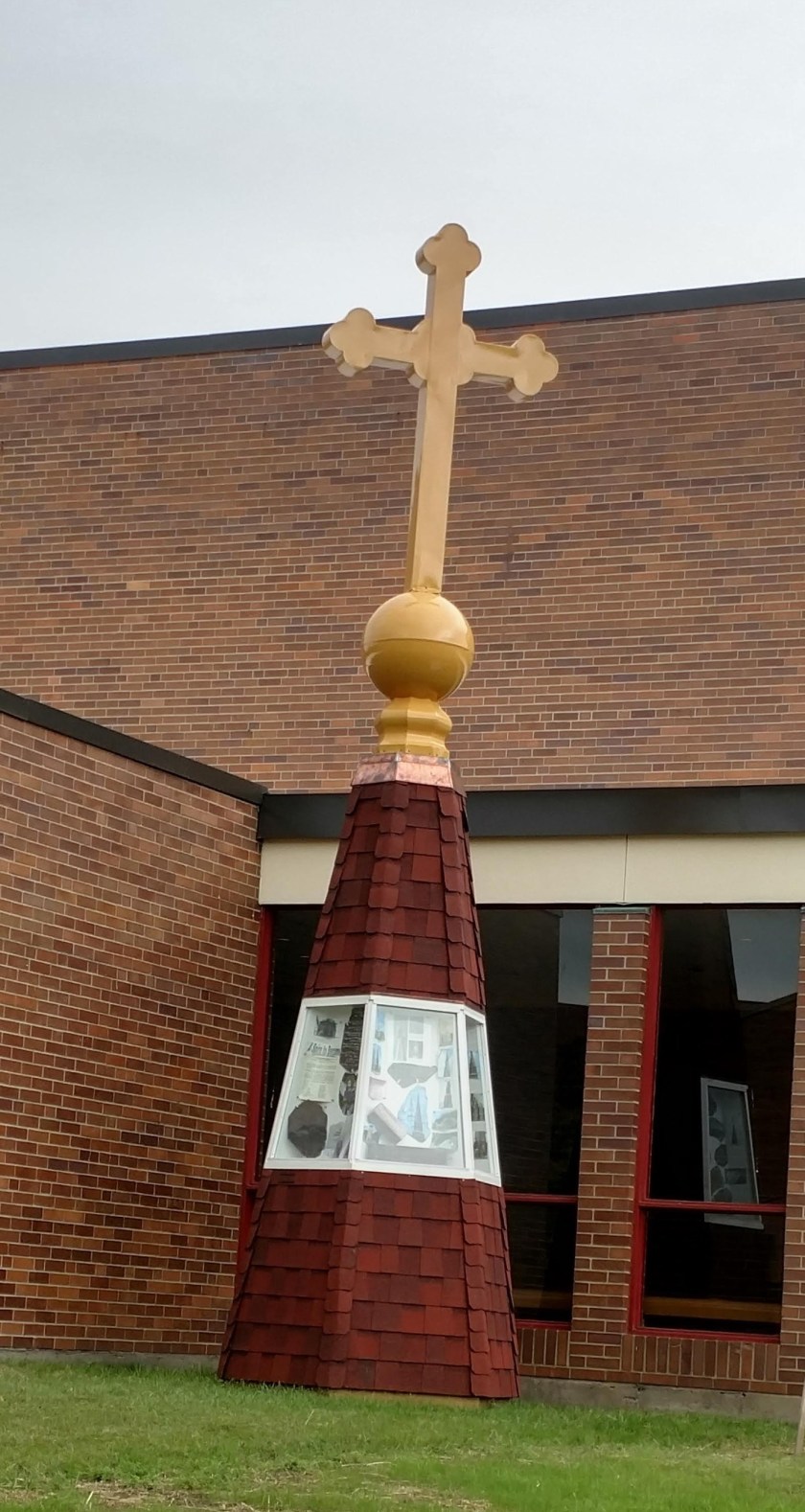
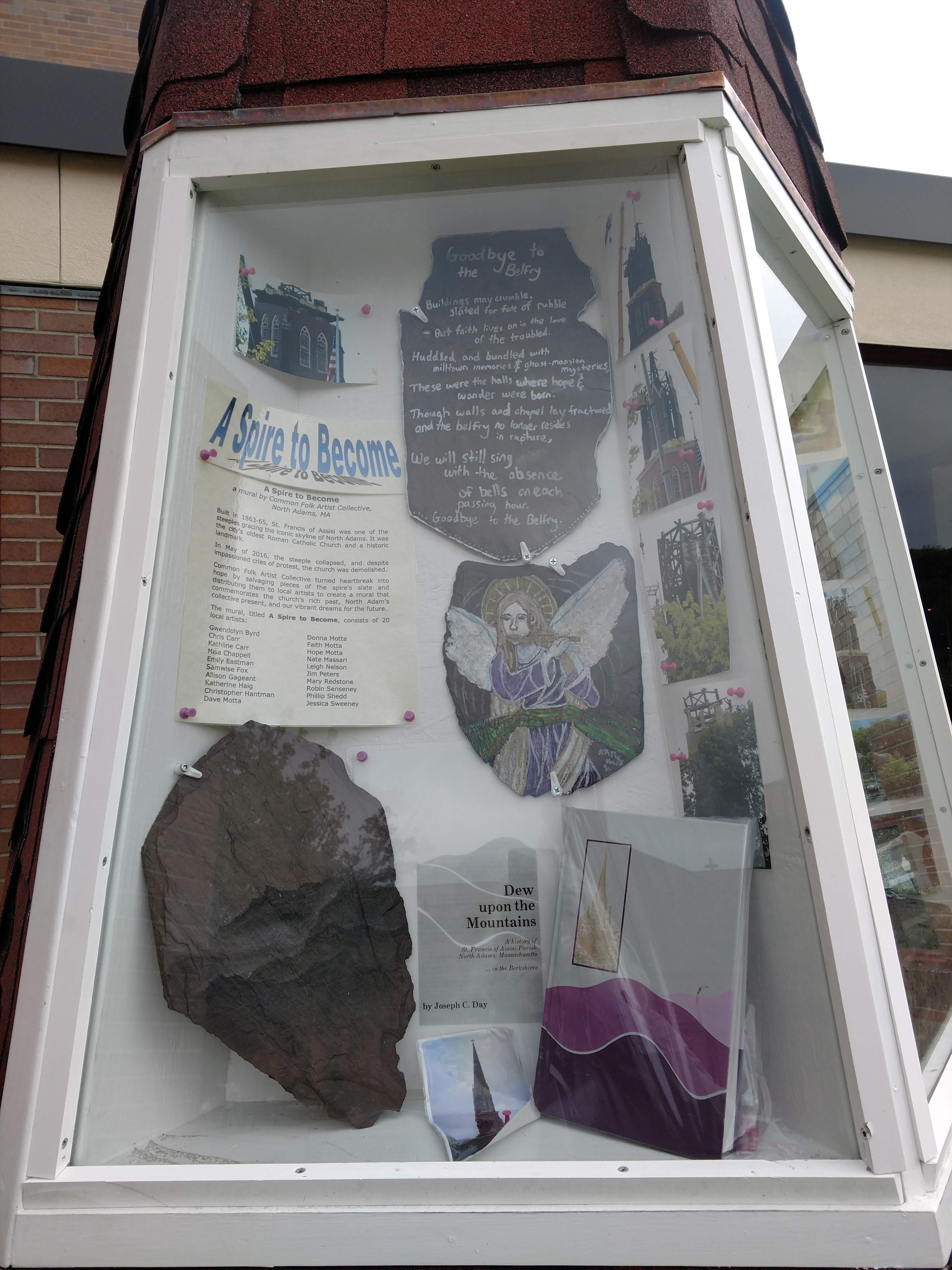
I exited through one of the back doors and was surprised to find a new memorial tucked into a small lawn between the driveway in the parking lot and the entrance to the parish hall. It’s a replica of the top of the steeple of St. Francis church, the mostly Irish-heritage church that had to be demolished when its structure deteriorated to a dangerous degree. Built into glassed-in alcoves on its sides is a memorial to the church with various memorabilia are twenty pieces of slate that had been salvaged from the wreckage and given to twenty local artists to create remembrances. Some are painted with scenes or designs, but some have text.
St. Francis memorial - North Adams
img_20191006_092542012-1
img_20191006_092612300_hdr
img_20191006_092556508_hdr
This is probably how the nostalgia/memorial spiral that I had feared started.

I had decided to attend the Fall Foliage Parade in the afternoon. I grabbed my box lunch from the museum cafe and found a spot on Hadley Overpass near City Hall, the last stretch before the turn onto Main Street and the reviewing stand. I had written poetry about the parades of my youth and the one I had attended a couple of years ago, but I wanted to see how people interpreted this year’s theme, “There’s no place like home in the Berkshires.” As I ate my sandwich and waited for the parade to reach us, I watched the vendors going by and, because I was near some families with young children, stopping to sell their wares. Most of the things were expected – various inflated toys, stuffed animals, plastic horns – but a few were jarring. The most puzzling combination was the vendor selling Trump 2020 flags alongside a green marijuana flag. I can’t say that I remember either political or drug-oriented flags at Fall Foliage parades before.

I was happy to see that, while there were only a few high school bands, they were larger than the last parade I had seen. I could have done with a lot fewer emergency vehicles in the opening section. I might not have minded so much if they hadn’t all felt compelled to blare their sirens all the time. I also could have done with fewer Oz-themed floats and costumes. You know your grand marshal is a good sport when she is waving from the back of an open convertible dressed as Glinda.

My favorite floats and signs had more pertinent interpretations of home. The young baseball and softball players doing variations on there’s no place like home plate. The signs which read, “There’s No Place Like a Safe Home” and “There’s No Place Like the Headstart.” Even though it was partially advertisement, the Grand Marshal’s Award went to Mountain One Bank with the theme “There’s No Place Like Your Hometown Bank.” The float that was closest to my heart, though, was the Hayden Award winner from Greylock Elementary School, “North Adams Is Our Emerald City.” Beyond being incredibly sweet, I was also touched that Greylock is continuing to be very active in the city. My father-in-law was principal there for decades, long enough to have been principal for three generations in some families, and I was moved to see that his spirit is still alive there.

Later in the afternoon, I workshopped one of my North Adams poems with the Boiler House Poets before heading to a high school friend’s home for dinner. Her husband made us a delicious dinner as I knew he would; he was a chef for many years and we ate at his restaurants many times. After dinner, my friend and I talked for hours, sometimes about current events, but mostly about our families with the array of illnesses and losses and moves and growth and letting go and plans and sorrows and disappointments. We hadn’t been able to see each other for a year, so there was a lot to catch up with, but all of Sunday put me in a vulnerable place for Monday, the last full day of our residency.

I had been workshopping North Adams-oriented poems, but decided to edit a poem which may end a revision of a chapbook I am working on about my mother’s experiences with congestive heart failure. She passed away in May and I thought I was ready to work on this poem, but I probably was not. I managed to do the edits, but it was stressful enough that I slipped back into my brain-full-of-holes, unmoored state that has been affecting me more often than not these last months.

I went back to my room in the apartment to rest for a while, but headed back to the museum for our usual 1:00 lunch. We had to make some plans for the rest of our time, but I was feeling indecisive and scattered. I knew I couldn’t write. One of the poets had told us at lunch that she had read one of her poems at the artwork about which it was written. I decided that I would follow her lead and read a poem in the place it belonged. In my case, though, it wasn’t about an artwork, but about a building.

Building 6 is the largest in the museum complex. It is located where the two branches of the Hoosic meet, so it is shaped somewhat like a wedge. The renovation created a shape in the narrow end of the building called “The Prow.” It is one of my favorite spaces in the museum and the subject of a poem I wrote about looking out its windows. I found a copy of it and went to read it there, except that I forgot to put it into my pocketbook to bring with me. I managed to find it on my phone, though, so I was able to read it there as I looked out at the river and the street and the hills. No one was there to hear it, but that was better. I might not have been able to gather the gumption needed to recite with an unsuspecting audience.

Despite my misgivings, I was able to workshop my poem when we met in the late afternoon. I have some more edits to make and some more things to mull. I’m not sure when, but maybe in a few weeks.

I know this month is going to be incredibly complicated.

JC’s Confessions #7

On The Late Show, Stephen Colbert does a recurring skit, now a best-selling book, called Midnight Confessions, in which he “confesses” to his audience with the disclaimer that he isn’t sure these things are really sins but that he does “feel bad about them.” While Stephen and his writers are famously funny, I am not, so my JC’s Confessions will be somewhat more serious reflections, but they will be things that I feel bad about. Stephen’s audience always forgives him at the end of the segment; I’m not expecting that – and these aren’t really sins – but comments are always welcome.
~ JC

Poets are supposed to submit work to journals or publishers on a consistent basis. I confess that I have not been doing this. Not even close. Other than a few stabs at Rattle’s Poets Respond series, which only takes submissions written within the last week on news items and is a very, very, very long-shot, I have only done one submission this year, which I did because a poet-friend asked me to do. (I am not counting poems published in Binghamton Poetry Project anthologies because they are not a competitive venue.)

Given how complicated these last months have been, I suppose it is understandable that I haven’t been submitting for publication. I confess that I find the process of figuring out to whom to submit which poem daunting and incredibly time-consuming. I get nervous about the formatting requirements, which never seem to be the same among different publications. I also need to be in a mindset that can take a lot of rejection, because the vast majority of submissions will be rejected.

The result of all this is that it is even more difficult than before to get motivated to work on submissions. Not publishing also erodes my already fragile sense that I am a poet – or, at least, a poet good enough to be published.

Which makes it harder to get motivated to submit and adds to my lack of confidence, and so on and so on…

Later in the fall, I may/will have more time to devote to writing and poetry. Will I be able to get my act together to do submissions?

I don’t know.

Stay tuned.

One-Liner Wednesday: loyalty

“I am loyal to the inconveniences of kindness.”
~ ~ ~ from an extraordinary poem/meditation by Reb Irwin Keller that was shared to FB by one of my friends of Jewish heritage
*****
Please join us for Linda’s One-Liner Wednesday! Details can be found here: https://lindaghill.com/2019/08/28/one-liner-wednesday-wtf-melani/

Badge by Laura @ riddlefromthemiddle.com

Poem in The Ekphrastic Review

With everything that has been going on, I hadn’t had any poems published for a long time. I’m pleased to tell you that I do have a new poem published today in The Ekphrastic Review. For those who aren’t familiar with the term, ekphrastic poems are ones that are based on another work of art. The Ekphrastic Review, edited by Lorette C. Luzajic, publishes poems inspired by visual art.

The Ekphrastic Review also offers ekphrastic challenges. They post an artwork on their website and invite writers to submit a poem or short prose piece in response. A selection of these pieces appears on their website along with the artwork that inspired them.

I submitted a response to “In Equipoise” by Teresa Vito of Pueblo, Colorado (USA), chosen by Kyle Laws, guest editor for the challenge. The ever-creative Kyle Laws arranged her selections into an amazing chapbook. I am honored that the tanka I submitted was chosen as a “breath” among longer poems.

The link is http://www.ekphrastic.net/ekphrastic/ekphrastic-challenge-responses-teresa-vito. Enjoy!


One-Liner Wednesday: Frost quote

“A poem begins in delight and ends in wisdom.”
– Robert Frost
*****
Join us for Linda’s One-Liner Wednesdays and Just Jot It January! Find out how here:  https://lindaghill.com/2019/01/30/jusjojan-2019-daily-prompt-jan-30th-and-one-liner-wednesday/
More information on JusJoJan and prompts here: https://lindaghill.com/2018/12/31/what-is-just-jot-it-january-2019-rules/