And the hits just keep on comin’…

Our wonderful family news has been a welcome distraction from the ever-evolving disaster of living in the United States right now.

We now have had over 5 million confirmed cases of COVID-19 in the United States, which is appalling and could and should have been averted. (For perspective, the US has about 4% of the world’s population but about 23% of the world’s cases.) I live in New York State and have posted a number of times how Governor Cuomo and his team followed the science and data to bring our once highest in the world levels down to about a 1% positive test rate. The daily fatalities once in the hundreds, is down to single digits. Businesses and services have been re-opening carefully and slowly, so our transmission rate has stayed very low for weeks. In September, schools will be allowed to re-open, with most choosing a hybrid model with a small subset of students in physical attendance on any given day with the bulk of instruction still happening online. As with everything else the state has done, data will determine if adjustments or temporary closures are needed to keep students, staff, and their families as safe as possible.

Many other states are having large numbers of cases, overwhelmed hospitals, and deaths, but are still opening schools, bars, gyms, and other businesses as though there wasn’t a pandemic going on. It’s as though they live in an alternate reality promoted by the president where coronavirus is just “sniffles” and the virus will “just disappear.”

Meanwhile, people are sick and dying.

Millions more are unemployed and/or impoverished. Most of the previously passed federal relief measures expired at the end of July. The House had passed the HEROES Act in May, which would have extended and expanded them, but the Senate didn’t take up the bill or craft a comprehensive plan of their own, despite the fact that the vast majority of economists, even conservative ones, say that a large-scale plan is needed to keep the economy from sinking into a depression.

Strangely, negotiations were going on between the Democratic Congressional leadership and White House chief of staff and Treasury Secretary; you would think that the Congressional Republican leadership would have been there as well, but they left town instead. Yesterday, the president announced some executive orders to address some of the issues, but they will almost certainly by found unconstitutional because Congress controls federal taxes and spending. We are dealing with not only the pain of the pandemic and its consequences but also with the shredding of our Constitutional federal government.

On top of this, the intelligence community has announced that several foreign powers are interfering in our upcoming election, partly be spreading and amplifying misinformation. Meanwhile, the president is casting doubt on the validity of our voting process, undermining confidence in voting by mailing in ballots (except in states with Republican governors, some of whom have purged large numbers of minority, student, and potentially Democratic voters from the rolls), and, through a crony as Postmaster General, slowing down the mail service. The president even floated the idea of delaying the election, something that is not at all in his power.

With both domestic and foreign interference at play, it may be difficult to mount a fair election. (By the way, the HEROES Act allocates money for both the postal service and for state election boards.) I am hoping that the vast majority of people will behave in a responsible, ethical, and legal way, so that the election really does reflect the will of all the citizens.

I don’t want to imagine what will happen if the election is unfair or disputed.

a non-reunion

In fall of 2015, I took a frightening leap of faith and attended my first-ever poetry residency/workshop. It was a collaboration between Tupelo Press and The Studios at MASS MoCA (Massachusetts Museum of Contemporary Art). As a relatively inexperienced poet, the only reason I was emboldened to apply was that it was in North Adams, the small city in the Berkshires where I had gone to high school. I grew up in the tiny town of Monroe Bridge, about twenty miles away, so North Adams had been a second hometown to me, with at least weekly visits to relatives and stores.

The residency was, well, complicated. It was daunting and terrifying at times and I was perpetually in over my head, but I learned a lot and met wonderful poets. I blogged about the experience and just re-read all the posts. This post contains links to the residency week’s posts, which convey things fairly well, except for downplaying the terror just a tad.

In those 2015 posts, I mentioned the possibility of a reunion residency and I’m pleased to say that the Boiler House Poets Collective has met every year since in early fall for a week at MASS MoCA.

Until this year.

Because of the pandemic protocols and travel restrictions, our 2020 reunion is cancelled. We are all sad, but we are on the schedule for fall 2021, so we know we will return.

In one of the 2015 posts, I mention my plan to put together a poetry collection about my personal and family ties to the North Adams area and that it might take a long time to put it together.

This turned out to be true.

While I have completed a different manuscript in the intervening years – and two major iterations of the North Adams collection, I am nowhere near finished with the collection I envisioned in 2015. I had planned to spend a major chunk of our 2020 residency hammering out more poems and a new version of the manuscript.

I get emails from MASS MoCA and The Studios, so I knew that a deadline was coming up to apply for individual residencies for winter/spring 2021 and I began pondering if that was something I should try to do. It’s a bit complicated because 1) it’s very competitive; 2) the minimum block is two weeks, which makes things trickier in terms of being away from home; 3) no one can project what kinds of virus levels, travel restrictions, closures, capacity limits, etc. may be in place in 2021, so cancellations could still occur; 4) the application would have been quite a chore, especially because I don’t have a cv prepared.

In discussing this with my spouse B and resident daughter T, an alternate solution came up – that I could go to North Adams on a self-styled writing retreat, staying in a local hotel/inn, visiting the museum with my membership pass, and writing in my room or some other socially distanced space that may present itself. If I do this, I could choose the dates myself and could wander about the area as I wished. Importantly, I could also go sooner rather than later, while both New York and Massachusetts have good control on virus levels and no travel restrictions between them. I would be able to maintain good social distancing, so my risks would not be any higher there than here.

So, I might make it to North Adams to write for a week after all. Of course, it won’t be as rich an experience as I am used to when being officially in residence with my inestimable Boiler House poet-friends, but the time away to work on the collection in the place where it is centered would still, I hope, be fruitful.

Stay tuned for future developments.

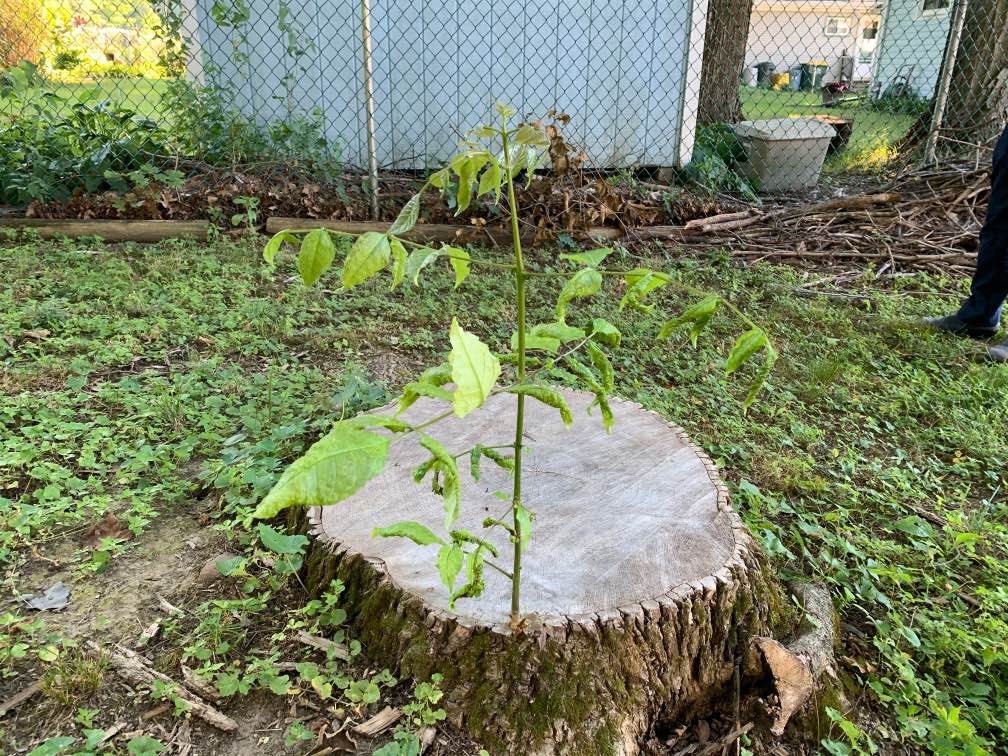
baby ash

I wrote in January about having to take down the ash tree in our backyard because it had been infested with emerald ash borer.

This week, we noticed something growing near the stump.

It’s a new ash tree!

It’s growing very quickly. It certainly has a very large root structure, given that it is growing directly from where the bark meets the wood of the stump. Given its position, we aren’t sure it will survive long-term, but it is nice to see nature trying to come back from a plague.

A little hope is a good thing to have right now.

SoCS: on conditions in the US

I don’t know how much more of this we can take.

“We” refers here to the United States.

This past week, we surpassed 150,000 COVID deaths and the virus is out of control in a number of states, including our three most populous. California has now passed the half million mark for cases – and the real number infected is, no doubt, much higher because mild or asymptomatic cases are unlikely to be found. There is some hope on the vaccine front with some Phase III trials beginning – the one I’m signed up for will start in August, I hope – but, even if one or more are successful, it will take months and months for enough doses to be available globally to quash the pandemic. Meanwhile, here in the US, there is still no national strategy and people are suffering because of it. Even states like mine (New York) who worked hard to get out case numbers way down are under threat of resurgence from infected people visiting our state, returning home from traveling, or coming back to our many colleges and universities. It’s terrifying.

On Thursday, the nation had an opportunity to reflect on love and justice and service. Rep. John Lewis, a central figure in the civil rights movement who went on to champion the rights of all people who suffered discrimination and prejudice – and the planet itself – was honored with a truly beautiful funeral service. Reflections were offered by clergy, family, friends, staff, colleagues, and all four former presidents, Jimmy Carter in writing and Presidents Clinton, Bush, and Obama in person. President Obama gave the main eulogy, which was also a call to action for justice and for voting rights, a cause which John Lewis literally bled for, was jailed for, and supported passionately for decades. The House of Representatives voted unanimously to re-name a voting rights bill that they had passed earlier after John Lewis. (OK, Mitch McConnell. Time to get it to the Senate and pass it into law.) Sadly, this law is needed after the Supreme Court struck down provisions of the Voting Rights Act originally passed in the 1960s, reasoning (wrongly) that the country was past discriminatory voting practices. Since then, many states have re-implemented practices that limit ballot access for citizens based on age, race, income level, location, and other factors.

To point out the threat to voting and election integrity – yes, there is also evidence of foreign election interference, as if the domestic problems weren’t bad enough – the same day as the funeral, the president floated the idea via Twitter that our November 3rd national election should be postponed. The date of the election is set by Congressional law, though, so the president can’t change it. Fortunately, even the Republicans in Congress said that the election date will not be changed. I also think there would be civil unrest if it was tried.

Still, the election is under threat from forces within the government. Each state is responsible for running its own election, but the pandemic has made in-person voting more complicated and dangerous. States are moving to make greater use of their absentee voting systems, but these usually rely on the postal service, which the president is undermining through inadequate funding and a new crony leading the postal service who is changing policy to slow service. The House of Representatives has passed legislation to allocate funds to the states and the postal service so that our election can be fair, free, and safe, but Sen. McConnell has refused to bring the bill to the Senate for a vote. His own proposal doesn’t address election integrity at all. It also doesn’t address aid to states – and it was over two months after the House passed their bill before he even put out his proposal.

During the impeachment and trial, Republicans kept saying that “the people should decide the fate of the president at the ballot box.” They should be ensuring that we can do that safely, securely, and freely, not putting up roadblocks. If they are confident in their positions on the issues, they should be eager to have the vote. This looks like they know they have failed in their obligations to protect and defend the people and the Constitution and realize they can only hold onto power by cheating and deceiving.

As if all of that wasn’t bad enough, there is more bad news on the economic front. The GDP declined at its highest rate since such things started to be calculated over 150 years ago. (GDP=Gross Domestic Product) Because the pandemic is so bad, many businesses are needing to close or scale back, so many more people are unemployed. Some who had thought they were temporarily unemployed are now permanently unemployed because their businesses that they owned or worked for are closing for good. Because the federal government isn’t helping the states, we are also facing a wave of layoffs of state and local workers. Unlike the federal government, most states are required to have balanced budgets. Their tax revenues are way down, so their budgets are broken. This can mean layoffs for police, public hospital workers, teachers, public works employees, and other essential workers that are needed even more now. This will make unemployment worse and cause more demand for anti-poverty programs – for which there is already inadequate funding. Oh, and the additional federal funds of $600/week that were added to state unemployment checks in the CARES Act this spring end this week. The House bill that passed in mid-May would extend them until January; McConnell’s new proposal cuts them way down.

Most economists advocate the federal government injecting much more money into the economy to keep it afloat until the pandemic ends. The very real fear is that what is happening now – with the CARES Act programs ending with nothing to replace them (or next to nothing) – that the steep recession will turn into an economic depression. Evictions and foreclosures, many of which had been forestalled by prior legislation, will likely accelerate, leading to an increase is homelessness and, possibly, bankruptcy for landlords who no longer have tenants. People may have even more problems finding food. There are already strains on both public and charitable food resources. Our health care system, which was already broken, will be even more overwhelmed.

I try to be realistic.

It’s hard, though, not to think that we are going to see more and more and more suffering in the months ahead.

As a nation, we need to summon more courage, more intelligence, more compassion, more reason to chart a path to restore peace, justice, and good health. I guess “restore” is the wrong word. We need to establish those things for everyone.

And we need to have the freedom to vote.

***** Linda’s prompt for Stream of Consciousness Saturday this week is “more.” Join us! Find out how here: https://lindaghill.com/2020/07/31/the-friday-reminder-and-prompt-for-socs-aug-1-2020/

2019-2020 SoCS Badge by Shelley!

Sad stats

The horror show that is the United States and coronavirus continues.

My state, New York, was the world epicenter in the early spring. Through good leadership informed by science and metrics and residents who took the policies seriously, we were able to get the pandemic under control. Through a careful, phased, and data-driven process, we have also been able to keep our transmission rate low as we have opened more of our economy.

Still, when the map of case numbers would be released every day, New York, the fourth most populous state, showed the highest number of total cases, over 400,000, because our initial outbreak had been so severe.

Until this week.

California, which is the most populous state, passed New York this week on confirmed COVID case numbers. (All the public health experts agree that the actual case numbers are much higher, but the official count uses only testing results and death certificates.) While California had had early success in containing the virus, it re-opened businesses too quickly and many people abandoned needed precautions like masks. Hence, their caseload is soaring. I’m hoping that New York will continue to keep the virus from resurging so that we never again reach the top number of cases, but Texas and Florida, second and third most populous states, are also in the midst of major outbreaks and might surpass California’s numbers in the coming weeks.

It’s appalling.

What saddens me is that it didn’t have to happen this way. New York and some of our partner states in the Northeast learned a lot of lessons through our experiences this spring and, in the absence of a national program, have been offering to help other states deal with the virus and the economic/social fallout. This has resulted in some positive news in the states being hard-hit now, for example, the mortality rate is lower, in part because of improved treatments for the severely ill. Most of the news, though, is bad: overwhelmed hospitals, people not wearing masks and attending large gatherings, bodies being stored in refrigerated trucks because mortuaries are backlogged, more and more states where the number of cases is rising.

Meanwhile, there is still no national plan. The House of Representatives, led by the Democrats and Speaker Nancy Pelosi, passed the Health and Economic Recovery Omnibus Emergency Solutions Act or the HEROES Act in mid-May, which would address some of the current problems with testing, contact tracing, and treatment of COVID, as well as a host of economic and social impacts on individuals, families, businesses, agencies, and state and local governments. The Senate, under the leadership of Republican Majority Leader Mitch McConnell, didn’t act on the bill this spring and just returned from a three-week break without their own version of a bill and, after a week’s work, they still don’t have a Republican proposal, much less a bill that has been negotiated with the Democratic and Independent senators so that it is ready for debate and vote.

Meanwhile, people are sick and dying, out of work, not knowing how they are going to be able to pay their bills, scared, and bewildered about their country’s dysfunctional state. The United States has become an object of pity around the world.

I’m disappointed that, even when the crisis is monumental, the Republican leadership can’t muster the will and/or competence to do their job and govern for the good of the people. If they had integrity, they would resign to make way for leaders who can and will serve the people and the Constitution. Resignations would be less disruptive than the current inaction.

Applying the past to 2020

While it has been flying under the radar a bit in this cataclysmic year, 2020 is the centennial of the passage of the 19th amendment to the United States Constitution, recognizing women’s right to vote.

B, T, and I recently watched a four-hour documentary on PBS, entitled The Vote. (At the moment, you can stream it for free by following the link.) It was a reminder to me of the long struggle to secure the vote for all women in the US and how interwoven it was with issues of religion, abolition, temperance, racism, property rights, wealth, war, and social mores. The derisive and/or violent reaction to the nearly always peaceful demonstrations that the women undertook seems frighteningly current.

T and I also saw Gloria: A Life, a docu-play based on the life of Gloria Steinem. The performance was filmed with the audience there, the first act as a play and the second act a discussion with the audience featuring Gloria Steinem herself. Like Steinem and Betty Friedan, I am an alumna of Smith College; while there I had taken an early women’s studies course, before the formation of an academic department of women/gender studies. By the time I was a teen, the Second Wave of feminism was well underway, so I recognized many of the names of Steinem’s feminist activist-colleagues. Early on in the play, there is a tribute to the many women of color who were leaders in the movement. One of the strange phenomenon that happened was that, even early on, the press would disproportionately cover and feature Steinem, marginalizing other leaders, especially those of color. This has led to the enduring false impression that Second Wave feminism was a white middle-class movement, when it was in reality what would now be termed “intersectional.” It drew together women’s rights with issues of race, immigration, sexual orientation, gender expression, union/labor rights, violence, medical care, and more.

This was particularly striking at this time when we see activists who had been working on issues in isolation now drawing together in this time of pandemic and outcry for social and racial justice. We see them supporting each other and crafting policy proposals to address the common good. I am so encouraged to see the #BuildBackBetter movement put forward plans that take into account historic racism, marginalization, discrimination, oppression, environmental degradation, unfair wages, etc. and take steps to redress the wrongs and put in place an equitable, fair, safe, and comprehensive system.

2020 has been immeasurably difficult, but we all have the opportunity to make a better future. Let’s go! The United States needs to live up to its highest ideals and join with the world community to heal the planet and all its inhabitants.

Choirs in the time of COVID

I often participate in Linda Hill‘s Stream of Consciousness Saturdays. Her last prompt was “song.” The instruction was to “find a picture–the closest one to you. Your prompt is the title and/or the lyrics of the first song that comes to mind when you look at the picture.”

I couldn’t manage to follow the instruction – my brain doesn’t work that way – but thoughts about song have been flooding my consciousness for the last couple of days.

I can’t remember the first song I sang, but singing has been an important part of my life, especially choral singing. Decades of it. Most of it has been associated with schools or church. It has been my privilege to sing some of the great choral works of Western music. I love singing Bach; my background as an organist probably influences that. My favorite large work to sing is Brahms’ Requiem, in German, of course.

I’ve written sorrowfully of the probable demise of University Chorus due to a re-organization of the choral program at Binghamton. At the time, I never dreamed that choral singing itself would be on indefinite pause.

It turns out that singing is a high-risk activity to spread coronavirus. A choir rehearsal, with lots of people singing in close quarters indoors, can easily become a super-spreader event. While some churches have begun re-opening, they cannot safely have their choirs sing. They can’t even have their congregations sing. The thought of returning to church but having to stay silent is more than I can bear.

Nine years ago, I made my first trip to Europe as part of the Smith College Alumnae Chorus. We sang the Mozart Requiem in Sicily. I have sung with the SCAC in several on-campus events, as well as last year’s tour of Slovenia. Any planning for future events is on hold, not knowing what conditions we will be facing over the next couple of years.

Someday, some year, there will be widespread vaccine and/or effective treatment for COVID-19 and singing in groups will again be reasonably safe. I hope that choral organizations manage to survive so that they can reconvene and make music together again. I hope that I, then in my sixties, will be considered young enough, healthy enough, and mellifluous enough to join in.

School/work

The pandemic has heightened awareness of a number of social problems in the United States.

One revolves around the care and education of children. Political and business leadership often spout platitudes about how important children are and how much they care about them, but they seldom back up their words with meaningful policies that help children and the people who love, care for, and educate them.

Before the pandemic, American families often cobbled together child care with parent(s), school, relatives, neighbors, and paid caregivers, who often had to charge more than the family could afford to pay even though their own salaries were so low it was hard for them to get by. When schools and most day-care centers closed due to the pandemic, parents were suddenly trying to do paid work themselves from home while simultaneously trying to care for and educate their children or were forced to quit a job outside the home to be at home for their children.

It’s not a sustainable situation for many families.

There is a big push by the president and some state and national leaders to re-open schools full-time and full-capacity in the fall, even though that is against the recommendations of public health experts, in order for adults to return to jobs outside the home or so they can work from home without interruptions, but, besides being a huge health risk for children and adults, it fails to address the root of the issue.

Somehow, caring for children in exchange for a salary is considered “work” but caring for children without a salary is not considered work. Hazel Henderson calls this non-monetized part of our system the “love economy.”

The United States lags far behind other countries with advanced economies in acknowledging the love economy. We don’t offer mandatory paid sick leave, parental leave, or caregiving leave. People who do get paid as caregivers, whether for children, elders, or other vulnerable people, often earn shockingly low wages. For that matter, many people working in other kinds of jobs also don’t make a living wage, making it impossible to fully care for their family. Other countries also have a must more robust system of social services, so that people have access to adequate clothes, shelter, food, medical care, and education regardless of their income level.

As part of our efforts to #BuildBackBetter, the United States should reform our economic, health, educational, and social systems so that every person has adequate resources to lead a life of dignity. Some components of such a system that have proven successful in other countries have been single-payer universal health care, required living wages for workers, a graduated tax system that raises enough revenue from the top of the income spectrum that those in the lower end can afford their tax bill without compromising the needs of their household, free public education, paid leave for sickness, caregiving, and vacation, and a robust social safety net so that no one goes without food, housing, and other basic necessities. I would also like to see more social recognition and financial support for caretaking that is currently part of the “love economy.” A possible way to address this would be through a program of universal basic income or a stipend for those caring for a child, elder, or person with a long-term illness or disabling condition.

Obviously, crafting systemic change will take time and new national leadership. For the moment, I think it is foolish to implement a national school opening policy. Historically, education has been the province of local districts within the framework of state policy, allowing the system to adapt to local conditions. The wisdom of that flexibility is even more evident during the pandemic. Areas with low rates of illness may plan to implement hybrid systems where students attend in person part-time and online part-time so that physical distancing can be used to keep the virus in check. Areas with very high infection rates may need to keep students at home learning virtually until their infection rate is under control, when they could begin to phase in in-person attendance. All schools will need plans for dealing with changing circumstances; as there have been school closing plans to deal with severe flu outbreaks or natural disasters, there will need to be COVID plans to try to keep the school community and the general public as protected as possible.

Everyone wants students to be back to in-person classrooms, but only if it is safe for them, the school staff, their families, and the community. Pretending we can go back to the pre-pandemic system without grave public health consequences is foolhardy. Instead of wishful thinking, we need to use data, science, expertise, care, and intelligence to adapt to our changed and changing circumstances.

It’s what our children and youth need and deserve.

The US and the First Nations

2020 has magnified long-standing structural racism in the United States. This has been most visible in regards to black Americans, as the legacy of slavery, violence, and repression over centuries have led to lower wealth and income, poorer health outcomes and access to care, higher levels of police brutality, and other injustices, now brought more strongly into the national spotlight by the pandemic, the killings of unarmed black men and women by police, the #BlackLivesMatter marches, and the removal of Confederate symbols.

There is hope that the United States is finally undergoing the kind of systemic and social change that will address the grievous wrongs against black people. I also hope that our country will acknowledge and redress the wrongs against the indigenous peoples of the Americas, who have suffered many centuries of oppression, violence, theft, and dehumanization at the hands of the United States government and society.

[A note on language: Generally, if I were referring to an individual, I would identify them by the tribe/nation to which they belonged. In this post, which is about all the indigenous peoples, I have decided to use the term “First Nations” even though it is more often used in Canada than in the United States. I hope that this term conveys the respect I intend.]

The First Nations have suffered many, many losses since the arrival of Europeans, from disease, violence, forced dislocation, theft, broken treaties, environmental degradation, attacks on language and culture, and more. People of the First Nations who live on reservations have high rates of poverty and chronic disease and sometimes lack access to running water, electricity, appropriate medical care, and educational and employment opportunities. There are also terrible problems with legal protection that have led to an alarming rate of murder or disappearance of women and girls.

This year has brought attention to the plight of the First Nations in two ways. First, COVID has afflicted some of the reservations very badly, as one might expect among communities that were already struggling. The Diné and Hopi Nations in the Southwest have some of the highest infection rates in the United States. Second, the public debate on removing statues of Confederate figures and/or slaveholders has broadened to consider those involved with oppression of the First Nations. This was heightened further by the president’s July 3rd speech and fireworks at Mount Rushmore. The monument there desecrates a site holy to the Lakota, who, by treaty, should have sovereignty in the Black Hills.

I hope that this greater awareness will result in concrete action to redress the centuries of damage done to the peoples of the First Nations. 2020 is increasingly appearing to be an inflection point in United States – and, perhaps, world – history. May the United States finally embody its highest ideals of equality, justice, and promotion of the common good.

A quiet Fourth

Yesterday was celebrated as Independence Day in the United States. We usually just call it the Fourth of July, which it is, of course, everywhere in the world.

Celebrations this year were muted by the ongoing COVID catastrophe. While we still have the virus pretty well controlled where I live in the Northeast US, much of the rest of the country is experiencing a rapid spread which is threatening to overwhelm the health care system. Many states in the South and West are breaking their records for new cases daily and some are belatedly issuing mandatory use of masks in public and closing bars, indoor restaurants, and beaches, in hopes of reducing their infection rates.

It breaks my heart to see the level of suffering, knowing that much of it could have been avoided if leaders and the public understood and respected what the public health experts have been telling us. Wear a mask. Wash your hands. Stay six feet away from people who don’t live in your household. Avoid gatherings. Stay at home except for essential work and errands.

The advice works! We proved it in New York State and other states in the Northeast. This is also how most of the other countries that have gotten their transmission rate to low levels did it.

On Independence Day, the United States commemorates the signing of the Declaration of Independence, which declares that all are equal and have the right to life, liberty, and the pursuit of happiness. Some of the people who won’t wear masks say doing so is an affront to their liberty, but liberty is not a license to abandon responsibility. I recently saw a political cartoon by Dave Whamond where a man was declaring his right to drive his car in the opposite direction on the highway. (It didn’t end well.) No person’s “liberty” should be allowed to interfere with someone else’s rights.

The Declaration of Independence ends, “we mutually pledge to each other our Lives, our Fortunes and our sacred Honor.” It was clear that the document was not about something so small as personal desire or preference or grievance.

We each bear a responsibility to others.

Don’t drive the wrong way down the highway.

Wear a mask.