Binghamton Poetry Project Fall 2020 anthology and reading

Due to the pandemic, the Binghamton Poetry Project has moved to Zoom for 2020. For each of our spring, summer, and fall seasons, we did five sessions of poem study and prompts, followed by a reading via Zoom. For the fall, our directors at Binghamton University have re-imagined our anthologies, which had been distributed in print at our in-person readings in prior years, as a digital publication. You can find the anthology at the Binghamton Poetry Project site here: https://thebinghamtonpoetryproject.wordpress.com/fall-2020-anthology/

One of the 2020 innovations from the Binghamton Poetry Project was to offer two different workshops, one for beginners and one for more experienced poets. I was part of the latter group. I enjoyed working with our instructor Shin Watanabe, who is a PhD student at Binghamton University. I also appreciated the opportunity to connect with the other community poets who attended, some of whom I have known for years in person and others of whom I have only met via Zoom. One of the advantages of Zoom meetings is that we have been able to include poets who are further afield, including some from the Ithaca area.

All three of the poems I chose for the anthology were written in response to Shin’s prompts based on our reading for that session. I thought it might be interesting to include how these poems came to be written; one of the advantages of taking a class or workshop is that you generate poems that otherwise would not have been written were it not for the prompts.

That being said, this first poem is one that was conceived before the prompt, as it will eventually be part of the collection about the North Adams, Massachusetts area that I have been working on for several years. The prompt was about employing interesting adjectives, based on our study of The Colossus by Sylvia Plath.

Navigating North Adams for MWS

Google maps had no street-view
for the addresses you had unearthed
through Ancestry.com
in the year since we each lost
our mothers May-days apart.
We were excited to discover
your great-grandmother

as a young Scottish immigrant
lived in the city where I also had roots.
As I drove the two hundred miles there,
I thought of you,
ten times further away,
of the photos I would send
so we could imagine

your ancestors and mine crossing
paths, setting in motion
our friendship generations on.
I navigated the streets too steep,
narrow, and unassuming
for the google-cars that take wrap-around
photos to satisfy the curious or nostalgic.

When Jeanie lived at 34 Jackson
did she cross Eagle
and walk with Ruth down
Bracewell toward the school?
When did the neighbors
at 27 Hudson put
up a sign, Established

in 1860? Surely
not back then, when
the hillside houses
were only middle-aged.
Did she sled down
Veazie with Mary
who lived parallel

on Williams? Did the imprint
of these ancestral
connections somehow
draw us to each
other as college roommates,
forty-year friends clinging
to each other on steep climbs?

The next poem was an experiment with line breaks, based on our discussion of Charles Bukowski’s Fingernails; Nostrils; Shoelaces.

Two and a half hours

The line stretched from
St. Paul’s Church down
the block to the library
voters spread six feet apart
waiting for
their turn to enter
go downstairs
wait
give their
name, sign the
tablet with a
disinfected stylus
watch the printer spit out
their ballot
sequester together in a
cubicle, completely fill in the
bubbles for their
choices with a
black felt pen
feed their ballot into the
machine, wait for
confirmation, walk back to
their car
go home and
hope.

This final poem is a failed attempt at the American Sublime, a la Hart Crane’s The Bridge: To Brooklyn Bridge. I think I managed a bit of the awe component, though.

For Jillian Grace

On my screen, you appear
smaller than your 2.9 kilos –
kilos because, from the start,
you are a British baby,
unlike your older sister, born
in the same upstate New York
hospital as your mother,
just miles from where
I, bleary-eyed at dawn,
stare at your first photos.

Your dark hair peeks
from under the knit cap
meant to keep you warm
as you adjust to air,
not the tiny ocean
that had been your home
for thirty-seven weeks,
your cheeks rosy
against the white blankets
and Winnie-the-Pooh sleeper.

I long to cradle you,
to breathe your newborn scent,
stroke your soft skin,
feel your fingers
wrap one of mine,
hum quiet lullabies,
claim you as my granddaughter,
but you are thirty-five hundred miles
and a pandemic
away.

I hope you will take a look at our anthology. Feel free to comment here or on the Binghamton Poetry Project site. Enjoy!

the pleasures and dangers of poetry readings

One of the opportunities that has arisen during the pandemic is the easy availability of poetry readings, as many institutions have re-imagined their live readings as online events.

I admit that I wasn’t in the habit of going to a lot of readings in-person before the pandemic. They are usually in the evenings and I try to keep as much evening time reserved for family as possible, so it was difficult for me to commit to the transport time plus the reading time. That is less of a factor now that I can attend and still be at home, in case something comes up that needs my immediate attention.

I’ve had the opportunity to attend a virtual book launch for fellow Boiler House Poets Collective member Erica Bodwell’s Crown of Wild. I heard one of my Smith College poetry godmothers Anne Harding Woodworth read from her new book Trouble, as well as her previous books. I’ve tuned into readings sponsored by the Smith College Boutelle-Day Poetry Center and the Binghamton University Center for Writers. I have even participated in an online reading with the Binghamton Poetry Project.

It’s been wonderful to hear poets reading their work and I’ve also appreciated the opportunity to hear poets speak about their lives and work in interviews or question and answer sessions.

I admit, though, that these discussions, particularly when they take place in academic settings, can shake my sense of myself as a poet.

I consider myself to be a community poet, meaning that my work is informed by my experiences much more so than by my academic background. While I have been blessed with learning about craft through the Binghamton Poetry Project, the Broome County Arts Council, Sappho’s Circle, and my poet-friends of the Grapevine Group and Boiler House Poets Collective, the last time that poetry was a significant part of my academic work was in grammar school, many decades ago. I’ve also learned a lot by reading different poets.

In comments in their readings, poets that I admire talk about the wonders of writing in forms like sonnets or villanelles and how this focuses their writing.

I’ve tried variously to write in form. I’ve never managed to write a traditional sonnet or villanelle that was worth making it out of my notebook.

The thought of trying to write a decent sestina is enough to make me break out in hives.

I do a bit better with forms that have made their way into English from Japan. I have written some successful haiku, tanka, and haibun. I am especially fond of tanka and have included several in my chapbook manuscript, which is still in circulation with publishers and amassing an impressive list of rejections. (Note to self: send more submissions.)

When I am feeling shaken about not having formal training, an English major, or an MFA with all their attendant skills and expertise, I try to remember the times that my poet-friends have reassured me that, although my poetry is different, it is still worthwhile – and that I am indeed a poet.

Now if I can just find those presses and publishers that agree…

in the middle of a nightmare

The pandemic has been more severe in the United States than globally for months – and now things are getting worse very, very quickly.

Yesterday, there were over 159,000 new cases diagnosed, which broke a record set the day before. There are entire states that are out of intensive care beds – or hospital beds in general. In some states, hospitals have to triage patients and turn some away who would benefit from care in favor of other patients who are sicker but have a higher chance of recovery.

Some places are so short-staffed that COVID-positive staff are continuing to work if their symptoms allow.

The hospitalization rate is also a lagging indicator. If the hospitals are this stressed now, what will the situation be in two weeks, given the huge numbers of new diagnoses this week?

I’ve reached a new level of dread.

New York State, where I live, still has one of the lowest infection rates in the country. Governor Cuomo is tightening restrictions on gyms, indoor dining and gatherings, as well as further ramping up testing and contact tracing in hot spots. Unfortunately, after all these months, there is an outbreak among residents in the skilled nursing unit of my father’s senior living community, as well as a number of staff members. The health center is in a separate building from where Paco lives in an apartment, so we are hoping the virus won’t spread, but it is very worrying for all of us.

And what, you may ask, is the Trump administration doing to address the explosion of cases, hospitalizations, and deaths?

Nothing.

Vice-president Pence, who chairs the coronavirus task force, finally held a meeting this week after several weeks without doing so during the campaign. There were no new actions or recommendations after the meeting.

Meanwhile, President-elect Biden has named a first-rate committee of physicians and public health experts to set up the plan against COVID for his administration, which will begin January 20th. Unfortunately, because the Trump administration refuses to acknowledge that Biden will be taking office, the Biden task force does not have access to the current plans in development for vaccine deployment, distribution of supplies, etc., which is an appalling and dangerous state of affairs.

What is even more appalling and dangerous is that, with the situation becoming more and more dire daily, the Trump administration is making no attempt at all to save people for illness, disability, and death.

I’m finding the level of stress and dismay crushing.

People desperately need help now.

January 20th is still a long way off.

post-election

I was relieved when Joe Biden and Kamala Harris were projected winners in the US election, becoming president and vice-president elect. Some say that those terms should not be used until the vote is certified in each state or until the electoral college meets in December but it has been common in past election cycles to do so and I’m observing the norm.

While there are still ballots being counted, it is clear that Joe Biden has comfortable margins of victory in enough states to have earned the presidency. Election officials and volunteers of all political persuasions are continuing to work hard to complete the final tallies of the record number of ballots cast. Despite the pandemic, attempts by both foreign and domestic actors to suppress the vote, postal service slowdowns, and unfounded accusations of malfeasance, this election saw the highest percentage of voter turnout in more than a century.

When Biden was reported as the projected winner on Saturday morning, spontaneous celebrations broke out around the country and around the world. Although there were some demonstrations with upset Trump supporters, there was not an outbreak of violence as many had feared. Congratulations poured in from around the nation and the world. On Saturday evening, Harris and Biden gave moving victory speeches, recognizing the historic achievement of the first woman and first person of color to become vice-president and calling for national unity to combat the pandemic and rebuild our economy and society. There has been particularly moving coverage of the impact of Kamala Harris’s election among girls, particularly those of African or Asian descent, who are excited to see someone who looks like them about to become vice-president.

Unfortunately, President Trump refuses to accept the reality that he has lost the election. Even more unfortunately, many of his supporters believe his baseless claims of widespread voter fraud. Perhaps most distressingly of all, many other Republican leaders, including Senate Majority Leader Mitch McConnell, are refusing to acknowledge that Biden has won the election.

This has delayed the official mechanisms that facilitate a smooth transition between administrations. While the Biden/Harris team is moving forward with their governing plans for after the inauguration on January 20th, most notably the convening of a coronavirus task force comprised of physicians and pubic health experts, they do not have access to all the current government personnel and assets that they need because the Trump-appointed head of the General Services Administration refuses to ascertain that Biden has won the election. With so many pressing issues, it is vital that these resources are available to the Biden-Harris transition team as soon as possible.

On Saturday morning, I wrote a simple message of congratulations to Joe Biden and Kamala Harris on Facebook. I did get one angry face as a reaction among the thumbs up and hearts, which I understand. There was also a negative comment that I wound up deleting because I don’t allow unchallenged falsehoods, conspiracy theories, or profanity on my social media. I remain committed to thoughtful dialogue and hope to be able to engage in some as the opportunity arises in the coming months.

I started writing this post early this morning and it is now late afternoon, so I will close, but, someday, I’ll write a post about my background that might prove elucidating about how my mind works.

Stay tuned.

over 90%

Today, Pfizer/BioNTech announced analysis that showed over 90% effectiveness of their coronavirus vaccine, currently in Phase III clinical trials. There are over 43,000 people around the world enrolled in this study, including spouse B, daughter T, and me. My most recent post on the trial is here.

That is an extraordinarily high percentage for a vaccine; for comparison, most years, the seasonal flu vaccine is about 50% effective. Lest you think that Pfizer or BioNTech are exaggerating the data, neither company did the analysis. That was accomplished by an independent science review board.

While this is welcome news, there are some cautions involved. The number of cases of COVID among the large study group is still small; as time goes on, it’s possible that the efficacy rate might drop. Because the virus and the vaccine are so new, there is no way to know how long immunity might last. This is part of the reason that the study is set to last for two years, so more data can be collected about the long-term efficacy, longevity, and safety of the vaccine.

Besides the speed with which this vaccine was developed, the remarkable thing is that this is among the first messenger RNA vaccines to be tested in a large trial. If it is shown to be safe and effective, there are hopes that the Moderna vaccine, also currently in Phase III trials and an mRNA vaccine, may be effective as well. Additionally, there are vaccines that were developed in more traditional ways in Phase III trials. The more vaccines that are shown to be safe and effective, the more people can be vaccinated in a shorter timeframe, so that we can bring the global pandemic to an end, perhaps as early as late 2021 or early 2022.

It’s possible that Pfizer will be able to apply for emergency use authorization in the United States later in November, after there is two months of safety data from half the study participants after their second dose. This, along with manufacturing safety data and the efficacy numbers, will be considered by the Food and Drug Administration to determine if the vaccine can begin to be distributed, with full approval coming after more data is collected.

It’s worth noting that Pfizer/BioNTech have a contract to provide 100 million doses to the United States government if the vaccine is approved. Unlike some other companies, though, Pfizer and BioNTech did not take money from the US for their research and trial expenses. The contract is for $1.95 billion but the US government will distribute it free of charge.

My hope is that this and several other vaccines will be approved over the next few months so that as many people as possible can be protected as quickly as possible, starting with frontline health workers, first responders, and those most vulnerable due to age, underlying conditions, living facilities, and occupation.

We got the sad news today that there are several people in the skilled nursing unit of Paco’s senior community who have tested positive for the virus. Access to the unit had already been restricted, so there is hope that it will not spread any further, but we are all worried about those impacted.

The sooner we have vaccines – and better treatments – the better.

some assembly required

As I wrote about Saturday, I’m not doing what I expected I would be today, arriving in London, UK for a month, with two weeks in quarantine and two visiting family, including meeting our newest grandchild JG.

I had spent weeks making arrangements for the trip, letting lots of other things, such as writing blog posts, slide. Instead, I spent a lot of time on the phone and online covering personal and family obligations for the four weeks of the trip plus the two weeks of quarantine required by New York State when we returned. I, along with B and T, also spent hours and hours organizing and cleaning the house to be ready for my sisters to stay here to be on hand for our dad, known here as Paco, while we were away. I had planned time to work on my poetry collection while we were in quarantine. I also had some reading and blogging work lined up.

And now, I need to figure out how to organize myself for the next six weeks.

And in general.

Again.

Still.

In my experience, the thought that I can organize my life and have things go according to plan is an act of hubris or, perhaps, folly. Over these last decades, my life plans have seldom unfolded as envisioned. Things happen. Priorities change. Plans get abandoned or put on hold. This is not a complaint, but an observation.

I know I have limited control, yet I somehow feel the need to make a plan when I sense there is a turning point, or, at least, a juncture when circumstances have changed.

A consequence of the household re-organizing we did to get ready for my sisters to come house-sit is that, for the first time in almost four years, B and I have moved back into the master bedroom, which we had given over to daughter E when she moved back home for almost three years while waiting for her spousal visa to be approved in the UK. The nearby room that had served as ABC’s nursery has now become B’s at-home office; his office building closed in March due to the pandemic and no one knows if or when it will re-open. My desktop computer is now in a guest room upstairs, opposite where T’s room is and has been throughout all the rest of the configuration changes. The living room, dining room, and kitchen are more organized than they have been in years.

I suppose the first part of my plan should be to keep things clean and organized, which would be an ongoing chore as I don’t enjoy cleaning and organizing. One of the things that made the task of getting ready to leave so daunting was the psychic strain of dealing with sorting and packing cards and other memorabilia from the last few years which included my mother’s final illness and death and E and ABC living with us. In truth, I will most likely never have a minimalist house, especially as we are storing things from both my and B’s parents’ homes and our adult daughters’. Some of it may migrate to E and T eventually…

But I digress. There is some hope that I can use our new configuration to my advantage, such as getting used to writing sequestered with my desktop rather than my laptop in the midst of the household.

The larger issue may be to de-clutter my mind. Over these last few years, when intergenerational care responsibilities have been my primary focus, I have gradually been shedding more and more of the things that used to occupy my time, such as extensive research and commentary on environmental/social justice issues and on women’s equality in the Catholic Church. I still care about those things and keep up on them to an extent, but I have let my membership in a lot of the related organizations lapse as I attended to in-person responsibilities. Admittedly, my email inbox is still overflowing with news – and requests for money – from too many entities, but I’m hoping to whittle down further after the election to free up more time and brainpower for other things.

It’s not that I don’t still care about these issues. I am heartened by the convergence of social and environmental justice issues that has happened this year and I will continue to lend support, but I will do it through a few select organizations with which I have a special connection, such as NETWORK, the Catholic social justice lobby that I joined in observance of the Jubilee in 2000. I am also heartened by the witness and energy of the Millenials and Gen Z in this convergence of social, racial, gender, economic, and environmental justice and will gratefully support their leadership with what experience and wisdom I can offer.

I’m hoping that 2021 will bring a new administration and Congress to Washington that will restore functionality and care for the common good to our national government. The last four years have been disturbing and exhausting and keeping up with the news has become an obsession and a time sink. I’m hoping to get back to a place where it doesn’t take so much energy to keep up with the news so that I can concentrate on writing and other mental work.

One of the very immediate conundrums is that I have to wrap my head around being at home on election day this Tuesday. We voted early last Monday and I had myself mentally prepared to be in London, five hours ahead as the election results began to come in. Instead, I think I will be staying up late Tuesday night into the wee hours of Wednesday, as results begin to be reported. We all know that the vote count will take several days, but the early numbers may allow some states to be called on election night. I’m hoping that everyone – the politicians, pundits, and public – will stay calm and that there will be an orderly transfer to a new administration and Congress.

Personally, I’m hoping that I will be able to spend more time writing. I promise that will include some blog posts, although I’m sure I will never be the on-topic, on-schedule blogger-type. I most want to write more poems and do revisions to produce a new version of my collection that centers on the North Adams MA area where I grew up and to which I have returned as a member of the Boiler House Poets Collective. Optimally, I’d like to have it together by spring so that I can do a manuscript review with my poet-friends. I also need to do some more submissions for my chapbook. Rejections have been coming in and two contests that I had planned to enter this fall have been pushed back, so I will need to hunt out more opportunities. I should also send out some individual poems to journals; I’ve been ignoring this for the most part over the last several years but need to get back to it.

I suppose I’d better plan some time for writing holiday cards and letters…

I also need to factor in time for essential shopping and errands for our household and for Paco. The pandemic and the supply chain problems it has caused have made shopping a major undertaking. It has also changed the way I help Paco, as I try to minimize time indoors his senior community’s building. Eventually, when there is widespread vaccine use, I’ll be able to resume regular in-person visits, but for now I am trying to deal with most things by phone and quick drop-offs.

I don’t know whether or not I can make some semblance of a schedule for myself or a plan to better work toward these goals. I had some hope as I started to write this post yesterday, but now I have all the uncertainties of the election, the pandemic, and personal life swirling about in my head.

But, hey, here is a long blog post about to be published, which is in line with my goals, so….

Progress?

Stay tuned.

And send good vibes.

early vote

This is the first presidential election year that New York State has had extensive in-person early voting. Because B, T, and I were planning to be out of the country on election day, we decided we would avail ourselves of that opportunity rather than voting absentee by mail, an option that was expanded this year to include fear of illness to protect people from exposure to coronavirus.

Across the country, there were long lines for early voting but no one knew how New York voters would respond. There was also no historic basis from which to plan. The first day of early voting was Saturday, October 24. We reasoned rightly the first weekend would be busy, so we planned to vote on Monday afternoon.

It was still very busy. It took us two and a half hours to vote, most of which was spent standing in a social distanced and masked outdoor line. Just as we were near the door into the library polling place, the line stalled. It turned out that one of the two ballot printing machines had stopped working, so the final check-in took longer, but all the election workers, volunteers, and people in line were very patient and respectful.

Because the lines were long, the county board of elections added more early voting hours so that wait times would be shorter.

I was glad to see so many here and across the country making themselves heard through their votes. The US has historically had low voter turnout and I’m hoping that the energy around voting this year will mark a new era of greater civic participation.

Our votes and voices are important. We all need to vote and make sure that our votes are counted. We also need to be patient while the counts are completed and certified.

It’s been a looooooong election season but it’s almost over. Stay strong, everyone!

SoCS: unwelcome news

It’s Halloween, which is traditionally a day for “trick or treat.” This has usually been mostly treats with very few tricks, but my family is suffering from a trick this year.

My spouse B, daughter T, and I have been planning for weeks to spend the month of November in London, UK, visiting daughter E, son-in-law L, granddaughter ABC and meeting new granddaughter JG in person for the first time. We were going to need to quarantine our first two weeks there, followed by two weeks for visiting, and returning to two weeks of quarantine back here in New York State. We had re-arranged appointments, stocked freezers and refrigerators for our housesitter and for my father, made a bunch of care arrangements for him, etc. etc. etc.

And now, everything is cancelled.

The UK, which, like much of Europe, is suffering a COVID spike, is instituting a raft of new restrictions which make travelling for leisure there impossible.

We are sad not to be able to see our family. We had planned to have JG’s baptism while we were there. Not only is our trip cancelled but the baptism will also need to be postponed.

When we planned the trip months ago, the spike wasn’t expected until winter, so we had hoped to sneak in before things got bad. The reality was that summer holidays started more cases and, when people went back to school and work, the case numbers went up quickly.

Of course, here in the US, the country has never had the pandemic tamped down across the country. We are lucky to be in New York State which has been able to keep its rate pretty low compared to most of the rest of the country, but the country as a whole is suffering record numbers of illness and death.

The prospect of winter making things even worse is horrifying.

I wish I could say that we would know when in 2021 we could safely travel to London, but it is unknowable. I guess I’ll just say sometime in 2021, we’ll get there.

Will JG be crawling by then?

Or walking?

*****
Linda’s prompt for Stream of Consciousness Saturday this week is “trick.” Join us! Learn more here: https://lindaghill.com/2020/10/30/the-friday-reminder-and-prompt-for-socs-oct-31-2020/

Pfizer vaccine update

My spouse B, daughter T, and I are participating in the Pfizer/BioNTech coronavirus vaccine trial. My most recent update on our personal experience is here, but I wanted to share an open letter from Pfizer which you can find here.

President Trump has been intimating that a vaccine would be available under emergency authorization by election day November third, which has led to fears that the companies might compromise the science in order to meet that deadline. The companies, though, have been trying to reassure the public that they will adhere to sound scientific and public health principles.

The letter from Pfizer’s chairman and CEO Albert Bourla explains that there are three necessary components for vaccine approval: effectiveness, for which they expect data by the end of October; safety, for which they will have data in the third week of November; and manufacturing data to ensure consistent quality. If there are good results confirmed by outside experts, Bourla believes that Pfizer will be able to apply for emergency use authorization from the United States Food and Drug Administration shortly after the safety data are available in the third week of November.

Even if the emergency and final authorization is approved, Pfizer will continue its study for two years in order to monitor safety and longevity of effectiveness.

I appreciate Pfizer’s transparency of their process and truly hope that their vaccine will be shown to be safe and effective so that we can begin to protect first our most vulnerable and eventually everyone from COVID-19. I also hope that lots of other companies in the US and around the world will also produce safe and effective vaccines so we can end the pandemic as soon as possible.

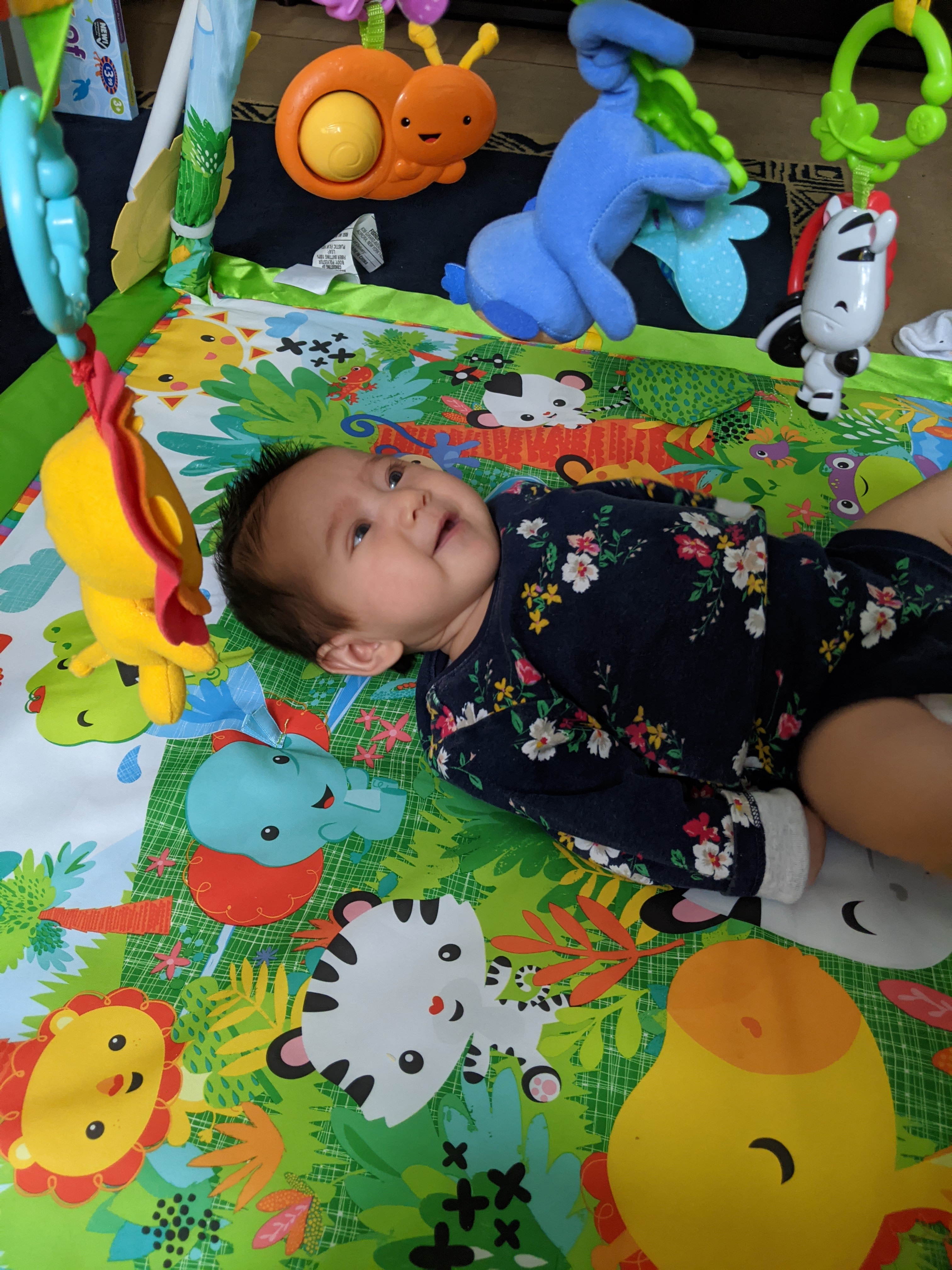
SoCS: JG+toys

two-month-old granddaughter JG whom we plan to meet in person next month

*****
Join us for Linda’s One-Liner Wednesdays! Find out more here: https://lindaghill.com/2020/10/14/one-liner-wednesday-the-thing-nobody-talks-about/