Does anybody really know what time it is?

No, seriously. Does anybody really know what time it is?

Earlier this week, daughter E and now five-month-old ABC returned from visiting spouse/daddy L and his family and friends in London. They were there for three weeks and had lots of good times and adventures and firsts, but crossing five time zones and having daylight savings time shift was a bit steep for a child who had barely been learning that night is supposed to be mostly for sleeping. The flight back was particularly disorienting, as it involved getting up at 4 AM London time and arriving here at 5 PM Eastern Standard Time, which feels like 9 PM in London. ABC decided to only take two one-hour naps in all that time, so both she and E were exhausted. That evening, they did both sleep for a six hour stretch, which was helpful, but one of our goals in the coming weeks will be see if we can get ABC to consistently sleep a long stretch at night and take a couple of daytime naps so there will be some semblance of schedule. There should be no more time zone travel for a while, so here’s hoping.

As we were preparing to change our clocks back to standard time last weekend, which, confusingly, happens in the US on a different weekend than in most of the rest of the Northern hemisphere, there were numerous media stories about proposals for the state of Massachusetts to switch to the Atlantic time zone, which would essentially be like being on Eastern Daylight Savings Time year-round, helpful for them as they are on eastern edge of the zone now, so have early sunsets. However, because they are a small state with five bordering states, they will have to convince the other northeastern states to change time zones along with them, joining the parts of Quebec that are on Atlantic Standard Time year-round. I am not a fan of daylight savings time shifts, so I would favor the change to Atlantic time, even though, being father west, it would extend the time that we have to wake up in the dark.

This week, I also mowed the front lawn and there were a couple of dandelions blossoming. Neither of these things are normal for November in our geography. It’s possible that it is a local sign of being in the Anthropocene, the proposed name for the current epoch of geologic time in which humans have significantly impacted our geologic/atmospheric systems. It does seem, though, that our colder fall temperatures have finally arrived. There had been a heavy frost, so I didn’t mow until late afternoon; still, there was a bit of frost close to the house where the sun hadn’t reached. Maybe now the grass will go dormant and we won’t have to mow again until spring.

This week also saw Election Day. Here in New York, we had only local races and some state-wide referenda, but we are observing an important milestone, the 100th anniversary of women’s suffrage in the state, three years before the national amendment was adopted. To celebrate, we had special commemorative “I voted” stickers. A few states had more extensive state votes. The Democrats fared better than expected with exit polls suggesting that some of the voters were motivated by displeasure with how the Republicans are handling government on the federal level. Next year’s midterm elections will be very interesting.

I submitted my poems for the Binghamton Poetry Project’s fall anthology this week. Our reading will be on November 18th and the anthology will be available to us. I will post the poems here that weekend. All three were written from prompts during our sessions and all three deal with issues from the past, including one about my friend Angie. You can read a prior poem about Angie here.

All of these events have had me pondering time and the meaning of time, but none as poignantly as having my mom, known here as Nana, under hospice care. While I know intellectually that the future is not promised to any of us, dealing with end-of-life care issues makes the finite nature of our lives more concrete. It helps me to appreciate more the little joys that we can still share – bringing her a fresh batch of lemon pizzelles –  enjoying hot soup at lunchtime or Sunday dinners together – visits with my sisters, my daughters, and especially ABC, her first great-grandchild.

Watching Nana and ABC together sharpens my sense that there really is, as the adage says, no time like the present.


climate commenting

When I was on the online rapid response team for commenting on fracking issues in New York,  I learned over time not to revisit comments on articles, even though I knew I was getting inaccurate (and occasionally nasty) replies.

Due to changing circumstances, I haven’t been commenting on much of anything lately, but I did make a comment on a recent column by Thomas Reese, SJ, on a carbon tax. This has turned into a long stream of comments from a man who does not believe in mainstream climate science with my replies and a few others weighing in.

I have decided to stop replying at this point, but I’ve spent so much time on it that I thought I would share it here:
https://www.ncronline.org/blogs/faith-and-justice/carbon-tax-revisited

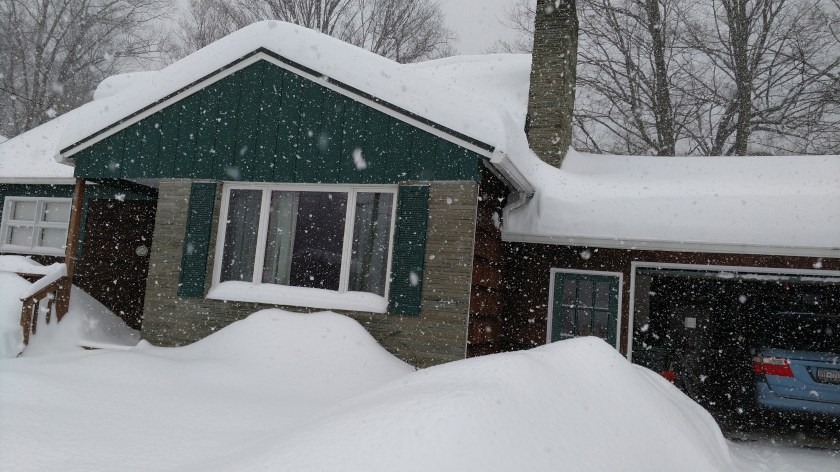
A few more snow photos

A few photos from shoveling part six, following up from my post with photos from earlier in the day:

IMG_20170314_170942858
House with snow banks at about 5 PM
IMG_20170314_170843794
I am really worried about the snow sliding off the garage roof and blocking the overhead door…
IMG_20170314_170741513
At 5 PM, I measured 27 inches (2/3 meter) of snow in the front yard.

The snow is supposed to continue until at least midnight and the wind has started to pick up. I am about to go out for shoveling session seven. We are all hoping that we don’t get heavy winds. Big snowstorm is preferable to blizzard.

activism refresher

Yesterday, I was able to attend two events that were updated but familiar.

First, I went to a presentation on sustainability in our area, hosted by SUNY BEST. Four speakers talked about different aspects of sustainability, including community revitalization, energy, and building/infrastructure.

My favorite presentation was by Amelia LoDolce of VINES (Volunteers Improving Neighborhood Environments). Daughter T was involved with this cause before it became a formal organization and I was thrilled to hear about how it has grown and all the good work it is doing and planning to do in the future. Their projects include community gardens, an urban farm in Binghamton which increases the availability of fresh produce for low- to moderate-income folks, youth employment, and educational outreach for schools and community.

It was nice to reconnect with some of the people that I met during the fight against fracking in New York. We have been hard at work continuing to fight against new fossil fuel extraction and infrastructure projects, as well as advocating for renewable energy and increased efficiency. Still, we don’t see each other as often as we used to in the days of frequent rallies…which leads to…

I left the presentation and proceeded to a press conference/rally at Senator Schumer’s local office, part of a coordinated effort around New York State. Senator Schumer is now the Minority Leader in the Senate, so he is vital to leading the opposition to DT’s agenda. We stood outside in the cold and snow to get our message out. Speakers called on Senator Schumer to vote against several of DT’s appointees. There were several speakers who talked about environmental concerns, particularly about Scott Pruitt’s nomination as EPA chief. We were happy that one of Senator Schumer’s staff members came and spoke to us; she passed out two-page documents that had quotes from Senator Schumer’s press releases of which nominees he is opposing and the reasons for his opposition. It was nice to be acknowledged and to know that the Senator is doing what he can to protect our rights and our environment.

Today, I finished watching a video of the Washington Women’s March. Daughter T and I participated in the Binghamton March. It is encouraging that so many people are banding together to fight for social and environmental justice. The people and groups are diverse, but we are stronger together as we support one another in these tumultuous times.


Solar!

I am pleased to announce that in late December, our household went solar!

Thanks to a change in the New York State laws, community solar projects were finally allowed in 2016 and we jumped in as soon as practicable.

We had had our rooftop evaluated for solar panels previously, but the south side of our house is too shaded. The shade trees help to cut down on air conditioning costs in the summer, so it would have been counterproductive to cut them down in order to put up solar panels. Also, some of the shade is supplied by trees in our neighbors’ yard, so we wouldn’t have been able to cut those down.

We had hoped to be able to join a community solar farm in our county, but Tompkins County was able to get permits and leases in place sooner, so we decided to go with Renovus in Ithaca, which is the home of T’s alma mater, Cornell University. Here is a short video of the final installation process a few weeks before it went online:  

(There is a lot of mud in the video, but it will be seeded in the spring.)

We own twenty panels in the array, which is in Trumansburg. Being a part of a solar farm does have some advantages. The panels are commercial grade, so their production is higher than residential panels. They can be optimally oriented and angled for catching the most sunlight. Also, if we move to a new home in our area, we can continue to use the credits from our panels. Alternatively, we can sell them, either to new owners of our home or to anyone else in our area.

It was nice to have the panels go online before the end of the year, as we will be able to apply for tax credits when we file our taxes.  It’s not optimal for solar production, though, with daylight hours so short. Still, we will get some reduction in our electric bill for the winter and spring. By summer, we will be able to start building up credits in our account to cover for the lower wintertime production next year. Our array is sized to cover our annual household usage, so it will all average out once we get through this initial low-production period.

Until we get an electric car…

Stay tuned.
*****
Join us for the last few days of Linda’s Just Jot It January! Find out how here:  https://lindaghill.com/2017/01/27/jusjojan-daily-prompt-jan-27th17/ 

jjj-2017


SoCS: Christmas wishes

I am tired of people asking, “What do you want for Christmas?”

Whether or not this is an appropriate question is a moot point. However, I draw the line at the recent ad campaign in New York State.

The ad instructs us to tell our legislature that all we want for Christmas is Uber.

New York State doesn’t allow Uber to operate here. I can understand why some people would care about this and want it to change so that Uber would be allowed.

But let’s leave Christmas out of it.

It’s bad enough that so much of the focus of Christmas has become shopping and gift-giving and receiving – material gifts, that is.

What I most want for Christmas has nothing to do with Uber, or clothes or kitchenware or other things.

I want peace. I want safety for travellers. I want a return to good health. I want people to help one another.

Uber? Not so much…
*****
Linda’s prompt for Stream of Consciousness Saturday this week is “moot.”  Join us! Find out how here: https://lindaghill.com/2016/12/16/the-friday-reminder-and-prompt-for-socs-dec-1716/


Feeling the Bern in Binghamton

I wrote about experiencing a few bubbles of near-normalcy after Grandma’s death almost three weeks ago.

This morning was another bubble, but “normal” is not the proper adjective to describe it.

Today, I attended a Bernie Sanders rally at Binghamton’s Veterans Memorial Arena. After arriving before 7 AM in a cold drizzle and snaking through a line with thousands of people – a few of whom I knew from my social justice and environmental work – I went through a metal detector and found a seat in the stands where I could see a profile view of whoever was at the podium. There was a HUGE American flag taking up most of the curtain at the end of the hall. While we were filling the seats in the stands, hundreds of people were gathering on the floor in front of the podium. I could have joined them but I didn’t think I would have the stamina to stand for a couple more hours on the very cold floor. The home ice of the Binghamton Senators is under those 4x8s.

The crowd was predominantly millennials with a good representation of us older adults and a smattering of children. I happened to be sitting with some students from my town’s high school, who said that attendance at school is low because everybody is at the rally!

There were lots of creative signs and apparel. A woman wearing an entire outfit made with cloth printed with Bernie’s face. A “Feel the Bern” sign with Bernie as an adorable-yet-terrifying, fire-breathing dragon. A large cloth sign with a very good, larger-than-life portrait of Bernie painted on it. Lots of Bernie 2016. A future to believe in. Feel the Bern.

Because of the security, it took a long time to assemble the crowd, but the Arena was filled to capacity. I heard later that more people wanted to attend but were turned away. The press area across the hall from me had over a dozen cameras on tripods and a couple dozen more journalists with laptops. About 5,000 of us were waiting for Bernie to arrive.

As I have posted about before, I am a supporter of Bernie Sanders because he comes closest of any candidate to my own views. On April 19, New York State will have its primary, but I won’t be able to vote for him. Like Bernie, I am an independent, which makes me ineligible to vote in the New York primary. I do support the campaign financially, though.

There were several introductory speakers. First, there was a woman representing the CWA, followed by one from the IBEW, who highlighted Bernie’s experience and support for labor unions and against unfair trade practices.

Next was Conrad Taylor, 20-year-old Binghamton University sophomore and Binghamton City Council member. Remember his name. Maybe in 24 or 28 or 32 years, he will be running for president. Conrad spoke about Bernie being the first presidential candidate in sixteen years to come to our area because he cares about us. He also represented Bernie’s appeal to young people because Bernie is forward-thinking, as young people need to be. The reaction to his mention of climate change was the biggest thus far.

Next up was Jim Hightower, who reminded us that agitators are”what gets the dirt out!”

The final introductory speaker was Gasland director Josh Fox, who got the crowd even more fired up, reminding us all of the grassroots strength that powered the movement to ban fracking in New York. When he introduced Senator Sanders, the crowd jumped up and made so much noise that I’m not sure what song they were using to introduce him.

Bernie told us that he was there to tell us the truth.

While some people complain that Senator Sanders is a one-issue candidate, although they don’t seem to agree on whether the one issue is campaign finance reform or income inequality, they are just wrong.

Topics that Bernie addressed included: campaign finance, oligarchy, Citizens United, income inequality, living wage, the challenges facing the young generation, the broken criminal justice system, youth unemployment, education, community policing reform, removing marijuana as a federal Schedule 1 drug, special interests and PACs, TPP and other trade issues, foreign policy, expanding Social Security, pay equity for women, student loan debt, comprehensive immigration reform, taxing Wall Street speculation, changing the government’s relationship with the First Nations, rebuilding inner cities and infrastructure, and health care as a right.

Two issues received special attention from Bernie. The first was climate change, which involved a long discussion of the dangers of fracking and methane emissions. This led to a second theme, the strength of grassroots organizing. It was especially powerful for those of us in the audience who are fractivists. Bernie’s message was that that kind of grassroots action has led to other needed changes throughout US history and that it can lead to more needed changes.

Together, we can make it happen.

Feel the Bern!

Update:  As a New York fractivist, I was honored that right after the Binghamton rally, the Sanders campaign released a new ad focused on Bernie’s opposition to fracking. I’m so happy that we were the springboard in bringing greater attention to Bernie’s stance on this important issue.  https://morningconsult.com/alert/bernie-sanders-new-ad-targets-clinton-fracking/


Dear Governor Cuomo

IMG_0083

I sent this letter to New York Governor Cuomo today on the election and shale drilling and equal protection and climate change and science and more.  I know it is overly long – although I could have written much, much more – but I am proud that I managed to get this done before the election, despite the disruption that recent family health issues have caused. I decided to write this today, even though I have 385 email messages to view, so apologies to anyone awaiting a personal email.
JC

Dear Governor Cuomo,

The election is eight days from today, but I do not think I will be able to vote for you because you are not doing enough to protect the health and safety of all New Yorkers equally.

I live in Vestal and I and my Southern Tier neighbors are at risk from the health and environmental impacts of shale gas production, processing, transport, and waste disposal, a risk from which you have not protected us.

Some of the impacts that have already occurred are road damage in Vestal from the overweight trucks transporting drilling supplies to sites in Pennsylvania, inability to get mortgages on leased land, crime associated with gas industry workers staying on the NY side of the border, leaking pipelines, increased truck traffic, light and noise pollution, airborne silica sand along rail lines and during trucking transfers, and an explosion at a Windsor compressor station.

Other impacts are probable but not being tested, such as degradation in air quality.  Some impacts are obscured by the lack of tracking of the fossil fuel industry.  For example, waste products are shipped by truck without the exact composition being known, so that if they are disposed of at a landfill the effects on the leachate are unknowable.  Given that some of this leachate is treated in Endicott, this is a local concern as well as a regional one.  Meanwhile, it is still legal to spread drilling wastewater on roadways in New York, despite the fact that we know that Marcellus wastewater is often high in radium, which is a radioactive, toxic element known to bio-accumulate and cause serious health problems, including cancer.

Other impacts are, of course, global in scope.  The latest readings of atmospheric carbon dioxide are at record highs and we know that humans burning fossil fuels have been the driving force in that.  Also, the atmospheric methane level is at a record high.  Methane is a much more potent greenhouse gas than carbon dioxide, 86 times more potent in a twenty year timeframe. After a long period of stability, atmospheric methane levels began rising in 2007, coinciding with “shale boom.”  Several new scientific studies say that replacing coal or diesel fuel with fossil methane will not help our climate situation.  Shale development will not cut the risk of the next record flood here in Vestal or the next superstorm roaring up the Atlantic coast.

I have been trying to follow the DEC’s SGEIS and regulatory process for years now.  I say “trying” because the process itself is obscure.  Besides the obvious problem of the Minerals division trying to promote fossil fuel production while also trying to regulate it, there is the larger problem that the DEC’s work has been hidden from the public for years now. Because there has been a large number of independent, peer-reviewed scientific research studies published in the last two years, the last publicly available draft of the SGEIS is totally outdated, but we have no idea whether or not the DEC has been continuing to update the SGEIS as these new scientific studies and data from other states who are drilling have become available.

The obscurity of the process has been compounded by the DOH “review” of the the health findings of the DEC’s work.  Although this has been referred to as a study, it is not.  A real health study would follow the national/international guidelines of a health impact assessment (HIA) and would be conducted as a clearly defined, public process. It would consider health impacts on different groups of people, such as children, the elderly, and pregnant women/infants. It would look at the interplay of exposures to many different substances and the interactions among them. It would look at impacts for those in close proximity to wells and related infrastructure and those further away, including air quality, possible food and water exposures, and climate impacts.  It would also consider socioeconomic changes, such as rates of crime and homelessness, property value, cost of living, stresses on community services, and gains and losses in different job categories.

The economic section of the draft SGEIS is particularly outdated and unrealistic, having been built on what we now know are totally impossible expectations, that the industry could get economically viable amounts of gas anywhere in the Marcellus and Utica.  The price of methane is so low that it is unlikely anywhere in New York can presently produce shale gas economically, with the danger that small companies would take that risk using borrowed money and leave behind wells that cause pollution that the state would need to clean up when the company goes bankrupt.  New York already has thousands of leaking, abandoned wells awaiting proper plugging; we should not compound the problem with even limited amounts of shale drilling.

Governor, you say over and over that the science must decide, but that you are not a scientist. You say that scientists disagree.  The actuality is that industry-funded science is presented and used in a way that makes it seem that shale drilling is safe, while independent science presents data and possible explanations for that data which show that there are environmental and health impacts occuring. A recent example of this is the media coverage of a recent federal Department of Energy study of a single PA deep shale well for eighteen months, which showed that fracking chemicals had not reached an aquifer 3,000 feet distant, which is being touted as “proof” that “fracking” doesn’t pollute water.  Meanwhile, a PNAS study of the official DEP records of PA wells drilled from 2000-12 which covers tens of thousands of wells and their failure rates (Abstract here: http://psehealthyenergy.org/site/view/1217 with link to full report) shows that leakage rates for new shale wells in Northeastern PA are significantly higher than those for conventional wells and for shale wells drilled in the rest of the state. Leaking wells equals methane migration into groundwater, soils, and/or through faults, wellbores, or cracks equals pollution of the water, land, air, and atmosphere. The fact that NE PA is particularly vulnerable to leaking shale wells is disturbing for those of us in the border area of New York as the Marcellus geology here is similar. Yet this much larger study is not getting the press attention of the DOE study which is much less helpful in assessing the situation in New York.

The situation is sadly reminiscent of the doctors and scientists in the employ of the tobacco industry who swore to Congress that smoking did not cause cancer, while independent doctors and scientists were raising public health alarms not only about smokers’ health but also about those exposed to second-hand smoke or in utero tobacco exposure.

For you or any governor to authorize shale gas drilling in the Southern Tier would be like deciding to lift the smoking ban here while continuing to protect other parts of the state.  Our health and well-being here in Vestal is every bit as important as your health in Albany or the health of my sister in NYC or my daughter at ESF in Syracuse.  With the current scientific literature, there is no way that the DEC and DOH can say that unconventional shale gas drilling and its attendant processes are safe. We in the Southern Tier are due protection from its risks equal to those in other regions.

Your television ads tout “Next-Gen energy” here in Broome County and we are justifiably proud of that. Do not compromise that pride by also saddling us with the outmoded 19th and 20th century fossil fuel dependence that is worsening global warming. It’s time to back up your rhetoric after Sandy about combating climate change with action.  NO to new fossil fuel development and infrastructure!  YES to renewable energy, clean energy storage, and energy efficiency initiatives!  YES to equal health and environmental protection for everyone!

Sincerely,
Joanne Corey

On being a NY fracktivist

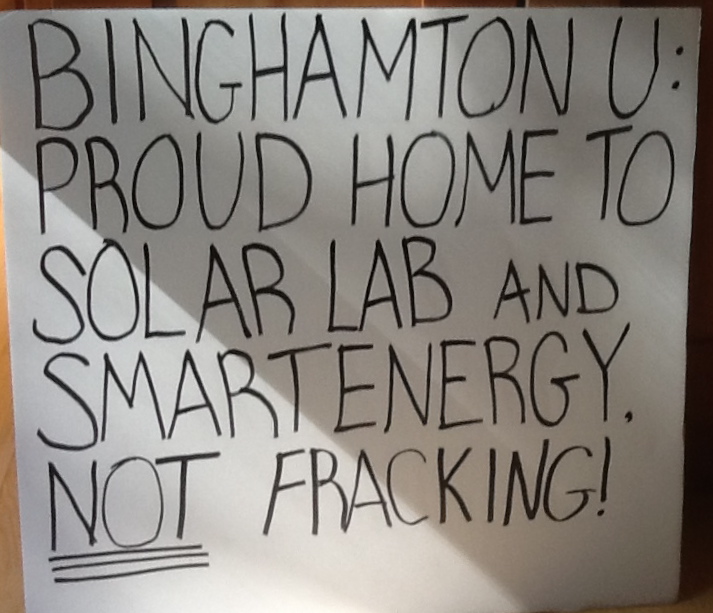
My sign - side one
My sign – side one

I spend a fair, some might say inordinate, amount of time on the fight to keep fracking out of New York State and to limit and end its use elsewhere. I frequently write comments on articles about it, a small fraction of which I share here at Top of JC’s Mind or on Facebook.  (For those who don’t know, fracking is the shorthand name for a process that extracts liquid and gaseous hydrocarbons from rock by using a mix of water, sand, and chemicals at extremely high pressure to fracture the rock.  Tons of information about environmental and health effects are available here: http://concernedhealthny.org/wp-content/uploads/2014/07/CHPNY-Fracking-Compendium.pdf )

I also attend events, rallies, and meetings when I can.  Fracktivists (or fractivists, a spelling I don’t use as often because people sometimes glance at it and read it as fascists, which takes their mind in a totally wrong direction) in New York have taken to showing up with signs asking for a ban on fracking whenever Governor Cuomo appears in public, usually on his way to an event that has restricted access.  This bird-dogging, as it is called, has become even more important in the run-up to the November election.

While Cuomo claimed that, as governor, he would keep an open public calendar, he has taken to keeping his schedule secret until the last possible moment. Thus, it wasn’t until late Wednesday evening that we got word that the governor would be arriving at Binghamton University at 11:00 AM Thursday.  Isaac, our intrepid community organizer – did you know that community organizers can become president some day? – quickly got the word out and about twenty of us showed up, signs in hand, to greet the governor’s motorcade and chant “Ban Fracking Now!”

As important as it is for Cuomo to see us wherever he goes, it is equally important that members of the press talk to us.  We had three television stations, public broadcasting radio, and the local newspaper taking interviews.  We were happy that Dr. Sandra Steingraber was among our number that day.  She is a biologist and public health expert who is currently at Ithaca College, a nationally and internationally known expert in toxic impacts of industrial pollution who is spending the lion’s share of her time and effort these days in the fight against fracking.  All the media outlets interviewed her.  Here is a sample of coverage that we received:  http://www.binghamtonhomepage.com/story/d/story/fractivists-protest-gov-cuomos-visit/34621/XNJzJy-Dkk-O7Wrr4WZOig.

We have been at this for several years and may be at it for several more.  It’s tough to fight an industry that spreads its huge wealth around to politicians to keep our country using polluting, climate-killing fossil fuels, but we have to keep fighting because it is so important to our present and future.

My sign - side two
My sign – side two

Slow recovery

Nearly every night on the news, there is coverage of devastation in some US state due to flood, wildfire, mudslide, tornado, hurricane, or ice/snowstorm. Solemn footage of some reporter surrounded by a tangle of building debris or downed trees and powerlines. If the disaster is widespread enough, the coverage may even go on for a couple of weeks. Invariably, though, the reporters and national attention move on to the next disaster scene, masking the truth that recovery, if possible, takes months or years.

I drove today though one of the neighborhoods in my town which was most severely affected in the September 2011 flood of the Susquehanna and its tributaries in the Southern Tier of New York. We had received ten inches of rain when the remnants of tropical storm Lee fell on ground already saturated by the fringe of hurricane Irene days before. First, there was flash flooding of the creeks, followed by record flooding of the Susquehanna. Some photos we took are here:

  https://www.facebook.com/media/set/?set=a.2019747698814.2103178.1397554070&type=1&l=f4365bbc43

 https://www.facebook.com/media/set/?set=a.2016067046800.2103029.1397554070&type=1&l=3df89ce2ba

You won’t see any of the neighborhood pictures here because it was cordoned off. Not even residents were allowed in for days. Even after the river had receded and water had been pumped out of houses and basements, storm water and sewage from the broken infrastructure system flowed into the basements, re-filling them. Some houses had to be pumped out four or five times.

Some houses were condemned. Some were repairable, but homeowners, many who had lived in their homes for decades, weren’t able to withstand the stress of rebuilding and worrying if it would happen again. A few properties were abandoned, while others were sold to speculators for pennies on the dollar. Some people were able to repair their homes with the help of federal flood insurance, while others relied on non-profits, friends, relatives, and savings to rebuild. Other homes were put on the market, some in a livable state and some not, but buyers were hard to come by.

There had initially been a tussle in Washington over funding FEMA’s response to Irene/Lee, but that was resolved. New York’s state government was very little help to us.

It wasn’t until the federal funding battle after Superstorm Sandy that New York State went to bat for us so that our area finally was able to get buyouts for some of our damaged properties, getting partial compensation to property owners and funds for the towns to tear down the houses and convert them to green space. It was too late for many of the affected homeowners, but it has helped some, and transformed the neighborhood into what I saw today.

The street is a patchwork of occupied houses with tidy lawns next to homes for sale – some repaired and some, surrounded by tall grass and overgrown shrubs, still in their flood-damaged state – next to lots where houses were recently leveled, covered in straw to protect grass seed, next to  larger-than-expected expanses of lawn where the demolitions were long enough ago  for the grass to have grown in. The nursing home that flooded is still sitting empty; they are building a new home in another part of town.

It still saddens me every time I drive through. For the neighborhood, nearly three years later, recovery continues, but it will never be complete.