
No to CO2 drilling in New York!

One of the things that has been occupying me over these last weeks is the unwelcome and unexpected need to return to the battle against unconventional gas drilling in my home region, New York’s Southern Tier (central NY along the border with Pennsylvania).

I was active with the coalition that successfully advocated for a ban on high-volume hydraulic fracturing in New York, which was first regulatory/executive in Dec. 2014 and made legislative in 2021.

In late summer/fall of 2023, a newly-formed, Texas-based company called Southern Tier CO2 to Clean Energy Solutions, Southern Tier Solutions or STS for short, began approaching landowners in Broome, Tioga, and Chemung counties with lease offers to use supercritical carbon dioxide to extract methane from the Marcellus and Utica shale formations thousands of feet under their land, claiming that it would also sequester the carbon. The scheme would involve thousands of miles of new CO2 and methane pipelines, plus ten or so new methane-burning power plants, which would burn the methane to produce carbon dioxide to use to extract more methane.

Mind you, this has never been done at scale anywhere in the world and does not have any solid scientific backing. The very real negative impacts of high-volume hydrofracking would be compounded by the dangers of carbon dioxide pipelines and injection, all at a time when New York State is implementing its landmark Climate Leadership and Community Protection Act to move us away from fossil fuels and toward renewable energy powering our lives efficiently.

When news of STS’s plans came to light, my New York State legislators, Assemblymember Donna Lupardo and Senator Lea Webb, began asking the Department of Environmental Conservation questions. I admit that I was alternating between fear and disbelief that the hard-won ban might be in jeopardy because it was predicated on the volume of water used and STS’s proposal plans to use supercritical carbon dioxide instead of water.

Fortunately, the coalition that had fought for years to win the hydrofracking ban quickly reconstituted and got to work. A coalition letter from over 90 organizations went out in December. Legislators got to work on legislation to add carbon dioxide to the existing ban with Dr. Anna Kelles as sponsor in the Assembly with Donna Lupardo as a prime co-sponsor and Lea Webb as sponsor in the Senate.

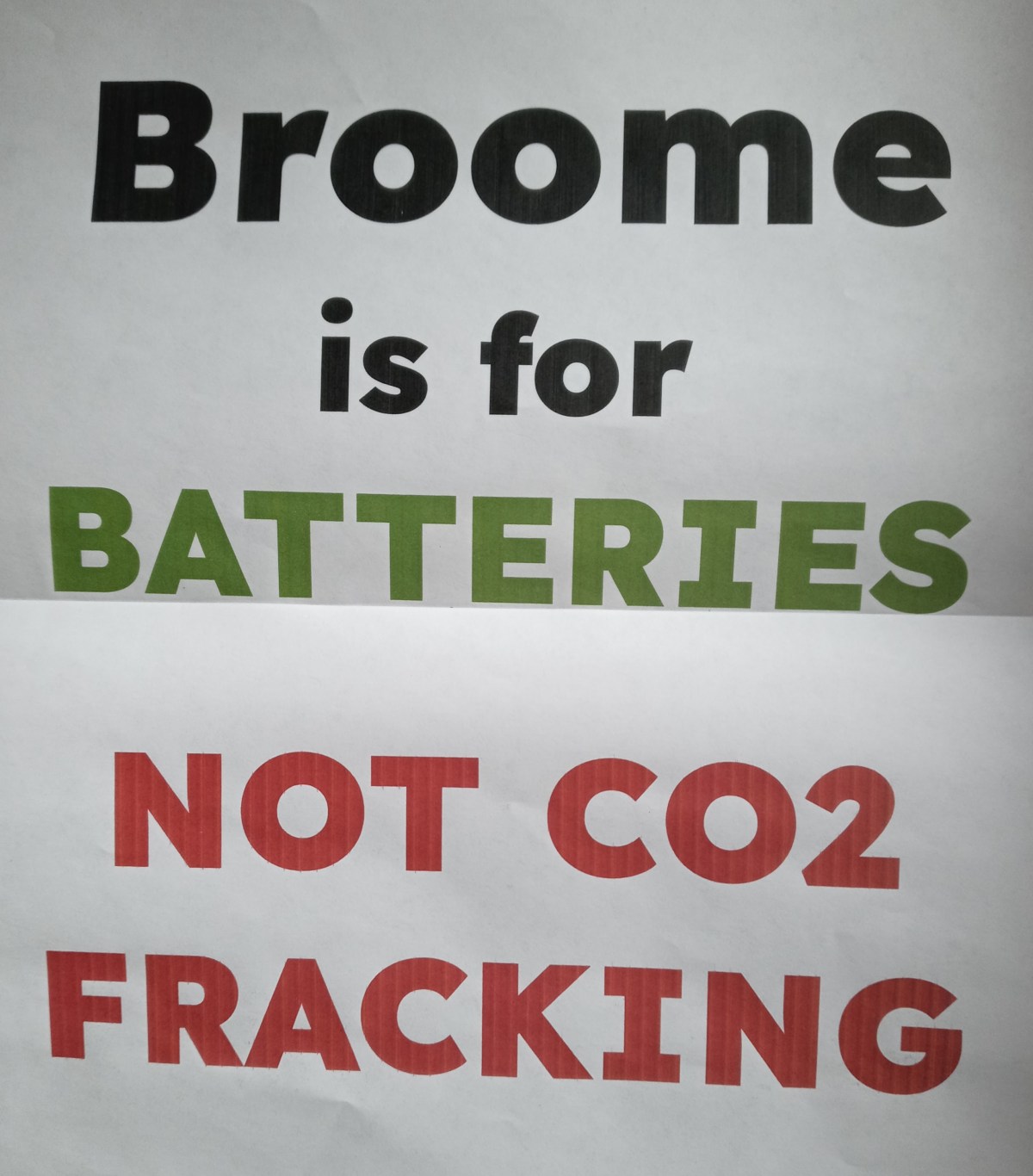
On March 5th, the coalition held a rally/lobby day in Albany. We had great speakers at the rally, including legislators, scientists, and leaders of organizations. I went local with my sign, emphasizing that the Broome County (Binghamton) area is part of the clean energy future as the center of a national technology hub for battery storage through the New Energy New York coalition and neither needs nor wants to be tied to dying fossil fuels. This was my first experience with in-person rallying and lobbying at the New York State Capitol. I was overwhelmed by the noise and busy-ness of it all but grateful to have been able to do my small part in the effort.

I’m thrilled to report that, on March 12th, the Assembly passed the bill with a vote of 97-50 and. on March 20th, the Senate followed with a vote of 45-17. Now, we are moving into the final phase, asking Governor Hochul to sign the bill quickly.

I’m shocked that the coalition was able to get this to move so quickly in Albany. As a Southern Tier resident, I’m immensely grateful to have support from around the state. In the original fight against hydrofracking, there were some very loud voices that were willing to use the Southern Tier as a sacrifice zone to get cheaper methane for their own use; this time, with the CLCPA in place, we didn’t encounter that sentiment as much. I’m also especially grateful to the Third Act Upstate NY working group, who jumped in as soon as I raised the alarm. Third Act is too new an organization to have been around for the original fracking battles but many members have extensive experience with climate activism and organizing and know how to get the word out.

While it seems that this is a local issue of a few counties in New York, the carbon dioxide drilling/sequestration scheme has global implications. Like plastics, it is an attempt by the fossil fuel industry to keep the world dependent on fossil fuels for decades to come, in defiance of the science that demonstrates the need to reduce atmospheric greenhouse gases as quickly as possible to keep the planet livable.

Part of the price to get fossil-fuel bro Joe Manchin’s vote in the US Senate on climate legislation was to include massive subsidies for carbon sequestration. It’s those subsidies that are behind STS’s proposed scheme to profit from the methane in the Marcellus and Utica shales, which is not economically viable to produce on its own. Using carbon dioxide from burning fossil fuels to extract even more fossil fuels is also inherently deleterious to environmental health and the climate. While there may be some instances where industrial carbon emissions can be collected and sequestered, the geology of the Southern Tier would not seem to support long-term sequestration. Sequestration would also be near-impossible in areas with a history of oil and gas wells because there would be too many pathways for injected carbon dioxide to escape.

My hope is that the example of New York banning this extraction/sequestration scheme will help other jurisdictions around the world see through the fossil fuels industry’s increasingly desperate attempts to keep the world burning their dirty products, even with the effects of climate change already causing damage and misery on a global scale.

Watch for news of these kinds of proposals near you. Don’t fall for the lies of the fossil fuel industry. Follow the science. Advocate for clean, renewable energy. Let elected officials know that we need and want protection from pollution and climate change. With so much damage already having been done, we need to act decisively now.

Together, we can move in a positive direction, as we are here in New York.

the (not clean) debt ceiling bill

Taking a break from posting about my chapbook Hearts to update you on the United States’ struggle on the debt ceiling.

Both houses of Congress passed a deal agreed to by President Biden and House Speaker Kevin McCarthy which suspends the debt ceiling until January 2025, after the next Congressional and presidential elections. It also limits some spending over the next two years and makes changes to some programs, such as food assistance and environmental project permitting.

While I’m grateful not to have the risk of default and national/global economic consequences hanging over our heads for the next two years, I would have much preferred for Congress to have passed a clean debt ceiling bill months ago. Then, they could have debated budgetary bills as part of the usual preparation for the fiscal year that begins October first. I also prefer raising taxes on the wealthiest individual and corporate taxpayers, in order to increase spending on social needs, while decreasing the extremely high military budget. (The CBS program 60 Minutes recently aired a piece investigating part of the reason.)

One of the absurd aspects of the bill is the inclusion of special permitting and judicial review provisions for the Mountain Valley Pipeline, a partially complected methane pipeline through West Virginia and Virginia that has been held up over its poor adherence to environmental regulations. It’s a pet project of Senator Joe Manchin of West Virginia, which he has tried and failed to include in past legislation. My heart goes out to the people and places along the pipeline route that will suffer damage because of its construction. It also flies in the face of our need, in light of global warming, to stop new fossil fuel extraction and infrastructure projects.

The best course of action for our financial future would be to eliminate the debt ceiling altogether. It seems to be in contradiction with the 14th Amendment, which states, “the validity of the public debt of the United States, authorized by law, including debts incurred for payment of pensions and bounties for services in suppressing insurrection or rebellion, shall not be questioned.” Whether this action comes through Congress or the courts, it would at least keep us from going through a similar scenario in the future with Congressional Republicans threatening to damage the economy if they don’t get their way on future budgetary policy.

A sigh of relief for now…

the continuing gun nightmare

Because things have been so busy and because my continuing healing from cataract surgery is still making computer time a bit more difficult, I’ve put off posting on some topics that have been top of mind.

One of those is the continuing – and seemingly accelerating – plague of gun violence in the United States.

Over these past couple of months, there have been some personal reminders of gun violence. The April 3rd anniversary of the American Civic Association shooting in Binghamton and driving by the memorial to it, only a few hundred feet from the site, knowing that, fourteen years on, if the victims are remembered at all, they are just numbers in a long tally of mass shooting victims. A Lenten program on gun violence that was part of a series on social sin, which led to my contacting my Congressional representative to request federal action on gun violence, only to get a discouraging reply that he won’t support such practical actions as keeping military-style weapons and ammunition out of civilian hands.

All of this while hearing every day of more mass shootings and their aftermath. The fact that we are averaging more than one mass shooting per day in 2023, 192 recorded by day 125, according to the Gun Violence Archive. The fact that firearms are now the leading cause of death among children and adolescents (ages 1-19) in the United States, far surpassing the rate in other industrialized nations. Laws being passed in some states to make it easier to carry weapons, despite the dangers to the public. The bizarre ousting of two state legislators in Tennessee for “lack of decorum” in speaking out against gun violence in the chamber, only to have those members re-appointed by their districts.

The feature of news coverage that makes these recent weeks even more disturbing is the increased attention to shootings that happened after harmless incidents. Being shot through a closed door for ringing a doorbell at the wrong address. After chasing an errant ball into a neighbor’s yard. While pulling out of a driveway in a rural area while trying to navigate to a friend’s home. Mistakenly going to the wrong car in a dark parking lot. All instances where you would expect a neighborly person to ask how they can help, not shoot and wound or kill.

I don’t understand.

Is it uncontrolled fear? Paranoia? Rage? Hate? Sense of entitlement? Illness? Racism? Misogyny? Addiction to power? Some combination of these, varying from incident to incident?

One thing that doesn’t vary? There’s always a gun.

We need legislation to address gun violence on the federal level. I live in a state with quite a few statutes regulating firearms but it is too easy for people to cross state lines or use the internet to circumvent them. I believe that military-style weapons don’t belong in civilian hands and that large ammunition clips should be banned, along with modifications that make a semi-automatic weapon behave like it is fully automatic. I think that there should be background checks, training, and licensing required for firearm ownership and robust laws against illegal possession and gun trafficking. People who have a history of violence or those who have restraining orders against them should not have guns. There should be universal red flag laws to make sure that those who are a danger to themselves or others do not have access to guns. Sadly, over half the gun deaths in the United States are self-inflicted; while people can and do die by suicide from other methods, guns kill a much higher proportion than other means. [If you are experiencing thoughts of suicide or are in a mental health crisis, dial 988 in the US or visit https://988lifeline.org/ to live chat or find resources. In other countries, use a search engine to find similar programs. Or ask a trusted friend, family member, doctor, etc. for help.]

Public polling in the US shows a large majority want more regulation of guns but Republican lawmakers are almost universally opposed. That needs to change. Either they need to change their minds or the people need to replace them with representatives who care about their safety.

Meanwhile, the losses, pain, and trauma accelerate…

election reflection

When I finally made myself post about the upcoming midterm elections in the US, I knew I’d have to do a wrap-up post, so here goes…

The election outcomes were more positive than I had feared but not as good as I had wished. Some of the ultra-MAGA candidates lost and accepted defeat but a few that lost are refusing to concede. Some who won their races are trying to leverage their position to move legislatures to the extreme right. This is particularly worrisome in the House of Representatives, where some individual Congress members are threatening to withhold their votes to make Republican Kevin McCarthy speaker of the House unless he agrees to undertake certain investigations that come out of right-wing conspiracy theories.

Technically, the election season is not quite over yet. While the Democrats picked up a Senate seat which gives them the majority of 50-49, the race in Georgia is going to be decided in a run-off in a few days. If current Senator Raphael Warnock is re-elected, the Democrats will hold a clear majority of 51-49, which will also give them a majority of committee seats and make confirming President Biden’s nominees quicker and easier in the new session. Theoretically, this would also help make legislation easier to pass but it’s unlikely that the Republican House will pass many bills that the Senate cares to take up. Given that the Republicans don’t really have a platform, it seems they are more inclined to undertake endless investigations than to actually try to make laws and pass budgets.

The impending change in the balance of power in the Congress has led to a push to enact as much legislation as possible before the end of the year. One thing that should happen is raising the debt ceiling; in my ideal world, it would be abolished but I doubt that is in the cards. There needs to be a budget resolution passed. I’d love action on voting rights, codifying reproductive health access, gun safety, care for children and the vulnerable, and anti-poverty programs like permanent expansion of the child tax credit. One major piece of legislation that has passed is marriage equality, which was in place in only some states before the 2015 Obergefell decision from the Supreme Court made it legal nationally. Given the current Court’s eagerness to overturn precedent, an explicit law from Congress will be helpful in ensuring the continuing right to marriage the partner of one’s choice.

I believe that the Republicans were only able to regain the House majority because of the Supreme Court’s gutting of the Voting Rights Act, along with their allowing redistricting maps that were found to be unconstitutional by state courts to stand for this election in Alabama, Georgia, Louisiana, and Ohio. There was also extensive gerrymandering in Florida and Texas that favored Republicans.

Contrast this with my home state New York. In an attempt to make redistricting fairer, map making was taken out of the state legislature and assigned to a bipartisan commission with an equal number of Democrats and Republicans. Unfortunately, the commission could not agree on a new map and sent two versions to the legislature, which drew its own map and adopted it. The Republicans sued, a court threw out that map, and a new one was drawn by an academic. This delayed our primaries and caused major changes in which some incumbents ran against each other in primaries and others had districts that had a majority of voters that were new to them.

It also led to some representatives shopping for a new district that would elect them, even though they don’t live there. Take my current representative Republican Claudia Tenney as an example. She lives in the present 22nd district, which nonsensically lumps part of the Southern Tier where I live with the Utica area where she lives. When it looked like one of the commission or legislative maps was going to be adopted, she had filed to run in the Southern Tier district to my west which was an open seat because the Republican incumbent had resigned. When the court map was adopted, she changed to run in the new 24th district which had been most of the district of the retiring Republican John Katko. I don’t know whether or not she plans to move. I now live in the 19th district and our incoming (Republican) representative, Marc Molinaro, also lives outside our district. I haven’t heard anything from him that he plans to move here, either.

I’ve heard a lot of complaints from national pundits that the Democrats lost the House majority because “the New York legislature is bad at gerrymandering” but they are off the mark. The fact is that the prior maps were drawn when the Republicans had the majority in the State Senate while the Democrats controlled the Assembly. The maps made the House districts upstate, which tends to have more Republicans, lower in population than the downstate districts, which tend to be more heavily Democratic. All the versions of the new maps made the population distribution for each district more even, which is good. Unfortunately, the court’s map that went into effect didn’t give much weight to the prior lines, so lots of voters and candidates were thrown into new districts at a very late date.

For me, that meant going from a central NY district that didn’t really make a lot of sense into a district that stretches from here, through the Catskills and Hudson Valley over to the Connecticut border. It would make much more sense for Binghamton to be included in a Southern Tier district. The Southern Tier is our economic development zone and our regional identity. If we needed to be connected to another region to make the population required, it would make the most sense to include some of the Finger Lakes region. We have much less in common with the Catskills/Hudson Valley.

There are big changes in Democratic Party leadership in the House. The most noted is that Nancy Pelosi, who has been either Speaker or party leader for twenty years is stepping down from leadership. This didn’t surprise me as she had promised to step down from leadership to make room for the next generation. Additionally, she is in her eighties and is recovering from the trauma of the politically motivated attack on her husband and their home before the last election.

Nancy Pelosi has been the most effective House speaker in my lifetime, shepherding through major legislation, such as the Affordable Care Act and the Inflation Reduction Act, with very small Democratic majorities and next to no help from Republicans. She is very astute in figuring out what is possible and bringing along the members to pass it. While she grew up around politics, I think a lot of her success comes from her personal values, shaped by Catholic social justice doctrine and the Constitutional call to “promote the general welfare,” and with her experience raising five children.

Unfortunately, she has been attacked by Republicans in personal and vile terms, which has led to political violence. Besides the recent attack at her home, there are several chilling videos of January sixth insurrectionists threatening her life. That she continues to serve her district and the country is a testament to her strength and convictions as a person and a public servant. I’m grateful that she is remaining in Congress as a mentor in the coming terms, as well as, of course, a powerful voice on policy questions.

When Pelosi stepped down from leadership, her fellow octogenarians Steny Hoyer and James Clyburn also took themselves out of the running for the next two highest-ranking leadership posts. The new top leadership team is Rep. Hakeem Jeffries as Minority Leader, Rep. Katherine Clark as Democratic whip, and Rep. Pete Aguilar as Democratic Caucus chair. They are all in their forties or fifties. Jeffries is the first Black to become leader of a major US political party. Clark is only the second woman, after Pelosi, to be in a top leadership post in Congress. Aguilar is the highest-ranking Latino in Congress.

What is happening with the Republicans is still unclear. While Kevin McCarthy was elected Republican leader, it remains to be seen if he has enough votes to be elected Speaker. It’s also unclear if he or anyone can hold the party together with a slim majority as Speaker Pelosi has been able to do with the Democrats. My fear is that the House Republicans will refuse to craft bipartisan legislation with the Democrats but not be able to hold their own party together to pass bills either. We could wind up with gridlock that leaves even vital legislation in limbo. We’ve seen this before under some past Republican Speakers.

I have a feeling that I will spend the next term writing to Rep. Molinaro, who claims to be a proponent of bipartisanship, asking him to stand up for reasonable legislation that passes the Senate to make it to the House floor for a vote, where it can pass with Democratic and a minority of Republican votes.

Will that happen? I don’t know, but I’ll try to at least start out with that hope.

Biden’s speech

Last night, President Biden addressed a joint session of Congress, although only a fraction of the members and a few guests and the press were present because of COVID limits on large indoor gatherings.

The real intended audience, though, is the American public among whom the president’s speech was well-received. A CBS/YouGov poll found 85% approval among Americans who watched the speech.

For me, it was easy to see why.

For over forty years, the federal government has been characterized as an obstacle rather than a solution to the problems everyday Americans face. We were told that tax cuts for wealthy corporations and individuals would “trickle down” to create more jobs, that spending on public projects was wasteful “pork barrel”, that our education and health systems were unparalleled, that hard work led to personal prosperity, that is was okay for Republican administrations to run huge deficits – in part to wage unfunded wars – but not for Democratic administrations.

Although many of us understood that the country was in trouble before the pandemic, 2020 revealed the weak state of our national government and the precariousness of most people’s lives. It showed the nation how dependent we are on what are now called essential workers, most of whom are poorly paid and who often don’t have even basic benefits like paid sick leave and health insurance. We saw the rates of illness and death, staggering in and of themselves, disproportionately higher among people of color and those in the lowest socioeconomic circumstances. We saw that most of our school buildings could not be made safe for staff and students and that many students and families did not have the proper resources available for remote learning. We saw our medical systems pushed beyond their limits. We saw vast inequality in outcomes among states because the Trump administration refused to lead in a time of national and international crisis.

I could go on but I think that this sets the stage for those who may not be familiar with life in the US.

After a major presidential address to Congress, the opposition party gives a response. Last night, this task fell to Senator Tim Scott of South Carolina. He claimed that, as Biden was inaugurated on January 20th, the nation was on the upswing. If the Republican leadership truly believes that, they are delusional. January 20th was only two weeks after the insurrection that breached the Capitol building where they meet for the first time in over 200 years. The country suffered 4,380 COVID deaths on January 20th, on its way to what would become the deadliest month of the pandemic in the US to date.

The country was in a fragile, precarious state.

One hundred days of competent and compassionate national leadership makes a huge difference.

Experiencing that change is what made Biden’s speech so popular and, more importantly, what makes his policy proposals and how to pay for them popular, as well. The American people want good transportation systems, water/sewer systems, electrical grid, communication systems, and fast internet service. They want high-quality affordable health care. They want a strong education system available to everyone regardless of where they live. They want high-quality care for children, elders, and anyone who is sick or vulnerable. They want to be treated with dignity. They want to live in safety. They want to be paid wages that can support themselves and their families in the present and that enable them to save for the future.

They see other advanced democracies manage to do those things, while the United States has been falling behind. Instead, wealth is increasingly concentrated in the hands of the top 1% of individuals and corporations, some of whom pay their executives huge sums while some of their employees need public assistance programs to have enough to eat and to pay rent. Many of the wealthiest people make most of their income from investments rather than from salaries, so they pay tax at a much lower rate.

This is why the Biden proposals to raise revenue from the highest income earners are popular with the public. All of the revenue for the programs would be raised from those with income over $400,000. The changes in the capital gains rates would only impact those over $1,000,000 in income. There is also a proposal to increase audits for high-income earners and to make it harder to avoid income taxes by using off-shore tax shelters. The corporate tax rate which was slashed by the Republicans in the 2017 tax bill would rise, although not to the level it was before that bill was passed.

This all strikes most Americans as fair.

We are in a bizarre situation where many Republican voters and local/state officeholders are in favor of Biden’s proposals but Republican members of Congress are opposed. The national Republican party is beholden to rich donors and is going to need to decide if they want to get on board and seriously negotiate with Democrats on these bills and then support the final product to benefit the people of their districts or if they are going to obstruct everything the Democrats try to do.

Now is the time that each member of Congress needs to remember that they are sworn to uphold the Constitution and are there to serve the people, not their party leadership.

It’s time to fulfill their promise in the Preamble to “promote the general welfare.”

filibuster update

Here at Top of JC’s Mind, I sometimes – and more frequently in recent years – wade into the political waters of the US. Last October, I mentioned the Senate filibuster and my hopes that is would be reformed, tangentially in this post and fleshed out a bit in the comments.

Remarkably, these early weeks of the Biden administration have given rise to a lot of public discussion of the filibuster and how this arcane Senate rule might be reformed or eliminated so that legislation can pass the Senate by majority vote rather than needing 60 of 100 senators to end debate and proceed to a vote. This is called “invoking cloture.”

For decades, filibusters and cloture votes were rare. Maddeningly, filibusters were used to attempt to derail legislation on civil rights, voting rights, labor rights, and anti-lynching. (Republican Minority Leader Sen. Mitch McConnell has tried to argue that the filibuster was not used as a racist tool, but this twitter thread from Kevin Kruse proves him wrong with a long, but not exhaustive, list of past racially-motivated filibusters.)

During the Obama presidency, McConnell and the Republicans frequently used the filibuster to slow or prevent approving appointments and to keep legislation from reaching the floor for a vote. This was possible because all a senator needed to do was to say they wanted to filibuster and it would take sixty votes to end it, which, with all the Republicans sticking together, meant that there were never enough votes to invoke cloture and proceed to a vote. This led to a rule change that appointments were not subject to the filibuster, though other kinds of legislation still were.

One of the reforms to the process currently being discussed is to require that a senator wanting to filibuster must stay on the Senate floor and speak on the bill being debated. This revives the practice that was in place until 1975, although senators then weren’t required to speak on the bill and could read from the phone book or cookbooks or talk about totally unrelated topics.

There is also a proposal to change the cloture vote. Rather than needing sixty votes to end the debate, which puts the burden on the majority, the new rule would be that 40 or 41 senators would need to vote to continue the debate. This preserves the ability of the minority to put forth their arguments on something they feel strongly about but requires them to put forth effort to do so.

The hope is that these two reforms would break the stranglehold on bills that became so stark during the Obama administration. It might also engender more bipartisan bills actually making it to the Senate floor for a vote. (Mitch McConnell famously once filibustered his own bill when it became clear that President Obama would sign the bill into law. McConnell valued gridlock over governing.)

Or, given that it is just a Senate rule and not a law, the filibuster could be eliminated. Many think this would be the simplest path, but a few Democratic senators are vehemently opposed to ending it totally, although the impetus for reform is definitely gaining momentum.

While I had hoped that, under President Biden who was a long-time senator, some of the more moderate Republicans would want to vote for common-sense and popular bills such as the American Rescue Plan, we have yet to see that happen. The American Rescue Plan, despite its popularity with the public and its many provisions that benefit people in their states, garnered no votes from Republicans in Congress; it passed with a simple majority in the Senate due to special budgetary rules that prevented a filibuster.

There are now some popular and much-needed bills that have passed the House that will become test cases on whether or not bipartisan support is possible or whether it will take filibuster reform or elimination to get them on the floor for a vote. The For the People Act (H.R. 1/S. 1) addresses voting rights, campaign finance reform, government ethics, gerrymandering, and election security. Further voting rights issues are addressed in the John R. Lewis Voting Rights Advancement Act, which would help to restore provisions of the 1965 Voting Rights Act which the Supreme Court struck down in 2013, on the grounds that these racial provisions were now obsolete. Sadly, we have seen evidence that they are not, as efforts are now underway in 43 states to restrict voting access to certain groups of people, including by making it harder for people of color to vote or by making it more difficult for students or elders to register and vote by mail.

There are two House-passed gun safety bills, one on universal background checks and one extending the time the FBI has to vet purchasers to ten days instead of the current three. Both of these measures have broad public support, including among Republicans and gunowners. An increase in the federal minimum wage is very popular with the public, as are bills to re-build our infrastructure, increase our production of goods and green energy to create sustainable jobs, and to increase taxes on the very wealthy.

If bills like these pass the House and appear on the Senate floor, what will the Republicans do? Will they vote yes in accord with their constituents? Will they filibuster to stop a vote from occurring? If they do decide to filibuster, they risk the Democrats reforming the filibuster, voting that certain kinds of bills such as voting rights are not subject to it, or eliminating it all together.

Fingers crossed that whatever scenario unfolds, these laws will be enacted for the common good. We have been waiting for Congress to actually participate in governing in the way the Constitution sets before them.

Calling on Republican Senators

As I write this, the US presidential race has not yet been called, although it is likely to be called later this weekend for Joe Biden. This would mean that Kamala Harris, as vice president, would preside over the Senate, with the power to break tied votes.

We also don’t know what the final make-up of the Senate will be and we won’t know until January as the state of Georgia, in a highly unusual circumstance, will have run-off elections for both of their Senate seats in January.

Regardless of the final composition of the Senate in 2021, I am making a plea to those Republican senators who actually want to help craft legislation and govern the country rather than engage in obstruction under the leadership of Sen. Mitch McConnell.

I think that those senators should form their own caucus. Their first act would be to vote for Sen. Chuck Schumer as majority leader, so that House-passed legislation would actually be considered in the Senate rather than gathering dust on McConnell’s desk as it has been.

They would then meet with the Democratic caucus on a regular basis to offer their ideas for advancing bipartisan solutions to the nation’s problems, which could then be enacted and signed into law. I’m sure that the Democrats would gladly agree to this solution to the Senate gridlock that has prevailed for years.

In my mind, some senators who might consider such an initiative are Sen. Romney of Utah, Sen. Collins of Maine, Sen. Murkowski of Alaska, and Sen. Toomey of Pennsylvania. Perhaps Sen. Sasse of Nebraska. They would not necessarily have to leave the Republican party to become independents, although some with strong support in their home states might be able to do that, thus obviating the threat of a primary challenger.

A lot would depend on what becomes of the Republican party without Trump as president. Will it attempt to revert to being a traditional conservative party or continue in the rather haphazard counter-factual populism it has exhibited in recent years? Would even the willingness to engage in bipartisanship be enough for the Republican leadership to kick out any senators who dared to attempt it?

In the House, the Democrats will still hold a small majority, but there might be some Republicans willing to form a similar caucus to help craft and advance bipartisan legislation.

Joe Biden has a long history of bipartisan cooperation as a senator and as vice president and has been speaking for months about restoring unity to our deeply fractured country.

Republican members of Congress, how do you respond to this call? You swear an oath to the Constitution which proclaims that our government is to “form a more perfect union” and to “promote the general welfare”.

Are you willing to act for the good of all people or only that segment that voted for you?

Update: A few minutes after I posted this, Joe Biden was projected the winner and is now President-elect. This will mean Vice-President Kamala Harris will preside over the Senate and have the power to break tie votes.

indictment of Russian military officers

I am appalled at DT siding with Putin against the very real evidence of crimes against the American people around the 2016 election by members of the Russian military.

The indictment is detailed and, of course, the grand jury, ordinary United States citizens doing their civic duty, saw the evidence behind the counts listed.

Russia will not extradite the officers to stand trial, so the trial will need to be held in absentia.

All members of Congress should speak up and support the Justice Department and courts as this process moves forward. They should also pass legislation to secure the 2018 and future elections.

They must also denounce the president for taking the side of Putin and Russia against the United States. I can barely believe the depths to which DT has sunk, as he denigrates our long-time allies while praising authoritarian leaders.

The Congressional oath of office begins, “I do solemnly swear that I will support and defend the Constitution of the United States against all enemies, foreign and domestic…” I call on all members of Congress to fulfill their oath and protect our democracy.

US Healthcare Update

Overnight, the Senate defeated the Affordable Care Act repeal bills. It wasn’t pretty, with 49 Senators willing to take health insurance away from millions of Americans, but 51 Senators stood up for us.

Now, we need Congressmembers from across the spectrum to engage with each other to craft legislation that improves and expands the Affordable Care Act so that everyone has access to affordable, quality health care. There are already some bill drafts that do that available as a starting point.

Let’s go.

Plan C? Seriously?

Last night, more Republican Senators made it clear that they would not vote to open debate on the latest version of the health care bill.

Within a couple of hours, Majority Leader McConnell announced that he would bring up a bill to repeal the Affordable Care Act, but delay its taking effect for two years, during which time the Congress would need to pass a replacement plan for the president to sign.

This is a bad idea.

The last time the Congress tried something similar was during a budget impasse. They put in place a sequester program that capped budget allocations for both discretionary and defense spending. The theory was that both parties would want to cooperate so they could allocate more money for their budget priorities. The reality was that no agreement was reached and there were some years that Congress didn’t even pass its appropriations bills, but used a series of continuing resolutions to fund the various departments.

This does not give high confidence that Congress would pass a replacement bill before the deadline.

Insurance companies and health care facilities are upset because this would create so much uncertainty for them.

The general public is concerned because the repeal is expected to immediately raise premiums and reduce the number of people who can afford insurance.

There are senators across the political spectrum calling for a new process to begin, involving input from all senators, along with public health professionals and the public, to craft health care reforms that will increase the availability and affordability of health care.

I hope that Senator McConnell will choose to engage in this more cooperative process which is in line with the way the Senate has traditionally operated.