
No-Mow May

In the United Kingdom and parts of the United States, there is an initiative called No-Mow May, encouraging people not to mow lawns (or a portion thereof) during the month of May in order to encourage the blossoming of wildflowers which provide food for bees, butterflies, and other pollinators.

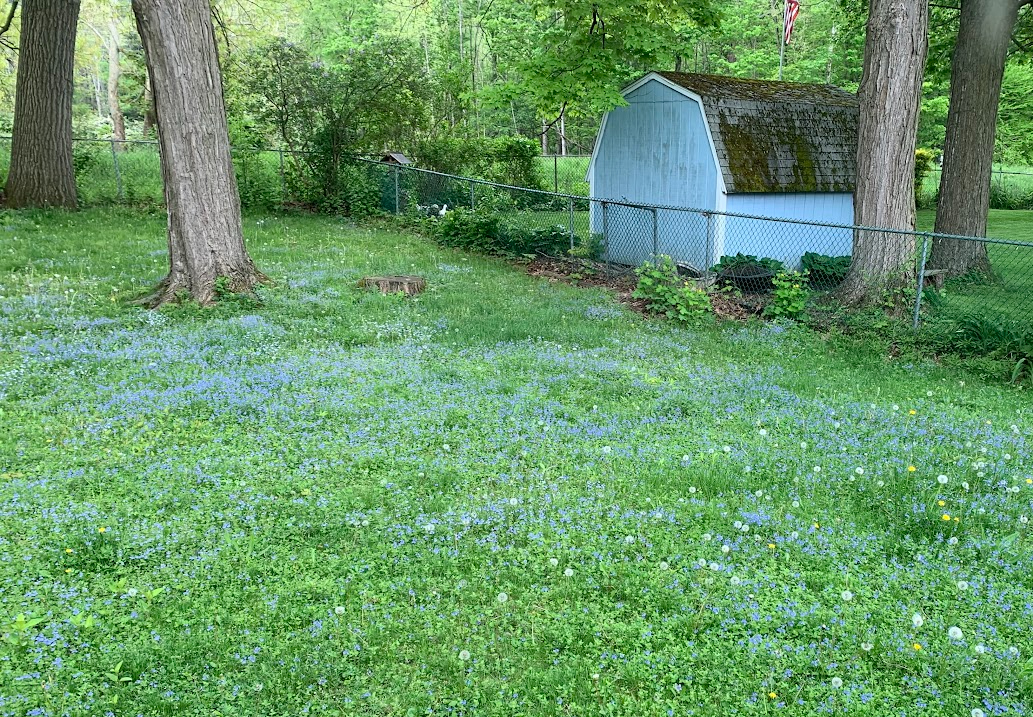
In the spirit of No-Mow May, we have limited our lawn mowing in our front yard and left most of the back yard to grow on its own. The front yard starts things off with dandelions, which we let blossom but then wind up having to mow for propriety’s sake. B leaves the lawnmower on the highest setting, though, so that the spent dandelion stems get cut while sparing the violets and white clover that follow. Even though white clover is not native, our bumblebees seem to enjoy it. It’s also helpful that we use a battery-powered mower so that the plants don’t have to contend with the heat and exhaust of burning gasoline.

Besides those, the backyard has waves of additional flowers, including wild strawberry, bluets, forget-me-nots, speedwell, buttercups, celandine, ground ivy, and fleabane. While these help our pollinators, they also provide food for other animals, including rabbits.

Besides the lawn, we have other spring-flowering plants, including bleeding hearts, PJM rhododendron, dwarf daffodils, lily-of-the-valley, brunnera, amsonia, and our heirloom rose bush.

Although not all the plants are native, our native pollinators frequently visit them, which is important to us, especially our bumblebees. When we had a landscape plan drawn up and planted in fall 2020, we requested native plants, but some of the plants that grow wild in our yard are non-native species that are now considered naturalized in our area, though not invasive. If we do find invasive species, such as garlic mustard, growing, we try to pull them out so that they don’t spread. It is also helpful that we have had wildflowers growing as part of our lawn for decades. We never use herbicides. The mix of plants and not mowing it too short also make our lawn drought-resistant. We never have to waste water by spraying it on our lawn.

We may stretch No-Mow May into early June in the backyard so that the daisies that have started to grow up but haven’t blossomed yet have a chance to do so. Perhaps, B will do what he has done in some past years and mow around the daisies until they have had a chance to flower.

Do people observe No-Mow May – or some variation better suited to your geography, like Low-Mow May or No-Mow April, where you live?

the return of lawn mowing

I just got in from mowing the lawn for the first time since the f(l)ight of the bumblebee.

I’m happy to report that I am unscathed, although I did give a wide berth to the one bumblebee that I saw.

And had an adrenaline rush every time anything flew near me, even if it was a startled moth or butterfly.

And did not go anywhere near the shed under which the bumblebees had nested.

But I did get the front lawn done, although, in an ideal world, I would have waited until afternoon, as the grass was still a tiny damp.

I am happy to report that I had a good reason for getting it out of the way this morning. This afternoon, B and I head to Albany to help our daughter T pack her things after her wildly successful summer internship with the New York State Department of Environmental Conservation Natural Heritage program.  She loved it and it confirmed that she had chosen the right major and career path for her master’s degree.

Now it will be back to the classroom at SUNY-Environmental Science and Forestry for her final year.  We are so excited and happy for her!

Wish her luck!

SoCS: the fight of the bumblebee

It’s not often that I run away from something – okay, it’s not often that I run, period – but this past week, I did.

I was out mowing the lawn, using our electric rechargeable lawn mower, which I convinced my husband to get a few years ago so I could help with the mowing. I had trouble even starting our gas-powered one and wanted a lawnmower with a smaller carbon footprint. So, while I don’t have decades of experience with lawn-mowing, I’m not totally new at it either.

While we live in a suburban-style neighborhood, we and many of our neighbors have more rural-style lawns, meaning that among the grasses there are other plants, some of which flower. Depending on the month, our lawn has wild strawberry blossoms, violets, creeping charlie, dandelions, clover, and other flowers blossoming. Where there are flowers, of course, there are bees and we are used to seeing them as we mow. They generally buzz away from the mower to find another flower that isn’t in its path, with bumblebees being the mellowest, just moseying slowly away.

I was really surprised, then, when a bumblebee came around the corner of our shed and headed straight at me. Startled, I ran away, even tripping and falling in my haste – and getting grass stains on my pants.

I felt sheepish about being chased away by a docile bumblebee and, determined to finish the little patch of lawn left, went back to the mower. After a couple more episodes of bumblebee-chasing, I realized that they were flying in and out from under the shed, which meant that they must have built a nest under it. By that point, I was almost done and was staying away from the shed, so I thought I was safe.

But, no.

One of the bumblebees, obviously upset by my continued presence, followed me back to the garage as I headed back to it to plug in the the mower, got under my shirt-sleeve, and stung me.

In the not-the-most-mature reaction, I screamed, batted it to the garage floor, and hurried inside the house. I called my husband and told him I was scared and didn’t know what to do. Because my mom is allergic to bee stings, I had grown up being scared of bees and had only been stung once by a yellowjacket when I was a child. My husband, on the other hand, has been stung many times over the years. He calmly told me to take a couple of benadryl and ice the sting. It was getting near time to come home, so he said he would leave and be there in a few minutes.

The ice helped with the pain and, when he arrived, he made sure there was no stinger in my arm. He looked up some information that confirmed that bumblebees, unlike some other species, don’t have barbed stingers, so, good news – the stinger doesn’t remain lodged in the victim but – bad news – they can sting multiple times without dying. They also are not aggressive unless they are defending a nest. Yup. Got that fact right, too.

I am all healed up now and none the worse for wear. I haven’t needed to go back out to mow, but, if I ever have to run away from a bee again, I’m not going to go back out and try to finish.

I learned my lesson.
*****
This post is part of Linda’s Stream of Consciousness Saturdays. The prompt this week was to build the post around a word that ended with “-ay.” Join us! Find out how here:  http://lindaghill.com/2015/08/14/the-friday-reminder-and-prompt-for-socs-august-1515/

SoCS badge 2015