
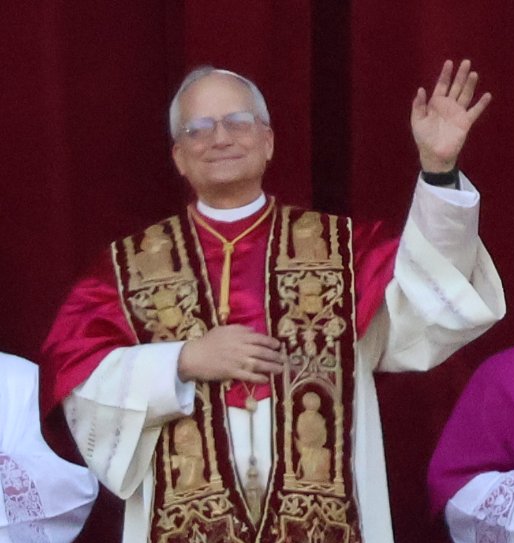
(By Edgar Beltrán / The Pillar – https://x.com/edgarjbb_/status/1920590815472108021, CC BY-SA 4.0, https://commons.wikimedia.org/w/index.php?curid=164970023)
When I wrote about Pope Francis right before the conclave, I didn’t expect that the conclave would end on the second day. As a reader of NCR (National Catholic Reporter), though, I was delighted but not shocked by the selection of Cardinal Robert Prevost as the next Pontiff. Although he was born in Chicago and educated in the United States (with an additional degree from the Pontifical University of St. Thomas Aquinas in Rome), most of his ministry has been outside the US. Fluent in several languages, including Spanish and Italian, he spent over twenty years in Peru as a pastor and, later, Francis-appointed bishop. He is well-known in church circles internationally because he visited close to fifty countries as prior general of the Augustinian order and, for the last two years, had been in Rome serving as head of the Dicastery for Bishops, which advises the Pope on the appointment of bishops world-wide. He was chosen as a cardinal on assuming this prominent role in the Curia, which is the Catholic Church’s bureaucracy.
While many had felt that it was impossible for anyone from the US to be chosen as Pope because the United States is such a powerful country, Cardinal Prevost was seen as more of an international figure. He is a citizen of Peru as well as the United States and has lived in Rome for over a dozen years. He understands the workings of the Vatican but retains the skills of a pastor. He supports Francis’s efforts to make the church more synodal in its approach, which broadens those with input into church matters instead of everything being concentrated in the power of the bishops, led by the Pope, who is given primacy as the bishop of Rome. I think that his skills and resume, as well as his familiarity in so many countries, made him a natural choice for the cardinal-electors.
I was struck that the name he chose was Leo XIV. This immediately brought to mind Leo XIII, whose 1891 encyclical Rerum Novarum (Of New Things) is the bedrock of Catholic social justice doctrine. That encyclical is subtitled Rights and Duties of Capital and Labor; it brought moral teaching to bear in response to the challenges of the industrial revolution. This choice of name signals that the new pope hopes to bring social justice doctrine to bear on the current challenges of the digital age. He also will continue the work of Francis’s 2015 encyclical Laudato Si’: On Care for Our Common Home, which emphasizes working to address “the cry of the earth and the cry of the poor.”
I was struck by his age. Born in 1955, Leo XIV is the first pope who was raised in the post-Vatican II church from childhood. My hope is that his papacy will continue the reforms of Vatican II which place the Catholic Church in the modern context rather than trying to isolate itself. This is the first time that a pope feels like a brother to me because he is actually close in age to my older sister. Being from the United States, I also understand better the environment in which he grew up. It lends a feeling of closeness that was not possible with the prior popes in my lifetime.
Leo XIV’s age also opens the possibility of a long pontificate. Leo XIII had one of the longest pontificates in history at 25 years; Leo XIV may not match that length but could remain pope for over two decades if his health holds.
I also have a personal attachment to the name Leo, which was my father’s name. He was named after his own father, although not a Junior as they had different middle names. Family lore is that my great-grandparents, after suffering the loss of several children, started to name them after popes, so my grandfather was literally named after Pope Leo XIII, who was serving at the time of his birth. All their sons who were named for popes survived into adulthood.
Welcome, Leo XIV! May God bless your pontificate and all the work you do for peace, justice, the world, and all peoples.


 Joanne Corey