another tribute?

Last week, I attended a choral concert at Binghamton University that had been billed as a tribute to Dr. Bruce Borton, who had served in the music department for almost three decades and who passed away in August.

I wrote here about the concert that the Madrigal Choir of Binghamton presented last month and had hoped that the concert at the University would address Bruce’s legacy there, but I was disappointed. It seemed that the choral groups had prepared their fall concert as usual and just tacked a couple of pieces on the end that they tied to Dr. Borton.

The most direct tie was the combined choirs singing “Bogoroditse Devo” from the Rachmaninoff All-Night Vigil. I had sung the piece with the now-defunct University Chorus under Bruce’s direction and this particular movement additional times. It was chosen because Bruce was a scholar of Rachmaninoff and loved this work in particular.

It was difficult for me to listen to it. I knew it well and could notice the differences in interpretation but the most glaring difference was the lack of maturity in the sound, especially from the basses. It’s not, of course, the singers’ fault that their voices are still maturing, but it demonstrated the reason that University Chorus, which included students, staff, and community members, was so important to Bruce. A more age-diverse choir can produce a richer sound and excute a greater expressive range than a younger choir. This might not matter with some repertoire, but it does with Rachmaninoff.

I was disappointed that they hadn’t reached out to the University Chorus alums still in the area to join the students to perform this piece. It wouldn’t have taken much rehearsal to include us as we know the piece well and it would have been very meaningful for us. I wish they had also reached out to us or a faculty member who worked with Bruce to speak about him. As it was, the only spoken tribute was from a former graduate conducting student, read from a cell phone by one of the conductors.

The concert intensified my feelings of loss, not only of Bruce but also of University Chorus, which was so dear to his heart and to our community.

a tribute to Bruce Borton

On Sunday, the Madrigal Choir of Binghamton (MCOB) opened its 46th season with a tribute concert to our late director, Dr. Bruce Borton, who passed away in August. He was only the second artistic director of Madrigal Choir and had served on their board and sung with them before being chosen as artistic director when founder Anne Boyer Cotten retired.

For the first few years of his tenure as MCOB director, Bruce was finishing out his long career with Binghamton (NY) University where I had had the privilege of singing under his direction for 29 years as part of the University Chorus, which included singers from the community as well as staff and students from the university. After the closure phase of the pandemic, with Univeristy Chorus permanently disbanded and Madrigal Choir in need of some additional voices, Bruce welcomed me to the second soprano section and invited me to serve on the MCOB board.

In spring of ’23, Bruce developed a serious illness and was on medical leave for most of the ’23-’24 season. He was, though, able to return to conduct Randall Thompson’s Frostiana for our spring concert in April. I had had a feeling at the time that it would be our last opportunity to sing under his direction but had not expected his decline to advance so quickly. I was grateful to be able to join with members of the Madrigal Choir, the Trinity Memorial Episcopal choir, and some of his former students at the University to sing at his funeral.

Uncharacteristically for me who often writes about difficult things in the moment, I couldn’t bring myself to post about Bruce until now.

The Madrigal Choir concert on Sunday was named for the anthem that Bruce had composed in honor of the 25th anniversary of his friend and colleague, Peter Browne, as music director of their church, Trinity Memorial Episcopal. The text is 1 Corinithians 13, which centers on love and is often used at both weddings and funerals. The second half of the concert began with a tribute to Bruce by Alison Dura, long-time Madrigal Choir singer, officer, and board member, followed by the singing of “Love Never Ends.” It was especially poignant to be singing it at Trinity, accompanied by the organ Peter had played for so many years and where both Peter’s and Bruce’s funerals had been held. The meaningfulness of the text and the beauty of Bruce’s setting were able to help me sing it without breaking.

The concert concluded with Morten Lauridsen’s Lux Aeterna, which re-interprets Latin texts and chant into more modern tonalities. It was a reflective way to remember Bruce as we sang, “Requiem aeternam dona eis, Domine, et lux perpetua luceat eis.” Rest eternal grant to them, O Lord, and let perpetual light shine upon them.

Alleluia. Amen.

One-Liner Wednesday: Madrigal Choir of Binghamton concert on Sunday

If you are in the Binghamton, NY area, please join the Madrigal Choir of Binghamton for this concert, which will include a tribute to our late director, Bruce Borton.

Join us for Linda’s One-Liner Wednesdays! Find out more here: https://lindaghill.com/2024/10/23/one-liner-wednesday-no-better-time/

end of our 45th season

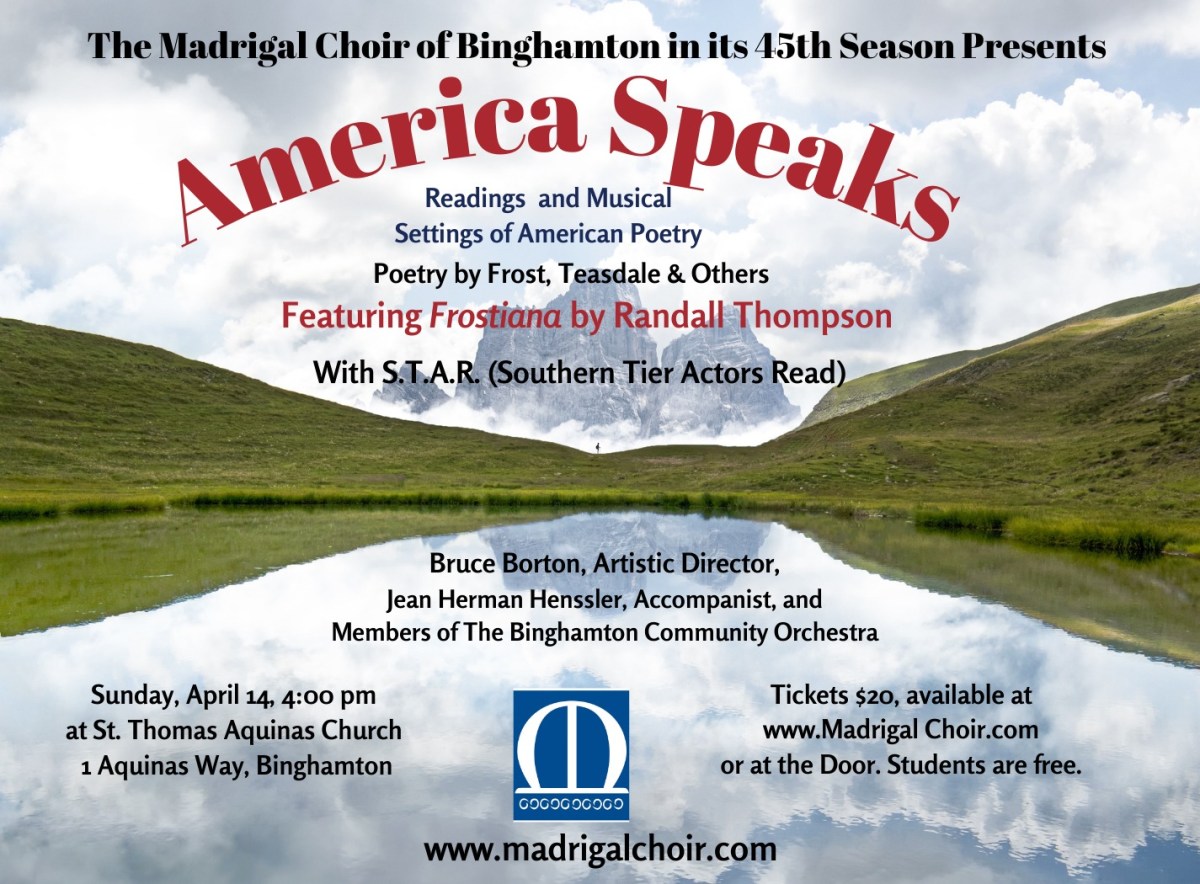
Yesterday, I sang with the Madrigal Choir of Binghamton as we closed out our 45th anniversary season, which had concentrated on American themes.

This final concert was called “America Speaks” and focused on American poets. In an interesting twist, the poems were read by members of S.T.A.R. (Southern Tier Actors Read) before we sang the settings based on the poems. As a poet, I’m accustomed to hearing poets read, but actors enunciate and emote much more than most poets. I especially love that this concert took place during National Poetry Month.

(As it happens, I will have the opportunity to hear “Some Time Else,” one of the poems from my chapbook Hearts, read by an actor affiliated with the Glimmer Globe Theatre at the Fenimore Art Museum in Cooperstown on Saturday as part of Write Out Loud 2024. Stay tuned for more information.)

The highlight of the concert for me was performing Frostiana, Randall Thompson’s setting of seven poems by Robert Frost, written to celebrate the bicentennial of Amherst, Massachusetts. We were accompanied by members of the Binghamton Community Orchestra, so we could appreciate Thompson’s skill as an orchestrator as well as a composer. I especially liked the flute’s imitation of thrush calls in “Come In.”

What was most special, though, was that our artistic director, Dr. Bruce Borton, was able to conduct Frostiana for the performance. He has been battling a serious illness and this was his only appearance at our concerts this season. I began singing under his direction in 1988, when he was at the local university as a professor and began conducting the Binghamton University Chorus, which I had joined in 1982. I first sang “Choose Something Like a Star,” the final piece in Frostiana, under his direction relatively early in his tenure, so it was especially poignant to sing it yesterday.

I managed not to cry.

I hope to sing for Much Ado in the Garden this summer and for our 46th season. I’ll post details as they become available.

Concert (and American) Reflections

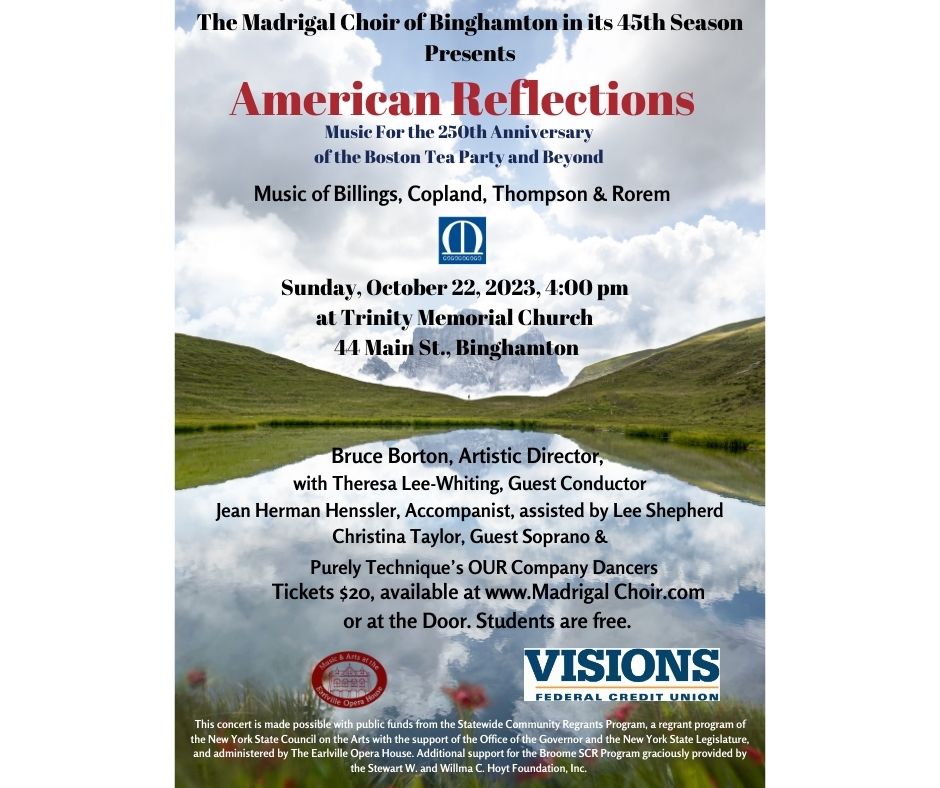
Yesterday, the Madrigal Choir of Binghamton presented the first concert of our 45th anniversary season, “American Reflections.”

Our artistic director, Bruce Borton, chose the program to commemorate a number of anniversaries. We sang a set of pieces by William Billings in commemoration of the 250th anniversary of the Boston Tea Party; Billings was a Boston resident at the time and two of the pieces we sang directly referenced the revolutionary period. Special guest soprano Christina Taylor sang four settings of Walt Whitman poems by Ned Rorem, in honor of Rorem’s centennial. We also sang Randall Thompson’s “The Testament of Freedom,” a setting of Thomas Jefferson texts composed in 1943 for the University of Virginia’s glee club commemorating the bicentennial of their founder Jefferson’s birth. We rounded out our all-American program with pieces from Aaron Copland’s opera, The Tender Land.

I’m pleased to say that the concert went well and was enthusiastically received by our audience. We owe our thanks to Theresa Lee-Whiting, who relinquished her role as singer and president of Madrigal Choir to serve as guest conductor for this concert after Dr. Borton needed to take medical leave. We were grateful that Dr. Borton was feeling well enough to attend the concert and hope that he was proud of the work we had done.

I admit that rehearsing and singing this program had its challenges from a historical perspective. For example, in “Stomp Your Foot” from The Tender Land, the text is very explicit about the devaluing of the work of “ladies” versus men. The story is set in the farmlands of the 1930s Depression era, so it is accurate for the times, if a bit galling to sing these days.

The more problematic text for me was Jefferson’s words in “The Testament of Freedom.” The bulk of the text Thompson chose to set is from the “Declaration of the Causes and Necessity of Taking Up Arms.” There are a number of references to bondage or slavery as a consequence of the colonists not taking up arms against the British. For example, “We cannot endure the infamy and guilt of resigning succeeding generations to that wretchedness which inevitably awaits them if we basely entail hereditary bondage upon them.” It’s difficult to sing the text with the knowledge that Jefferson was holding hundreds of men, women, and children in “hereditary bondage” as he wrote these words. He also writes that the colonists must take up arms “for the protection of our property, acquired solely by the honest industry of our forefathers and ourselves,” as though the work of those he enslaved was not also adding to his wealth, although he would have considered those people part of his property. I wonder if Thompson would have chosen the passages to set differently if more modern scholarship on the colonial and Revolutionary War times had been available to him in the 1940s.

Given that he was composing this work during World War II, the final movement, using text from a letter Jefferson wrote to John Adams in 1821, is poignant. “And even should the cloud of barbarism and despotism again obscure the science and liberties of Europe, this country remains to preserve and restore light and liberty to them…” Some of the young men premiering this work would have been about to enter the armed forces to fight in Europe or the Pacific theater. Both my and my spouse’s fathers were in the service during World War II eighty years ago. It was sobering for me to sing these words at a time when democracy is again assailed by authoritarian and fascist influences in Europe and here in the United States.

The fourth movement begins with these words from Jefferson to Adams, “I shall not die without a hope that light and liberty are on steady advance…” On July 4, 1826, both former presidents died on the 50th anniversary of the Declaration of Independence they both signed.

May light and liberty – and music – continue to advance.

A Tale of Two Concerts

My recovery from cataract surgery has been complicating my computer time but the delay gives me a chance to draw together two remarkable choral concerts that I was honored to be part of this month.

The first was a performance of Mahler’s Second Symphony at my alma mater, Smith College, on April first. As you might expect, the performance forces were large, 90-some members of the orchestra and almost 200 singers, student ensembles from Smith, Amherst, UMass-Amherst, and Penn State plus alumni from Smith and Penn State. The orchestra filled the stage at John M. Greene Hall, with the chorus in the gallery.

The concert began with a piece from each of the four college choirs, followed by a brief intermission for all of us to assemble for the Mahler. The Second Symphony is known as the “Resurrection Symphony” – you can read more about it at the link above. The chorus sings in the later part of the fifth and final movement, which afforded us the luxury of watching our conductor, Jonathan Hirsh, and the orchestra playing for an hour before we joined in. As always, I was struck by Mahler’s talent in using such large forces in ways both subtle and powerful. He also uses space in an interesting way, for example, by using percussion and brass off-stage. The fourth and fifth movements include soloists, in our performance, Katherine Saik DeLugan, soprano, and
Rehanna Thelwell, mezzo-soprano, who both sang with soaring beauty.

Of course, the disadvantage of singing at the end of a symphony is that you have to have your brain and voice ready when it’s been a couple of hours since you have warmed up. Fortunately, we were able to rise to the occasion and do our part to create a remarkable and moving performance.

It is always risky to assemble a chorus from singers in disparate locations, who literally don’t rehearse together until 24 hours before the performance. Yet, thanks to Jonathan Hirsh’s skill as a conductor, the preparation given by the other choral directors, and the solitary practice of the alums in our homes, we were able to deliver a moving performance. As soon as Jonathan’s baton came down after the final cadence, the audience was on their feet. It was the longest ovation I have ever seen after a performance in which I have participated. It was a fitting tribute to Iva Dee Hiatt, in whose memory the concert was held.

The weekend was also meaningful for me because I was able to connect with several people who I knew in my student days from 1978-82. I had a lovely lunch with RP, my theory and composition professor and major advisor, whom I also saw at the concert along with his wife. I had dinner with my friend LT, who is an alum from ’81 and who lives in town. She joined several other members of ’81 at the concert, including MC who I hadn’t seen in person in about forty years. There were several alum members of the chorus from my era, including my senior year suite-mate PT. I was able to visit some special places on campus – Helen Hills Hills chapel where I played often for services and spent countless hours practicing, the Lyman Plant House and gardens, Sage Hall, Josten Library, John M. Greene Hall where we performed and where I played my senior recital, and the Poetry Center which didn’t exist in my day but has become an important entity for me.

The second concert was on Sunday, April 23rd. The Madrigal Choir of Binghamton sang our way through a hundred years of Broadway tunes. While we are more accustomed to singing art music, it was fun to sing a popular concert. We were thrilled to draw an audience of over 250 people, who smiled, swayed with the beat, and applauded familiar tunes from Gershwin, Rodgers & Hammerstein, Sondheim, and Bernstein, while also enthusiastically receiving some newer tunes that might have been unfamiliar, such as “Who Lives, Who Dies” from Hamilton.

It was also great to have the opportunity to feature our accompanist, Jean Herman Henssler, at the beautiful grand piano at St. Thomas Aquinas Church and soloists from Madrigal Choir. We were honored to have a special guest, Bex Odorisio, who recently completed a national tour of Hadestown, sing a couple of tunes from her extensive repertoire. I especially enjoyed “Times Like This” from Lucky Stiff.

This was our final concert of the season and I’m looking forward to seeing what our director, Bruce Borton, has planned for our next season, which will be the 45th anniversary of the Madrigal Choir of Binghamton. While I’ve only been a member for a little over a year, I’m so grateful to have a choral home again after the demise of the Binghamton University Chorus, with whom I sang from 1982-2019.

Stay tuned for more music gigs, perhaps this summer, but definitely in the fall!

“A Ukrainian Prayer”

Celebrated British composer John Rutter, moved by the plight of the Ukrainian people, set a prayer in Ukrainian and made it available free of charge to choirs around the world, so that they can learn, record, and share it as widely as possible.

I was honored to join in this effort as a member of the Madrigal Choir of Binghamton. (You can find my post about my first concert with them here.) You can view our recording under the direction of Bruce Borton here: https://fb.watch/co_j5FwNUm/. Although the recording is hosted on the Facebook platform, it is available publicly; you do not need to have a Facebook account to access and share the recording.

At this point, there are a number of recordings of this moving piece available online. If you listen to several, you may notice that the rhythm differs. On March 28th, Rutter released a modified version of the score to better align with the Ukrainian language. The Madrigal Choir sang this modified version. Rutter also has provided a singing translation in English. I’ve yet to hear a recording using the English text, but you may run across one at some point. The Ukrainian text is brief and a translation appears at the beginning of our recording.

Whether or not one follows a personal spiritual tradition, this music is a powerful sign of support for the Ukrainian people. I also urge people to send financial support, if they are able. There are many organizations helping in relief efforts. One of my favorites is World Central Kitchen, which is on the ground in crisis situations around the world, including in Ukraine and surrounding countries that are welcoming refugees.

Rutter’s intent for this piece is that it will spread around the world to show solidarity with the Ukrainian people. If you are so moved, share this post, the link to the Madrigal Choir rendition, and/or another recording you may encounter. If you sing in a choir and would like to participate in this effort, you can find details and procedures for downloading the score here: https://johnrutter.com/news-features/prayer-for-ukraine.

Lord, protect Ukraine. Give us strength, faith, and hope, our Father. Amen.

Forsaken of Man

Yesterday, for the first time since the Smith College Alumnae Chorus concerts in Slovenia in July 2019, I sang in a choral concert. This ends the longest drought in choral performances since I was a teenager. While the pandemic was a major factor in this break, the other complication was that the Binghamton University Chorus, which I joined in fall of 1982 after moving to the area, may have been permanently disbanded, something that I suspected at our last concert in May, 2019.

Last fall, I attended the first in-person concert since the onset of the pandemic by The Madrigal Choir of Binghamton. I have long had friends who sang with Madrigal Choir, but always assumed that I would not be the most qualified person they could find to fill a rare opening in the soprano section. At the concert, they announced, though, that they were looking for new members in all voice parts. Bolstered by the fact that Bruce Borton, professor emeritus from Binghamton University under whose direction I sang with University Chorus throughout his tenure, is now the director of Madrigal Choir, I inquired about joining and was accepted. Due to our family trip to London for the holidays and the omicron spike, the concert yesterday was my first opportunity to perform as a member of Madrigal Choir.

We joined with the choir of Trinity Memorial Episcopal Church to present Leo Sowerby’s Lenten cantata, Forsaken of Man, under the direction of Trinity’s music director Timothy Smith. While I had been familiar with some of Sowerby’s work, I had not previously heard this powerful and dramatic piece. With passages from the gospels, including some of Jesus’s hopeful teachings, and additional text by Edward Borgers, Forsaken of Man concentrates on the betrayal and abandonment of Jesus in his final days.

As often happens in Passion settings, the story is proclaimed by The Evangelist, for us tenor Kevin Bryant. Brian Mummert portrayed Jesus and bass John Shelhart chillingly sang the roles of Caiaphas, Judas, and Peter. They were all magnificent as were the other soloists with smaller parts, including Dr. Borton as Pilate.

What I appreciate as a member of the chorus is the role that Sowerby chose for us. Sometimes, we were participants in the narrative, becoming the disciples, or the crowd calling for crucifixion, or the soldiers mocking Jesus. At other times, we set the scene or offer commentary, as in the choral prologue and epilogue.

Unlike many Passion settings, the soloists and chorus unfold the story in a series of four parts, rather than a succession of short solo arias and choral movements. This is part of the drama of the piece, as there are many sudden shifts in mood, voicing, and tempo.

Another major driver of the dramatic expression of the story is the incredibly demanding organ part, played masterfully by the William K. Trafka on Trinity’s Casavant organ, which was expanded in 2018. Sowerby was himself an organist, as is evident from the complexity and expressive nuance of the score. It was a thrill for me to be singing in the chancel at Trinity. I had served there as an assistant back in the mid-’80s and this concert brought back many memories of that time, including some choir members who are still serving.

The sad news is that this is the last public performance of the season for the Madrigal Choir but I am looking forward to the announcement of the next season. I’m grateful to have a new choral home! Stay tuned for more about Madrigal Choir in the fall when we resume – or perhaps before…

St. John Passion

Over the weekend, daughters E and T accompanied me to a concert of Bach’s Passion According to St. John. The Binghamton Madrigal Choir was joined by the choir of Trinity Memorial Episcopal Church, soloists, and an 18-piece orchestra for the performance.

Trinity Church was filled to capacity for the concert. I worked at Trinity for a couple of years in the mid-1980s and sometimes visited there afterward for concerts and services, as my friend Peter Browne served as organist and choirmaster there for many years. The choir stalls had been removed and the organ console moved to the center, a reminder that the organ had recently been extensively rebuilt, as the console used to be fixed in place. The accompanist of madrigal choir played the organ while Peter’s successor played the harpsichord.

Bruce Borton, under whose direction I sang for many years with the Binghamton University Chorus until his retirement, directs the Madrigal Choir and conducted this performance. It was great to see him conducting, even though we could only see him from behind.

The concert was very moving. I especially enjoyed the choral movements. I had had the opportunity to sing the St. John Passion with University Chorus in the ’80s, when we were still under the direction of founding director David Buttolph. I love to sing Bach and was remembering many passages as the choir sang, including how many (terrifying) times the choir has to begin a movement with no introduction, finding their pitches from the prior cadence.

In order to make the concert more easily understood, especially as it was just before Holy Week, the original German had been translated into English. The English translation was occasionally awkward, but it did allow the audience to join the chorus in singing the chorales that appear among the recitatives, arias, and choruses. When the director invited us to sing the chorales, which were printed in the extensive program, some people laughed as though they thought he was joking, but that is how the congregation in Bach’s time would have participated in the Passion.

My daughters and I thoroughly enjoyed singing the chorales. After the concert, the man who had been sitting in front of us turned around and said that someone behind him had a lovely voice. I told him that it was E and T.

As we were putting on our coats, the woman next to me told me that I had a nice voice, too. I know that I will never have as nice a voice as my daughters, especially E who had sung the soprano arias when she was in school, but it was a sweet gesture.

I want to thank all the musicians who made the performance of the Passion possible. It was also special to be able to attend a concert with my daughters. Because the last few years have been so intensive on the caretaking front, I haven’t been able to get out to cultural events very often, so it was extraspecial to be able to experience this together.

end of an era

On April first, Dr. Bruce Borton conducted his last concert with the Binghamton University Chorus, the town/gown group with which I have sung since 1982. Bruce has been our director for the last twenty-nine years. Fittingly, the featured piece on the program was the Fauré Requiem, a piece that Bruce had known since high school and that had appeared throughout his career but that he had never conducted with our Chorus.

Last night, we gathered for a retirement party at the University. There were many community members from University Chorus and/or the Madrigal Choir of Binghamton, as well as faculty, staff, and alumni from the University. There were reminiscences with Bruce and his wife Nan, who has sung with us and taught piano in the community over the years, as well as among ourselves.

After dinner, there was a program of tributes from colleagues and alumni of the master’s program in choral conducting, some in-person and some recorded. (While the party was not a surprise to Bruce, the content of the program was, which made it all the more fun.)

Of course, there were musical tributes as well. The Madrigal Choir, who welcomed Bruce as their director several years ago and whom he will continue to direct in his retirement, sang a favorite piece of Bruce’s which had been written as a tribute to his college choral director. They then favored us with the Thomas Morley madrigal “Now is the Month of Maying” – with some special added humorous verses honoring Bruce, his music-making, and even his hobby, woodworking.

The women of Harpur Chorale, the select student ensemble, called Bruce up for a rendition of “Chili con Carne” during which they gifted him with the makings for chili, tortilla chips, beer, sunglasses, and a sombrero.

The pièce de résistance, though, was an audio recording of Bruce singing “Howdy There” from PDQ Bach’s Oedipus Tex, which members of the faculty had performed for an April Fool’s Day concert years ago. I had seen the concert and remembered it with fond affection and giggles, so it was fun to hear it again, although the ovation after it caused Bruce to cover his face with his newly-acquired sombrero!

The evening was a wonderful tribute to Bruce and a lot of fun, but, for me, it was also bittersweet. It marks the end of working with a choral director who knew me in my younger years when I was still also active in church music. It was also a reminder of people who were not there to celebrate with us, especially Peter Browne. In a slideshow that was playing during dinner, there was a photo of Bruce and Peter. Peter was the accompanist for University Chorus for many years, as well as music director of Trinity Episcopal in Binghamton. When Bruce’s administrative duties at the music department necessitated his cutting back on the number of choral groups he could conduct, Peter became an adjunct to conduct Harpur Chorale. Peter died unexpectedly two years ago.

Singing our last concert with Bruce was difficult for me. Besides it being my last concert with Bruce conducting, it was just after the first anniversary of my mother-in-law’s death, which made the Requiem especially poignant. On the program, we also sang the stunningly gorgeous Fauré “Cantique de Jean Racine”. It was a piece that I first learned from Peter when I worked for him at Trinity. When I hear the introduction, my mind and heart return to singing it at Trinity Church, with a harpist accompanying and Peter conducting.

Memories are the only connection now to that era.