
SoCS: singing

I like to sing.

I have been singing for as long as I can remember. When I started school, we had a music teacher who came once a week to lead music class. Our classroom teacher also played the piano and would sometimes have us sing in the classroom which was combined first through fourth grade. She had been trained at a normal school before there were education colleges in our area and I think that grammar school teachers for young children had to learn piano as part of their program.

When I was in sixth grade, I was old enough to sing in the choir at church. Because it was a small church, the choir only sang at Christmas and for Holy Week. I sang with them until my sophomore year in high school when I became the organist. Then, I was always singing as I played the hymns. It helps your playing because you are more observant of reflecting when breaths should be taken.

In high school in a city about twenty miles from our little town, I got to sing every day! I sang with the mixed chorus and later also with a small girls’ ensemble. I learned to smile, sing, and do a bit of choreography at the same time, a skill that doesn’t seem all that useful but actually is. It makes it easier to convey the emotion of what you are singing to your audience.

When I was at Smith College, singing was a big part of my life. I worked my way through the extensive choral program at the time, starting with Choir Alpha as a first year, College Choir the next year, and my final two years in Glee Club. I also accompanied for two years for Choir Alpha. As an organist who was Catholic, I also frequently played for mass at Helen Hills Hills Chapel. I got married there the month after I graduated.

When we moved to Broome County, NY, I began to sing with the (Binghamton) University Chorus. (Actually, B had already moved and was working out here when we married, so I guess I should have said when I moved.) I sang with them until they unceremoniously disappeared, just prior to the pandemic. I still miss that group, which was a town/gown group, meaning that we had singers both from the university (students/faculty/staff) and from the broader community.

Until 2005, I also did some singing at my church with our Resurrection Choir, which ministered at funerals. It was sometimes difficult but was so important for the family to have us there to represent the parish in their time of grief.

I had thought when University Chorus ended that I would never have another choir gig but, after the pandemic shutdown, I attended a concert with the Madrigal Choir of Binghamton and found out they had openings for sopranos. This was a bit of a shock as choirs usually have more sopranos than they know what to do with but some people had moved away during the pandemic so they had lost some singers. I knew the director because I had sung with him when he directed University Chorus for 25 or so years before he retired and was very happy when he accepted me into Madrigal Choir.

Despite my current health issues, I’ve been continuing to sing with them and hope to as long as I’m able and my voice holds out. I’m lucky that I don’t have a big natural vibrato, which helps my voice to not get as much shake or wobble as some older singers get.

I hope.
*****
Linda’s prompt for Stream of Consciousness Saturday this week is “sing.” Join us! Find out more here: https://lindaghill.com/2025/05/02/the-friday-reminder-and-prompt-for-socs-may-3-2025/

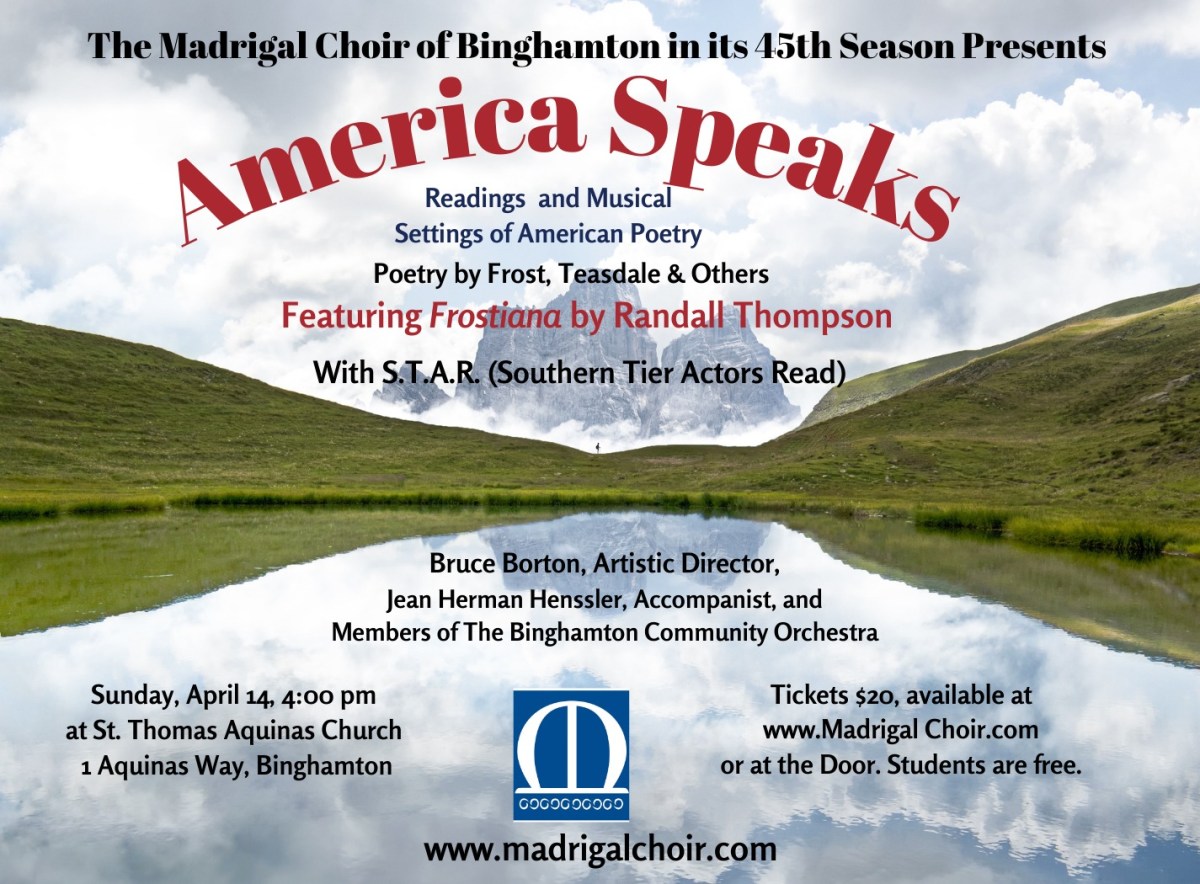
end of our 45th season

Yesterday, I sang with the Madrigal Choir of Binghamton as we closed out our 45th anniversary season, which had concentrated on American themes.

This final concert was called “America Speaks” and focused on American poets. In an interesting twist, the poems were read by members of S.T.A.R. (Southern Tier Actors Read) before we sang the settings based on the poems. As a poet, I’m accustomed to hearing poets read, but actors enunciate and emote much more than most poets. I especially love that this concert took place during National Poetry Month.

(As it happens, I will have the opportunity to hear “Some Time Else,” one of the poems from my chapbook Hearts, read by an actor affiliated with the Glimmer Globe Theatre at the Fenimore Art Museum in Cooperstown on Saturday as part of Write Out Loud 2024. Stay tuned for more information.)

The highlight of the concert for me was performing Frostiana, Randall Thompson’s setting of seven poems by Robert Frost, written to celebrate the bicentennial of Amherst, Massachusetts. We were accompanied by members of the Binghamton Community Orchestra, so we could appreciate Thompson’s skill as an orchestrator as well as a composer. I especially liked the flute’s imitation of thrush calls in “Come In.”

What was most special, though, was that our artistic director, Dr. Bruce Borton, was able to conduct Frostiana for the performance. He has been battling a serious illness and this was his only appearance at our concerts this season. I began singing under his direction in 1988, when he was at the local university as a professor and began conducting the Binghamton University Chorus, which I had joined in 1982. I first sang “Choose Something Like a Star,” the final piece in Frostiana, under his direction relatively early in his tenure, so it was especially poignant to sing it yesterday.

I managed not to cry.

I hope to sing for Much Ado in the Garden this summer and for our 46th season. I’ll post details as they become available.

Paul Goldstaub tribute concert

On January 31st, the Music Department of Binghamton (NY) University presented a concert of Professor Emeritus Paul Goldstaub’s music on the first anniversary of his death. It was wonderful to hear such an eclectic mix of Paul’s music, much of it performed by the musicians who had premiered it.

I found my mind going back to my own studies of theory and composition at Smith. At that time, we began our theory course sequence in a contemporary setting with the study of rhythm, timbre, and melody, before progressing in later semesters to common practice period harmony, counterpoint, and chromatic harmony. The concert opened with a fugue for 3 snare drums, which included some air drumming and left us wishing that we could have seen the score to see how Paul had notated it. The second half of the concert opened with Pastorale II for flute and digital delay, played by Georgetta Maiolo. I loved how it wedded wonderful melodic writing with contemporary technology, with the digital delay taking the place of what would probably have been done by tape in my student days.

I also appreciated that Paul wrote for so many different instruments and combinations. In the concert, there was a piece for trombone and piano and one for marimba and piano. Hindemith came to mind. The concert program included a full list of Goldstaub’s composition, arranged chronologically, which allowed us to appreciate the full scope of his range as a composer.

Paul’s inventiveness as a composer was on fullest display in the excerpts from Every Evening for baritone, a chorus of three sopranos, piano, and percussion duo. Before each movement was sung, the poem was read by Professor Emeritus Martin Bidney, who had translated them from Russian, into which they had been translated from the Spanish folk tradition. The settings that followed had an incredible richness of soundscape, including some pitched speech reminiscent of Sprechstimme, close harmony from the three sopranos, and dialogue between the baritone and varied combinations of the sopranos.

As a member of a chamber chorus drawn from the Binghamton University Chorus, it was my privilege to participate in the final piece on the program, the first movement of Shakespeare Mix, which Paul had written for us in 2002. Accompanied by two pianos and percussion, we sang from Twelfth Night, “If music be the food of love, play on.” As we finished, a photograph of Paul was projected on a screen beside the stage. As the ovation went on, it was good to know that we had all joined together that evening to make sure that Paul Goldstaub’s music does “play on.”