re-opening fears

Some of the states here in the US are re-opening stores, hair, salons, dine-in restaurants, recreation activities, and other businesses, even though they haven’t met the not-very-ambitious federal benchmarks to do so during the pandemic.  They feel safe enough because they are not large cities like New York City or Chicago and they don’t have thousands of new cases every day in their state – or are ignoring it if they do.

I’m afraid they are ignoring not only science but also the experience of my state, New York.

The health guidelines are that limited re-opening should not occur until a state has had two weeks of decline in the number of cases. The reason for the two week timeframe is that fourteen days is considered the maximum incubation period, although people can develop symptoms as few as two days after exposure. If numbers are declining for two weeks, it signals that the outbreak is under some measure of control, so careful resumption of some business and recreational activities can resume in conjunction with testing widespread enough to quickly detect a rise in cases, in which case stricter measures would be resumed until there was again a two week decline. Not only do the states that are opening not meet the two-week decline criteria but also they don’t have the testing capacity to quickly detect an uptick in cases.

The Centers for Disease Control and Prevention, in studying the virus’s path in the United States, now realize that the strain that has caused so much illness and death in New York came through Europe, not directly from China. This strain appears to be even more virulent than the strain that came to the western US directly from China. During the weeks when the administration was banning travel from China, thousands upon thousands of travellers arrived from Europe to NYC area airports, some of them bringing the virus with them. It’s now estimated that there were 10,000 cases in the NYC area before any were officially recognized as COVID-19; this explains why New York State has so many more cases and, unfortunately, deaths than other states. The virus was already wide-spread in an area with a high population density weeks before anyone realized it.

New York, through closing all but essential or work-from-home businesses and encouraging most people to stay at home except to buy needed supplies, has managed to bring down the number of new cases, hospitalizations, and deaths, although not yet for long enough to enter phase one re-opening of some businesses. Plans are being made for eventual re-opening with testing in place to make sure that things will not get so out of hand that our hospitals will be overwhelmed with critical cases. There is the very real possibility that, despite all the planning and precautions, we might have to reverse course and close down again if the numbers start climbing. Until there is a vaccine, it is unlikely we will be able to get the case number down to zero or resume large-scale gatherings.

It’s not that Governor Cuomo and other state leaders don’t want to open more of the economy. They do, but not at the cost of more debilitating illness and death. As a community, we are all responsible for trying to protect the health of others, especially those most vulnerable to complications and those who are working in health care, food service, delivery, transit, custodial, and the other essential businesses that have been continuing to serve throughout the pandemic and who have been getting sick at much higher rates than other New Yorkers.

Our state leaders are also acutely aware of those who are unable to work because of the restrictions in place. There is enhanced unemployment insurance in place, as well as emergency food, utility, health, and homeless outreach programs. They are refusing the false dichotomy of illness/death or the economy, trying to prioritize health and life for everyone so that we are healthy to re-build our economy.

There are some New Yorkers and some folks in other states who are claiming that they have a right to be anywhere they want and do anything they want and that government has never interfered in people’s lives like this. They are overlooking that with our rights, both political and human, come responsibilities. The individual has the right to risk their own health, for example by drinking alcohol, but with that comes the responsibility not to harm others through violence or driving drunk. National and state governments have taken action to protect the public health in prior epidemics, such as the 1918 flu pandemic and the waves of polio that afflicted the world before the development of the vaccine. As I am fond of pointing out, in the Preamble of the Constitution, we the people of the United States established our national government to “promote the general welfare.” Each person has that responsibility to all the others. While some may have fallen into the illusion that individual freedom entitles them to do whatever they want, our system has always been a social one. One person’s freedom can’t interfere with others’ well-being, at least, not without challenge.

As I watch the news of opening of businesses in other states and see people in large gatherings without personal protection, I worry that, within a couple of weeks, there will be coverage of spikes in cases, more hospitalizations, and more deaths, especially because some of the states have re-opened with major outbreaks in factories, nursing homes, and prisons, as though those cases won’t spread beyond facility walls. Maybe the strain they have circulating is not the more virulent one we have suffered with in New York.

Or, maybe, our collective burden of sorrow will be increased, knowing that learning lessons from New York’s experience could have saved heartbreak and lives, if only people had heeded them.

“The Time Is Now”

Shortly before the spirituality class that I facilitate went on indefinite hiatus due to the pandemic, we finished our study of The Time Is Now:  A Call to Uncommon Courage by Joan Chittister, OSB. It was published in March, 2019 in response to the signs of the times.

The book deals with the characteristics of prophets, using examples from biblical times up through the present. While some think of prophets as people who tell us our future, prophets are not fortune-tellers. They are more often those who speak hard truths to draw the community back to its original ideals when it has strayed or who call for growth and positive change in times of selfishness or apathy.

As we studied the book week after week, we often drew parallels between the text and things we were experiencing in the present. These parallels have become even more evident now that the world is dealing with the pandemic.

We see examples of prophetic voice and action, such as Doctor Li Wenliang of China, who in early December alerted colleagues to cases of what appeared to be a new virus, only to be detained by police for several days for “spreading false rumors.” After his release, he went back to work at the hospital. He contracted COVID-19, sent out another medical alert online, and died from his illness in early February. He acted as a prophet in giving warning of danger and was maligned by authorities and ignored, as often happens with prophets. As sometimes happens, he also became a martyr, with his death serving as stark testament to the truth of his message.

Sister Joan calls us to look at what is happening around us and to stand up for truth, whether that means being a prophetic voice ourselves or standing in solidarity with those who are prophets, speaking truths that are considered threatening by the powers that be. We have seen this recently in the United States where some of the governors have been belittled by the president for their science-based and prophetic public statements about the present and likely future effects of COVID-19 in their states. New York State, where I live, is the epicenter of the outbreak in the United States and our governor, Andrew Cuomo, gives daily public briefings. He is very straightforward and makes it clear what is evidence-based and what is his opinion. It is very upsetting to have the president disparage him – and even more upsetting that the president contradicts the science and facts because he thinks it makes him look weak or bad personally.

It is time for all of us to have the courage to follow the prophetic voices or, if so called, to be a prophetic voice ourselves.


SoCS: looking for meaning

I, along with millions of others, am searching for a deep, inner meaning in these troubled times.

I’m fortunate to be affiliated with a number of organizations that center on social and environmental justice. While these organizations are working on ways to help in the immediate circumstances, they are also looking forward toward lessons to take away from these times and ideas to transform our social systems to better support people and the planet in the future.

Here in the United States, it is easier than ever to see the impacts of income inequality. So many people don’t earn enough to have any savings cushion at all that the sudden loss of work immediately puts them at risk of hunger and/or homelessness. As we rebuild our economy in the coming months/years, I hope the US will finally institute some kind of living wage protocol so workers can afford to live a dignified life and support their families, with some ability to save for future needs. We also need a stronger social safety net to help people who, due to age, health status, location, caregiving responsibilities, etc., are not able to have paid work.

At the moment – and for decades before now – the United States has had economic policies that have favored business owners and stockholders over the rest of the population. Money is taken to be a form of free speech and politicians have been showered in money by the powerful. Many of them are representing these monied interests more so than their human constituents. As we take stock of the pandemic and post-this-particular-pandemic world, we need to return to the founding principle that government exists to “promote the general welfare.” (That’s from the preamble of the US Constitution, for those not familiar with the phrase.)  It’s also often called working for the common good.

Scientists have noted how much clearer the air is, especially in major cities. With people in many countries staying at home and with a large number of businesses shut down, there are a lot fewer emissions that cause air pollution and that add to the climate crisis. Those of us who have been working on climate issues have been hearing for years that there isn’t political will to change our lifestyles to cut carbon for the sake of the planet, but the pandemic shows that our world can mobilize on a large scale – and quickly – to change business as usual. Obviously, emissions will rise when more businesses are able to re-open, but, perhaps, the pandemic will lead to some permanent changes that will keep emissions lower than what had been the status quo. Perhaps some employees will work from home most days of the week, coming together physically only on certain days to better work out solutions to problems. Maybe there will be less business travel in favor of teleconferencing. Maybe the reorganizing of the economy will include more local/domestic manufacturing and food production to cut down on shipping and boost supplies. Maybe the US will follow the lead of Europe and use this juncture to institute a “green deal” that promotes both climate/environmental and social justice causes.

So many possibilities.

There is a lot of work that many are doing to meet the immediate needs of people in this time of pandemic and I commend all of them for their deep sense of duty and service. I also appreciate those who are able to analyze the past and the present and use those insights to help us prepare for the future. If we are wise and brave, we will build a safer, better, sustainable, and dignified life for all living beings and our planet.
*****
Linda’s Stream of Consciousness Saturday/A to Z prompt is “deep.” Join us! Find out how here:  https://lindaghill.com/2020/04/03/the-friday-reminder-and-prompt-for-socs-april-4-2020/

2019-2020 SoCS Badge by Shelley!
https://www.quaintrevival.com/

charting a pandemic path

Around the world, most of us are sharing in the battle to limit the damage from COVID-19 to the extent possible.

In some places, the path is proscribed by local or national government and there are not a lot of personal decisions to make.

Here in my county in upstate New York (USA), things are not laid out as clearly. I have been trying to prepare and make plans, but circumstances keep changing – and so must the plans. Our state and local governments and community organizations have been much more proactive than the federal government, but, as more and more cases are diagnosed closer and closer to where I live, additional measures continue to roll out.

Over a week ago, I started the general preparedness guidelines to have a couple of weeks of food and medications available in case we had to self-isolate. This was not a big deal for our house, but I have been much more concerned about preparing things for my dad, known here as Paco. He lives in a senior community in an independent living apartment, so he has a number of services available in-house, but I visit every day to check on him, make sure his medications are all organized and his schedule is laid out, etc. Early last week, a sign went up that people who were having any symptoms of illness should not visit. This is practical and a commonsense precaution that I would follow anyway, but, later in the week, the health care part of the center was closed to all visitors, except those whose loved one is in very grave condition. This meant that Paco could no longer go over to concerts and singalongs held in the health care facility. At the same time, they cancelled activities in independent living that involved outside performers or volunteers. For example, the Irish dancers would not be able to come for a scheduled pre-St. Patrick’s Day performance.

At this point, I had to face the probability that even healthy visitors might not be able to visit independent living at some point, so I started making contingency plans that could be carried out reasonably well without me. Sadly, we’ve had to cancel a planned visit from my sisters and their families to celebrate Paco’s 95th birthday later this month. They all live in areas where the virus is more prevalent and we didn’t want to risk them bringing it with them, given that they might not have obvious symptoms.

Thursday night into Friday, several large employers announced that they would be having most of their employees work from home starting on Monday. The universities had also announced that they were moving most of their instruction online for several weeks or the rest of the semester. Professional sports leagues announced they were suspending or delaying their seasons. Some combination of these functioned as a trigger that caused some people who hadn’t been taking the virus very seriously to spring into action – or, at least, into shopping. I went to my favorite grocery store to pick up a few things for Paco and for my household and was surprised to find that there was almost no peanut butter, canned legumes, frozen vegetables, etc. in the store. And I hadn’t even checked the cleaning supplies and paper goods aisles. The evidence of panic-buying took me by surprise. Given that I had been in concern and preparation mode for days, I had obviously underestimated the number of people who were suddenly paying attention and freaking out a bit.

On Saturday, the county executive announced that all primary and secondary schools will close through mid-April. Now, people are even more upset.

It appears that there are some people who still think that fears of the virus are overblown, given that we have no known cases in our county, even though our neighboring counties do have confirmed cases; they don’t want their personal and family routines disrupted. Others have been following the news and the advice of medical experts and realize that, while we can’t stop the virus completely, there will be fewer deaths and more treatment available to those with severe illness if we can spread out the number of cases over a longer period of time, so as not to overwhelm our medical system. The way to do that is to reduce the number of people who are in close contact and in large groups, also known as social distancing.

There are a number of different opinions about how much distance is required and how many is considered too many to be in a crowd. This leaves some situations to personal discretion. I admit that I had a difficult time figuring out what to do about church attendance this weekend. Our diocese has dispensed with our obligation to attend mass, but services are still being held. I am not especially concerned about my getting seriously ill, but I am concerned with the possibility of bringing the virus into Paco’s community, so I’ve decided to participate in a mass on television. At least for now, I plan to still shop. occasionally eat at restaurants, and attend small gatherings with friends. If we start seeing community spread in my town, though, I’d cut back further. If we get to that point, I’m sure I wouldn’t be able to visit Paco; it’s likely that only residents and staff would be allowed in the building.

I admit that it is disconcerting to know that, despite our best efforts, people are going to continue to get sick, some of them severely sick, and some of them will die. I hope that our communities will face up to this challenge and do as much as we can to protect people, especially the most vulnerable.

Be well. Be kind. Be thoughtful. Be considerate.

attack of the woodpeckers

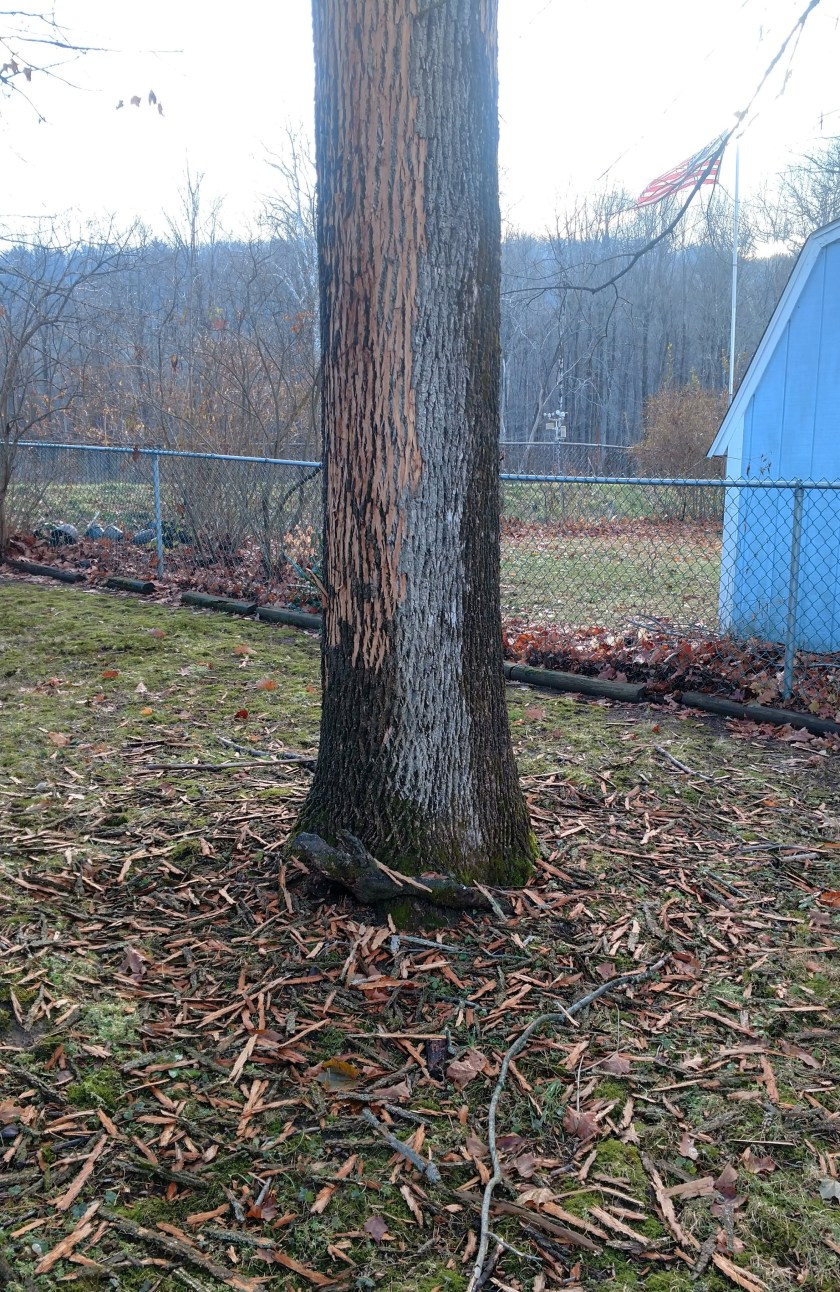
We have an ash tree in our backyard. When we looked out the window the other day, some of the bark on either side was badly scraped. At first, we thought maybe a bear had been climbing it.

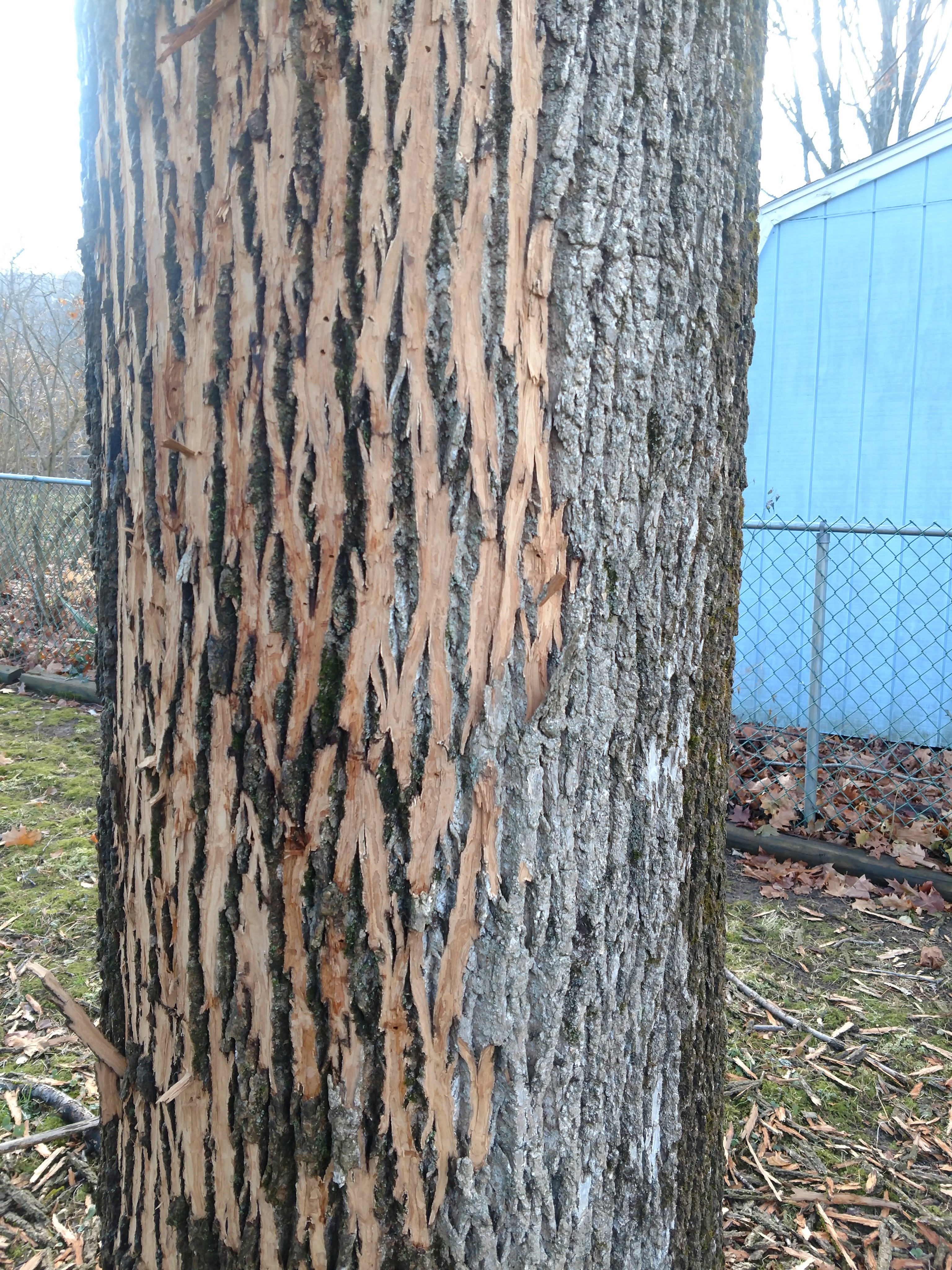
Then, a piece of bark dropped down from higher up the trunk and we saw a pileated woodpecker, pecking assiduously and creating more places with almost no bark left. Although the pileated woodpeckers are far and away the largest, there are hairy and downy woodpeckers joining the party, too, creating an ever-growing patch of stripped bark on the ground.

Obviously, the tree is very sick. The wood underneath is spongy instead of hard and woodpeckers generally can’t strip bark like they have been here. We have called a tree service to evaluate, but it seems to fit the signs of infestation by emerald ash borer.

ash tree
the base of the tree with bark shards on the ground
img_20191124_153209832
Close-up of the damage

We had hoped the tree would be spared because the immediately surrounding trees are not ash, but adult insects can travel about half a mile from their source, so it was probably inevitable.

Ironically, we were getting ready to call the tree service to look at one of our maples, which seems to be dying back and may have verticillium wilt, which is caused by a soil fungus. There is a second maple that is very close to the ash tree which may need to be removed as well. It’s possible that all three of the mature trees closest to our house on the south side may be cut down, which is not good news on the air conditioning front, although our new heat pump will decrease our cooling costs a lot compared to our old central air unit. It may mean though, that we can get enough sun to grow small trees, shrubs, and flowers. We used to have a vegetable garden in the backyard, but it became too shaded. (It also got eaten by groundhogs who could easily climb the fence around the garden, but that is another story.) We may also have less moss in the yard, although I prefer more wildflowers instead of more grass.

It could also mean that we have to re-landscape on all sides of our house, given that our front and side yards are torn up from the drilling and burying of the outdoor part of our geothermal system. Given that we have had cold weather earlier than usual this year, we may have to wait for spring.

One-Liner Wednesday: fear and understanding

“Nothing in life is to be feared, only understood.  Now is the time to understand more so that we may fear less.”
~~~ Marie Curie
*****
Please join us for Linda’s One-Liner Wednesday! Find out how here:  https://lindaghill.com/2019/11/06/one-liner-wednesday-essential/

Badge by Laura @ riddlefromthemiddle.com

One-Liner Wednesday: Nobel!

Congratulations to Dr. M. Stanley Whittingham on your Nobel Prize in Chemistry for your work on lithium-ion batteries!
~~~ in appreciation of Professor Whittingham, who lives in my hometown, and teaches and conducts research at Binghamton (NY) University
*****
Please join us for Linda’s One-Liner Wednesday! find out how here:  https://lindaghill.com/2019/10/16/one-liner-wednesday-hey-this-is-fun/

SoCS: hole in the ground

For the last three days, there has been a crew in our front yard drilling a 500-foot hole in the ground. That’s about 150 meters for all you people who live in the metric world, which is almost everyone except the US…

The reason for this is not to find water, which happened well before they hit rock at 80 feet. Instead, this very deep hole is to install a geothermal heating and cooling system.

I’m excited because, after the new system is in, we will be able to permanently disconnect our house from the methane supply system. Our cooling costs will also be much lower because geothermal systems are much more efficient than the typical central air conditioning unit.

I will be glad not to be using any fracked gas which has caused so much trouble for our PA (Pennsylvania) neighbors and the climate. We will also helping to support the New York State version of a “Green New Deal”, moving to renewable energy in a way that is supportive of impacted workers and communities.

At the moment, though, we just have a very deep hole in the ground with two tubes coming out of it – and a very, very muddy, messy yard.
*****
Linda’s prompt for Stream of Consciousness Saturday this week is “ground.” Join us! Find out how here:  https://lindaghill.com/2019/10/11/the-friday-reminder-and-prompt-for-socs-oct-12-19/

Climate strike – part two

Friday, September 27th was the last day of the Climate Action Week that featured youth-led marches, rallies, and work/school strikes around the world. As happened around the world, there was an opening event last Friday in Binghamton, with a larger event scheduled for the closing day.

This event was held at the Peacemaker’s Stage near the confluence of the Chenango and Susquehanna Rivers. We began with a welcome from the University student-organizers, who recalled that we were on land of the Onondoga Nation, who have endured centuries of broken treaties and environmental assault. This continued the emphasis on social/environmental justice as an integral component of climate action.

The climate movement in the United States is being energized by youth and indigenous leadership. At the Binghamton rally on Friday, there were speakers from the local high school and university, as well as young adults from Citizen Action and local government, either as city council members or candidates. There were people on hand to register new voters or process address changes for those who have moved to be ready for the local elections coming up in November.

Some of the speakers were people of color. Amber, from Citizen Action, reminded us that we bring our personal and community heritage with us, as well as our efforts toward treating everyone with equal dignity. It reminded me of what Pope Francis in the encyclical Laudato Si’ calls “integral ecology” and what I personally experience.

While I am following the science on climate change, I am also taking into account the ethics involved. Because of my Catholic faith, I see the situation in terms of social justice doctrine, which calls for care of creation and of others, especially the most vulnerable. People of color, people of lower socioeconomic standing, indigenous peoples, women, the elderly, babies and children, and people with illnesses are more affected by environmental degradation and climate change, so they merit special support in our efforts.

Amber and other speakers reminded us that all our efforts are connected. You don’t leave your efforts toward combating racism, sexism, poverty, violence, etc. when you are talking about climate and other environmental problems. All of these are justice issues; they are interconnected and the solutions need to take the whole spectrum of humanity and nature into account.

Besides the speakers, the event featured tables set up by different organizations. It was good to have a space for the youth organizations to meet up with the older, established local organizations. It will make it easier to coordinate efforts and initiatives. Next Sunday, there will be a planning meeting open to everyone to keep the momentum going.

There is a lot of work to do. Let’s get to it!


Climate Strike!

The day after I wrote this post lamenting the lack of a local climate strike action, I got an email from a local climate champion saying that there would be an event in Binghamton on Friday, the day that millions of people took part in thousands of actions around the world.

We met in front of the building that houses Senator Schumer’s office. As Senate minority leader, he is our most influential representative in Washington. In keeping with the youth leadership of climate strikes, this was organized by local university students, with lots of energy coming from the students who gathered. There were also a number of allies, many of whom were veterans of the fight against fracking in New York State.

I was pleased to be able to attend and lend support and happy to be part of three generations in my family there. Daughters E and T were both there; granddaughter ABC, at two years old, was the youngest attendee. Several people commented that we were gathered there for climate action for her and her generation, so that they will have a livable planet.

Our climate strike event on Friday was very grassroots, with the co-organizers speaking and then offering the mike to anyone that wanted to speak. Next Friday, September 27th, will be a larger and more formal event with several local organizations as sponsors, featuring speakers, music, tabling, and food. I hope to be able to attend that, too.

There is a lot of work to do in order to keep global temperature rise in check, so much that it often seems impossible, but I am more hopeful than I have been for a while. With young people around the world rallying and demanding action, maybe national leaders will finally find the political will to make a rapid and just transition to a sustainable, though still damaged, world.