a pandemic paradox

Over the past several years of spending a lot of time as a caregiver, I’ve valiantly tried to cut down the size of my email inbox, which is often overflowing with news, newsletters, and calls to action from various charitable, social justice, and environmental causes, along with personal and poetry-related emails. Even with my diligent attempts, I routinely handle over a hundred emails a day, which is still a lot, so I am unsubscribing from even more email lists and trying to avoid signing too many petitions which lead to my being on even more lists.

Paradoxically, as we have been avoiding in-person meetings over these last months, my inbox is full of invitations to connect via Zoom or Go to Webinar or some other platform. Instead of having fewer demands on my time, there seem to be more.

I can’t keep up.

In order to create some semblance of order, I’ve decided to narrow the selection of online events that I will accept. Of course, I will continue with my local poetry circle, which I call the Grapevine Group after the cafe where we used to meet pre-pandemic. I am also looking forward to the five-week summer session of the Binghamton Poetry Project, which, for the first time, is breaking into a beginner and a more experienced section. I am also signed up for six summer sessions with a local spirituality center that has had to re-convene virtually rather than offering in-person programs and retreats.

Beyond that, I plan to accept a very limited number of educational/advocacy meetings on social/environmental justice to keep informed and to take directed action. I am heartened by the increasing convergence of climate/environmental justice with racial/economic justice and want to advocate for effective change.

Beyond that, I hope to say “No” and continue to unsubscribe so that I have more time to accomplish what I need to and respond to ever-shifting circumstances.

(She writes, hoping she can actually manage to do so.)

June birthdays

Already this month, my younger daughter T turned 30 and my granddaughter ABC turned 3.

This is simultaneously wonderful and terrifying.

I am very concerned for their future, the future of all young people, and the planet.

When I was thirty, I was at a home that we owned with two young daughters and a spouse whose job supported us all comfortably and enabled us to save for the future. T and her Millennial friends do not have anything approaching that kind of economic security. Even if they are well-educated and skilled workers, most available jobs don’t pay enough to live on, even as a single person, much less a family. The pandemic and ensuing economic collapse have made matters worse and it is unlikely that recovery will be rapid. The best case I can hope for is that this economic and health catastrophe will re-set priorities and policies so that economies and governments serve the common good and recognize human dignity.

The pandemic taught us an important lesson. Those who were hit hardest – people of color, low-income communities, the elderly, and those with complicating medical issues – were also those who were already being ignored or discriminated against. The death of George Floyd, the killing of yet another unarmed black man by police, underscored the racism still in evidence in the United States, a message that has resonated around the world, as white people have been examining their behavior toward people of other races in their countries, too.

Women who are my age (almost 60) shake our heads in disbelief that so much discrimination and harassment and belittling of women and girls still exists. I am sad that our fight for equal rights is not yet won and now falls onto the younger generations as well.

Over all of this, lies an atmosphere so polluted with excess carbon dioxide, methane, and other greenhouse gases that the levels are higher than they have been at any time in human history. The consequences of that are far reaching and serious, the efforts thus far to address it wholly inadequate.

While I have been in stay-at-home mode because of the pandemic, I have been deluged with opportunities for webinars, a number of which are looking at a path forward from the current massive disruption of “business as usual.” It is heartening that so many are looking to #BuildBackBetter, looking at structural change that addresses climate change, pollution, racism, income inequality, sexism, all manner of discrimination, and the call to honor human dignity. I have become accustomed to linking human welfare with planetary welfare, articulated so well five years ago in Pope Francis’s encyclical Laudato Si’: On Care for Our Common Home. This follows the tenets of Catholic social justice doctrine and has been my basis for activism, looking for systemic ways to address problems and injustice holistically, rather than trying to rectify a problem narrowly, which could inadvertently cause adverse effects. (There are specific instances that can be addressed with a narrow solution, but systemic change can solve many smaller problems more completely and rapidly.)

If this truly is a pivot point in human history, perhaps we can work together and construct a new way of living which respects all life and the planet, as well. That would give me hope for T’s generation, for ABC’s generation, and for the generations to come. The work will be difficult, but it is what is called for at this critical moment in history.

JC’s Confession #13

In the first few seasons of The Late Show, Stephen Colbert did a recurring skit, now a best-selling book, called Midnight Confessions, in which he “confesses” to his audience with the disclaimer that he isn’t sure these things are really sins but that he does “feel bad about them.” While Stephen and his writers are famously funny, I am not, so my JC’s Confessions will be somewhat more serious reflections, but they will be things that I feel bad about. Stephen’s audience always forgives him at the end of the segment; I’m not expecting that – and these aren’t really sins – but comments are always welcome.

JC

I haven’t gone to a march or demonstration against racism since the murder of George Floyd.

This is something I absolutely would have done pre-pandemic. I know many at-risk people have chosen to participate because of the importance of the cause and the present moment’s possibilities for progress on human rights, trying to fulfill the call for justice that has been so long denied.

Still, I can’t bring myself to attend a public gathering, knowing that I will be seeing my 95-year-old dad and possibly some of his senior-community neighbors in the coming days. I always wear a mask, but I’m not comfortable having any more exposure to people than I absolutely must in order to function as a household.

On the day of George Floyd’s funeral, there was a brief ecumenical gathering to kneel for 8 minutes, 46 seconds in his memory. While I stayed at home, T attended, so our household was represented. The gathering was outdoors, it was sunny and windy, T wore her mask, and people spread out as best they could, so it’s unlikely she was exposed.

Still, it feels odd to not have a physical presence myself at this crucial time. I will try to be content with my efforts to educate myself and keep updated online and through the media, as well as to pursue lobbying and advocacy opportunities with the social justice organizations with whom I have relationships.

I also have my platform, however small, here at Top of JC’s Mind. Every voice, every action, adds something to what must, finally, this time, be permanent changes in the US and the world.

Where am I?

Yesterday, June 1, 2020, was one of the darkest and most frightening days of my almost sixty years as a citizen of the United States.

President Trump is pressuring governors to use the US military against protesters in their states and is threatening to use the military, beyond the National Guard which is under the jurisdiction of each governor, within the states if the governors refuse. To do this, he would have to invoke the Insurrection Act, which, in the rare instances in which it has been used, has only been applied to a small, specific area for particular isolated incident. If the president tries to invoke this act across different states and regions, is he surmising that a widespread insurrection is underway? The Cambridge Dictionary defines insurrection as “an organized attempt by a group of people to defeat their government and take control of their country, usually by violence.” This is not at all what is happening. Even if you add civil unrest as a possible cause, the vast majority of the country is seeing non-violent protests, which are within our rights to free speech and assembly. The limited amount of violence and destruction/theft of property are matters for local law enforcement, sometimes aided by the state’s National Guard, if the governor sees fit to use them.

The president seems to think that his bravado makes him look strong, but the opposite is true. His resorting to such threats shows how weak he is as a leader that he cannot talk to the nation to calm the situation and take effective action to address the injustices that have so many millions across the country taking to the streets.

The most horrifying part of yesterday was that the area near the White House was cleared of protesters so that the president could go to a nearby church for a photo op. These protesters were non-violent and the curfew had not yet taken effect when they were attacked with teargas, concussion grenades, rubber bullets, and physical violence. Clergy and volunteers who had been offering water, snacks, and assistance to the protesters throughout the day were also driven from the area.

These actions ordered by the president violated the free speech and freedom of assembly rights from our Constitution, as well as interfering with the religious expression of those who were there to serve others to fulfill the calling of their faith. The president also did not inform the clergy of St. John’s or the Episcopal Bishop Mariann Budde that he would be clearing the church grounds and using their sacred space for a photo op. Rev. Budde and other Christian faith leaders have objected to the president’s actions and rhetoric, pointing out that he is espousing views antithetically opposed to the tenets of Christianity.

Donald Trump has no moral authority whatsoever. He says that he wants “law and order” while himself violating the Constitution that he has sworn to uphold.

I am afraid of what will come next. I don’t have a vivid enough imagination to envision what will happen beyond the pandemic, injustice, and widespread suffering we have all around us.

We need competent and compassionate national leadership as soon as possible. There are millions of us all over the country ready to embark on the gargantuan task of building back a country worthy of our highest ideals of equality, unity, peace, and community.

JC’s Confessions #12

In the first few seasons of The Late Show, Stephen Colbert did a recurring skit, now a best-selling book, called Midnight Confessions, in which he “confesses” to his audience with the disclaimer that he isn’t sure these things are really sins but that he does “feel bad about them.” While Stephen and his writers are famously funny, I am not, so my JC’s Confessions will be somewhat more serious reflections, but they will be things that I feel bad about. Stephen’s audience always forgives him at the end of the segment; I’m not expecting that – and these aren’t really sins – but comments are always welcome.

JC

I don’t miss going to church.

I’m writing this after being unable to attend in-person mass for two and a half months due to the COVID-19 pandemic. I have been watching a pre-recorded mass on television and often reading a homily from the Catholic Women Preach website. These are good resources, but I feel more like an observer than a participant. Obviously, there is no opportunity to receive communion, which is a very important part of Catholic practice.

I should interject that there has never been a time in my life when I haven’t gone to church every weekend. For many years, I was involved in music ministry and liturgy planning. I am also a long-time advocate for church reform, including the ordination of women, the recognition of equality among the laity and clergy, and the model of servant-leadership. In 2005, my parish home was shattered due to abuses of power. Those wounds have never healed, but I still continued participating in mass, even though I would sometimes cry – and sometimes feel that I could write a more thoughtful homily than the one I heard in church.

Perhaps, being an isolated home observer feels safer than being in the midst of a congregation when I get emotional. It’s also unlikely that televised mass will plunge into fraught topics, so there is a certain level of safety that doesn’t exist when you are in the pews.

Some church congregations or groups have taken to meeting via Zoom or other kinds of video conferencing during the pandemic. The congregations that I know that have done this are much smaller, though, so there is opportunity for interactions, such as offering prayer petitions. There are well over 1,000 families in my parish here, which makes meaningful videoconferencing impractical. Some of the church reform groups with whom I affiliate are offering prayer services, which is appealing in concept, but I worry that participating would make it even more difficult to remain within the institutional church. Leaving has been a decades-long temptation for me. [There is not enough room in this post to explain that struggle. Maybe, someday…]

I received a letter from my parish, explaining that this weekend they will begin celebrating mass under a new protocol. The priest will livestream weekend masses so that people can see and hear it on their phones or other wifi devices from the church parking lot. At communion, several Eucharistic ministers will zigzag through the parking lot, stopping at each car so that its occupants can come out and receive communion and then get back in their cars so that they won’t be near to anyone else.

This scenario does not appeal to me. I worry about the risk to the Eucharistic ministers, who will be in close contact with dozens of people, albeit outdoors. Other than being able to receive the Eucharist, the participation quotient is about the same as watching a televised or live-streamed mass, other than being in your car in whatever weather that day offers instead of in your home.

The root meaning of the word liturgy is “the work of the people.” To me, the current methods of celebrating liturgy at a distance feel more like watching a performance. I don’t know if I will adjust to this over time or not. I also don’t know if, many months from now when larger gatherings with singing are reasonably safe to attend, it will be difficult for me to muster the energy to leave my home and be in the midst of people and all the uncertainties that involves.

I don’t know and it makes me sad.

a very different Mother’s Day

Today in the United States, we are observing Mother’s Day, which was originally begun as a call by women for peace, but that is another story.

I have been dreading Mother’s Day this year because it is the first since my mom’s death last May.  She was under hospice care in the nursing home, but we were still able to be with her and bring cards and flowers and treats. I keep thinking about how different it would have been this year with pandemic protections in place. No visiting is allowed. I know that is necessary to keep the virus away from such vulnerable people, but it must be so difficult today for all those moms, grandmothers, and great-grandmothers to be separated from their loved ones.

I am grateful to have daughter T here with us. We got to videochat with daughter E and granddaughter ABC. ABC showed me a special drawing that she and her dad had made for me for Mother’s Day. They were able to scan it and B printed it for me, so now it is on the mantel. It was fun to see ABC dancing about the living room, to hear her sing and “play” the piano, and hear her ever-expanding vocabulary. She will turn three next month. This is also the first Mother’s Day since they moved to London after E’s spousal visa finally came through. Though I wished E a happy Mother’s Day, the UK celebrated weeks ago.

It has also been unseasonably cold here. We have had snow this weekend, which is late in the spring for us. No outdoor flowers for Mother’s Day gifts this year!

Because of my mood and the pandemic restrictions, our celebration here will be low-key. B made Chelsea buns for breakfast, which were amazingly delicious and hot-from-the-oven. For supper, he is making lasagna, using the recipe that my mom always did. It is definitely the comfort food that I need today.

It was also comforting to watch mass recorded from television. The one I chose was my mother’s favorite when she was homebound for so many months. Of course, they mentioned Mother’s Day and included prayers for mothers. It was another way to remember my mom on this special but difficult day.

a package!

Like many other places during this pandemic, our stores have been out of yeast for weeks.

I usually keep a jar of bread machine yeast in the refrigerator. Besides using it in the machine, B sometimes uses it to make treats like Chelsea buns. As my jar was running low, every time I went to a store, I would check to see if I happened to catch a new shipment coming in, but either my timing was never right or there wasn’t any in the warehouses to send to the stores.

I decided to look online. I couldn’t find any jars or packets, but finally found a one-pound bag of Fleischmann’s instant yeast. I wasn’t used to the term “instant yeast” but apparently it is the same as rapid-rise or bread machine yeast. The yeast is sourced from Canada, so perhaps instant yeast is the term most often used there.

It took over a week to arrive, but now we should be supplied for a long time, given that this bag is equivalent to four of the jars I usually buy.

The pandemic has changed my perspective of time so much. I admit to thinking maybe this yeast will last until we have a vaccine available to the public so that the pandemic will be well and truly over.

Of course, this won’t be a miracle like the story of Elijah and the widow in 1Kings 17, where the flour and oil did not run out until the drought was over, but it does symbolize to me that same sense of perseverance, that call to not be afraid while we wait, watch, and work for better times.

the later verses

For some reason, yesterday the topic of the later verses of songs to which many know only the first verse well came up a couple of times. In a Binghamton Poetry Project session, we read Ada Limón’s poem “A New National Anthem” which quotes from and asks why we don’t sing the third verse of the “Star-Spangled Banner”. Last night, I was discussing the hymn “Amazing Grace” with a friend; I relate much better theologically with the ending verses than the opening ones, which are the ones most people recognize.

Although I am Catholic, much of my training as an organist was in a Protestant context. Unlike most Catholic churches, which often sing only two or three verses of a hymn, Protestant churches usually sing all the verses, which, as a poet and a liturgist, I find more proper. I sometimes choose a hymn specifically for a message in a later verse. I did this in choosing hymns for my father-in-law’s funeral, only to have the substitute organist truncate the hymn so we never got to verses that were connected to the occasion. I noticed the pastor giving a sidelong glance at the organist, but he didn’t take the hint.

Some of my favorite verses of hymns are later ones. In Katharine Lee Bates’ “America the Beautiful”, I especially like the end of the second verse/stanza: 
America! America!
God mend thine every flaw,
Confirm thy soul in self-control,
Thy liberty in law!
We could really use some of that self-control these days. Interestingly, in researching the poem, I found that the version most of us know is the 1911 revision. The original 1893 version ends the third stanza with:
America! America!
God shed His grace on thee
Till selfish gain no longer stain,
The banner of the free!
We could really use that message now, too.

Sometimes, later verses are just fun because you get to sing words that your would not otherwise. For example, the second verse of the standard version of the United Kingdom National Anthem “God Save the Queen” which deals with the Queen’s enemies contains the lines “Confound their politics, Frustrate their knavish tricks”. It’s not often one gets to sing about “knavish tricks”!

Sometimes, especially in folk/protest songs, verses are included, excluded, or altered due to political circumstances or the audience. Woodie Guthrie’s original lyric of “The Land Is Your Land” contains a verse about private property and ends with a verse about hunger that closes “As they stood hungry, I stood there wondering if this land was made for you and me.” Most people are familiar only with the verses that are a US travelogue, not these more challenging ones.

There are some hymns, such as “Sing a New Church” by Delores Dufner, OSB, that I love all the verses so much that I will sing omitted verses to myself if we don’t get to sing them all during the service.

My first college choral conductor, Rob Kolb, taught us that the hymn is the poem which is the text, as opposed to the tune, which is interchangeable with another of the same metric form. Because the hymn is the poem, you sing it as you would recite it, with its punctuation and word emphasis intact. You also honor the hymn as an entity, so you sing all the verses, as you would read or recite all the stanzas of a poem.

Some lessons stick with you for life.

Is it Easter yet?

In my religious tradition, Easter is about joy and light and hope.

Easter this year does not feel like that.

I was trying to get ready for Easter by viewing this series for Holy Thursday, Good Friday, and Easter Vigil. They were beautiful videos and being able to watch them alone was helpful. I spent decades involved with church music and/or liturgy planning, so I have many wonderful memories of those liturgies. They are very emotional for me. Even if we had been able to celebrate at our church, though, I probably would have chosen not to attend because I would have been at risk for crying through them. At this time last year, we were in the last few weeks of my mother’s life, so this is another in the long line of “first times” we have been dealing with over these last months. In some ways, it felt appropriate to be commemorating at this time alone.

Easter Day itself was complicated by some upsetting things that happened with family and friends beyond our household. It is difficult to want to help but not be able to do anything, or even to go to see them. Instead of Easter joy, there was a lot of sadness. pain, and uncertainty. One bright spot was watching Mass recorded at our diocesan cathedral. I decided to watch because our bishop is relatively new and I hadn’t heard him preach yet. I  appreciated how pastoral he is: Pope Francis has been appointing bishops who have more pastoral experience rather than just those who have worked their way up through the bureaucracy. It was also nice to hear the cathedral’s pipe organ, two great soloists, and trumpet. I especially appreciated the soprano singing the Mozart “Alleluia” that daughter E had sung for her college auditions.

This Easter Monday has been spent trying to work through some of the complications that arose yesterday. In the back of my mind, I am also thinking of my parents, who were married on an April Easter Monday, though that year Easter Monday was not the thirteenth.

It was 66 years ago and the first time that they won’t be celebrating together.

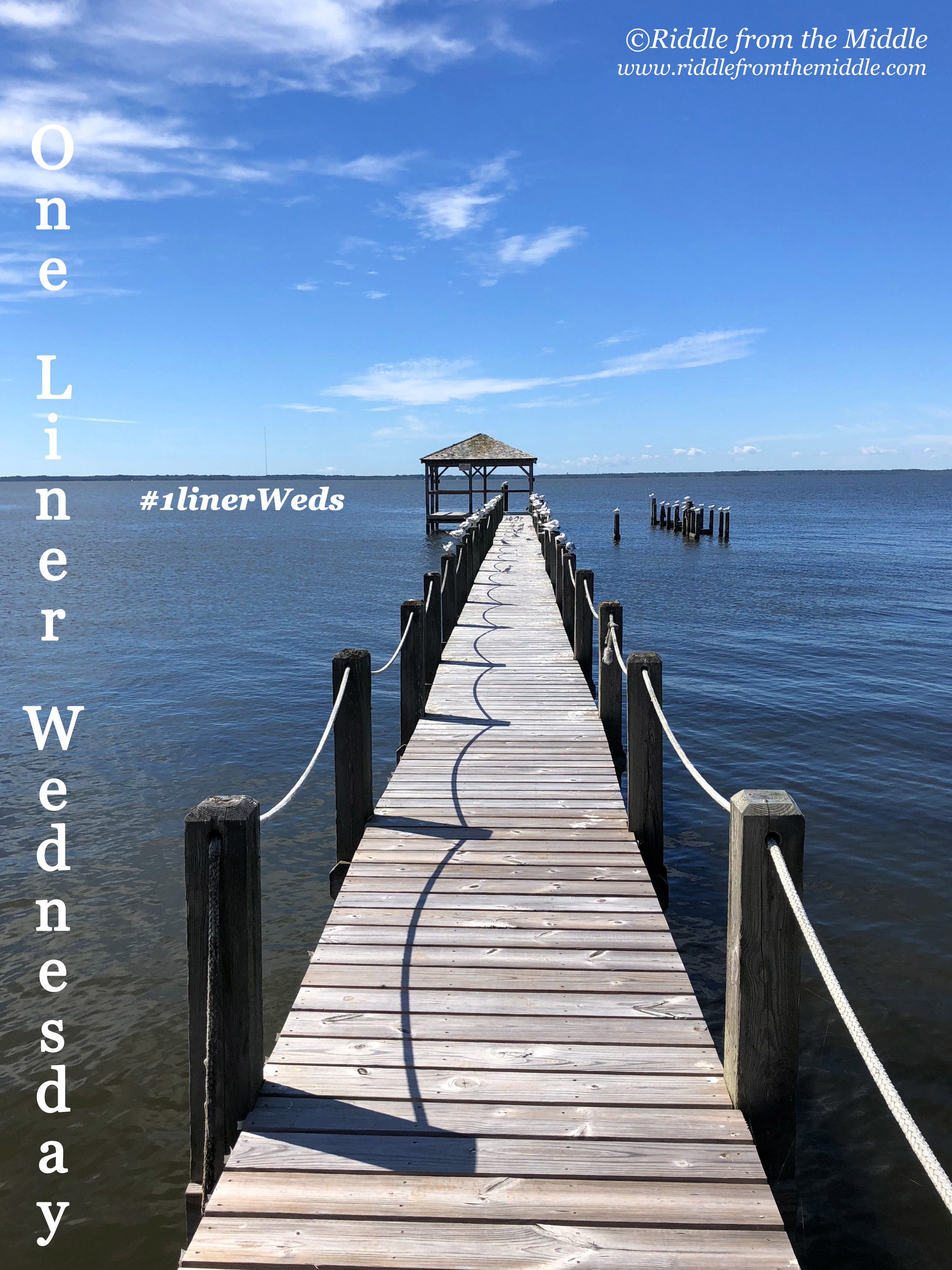
One-Liner Wednesday: rules and principles

“Rules are not necessarily sacred,” Franklin Delano Roosevelt said, “principles are.”

This quote begins Sister Joan Chittister’s column this week about applying the wisdom of centuries to the present day. I highly recommend reading it: https://www.ncronline.org/news/opinion/where-i-stand/principles-pandemic
*****
Join us for Linda’s One-Liner Wednesday! Find out how here:  https://lindaghill.com/2020/04/08/one-liner-wednesday-april-8th-2020-connection/

Badge by Laura @ riddlefromthemiddle.com