Lewiston

Another mentally ill man with an assault rifle mowing down people, including children, who were out with family and friends enjoying recreation and sharing meals in another US city. This time, it was Lewiston, Maine. As I write this, there are 18 confirmed dead, although only eight have been officially identified. Assault weapons cause such grievous injuries that even family members may not be able to identify victims by sight, so forensic methods need to be used. Thirteen people are injured.

As of October 27th, the Gun Violence Archive has recorded 566 mass shootings in the United States so far in 2023, which is tragic and appalling. The total number of deaths due to gun violence is 35,389 with 19,800 of those being self-inflicted, which is also tragic and appalling.

The entire population of Lewiston, Maine was listed as 36.617 in 2021. Would we finally be able to get more governmental attention to the issue of gun violence if we think of it as an entire small city dying due to guns rather than looking at each individual instance in isolation?

Even though there is support from over 80% of the public for some gun safety measures like universal background checks for all gun sales, Congress has not been able to pass these into law. The House Representative whose district includes Lewiston has apologized to his constituents for his prior opposition to gun safety laws and now promises to support them. I challenge other members of Congress to look at gun violence in their own districts and states, whether they are mass shootings, individual homicides, accidents, suicides, or woundings, and determine a path to make life safer for all people.

It’s too late for 35,389 people this year but not too late for countless others. Congress, act now.

Photo credit: Photo by Lucas Sankey on Unsplash

Concert (and American) Reflections

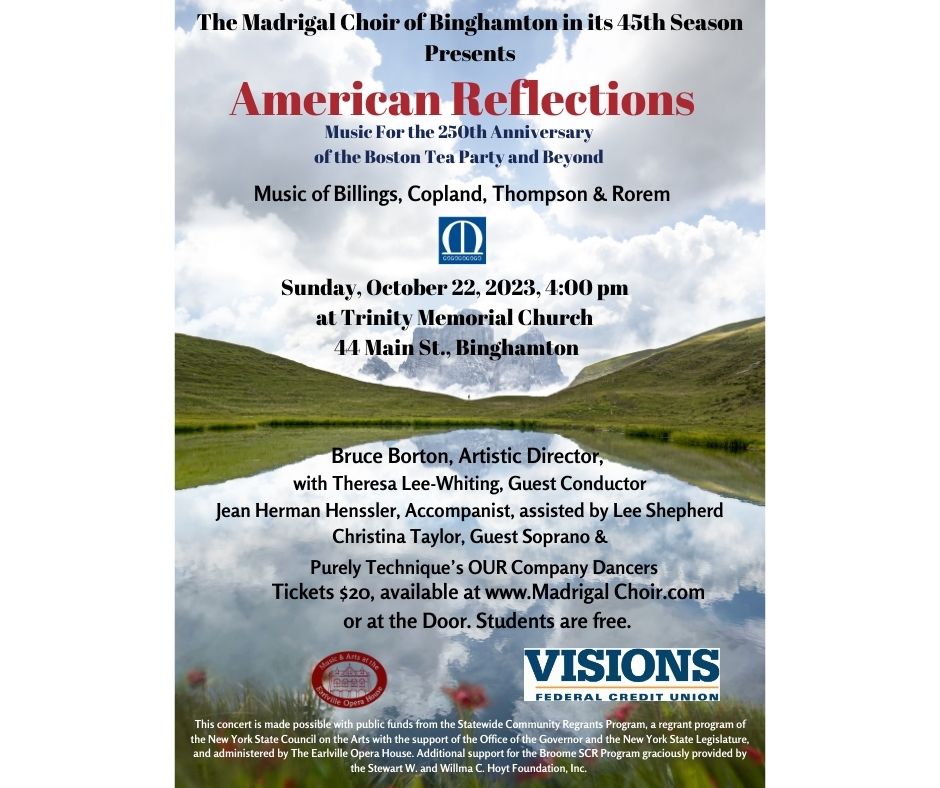
Yesterday, the Madrigal Choir of Binghamton presented the first concert of our 45th anniversary season, “American Reflections.”

Our artistic director, Bruce Borton, chose the program to commemorate a number of anniversaries. We sang a set of pieces by William Billings in commemoration of the 250th anniversary of the Boston Tea Party; Billings was a Boston resident at the time and two of the pieces we sang directly referenced the revolutionary period. Special guest soprano Christina Taylor sang four settings of Walt Whitman poems by Ned Rorem, in honor of Rorem’s centennial. We also sang Randall Thompson’s “The Testament of Freedom,” a setting of Thomas Jefferson texts composed in 1943 for the University of Virginia’s glee club commemorating the bicentennial of their founder Jefferson’s birth. We rounded out our all-American program with pieces from Aaron Copland’s opera, The Tender Land.

I’m pleased to say that the concert went well and was enthusiastically received by our audience. We owe our thanks to Theresa Lee-Whiting, who relinquished her role as singer and president of Madrigal Choir to serve as guest conductor for this concert after Dr. Borton needed to take medical leave. We were grateful that Dr. Borton was feeling well enough to attend the concert and hope that he was proud of the work we had done.

I admit that rehearsing and singing this program had its challenges from a historical perspective. For example, in “Stomp Your Foot” from The Tender Land, the text is very explicit about the devaluing of the work of “ladies” versus men. The story is set in the farmlands of the 1930s Depression era, so it is accurate for the times, if a bit galling to sing these days.

The more problematic text for me was Jefferson’s words in “The Testament of Freedom.” The bulk of the text Thompson chose to set is from the “Declaration of the Causes and Necessity of Taking Up Arms.” There are a number of references to bondage or slavery as a consequence of the colonists not taking up arms against the British. For example, “We cannot endure the infamy and guilt of resigning succeeding generations to that wretchedness which inevitably awaits them if we basely entail hereditary bondage upon them.” It’s difficult to sing the text with the knowledge that Jefferson was holding hundreds of men, women, and children in “hereditary bondage” as he wrote these words. He also writes that the colonists must take up arms “for the protection of our property, acquired solely by the honest industry of our forefathers and ourselves,” as though the work of those he enslaved was not also adding to his wealth, although he would have considered those people part of his property. I wonder if Thompson would have chosen the passages to set differently if more modern scholarship on the colonial and Revolutionary War times had been available to him in the 1940s.

Given that he was composing this work during World War II, the final movement, using text from a letter Jefferson wrote to John Adams in 1821, is poignant. “And even should the cloud of barbarism and despotism again obscure the science and liberties of Europe, this country remains to preserve and restore light and liberty to them…” Some of the young men premiering this work would have been about to enter the armed forces to fight in Europe or the Pacific theater. Both my and my spouse’s fathers were in the service during World War II eighty years ago. It was sobering for me to sing these words at a time when democracy is again assailed by authoritarian and fascist influences in Europe and here in the United States.

The fourth movement begins with these words from Jefferson to Adams, “I shall not die without a hope that light and liberty are on steady advance…” On July 4, 1826, both former presidents died on the 50th anniversary of the Declaration of Independence they both signed.

May light and liberty – and music – continue to advance.

Launch!

Third Act Upstate New York has launched! You can watch the video of our amazing launch program:

Third Act Upstate New York: Working Group Launch from Third Act on Vimeo.

US-based Third Act was founded by Bill McKibben and Vanessa Arcara, both of whom spoke movingly at our launch, to engage elders (those 60+) in response to the current crises around climate and democracy. It is a national organization that has undertaken large-scale initiatives, such as the 3.21.23 Day of Action to Stop Dirty Banks targeting the big banks that are funding dirty fossil fuel development. It partners with other organizations across the age spectrum in support of climate and democracy initiatives, such as the recent climate week march in New York City. Its three main areas of activism are currently Fossil Free Finance, Democratize Energy, and Uplift Democracy and Voting.

If you are an elder anywhere in the United States, you can become a Third Act volunteer. The first step is to join the mailing list. That will get you information to join national calls and campaign initiatives. It also gives you the opportunity to join a Working Group. Some are affinity groups, such as Educators, Faith, or Retired Union Members. Others are geographic groups. Working groups help on national initiatives and also mobilize efforts around more local and state concerns that align with Third Act’s mission.

On our Upstate New York launch call, we were privileged to hear from Dr. Curt Stager of Paul Smith’s College speaking about how climate change is in evidence in the Adirondacks, from Dr. Bob Howarth of Cornell University about the implementation of the landmark New York Climate Leadership and Community Protection Act, and Alÿcia Bacon of Mothers Out Front about energy equity.

Our launch also featured some arts breaks. Jane Hirshfield read her poem “Let Them Not Say” and Sarah Stockwell-Arthen sang Rabbi Shoshana Meira Friedman’s “The Tide Is Rising.”

Our theme for our Upstate New York launch was “Ordinary people doing extraordinary things…together.” We emphasized this by having several of our working group members, including me, offer brief comments on what brought them to Third Act and provide introductions to our speakers.

Part of the purpose of the launch was to encourage people who are lucky enough to be elders in Upstate New York to join us. Our invitation was delivered through a recorded message from Dr. Robin Wall Kimmerer, author of Braiding Sweetgrass and professor at SUNY-Environmental Science and Forestry, and a live appeal from Michael Richardson, current facilitator for the Third Act Upstate New York Working Group.

I will add my own invitation because it is never too late to join in the effort, even if you are happening upon this post months or years after our October 5, 2023 launch date. You can join Third Act National using the link earlier in this post and, if you are an Upstater, our Working Group here: https://thirdact.org/working-groups/upstate-new-york/. You can find us on Facebook and Instagram.

I was part of the Launch Committee that planned this event, guided by the incredible Lani Ritter Hall, Third Act advisor and volunteer. Even if being able to join Third Act is far in your future, I hope you will watch our launch and draw information and inspiration from it.

If you are an Upstate NY elder, I hope to see you at an upcoming online meeting or in-person action.

Remember – Ordinary people can do extraordinary things together!

horror and sorrow

I don’t have words that adequately express my horror and sorrow at the death, injury, trauma, and destruction in Israel and the Gaza Strip.

We know that more will be added.

The fate of hostages that Hamas has taken is a primary concern for people around the world.

I understand that Israel is trying to warn civilians to leave northern Gaza before they invade but it’s impossible to re-locate so many people in such a densely populated area when there is a total embargo on bringing in aid, there is no electricity, there aren’t safe shelters, and the borders are sealed so they can’t leave Gaza. There are two million people in Gaza, about half of whom are children and teens. Only a tiny number are terrorists and militants. The vast majority are trapped and suffering.

We don’t know how this immediate situation will resolve but we do know that it is another chapter in a decades-long struggle. We don’t know when or if there will be a resolution that brings about lasting peace.

I am also struggling with reports of attacks against Jews and Muslims around the world. I know in the United States many synagogues and temples are being offered extra security as they prepare for Sabbath services.

All the major religious traditions teach peace. Secular philosophers teach peace. How can some still not hear that message and live it?

Another new Speaker

Not that there is ever a good time for the United States House of Representatives to be without a Speaker – and thus unable to consider any legislation – but now seems like a particularly unfortunate time to be in that situation, with no House-passed budget bills that could clear the Senate; ongoing wars in Ukraine, Israel, and elsewhere; and important work needed domestically and internationally around climate action and disaster relief.

The two leading candidates for Speaker, Rep. Jim Jordan of Ohio and Rep. Steve Scalise of Louisiana, probably don’t have the votes to be elected by the majority Republican conference because they are too far to the right to work with the Senate to get legislation through both chambers.

I think the more moderate Republicans should look among their ranks for a nominee for Speaker who can work with Democrats to craft bipartisan legislation that can pass the House and the Democratic-majority Senate. The Senate has managed to pass all twelve fiscal year 2024 appropriation bills out of committee with large bipartisan majorities, which are in line with the spring debt ceiling legislation. If a new Speaker were to put these bills on the House floor, they could pass with Democratic and Republican votes from members who actually want to govern, as opposed to the Freedom Caucus and other similarly inclined Republican House members who seem intent on just not having a functioning government at all. (The Constitution stipulates that government funding bills must originate in the House, so the Senate can’t pass their version of the bills until the House acts.)

I believe that this Republican nominee should not be someone, though, who voted against certifying the legitimate results of the 2020 presidential election after the mob had attacked the Capitol and sent members fleeing for their safety.

My hope is that, if a reasonable candidate comes forward and speaks with the Democratic leadership, the House Democrats will supply enough votes to elect a Speaker quickly so that needed legislation can be put in place, showing our citizens and the international community that our democracy can function in a civil way for the common good. If the new Speaker keeps their promise to preside in a bipartisan way, following the lead of the Senate, they would be insulated from threats by the far right Republicans to “vacate the Chair,” i.e. throw the Speaker out of their job as we just witnessed for the first time with the ousting of Kevin McCarthy.

House Republicans, it’s time for you to step up and put our country first. You were elected to govern, not obstruct. The Senators and President Biden have shown that bipartisanship is still possible.

Follow their lead.

Photo credit: Photo by Lucas Sankey on Unsplash

age and/or competence

Here in the United States, there is lots of discussion and public opinion polling around whether there should be an upper age limit for the presidency and other powerful federal positions, such as Supreme Court justices.

This is sometimes termed more simply as “Is Joe Biden too old to run for re-election?” Joe Biden is currently 80. Donald Trump, current leader in the race for the Republican party nomination, is 77.

Thirty-five is the Constitutional minimum age for the presidency, presumably to allow the president to have gained some measure of life experience and maturity to handle such a demanding position, but there is no upper limit specified.

I prefer that there not be one.

Rather, I want to be able to look at the personal qualities and policy positions of the candidate. Their physical and mental health status is part of that analysis.

Age is not necessarily a good indicator of health status or fitness. Joe Biden, as evidenced by his physical examination results from February, 2023, does not have major medical issues. His gait is stiff due to some arthritis. He works out on a regular basis. He has been able to keep up a rigorous daily schedule, including frequent travel, both domestically and internationally.

The president has a stutter; sometimes, his word pacing and choice are efforts to compensate. That we seldom hear him stutter is a testament to the work he has done over the years to address this issue. There is no evidence of cognitive impairment.

Of course, not all recent presidents have been as extensive in reporting their physical exam results. Donald Trump’s results were not reported in detail.

In the more distant past, the physical condition of the president was often kept private. For example, the public did not know the extent of damage caused by Woodrow Wilson’s 1919 stroke. Franklin Roosevelt’s post-polio condition was kept out of the public eye as much as possible. Not even Harry Truman as vice-president knew how ill FDR was with cardiovascular disease before his death in 1945 at age 63.

My mother, who had experience with family members dealing with cognitive decline, observed that Ronald Reagan’s behavior and speech while he was president reminded her of someone who was developing dementia. She was not surprised when his diagnosis with Alzheimer’s disease was made public five years after he left the presidency. There was a lot of debate about when Reagan’s cognitive decline began and there is no definitive determination, although some analysis has shown that his speech patterns changed over the years of his presidency in ways that indicate cognitive decline. Reagan was 77 when he left office at the end of his second term.

So, circling back to the present debate on the age of presidential candidates, it seems to me that age alone is not a good indicator of health or fitness for the rigors of the presidency. President Biden seems to be doing well at age 80 with both the physical and mental demands of the job. I also appreciate his even temperament and moral grounding, which, as a fellow Catholic, I recognize as rooted in Catholic social justice doctrine and in line with the American concept of working for the common good, articulated in the Constitution as a call to “promote the general welfare.”

On the other hand, when Donald Trump was president, he was not known to keep a very rigorous schedule of official duties. He didn’t seem to understand the complexities of the job, such as dealing with classified materials. He was volatile and resorted to bullying, name calling, and lying to try to get his way, regardless of facts, laws, or policies. Sometimes, when he is speaking without a teleprompter, he doesn’t seem able to construct cogent sentences. I don’t know if there is a medical diagnosis that elucidates these behaviors or not, but I don’t think his age is the salient factor.

While I would prefer younger presidential candidates, in their fifties or sixties perhaps, it is much more important for me that the president be someone who is dedicated to the American people and the rule of law, trying to do what is right for the good of the country and protecting those who are under threat.

If that person happens to be 80-something, so be it.

COVID update – late summer 2023

There are many people here in the United States who are no longer taking COVID-19 seriously and a disturbing number who never did.

I am not one of them.

I’ve written dozens of posts over the past three and a half years about it, including about my family’s participation in the Pfizer/BioNTech Phase III clinical trial. I’ve tried to encourage people to take precautions to reduce their chances of infection and serious illness. In that vein, I offer this update.

There was a summer wave in the US with the most prevalent strain being Omicron XBB.1.5. On September 12, the Centers for Disease Control and Prevention Advisory Committee on Immunization Practices will meet to develop a recommendation for a newly formulated booster based on the XBB.1.5 variant. It’s anticipated that the recommendation will be that most people get this new booster, which is expected to be available by the end of September. I will get the booster as soon as I am able. To my knowledge, I’ve still not contracted COVID and would love to keep it that way. Even if the vaccine does not keep me from getting infected, it, along with taking an anti-viral such as Paxlovid, will likely keep me from being hospitalized.

Of course, SARS-CoV-2 continues to mutate. Even now, the variant mix has shifted in the US. EG.5 has become the highest in prevalence with FL.1.5.1 next in an array of variants currently circulating. (You can find current data in the US at the CDC site here.) It is expected that the new booster, though based on XBB.1.5, will still be effective against these other Omicron strains.

The unfortunate wild card at this point is another Omicron variant BA.2.86. The link is to a 8/22 post from epidemiologist Dr. Katelyn Jetelina, explaining why this variant may be more problematic than others, perhaps even warranting the World Health Organization to name it a variant of concern with the name “Pi.” BA.2.86 has over 30 mutations of the spike protein, which is part of the virus that our bodies learn to recognize via vaccines, infection, or both. The fear is that we could see another world-wide wave develop because BA.2.86 might be able to evade our defenses. Researchers are studying it to see if our current tests, vaccines, and treatments will work against it and how it might affect individuals and populations exposed to it. The current number of cases world-wide are thought to be small, but that has been the beginning status of any variant that has become dominant.

Part of the problem is that we don’t have as much data to work with. Most COVID cases aren’t reported to public health authorities anymore. Surveillance and genomic sequencing are lower. This results in less public awareness and information. Theoretically, we should be able to ramp up our system more quickly if a new wave occurs but I wish we had kept up our system in the first place in a proactive stance.

I’m concerned about the attitude that equates COVID infection with other viruses. A study in the journal Nature Medicine shows increased risks for an array of medical conditions, including diabetes, pulmonary and cardiovascular problems, two years after COVID infection, even if the initial case was mild.

“A lot of people think, ‘I got covid, I got over it and I’m fine,’ and it’s a nothingburger for them. But that’s not everything,” said the study’s senior author, Ziyad Al-Aly, a clinical epidemiologist at Washington University School of Medicine in St. Louis. After a couple of years, “maybe you’ve forgotten about the SARS-CoV-2 infection … but covid did not forget about you. It’s still wreaking havoc in your body,” said Al-Aly, chief of research at the Veterans Affairs St. Louis Health Care System.

source: https://www.washingtonpost.com/health/2023/08/21/long-covid-lingering-effects-two-years-later/

The risk of long COVID is real. The article cited above, which is free to access, explains more about the attempts to do research and get care for people with long COVID. People need to realize that they might be someone who gets COVID and has a mild case without long-term repercussions or they might become seriously ill or they might have symptoms for months and years to come. They could also infect someone else who would face the same uncertainties.

I’m once again imploring people to take COVID seriously. Vaccinate, if it is recommended for you. (Being in the US, I’m most familiar with recommendations here but people should look to their own local health authorities and medical practitioners for guidance in their area.) Test and treat an infection. Stay home if you are sick and avoid infecting others. Avoid crowds indoors; wear a high-quality mask if you can’t. If infection rates are significant in your area, mask indoors when you are away from home. Increase ventilation and air filtration. Wash your hands. Get adequate rest and nutrition. Remember that everyone deserves respect, so never question someone else’s decision to mask; they could be immunocompromised, caring for a vulnerable person, etc. and need that protection.

Eventually, we may get to a place where COVID is endemic, like the flu, but we aren’t there yet. Be careful and be kind as we continue to face this still-formidable challenge.

New Poem: On August 24, 2023

For some reason I cannot ascertain, I’ve been having poetic responses spring to mind from current events lately. After having them rejected by the venues that I know that concentrate on current event poems, I am publishing them here at Top of JC’s Mind, as I did last week with my Georgia RICO indictment poem.

This one is much shorter, almost but not quite a haiku. (Syllable counting is difficult when you use numbers.) It is a response to Donald Trump surrendering to authorities at the Fulton County, Georgia jail and then raising money using his scowling mug shot, which I’ve already seen more times than I care to.

As always, comments are welcome.

On August 24, 2023

Inmate P01135809 
says “NEVER SURRENDER!” 
but he does.

NCR comment

A comment I wrote about fossil fuel subsidies in response to this piece by Thomas Reese, SJ is now available on the NCR (National Catholic Reporter) website.

Some of Father Reese’s proposals to combat climate change strike me as not likely to be sufficient in the time frame available but I wanted to offer an additional suggestion rather than being critical.

This post is a bit of a throwback to the early days of Top of JC’s Mind when I was often posting comments in opposition to fracking.

Next month will mark the tenth anniversary of Top of JC’s Mind, which hardly seems possible.

Stay tuned…

GA RICO poem

No, really.

While reading the indictment from the Fulton County, Georgia grand jury last week, I found a poem.

No, really.

A found poem is one that is constructed from a preexisting, usually non-poetic text. As I was reading the 161 acts that are listed as evidence of racketeering, I was struck by the repetition of “an overt act in furtherance of the conspiracy.” Repetition is a common feature of poetry, so the rhythm of this mantra resonated with me. I took the last line from each of the 161 acts to construct this poem.

Most poems are meant to be heard, as well as read. This one is probably better experienced as a visual piece, allowing the repetition with its variations to weigh on you. As always, comments. are welcome

from The Acts of Violation of the Georgia RICO (Racketeer Influenced and Corrupt Organizations) Act – a found poem by Joanne Corey

  1. The speech was an overt act in furtherance of the conspiracy.
  2. This telephone call was an overt act in furtherance of the conspiracy.
  3. These were overt acts in furtherance of the conspiracy.
  4. This was an overt act in furtherance of the conspiracy.
  5. This meeting was an overt act in furtherance of the conspiracy.
  6. This was an overt act in furtherance of the conspiracy.
  7. The false statements and solicitations were overt acts in furtherance of the conspiracy.
  8. These were overt acts in furtherance of the conspiracy.
  9. These were overt acts in furtherance of the conspiracy.
  10. This was an overt act in furtherance of the conspiracy.
  11. This was an overt act in furtherance of the conspiracy.
  12. This was an overt act in furtherance of the conspiracy.
  13. This was an overt act in furtherance of the conspiracy.
  14. This was an overt act in furtherance of the conspiracy.
  15. This was an overt act in furtherance of the conspiracy.
  16. This was an overt act in furtherance of the conspiracy.
  17. These were overt acts in furtherance of the conspiracy.
  18. This was an overt act in furtherance of the conspiracy.
  19. The request was an overt act in furtherance of the conspiracy.
  20. These were overt acts in furtherance of the conspiracy.
  21. These were overt acts in furtherance of the conspiracy.
  22. This was an overt act in furtherance of the conspiracy.
  23. This was an overt act in furtherance of the conspiracy.
  24. This was an act of racketeering activity under O.C.G.A. § 16-14-3(5)(A)(xxii) and an overt act in furtherance of the conspiracy.
  25. This was an act of racketeering activity under O.C.G.A. § 16-14-3(5)(A)(xxii) and an overt act in furtherance of the conspiracy.
  26. This was an overt act in furtherance of the conspiracy.
  27. This was an overt act in furtherance of the conspiracy.
  28. This was an overt act in furtherance of the conspiracy.
  29. This was an overt act in furtherance of the conspiracy.
  30. This was an overt act in furtherance of the conspiracy.
  31. This was an overt act in furtherance of the conspiracy.
  32. This was an overt act in furtherance of the conspiracy.
  33. This was an overt act in furtherance of the conspiracy.
  34. This was an overt act in furtherance of the conspiracy.
  35. This was an overt act in furtherance of the conspiracy.
  36. This was an overt act in furtherance of the conspiracy.
  37. This was an overt act in furtherance of the conspiracy.
  38. This was an overt act in furtherance of the conspiracy.
  39. This email was an overt act in furtherance of the conspiracy.
  40. This request was an overt act in furtherance of the conspiracy.
  41. This was an overt act in furtherance of the conspiracy.
  42. This was an overt act in furtherance of the conspiracy.
  43. This was an overt act in furtherance of the conspiracy.
  44. This was an overt act in furtherance of the conspiracy.
  45. This was an overt act in furtherance of the conspiracy.
  46. This was an overt act in furtherance of the conspiracy.
  47. This was an overt act in furtherance of the conspiracy.
  48. This was an overt act in furtherance of the conspiracy.
  49. This was an overt act in furtherance of the conspiracy.
  50. This was an overt act in furtherance of the conspiracy.
  51. This was an overt act in furtherance of the conspiracy.
  52. This was an overt act in furtherance of the conspiracy.
  53. This was an overt act in furtherance of the conspiracy.
  54. This was an overt act in furtherance of the conspiracy.
  55. This was an overt act in furtherance of the conspiracy.
  56. This was an act of racketeering activity under O.C.G.A. § 16-14-3(5)(A)(xxii) and an overt act in furtherance of the conspiracy.
  57. This was an overt act in furtherance of the conspiracy.
  58. This was an overt act in furtherance of the conspiracy.
  59. This was an overt act in furtherance of the conspiracy.
  60. This was an overt act in furtherance of the conspiracy.
  61. This was an overt act in furtherance of the conspiracy.
  62. This was an overt act in furtherance of the conspiracy.
  63. This was an overt act in furtherance of the conspiracy.
  64. These were overt acts in furtherance of the conspiracy.
  65. This was an overt act in furtherance of the conspiracy.
  66. This was an overt act in furtherance of the conspiracy.
  67. This was an overt act in furtherance of the conspiracy.
  68. This was an overt act in furtherance of the conspiracy.
  69. This was an overt act in furtherance of the conspiracy.
  70. This was an overt act in furtherance of the conspiracy.
  71. This was an overt act in furtherance of the conspiracy.
  72. This was an overt act in furtherance of the conspiracy.
  73. This was an overt act in furtherance of the conspiracy.
  74. This was an overt act in furtherance of the conspiracy.
  75. This was an overt act in furtherance of the conspiracy.
  76. This was an overt act in furtherance of the conspiracy.
  77. This was an overt act in furtherance of the conspiracy.
  78. This was an overt act in furtherance of the conspiracy.
  79. This was an act of racketeering activity under O.C.G.A. § 16-14-3(5)(A)(xxiii) and an overt act in furtherance of the conspiracy.
  80. This was an act of racketeering activity under O.C.G.A. § 16-14-3(5)(A)(xvi) and an overt act in furtherance of the conspiracy.
  81. This was an act of racketeering activity under O.C.G.A. § 16-14-3(5)(A)(xxii) and an overt act in furtherance of the conspiracy.
  82. This was an act of racketeering activity under O.C.G.A. § 16-14-3(5)(A)(xxii) and an overt act in furtherance of the conspiracy.
  83. This was an act of racketeering activity under O.C.G.A. § 16-14-3(5)(A)(xvi) and an overt act in furtherance of the conspiracy.
  84. This was an act of racketeering activity under O.C.G.A. § 16-14-3(5)(A)(xxii) and an overt act in furtherance of the conspiracy.
  85. This was an overt act in furtherance of the conspiracy.
  86. This was an overt act in furtherance of the conspiracy.
  87. This was an act of racketeering activity under O.C.G.A. § 16-14-3(5)(A)(xxvii) and an overt act in furtherance of the conspiracy.
  88. This was an act of racketeering activity under O.C.G.A. § 16-14-3(5)(A)(xxvii) and an overt act in furtherance of the conspiracy.
  89. These were overt acts in furtherance of the conspiracy.
  90. This was an overt act in furtherance of the conspiracy.
  91. This was an overt act in furtherance of the conspiracy.
  92. This was an overt act in furtherance of the conspiracy.
  93. This was an overt act in furtherance of the conspiracy.
  94. This was an overt act in furtherance of the conspiracy.
  95. This telephone call was an overt act in furtherance of the conspiracy.
  96. This was an overt act in furtherance of the conspiracy.
  97. This was an overt act in furtherance of the conspiracy.
  98. This was an act of racketeering activity under O.C.G.A. § 16-14-3(5)(A)(xxii) and an overt act in furtherance of the conspiracy.
  99. This was an overt act in furtherance of the conspiracy.
  100. This was an overt act in furtherance of the conspiracy.
  101. This was an overt act in furtherance of the conspiracy.
  102. This was an overt act in furtherance of the conspiracy.
  103. This was an act of racketeering activity under O.C.G.A. § 16-14-3(5)(A)(xxii) and an overt act in furtherance of the conspiracy.
  104. This was an act of racketeering activity under O.C.G.A. § 16-14-3(5)(A)(xxii) and an overt act in furtherance of the conspiracy.
  105. This was an act of racketeering activity under O.C.G.A. § 16-14-3(5)(A)(xxii) and an overt act in furtherance of the conspiracy.
  106. This was an overt act in furtherance of the conspiracy.
  107. This was an overt act in furtherance of the conspiracy.
  108. This was an act of racketeering activity under O.C.G.A. § 16-14-3(5)(A)(xxii) and an overt act in furtherance of the conspiracy.
  109. This was an overt act in furtherance of the conspiracy.
  110. This was an overt act in furtherance of the conspiracy.
  111. This was an overt act in furtherance of the conspiracy.
  112. This was an overt act in furtherance of the conspiracy.
  113. This was an act of racketeering activity under O.C.G.A. § 16-14-3(5)(A)(xxii) and an overt act in furtherance of the conspiracy.
  114. This was an overt act in furtherance of the conspiracy.
  115. These were overt acts in furtherance of the conspiracy.
  116. This was an overt act in furtherance of the conspiracy.
  117. This was an overt act in furtherance of the conspiracy.
  118. This was an overt act in furtherance of the conspiracy.
  119. This was an overt act in furtherance of the conspiracy.
  120. This was an act of racketeering activity under O.C.G.A. § 16-14-3(5)(A)(xxii) and an overt act in furtherance of the conspiracy.
  121. This was an act of racketeering activity under O.C.G.A. § 16-14-3(5)(A)(xxvii) and an overt act in furtherance of the conspiracy.
  122. These were overt acts in furtherance of the conspiracy.
  123. This request was an overt act in furtherance of the conspiracy.
  124. This was an overt act in furtherance of the conspiracy.
  125. This was an overt act in furtherance of the conspiracy.
  126. This was an overt act in furtherance of the conspiracy.
  127. These were overt acts in furtherance of the conspiracy.
  128. This was an overt act in furtherance of the conspiracy.
  129. This was an overt act in furtherance of the conspiracy.
  130. This was an overt act in furtherance of the conspiracy.
  131. This was an overt act in furtherance of the conspiracy.
  132. This was an overt act in furtherance of the conspiracy.
  133. This was an overt act in furtherance of the conspiracy.
  134. These were overt acts in furtherance of the conspiracy.
  135. This was an overt act in furtherance of the conspiracy.
  136. This was an overt act in furtherance of the conspiracy.
  137. This was an overt act in furtherance of the conspiracy.
  138. This was an overt act in furtherance of the conspiracy.
  139. This was an overt act in furtherance of the conspiracy.
  140. This was an overt act in furtherance of the conspiracy.
  141. This was an overt act in furtherance of the conspiracy.
  142. This was an act of racketeering activity under O.C.G.A. § 16-14-3(5)(B) and an overt act in furtherance of the conspiracy.
  143. This was an act of racketeering activity under O.C.G.A. § 16-14-3(5)(B) and an overt act in furtherance of the conspiracy.
  144. This was an overt act in furtherance of the conspiracy.
  145. This was an overt act in furtherance of the conspiracy.
  146. This was an act of racketeering activity under O.C.G.A. § 16-14-3(5)(A)(xix) and an overt act in furtherance of the conspiracy.
  147. This was an act of racketeering activity under O.C.G.A. § 16-14-3(5)(A)(xix) and an overt act in furtherance of the conspiracy.
  148. This was an act of racketeering activity under O.C.G.A. § 16-14-3(5)(A)(xix) and an overt act in furtherance of the conspiracy.
  149. This was an act of racketeering activity under O.C.G.A. § 16-14-3(5)(B) and an overt act in furtherance of the conspiracy.
  150. This was an act of racketeering activity under O.C.G.A. § 16-14-3(5)(B) and an overt act in furtherance of the conspiracy.
  151. This was an act of racketeering activity under O.C.G.A. § 16-14-3(5)(B) and an overt act in furtherance of the conspiracy.
  152. This was an act of racketeering activity under O.C.G.A. § 16-14-3(5)(B) and an overt act in furtherance of the conspiracy.
  153. This was an act of racketeering activity under O.C.G.A. § 16-14-3(5)(B) and an overt act in furtherance of the conspiracy.
  154. This was an overt act in furtherance of the conspiracy.
  155. This was an act of racketeering activity under O.C.G.A. § 16-14-3(5)(B) and an overt act in furtherance of the conspiracy.
  156. This was an overt act in furtherance of the conspiracy.
  157. This was an act of racketeering activity under O.C.G.A. § 16-14-3(5)(A)(xxii) and an overt act in furtherance of the conspiracy.
  158. This was an act of racketeering activity under O.C.G.A. § 16-14-3(5)(A)(xxii) and an overt act in furtherance of the conspiracy.
  159. This was an overt act in furtherance of the conspiracy.
  160. This was an act of racketeering activity under O.C.G.A. § 16-14-3(5)(A)(xxv) and an overt act in furtherance of the conspiracy.
  161. This was an act of racketeering activity under O.C.G.A. § 16-14-3(5)(A)(xxv) and an overt act in furtherance of the conspiracy.