Memorial Day

(Photo by Lucas Sankey on Unsplash)

Today is observed as Memorial Day in the United States, set aside to honor all those who died in the armed services.

One of our neighbors has turned their front yard into a memorial for the day with small flags in rows and a sign listing the last names of those killed in recent US military actions, starting with Iraq and Afghanistan.

Remembering them and all who have died in service of the United States today and hoping for peace and comfort for the families who grieve their loss.

Also, praying for peace so that no more deaths will be added to those already suffered over the centuries.

Vote for Democracy #7

(Photo by Lucas Sankey on Unsplash)

Over the last several decades, it’s become customary to ask the electorate in the run-up to presidential elections if they were better off four years ago.

I can safely say that our family is much better off now than four years ago.

During Trump’s last year in office, we spent a lot of time in either complete COVID isolation or significant restrictions. There were shortages of many consumer goods. While we were fortunate that B’s job could be done remotely, our finances had been negatively impacted by the Trump/Republican tax cuts, which saved wealthy individuals and corporations millions of dollars but raised federal income taxes for those of us who live in states with higher property and state income taxes by restricting our ability to itemize. (Republican Claudia Tenney was our representative at the time and put out an illustration of how much a family with three children under 14 would save in federal income tax, ignoring that the vast majority of her constituents didn’t fit that model and certainly a household like ours, older couple with no dependents, had a significant tax increase, not a cut.) Our retirement savings took a hit as both stocks and bonds were suffering from the disruption of the world economy due to the pandemic.

While we were fortunate to have a stable home and employment, 2020 was generally a scary time. Many in our community had job losses and health problems, including serious COVID cases. Too many people suffered lasting health consequences or death from the pandemic. While our state government did their best to deal with those early pandemic months, President Trump was a hindrance rather than a help in safeguarding our well-being.

In this final year of President Biden’s first term, things are much better for our family. With federal support for vaccines and treatments and with our own precautions, we have only had one relatively mild COVID case in our household. While inflation has raised some of our household costs, wages have gone up, too. We have appreciated higher interest rates on our savings and the record levels of the stock market have helped our retirement savings to recover and grow. The current unemployment rate in Broome County NY, where I live, is 4.5%, slightly higher than the national average of 3.9%. By contrast, in April 2020, our county set its record high unemployment rate at 15.2%.

While I know there are individuals who were better off four years ago, the majority of people are healthier and in a more stable situation than they were in 2020.

Still, many people feel differently. Perhaps, the trauma of the early part of the pandemic caused them to forget the fear, illness, job losses, shortages, and isolation we experienced. Perhaps, their personal income wasn’t able to compensate for inflation. (For the record, the supply chain problems that caused some of the inflation surge have resolved but the extra profit-taking by companies has not, especially with products that have only a handful of suppliers. The blame for price gouging should fall on greedy corporations, not on the administration.) Perhaps, some people are victims of fear-mongering or misinformation about the economy and public policy.

Admittedly, as I decide which candidates to support, I prefer to look at the broader picture of my local community and the country rather than the small picture of my household. In my area, there are lots of infrastructure improvements underway, especially with our roads. The local hospital just opened a new building. There is lots of government and private support for new and expanding business because we are a nationally recognized center for battery technology. Old factory buildings that were sitting vacant for decades are being renovated for housing and business use. Our regional airport is undergoing enhancements.

Many other counties around the country have similar stories of positive change.

I hope that voters will look honestly at their own past and present when evaluating the economic and health aspects of deciding among candidates. Don’t let other people or the media tell you what you should think. It’s also helpful to look at how government helped or hindered the economy or public health. The United States economy, including employment and inflation, has recovered much more quickly from the shock of the pandemic than other countries with advanced economies. The actions of the Biden administration are a factor in this economic strength.

An example of how public sentiment diverges from legislation and statistics is this poll from late April which finds that, when asked whether Biden or Trump did “more to promote infrastructure and job creation,” the results were 40% Biden, 37% Trump, 12% both equally, 12% don’t know. The fact is that no major infrastructure bills passed during the Trump administration while the Biden administration was heavily involved in crafting the bipartisan Infrastructure Investment and Jobs Act. This law along with the American Rescue Plan, the CHIPS and Science Act, and the Inflation Reduction Act have contributed to 15 million jobs added to the US economy under President Biden while the Trump presidency saw a loss of 2.9 million jobs. That the poll opinions deviate so dramatically from the legislative record and statistics suggests that other factors are at play, such as dis/misinformation, taking personal experience as universal, fear, and partisanship. Robert Reich had an interesting piece on his Substack yesterday exploring some of the facts, possible reasons they aren’t breaking through with the public, and possible ways to address the disparity.

When I look at this question of how my family, community, state, and country are doing during the Biden presidency and contrast it with the Trump presidency, it’s clear that Biden has the better record and plans for the future. I will vote for Biden and for Congressional candidates who will support Biden’s agenda.

I hope that all voters will evaluate the facts on the economy as they make decisions about voting.

One-Liner Wednesday: RBG

Fight for the things you care about, but do it in a way that will lead others to join you.

Ruth Bader Ginsburg

Join us for Linda’s One-Liner Wednesdays! Find out more here: https://lindaghill.com/2024/05/01/one-liner-wednesday-sprung/

Vote for Democracy #6

(Photo by Lucas Sankey on Unsplash)

I can’t quite believe that I am compelled to write this but I feel I must after yesterday’s Supreme Court hearing on whether or not blanket presidential immunity exists.

Donald Trump’s lawyer was arguing that a president shouldn’t be able to be prosecuted by the judicial system for criminal acts, including ordering the assassination of a political rival, if it was considered an official presidential act.

He is saying that, literally, a United States president should be able to get away with murder.

That is wrong legally, ethically, and morally.

Every person, citizen or not, elected official or not, is subject to the laws of the United States and whatever state or other jurisdiction they find themselves.

Period.

Do not vote for Donald Trump or any other candidate who believes that any person should be above the law.

Vote for Democracy #5

(Photo by Lucas Sankey on Unsplash)

One of the most disturbing aspects of Donald Trump and many Republicans is their embrace of violence, both as a threat and as a weapon.

Trump has used violent language throughout his political career, encouraging people to beat up protesters at his rallies, ordering or condoning violence against peaceful protesters, and, most notoriously, encouraging and cheering the violent insurrection at the Capitol on Jan. 6, 2021.

He has also been credibly accused of sexual violence and abuse by many women and was found liable in the E. Jean Carroll case.

Most often, though, Trump doesn’t physically participate himself, but other people follow his directions, such as when he told the Proud Boys in a presidential debate to “stand back and stand by” and then they showed up in force on Jan. 6. A number of them were criminally charged and convicted, but Trump now calls them “hostages” or “political prisoners” and seems poised to pardon them if he is elected.

Trump is promising to send in federal troops to US cities without being asked for assistance by the mayors or governors who have jurisdiction. He would apparently do this by invoking the Insurrection Act, perhaps even at the start of his term and on a national basis rather than targeted against a specific, violent event. A blanket application of the Insurrection Act would end the rights to free speech, freedom of assembly, and infringe the right to petition the government, all of which are included in the First Amendment of the US Constitution.

Trump is also threatening arrest of his perceived enemies, including Joe Biden and all the House members who were part of the January 6th study committee. There is no evidence of criminality against any of them, but Trump has called multiple times for vengeance because of the charges against him, for which there is ample evidence. (Links to the indictments and congressional and judicial reports are readily available online.)

Followers of Donald Trump have committed acts of violence, which he then turns into jokes rather than condemning. After Paul Pelosi, spouse of then-Speaker of the House Nancy Pelosi, was brutally attacked by an assailant in his home, Trump joked about it for months afterward, which is cruel and encourages others to commit even more violence on Trump’s behalf.

All of this is heightening the threat of political violence, particularly among Republicans. In a recent poll, 28% of Republicans agreed that “Americans have to resort to violence to get the country back on track.” (Independents were 18%; Democrats, 12%.) With Republican households having higher levels of gun ownership than other households, it is likely that a higher proportion of people holding this viewpoint have access to firearms. It has also been Republicans in Congress and judges appointed by Republicans who have blocked common sense gun safety measures. The cycle of violence perpetuates.

Last night, it was my privilege to hear John Dear speak on nonviolence. He was speaking about his new book, The Gospel of Peace: A Commentary on Matthew, Mark, and Luke from the Perspective of Nonviolence. He spoke movingly about Martin Luther King, Jr. and Mahatma Ghandi and their commitment to living the nonviolent life that Jesus did. He told us that Ghandi, a Hindu, read from the Sermon on the Mount, found in the gospel of Matthew, chapters five through seven, every day for decades. Even faced with the prospect of a violent death, King and Ghandi continued their commitment to nonviolence as Jesus did.

Father Dear reminded us that anger and fear are the underpinnings of violence. I have long known that fear-mongering is part of the lead-up to violent rhetoric from Trump and other Republicans, even when the underlying statements are untrue. For example, there is a lot of fear-mongering over crime. People think that crime rates are rising and are so afraid that they are willing to elect a strongman who promises to crack down violently on perceived enemies, which these days for Republicans seems to include immigrants, most people of color, Democrats, and people who identify as anything other than straight male/female.

When someone expresses a belief to me that is counterfactual, I’ll try to offer the facts if I can but I also try to address the fear that is underlying the issue and making them ready to justify violence to address it. If someone insults me or my intelligence, I don’t respond in kind but will explain my thoughts in a clear, honest way.

Back in the days of the fight against hydrofracking in New York, I often wrote comments on press articles and would be attacked by a small group of local drilling proponents who tended to hurl insults. I admit that it would scare me but I would always respond respectfully with facts to back up my opinion. Eventually, most of the press outlets stopped allowing comments. On my blog, I welcome respectful comments and engage with those who disagree with me, while reserving my right to remove comments that are disrespectful, violent, or likely to promote misinformation. Fortunately, this happens very rarely.

As we continue to prepare for the elections, listen to what the candidates are saying and reject those who espouses violence and stoke unwarranted fear. Check for the facts behind campaign rhetoric to make sure you can separate truth from lies and manipulation.

Vote for democracy, which means equal protection for all. NO! to Trump and all those who promote personal and political violence.

Vote for Democracy #4

(Photo by Lucas Sankey on Unsplash)

The United States is not a “Christian nation.”

In the Bill of Rights, the First Amendment makes clear that “Congress shall make no law respecting an establishment of religion, or prohibiting the free exercise thereof.” It is the first freedom listed in the ten amendments of the Bill of Rights, which was considered so vital that the states required it to be added before they would adopt the Constitution.

While some of the colonies had originally had an established religion, others, such as Rhode Island, had been founded explicitly without a government-sanctioned religion. At the time of the founding, the majority of United States residents were Christian, which is still true today, but the country was explicitly founded to be non-sectarian.

That’s why it’s so disturbing to me to see so many Republicans pushing the concept that the United States either is or should be a “Christian nation,” ignoring both the First Amendment and our history.

A particularly disturbing example of this is that this week, observed by the majority of Christian denominations as Holy Week leading to the celebration of Easter on Sunday, Donald Trump is selling the God Bless the USA bible, which includes the King James version of the Bible along with the US Declaration of Independence, Constitution, and Pledge of Allegiance. Trump’s message is “Let’s Make America Pray Again.” He thinks every home should have a (this/his) Bible.

This flies in the face of the First Amendment, which is, one assumes, included in this volume.

As a United States citizen and a Roman Catholic Christian, I am appalled that Trump is raising money in this blatant attempt to appeal to “Christian nationalists,” who want the United States to become a Christian nation, most of whom intend it to be a white Christian nation.

No.

The United States is a pluralistic nation and that is one of its strengths. It has certainly been an imperfect union with egregious examples of discrimination, bigotry, and injustice over the centuries, but we are working to move in a direction closer to equality for all people. Favoring one religion over another in our government must not be allowed.

Our government is a secular one and must remain so, as the Founders and generations of Americans intended.

When we vote, we should keep this principle in mind and reject any candidate who thinks the US is or should be a “Christian nation.”

One-Liner Wednesday: Keep on!

A call to keep on from Frederick Douglass.

Each and every one of us must keep demanding, must keep fighting, must keep thundering, must keep plowing, must keep on keeping this struggling, must speak out and speak up until justice is served because where there is no justice there is no peace.

Frederick Douglass

Join us for Linda’s One-Liner Wednesdays! Find out more here: https://lindaghill.com/2024/03/27/one-liner-wednesday-responsibility/

COVID into the fifth year

Four years ago, here in the US, things were pretty much shut down due to the COVID-19 pandemic. B was working from home. I was the household’s designated shopper and would go, masked, to the grocery store every other week to stock up, although I’d sometimes have to visit more than one store because supply was a problem. We managed to keep ourselves safe, although we were horrified at the death toll in the US and around the world and at the people who became very ill. Over time, we also saw that some people had lasting damage to their lungs or other organs and others had symptoms that debilitated them for months.

Now, things are much better, due to vaccines and other precautions that have cut down on serious illnesses, although the US has slipped on vaccination, even as the virus has mutated in ways that make SARS-CoV-2 more infectious and immune-evasive. There are still way too many people getting sick and suffering long-term damage or death. While there are studies and some treatments on-going, there are still a lot of people suffering from long COVID.

We finally had our first case of COVID in our house last November, when B contracted it at a rare, in-person event for work. He isolated in part of our house and daughter T and I remained infection-free.

I don’t know how much longer we will be able to manage that status.

I was disappointed when the Centers for Disease Control and Prevention changed their guidance about isolating when infected with COVID. The new recommendations are for respiratory viruses in general and say that people can resume normal activities when their symptoms are improving and they have been without fever for 24 hours without being on fever-reducing medication. People are supposed to use masking, distancing, and other strategies to protect others from infection for five days afterward.

While I appreciate CDC’s reasoning, which is based on statistics, I don’t find it personally useful. It is typical that a person with COVID is infectious for ten days. It’s entirely possible to be fever-free and have improving symptoms and still be infectious. I’m afraid that most people won’t hear or won’t follow through on the part of the recommendation for masking and taking precautions to avoid exposing others after they leave isolation. This is especially troubling to me because so many people are not current on their vaccinations and/or are vulnerable due to age or health conditions. It’s great that the immunity level in the population halved the rate of serious illness and death, but that’s cold comfort if you expose a loved one, neighbor, co-worker, etc. and they become seriously I’ll or die.

If/when I contract COVID, I will isolate and mask until I test negative and am reasonably sure I can’t transmit the virus to anyone else. I want to protect my family and my community, especially our elders and those with medical issues, from contracting a virus that could cause them severe symptoms.

Please remember, when you see someone wearing a mask in public, to be kind and understanding. It’s entirely possible that they are trying to protect your health, not just their own.

(COVID Photo by Martin Sanchez on Unsplash)

No to CO2 drilling in New York!

One of the things that has been occupying me over these last weeks is the unwelcome and unexpected need to return to the battle against unconventional gas drilling in my home region, New York’s Southern Tier (central NY along the border with Pennsylvania).

I was active with the coalition that successfully advocated for a ban on high-volume hydraulic fracturing in New York, which was first regulatory/executive in Dec. 2014 and made legislative in 2021.

In late summer/fall of 2023, a newly-formed, Texas-based company called Southern Tier CO2 to Clean Energy Solutions, Southern Tier Solutions or STS for short, began approaching landowners in Broome, Tioga, and Chemung counties with lease offers to use supercritical carbon dioxide to extract methane from the Marcellus and Utica shale formations thousands of feet under their land, claiming that it would also sequester the carbon. The scheme would involve thousands of miles of new CO2 and methane pipelines, plus ten or so new methane-burning power plants, which would burn the methane to produce carbon dioxide to use to extract more methane.

Mind you, this has never been done at scale anywhere in the world and does not have any solid scientific backing. The very real negative impacts of high-volume hydrofracking would be compounded by the dangers of carbon dioxide pipelines and injection, all at a time when New York State is implementing its landmark Climate Leadership and Community Protection Act to move us away from fossil fuels and toward renewable energy powering our lives efficiently.

When news of STS’s plans came to light, my New York State legislators, Assemblymember Donna Lupardo and Senator Lea Webb, began asking the Department of Environmental Conservation questions. I admit that I was alternating between fear and disbelief that the hard-won ban might be in jeopardy because it was predicated on the volume of water used and STS’s proposal plans to use supercritical carbon dioxide instead of water.

Fortunately, the coalition that had fought for years to win the hydrofracking ban quickly reconstituted and got to work. A coalition letter from over 90 organizations went out in December. Legislators got to work on legislation to add carbon dioxide to the existing ban with Dr. Anna Kelles as sponsor in the Assembly with Donna Lupardo as a prime co-sponsor and Lea Webb as sponsor in the Senate.

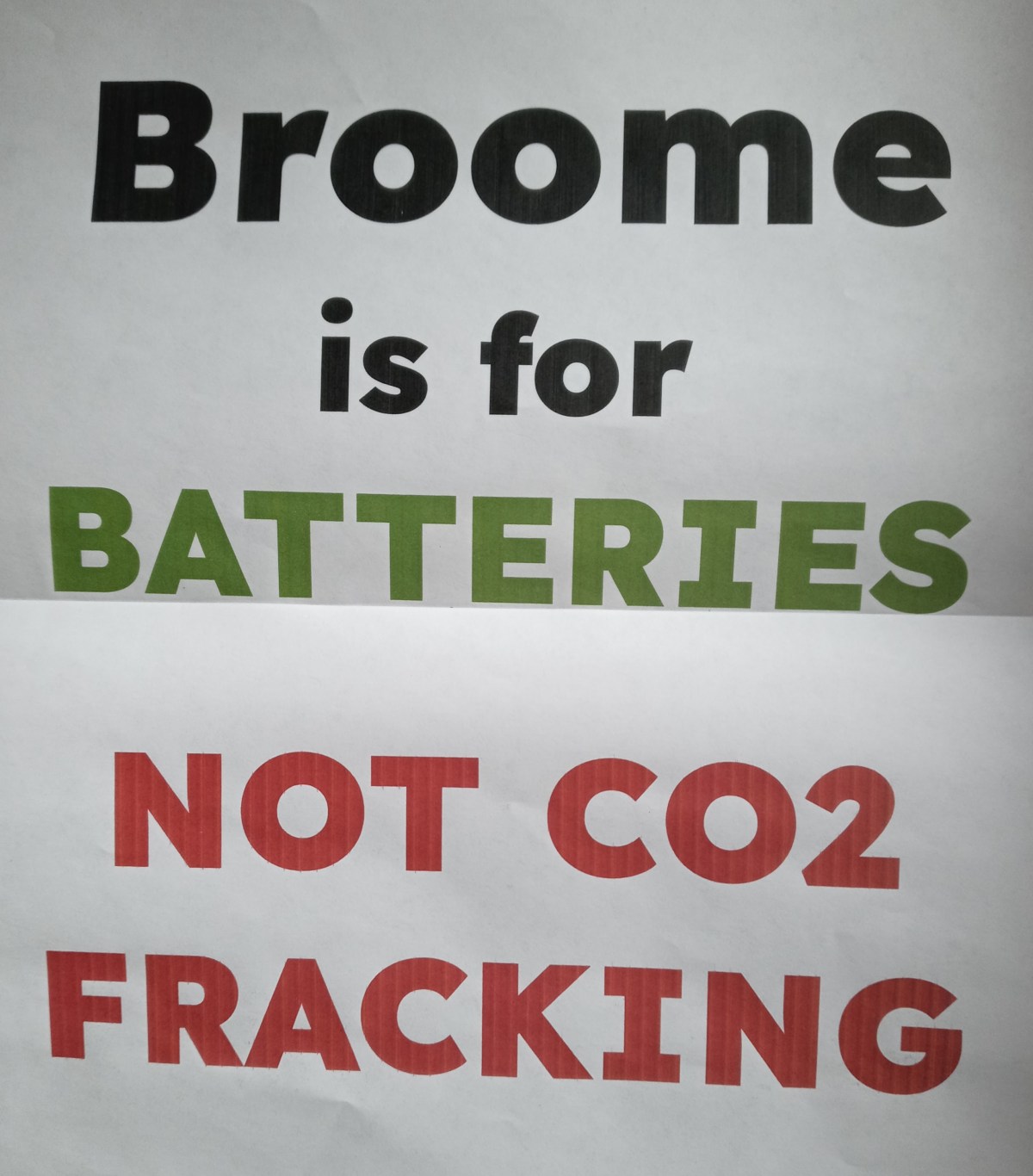
On March 5th, the coalition held a rally/lobby day in Albany. We had great speakers at the rally, including legislators, scientists, and leaders of organizations. I went local with my sign, emphasizing that the Broome County (Binghamton) area is part of the clean energy future as the center of a national technology hub for battery storage through the New Energy New York coalition and neither needs nor wants to be tied to dying fossil fuels. This was my first experience with in-person rallying and lobbying at the New York State Capitol. I was overwhelmed by the noise and busy-ness of it all but grateful to have been able to do my small part in the effort.

I’m thrilled to report that, on March 12th, the Assembly passed the bill with a vote of 97-50 and. on March 20th, the Senate followed with a vote of 45-17. Now, we are moving into the final phase, asking Governor Hochul to sign the bill quickly.

I’m shocked that the coalition was able to get this to move so quickly in Albany. As a Southern Tier resident, I’m immensely grateful to have support from around the state. In the original fight against hydrofracking, there were some very loud voices that were willing to use the Southern Tier as a sacrifice zone to get cheaper methane for their own use; this time, with the CLCPA in place, we didn’t encounter that sentiment as much. I’m also especially grateful to the Third Act Upstate NY working group, who jumped in as soon as I raised the alarm. Third Act is too new an organization to have been around for the original fracking battles but many members have extensive experience with climate activism and organizing and know how to get the word out.

While it seems that this is a local issue of a few counties in New York, the carbon dioxide drilling/sequestration scheme has global implications. Like plastics, it is an attempt by the fossil fuel industry to keep the world dependent on fossil fuels for decades to come, in defiance of the science that demonstrates the need to reduce atmospheric greenhouse gases as quickly as possible to keep the planet livable.

Part of the price to get fossil-fuel bro Joe Manchin’s vote in the US Senate on climate legislation was to include massive subsidies for carbon sequestration. It’s those subsidies that are behind STS’s proposed scheme to profit from the methane in the Marcellus and Utica shales, which is not economically viable to produce on its own. Using carbon dioxide from burning fossil fuels to extract even more fossil fuels is also inherently deleterious to environmental health and the climate. While there may be some instances where industrial carbon emissions can be collected and sequestered, the geology of the Southern Tier would not seem to support long-term sequestration. Sequestration would also be near-impossible in areas with a history of oil and gas wells because there would be too many pathways for injected carbon dioxide to escape.

My hope is that the example of New York banning this extraction/sequestration scheme will help other jurisdictions around the world see through the fossil fuels industry’s increasingly desperate attempts to keep the world burning their dirty products, even with the effects of climate change already causing damage and misery on a global scale.

Watch for news of these kinds of proposals near you. Don’t fall for the lies of the fossil fuel industry. Follow the science. Advocate for clean, renewable energy. Let elected officials know that we need and want protection from pollution and climate change. With so much damage already having been done, we need to act decisively now.

Together, we can move in a positive direction, as we are here in New York.

One-Liner Wednesday: Senate debate

This afternoon in Albany, Senator Lea Webb will lead the effort to add carbon dioxide to New York State’s existing high-volume hydraulic fracturing ban, all of which I will explain in a post at some point…

This (somewhat informative) post is part of Linda’s One-Liner Wednesdays. Join us! Find out more here: https://lindaghill.com/2024/03/20/one-liner-wednesday-technology/