today’s changes

When I wrote about covid-19 over the weekend, I assumed that things would continue to change.

I was correct.

Today, I learned the following:

  1. While visitors are still allowed in Paco’s independent living apartment building, they are no longer allowed in public areas, including the dining room. This means that our usual Sunday morning breakfast together won’t be possible, unless we order ahead and Paco goes to pick it up from the dining room.
  2. My hopes that the panic buying for groceries, medications, and household goods was just for Friday and over the weekend were dashed. It took three stores today to find a short list of items that Paco or my household needed. None of it was hoarding or earth-shatteringly necessary, but it was so strange to still see entire categories of foods unavailable.
  3. Stores are adjusting to the circumstances as best they can. Wegmans, where I usually do most of my shopping, has instituted limits on certain items, hoping to keep staples available for as much of the day as they can. They are usually open 24 hours a day, but are now closing between midnight and 6 AM to allow for more extensive re-stocking. Even with that, there was almost no fresh meat this morning and there were signs up saying they wouldn’t be getting a shipment until tomorrow afternoon.
  4. People must rely a lot on peanut butter, because it is very hard to find.
  5. France is reporting that over-the-counter anti-inflammatories may worsen covid-19 symptoms. They recommend other fever-reducing medications, such as acetaminophen.
  6. Starting at 8 PM today, all restaurants in New York, New Jersey, and Connecticut will be open only for takeout and delivery. Also, the new definition of allowable gathering size is 50. This will effectively close lots of businesses and organizations.
  7. Many of the closures are scheduled until end of March or mid-April, but many of us assume they will go on longer.
  8. I had thought that the United States national government had the most haphazard response to covid-19, but it appears the United Kingdom is also in the running for this dubious distinction. Because my daughter and her family are in London, we often exchange news. The UK is not even using social distancing as a strategy for the population at large. It’s mind-boggling and scary. [Update:  Right after I published this post, my daughter sent me a link showing that someone finally got through to Boris Johnson that he needs to change his strategy for the UK.]

Who knows what tomorrow will bring?

(I will try to make my next post be about something cheerier.)

charting a pandemic path

Around the world, most of us are sharing in the battle to limit the damage from COVID-19 to the extent possible.

In some places, the path is proscribed by local or national government and there are not a lot of personal decisions to make.

Here in my county in upstate New York (USA), things are not laid out as clearly. I have been trying to prepare and make plans, but circumstances keep changing – and so must the plans. Our state and local governments and community organizations have been much more proactive than the federal government, but, as more and more cases are diagnosed closer and closer to where I live, additional measures continue to roll out.

Over a week ago, I started the general preparedness guidelines to have a couple of weeks of food and medications available in case we had to self-isolate. This was not a big deal for our house, but I have been much more concerned about preparing things for my dad, known here as Paco. He lives in a senior community in an independent living apartment, so he has a number of services available in-house, but I visit every day to check on him, make sure his medications are all organized and his schedule is laid out, etc. Early last week, a sign went up that people who were having any symptoms of illness should not visit. This is practical and a commonsense precaution that I would follow anyway, but, later in the week, the health care part of the center was closed to all visitors, except those whose loved one is in very grave condition. This meant that Paco could no longer go over to concerts and singalongs held in the health care facility. At the same time, they cancelled activities in independent living that involved outside performers or volunteers. For example, the Irish dancers would not be able to come for a scheduled pre-St. Patrick’s Day performance.

At this point, I had to face the probability that even healthy visitors might not be able to visit independent living at some point, so I started making contingency plans that could be carried out reasonably well without me. Sadly, we’ve had to cancel a planned visit from my sisters and their families to celebrate Paco’s 95th birthday later this month. They all live in areas where the virus is more prevalent and we didn’t want to risk them bringing it with them, given that they might not have obvious symptoms.

Thursday night into Friday, several large employers announced that they would be having most of their employees work from home starting on Monday. The universities had also announced that they were moving most of their instruction online for several weeks or the rest of the semester. Professional sports leagues announced they were suspending or delaying their seasons. Some combination of these functioned as a trigger that caused some people who hadn’t been taking the virus very seriously to spring into action – or, at least, into shopping. I went to my favorite grocery store to pick up a few things for Paco and for my household and was surprised to find that there was almost no peanut butter, canned legumes, frozen vegetables, etc. in the store. And I hadn’t even checked the cleaning supplies and paper goods aisles. The evidence of panic-buying took me by surprise. Given that I had been in concern and preparation mode for days, I had obviously underestimated the number of people who were suddenly paying attention and freaking out a bit.

On Saturday, the county executive announced that all primary and secondary schools will close through mid-April. Now, people are even more upset.

It appears that there are some people who still think that fears of the virus are overblown, given that we have no known cases in our county, even though our neighboring counties do have confirmed cases; they don’t want their personal and family routines disrupted. Others have been following the news and the advice of medical experts and realize that, while we can’t stop the virus completely, there will be fewer deaths and more treatment available to those with severe illness if we can spread out the number of cases over a longer period of time, so as not to overwhelm our medical system. The way to do that is to reduce the number of people who are in close contact and in large groups, also known as social distancing.

There are a number of different opinions about how much distance is required and how many is considered too many to be in a crowd. This leaves some situations to personal discretion. I admit that I had a difficult time figuring out what to do about church attendance this weekend. Our diocese has dispensed with our obligation to attend mass, but services are still being held. I am not especially concerned about my getting seriously ill, but I am concerned with the possibility of bringing the virus into Paco’s community, so I’ve decided to participate in a mass on television. At least for now, I plan to still shop. occasionally eat at restaurants, and attend small gatherings with friends. If we start seeing community spread in my town, though, I’d cut back further. If we get to that point, I’m sure I wouldn’t be able to visit Paco; it’s likely that only residents and staff would be allowed in the building.

I admit that it is disconcerting to know that, despite our best efforts, people are going to continue to get sick, some of them severely sick, and some of them will die. I hope that our communities will face up to this challenge and do as much as we can to protect people, especially the most vulnerable.

Be well. Be kind. Be thoughtful. Be considerate.

SoCS: barbed wire

When daughter T was working in Clinton, Missouri, we visited the local museum. The collection was very eclectic with unexpected things around every corner.

One of the exhibits was a barbed wire collection. I hadn’t realized there were so many different styles.

Having grown up in rural areas, both my spouse B and I were familiar with barbed wire fences. B had grown up maintaining a barbed wire fence around the pasture. I grew up with a barbed wire fence that ran along the edge of the reservoir behind my house.

Both of those were meant for protection. It saddens me to think of barbed wire being used to keep people away, though. It especially hurts to think of people who are fleeing war and violence being encountered with barbed wire and other barriers. Instead of finding protection, they find exclusion.

Barbed wire fences never seem to have gates.
*****
Linda’s prompt for Stream of Consciousness Saturday this week is “wire.”  Join us! Find out more here:  https://lindaghill.com/2020/03/13/the-friday-reminder-and-prompt-for-socs-march-14-2020/

2019-2020 SoCS Badge by Shelley!
https://www.quaintrevival.com/

JC’s Confessions #10

On The Late Show, Stephen Colbert does a recurring skit, now a best-selling book, called Midnight Confessions, in which he “confesses” to his audience with the disclaimer that he isn’t sure these things are really sins but that he does “feel bad about them.” While Stephen and his writers are famously funny, I am not, so my JC’s Confessions will be somewhat more serious reflections, but they will be things that I feel bad about. Stephen’s audience always forgives him at the end of the segment; I’m not expecting that – and these aren’t really sins – but comments are always welcome.
~ JC

I don’t feel like a musician anymore.

I started playing piano at seven. I began studying organ as a preteen and was the organist of my rural Catholic church at fourteen. I majored in music at Smith College, where organ was my main instrument, I played often at chapel, I sang in choirs, learned that I could compose, and was named the Presser Scholar in my senior year.

After I graduated, married B, and moved to the Binghamton NY area, I continued with church music until I took a few years away when my children were young.  Realizing that it wouldn’t work for our family for B and I to never have a common day off, I volunteered with the music ministry at my church, accompanying the youth and junior choirs and subbing when our music director needed to be away. When tendon problems in my elbow eventually made it impossible for me to play for very long at a time, our music director would play and I would conduct.

When our parish disintegrated in 2005 and my church music volunteering evaporated, except for occasional special celebrations, I still had my long-time affiliation with University Chorus to keep me musically active. After the retirement of our long-time director, though, University Chorus, which used to sing a major concert every semester, has cut back to only singing at one concert a year, at most. This academic year, we have not met at all and I am not sure we will ever re-convene. Due to uncertainty and personal scheduling complications, I haven’t been able to join another group.

With my last steady musical commitment gone, I don’t feel that I am still a musician, which leaves an empty space in my identity. In a period of my life when there has been so much loss, losing that piece of myself is especially difficult because music has long served as a vehicle to express emotion and to find community and comfort.

I don’t know if I will ever recover the musician part of my identity. Theoretically, I could be singing on my own every day and working on sight reading so that I would be ready to audition if there is an opportunity, but it feels too futile, not helped by the fact that I am a very anxious and not particularly good auditioner.

It is likely that I will sing again with the Smith Alumnae Chorus, either on campus or on tour, but those choral experiences would only be a few days a year. Not an identity-affirming amount of time.

Maybe what I should say is that, for many years, I was a musician.

SoCS: E-I-E-I-O

When my granddaughter ABC was living with us, we sang a lot of songs with her, but one of her favorites was “Old McDonald”.

I would often sing it to her when we were trying to get her to sleep. Using it for that purpose, I would try to sing as many verses as possible, and would extend each verse by singing the animals sounds backward in succession.

This was a challenge when you were doing 15 verses or so. In order to keep things, well, in order, I would group the animals and then remember the order within each subgroup.

I’d start with barnyard animals, cows first because she had a book where Old McDonald had a cow. (It was a board book, so only cows.) Then, horse, sheep, pig, sometimes goat, ending with dog and cat, which could be pets or work animals.

Next, I would go on to fowl. Chicken, duck, goose, turkey, sometimes chicks and doves.

E-I-E-I-O!

Then, I would go on to animals that could be wild animals or ones that were part of the farm. Frogs, bees, and sometimes animals that don’t make sounds, like rabbits. (FYI: rabbits go hop, hop here and hop, hop there.)

I could sing continuously for about fifteen minutes, which was usually enough for ABC to drift off to sleep. I’d sometimes back out of the room and close the door still singing.

Ending very quietly e-i-e-i-o…

ABC, who is now living in London, is now heavily into dinosaurs and making what she thinks are dinosaur sounds.

I don’t think Old McDonald had one of those…

E-I-E-I-O!
*****
Please join us for Linda’s Stream of Consciousness Saturdays! This week’s prompt was animal sounds. You can find more info here.

2019-2020 SoCS Badge by Shelley! https://www.quaintrevival.com/


Family time in London

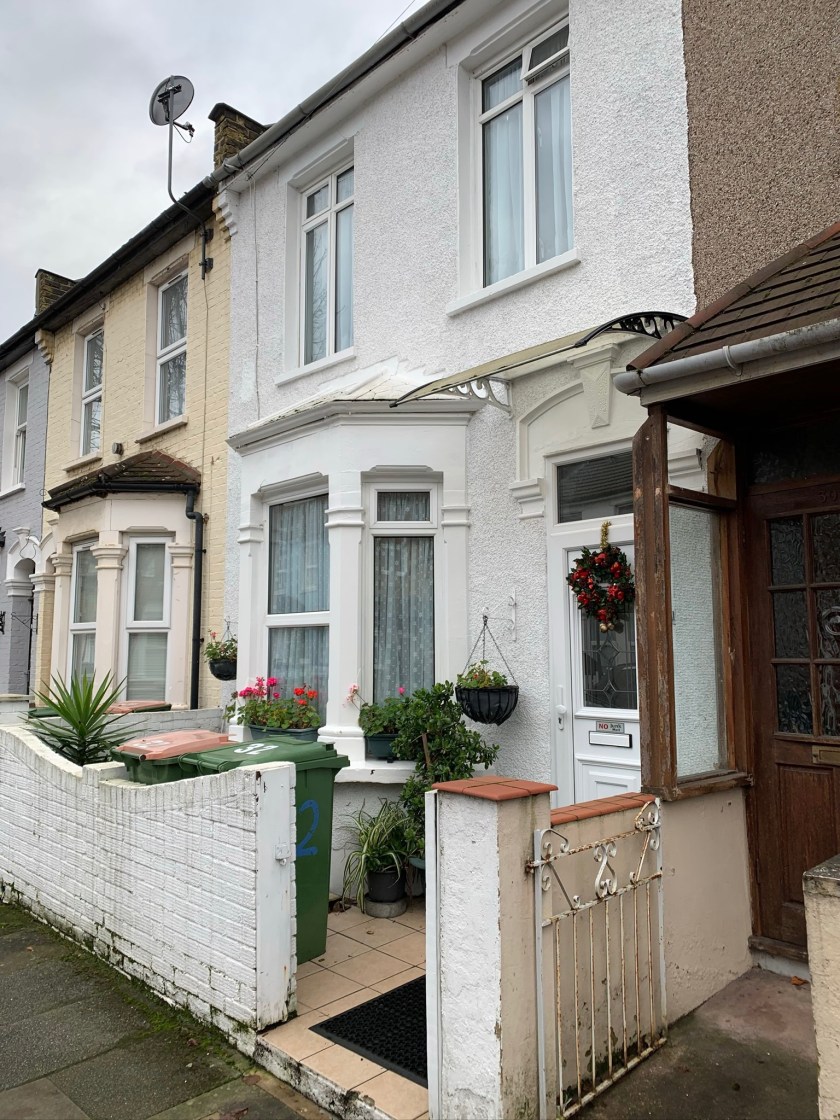
One of the great things about going to visit family living in a historic and dynamic city is that you get to experience non-touristy, neighbourhood life. (I hope all my UK and Commonwealth friends will appreciate my remembering to put the u in.) L, E, and ABC live with L’s parents in Plaistow. The row houses there remind me of ones that you see in some US cities.
Larry's parents' house in London
L’s parents love gardening. The weather in London is mild enough for flowers outdoors in the winter. There were definitely no flowers co-existing with Christmas wreaths at our house in upstate New York!

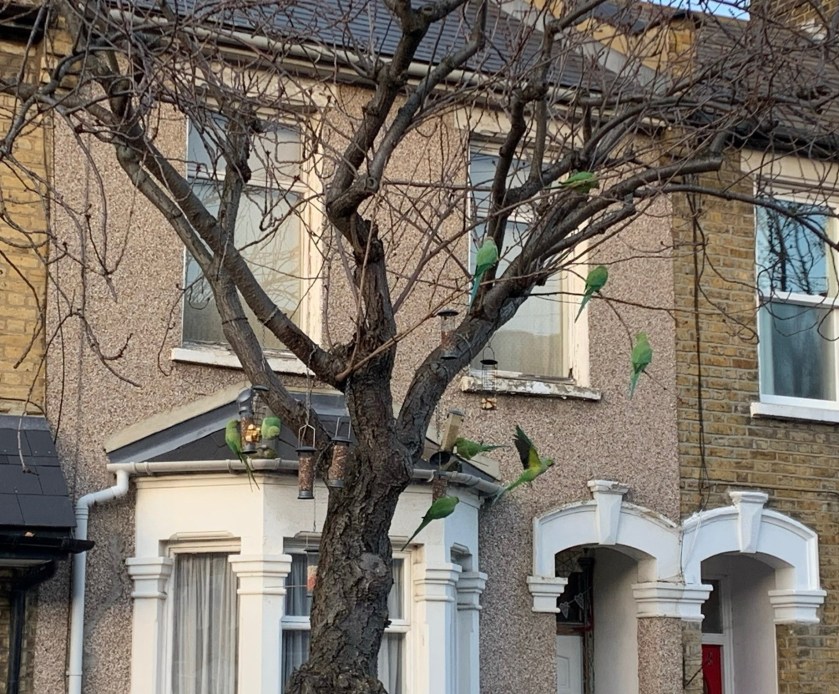
We were surprised to see a tree full of parakeets! Apparently, escaped parakeets have led over the decades to thousands of these birds flying about London.
parakeets in London!

We learned that while most of the utilities are underground, the phone lines are not. Londoners get a lot of use from one utility pole!
London telephone lines

While we sometimes went in a family car, we most often got around by train or bus. Never having lived in a large city with good public transportation, I appreciated the extensive network of routes. While people in the US tend to think of double-decker buses as tourist vehicles, they are the common bus on most routes. They can carry twice as many people as regular buses and there are definitely a lot of people on the move.
London bus station
ABC loves to go on the buses and trains, especially when she can sit in the front of a train car or the top level of a bus. She likes to pretend she is driving.

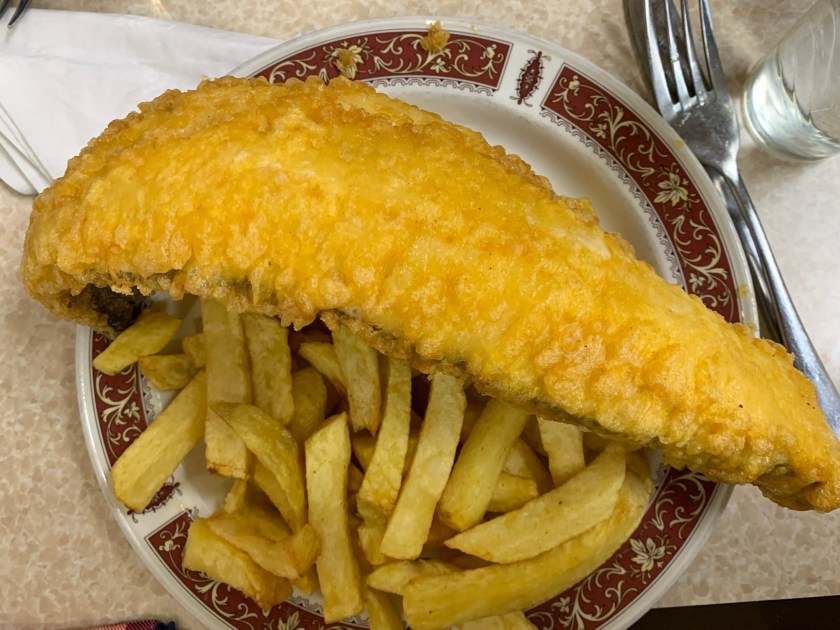
Another advantage of being with Londoners is that they can direct you to phenomenal neighbourhood fish ‘n chips shops that a tourist would never find. We decided on haddock and there was so much food it overflowed the plates!
London fish 'n chips
It was also great to have so many home-cooked meals, especially when we had Filipino dishes. Given that most of us came down with a cold, it was especially great to have homemade soup.

More in London

Earlier, I posted about the beginning of our trip to London. Continuing on…

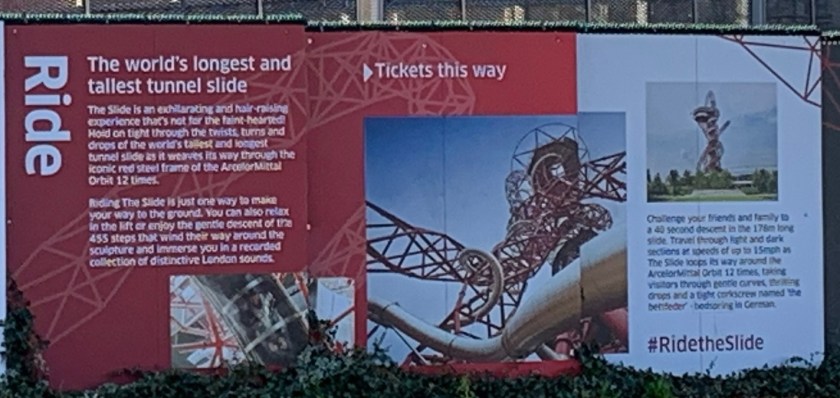
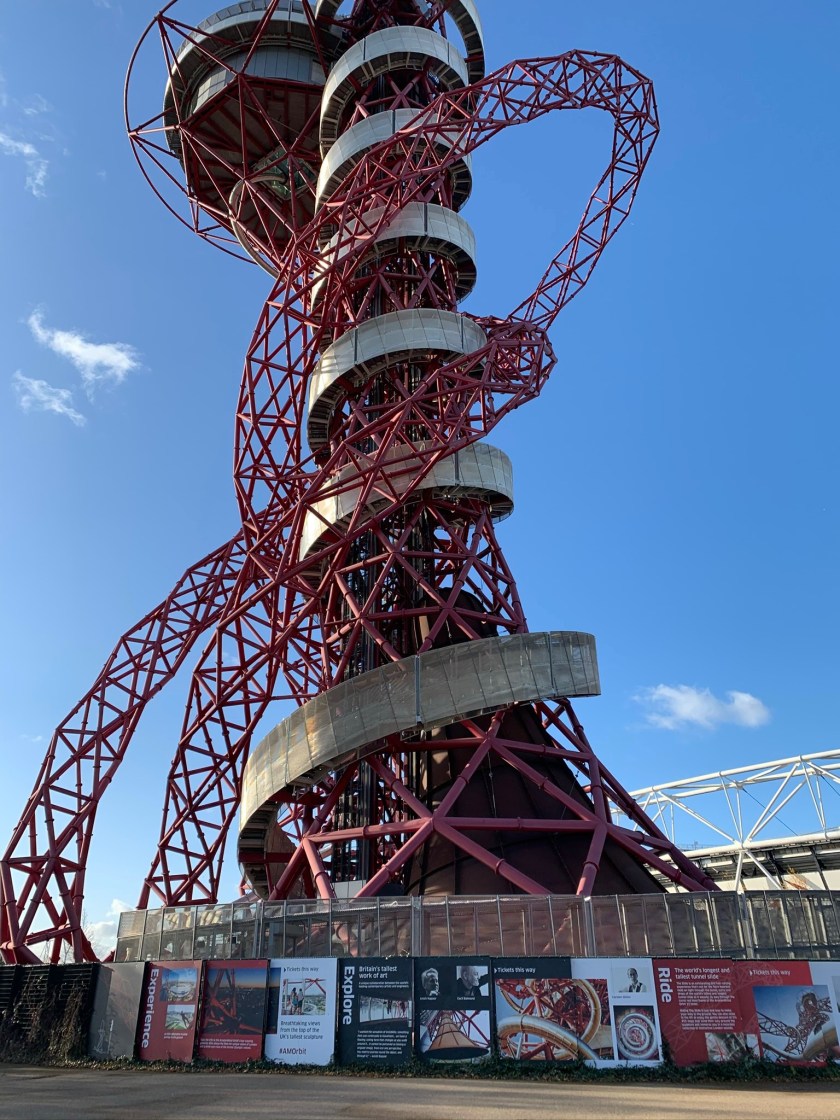
sign for London slide
Why, you may ask does London have the “world’s tallest and longest tunnel slide”?

Olympic torch-slide
Answer:  Because the Olympic torch structure was very, very tall and curvy.
When we watched the 2012 London summer Olympics, we didn’t really appreciate the scale of the torch, but we certainly did standing near its base and looking up. We did not go on the slide. It was very windy, damp, and chilly the day we were there. Maybe on a future visit when it is warmer.

Parts of the Olympic Park are open for walking, biking, etc. There are gardens from the different continents, which were interesting to T, who has a master’s in conservation biology of plants, even though it was winter. The former Olympic stadium is now home to the West Ham football (soccer to US folks). Interestingly, the old West Ham stadium used to be next to L’s church. That site is now being redeveloped as housing and such.
West Ham stadium at Olympic Park

I’m sure you notice the crane and construction site in the foreground. Much of the Queen Elizabeth Olympic Park area is under development. (It’s good to be the queen! You get lots of things named after you.) Most of the new venues will be cultural and/or educational. In the future, there will be museum space, a theater, the London College of Fashion, the BBC music studios, and more, including a hip hop academy.

There are already many stores open near the Park. We spent quite a lot of time at Marks & Spencer, a London-based chain of stories that combines a department store, grocer, and cafe rolled into one. Here is ABC sharing her grandpa’s chocolate cake. We think she may have eaten more than he did! ABC was also rockin’ the ever-expanding dinosaur section of her wardrobe.
Ada and chocolate cake at Marks & Spencer

We also visited E’s favorite chocolate shop, Hotel Chocolat. They offer lots of yummy treats, including vegan chocolates for the lactose-intolerant segment of the family and white chocolate for me, who, sadly, can no longer eat cocoa. It was a fun place to shop for Christmas chocolates to bring home. Just in case you needed a reminder of how long it has taken me to roll out London posts…


SoCS: snow

It’s been an odd fall/winter season here in upstate New York. We had a lot of snow in the second half of fall and then not much since.

Until yesterday.

We were originally in a 4-7 inch band but overnight got bumped into 6-12 inches. When the snow started, it came down fast, between one and two inches an hour. (Sorry that I can’t do all the centimeter conversions in stream of consciousness, but 1 inch is about 2 and a half centimeters.)

I wanted to shovel during the storm because it can be hard to move deep snow all at once at the end of the storm. I had ambitions to keep the driveway and walk relatively clear.

Well, as it turned out, ambitions, but not enough strength.

The snow was very heavy, the kind that packs really well but is a bear to shovel because it sticks to the shovel, making it difficult to throw onto the snowbank. If ABC were still living here, we would have had fun making snow-children with the sticky, packable snow. They don’t tend to get a lot of snow in London, though. Maybe I should have made a miniature snow family and sent her a photo. When E and T were young, we used to make smaller snow figures instead of Frosty the Snowman size ones. It was easier for little hands – and very cute besides!

Because it has not been a very snowy winter here, we don’t have much snowpack to speak of. That’s not much of a problem here because we tend to get adequate precipitation throughout the year. I know that some places need to depend on the snowpack for water in the spring and summer, though, so I hope those regions are getting plenty of snow.

When I was growing up, my dad, known here at TJCM as Paco, worked for New England Power in the hydro division. They had several reservoirs and hydroelectric stations along the upper Deerfield River. I remember Paco and his crew going up into the woods to measure the snowpack and how much water it was holding so that they could predict how the spring run-off would be. They wanted to be able to fill the reservoirs and control the flow in the river so that it didn’t flood – or, at least, didn’t flood too badly. In those days, with climate change impacts not as pronounced as they are now, they were able to predict things pretty well. Paco has been retired for a long time and doesn’t live in that area anymore, but I’m sure his successors have a more challenging time assessing run-off from their snowpack measures.

Everything is so much more unpredictable nowadays.

In a lot of ways, but that would be another (several) posts…,
*****
Linda’s prompt for Stream of Consciousness Saturday this week is “(un)pack.”  Join us! Find out how here:  https://lindaghill.com/2020/02/07/the-friday-reminder-and-prompt-for-socs-feb-8-2020/

One-Liner Wednesday: dinosaurs!

“T-Rex ate meat!”
~~~ how my two-year-old granddaughter ABC greeted the choir, the priest, and random parishioners at church last Sunday
*****
Join us for Linda’s One-Liner Wednesday and/or Just Jot It January! Find out how here:  https://lindaghill.com/2020/01/29/one-liner-wednesday-jusjojan-the-29th-2020-doggy-boo-boo/

Badge by Laura @ riddlefromthemiddle.com

Sightseeing in London

Last month, my spouse B, younger daughter T, and I made our first family trip to London to visit daughter E, her spouse L, our granddaughter ABC, and L’s family. After almost three years of waiting, E’s spousal visa finally came through and she and ABC relocated to London in October.

Yes, I am horribly late posting about the trip. I came home sick and had a hard time shaking it and there were holidays and technical issues – I am notoriously bad at dealing with photos – but I’m hoping to get out a few posts in the coming days.

We arrived in the UK on Saturday and did central London sightseeing on Sunday, after attending mass the church where Larry serves as organist and director of the adult choir. We had bought advance tickets to ride the London Eye, also known as the Millenium Wheel.
London Eye

It was nice to see some of the historic London landmarks from above. Here is the Palace of Westminster, where Parliament meets. You can see the clocktower which usually houses Big Ben shrouded in scaffolding as part of the ongoing restoration project.
Parliament

Two-and-a-half-year-old ABC was much more impressed with the boats on the Thames than the buildings!

After our ride on the Eye, we grabbed some lunch and went on a walking tour. On future trips, we may try to tour some of the buildings. We anticipate many trips to London in the future!

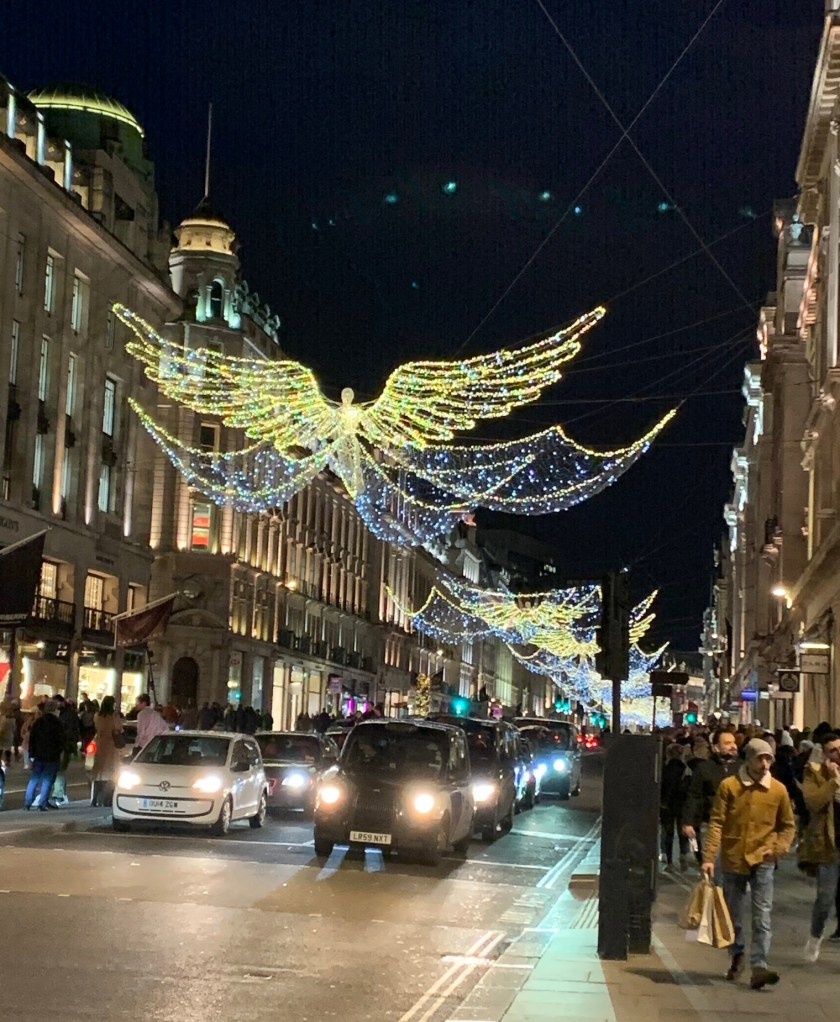
Because daylight hours are short in London in the winter, as we walked in the area of Trafalgar Square and Piccadilly Circus, we were able to see some of the holiday lights.
London holiday lights

In Trafalgar Square, we were drawn to the sculpture on the Fourth Plinth, part of “The Invisible Enemy Should Not Exist” by Michael Rakowitz, a US artist of Iraqi ancestry. It is a replica of Lamassu, a protective deity from the gates of Nineveh in 700 BCE which was destroyed by the Islamic State in 2015. This sculpture is made from 10,500 empty date cans; dates were once a major part of the economy in Iraq, but 90% of the 30 million date trees have been destroyed in the long years of war. Rakowitz is trying to recreate all the art that was stolen from the museum in Baghdad or destroyed at sites across Iraq.  The art on the Fourth Plinth changes every couple of years and this sculpture will be replaced in 2020, so we were fortunate to have seen it.
Lamassu sculpture in London

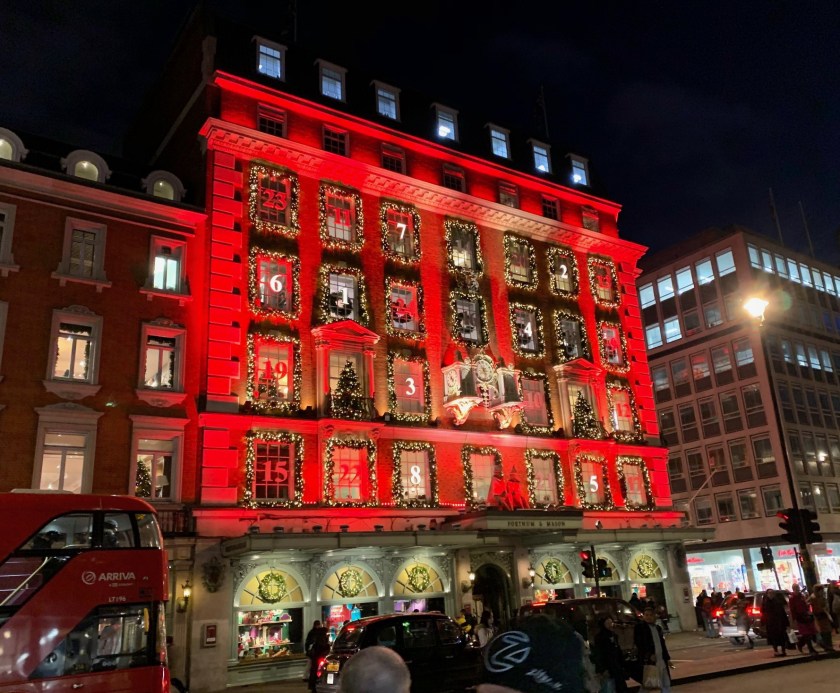
As we were walking in the Piccadilly shopping district, I was delighted to see this building with Advent calendar decorated windows. It is Fortnum & Mason, a fancy department store. We went in to browse a bit, but it was so crowded we could barely move. We are definitely not used to that!
Advent calendar F & S

It was fun to see some of London with holiday lights. While we expect to visit frequently in the coming years, I don’t know how often we will be able to go in December. Time will tell…

Photos courtesy of B
*****
Join us for Linda’s Just Jot It January! Find out more here: https://lindaghill.com/2020/01/27/daily-prompt-jusjojan-the-27th-2020/