JC’s Confessions #24

In the first few seasons of The Late Show, Stephen Colbert did a recurring skit, then a best-selling book, called Midnight Confessions, in which he “confesses” to his audience with the disclaimer that he isn’t sure these things are really sins but that he does “feel bad about them.” While Stephen and his writers are famously funny, I am not, so my JC’s Confessions will be somewhat more serious reflections, but they will be things that I feel bad about. Stephen’s audience always forgives him at the end of the segment; I’m not expecting that – and these aren’t really sins – but comments are always welcome.

JC

Over the many years of caregiving and volunteering I have done, people have often advised (admonished) me to “take care of myself.”

I don’t think it is something that I do very well.

I do try. I eat well (usually) and sleep (generally not so well, but not for lack of trying). I do my physical therapy exercises most days and speak with my counselor on a regular basis. (I love getting massages but the pandemic and other complications have interfered with what used to be a regular part of my self-care plan.)

I admit that the amount of stress, grief, and loss has been high for a lot of years. I would sometimes joke in recent years that it was too late for whatever stressor to give me gray hairs, although I notice that my eyebrows are beginning to turn silver and that my facial lines seem to be more indicative of sadness, unless I am actively smiling. (Or maybe this is straight-up aging, rather than stress-induced?)

(Hmmm…wonder if my extensive use of parentheses in this post is a form of denial, distancing, or hedging?)

But here’s the thing. When people want you to “take care of yourself,” the subtext is often to put yourself first, which is not my nature as an HSP (Highly Sensitive Person). I will always care about what people close to me are experiencing and try to do whatever is in my power (and sometimes attempt what is not really in my power) to help. I also feel compelled to serve my neighbors, whether near or far, which, given the state of the US and the world, is a huge task, but I try to shoulder my tiny sliver of it as best I can.

It’s a lot.

I can hear some people’s brains clicking with (totally valid) thoughts about boundaries and such…

And maybe I’ll manage that wisdom if I am gifted with enough years.

Or maybe I will always be “guilty” of prioritizing the needs of others before my own.

Or maybe that is just who I authentically am.

heatwave kitchen

I did something I seldom do this morning.

I wore an apron.

Like many other locations in the Northern Hemisphere, this week we are having a heat wave. It was already 90 F (32 C) by 11:00 AM, so two hours before solar noon, given Daylight Saving Time. Not quite as bad as daughter E in London which set an all-time record at 40 C (104 F) earlier this week, but hot enough that I wanted to get kitchen work that involved heat out of the way this morning.

When I was at the farmstand earlier this week, they were selling beets for only a dollar a quart, so I bought some to roast. I decided to peel and cut them in chunks before roasting. Because I didn’t want to risk splattering my cream and blue print sundress with red beet juice, I donned the apron that B wears sometimes when he is baking.

While the beets were roasting, I made cooked butterscotch pudding for a pie. When I was growing up, my mom used to make pudding pies or sometimes fruited jello pies in the summer. I think that it isn’t a very common practice anymore because there were no pie directions on the pudding package. I remembered the modifications well enough, I hope, that the pie should set. Bonus: I had a graham crust in the cupboard so I didn’t have to bake one.

Admittedly, I don’t have to worry about our kitchen getting unbearably hot because of our air conditioning, provided very efficiently by our geothermal heat pump system. (Geothermal heat pumps use much less energy than conventional central air systems but I wanted to get my electric cooktop and oven work done early so as not to add to the electricity burden which rises in the late afternoon/evening.)

As I keep hearing about people in Europe and the US suffering from extreme heat, my mind goes to heat pumps which will keep them warm in the winter without burning methane and safely comfortable in the increasingly hot summer heat waves, all while helping to combat the greenhouse gas emissions that worsen climate change. Bonus: Heat pumps can break the stranglehold that Russia and other oligarchies have over fossil fuels, promoting peace and economic stability. So much conflict has fossil fuels as an underlying cause. We would do well to stop using them as quickly as possible, so, for peace and the planet, let’s transition to heat pumps NOW.

The US and guns – update

In late May, when I wrote this post, I knew there would need to be an update in the continuing saga of gun violence in the United States. A lot has happened since then, so here goes.

In the wake of the national furor over the Buffalo and Uvalde shootings, a bipartisan group of senators managed to hammer out a bill that could pass. It is much weaker than the bill that had originally passed in the House but does have some important provisions. It increases funding for mental health services, which is much needed. The impact on mass shootings is unclear but the majority of gun fatalities in the United States are suicides, so there is hope that these funds will avert some share of these deaths. There are incentives for states to implement red flag laws, which prevent firearm sales and/or remove guns from homes where someone is deemed threatening to themselves or others. The laws preventing those convicted of domestic violence from obtaining guns were strengthened. There will be enhanced background checks for those ages 18-20. Penalties for those who purchase guns for someone who is not eligible to own one have been increased. Funding for security in schools will increase.

Unfortunately, stronger prevention measures were not included, most of which have broad public support. Among these are strengthened and universal background checks, banning military-style assault weapons and large ammunition clips, and raising the age to buy semiautomatic weapons to 21. It’s unlikely that Republicans will agree to any further national legislation in the immediate future, so it is up to states to do what they can to protect people, although it is easy for anyone intent on getting a weapon to do so by visiting a state with looser regulations.

Ironically, just as this legislation was passed, the Supreme Court handed down an opinion that struck down the process to carry a concealed weapon in my home state, New York. This law, which had been on the books for over a century, was somehow not deemed to be part of our history and tradition by the conservatives on the Court, while ignoring the clear text of the Second Amendment that places gun rights in the context of “a well-regulated militia.”

Governor Hochul called the state legislature, which usually is in session only in the winter and spring, back from recess to pass new laws that would seem to be acceptable to the Court which had objected to a gun owner proving that they needed to carry a concealed weapon for protection. The new laws include mandatory standardized training and tests to obtain a concealed carry permit, a blanket prohibition on carrying firearms on private property and businesses unless they expressly give permission, and a list of “sensitive places” where concealed weapons are not permitted, including public transportation, medical facilities, schools and day care facilities, libraries, government buildings, houses of worship, public demonstrations, entertainment venues, and establishments that serve alcohol.

There are also provisions that strengthen New York’s already relatively strict gun laws, including background checks for all ammunition purchases, enhancements of the safe storage requirements including in vehicles, and extending the sales ban on body armor to include hard body armor which was used by the shooter in Buffalo.

These new laws will take effect on September first. They may be challenged in court but the legislature and governor tried to design them in such a way that they will be upheld. At least, we will have greater protections while the cases wind their way through the courts.

Meanwhile, of course, gun violence continues unabated. The Fourth of July weekend was especially brutal, with over 500 shootings, at least 11 of which were categorized as mass shootings (four or more injured or killed, not counting the shooter), resulting in over 220 deaths and nearly 570 injuries. The information source for this reporting is the Gun Violence Archive, an organization that collects and compiles data on shootings in the US. That our country has need of such an organization is sobering in and of itself. As I write this on July 7, 2022, they have verified 22,733 gun deaths so far this year, of which 12,408 were suicides.

The most prominent of the mass shootings this weekend was at a Fourth of July parade in Highland Park, Illinois, just outside of Chicago. A 21-year-old man, shooting with a military-style weapon from a rooftop overlooking the parade route, killed seven with several dozen wounded. He was later arrested and has confessed to the crime. Our news reports are filled with the tragic losses of family members, including the parents of a 2-year-old who was found beneath his father’s body.

This father died protecting his only child from a young man who should not have had a weapon of war. All of us need the protection of law to keep these weapons out of civilian hands. Congress, do your job and pass more laws so that our rates of gun violence are more in line with those of other advanced democracies. Other countries have similar rates of mental illness, violent video games, and social problems, but have nowhere near our rates of gun violence. Republicans, it’s time to wake up and admit the truth that the heart of the problem is too-easy access to guns, especially military-style weapons. And remember that your beloved Second Amendment is about a “well-regulated militia” – now akin to the National Guard – not your mentally unstable 18-year-old neighbor who has fallen into some dark conspiracy-laden corner of the internet and thinks he should kill some folks to show he has power over them.

Congressional Republicans, you have the power to join with your Democratic and Independent colleagues to protect us. If you need help mustering courage, look to the example of that dad in Highland Park. Your possibly sacrificing a few votes in your next election or some campaign contributions is nothing compared to his sacrificing his life and his chance to see his child grow into adulthood.

this Fourth of July

It’s the fourth of July, commemorated here in the United States as Independence Day. It’s supposed to be a “happy” day, but it’s hard to feel happy with our country mired in divisiveness and the undermining of our fundamental rights and democratic institutions.

I know I have been relatively silent here at Top of JC’s Mind lately. Part of it is a renewed wave of grief over Paco as we have entered the one year anniversary of his fall and final decline and the fact that I had deferred a large portion of my grief over Nana while dealing with his needs.

The larger share of my delays in posting, though, is that the posts I need to write about the Supreme Court decisions and the January 6 Select Committee hearings are difficult to write.

The Preamble to our Constitution proclaims that “We the People” are striving toward “a more perfect Union.” This Fourth of July is one of grief, watching my country lurch further away from that ideal rather than making halting, if messy, progress toward it.

COVID update

Remember the COVID-19 pandemic?

It’s still going on, even though most people here in the US are ignoring it. We crossed the one million death threshold in mid-May, although it is likely that the true number is higher as not all deaths caused by COVID are listed as such.

The good news in the US is that both the Moderna and Pfizer/BioNTech vaccines have been approved for children beginning at six months. It remains to be seen how many parents/caregivers decide to vaccinate their babies/toddlers/preschoolers. If it were me, I’d be first in line, but I expect we won’t see very high numbers. Only about 30% of 5-11-year-olds are fully vaccinated, despite availability since November, 2021. This boggles my mind, given that these same parents have vaccinated their children against a host of other serious diseases, yet have chosen to leave them unprotected against a disease that has sickened and killed so many here and around the world. It’s true that the vaccines are not a guarantee against infection but they prevent some infections and usually keep those that do occur from causing hospitalizations or deaths. From a public health standpoint, the more people who are vaccinated, the more likely it is that the pandemic will end and COVID-19 becomes endemic.

We are still far from that point, especially as new variants and subvariants are better at evading immunity, whether from vaccination or infection. The US right now is still dealing with Omicron subvariants. BA.2.12.1 is still responsible for the majority of cases here at about 56% but BA.4 and BA.5 are up to 35% of cases which is a large increase and a sign that they may out-compete the already wildly contagious BA.2.12.1.

Our county, which has been struggling with high infection rates for months, mostly due to BA.2 sub-variants that originated in central New York before causing misery more widely, is finally back in the “medium” risk category according to the CDC. It’s a bit discouraging in that Broome and our neighbor Tioga are the only two counties in all of upstate New York that haven’t dropped down into the “low” category. Maybe soon. Meanwhile, I’m continuing to avoid crowds and mask in public places like stores and church.

As you may recall, spouse B and I left the Pfizer/BioNTech COVID vaccine trial this spring in order to receive a fourth shot to boost our immunity before we travelled, but daughter T is still participating. Next month will be the one-year anniversary of her third dose, so she will be having an in-person visit for blood tests and such.

Pfizer and Moderna have both developed newer forms of their vaccines to better battle Omicron. The Food and Drug Administration scientists are meeting today to begin consideration of a new round of booster shots this fall to try to increase protection. It would be great if we can do so. I will definitely get another booster if it is offered, as I am still trying to keep from getting infected because I don’t want to be sick, especially with long COVID.

In the UK, where our daughter E and her family live, BA.4 and 5 are causing another spike in cases. Last week, it is estimated that 1 in 40 people in England and 1 in 20 in Scotland were currently infected. While the UK was initially slow to immunize children, earlier this year they began routine availability for COVID vaccination at age five. ABC’s recent fifth birthday came with the opportunity for her first Pfizer dose, for which we are grateful in the midst of the current wave. While it remains true that children have much lower rates of severe illness than adults, by not immunizing them you are allowing a large pool of little people to congregate, pass around germs, and spread them to their homes and communities. It’s one thing when we are talking about colds or even flu, but COVID-19 is a much more serious public health threat.

As usual, I renew my plea. Vaccinate if you are eligible and have access. Pay attention to infection rates in your area. Mask in indoor public places unless transmission rates are low. Avoid large crowds. Increase ventilation. Stay home if you are sick. Test and talk to your health care provider if you have symptoms. The SARS-CoV-2 virus has already caused immense suffering. Do everything you can to keep it from affecting you, your loved ones, and your community.

a lake, a landmark, and rubies

Spouse B and I returned yesterday from a weekend celebrating our 40th wedding anniversary at Geneva on the Lake. We had never been there before but had received a gift certificate for the inn as an expression of gratitude from my sisters after our father’s death for the years of caretaking for Nana and Paco as the “local daughter.”

Geneva on the Lake is located in the Finger Lakes region of central New York State, on the north end of Seneca Lake, about a two-and-a-quarter hour scenic drive from our home, featuring views of farms, vineyards, forested hills, and the entire western side of the lake.

After delays in our getaway due to pandemic surges, weather conditions, and our trips to the UK to visit family, we decided to go for the weekend of our 40th wedding anniversary. The gift certificate allowed us to splurge on the Loft Suite in the original 1910 portion of the villa, directly overlooking the gardens and Seneca Lake. In this photo, our suite is located on the third floor above the central doors, where you see three half-moon windows and three rectangular windows above.


Here you can see the windows from the inside and why it is called the Loft Suite:


All the furniture in the suite, including in the adjoining bedroom, is Stickley, which is a venerable upstate New York mainstay, still headquartered in Manlius, near Syracuse. I especially enjoyed the loft space for reading and looking out at the lake.

There was also a full kitchen and a small dining table, although we didn’t have much use for them as we ate breakfasts and dinners at the Inn. Our first evening there was warm, so we ate under the canopy on the terrace but the other meals were in the Lancellotti dining rooms. Because we like to eat (unfashionably) early, we were able to sit near the windows and enjoy our food and the view in relative – and unmasked – quiet.

When staff asked if we were there celebrating, we told them it was our 40th anniversary. They would offer congratulations, followed on a couple of occasions by the question, “What’s your secret?” Like the college reunion question about what I’d been doing for the last forty years, I didn’t have a ready answer. If I had been able to think quickly enough, I might have echoed Paco’s line about taking it one day at a time, although I don’t think that is the answer.

Like my answer to most questions, it’s complicated. First, I don’t think there is a secret to being married for forty years. It helps to find the right person when you are young and to manage not to develop a grave illness that threatens longevity. Of course, there needs to be love and respect between the spouses, but that is not a secret.

I think, for B and me, an important factor is that we met and became friends early in high school. Because we experienced adolescence together, we managed to influence, complement, and support each other as we grew into adulthood. I don’t think I would be the same person that I am now without B’s love, encouragement, and commitment over the years.

B and I share our rural roots and were both raised by long-married parents; my parents, known here as Nana and Paco, celebrated their 65th anniversary not long before her death in 2019. We both are of a serious temperament with wide-ranging interests and the inclination to dig deeply into topics. However, our central interests differ. I spend much more time on the arts, especially music, writing, and poetry, and on spiritual/philosophical issues, which influence my analysis on politics and public policy. B is much more involved with technology and quantitative/analytical issues with additional interests in history and science fiction/fantasy. We are both liberal-artsy enough, though, to be able to understand and approach different topics and problems from multiple vectors. This helps when we have to make decisions, whether it’s nuts and blots plans for our home or complex care-giving situations. We have faced a greater than average number of medical problems across our families’generations. Many marriages succumb to these kinds of stressors, but B and I have been able to weather them with our ability to think and talk things through and our commitment to dedicate ourselves to doing the best we are able. Our mantra has been “no regrets” and, while we certainly do have instances where outcomes were not what we had hoped, we are content that we were able to give comfort and care to the best of our abilities.

Sunday was also Father’s Day, our first without Paco and B’s first as being part of the eldest generation in the family. I admit that our anniversary was a good distraction for me to keep me from dwelling too much on being without my father on Father’s Day for the first time. I hope that B will be granted a similarly long stint as a grandparent and, if ABC and/or JG choose, the opportunity to become a great-grandfather someday. B loves being a grandpa, although the distance factor does present complications. We are hoping, though, that when B retires, we may be able to spend some longer periods of time in the UK.

We returned home from Geneva in time to celebrate Father’s Day and our anniversary with daughter T, who had chosen cards for the occasion. When we decorate envelopes for hand-delivered greeting cards, we often draw a personalized “stamp” in the corner. On our anniversary card, T had drawn a shining ruby. As I don’t often wear jewelry, I had neglected to look up that the 40th anniversary is commemorated with rubies.

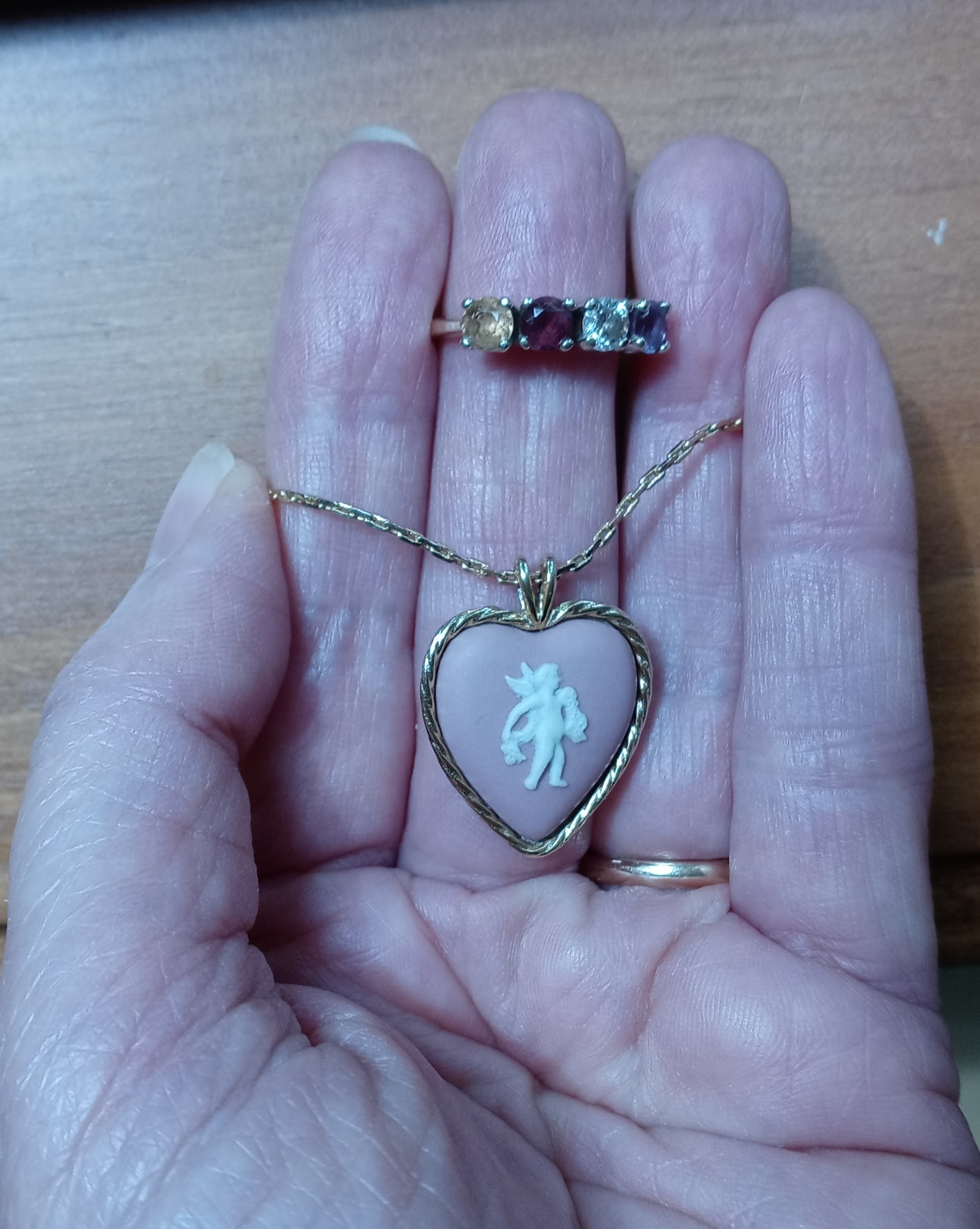
I had, however, worn two significant pieces of jewelry for the weekend.

The ring is a family birthstone ring with topaz for B, rose zircon for me, the diamond that was originally in my engagement ring for E, and alexandrite for T. The necklace is by Wedgwood and was B’s wedding gift to me.

In the photo, you can also see my gold wedding band, which I always wear. It’s a simple gold band and has been resized once but still bears its original inscription of our name and wedding date on the inside.

It’s more precious to me than any ruby could be.

birthdays and Jubilee

As I mentioned in this post, spouse B, daughter T, and I were recently in London, UK, visiting daughter E, her spouse L, and granddaughters ABC and JG, who live in East London with L’s parents.

The main reason for the timing of the visit was that it was half-term break for ABC and her fifth birthday. We were so happy to be there to celebrate with her. Due to a number of health issues – thankfully, not COVID – and other complicating logistical factors, we spent most of our time visiting between their house and our apartment hotel. ABC was thrilled to even have an overnight in our unit.

Because ABC lived with us in the US for her first couple of years, she is very comfortable with us. For JG, who was born in August 2020, we are virtual strangers or, at best, figures from a computer screen who inexplicably appear in person. Still, she was able to relate to us better this time than when we visited last December/January. Both ABC and JG relate more to Auntie T than to Nana and Grandpa. Aunties are obviously much better playmates!

It’s also nice that JG is finally able to be out and about more in public. As a pandemic baby, she wasn’t able to go visiting or go to stores, libraries, churches, etc. for a big chunk of her life, so people beyond her household can still be daunting, exacerbating the developmental stranger anxiety that waxes and wanes throughout infancy and toddlerhood. As she gets older, we expect that she will warm up to us more quickly when we visit.

The timing of our visit also meant that we were there for Queen Elizabeth’s seventieth Jubilee. As we are crowd averse even in non-pandemic times, we didn’t go to any celebrations in person but watched them on BBC One. I saw the trooping the colour, the lighting of beacons, the service of thanksgiving, the Derby, and the Jubilee concert. There were also various block parties. There was so much celebrating that there was a shortage of decorative bunting!

It was ironic that as soon as the Jubilee celebration concluded, there was a no-confidence vote among the Conservatives in Parliament on the leadership of Prime Minister Boris Johnson. Johnson survived the vote, but the narrow margin suggests that he may have to step aside as PM in the coming months. We’ll see.

It was nice to see people being so supportive of their aging monarch, even as she, understandably, needed to pass on some of the hosting duties to her heirs. It was also touching to see the Tree of Trees sculpture that celebrated the Queen’s request to plant a million trees in honor of her platinum Jubilee.

We had a bit more celebrating to do, as T’s birthday was the day we returned home. While we could not have a “tree of trees” to celebrate her, part of her birthday gift was a donation in her honor to a project that is working to preserve the ‘ōhi‘a trees of Hawai’i. The trees are being killed by a fungal disease for which there is no known remedy so there is an ongoing seed banking project in order to restore the population after the fungal disease has run its course.

I appreciate that these commemorations celebrate the past by looking to the future. There is so much to do to secure a future for the younger generations and the planet. Our history gives us both positive and negative examples of how to react to and make change. Instead of rosy nostalgia, we need to be clear-eyed about our past and present and use that knowledge to improve the situation. especially for those who are now children, teens, and young adults.

a trip to IKEA

I know it may seem as if I have fallen off the face of the earth lately because I’ve posted less often than usual but I am still here.

Well, not my usual “here” as I am in London visiting daughter E and her family. Yesterday, E and granddaughter JG took us to IKEA for the first time. While there are IKEAs in the US, none of them are near our home. E was explaining that in some places, like Germany, rentals tend to have just the four walls so stores like IKEA offer furnishings for whole rooms as a package.

We ate lunch there. Of course, I had to try the Swedish meatballs. They reminded me a bit of the Swedish meatballs my mom used to make using a recipe from her Swedish neighbor. None of this putting sour cream in the gravy nonsense!

I’m still struggling a bit with jet lag but slept almost normal hours last night. Today is the first day of the half-term break for granddaughter ABC and for son-in-law L. We are hoping to do a bit of sight-seeing next week, although we may try to do gardens and outdoor venues as much as possible. We need to stay COVID-free if at all possible!

I’ll try to get some posts out in the coming days. I had intended to write a post about the mass shooting in Buffalo but then the Texas school shooting happened so I need to expand somewhat.

Stay tuned…

My 40th reunion at Smith

Last week, I attended my fortieth reunion at Smith College in Northampton, Massachusetts. For those who may not be familiar, Smith is a women’s liberal arts college, chartered in 1871, one of the traditional Seven Sisters, five of whom remain as women’s colleges.

I came into town a day early in order to meet up with an alumna friend who lives in Northampton and graduated a year before me. Her sister was a member of my class and passed away in fall 2020. I was honored to be able to commemorate her at the Service of Remembrance during our reunion. My ’81 friend and I enjoyed hours of conversation on her front porch, followed by dinner on the porch at Mulino’s, an Italian restaurant that did not exist back in my student days.

I stayed at the historic Hotel Northampton, which has fun features like a mail slot near the elevators on each floor that connects to a large brass mailbox on the main floor for pick-up by the postal service every morning. I also got to do a bit of shopping at Thorne’s Marketplace, a collection of local shops and restaurants housed in a grand historic building. Thorne’s was a fairly new undertaking back in my undergrad days and I’m glad to see that it continues to thrive. I bought some cards and gifts and books and made two trips to Herrell’s ice cream shop. I got a sampler each time, so I got to enjoy eight – count ’em, eight! – of their delicious homemade flavors. This will surprise no one that knows me. I also got to have lunch at Fitzwilly’s, a restaurant/bar that was also relatively new during my student days. I had mac ‘n cheese that featured fresh asparagus from a farm in nearby Hadley. I love asparagus, which is one of the glories of spring in New England; it reminds me of going with my parents to harvest a patch near my father’s hydro station, a remnant of a garden from an old company-owned house that had been torn down.

On Thursday afternoon, I went up to campus for the duration of reunion. Because of the pandemic, everyone had to have proof of vaccination and boosting to register and many of the meals and events were held outdoors. Indoor events were masked, except while eating and drinking. I immediately met up with some of my ’82 friends and the celebration began!

One of the things about Smith reunions – and Smith alums in general – is that we somehow manage to have meaningful conversations with each other at the drop of a hat. Perhaps because of our shared liberal arts background, we are engaged with a broad range of topics across current affairs, public policy, arts and culture, and on and on. Of course, the deepest conversations happen with our close friends but there is a lot of sharing of ideas with acquaintances, too. In retrospect, I wish I had prepared a succinct answer to the question “What do you do?” Lacking a shorthand reply, like “I’m a lawyer, working for this government agency” or “I teach at such-and-such school”, I found myself stumbling to explain forty years of my life in any brief, comprehensible way.

Unlike the vast majority of my classmates, I’ve done little paid work in my life. I’ve devoted many years to being a caregiver of both elder and younger generations, with more than our share of medical issues. I’ve volunteered in church music and liturgical ministry and facilitated a spiritual book study group. During my daughters’ years in public school I served on curriculum committees and shared decision making teams and helped design the honors program at the high school. I joined NETWORK, a national Catholic social justice lobby, in 2000 to advocate for social justice. I was part of the anti-fracking movement in New York which finally achieved an administrative and later legislative ban in our state; this led to ongoing involvement in the fight for climate and environmental justice. There is my writing life, as a blogger and poet.

This does not condense into an easy answer to “What do you do?” but it does constitute the bulk of my adult life, which would not have been as rich and varied were it not for my Smith education. The ideal of a liberal arts education is that you “learn how to learn.” By studying across the spectrum of academic disciplines, one absorbs different approaches to real-life issues, enabling critically sound and creative solutions that promote well-being for ourselves and others and for our environment.

Maybe I should have replied, “Just forty years of being liberal-artsy.”

The other thing that I hadn’t quite prepared myself for was the flood of family memories. Because it was only an hour-ish drive to campus, my parents visited often for concerts and events. They were there for my recitals in Helen Hills Hills Chapel and John M. Greene Hall. They visited at Haven House where I lived all four of my years on campus. There were there, of course, at B and my wedding, a few weeks after commencement with the reception at the Alumnae House. This reunion was the first time since their deaths that I was back on campus and missing them added another layer to the strange mix of familiarity and difference that the passage of forty years brings. For example, I thought about my parents when we were attending the remembrance service, sitting in rows of chairs where the pews had once stood. The pews were removed years ago to allow for more flexible use of the space but their absence felt strangely current when I remembered B and my parents there in the front pews on either side for our wedding.

I also found myself missing my mother in particular among the spring flowers. We were blessed with unusually warm weather for mid-May and the flowers and trees were blooming simultaneously and profusely in response. The scent of the lilacs between the President’s House and the Quad, where we were staying, was so overwhelming I nearly choked. There were lily-of-the valley in bloom, which are Nana’s birth flower. What would have been her 90th birthday was the day after reunion and the third anniversary of her death is a few days from now.

I’m grateful to have been among friends who could support me with this grief aspect. Many of us have lost our parents now, with some still in the phase of dealing with their final years and indeterminate endpoint. As classmates, we were also dealing with the deaths of more of our ’82ers, adding to the list that, sadly, began during our senior year when we lost one classmate in a plane accident and a second to cancer. That’s why I and some friends always make a point to attend the service of remembrance during reunion. We want to honor our departed ones and their importance in our lives, even if they left us long ago. After the service, we visited the memorial tree planted beside the chapel in honor of our classmate Beth. We took a photo which we will send to her mother, who I know finds comfort that we remember her all these decades after her death.

While the central activity in reunion is visiting friends, there are plenty of other things to keep us busy. Some are long-standing traditions, such as Ivy Day when the alums, wearing white, parade between rows of the graduating seniors, also wearing white and carrying red roses, welcoming them into the community of alumnae. The night before commencement, the central campus is illuminated with Japanese lanterns. People stroll among them with live music in several locations.

There are also a number of lectures, receptions, and concerts. The President gave an update on the state of the college. Everyone is very excited that grants are replacing loans in financial aid packages at Smith, making an education possible without graduating in debt. Smith also highlights its accessibility for students who are the first generation in their family to attend college. That was my situation forty years ago but it was not recognized in the way it is today. I also attended two lectures of interest. One was how the Botanic Gardens are being re-imagined in keeping with the UN Sustainable Development Goals and best practices for preserving species in the face of climate change, all with an eye toward education and social/environmental justice. The other was about the transition of campus to ground-source heating and cooling, which will be a major contributor to Smith being carbon-neutral by 2030 without making extensive use of purchased off-sets. I was particularly interested in this because of the projects we have done at our home to reduce our carbon footprint and because my church is in the process of drawing up a strategic plan to reduce or eliminate our use of fossil fuels.

Besides college activities, we had a few opportunities just for our class. I alluded to one in this post – an open mic event to read something from our college years. I chose a passage from my adult psychology course journal about my experience coming from a tiny town to Smith. A few of us had brought something with us but we had time to do additional sharing which was fun. Our class theme for Reunion was “Writing Our Next Chapter” and I appreciated that our futures also came into that discussion.

We were also honored to have a preview screening of Where I Became, a documentary about South African students who came to Smith during apartheid. Our classmate Jane Dawson Shang is co-producer and shared some of her experiences making the film. When it becomes publicly available, I will surely share that information here at Top of JC’s Mind so everyone can see the remarkable story of these women.

Reunions at Smith are always exhilarating but exhausting. I had originally planned to attend commencement on Sunday morning but opted for quiet conversation with friends. Walking 17-20,ooo steps a day for three days straight in hot. humid weather proved to be a bit much for my feet and ankles, which swelled rather impressively.

It also meant that my reunion experience ended with what is always most important, sharing with friends in a place that was instrumental to our lives. I hope to see some of them and return to campus before our next reunion.

Five years seems too long to wait.

upcoming reunion

Later this week, I will travel to Northampton, Massachusetts to attend my fortieth reunion at Smith College. We only found out on March first that our reunion would be on campus rather than virtual, so a lot of direct preparation was done relatively quickly and closer to the event than in prior iterations.

One unexpected task that fell to me was updating our class website. I was lucky that it was built on the WordPress platform, although it was still using the classic rather than the block editor. Fortunately, I have been blogging long enough that I had experience with the older editor, although it did take a fair amount of reaching into my memory banks to resurrect some of the particulars. It was also good that there were templates in place from our reunion five years ago so that I didn’t have to build from scratch.

I am fortunate to live close enough to drive, so I didn’t have to worry about plane reservations. I did decide to come into town a day early to see some friends who live in the area before reunion begins. Due to pandemic protocols, the campus is not open to the public as it usually is, so it made sense to see friends before and then stay on campus exclusively once reunion begins.

All alums and guests had to prove they are vaccinated and boosted to register to attend. Many of the activities and meals will be held outdoors with masks in use for indoor events other than while eating and drinking. Campus will be very busy because our reunion coincides with commencement weekend this year, so the seniors and their guests, along with students who are participating in or working for the festivities and staff members, will be thronging the buildings and grounds. (It could be worse. All reunions used to be held on commencement weekend. Now, only some are with the rest happening the following weekend.)

I’m working on final preparations for packing. I have to remember to bring an all-white outfit for the Ivy Day parade and ceremony, one of the very-long-standing traditions of the College. I’ll need to be prepared for the changeable weather of a New England spring. I also need to be prepared to deal with my new orthodontia, which is causing more than a little anxiety.

The most fraught thing is trying to decide what to bring for one of our class events. We are having an open mic-style reading of things from our student days. I’ve known for months that this was planned but I was in no mood to look back that far. Our class theme is “Writing Our Next Chapter” and I would have much preferred looking forward, but I recently decided that I should look for something to add to the event.

B helped me excavate some of my old memorabilia boxes. To my shock, I found some papers going back to elementary school, including a poetry journal that I had thought was lost long ago. There were some high school papers, too. I read an interview assignment that a friend and I had done in journalism class our senior year. The bulk of the papers were from college, though. Note books from some of my most important classes. Music I had written for theory and composition classes. Yellow books for midterm exams and blue books for finals. Final papers carefully typed on corrasable bond.

I had hoped to find some of my letters but their whereabouts are still a mystery. I did, though, find the one notebook that I thought might have something from my college years worth sharing – a journal that I was assigned to keep as part of an adult psychology course I took the fall semester of my senior year.

The journal was designed to be self-reflective, as well as responding to course readings and discussions, so I thought I might find something personally substantive rather than just academic to share. Something that represented who I was at twenty-one. Something that would be authentic but not totally mortifying in hindsight.

And I did.

Before I go on, I should explain what that semester was like for me. I was taking adult psychology and a course on women and philosophy, an early foray into what eventually evolved into the women and gender studies department. I chose these courses in hopes of learning things that would be helpful to me in my life after graduation. I was also taking a seminar in music composition and preparing for my senior recital, a full-length organ program on stage at John M. Greene Hall. B and I were engaged and our wedding was already planned at Smith a few weeks after my commencement. I was very much in a preparatory mode for my future “adult” life.

And then, things happened.

There were two unexpected deaths in October. The first was a classmate who was killed in a plane accident over October break. The second was B’s grandfather, his last remaining grandparent. Then, at Thanksgiving in late November, B had a bad car accident, as in, his car wound up on its roof in an icy, but thankfully shallow, river. He wasn’t injured but we were both traumatized at how close he came to disaster.

So, here I am, forty-and-a-half years later reading this journal…

I was surprised by how astute I was in my analysis, by how much of what I consider to be my core identity now was already there. The high school interview I found in the memorabilia box described me as “serious”; my college friends would most likely have used that word, too. The advantage I have looking back now is that I can recognize the role of my level of introversion, my need to ponder extensively before I speak, my discomfort at speaking in groups, my penchant for wanting to understand and integrate everything, what I now recognize as the gifts of being an INFJ and an HSP but what I thought of then as traits I could change if I just tried hard and long enough.

I had forgotten how painfully aware I was of these things about myself and how I congratulated myself when I managed to cover them in social situations. Over the ensuing decades, I would get more practiced at this but my core has remained the same. Just in the last few years, when introversion has been more in public view with books like Quiet: The Power of Introverts in a World That Can’t Stop Talking by Susan Cain, I’ve come to understand that there isn’t any shame in being who I am. As I’ve weathered the final years of my parents’ lives and the pandemic, it’s become more evident to me that I need to take my inherent nature into account as I plan my “next chapters”. While there will always be some situations in which I need to make myself heard in a large group discussion or react quickly to an event, I will try to tailor most of my activities to play to my strengths and not waste energy on pretending to be someone who is outgoing and quick on my feet.

I am comforted by knowing that I had the same core at twenty-one that I have at sixty-one and that I understood more about myself at that age than I expected. I suppose that some people might be perturbed to discover such resonance with their younger selves, as though it meant that they hadn’t learned anything or grown over the decades. For me, though, I recognize that I have grown and changed and learned from my experience, all while staying true to my authentic core as a person.

I look at this journal now with what I hope are wiser eyes than the somewhat bleary ones of a college senior scrawling long-hand in a notebook, getting ready to graduate, marry, move to a new state, and deal with any number of unexpected things.

I hope I’m wise enough now to choose a passage to share at reunion that gives a sense of who I was then and still am today.