Make your own climate plan!

Bill McKibben writes a weekly newsletter on climate issues for The New Yorker. The link will take you to a recent one that encourages readers to explore a website that allows you to devise your own climate action plan and see the likely results. There is an introductory video:

The En-Roads website from Climate Interactive and MIT Sloan’s Sustainability Initiative is fascinating. You can change parameters, such as the mix of energy supply, energy efficiency measures, and electrification, and see what the global warming impact would be. You can tweak your plan and then share it with others via social media. Check it out!

time slips by

I know some people who are under shelter in place or stay home orders are struggling with finding ways to fill time, but I am having the opposite problem. There always seems to be more to do than time/energy/brainpower permits.

Part of this is the continuation of dealing with grief. A year ago at this time, we were in the last few weeks of my mother’s life, so there is sadness with the coming of spring. My heart goes out to all those who are currently in nursing homes and hospitals who are not allowed to have visitors. While those last weeks with Nana were difficult, it would have been even more difficult not being there to bring her ice water and chat between naps.

This personal grief is enveloped by the global grief of dealing with the pandemic, its toll on people, and its laying bare all the inequities of society. The pandemic is bringing out the selfishness and greed of some, the suffering of most, and the generosity and community spirit of many. While some just want to “get back to normal” and are willing to risk public health to do it, more and more are talking about “building back better.”

The #BuildBackBetter movement is encouraging. It calls on us to examine the past and present so that we can build a better future. Here in the United States, the problem of lack of access to quality, affordable health care has been made even more apparent, especially for black and brown folks, immigrants, people living in poverty, those without homes, and elders. So many losing their jobs and their health insurance along with it also illustrates the inherent weakness in our current healthcare system.

Many of our essential workers, including caregivers and transit, food service, janitorial, grocery, and agricultural workers, are also our lowest-paid. These people are risking their lives to keep basic services going for less money than they would make if they were collecting enhanced unemployment and too many have contracted, or even succumbed to, COVID-19. My hope is that the new-found appreciation many feel for these essential workers will lead to living wages for all jobs, benefits for those who are without paid work that reflect human dignity and care, and a realization that wealth is created by the society, not just the business owners.

While grief and fear can be mind-numbing, it is a comfort to hear about all those who are serving others, dispensing accurate information, and planning for a responsible path forward. I admit that I watch or listen to a lot of coronavirus coverage. I want to stay up to date with the science and the demographics, which is especially important here in New York State, which has the largest number of cases in the country. I listen to our governor, Andrew Cuomo, give his daily briefings because he is very truthful, forthright, and compassionate. It is comforting to know where we are, even when the statistics are unnerving, because there are plans unfolding that are modified as the circumstances change. As our caseload in the state starts to come down, Governor Cuomo is talking more about how we will move into the next phase. He is a big proponent of building back better, socially, economically, justly, and in accord with the best science available for human, environmental, and climate health. This gives me hope that some good will come out of a horrifying situation. Most of the time, I see the Governor through Facebook Live, so there are comments coming in; it’s amazing how many in other states and countries tune in to his briefings for the facts and for a practical, compassionate response to our current challenges. Sadly, the same cannot be said for White House briefings, which I avoid.

I am fortunate that things in my household are on an even keel. I am sad, though, to have family and friends who are suffering because of the lockdown or the virus itself. It’s hard not to be able to go to them and help, though I try to do what I can by phone or online.

I am not struggling with staying at home, though. I am pretty high on the introversion scale, so I am content to be at home with my family. I don’t know how I would react, though, if I lived alone, which is something I have never done.

I do spend more time on shopping and meal planning/preparation than I used to. We are still having significant shortages in our area, so weekly shopping has turned into several hours in several stores to find basic items. There are more meals to plan for because we can’t go out to dinner and because everyone is here for all their meals every day. We do sometimes get takeout from a local restaurant, but there is definitely more cooking going on at home.

I’ve been trying to keep up with my social and environmental justice activities online and have taken the opportunity to attend some webinars. The Binghamton Poetry Project and my local poetry-workshop group have been meeting via Zoom. I’ve also finished revisions of my chapbook and have been slogging through the time-consuming and anxiety-producing process of finding contests to enter. Seven and counting…

I do write blog posts now and then…

I wish I could say that I was reading more. I admit that, most days, I don’t even get through my email. By evening, I find that my brain can only handle watching television while playing not-too-taxing computer games. As I’ve been saying for years now, it’s often not so much about time as brainpower.

How are you all doing wherever you find yourselves during this pandemic?
 

SoCS: looking for meaning

I, along with millions of others, am searching for a deep, inner meaning in these troubled times.

I’m fortunate to be affiliated with a number of organizations that center on social and environmental justice. While these organizations are working on ways to help in the immediate circumstances, they are also looking forward toward lessons to take away from these times and ideas to transform our social systems to better support people and the planet in the future.

Here in the United States, it is easier than ever to see the impacts of income inequality. So many people don’t earn enough to have any savings cushion at all that the sudden loss of work immediately puts them at risk of hunger and/or homelessness. As we rebuild our economy in the coming months/years, I hope the US will finally institute some kind of living wage protocol so workers can afford to live a dignified life and support their families, with some ability to save for future needs. We also need a stronger social safety net to help people who, due to age, health status, location, caregiving responsibilities, etc., are not able to have paid work.

At the moment – and for decades before now – the United States has had economic policies that have favored business owners and stockholders over the rest of the population. Money is taken to be a form of free speech and politicians have been showered in money by the powerful. Many of them are representing these monied interests more so than their human constituents. As we take stock of the pandemic and post-this-particular-pandemic world, we need to return to the founding principle that government exists to “promote the general welfare.” (That’s from the preamble of the US Constitution, for those not familiar with the phrase.)  It’s also often called working for the common good.

Scientists have noted how much clearer the air is, especially in major cities. With people in many countries staying at home and with a large number of businesses shut down, there are a lot fewer emissions that cause air pollution and that add to the climate crisis. Those of us who have been working on climate issues have been hearing for years that there isn’t political will to change our lifestyles to cut carbon for the sake of the planet, but the pandemic shows that our world can mobilize on a large scale – and quickly – to change business as usual. Obviously, emissions will rise when more businesses are able to re-open, but, perhaps, the pandemic will lead to some permanent changes that will keep emissions lower than what had been the status quo. Perhaps some employees will work from home most days of the week, coming together physically only on certain days to better work out solutions to problems. Maybe there will be less business travel in favor of teleconferencing. Maybe the reorganizing of the economy will include more local/domestic manufacturing and food production to cut down on shipping and boost supplies. Maybe the US will follow the lead of Europe and use this juncture to institute a “green deal” that promotes both climate/environmental and social justice causes.

So many possibilities.

There is a lot of work that many are doing to meet the immediate needs of people in this time of pandemic and I commend all of them for their deep sense of duty and service. I also appreciate those who are able to analyze the past and the present and use those insights to help us prepare for the future. If we are wise and brave, we will build a safer, better, sustainable, and dignified life for all living beings and our planet.
*****
Linda’s Stream of Consciousness Saturday/A to Z prompt is “deep.” Join us! Find out how here:  https://lindaghill.com/2020/04/03/the-friday-reminder-and-prompt-for-socs-april-4-2020/

2019-2020 SoCS Badge by Shelley!
https://www.quaintrevival.com/

SoCS: making welcome

In these days of social distancing, how can we make each other feel welcomed?

We have been used to meeting in person, hugging, kissing, shaking hands, or whatever local custom and closeness of relationship between the people indicated, but, with fears of infection mounting and lots of restrictions in place depending on your location, it is hard to get within six feet of a person who is not a member of your household.

It seems to be a good time to use our voices. In some places in Europe, people who are not allowed to leave their homes are singing to each other from their balconies. That requires a certain kind of city to work. If I sang from my front porch, I don’t think any of the neighbors would hear. Then again, I don’t have a very loud voice.

I do, however, have a renewed appreciation for phone calls and the much more recent videochats. I especially love being able to hear and see E and ABC in London. After our visit in December, we had thought we would be able to visit again this spring, but there is about 0% chance of that with the travel restrictions in place now and any reasonable projection of the spread of COVID-19 in both the US and the UK.

I’m also even more appreciative of notes and messaging and emails. I admittedly have been doing a lot of that in recent years, but even more so in these recent weeks. Groups from whom I receive emails are busily trying to strengthen online connections. Two big in-person actions planned for this spring – major climate/environmental action centered around the 50th anniversary of Earth Day in the US in April and a world-wide Catholic women’s strike in May – are now re-imagining their activities. Even retailers are writing about what they are doing in terms of store closings and online shopping, while also expressing concern for the health of their employees and the communities they serve.

I also truly appreciate all the friends and family who are posting to social media or sending private messages, letting others know they are okay and checking up on people.

Later today, I will be welcoming people to a review of my chapbook manuscript. Until a few days ago, it was going to be a small in-person party. Now, our plan is to meet via Zoom. We will safely be able to see each other and talk about the manuscript, each from the safety of our own homes, places where we are safe from both the virus, which is not widely prevalent in our county yet, thank God, and from the very real fear that we might unwittingly pass it to someone before having any symptoms or ideas that we are infected.

It will be different than the prior manuscript reviews our circle of poets have done in-person, but, in a way, it may feel more precious and more connected, precisely because we know we won’t be able to gather in person for weeks or months to come. When we are allowed, I hope that we will be able to have a much-delayed party with everyone gathered in one room.

If I am very, very ,very, very lucky, maybe one day we can celebrate its publication.
*****
Linda’s prompt for Stream of Consciousness Saturday this week is “welcome.” Join us! Find out how here:  https://lindaghill.com/2020/03/20/the-friday-reminder-and-prompt-for-socs-march-21-2020/

2019-2020 SoCS Badge by Shelley!
https://www.quaintrevival.com/

Ash down

In November, I posted about the ash tree in our backyard being massively damaged by emerald ash borers, with an assist from woodpeckers.

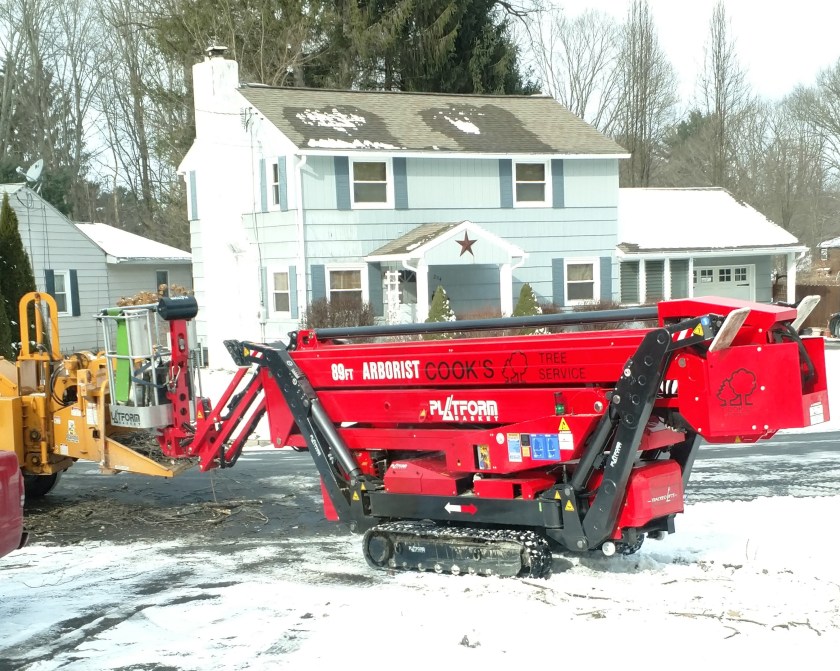
This week, with the ground frozen and the tree service available, it was cut down. The last time we had a tree removed from the backyard, the tree service parked a truck with a boom in our driveway and worked over the garage roof. They have gotten some new, more flexible equipment since then. Our favorite was this platform vehicle.
remote control platform vehicle
It operated by remote control! Biggest remote control vehicle I’d ever seen…

When it was in the backyard and in use, it looked like this:
tree platform in the backyard

The first thing that happened was trimming of some encroaching limbs from two nearby maple trees. Next, the branches of the ash were sawed off and lowered to the ground to be picked up and fed into a chipper that was parked along the street. Then, the upper parts of the trunk were cut until what was left could be brought down without hitting the house.

They used a chainsaw to cut a huge wedge near the base of the trunk.
a big chip!

And, finally, this:

Because other trees are so close, they didn’t try to grind down the stump for fear of damaging the roots of the maples and oak. I wonder how long it will be to adjust to the new look of the backyard?
*****
Join us for Linda’s Just Jot It January! Find out how here:  https://lindaghill.com/2020/01/23/daily-prompt-jusjojan-the-23rd-2020/


attack of the woodpeckers

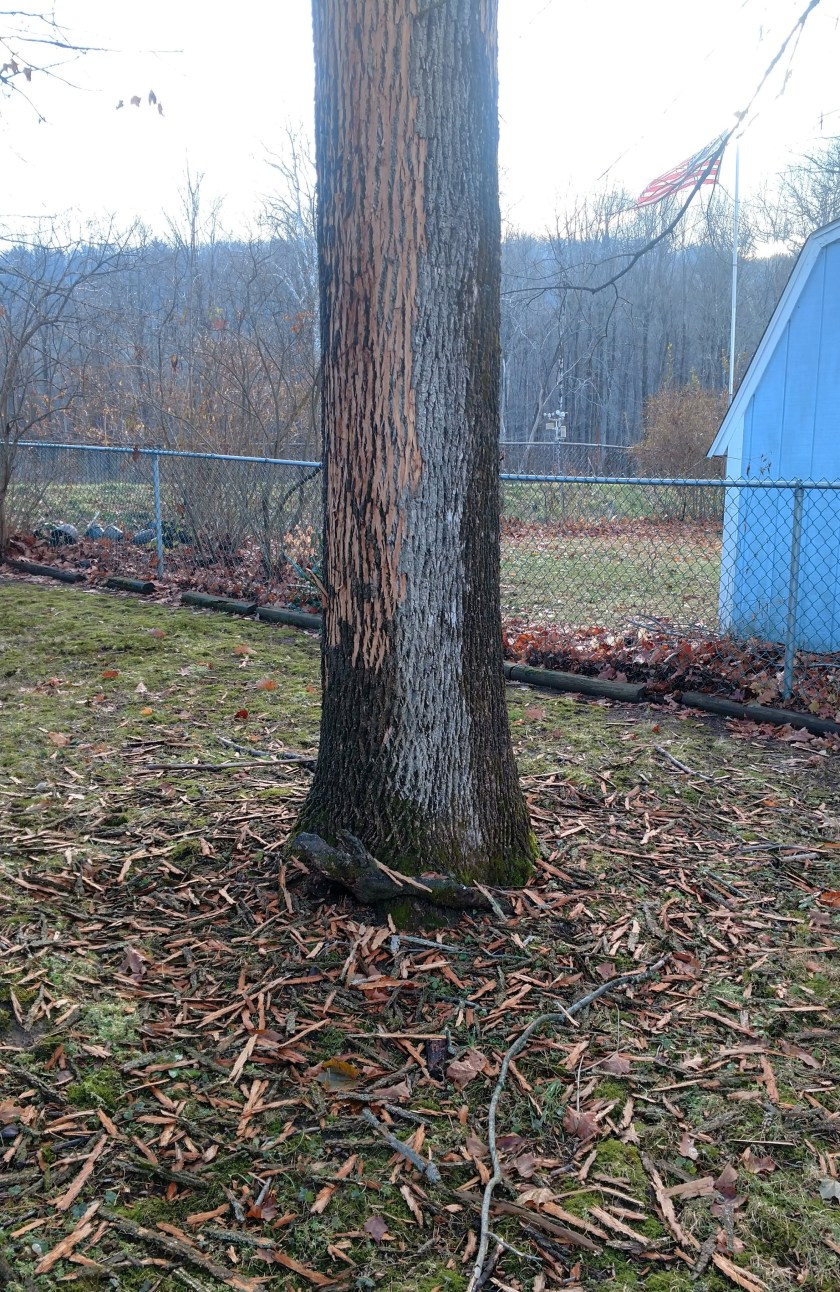
We have an ash tree in our backyard. When we looked out the window the other day, some of the bark on either side was badly scraped. At first, we thought maybe a bear had been climbing it.

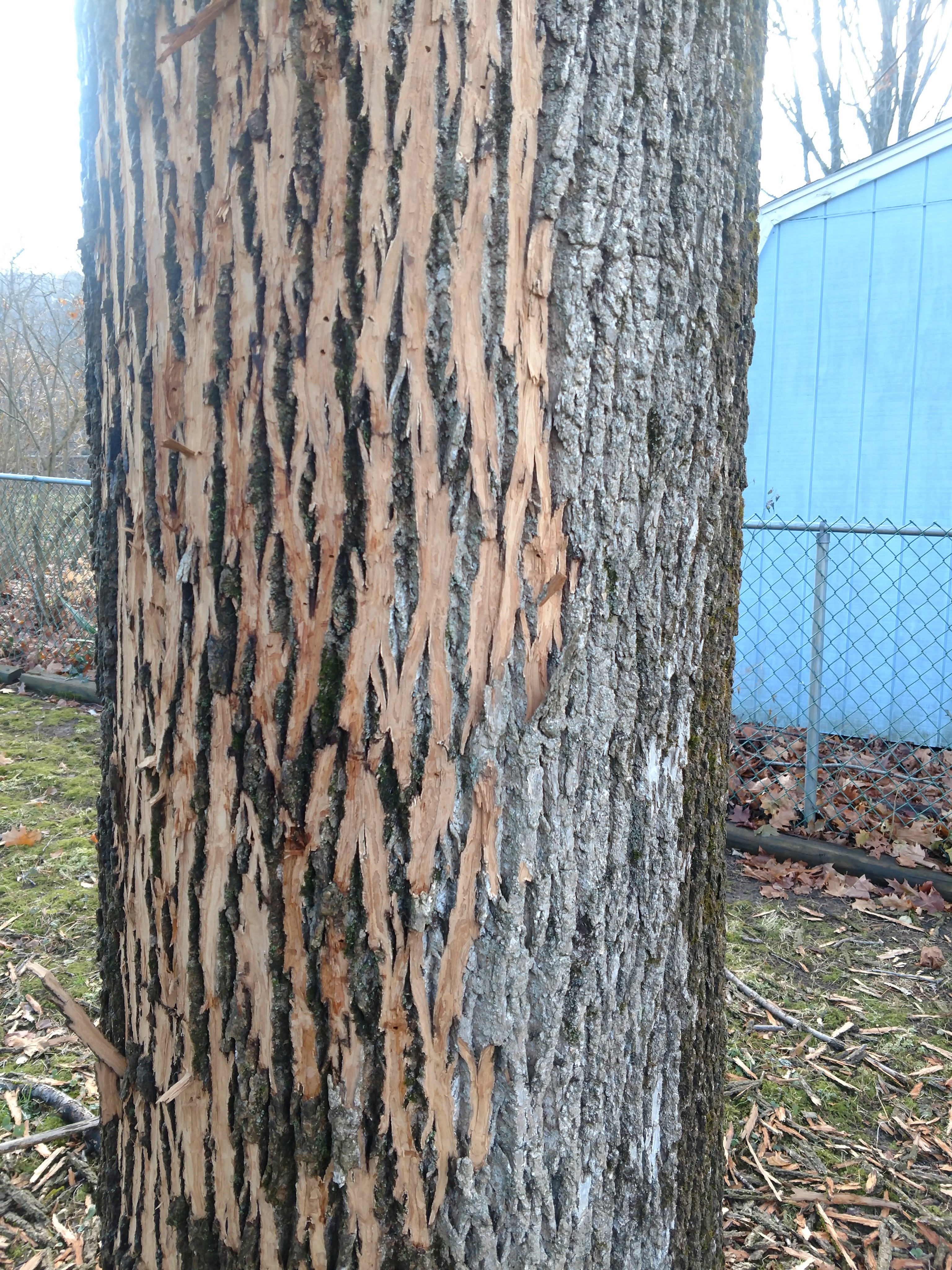
Then, a piece of bark dropped down from higher up the trunk and we saw a pileated woodpecker, pecking assiduously and creating more places with almost no bark left. Although the pileated woodpeckers are far and away the largest, there are hairy and downy woodpeckers joining the party, too, creating an ever-growing patch of stripped bark on the ground.

Obviously, the tree is very sick. The wood underneath is spongy instead of hard and woodpeckers generally can’t strip bark like they have been here. We have called a tree service to evaluate, but it seems to fit the signs of infestation by emerald ash borer.

ash tree
the base of the tree with bark shards on the ground
img_20191124_153209832
Close-up of the damage

We had hoped the tree would be spared because the immediately surrounding trees are not ash, but adult insects can travel about half a mile from their source, so it was probably inevitable.

Ironically, we were getting ready to call the tree service to look at one of our maples, which seems to be dying back and may have verticillium wilt, which is caused by a soil fungus. There is a second maple that is very close to the ash tree which may need to be removed as well. It’s possible that all three of the mature trees closest to our house on the south side may be cut down, which is not good news on the air conditioning front, although our new heat pump will decrease our cooling costs a lot compared to our old central air unit. It may mean though, that we can get enough sun to grow small trees, shrubs, and flowers. We used to have a vegetable garden in the backyard, but it became too shaded. (It also got eaten by groundhogs who could easily climb the fence around the garden, but that is another story.) We may also have less moss in the yard, although I prefer more wildflowers instead of more grass.

It could also mean that we have to re-landscape on all sides of our house, given that our front and side yards are torn up from the drilling and burying of the outdoor part of our geothermal system. Given that we have had cold weather earlier than usual this year, we may have to wait for spring.

mostly fossil-free home!

A project that B and I have been working on for years is finally complete. With the installation of a geothermal heating/cooling system, we are able to disconnect our home from the methane infrastructure, which in our area means that we are no longer burning fracked gas from neighboring Pennsylvania in our home. Because we had previously installed a hybrid electric/heat pump hot water heater, our furnace had been the only thing still attached to the gas lines. Now that it is gone, we won’t have to pay for methane, which is relatively low-priced at the moment, or the delivery charges, which are relatively expensive in New York. Those savings will help with our electric bill, which will go up, although our panels in a community solar array generate a good chunk of our electricity. In our region of New York, changing from methane to geothermal for heating is considered a wash in terms of cost, but our air conditioning costs will be much lower with the heat pump than with our outdoor compressor unit.

We have done other projects to make our home more efficient, such as changing to LED lighting and adding more insulation. We use a rechargeable battery-operated lawn mower and electric leaf blower. The only two household things that will still use fossil fuels are our propane grill and our gasoline-powered snowblower, which is only needed a handful of times a year, if that.

We have also cut way back on our use of gasoline for transportation, driving an all-electric Chevy Bolt and a plug-in hybrid electric Chrysler Pacifica. We only use gasoline when we take the Pacifica on longer trips. It gets 30ish miles on battery. When it is running on gas, some of the engine power re-charges the battery, so even when we have no plug-in charge remaining, a quarter to a third of our miles will still be battery powered. It could be even more than that if we are driving on roads with terrain or lots of stop signs/lights because the braking is regenerative, meaning the energy from slowing the car goes toward charging the battery. It’s possible that, as rapid charging stations become more available, we may be able to take longer trips in our Bolt, which would cut our gasoline usage even further. (I know some of you urbanites are wondering why we don’t use mass transit. Unfortunately, our area has almost no mass transit available.)

We have tried to cut down our fossil fuel usage and control our total energy usage as much as is practicable, but I know there is one sector where our carbon footprint will become heavier rather than lighter. I have not been a frequent flyer in my first almost-six decades, but I am likely to be flying several times a year for the foreseeable future. With daughter E and granddaughter ABC’s recent move to London, I see a fair number of airplane flights coming.

The first one will be next month.

One-Liner Wednesday: Nobel!

Congratulations to Dr. M. Stanley Whittingham on your Nobel Prize in Chemistry for your work on lithium-ion batteries!
~~~ in appreciation of Professor Whittingham, who lives in my hometown, and teaches and conducts research at Binghamton (NY) University
*****
Please join us for Linda’s One-Liner Wednesday! find out how here:  https://lindaghill.com/2019/10/16/one-liner-wednesday-hey-this-is-fun/

SoCS: hole in the ground

For the last three days, there has been a crew in our front yard drilling a 500-foot hole in the ground. That’s about 150 meters for all you people who live in the metric world, which is almost everyone except the US…

The reason for this is not to find water, which happened well before they hit rock at 80 feet. Instead, this very deep hole is to install a geothermal heating and cooling system.

I’m excited because, after the new system is in, we will be able to permanently disconnect our house from the methane supply system. Our cooling costs will also be much lower because geothermal systems are much more efficient than the typical central air conditioning unit.

I will be glad not to be using any fracked gas which has caused so much trouble for our PA (Pennsylvania) neighbors and the climate. We will also helping to support the New York State version of a “Green New Deal”, moving to renewable energy in a way that is supportive of impacted workers and communities.

At the moment, though, we just have a very deep hole in the ground with two tubes coming out of it – and a very, very muddy, messy yard.
*****
Linda’s prompt for Stream of Consciousness Saturday this week is “ground.” Join us! Find out how here:  https://lindaghill.com/2019/10/11/the-friday-reminder-and-prompt-for-socs-oct-12-19/

One-Liner Wednesday: presence

The biggest gift you can give is to be absolutely present, and when you’re worrying about whether you’re hopeful or hopeless or pessimistic or optimistic, who cares? The main thing is that you’re showing up, that you’re here and that you’re finding ever more capacity to love this world because it will not be healed without that.
~~~ Joanna Macy
*****
Join us for Linda’s One-Liner Wednesday! Find out how here: https://lindaghill.com/2019/10/02/one-liner-wednesday-sorry/ 

Badge by Laura @ riddlefromthemiddle.com