
We are in Dulles airport (Washington DC) waiting for our connection to San Francisco. We will be flying over the storm system that has caused so many tornadoes and so much death and destruction with the unfortunate expectation that there will be more to come as it slowly moves eastward. Sending out thoughts and prayers on behalf of all those who have been affected and those who are in the path of this storm system.
Blog – Top of JC’s Mind

Saint John XXIII
Today, the Catholic church canonized Pope John XXIII along with Pope John Paul II. Although John Paul was pope for about half of my lifetime, it is John’s legacy that most shaped the church that I know.
Because I was born in 1960, the only church I have known is the Vatican II church. I don’t remember when the Mass was in Latin rather than the vernacular and the choir was the only one singing the responses. I grew up with the expectation that I would continue to study the Bible, theology, spirituality, and doctrine and be responsible for developing and acting in accordance with my own conscience. It would have been very different if John, elected at 78 and not expected to do anything of substance, had not had the vision and inspiration of the Spirit to convene the Council of the world’s Catholic bishops and invite observers from other faiths. He wanted an “aggiornamento” or updating of the church, to open the Church, which had not changed significantly in the centuries since the Council of Trent in reaction to the Protestant Reformation, to the modern world. This is the Church in which I was raised and which I continue to live out in my life to the best of my abilities.
Much of the secular media coverage talks about how the Church is “making” these two popes saints, but that is a mistaken characterization. Rather, the Church recognizes that these men are saints in heaven. God “makes” saints. Alleluia!
Share this:

The Less Memorialized Side of War – Friday’s Thought
Continuing on with National Poetry Month, a reblog containing a searing poem by Wilfred Own. Thanks, Jenni, for the thoughtful post.

 John Singer Sargent’s painting Gassed hangs in the Imperial War Museum in London; the canvas is over seven feet high and twenty feet long.
This impressive painting depicts soldiers blinded by gas being led in lines back to the hospital tents and the dressing stations; the men lie on the ground all about the tents waiting for treatment.
The following poem Dulce Et Decorum Est by Wilfred Owen is famous for its depiction of the less noble side of the sacrifice our soldiers make and while I believe it is important to honor and respect those who have fought and those who still fight for our country it would be wrong to ignore the terrible price and awful humanity of war itself.
Dulce Et Decorum Est
Wilfred Owen
 Wilfred Owen 1893 – 1918
Bent double, like old beggars under sacks,
Knock-kneed, coughing like hags, we cursed through sludge,
Till on…
View original post 202 more words
Share this:

Binghamton Poetry Project
In this post , I wrote about participating in The Binghamton Poetry Project and my first ever slam(ish) poem. This evening, we will have our poetry reading for all the different workshops, children, teens, and two adult groups, and the distribution of our anthology. Yay, publishing credit!
I have three poems in the anthology, but we will only read two poems apiece. I will first read “Moonlight,” because it is the poem that bought me to the Project in the first place. Last April for National Poetry Month, our local public radio station WSKG had an edition of Bill Jaker’s book-themed show “Off the Page” devoted to local poets, one of whom was Nicole Santalucia, founder of The Binghamton Poetry Project. Nicole is a native of this area and had returned here to pursue a PhD at Binghamton University. She read some of her own poems and talked about starting The Binghamton Poetry Project to give a space for people in the community to learn about and create poetry. Bill Jaker had previously invited listeners to send in their own poems and I had submitted “Moonlight,” which he chose to read on air. I was so excited to hear my poem on the radio, although it was a bit surreal to hear another voice, and a male one at that, read a poem I had written. I decided to look up more info on The Binghamton Poetry Project and join in when I could, which turned out to be this semester’s session in March/April.
I will also read “Constancy,” which I wrote during the workshop, when we were writing from prompts about family relationships, including “Married” by Jack Gilbert. I usually work poems out in my head over the course of hours/days/weeks before writing them down, so writing a poem in twenty minutes from given prompts was a challenge for me. You have to decide on an idea very quickly. I wrote the first draft of “constancy” in the workshop but was too choked up to even consider reading it that evening. I did a bit of work on it over the next week and decided that I should share it with the workshop at the time reserved for that at the beginning of the next meeting. I practiced reading it aloud to myself and then to my other daughter who is at home to make sure I could get through it without breaking down. It was the first poem I read to the group and is the “prior week’s poem” that I refer to in the linked post.
“fingernail” was written in April 2012 and previously appeared in the fall 2012 newsletter of the Samaritan Counseling Center. Given that all three are now considered previously published because of the anthology, I can post them on my blog without having to worry about breaking any publishing precedence rules. So, here are my three poems from the Spring 2014 edition of the journal of The Binghamton Poetry Project.
Moonlight
by Joanne Corey
In the narrow valley of youth,
the moon was distant,
as though at perpetual apogee.
Cocooned in darkness,
I slept soundly.
In the broad valley of adulthood,
the moon is close,
casting sharp shadows.
Bathed in eerie light,
I lie awake.
~~~~~~~~~~~~~~~~~~~~~~~~~~~~~~~~~~~~~~~~~~~~~~
fingernail
by Joanne Corey
the nail splits
not breaking entirely
but calling attention to itself
every time a sock needs to be pulled up
or a shirt pulled on
or hands need to be dried
after some chore or other
scissors
files
emery boards
only smooth the rough edge
bandages only protect
from tearing further into the quick
the split is still there
a dead nail can’t heal
only growth
makes it possible
to get beyond the split
and restore wholeness
~~~~~~~~~~~~~~~~~~~~~~~~~~~~~~~~~~~~~~~~~~~~~~
Constancy
by Joanne Corey
You were eleven,
the child that’s born
on the Sabbath Day,
“Bonny and blithe
And bright and gay.”
Blond and blue-eyed,
Smart and vivacious,
Quick-witted and talented,
With a beautiful soprano voice.
Who knew then that you were always in pain?
No one, not even you,
Who thought this was what
Growing up felt like.
There were the unexplained illnesses,
Mysterious fevers,
The eight month migraine,
But you were twenty-one
Before we finally knew its name.
Fibromyalgia/
Chronic Fatigue Syndrome.
Always in pain.
Always exhausted.
Even when you were singing
Or smiling
Or reading
Or talking around the dinner table.
But I am your mother.
How could I not have known?
It’s the only pain I have
That is a constant.
Share this:

Bayou Corne sinkhole
I have been following the Bayou Corne, Louisiana sinkhole story since it began in 2012. Here is a link to a story on it from earlier this month from a local source: http://www.examiner.com/article/louisiana-s-bayou-corne-sinkhole-eats-well-pad-people-next
This morning a story about sinkholes was on CBS This Morning, which is a US national network news broadcast. They were doing a story on sinkholes and talked about the Bayou Corne sinkhole as though it was typical of other sinkholes around the country. They had to reference it in the report because research done in conjunction with it may be helpful in predicting ordinary sinkholes, but they should have pointed out that Bayou Corne is an industrial accident featuring hydrocarbon storage and a salt dome collapse, not an “act of God.”
My comment sent to CBS This Morning:
I am watching CBS This Morning on Thursday, April 24. You just aired a piece about sinkholes that twice referenced the Bayou Corne sinkhole in LA. You should have pointed out that this sinkhole was caused by the collapse of a salt dome being used for hydrocarbon storage. This is a totally different mechanism than the typical limestone dissolution and collapse that causes sinkholes in places like Florida. The Bayou Corne sinkhole is an industrial accident, which was preceded by tremors and release of methane and other hydrocarbons. It has resulted in the evacuation and now permanent re-location of 300 people. It is in no way just another sinkhole; it is a criminal act causing huge environmental damage by an irresponsible company, not a natural process. You should have pointed this out in your report.
Share this:

One, Two, Three Popes…
From an Italian blog that I follow. I hope that Francis will find the wherewithal to follow the example of John XXIII. It is said that, had he been elected instead of Benedict after John Paul II’s death, he would have chosen the name John. Perhaps that is a sign of things to come.

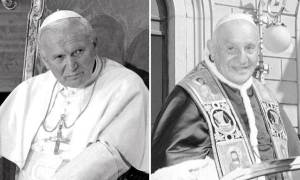 http://www.Ansamed.info
The canonization of both John XXIII and John Paul II will take place this Sunday, April 27, in Rome, and the event is expected to attract million of people to the epicenter of Catholicism.
Though both popes will be elevated to sainthood on the same day, their impacts on the Catholic Church and its more than a billion followers worldwide could not be more different.
I am not sure many people remember John XXIII, who after all, died in 1963. He was a stocky little man with a prominent nose and a gentle voice. he was considered a “transitional pope”, being 76 years old when he was elevated after eleven ballots to the Throne of Peter.
Regardless, during his short-lived papacy (just under five years), he did much to open the Church not only to the world but also to the future. In calling the Second Vatican Council…
View original post 382 more words
Share this:

Tasmanian Forests Threatened
http://jenniferann1970.wordpress.com/2014/04/23/my-wish-for-wednesday-thought-for-the-day/
The above link is a reblog of a post from an Australian friend’s blog. We all need to support one another to protect the earth as a whole. Every corner of the globe is important!
Share this:

If we really want to help Ukraine…
I have heard several things today through various media, including this blog post: http://www.nofrackingway.us/2014/04/22/kerrys-shale-gas-bluff/ about the situation with Ukraine in regards to the dangers of losing access to Russian methane.
If the US really wants to help Ukraine and other European countries get out from under the thumb of Russian fossil fuel threats, it should help them quickly implement alternate energy sources, especially renewable ones. Help fund a transition to geothermal heat pumps for heating and cooling. Find appropriate sites for solar and wind electrical production. Local, distributed energy systems will increase economic well-being and alleviate the fear of Russia cutting off Ukraine and, by extension, much of the rest of Europe from methane for heating during the winter.
Earth Day bonus: It would be a huge help to the climate as we urgently need to stop burning fossil fuels as soon as possible.
Share this:

The rest of the Triduum
In the Catholic liturgical year, there is no starker contrast than the juxtaposition of the Commemoration of the Lord’s Passion on Good Friday and the Great Vigil of Easter on Holy Saturday night.
Good Friday is the only day all year when Mass is not celebrated. The commemoration service is traditionally held mid-afternoon and begins with the clergy processing in and lying prostrate before the altar. It continues with readings, including the reading of the passion narrative from the gospel of John and then moves on to the veneration of the cross, in which all present process to a plain wooden cross and venerate it in some way, according to local tradition. At Holy Family, we bowed before the cross; other parishes genuflect or touch or kiss the cross. Then, after praying the Lord’s Prayer, communion is distributed from hosts that were consecrated on Holy Thursday night. The church is unadorned – no flowers, only the simplest altar cloth, which is removed after the service concludes, and the empty tabernacle with its door left open.
When we arrive at Holy Family for Easter Vigil, although the church is only dimly lighted, it is bursting with color – long bolts of cloth, each a different hue, radiate from a central point high in the sanctuary out over the congregation – flowers banked in several locations, not only the traditional white Easter lilies but also red and blue hydrangeas, orange lilies, pink azaleas, and light green mums – the altar draped in white, which is the color of Easter. The tabernacle, still empty with its door open, is the only visual reminder of the first two days of the Triduum.
We begin with the service of light, where a new fire is kindled and used to light a new Easter candle, whose light is spread to the candles that the congregation holds. After the Easter Proclamation is sung, we extinguish our candles and proceed with an extended liturgy of the word, including the singing of the Gloria and Alleluia, which are not used in Lent. Speaking to my daughter’s and my heart, the homilist chose to concentrate on Mary Magdelene’s place as the first witness of the resurrection, in a time and culture when women were not allowed to testify in court, chosen by God to go and tell, which is the apostolic mission. In place of the creed, after new holy water is blessed, we renew our baptismal promises and are blessed with the new water. We continue on with the liturgy of the Eucharist and, after communion, the tabernacle is finally filled and the door closed.
One of the most powerful elements in these liturgies is the music, which is not only enhanced by the participation of our choir, cantors, and instrumentalists but also by the participation of the people. Because none of the liturgies of the Triduum are obligatory, the people who choose to participate are those who are steadfast in their commitment to celebrating as a community. On Good Friday, I was especially moved by people joining in with the choir singing the spiritual “Were You There?” and the Taize prayer “Jesus, Remember Me” during the long procession for veneration of the cross. The Easter Vigil brings some music that is only used at that Mass. I was especially moved by the Easter Proclamation (Exsultet) and a sung form of the Exodus reading about the horses and chariots of Egypt being cast into the sea to protect the fleeing Israelites, by Rory Cooney. The elements of light and water re-appear in the much of the music, with more songs about the Resurrection appearing after the Easter gospel is read. The music was extra festive because a trumpeter joined the choir, organ, and congregation for many of the songs.
I wish a blessed Easter to all Christians, continued blessings of Passover to all Jewish people, and peace, love, and light to all people!
Share this:

60th Anniversary
Today is my parents’ 60th wedding anniversary. The whole family feels blessed that they have achieved such a rare milestone. Most couples are not blessed with such longevity combined with mutual love and regard for one another. It’s not that there haven’t been challenges over the years, including health issues, especially with my father, who has survived three separate types of cancer and a double bypass, while dodging a strong family history of Alzheimer’s. But they always persevere and get back to their routine with each other, taking walks, going to exercise class, running errands, lots of conversation and a healthy dose of laughter.
They are not, however, big party people, so their anniversary celebration has been a family affair. Because they retired near us twenty-five years ago, we see them often, but my sisters live further afield, so the celebration has had several parts. It started last month with a visit and special dinner with my older sister and her husband, who travelled up from Maryland. The main part of the celebration began yesterday with the arrival of my younger sister and her family from NYC and featured a lot of gaiety as they presented my parents with a part pre-recorded, part live presentation of sixty things for their sixtieth anniversary, culminating in the cutting of celebratory wedding cupcakes with Italian soda toast in (plastic) champagne flutes. For the big day today, we had a lunch out at one our favorite local places and tonight my parents will have a table for two at their favorite local Italian restaurant.
Their marriage and their love for one another is an inspiration. I wrote this poem for the occasion and they gave me their permission to share it on my blog.
For Mom and Dad – On Their 60th Wedding Anniversary
April 19, 1954
Easter Monday
Patriots’ Day and
Your wedding
Elinor married Leo
“One of those Americans”
(Translation: Irish-American,
not Italian-American)
But that didn’t matter
There was plenty of love to share
By December of ’62
Three daughters and
Friends and neighbors and
As years went by
Daughters’ friends
(including a dance company
or two)
Still plenty of love to share
The family grew
Adding heritage from
Asia
Africa
more parts of Europe
Canada
Constructing our version
of the United Nations
With plenty of love to share
In retirement
in JC
at Castle Gardens
at GSV
Still encompassing
Others in your circle of love
Sixty years
With plenty of love to share

 Joanne Corey