Blog – Top of JC’s Mind

Koper

After a few hours in Piran, we boarded our bus for a late lunch in Koper and then went to the cathedral to rehearse for our concert that evening.
img_0339
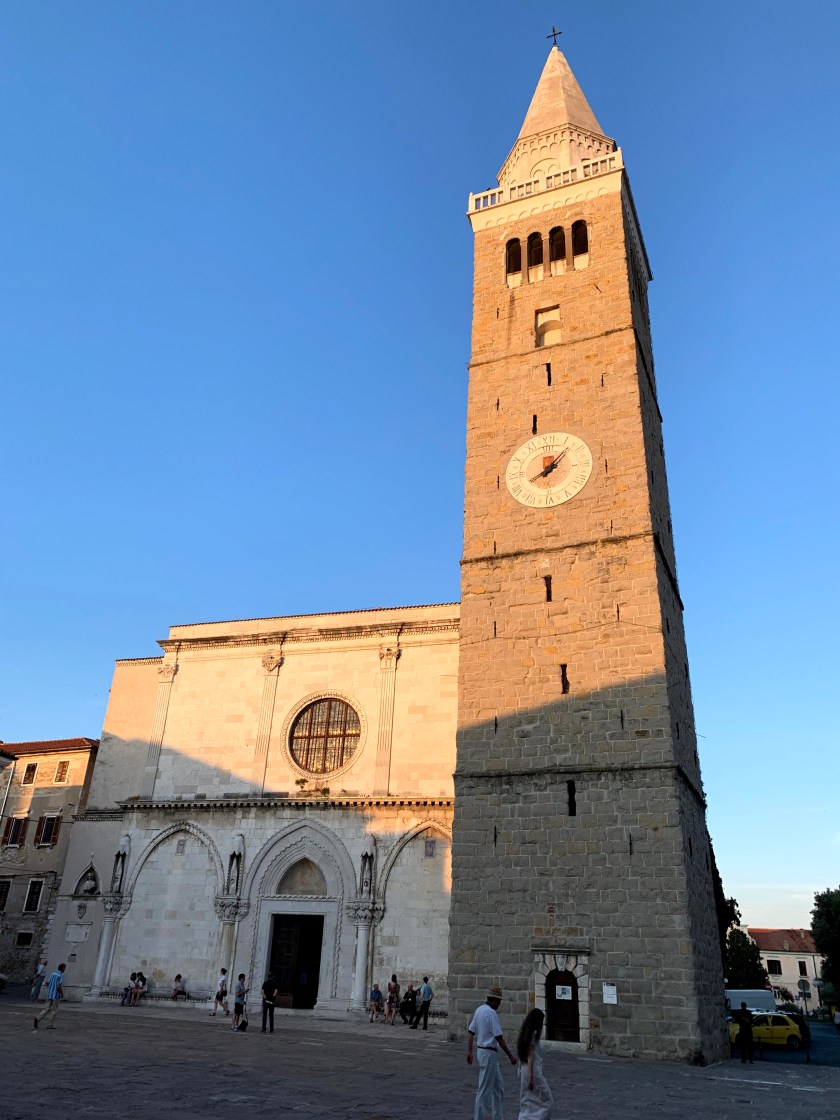
The cathedral is dedicated to the Assumption of Mary. Our Slovenian guide told us that about half of the churches in Slovenia are dedicated to Mary under one or another of her many titles. Originally built in the 12th century, the cathedral evolved over the centuries to incorporate elements of later styles. Interestingly, the bell tower was originally a Roman watchtower, which explains why the stonework is so different from the rest of the cathedral. You can see some beautiful photos of the cathedral, including its impressive artwork, here.

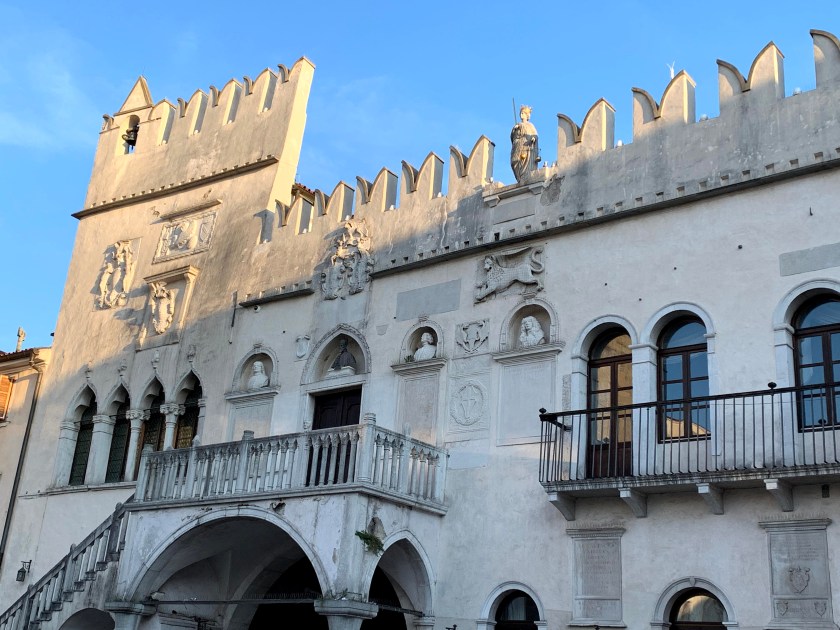
As we saw often in Slovenia, locations tend to be a mix of styles over its long history, most of it spent dominated by other entities. The square where the cathedral is located is named Tito Square, after the president-for-life of Yugoslavia. The City Hall, which is on another side of the square, is a 15th century Venetian palace.
img_0337

After rehearsal, we had a bit of time to get something to eat before we had to dress for the concert. Given that our lunch had been both late and large, B and I decided to visit a gelato shop down near the port. We ate quite a lot of gelato in Slovenia, as there were shops or stands selling it wherever we had free time, perhaps a nod to the Italian influence in at least the southern part of Slovenia. Fortunately for B, who is lactose intolerant, most of the shops had a nice selection of sorbets and vegan gelato. On this evening, I chose a yummy vegan peach gelato.

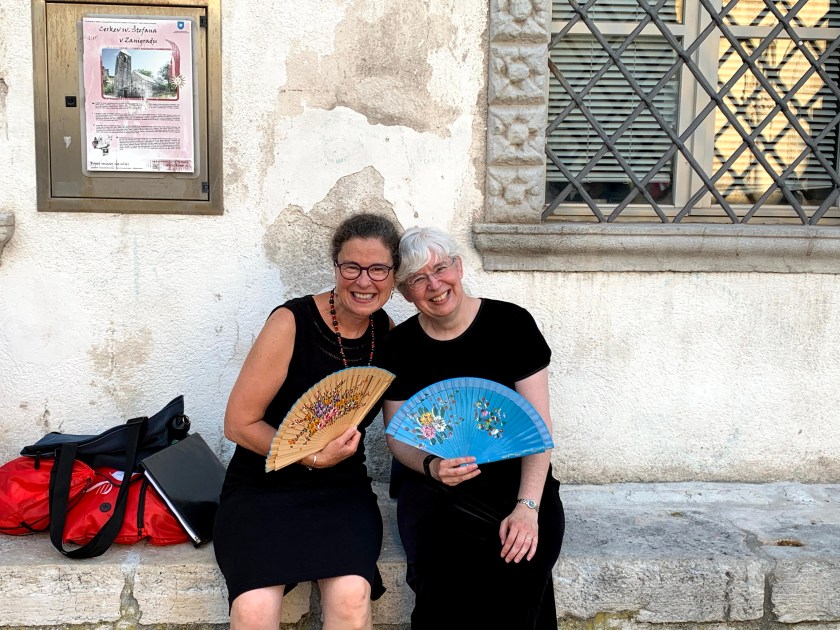
After we dressed in our black concert attire, we waited outdoors until it was time to file into the cathedral. Here, my roommate at Smith and my first Smith friend are sitting and waiting, utilizing the fans that she brought for us. The sitting was important because we would be spending a lot of time standing on stone floors. The fans were important because it was July and quite warm. We were lucky, however, to have been in Slovenia in the time between two major European heat waves that set many all-time high temperature records. (I’m the one on the right with the silver hair and blue fan.)
img_0336

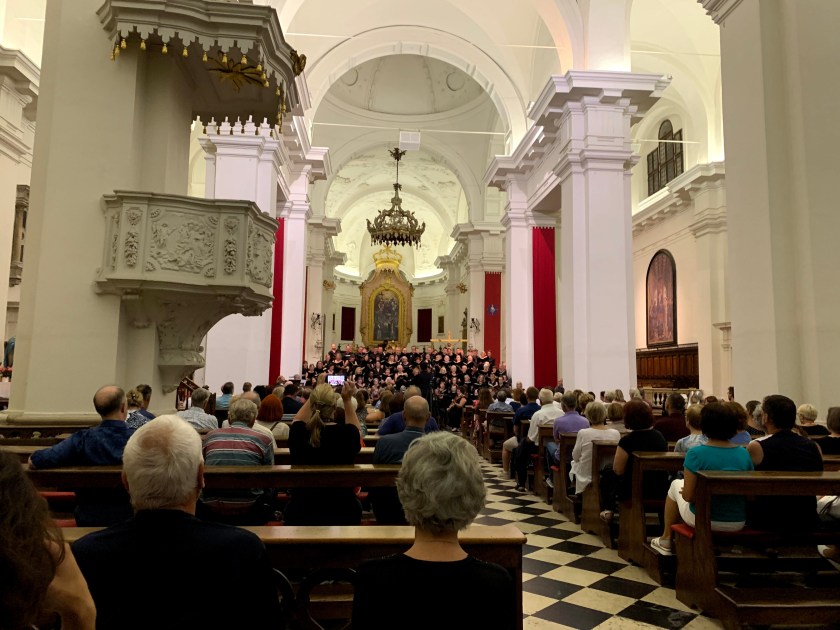
The concert was well-attended and well-received. It was so much fun to sing in that acoustical environment. You can read more about the music and concerts here.
img_0340


SoCS: where?

Where I’ve been was a topic I addressed in a recent post. The short answer is Slovenia. I have done a number of posts about the trip with more to come.

The long answer, aside from my physical location at home, is in the ozone. Well, not literally. Or in a fog. Not literally that, either.

I’ve been juggling a lot of things for a long time, primarily caretaking for various people. After my mom, known as Nana here at TJCM, passed away in May and after the immediate busy-ness of the funeral and the bunch of paperwork and phone calling that needed to happen, I had hoped that I could be more organized and not feeling like my mind is scattered most of the time, but no. At least, not so far.

A friend reassured me that it is still early days, that my sense of clarity will return, but that it takes a long time.

Admittedly, it doesn’t make sense to reorganize my life now anyways. We are in the final weeks of having daughter E and granddaughter ABC in residence. We expect her visa to come through sometime soon and then she will need to move to London within 30 days. I am expecting that, when they leave after 2+ years of living here, there will be another period that is like mourning, too.

So, I guess it may be a long time before I feel like I can think, plan, write, organize, as I used to.

Before I feel like I know where I am going.
*****
Linda’s prompt for Stream of Consciousness Saturday this week is “where.” Join us! Find out how here:  https://lindaghill.com/2019/08/09/the-friday-reminder-and-prompt-for-socs-august-10-19/

SoCS badge by Pamela, at https://achronicalofhope.com/

Piran

On Friday, the Smith College Alumnae Chorus and our travelling companions visited Piran, a beautiful, historic town on the Adriatic coast of Slovenia. Slovenia, before its independence in 1991, had spent centuries under the dominance of other entities. Piran shows the influence of its time as part of the Venetian republic.

The main square has a statue of Italian composer and violinist Giuseppe Tartini, whose birthplace, now a historic landmark, is on the piazza.
img_0259

As you would expect, some of the streets, now used as footpaths, are very narrow.
img_0295

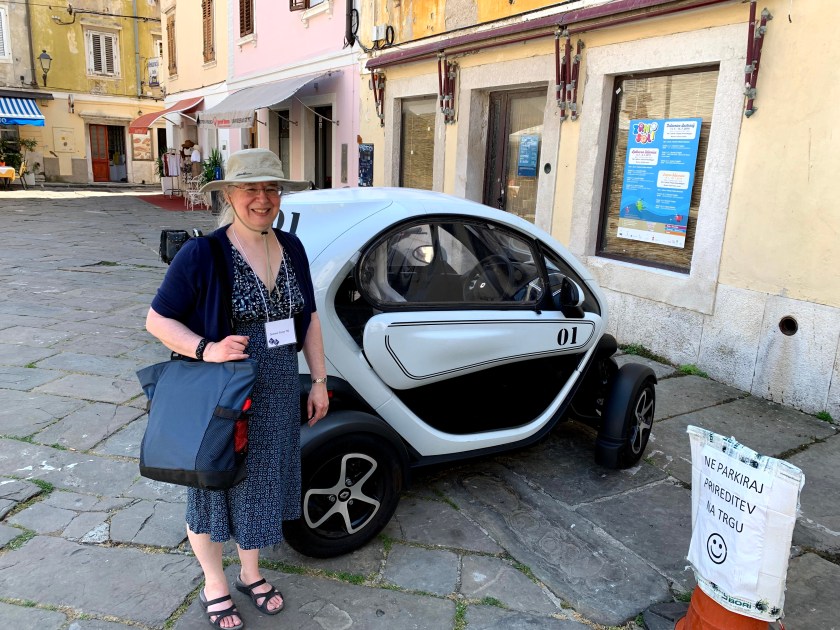
Consequently, the cars are very small by US standards. (For scale, I am 5’1.5″ or 156 cm.)
img_0326

We walked up to the Church of St. George, shown here from Tartini Square.
St. George, Piran, Slovenia

The baptistry is the small, octagonal building whose roof you see to the right of the belltower, which is itself a smaller replica of the tower of St. Mark’s in Venice.
img_0270-2

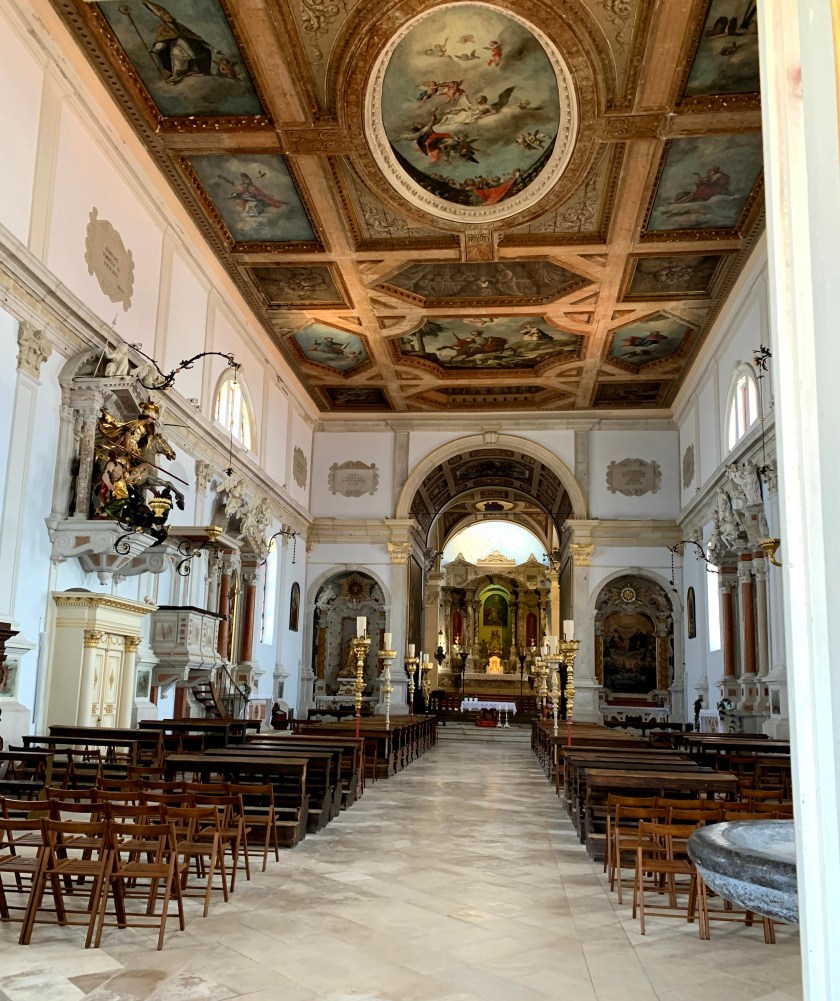
The restoration of the church is amazing! The wall on the left has a sculpture of St. George slaying the dragon.
St. George church, Piran, Slovenia

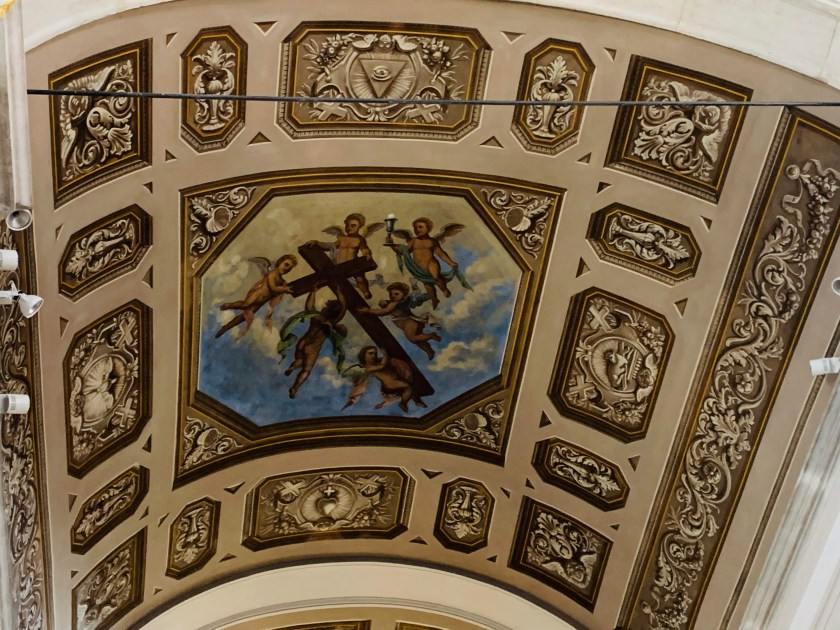
The ceilings were especially eye-catching.
img_0320

Because I was an organist, B took a special photo of the organ.
img_0313

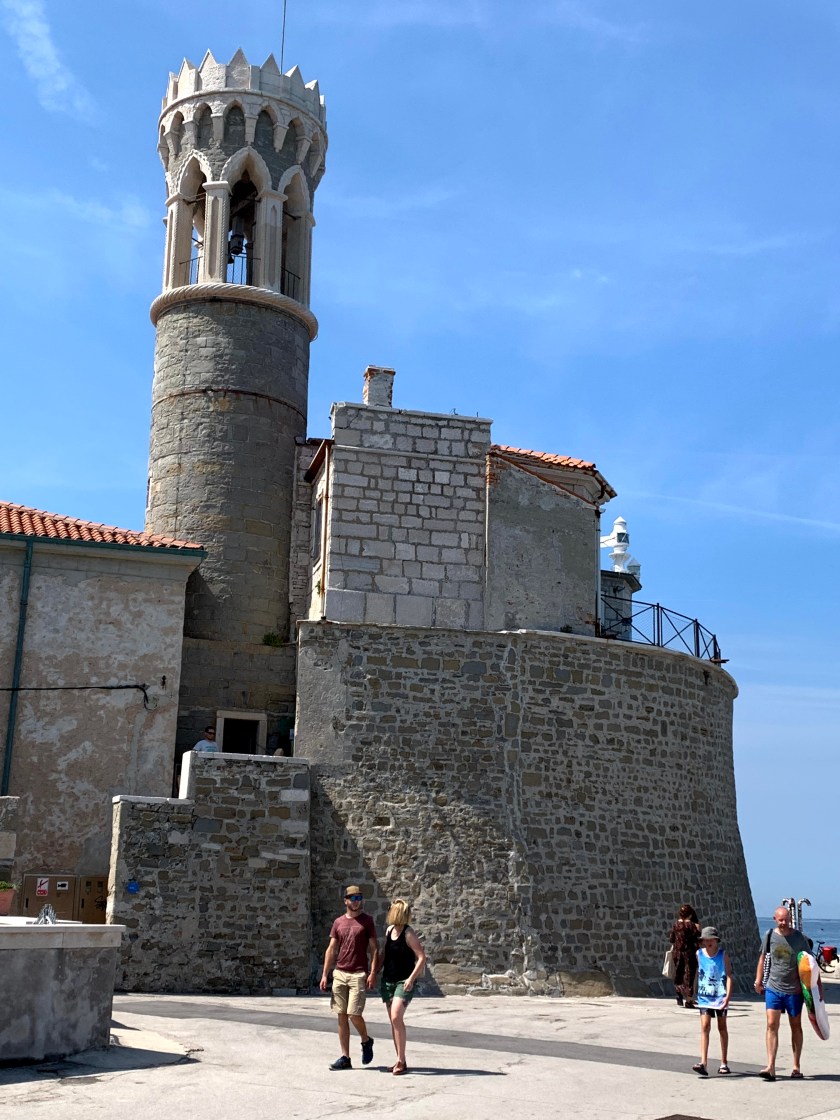
A path leads down from the church to the point and lighthouse.
img_0292

Piran affords views of the coast of Italy, Slovenia, and Croatia.
Piran view of the Adriatic

We loved our visit to Piran and definitely recommend including it in your itinerary if you visit Slovenia.

One-Liner Wednesday: another joke from Slovenia

Another joke from our Slovenian tour guide: If Melania and Donald divorce, Slovenia get half the United States, although it depends on the prenup…
*****
Join us for Linda’s One-Liner Wednesday! Find out how here:  https://lindaghill.com/2019/08/07/one-liner-wednesday-the-good-ol-days/

Trieste

The day after our visit to Lake Bled, we took a trip to Trieste, Italy, on the Adriatic Sea, not far from the Slovenian border. Even though we only had a few hours, I was looking forward to being in Italy, which is my maternal lineage’s homeland. Also, B had never been to Italy, so it was fun to add another country to his international list, which is substantially longer than mine due to business travel.

We first went to Saint Just Cathedral, a centuries-old church on the hill overlooking the city. While other cathedrals were remodeled as artistic styles changed, this one remains in the Romanesque style and incorporates some features salvaged from Roman Empire structures, as you can see in the tower.
img_0216

On entering the cathedral, my eyes were immediately drawn to the magnificent – and vibrantly colored – mosaic over the main altar.
img_0228

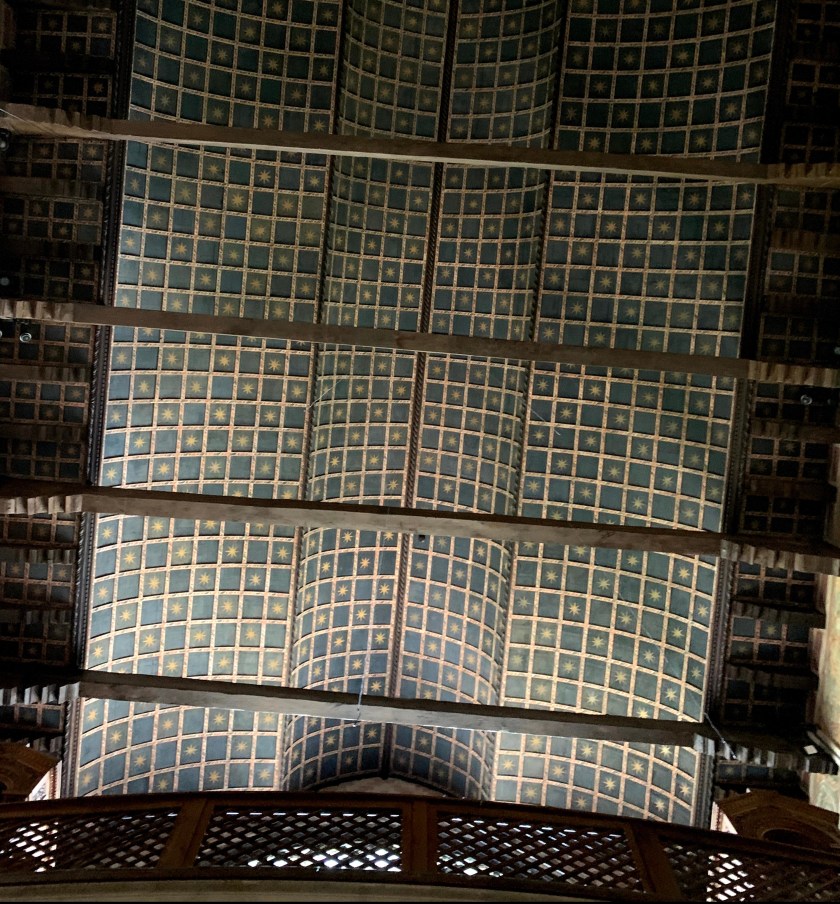
The ceiling over the nave was also interesting.
nave ceiling St Just - Trieste

To the left of the main altar, was this one with the Madonna and Child.
img_0226

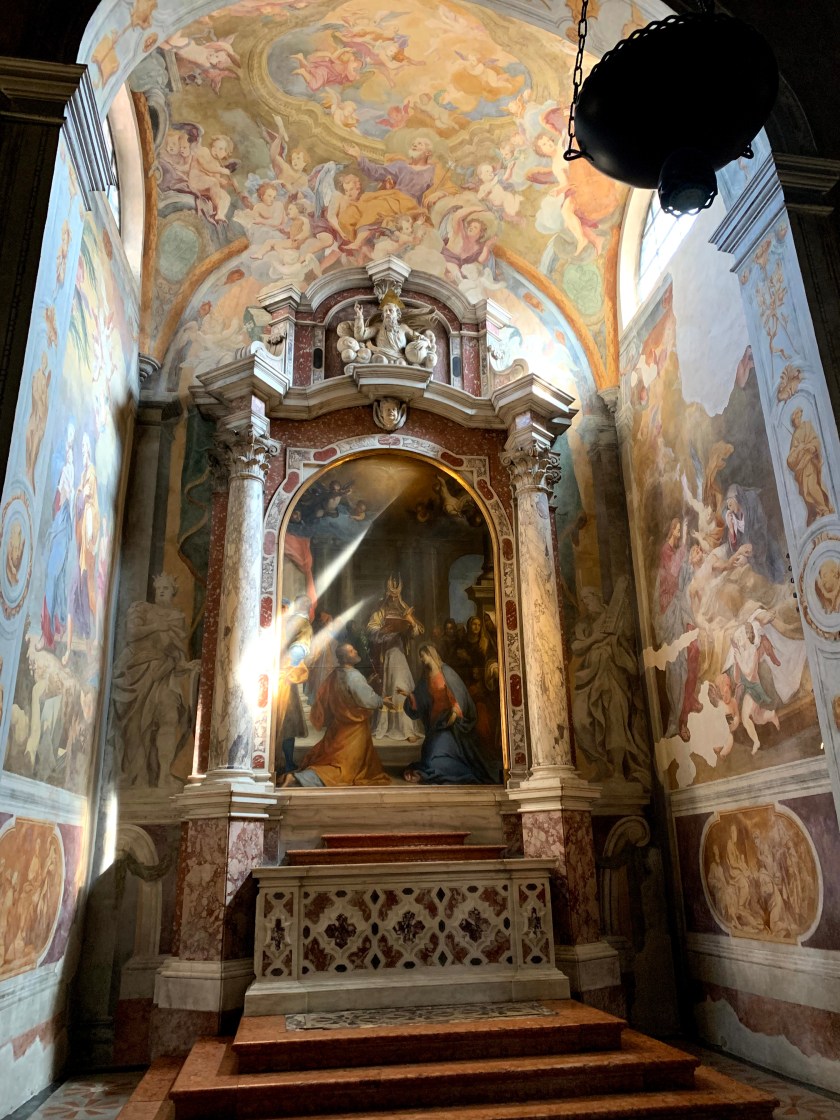
As one expects in old cathedrals, there were other small altars along the sides. I particularly liked the sunlight streaming into this beautifully painted one.
img_0221

Painting detail:
img_0222

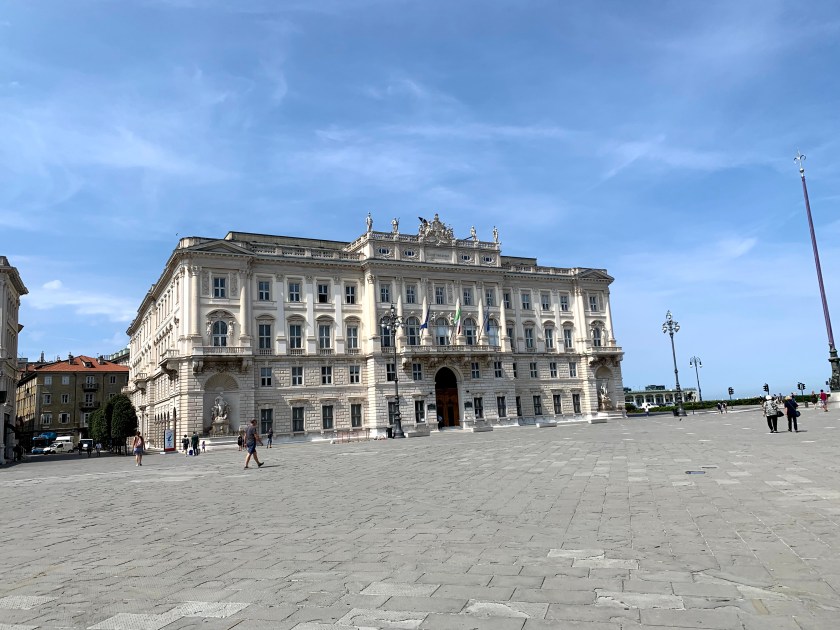
Next, our amazingly skilled bus drivers took us down some narrow, twisting streets to  Trieste’s main piazza near the sea.  The square is surrounded by impressive palaces and government buildings. It is now called Piazza Unità d’Italia, a name it acquired a century ago when Trieste became part of Italy; it had previously been part of the Austro-Hungarian Empire.
img_0238

The Piazza contains the Fountain of the Four Continents. It was sculpted in the 1750’s representing the four continents known at that time: Europe, Asia, Africa, and the Americas.
img_0245

We also visited the remains of a Roman amphitheater nearby. Dating from the first to second century of the Christian era, it was unearthed in 1938. There are still occasional concerts held at the site.
img_0242

The unfortunate thing about our excursion to Trieste was that it was too brief. Perhaps, some day we will return.

another sad day in the US

I will probably get back to post about Slovenia later today, but right now, all I can think about is the horrible juxtaposition of the mass shootings in El Paso, Texas and Dayton, Ohio. So many dead. So many wounded. So many times we in the United States turn on our televisions to have them filled with police officers behind crime tape and press conferences with politicians and police chiefs updating the death toll and the condition of the wounded and what we know about the perpetrator.

Each new iteration feels like a surreal retelling of the same story. Different details. Same shock, grief, and bewilderment.

People ask, “How could it happen here?” It can happen anywhere in the United States. A school. A church. A store. A nightclub. A workplace. A movie theater. Any day. Any time.

It happened a few miles away from my home in April, 2009.

Many of us have made pleas for stricter gun laws, which sometimes works at the state level. Many of us have advocated for better mental health care, which sometimes works at the state level. But state borders are easily crossed, so we need action at the federal level.

Increasingly, though, the perpetrators appear not to be suffering from mental illness. Instead, they are shooting at people as an expression of hatred, because of race or religion or national origin or sexual orientation or some other difference that, in their viewpoint, sets “us” against “them.”

It is hateful rhetoric turned into hate-fueled action.

I don’t know if that brand of rhetoric stops, it will lead to fewer deaths and injuries, but it is well-worth trying, especially if it is replaced by respectful conversation where people of differing viewpoints actually listen to one another.

It may sound like a pipe dream, but it is possible. There are already people in both the public and private sphere who model this behavior.

It’s something we can all do, in addition to the oft-requested thoughts and prayers.

Today, I am renewing my commitment to respectful dialogue. Will you?

Lake Bled

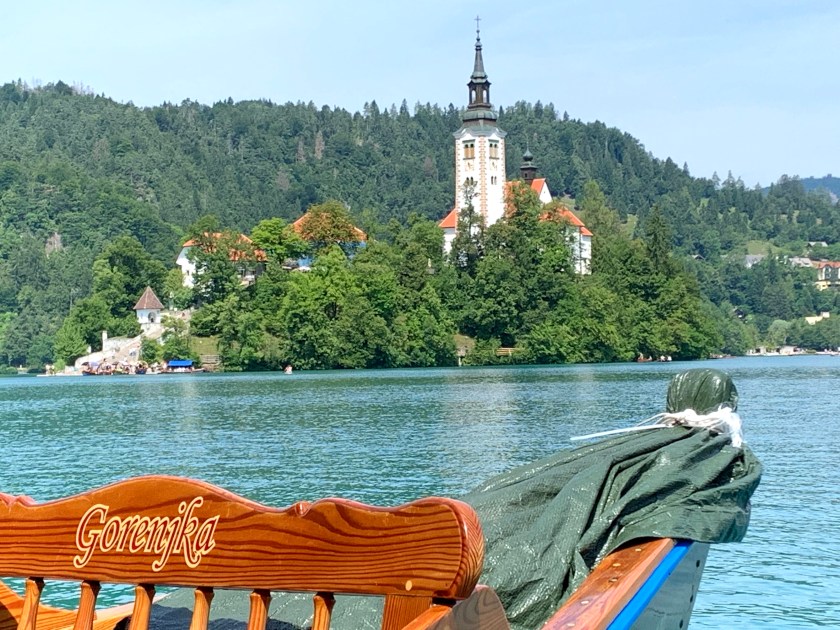
Our first excursion away from Ljubljana was to Bled, which is northwest of Ljubljana and close to the border with Austria. Bled is famous for its beautiful lake, which has an island with a church and belltower.
img_0159

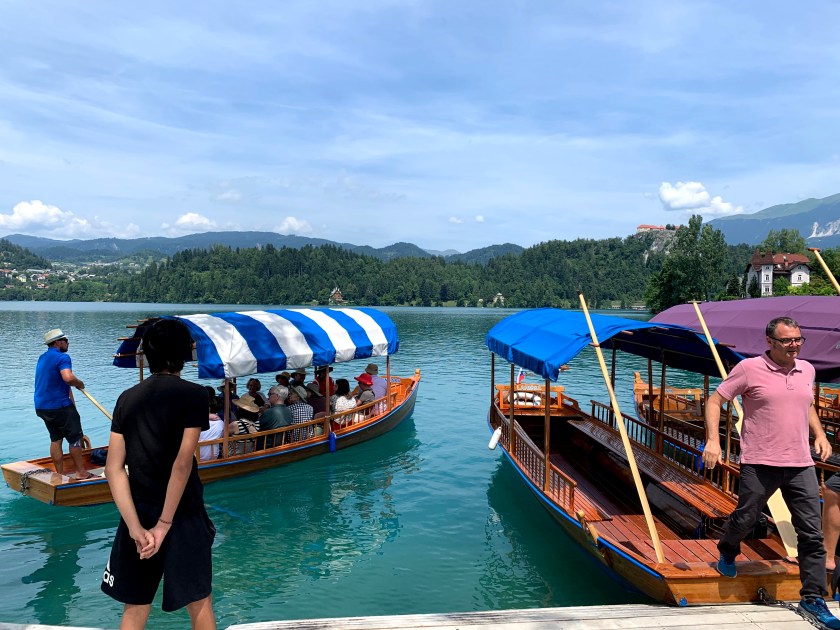
As you can see in the foreground of the photo above, one common way to visit the island is by pletna boat, powered by a single (very adept) oarsman. This is a job that tends to be passed down within families; our rower had a brother working on the lake, both following prior generations of their family.
img_0194

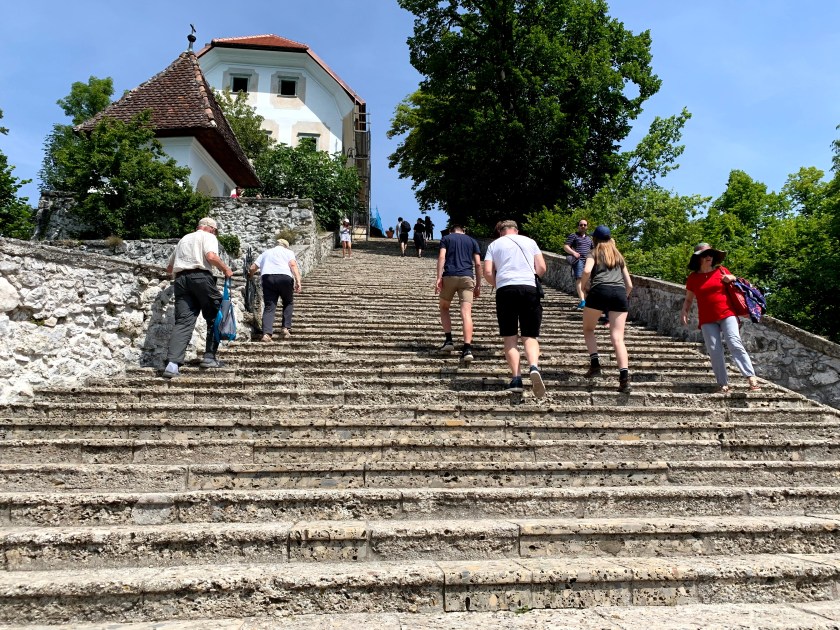
One must climb 99 steps to reach the church.
img_0161

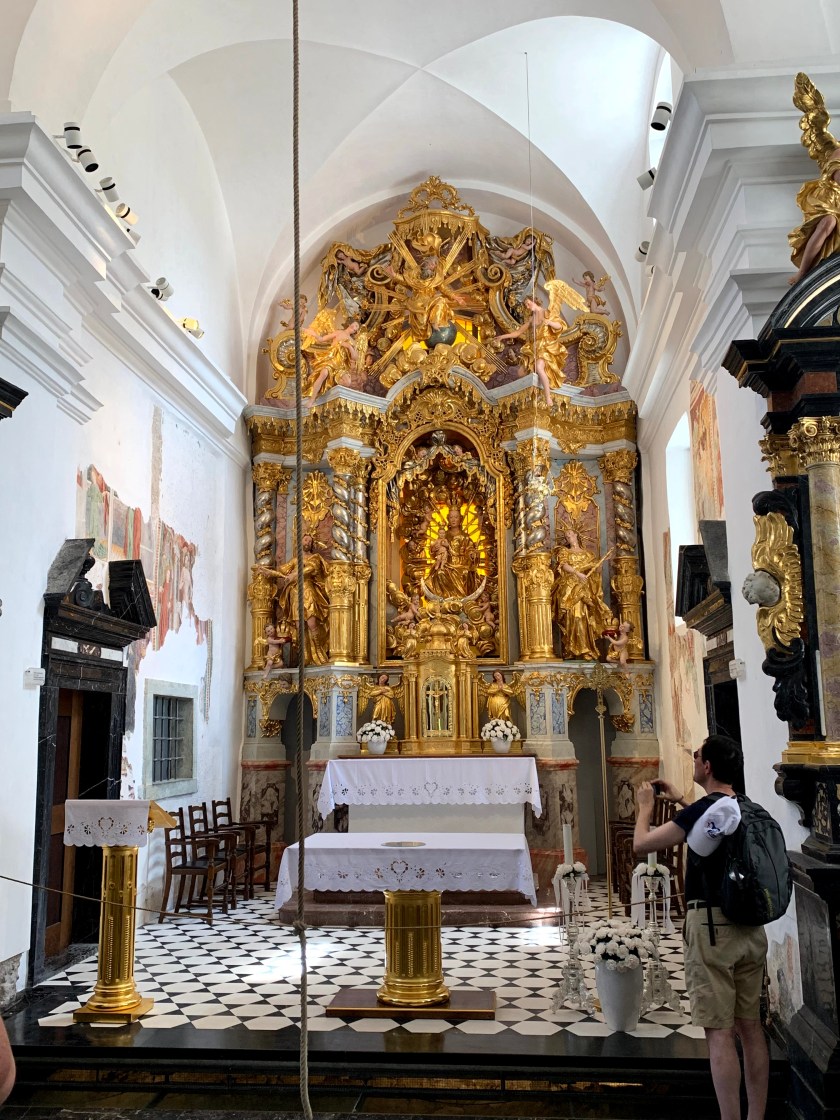
The current form of the church dates from the the 17th century but there has been a Christian church at the site since the 12th century. In earlier times, it is believed that a temple to a Slavic goddess stood at the site. The church is dedicated to the Assumption of Mary, but is sometimes called, for obvious reasons, Our Lady of the Lake. Here is the main altar in the Baroque style; on the side walls are fresco remnants of the prior Gothic-style church, which was damaged in an earthquake. img_0180

After spending some time in the church, we climbed the belltower.
img_0171
B took this interesting shot as we ascended the stairs, showing the weights that make the clock work.
img_0188
We were in the tower at noon. Unlike many clocktowers which would just ring the hour, these bells rang for several minutes. It was a bit loud, being that close to the bells, but it was interesting to watch the mechanism work.
img_0187

After our time on the island and the return to shore by pletna, we took our buses up to Bled Castle. And I do mean up! Here is what Bled Castle looked like from our boat.
img_0158

And here is what Lake Bled looked like from the castle.
img_0197

The castle paths were quite steep, but we were rewarded with a fancy lunch at the restaurant. It was the first time I have had trout caviar; probably the first time I have had caviar at all.
menu from Bled Castle

And because it never hurts to end a post with dessert…
dessert at Bled Castle

Centered in Ljubljana

One of the nice features of the Smith College Alumnae Chorus’s tour of Slovenia was that we stayed for the whole week in Ljubljana in the City Hotel, just on the edge of the (mostly) pedestrian-only Old City. It was nice to be able to settle into our hotel rooms and walk to rehearsals, meals, shops, etc. in the Old City, only using our buses when we ventured further afield for sight-seeing or singing.

Because I needed to be in rehearsal, B had the chance to do more exploring than I did. I happily delegated picture-taking to him and want to share a few photos of places he/we visited.

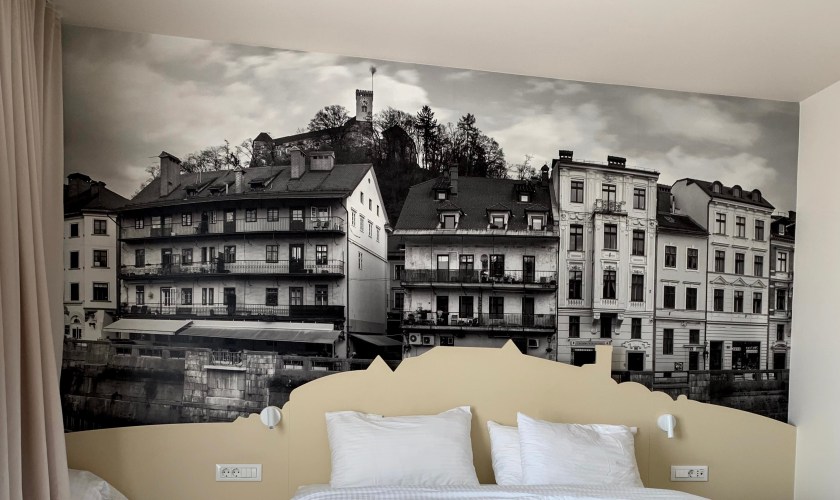
One of the really nice features of our hotel rooms were that they had large murals of black and white photographs of Ljubljana by Slovenian photographer Žiga Koritnik. Here is the one in our room: CIty Hotel Ljubljana

While walking around the city, B found the exact location and took this photo, with the river walls in the foreground and the castle on the hill above:
matching our hotel room mural

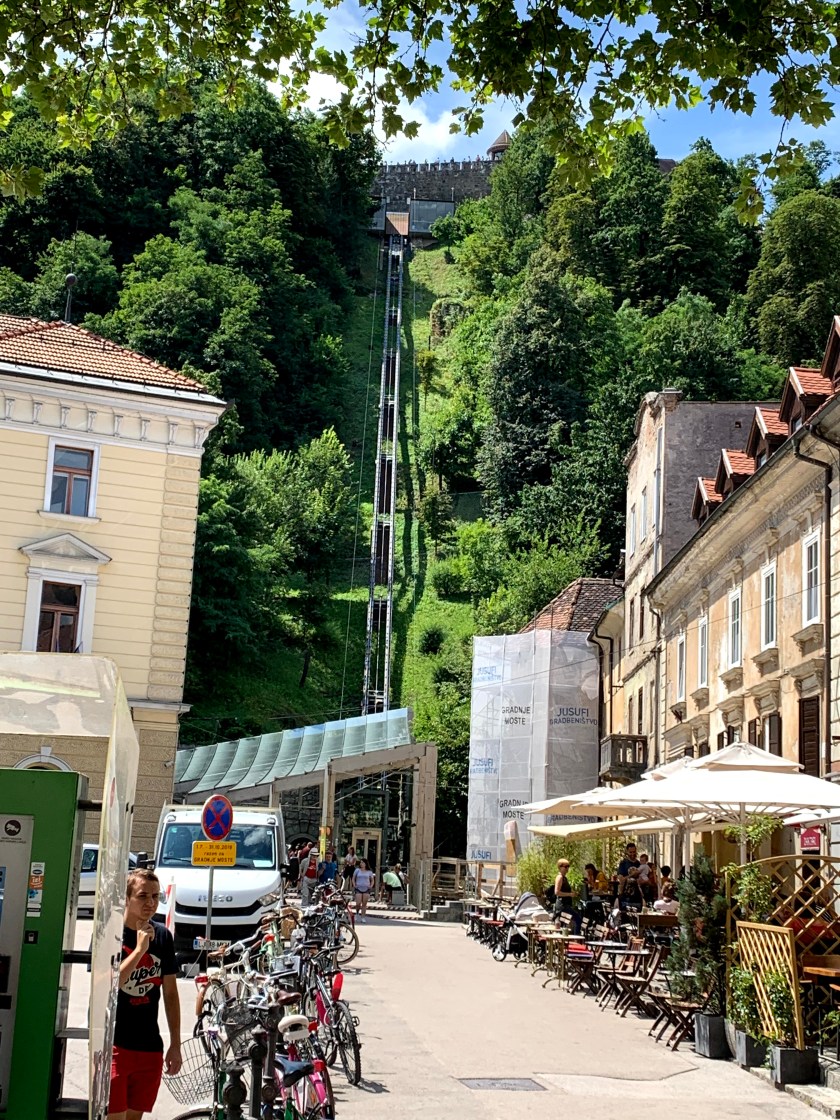
While I did get to go to the castle on the hill by funicular,
img_0084

B walked up several times, enabling him to get some shots of the city and the Alps beyond:
img_0120

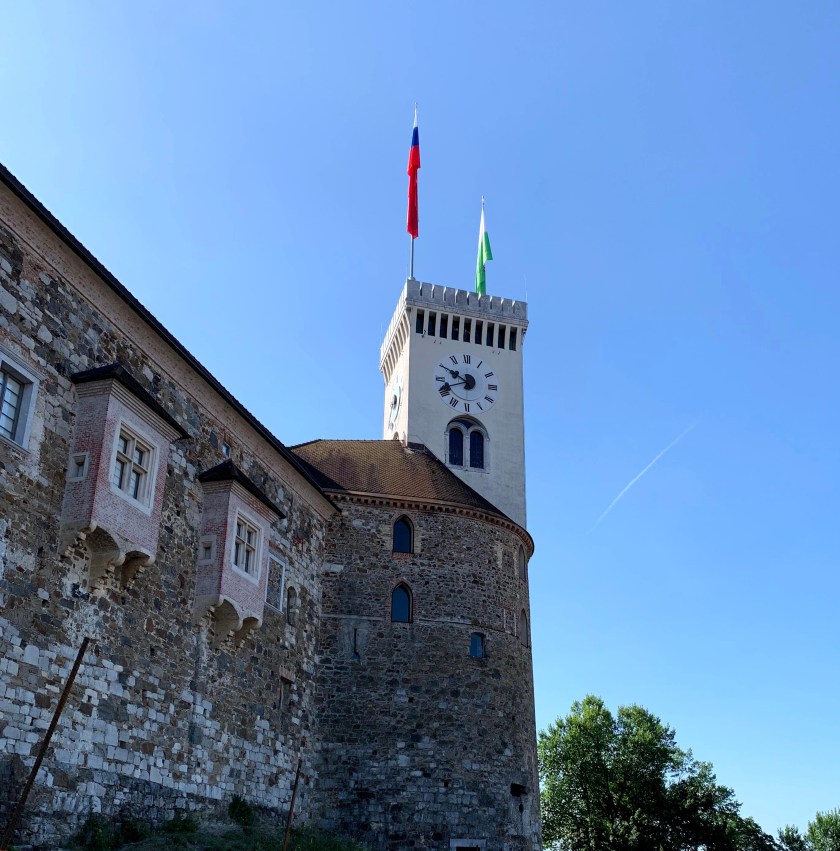
And a close-up of the castle clocktower, flying the flags of Slovenia and Ljubljana:
tower of Ljubjlana castle

The Ljubljanica River flows through the heart of the Old City:
img_0080

where it is crossed by many bridges, including the Triple Bridges:
img_0062

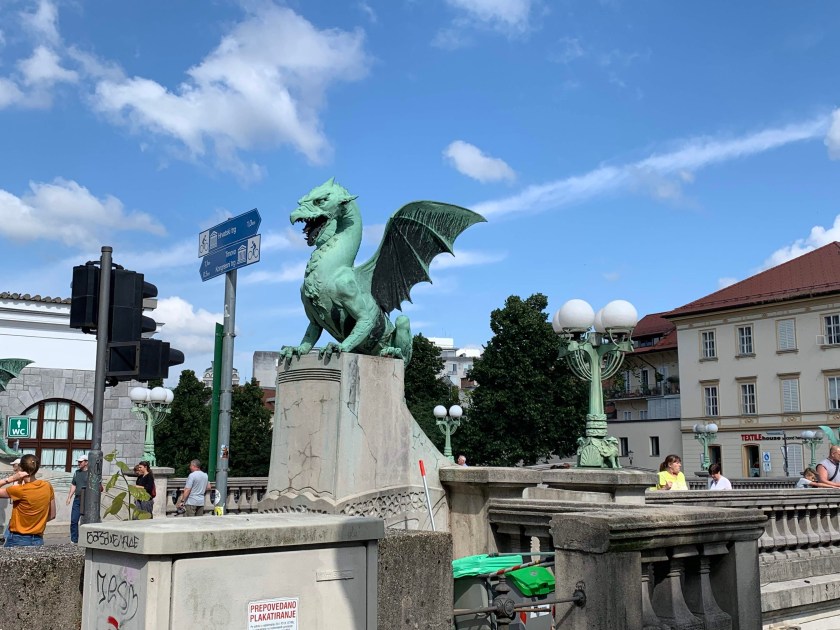
One of the most famous of the bridges is the Dragon Bridge, guarded by this fellow:
img_0054

with the help of some griffins:
img_0118

Every day in the Old City, there are farmers and artisans selling their wares from shaded booths:
Ljubljana open air market

And sometimes, just the walkway itself is interesting:
sidewalk in Ljubljana


One-Liner Wednesday: Slovenian joke

A joke from our Slovenian tour guide: Melania likes that Donald was elected president because now people call her First Lady instead of “third wife.”
*****
Join us for Linda’s One-Liner Wednesday! Find out how here:  https://lindaghill.com/2019/07/31/one-liner-wednesday-up-there/

Why we went to Slovenia

I have done a couple of posts on Slovenia here and here, but am hoping to do a series of posts on different things that we did and saw there. I thought I’d start on the reason we travelled to Slovenia.

I am a member of the Smith College Alumnae Chorus. We sing at occasional events on campus in Northampton, Massachusetts, and every other year or so, go on an international tour. This year, we spent a week in Slovenia. We sang the Haydn Missa in Angustiis, also known as the Lord Nelson Mass, and the Duruflé Requiem, in conjunction with orchestra, tenors, and basses from Slovenia. We did have a few tenors and basses of our own along, mostly spouses of alumnae, but, as a women’s college, the vast majority of our chorus is sopranos and altos.

We performed two concerts under the direction of our conductor Jonathan Hirsh on our last two evenings in Slovenia. Our Friday night performance was at the cathedral in Koper.
Koper cathedral performance

On Saturday night, we performed at Saint James’ Church in Ljubljana. To our surprise, a representative from the United States Embassy came to greet us and the performance was recorded by the Slovenian public broadcasting service.
St. James Ljubljana performance

To the delight of the audience, Maestro Hirsh addressed them in Slovene before each concert. He told them a bit about our chorus’s mission to collaborate with local musicians when we toured and a bit about each piece. Both were written in times of strife and uncertainty. The Haydn, which was the first half of the concert, ends with a forceful plea for peace. The Duruflé, however, is much more meditative and ends very quietly with the “In Paradisum” as the soul enters into paradise. Mr. Hirsh asked the audience to take a few moments to reflect before applauding.

Those moments of silence, after the last chord had finished reverberating in those magnificent spaces, were incredibly moving, illustrating the power of music to reach across language, social differences, and time to touch hearts and minds.