Old haunts

This is my last full day in the North Adams area. MASS MoCA is closed today, so I planned to go back to Monroe Bridge, Paco (my dad) and my hometown, and Hoosac Tunnel, Nana’s (my mom) hometown. I thought it would take a couple of hours this morning and I’d be back to the hotel by noon.

I got carried away.

I wound up stopping at a lot of old-but-changed haunts and taking tons of photos. (Don’t worry. I’ll only share a few.) Many of the ones I won’t show are unlikely to be meaningful to anyone without long-standing personal history in the area, as there is a lot of “what used to be here” in play. Warning: There will also be a lot of dams and reservoirs and hydroelectric plants. Paco was superintendent of the Upper Deerfield River (southern Vermont/western Massachusetts) for what was then New England Power Company and my sisters and I grew up traipsing around powerplants and such.
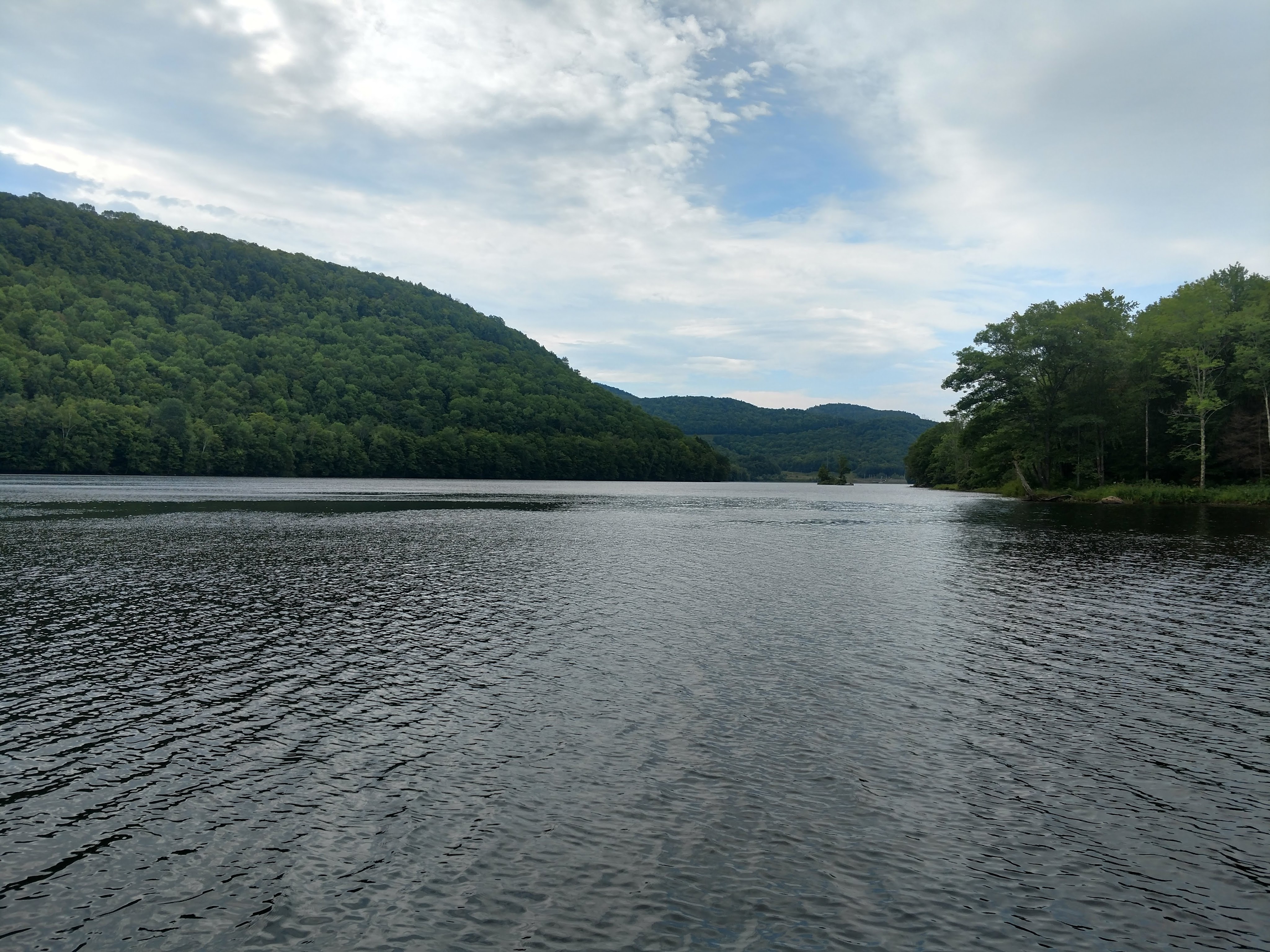
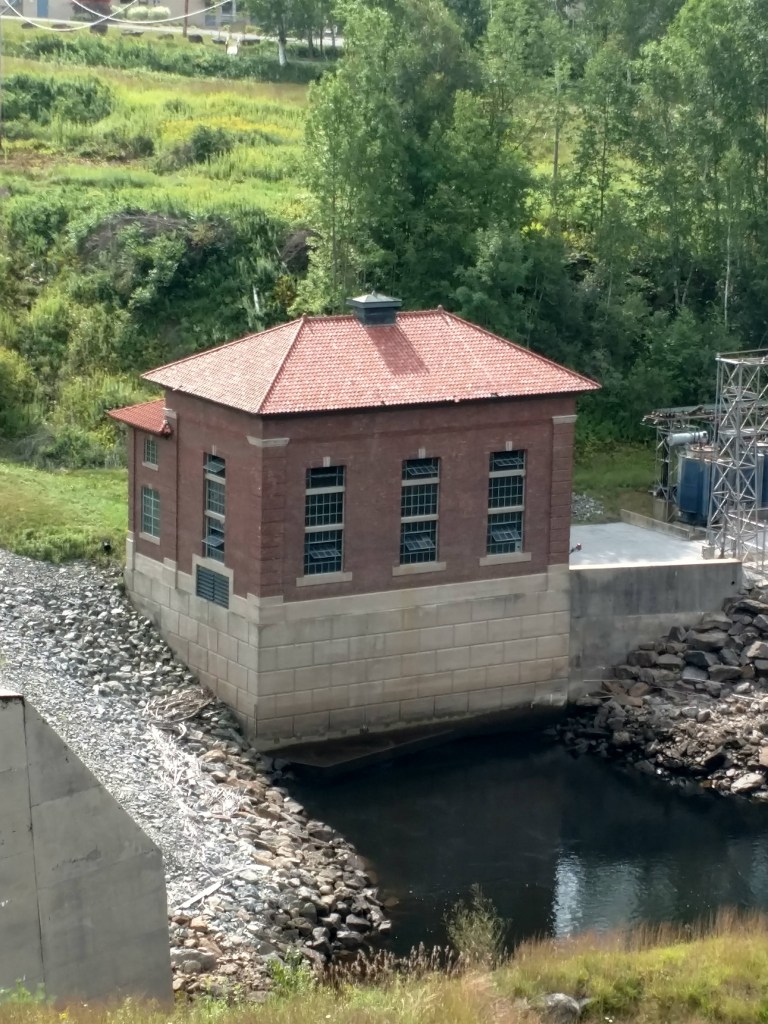
Sherman Reservoir – our house, which is no longer there, was near the dam that created the reservoir
Sherman Station, the hydroelectric plant just below the dam and our “neighbor”

The building in the photo below was built by the WPA in the 1930’s. My father and some of his siblings attended school there when it was new. It also housed the town office and library. They are still there, but most of the building is now offices for the current successor of New England Power Company. The array of mailboxes is a poor substitute for the post office, which was the center of town life for many years. Olga, the postmistress was a good friend of my mom’s; they saw each other nearly every day and stayed in touch after retirement and moves put them at a distance.

Front of the former school with tree dedicated to Olga Simonetti, former postmistress
Olga’s memorial plaque

I went down to the river and crossed the bridge; our town’s name was Monroe, but the mailing address became Monroe Bridge because they would leave the mail at the Monroe bridge. This iteration of the bridge was built in 2015. The dam is quite a lot older. Part of the old paper mill was torn down and replaced with a little park. The rest is still there, although the worse for wear.

I continued downriver. I visited the Dunbar Brook picnic area, which was deserted except for a toad that I startled as I walked across the grass. I got to take a ride on a swing, which was refreshing and nostalgic. When I went back to my car, I was surprised to see that the old road along the river leading toward the Bear Swamp lower reservoir was open. I drove all the way down to the gate just before the Number 5 Station.
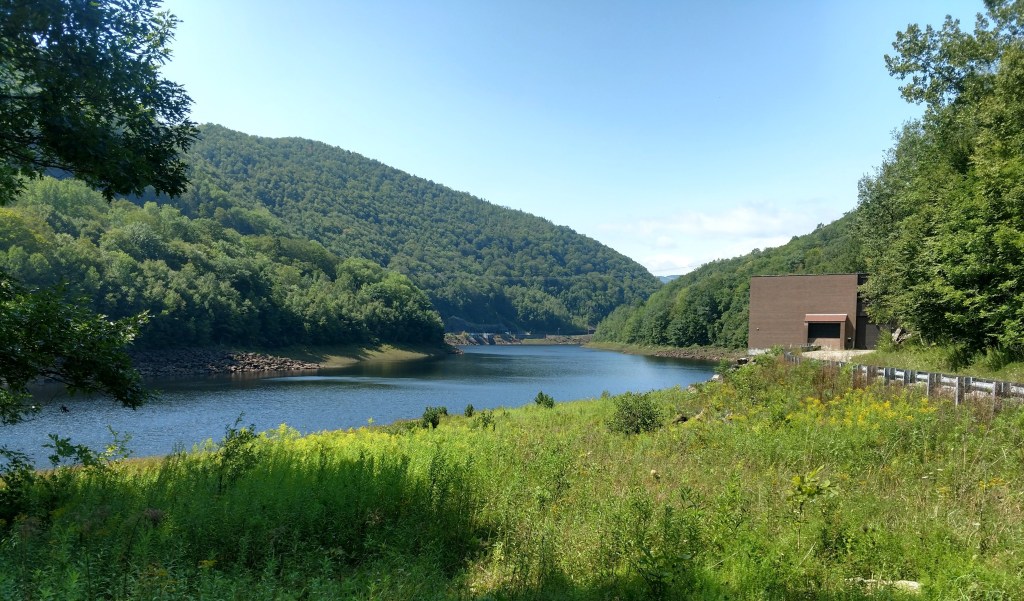
Number 5 Station and the Deerfield becoming the lower reservoir for Bear Swamp pumped storage

When I went back up to the main road, I stopped to pay my respects at the Legate family cemetery. When Nana and Paco were first married, they lived in the old Legate House, which was then owned by New England Power. The house was torn down decades ago, but the little cemetery is still tended to.

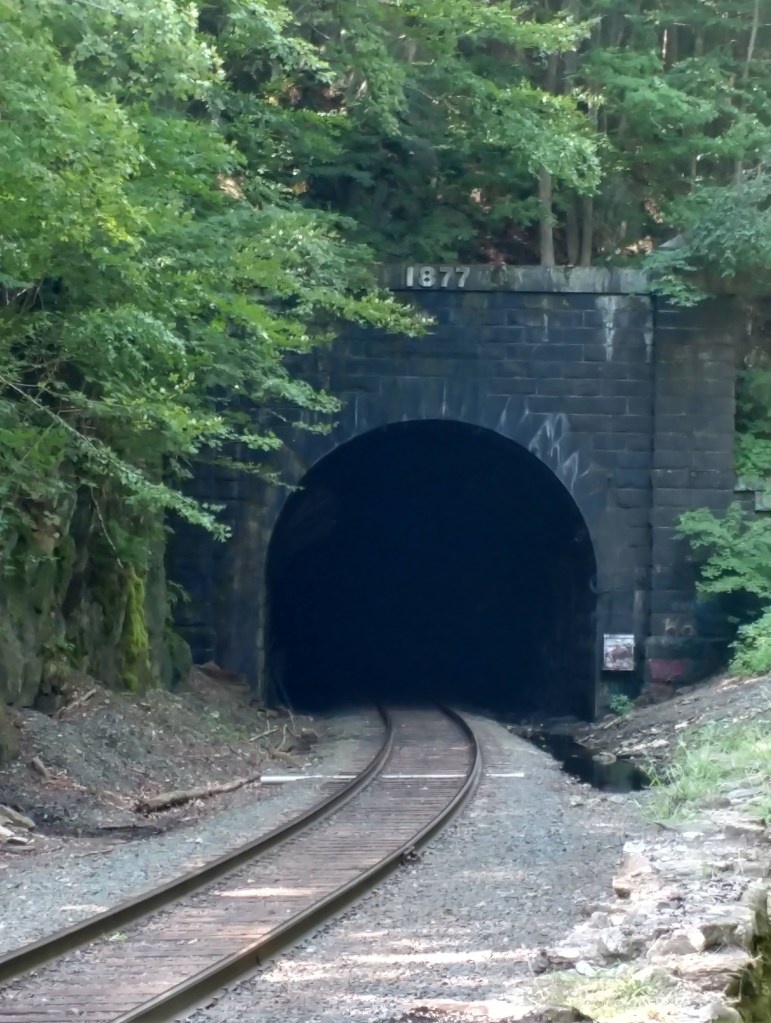
I wish I could show you a decent photo of the lower reservoir for Bear Swamp. I wish even more that I could tour the underground powerhouse that we visited with Paco so many times as it was being built and after it was completed, but it is all fenced in for safety and security reasons. I will close, though, with a photo of the Hoosac Tunnel. Nana grew up in Hoosac Tunnel, a part of the town of Florida, Massachusetts, because her father headed a maintenance crew for the Boston and Maine Railroad. At the time it was built, the Hoosac Tunnel was an engineering marvel. This is the less-fancy eastern portal. The North Adams side was more decorative, befitting a growing city in the late 1800s.
I feel very fortunate to have had the opportunity to revisit my roots. I hope that the sense of connection and the energy and the comfort of familiarity will stay with me so that I can make progress on my poetry collection after I am home.

If not, I may have to come back.

Or, maybe, I’ll come back regardless.

Russia – again

People sometimes describe the torrent of daily news in the US as “trying to drink from a fire hose.” Last week, there was deservedly a lot of focus on the Democratic National Convention that officially nominated Joe Biden and Kamala Harris to run for president and vice president in November.

I want to highlight a news story that is extremely important, but that did not get as much attention as it deserved. The Senate Select Committee on Intelligence published a one-thousand(!) page, bipartisan report on “Russian Active Measures Campaigns and Interference in the 2016 U.S. Election Volume 5: Counterintelligence Threats and Vulnerabilities“. Yes, the link is to the actual report, just in case anyone is in the mood for a political horror story…

The report details dozens of links between Trump associates and Russian intelligence, including the relationship between one of Trump’s 2016 campaign manager Paul Manafort and Russian operative Konstantin Kilimnik. It makes clear that Russia interfered extensively in the election to aid Trump and that the Trump campaign knew it and aided in various ways.

It’s not that there wasn’t plenty of evidence in public before this. Prior investigations, reports, and court documents had already established the Russian interference, but this new report reveals even more, albeit with some redactions.

It still sickens me that the 2016 election was tainted by foreign interference, but I wish this report had been available sooner. Here we are, with the 2020 election only two months and a bit away, facing the continuing danger of Russian interference, as well as influence from other foreign countries. The US electorate expects our elections to be fair and free, yet we face foreign attacks as well as domestic shenanigans.

I hope that all US voters will take their responsibilities seriously. We need to make sure that we are receiving reliable, truthful information and that we cast our ballots in a safe and timely way. We must have this election be one of integrity so that everyone can honor the results.

COVID vaccine trial update

Last week, B, T, and I each had our initial visit for the Pfizer/BioNTech vaccine trial for COVID-19. There was a lengthy informed consent document, medical history and physical exam, COVID test, blood draw, and injection with either the trial vaccine or placebo. Two of us had some mild side effects and one of us did not, so we are surmising that one of us received the placebo, but the study is triple-blind (participant, care provider, investigator) so we don’t know for sure if that is the case.

The Pfizer/BioNTech vaccine is a messenger RNA vaccine; this type of vaccine has not previously been approved for widespread use. It works by enclosing a strip of messenger RNA in a lipid shell. When it gets into cells, it manufactures the spike protein that the SARS-CoV-2 has on its exterior, so that the body recognizes it and makes antibodies and T-cells to combat it.

The phase I data looks promising, so I hope that this vaccine will be found effective. RNA vaccines are able to be manufactured quickly, which will be a plus if they are approved for use. I am hoping that a number of vaccines will be able to complete Phase III trials and earn approval, so that we can get as many people around the world vaccinated as quickly as possible. It’s the only way to gain herd immunity without a horrifying level of illness and loss.

The Pfizer/BioNTech trial is expected to finish its primary collection of data needed for approval in mid-April 2021, although the trial will continue to follow participants through November 2022 to see how well antibodies and T-cells persist.

Science takes time and the COVID vaccine is being developed at a blindingly fast rate in terms of past vaccine development. Remember that we are still looking at months before approval, not weeks. Even when one or more vaccines are approved, people will need to keep up with distancing, masks, sanitizing, etc. to keep the disease at bay while vaccination production and distribution campaigns occur.

Please, everyone, do your part to keep yourself, your family, and your neighbors as safe as possible, while vaccines and effective treatments are developed. I’ll post more information about our trial as time goes on.

Retreat in progress

I wrote here about heading to North Adams on a private writing retreat and wanted to give an update.

I have made two visits to MASS MoCA (Massachusetts Museum of Contemporary Art), concentrating on exhibits that have arrived since the Boiler House Poets Collective’s last residency in early fall 2019. I’ve taken a lot of photos to help me with my work on my collection and have even been able to sit in the galleries and work on some first drafts for poems. I have a growing sense that I need to center the collection on place, on what it means to be from and of this part of the world. To help with this, I’ve also been taking photos of the plaques scattered around the museum about the history of buildings and people’s remembrances. I even bought a book from the gift shop by Joe Manning, an artist/poet/author/historian, filled with interviews from people in the area.

While I miss my Boiler House poet-friends, I am enjoying the freedom of being totally on my own. I watched a long video about Sol Lewitt and spent time writing in the galleries, which I probably wouldn’t have done if I had our usual studio access, workshopping schedule, and shared meals. I certainly miss the immediate feedback on my poems, although I can sometimes hear echoes of their comments from prior years and feel that this is helping me in my writing and edits now.

The Museum is very responsive to the COVID dangers. Everyone has masks and distances appropriately. The Museum itself is huge, given that it is located in a series of old factory buildings, so it is easy to not be close to other people. They are leaving some windows open to increase air exchange and there are abundant hand-sanitizing stations. The cafe has expanded its indoor and outdoor seating to safe distances. Admission is arranged in advance so that there are not crowds trying to get in at the same time. During the shutdown, B and I became members of the Museum, so I am making good use of my free admission privileges.

Today, I decided not to go the museum. I did practical things in the morning and spent the whole afternoon writing and editing. It felt like a luxury. This evening, I’m catching up on reading, blogging, and email.

I’m also getting to visit some of the people I know who still live in the area. I got to have outdoor and distanced dinner with a high school friend and will have a cousin visit tomorrow in B’s hometown, Stamford VT. On Tuesday, when the Museum is closed, I will most likely drive to my and my dad’s hometown, Monroe Bridge, and my mom’s, Hoosac Tunnel. They appear in some of the poems in my collection.

I am more than halfway through my time here and am feeling like I have accomplished a lot. Perhaps, the most useful thing I have learned is that this time away is fruitful and a possibility to repeat in the future, COVID and family obligations permitting.

Looking out on part of the Ledelle Moe exhibit “When” https://massmoca.org/event/ledelle-moe/

change of scenery

Unfortunately, the Boiler House Poets Collective‘s reunion residency at the Massachusetts Museum of Contemporary Arts planned for this fall had to be postponed to fall 2021 due to the pandemic. We are all disappointed not to be together in North Adams. Fall 2021 seems impossibly far away.

I had hoped to get in a lot of work on the collection that I am working on about the area and my family history here. It’s already a years-long project and the thought of not having concentrated time to work on it was difficult.

I had begun to make plans to come on my own when a poetry reading that I was set to participate in was pushed back. I hurriedly moved up my plans, taking advantage of the fact that neither New York nor Massachusetts are requiring quarantine against each other.

So, here I am, in my hotel room overlooking one of the newest MASS MoCA community arts installations:

Tomorrow, I have a reserved entrance time at the museum and a reserved tour for an exhibit by Wendy Red Star. The reservations are part of the COVID precautions in place. The buildings and grounds are very spacious, so, while everyone will be masked, it will be easy to keep a healthy distance from other visitors and staff. I will have a notebook with me and see what strikes me as something to write about, now or later.

I’m trying to let things unfold as they will, although I have already had a bit of a bump in the road. As I was driving to North Adams, a stone or something impacted my windshield and cracked it. It is relatively small and should be repariable, but I’ve already had to spend time online and on the phone to schedule the repair for Saturday.

I’m hoping that unexpected cracks do not become a theme for my private writing retreat…

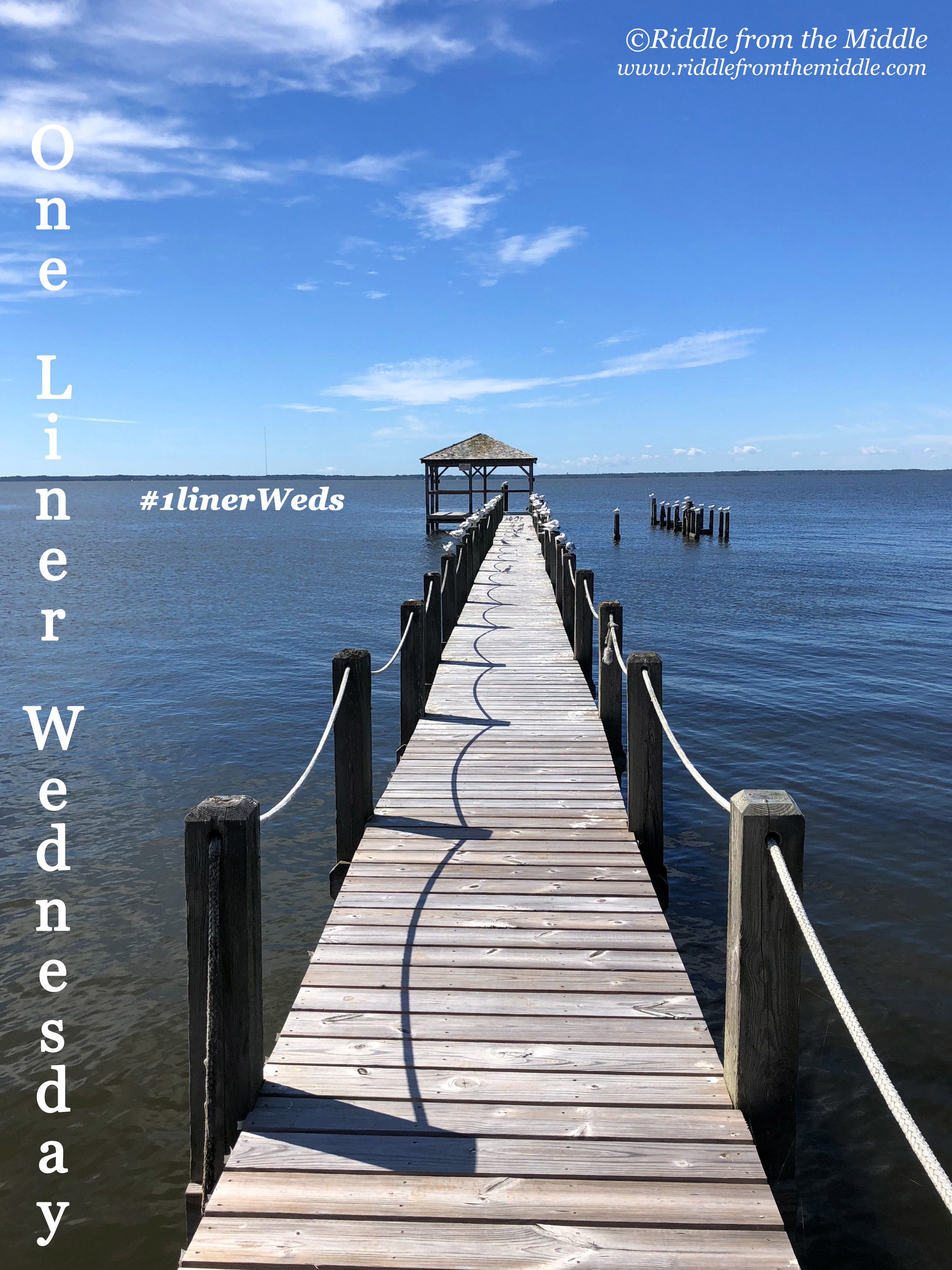
One-Liner Wednesday: fortune?

“Your fastidious nature will have much more fun this year!”
~ the inscrutable fortune in my cookie this week

Please join us for Linda’s One-Liner Wednesdays! Find out how here: https://lindaghill.com/2020/08/19/one-liner-wednesday-dreamin/

Badge by Laura

Votes for Women!

On August 18, 1920, the 19th Amendment to the United States Constitution was ratified, recognizing women’s right to vote. It reads: “The right of citizens of the United States to vote shall not be denied or abridged by the United States or by any State on account of sex. Congress shall have power to enforce this article by appropriate legislation.”

It had taken many decades to pass the amendment. Generations of women who had worked toward it died before they were able to legally cast a ballot. Many black women continued to be denied voting rights until the Voting Rights Act of 1965. Shamefully, part of the Congressional enforcement of the Voting Rights Act was struck down by the Supreme Court in 2013 and some states have enacted discriminatory practices. The House of Representatives has passed the John R. Lewis Voting Rights Advancement Act to address these issues, but Sen. Mitch McConnell has not brought it up to a vote in the Senate. A brief overview of the bill can be found here.

Because of the centennial, there have been a number of documentaries and news features about women’s suffrage in the United States, as well as articles and editorials. We have seen striking visual reminders of the struggle, such as the women in Congress wearing white for the State of the Union address, because white was the color that many suffragists wore during their marches and demonstrations. [A side note on wearing white: When I was a member of the Smith College Glee Club, we wore white when we performed. I don’t know if this tradition sprang from the suffrage movement or not. After I graduated in 1982, the Glee Club moved to wearing all black, but I admit that I still miss the striking sight of a group of young women blazing onto the stage wearing white.]

Because of the pandemic and the current civil and voting rights struggles, the commemorations of the ratification of the 19th amendment will be somewhat muted. I’m remembering, though, the 75th anniversary, which was a special event for me.

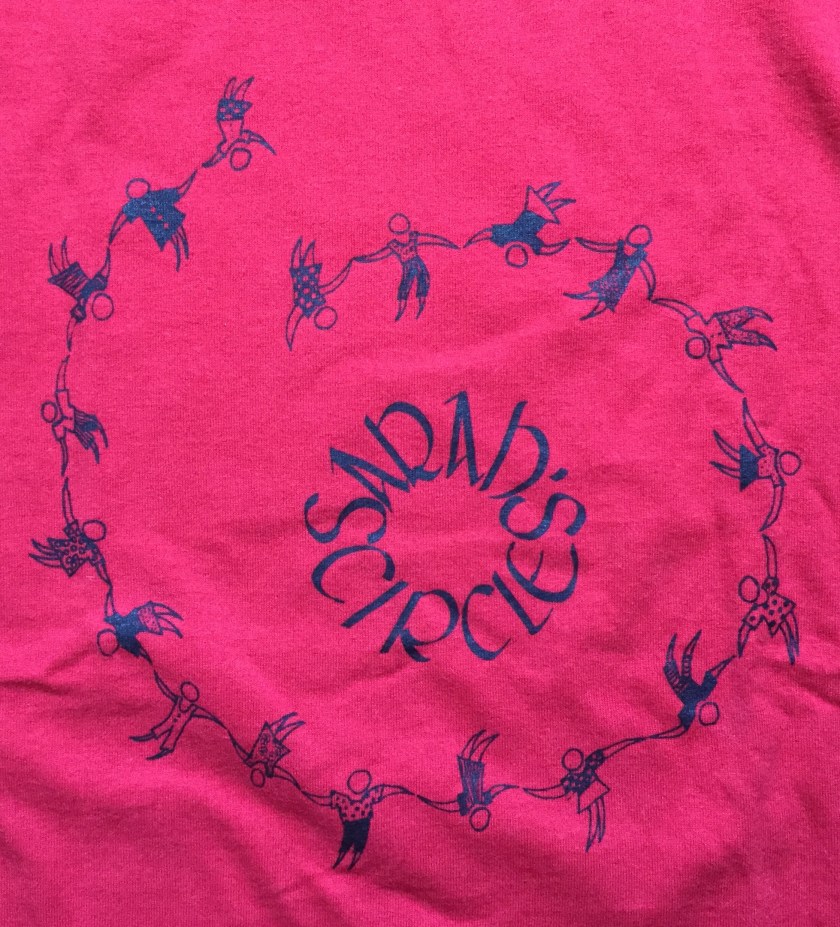
I live in upstate New York, a couple of hours drive from Seneca Falls, home of the National Women’s Hall of Fame and the Women’s Rights National Historical Park. Twenty-five years ago, I was a member of a mostly female, mostly Catholic group called Sarah’s Circle. We met for prayer and discussion on a regular basis and occasionally took part in public events. We decided to take part in the parade and other events in Seneca Falls. We marched wearing matching shirts with our logo, designed by one of our members, on the front:

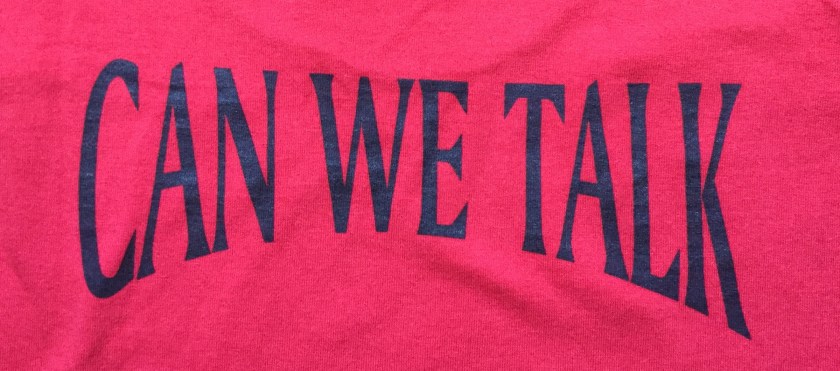
The back read “Can We Talk” because, at that time, an instruction had come down from the Vatican forbidding even the discussion of women’s ordination.

This did not deter the members of Sarah’s Circle from still speaking up about women’s ordination, but we were trying to appeal to members of the hierarchy to speak with us about it. A number of the our members who felt called to ordination wore Roman collars with their shirts. At the time, I did not feel that call personally so I did not add the collar. As we marched, we sang women’s suffrage verses that one of our members had written to familiar hymn tunes.

It was an inspiring day, filled with joy, hope, and thanksgiving. We had no idea that, twenty-five years later, there would still be such a struggle for fair voting and for equal rights and opportunity. May this centennial commemoration energize us to continue to speak out and vote for those who will uphold the voting and civil rights and the dignity of every person. May we also defend vice-presidential nominee Kamala Harris from sexist and racist attacks.

We’ve come a long way in one hundred years, but not nearly as far as we should have.

Biden/Harris

A few days ago, former vice-president of the United States Joe Biden announced that he has chosen Senator Kamala Harris of California as his running mate. Their nomination will be formally adopted at the Democratic convention, which will be held virtually this week.

Choosing Sen. Harris to run for vice-president is historic. She is the first woman of color nominated by a major political party, the first black woman, and the first Asian-American woman. She has experience in the judicial branch as a district attorney and attorney general in California, executive experience as attorney general in our most populous state, and national legislative experience as a Senator. She was part of the astonishingly large and diverse group running for the Democratic presidential nomination, so she has been part of national campaigning and debates. The daughter of immigrants, her mom from India and her dad from Jamaica, who met at civil rights rallies, she has a compelling personal story. She graduated from a historically black college and belongs to a strong black sorority.

I should be excited and energized about the ticket, but I’m not.

Let me be clear that I am 100% committed to voting for Joe Biden and Kamala Harris and hope and pray that they have the opportunity to govern and begin to guide the country out of the stifling morass in which we currently find ourselves. I’m looking forward to celebrating the 100th anniversary of US women’s suffrage with, at long last, the election of a woman to national executive office. As someone with family members who have roots in Africa and Asia, I appreciate the value of seeing a BIPOC woman in a position of executive leadership in the United States.

But I’m not excited.

Some people have described the ticket as a “dream ticket” for Democrats, but I’m not a Democrat. I’m an independent who is a progressive. My dream ticket from the people running in the Democratic field was Elizabeth Warren/Julian Castro, which would have been a historic ticket in different ways. Many people thought they were too progressive to be elected, but the pandemic and ensuing economic disaster have highlighted the issues of income inequality, gaps in our health care system and social safety net, and the impacts of systemic racism, sexism, immigration status, state residency, rural/suburban/urban residency, etc. on the lives of individuals and families. Biden and Harris are both moderates, but the circumstances at the moment and, increasingly, the will of the electorate will probably make their governing style more progressive. As others have pointed out, many elements of #BuildBackBetter are similar to the Green New Deal, melding climate/environmental/social justice with economic rejuvenation.

I’m steeling myself for the continuing onslaught of sexist and racist attacks directed at Sen. Harris. There is already a ridiculous attempt to say that Harris isn’t qualified to run because her parents were immigrants; the Constitution is very clear that the president must be at least 35 years old and a natural-born citizen. Kamala Harris was born in California. End of story.

I think the biggest reason, though, that I’m not excited is that I’m too overwhelmed with anxiety. The president and the Republican party are putting up as many roadblocks as possible to having a free and fair election from interfering with the postal service to unjustly purging voter rolls to closing polling places in neighborhoods with more people of color or Democrats to court challenges against state rules to make it easier to vote by mail during the pandemic. We also know that Russia, China, and other countries are interfering in our election process and helping to spread disinformation. The administration is acting in increasingly authoritarian ways, trying to silence critics, violating freedom of speech and of the press, and violently attacking peaceful protesters. They have removed dedicated civil servants without cause, including the inspectors general who investigate allegations of wrongdoing within the executive branch departments. People are suffering from the pandemic and the economic fallout and the Republican Congressional leadership and the administration are not doing anything to help those most affected; while the richest people and companies in the country are doing well, most people are struggling.

When the votes are counted and Biden and Harris have been elected, that is when I will be be excited. Until then, I’ll keep doing what I can to spread the truth about the candidates and make sure that my vote and all the votes are counted accurately.

SoCS: mail

One of the big news stories in the United States this week has been changes in the postal service.

Let’s start with the cons.

The postmaster general, a recent Trump appointee who is a major Trump donor and who has no experience with the postal service other than owning stock in USPS competitors and contractors, has implemented allegedly cost-cutting measures, among them removal of large sorting machines that are especially useful for large mailings, removal of postal boxes where folks can mail envelopes and small packages without having to go to the post office, sending letter carriers out on their routes even when the mail has not all been sorted so that mail is getting left behind, and not allowing letter carriers to go back out on a second pass.

This results in mail delivery being delayed, which is annoying for senders and recipients. Sometimes, it is even dangerous as many seniors, veterans, and just members of the general public receive medications through the mail. It’s also difficult for the many, many businesses and consumers who are using delivery of goods rather than shopping in-person. It affects even businesses that use private carriers like United Parcel because many of them use the USPS as a so-called “last mile” service, delivering the packages to the local post office rather than to the door of the final recipient.

The postal service also informed at least 46 states and the District of Columbia that it might not be able to delivery ballots for the November election in a timely way, risking the integrity of accurate counting of votes.

The removal of postal boxes makes it difficult for people to get mail sent, especially if they can’t get mail picked up from their home and don’t live within walking distance of their post office.

Removing equipment is causing delays in delivery. While the changes were supposed to result in cuts to overtime, in many places the changes have resulted in increased overtime because things are not able to be done in the most efficient way.

I can’t come up with a single “pro” for the public, who overwhelmingly approve of the USPS, which is unusual for any part of the government. The postal service is as old as the country and is established in the Constitution itself!

The president in an interview this week described/admitted to a “pro” for him – that the election in November that is anticipated to involve lots of voting by mail due to the pandemic making in-person voting more risky will not be able to move forward effectively. The president opposes increased funding for the postal service which is included in the HEROES Act that has passed the House but is not being considered in the Senate, which is now on break through Labor Day in September.

The general public and some members of Congress are pushing back. Yesterday, the USPS postmaster general halted the removal of mail collection boxes until after the election. This is a start, but much more needs to be done to reverse the other changes and to make sure that all ballots (and other mail) gets delivered in a timely way.

The sad and infuriating thing is that the president himself revealed that the whole thing is a con.

Which many of us suspected.

You’re also not a very good con man if you give the con away.

*****
Linda’s prompt for Stream of Consciousness Saturday this week is “pro/con.” Join us! Find out how here: https://lindaghill.com/2020/08/14/the-friday-reminder-and-prompt-for-socs-aug-15-2020/

2019-2020 SoCS Badge by Shelley!

tree trimming

Today, we had a tree service come and trim the large trees in our backyard. They are all at least seventy years old and some of them had some dead branches that threatened to get blown down during storms. There are two maples, an oak, and a cherry.

The company we hired was recommended by the landscapers who are going to give our yard a major makeover this fall. They have certified arborists and we were impressed with their work and their observance of safety protocols. T’s environmental science background informed her appreciation of the helmets, rigging, ropes, chaps, etc. involved. Bonus: They did a great job with cleaning up after they were done.

It’s nice to have a bit more sunlight making it down into our yard, especially where we have my mom’s heirloom rosebush, while, at the same time, still having these big shade trees on the south side of our house.

It’s also nice not to have to worry so much about being impaled by javelin-sticks when it gets windy.