
Thanks to Emily for writing about this book. I admit that it continues to bother me that homemaking is not considered as contributing to the economy/society, unless you are paying someone else to do the work. I hope to read this book someday.
Author: Joanne Corey
Please come visit my eclectic blog, Top of JC's Mind. You can never be sure what you'll find!

Alice Parker

This is the first of what I hope will be several followups to the Smith College Alumnae Chorus celebration of Alice Parker ’47 which took place on September 21. I thought it best to begin with a post concentrating on Alice Parker and her music.
The Alumnae Chorus sang two sets of Miss Parker’s compositions, Three Seas, with three poems by Emily Dickinson as texts, and Incantations, with four poems by Elinor Wylie. We also sang a Parker arrangement of the spiritual “Come On Up.” Miss Parker conducted her pieces in the concert, although we were able to rehearse with her only on Friday afternoon and Sunday morning.
The music was challenging, especially under the circumstances, with each member of the chorus learning the pieces on her own before coming together to have everything performance ready in under 48 hours. (We also prepared three Ralph Vaughan Williams settings of English folk songs, which were conducted by Jonathan Hirsh, the current Smith Glee Club director.) I knew there would be mistakes in the concert, but the performance was successful because we were able to communicate the poetry, music, and mood to the audience. We were relieved to hear Miss Parker reminds us several times during rehearsal that there is no such thing as a perfect performance.
The best part of the experience of working with Miss Parker was hearing her talk about poetry, her process as a composer, and her life. She read the poems to us in rehearsal – and to the audience in the concert, relishing not only the meaning conveyed but also the sounds of the vowels and consonants tumbling along one after the other. She talked about how poems in English fall into rhythms in groups of twos and threes, which results in so much of her music being written in 5 or 7 (3+2 or 3+2+2) to follow the word rhythm. Miss Parker works only on commission, so she always has a specific group for which she is writing and a deadline to deliver the score. She explained that once she has chosen the texts, she reads them aloud over and over and, as she begins to compose the melody for the text, sings and dances the poems, filling in the harmony and counterpoint in her head. She wants the music to be fluid and alive as long as possible, only committing it to paper when the deadline is looming. She said, “The page is nothing but a prison for music.” I was so struck by that statement that I hurriedly wrote it down. It will always remind me that music is alive and not the static black-on-white notation that we struggle to replicate.
Miss Parker also told us stories from her life, especially her famous association with Robert Shaw, with whom she collaborated on many arrangements before taking on solo assignments from him. The director of the Binghamton University Chorus, with which I have sung for years, also worked with Mr. Shaw and loves to tell stories about him, so it was fun to hear stories about him from a different perspective.
What was most heartening was seeing a woman born in 1925, still engaged in creative work and still engaged with family, friends, community, and her alma mater. Should we all be so blessed.
Share this:

Into the Woods
Last night, we went to see a production of Stephen Sondheim’s Into the Woods at our local professional theater. “We” equals me, my spouse, and my parents. My mother-in-law was to have joined us, but she is having difficulties with her back and couldn’t sit for such a long performance.
Into the Woods is one of my favorite musicals. I find the interwoven fairy tale adaptation fascinating and love Sondheim’s ability to pack both wit and depth of feeling into the lyrics, which move the plot along even more than the spoken dialogue. I also have a longstanding relationship with the musical because it was a favorite of my daughters when they were young. We watched it many times through a recording of the original (1988) Broadway cast. For quite a while, I only let our younger daughter see the first act, which ends with the somewhat expected “happy ever after” vibe, shielding her from the much darker second act, until her four-years-older sister told her what happened and my shielding tactic became moot.
I enjoyed last night’s performance because the brilliance of Sondheim and James Lapine, who wrote the book, shines through. I especially enjoyed the performances of CInderella, the Baker’s Wife, and Little Red Ridinghood and the singing voices of the two Princes. Some of the other performers were occasionally flummoxed by Sondheim’s complex melodies, although those in the audience who have not heard the music over and over might not have realized it.
My major disappointments were with the technical aspects. The lighting was often too dark – and, yes, I get the whole being-in-the-woods thing, but it would have been better to use dappled lighting to give the illusion of moonlight through trees, rather than just not having enough light to see the actors. There was also a gaping hole in the back wall of the set, which was only used in one scene in the second act. It was very distracting to look at it for two and half hours when it was so little used. The stage could also have used some pitch, as quite a few songs took place sitting on the stage; alternatively, the actors could have been placed more upstage to make them more visible to those in the back rows. (The seating is cabaret style, so there aren’t many rows, but each row is deep.)
I was also disappointed with the costuming. Many of the costumes were too drab. A number of them were ill-fitting, especially too tight.
The theater company is in the midst of a change in leadership. I wonder if some of the technical problems are the loss of a long-time team experienced with this theater, which was once a storehouse for apples. It is a tricky space in which to work and the new team may be groping a bit as they adjust to its idiosyncracies.
One of the surprises last night was of a more personal nature. I found that the second act’s deaths of a number of mothers of varying ages hit me hard. As I have said, I know the play well, so I knew what was coming, but I found myself tearing up as the losses mounted. Sitting beside my mother, who had a heart attack on July 31st, missing my mother-in-law who is suffering from osteoporosis, having spoken earlier this week with a friend who recently lost her mother, and anticipating the upcoming birthday of a friend who died much too young nine years ago, my heart was aching more than usual in reacting to the losses in the play.
The loss of a mother – at whatever age – represents its own brand of pain and even fictional losses on stage can echo or foreshadow that pain in our own lives.
Share this:

SoCS: First/second
We just found out that our firstborn daughter and her husband will be visiting from Hawai’i for Thanksgiving week. This will be their first visit since Christmas 2011, when we were happy witnesses to a Christmas morning marriage proposal. To make this visit even better, our secondborn daughter will be home all that week on break from her first semester of graduate school. So, YAY! Thanksgiving with our daughters and son-in-law and the three grandparents will be soul-warming and prefect, even if the turkey is slow to cook or the pies don’t come out perfectly.
~~~~~~~~~~~~~~~~~~~~~~~~~~~~~~~~~~~~~~~~~~~~~~~~~~~~~~~~~~~~
Linda’s Stream of Consciousness Saturday prompt was use of ordinal numbers. Please join us! Details here: http://lindaghill.wordpress.com/2014/09/26/the-friday-reminder-and-prompt-for-socs-september-2714/
Badge by Doobster @ Mindful Digressions 
Share this:

The magnetic force of hope – Global Sisters Report
The magnetic force of hope – Global Sisters Report.
I had to re-blog this post from the Nuns on the Bus Tour on Sister Simone Campbell’s acceptance of the Pacem in Terris Award. She is such a powerful advocate for peace and the common good.
Share this:

On being a NY fracktivist

I spend a fair, some might say inordinate, amount of time on the fight to keep fracking out of New York State and to limit and end its use elsewhere. I frequently write comments on articles about it, a small fraction of which I share here at Top of JC’s Mind or on Facebook. (For those who don’t know, fracking is the shorthand name for a process that extracts liquid and gaseous hydrocarbons from rock by using a mix of water, sand, and chemicals at extremely high pressure to fracture the rock. Tons of information about environmental and health effects are available here: http://concernedhealthny.org/wp-content/uploads/2014/07/CHPNY-Fracking-Compendium.pdf )
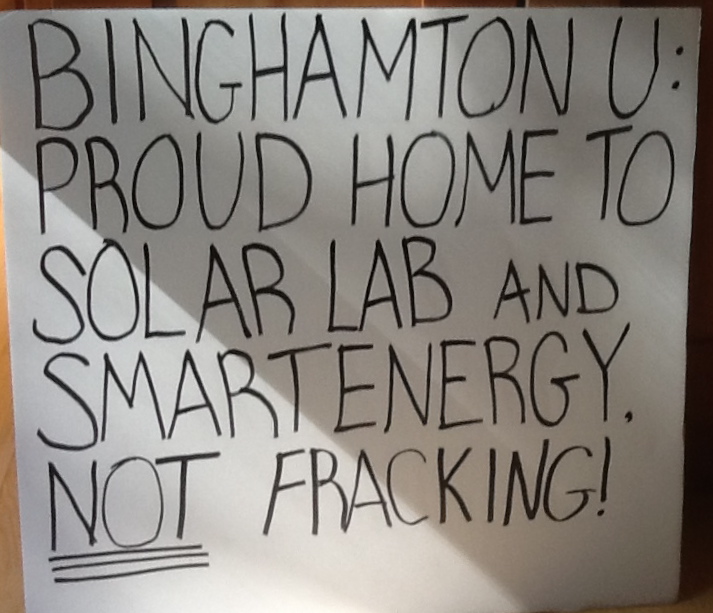
I also attend events, rallies, and meetings when I can. Fracktivists (or fractivists, a spelling I don’t use as often because people sometimes glance at it and read it as fascists, which takes their mind in a totally wrong direction) in New York have taken to showing up with signs asking for a ban on fracking whenever Governor Cuomo appears in public, usually on his way to an event that has restricted access. This bird-dogging, as it is called, has become even more important in the run-up to the November election.
While Cuomo claimed that, as governor, he would keep an open public calendar, he has taken to keeping his schedule secret until the last possible moment. Thus, it wasn’t until late Wednesday evening that we got word that the governor would be arriving at Binghamton University at 11:00 AM Thursday. Isaac, our intrepid community organizer – did you know that community organizers can become president some day? – quickly got the word out and about twenty of us showed up, signs in hand, to greet the governor’s motorcade and chant “Ban Fracking Now!”
As important as it is for Cuomo to see us wherever he goes, it is equally important that members of the press talk to us. We had three television stations, public broadcasting radio, and the local newspaper taking interviews. We were happy that Dr. Sandra Steingraber was among our number that day. She is a biologist and public health expert who is currently at Ithaca College, a nationally and internationally known expert in toxic impacts of industrial pollution who is spending the lion’s share of her time and effort these days in the fight against fracking. All the media outlets interviewed her. Here is a sample of coverage that we received: http://www.binghamtonhomepage.com/story/d/story/fractivists-protest-gov-cuomos-visit/34621/XNJzJy-Dkk-O7Wrr4WZOig.
We have been at this for several years and may be at it for several more. It’s tough to fight an industry that spreads its huge wealth around to politicians to keep our country using polluting, climate-killing fossil fuels, but we have to keep fighting because it is so important to our present and future.
Share this:

good news from K
I wrote and posted this poem in February and re-posted it recently when it was accepted for publication. Today, I have the best possible follow-up. I saw K this morning and she shared that her recent CT scan revealed that her tumor has not just shrunk, but disappeared. This winter and spring, she had been treated aggressively with simultaneous chemotherapy and radiation, until she nearly died from side effects and the treatment had to be halted. She has been in a rest/recovery phase over the summer, but it was a huge and wonderful surprise that the tumor was gone. Hallelujah!
Share this:

One-Liner Wednesday: Richard Rohr quote
“Soulful people, invariably humble and honest about themselves, are also risk takers: they both know the rules and how to break them properly.”
– Richard Rohr, Immortal Diamond (page 20)
Join in Linda’s One-Liner Wednesdays: http://lindaghill.wordpress.com/2014/09/24/one-liner-wednesday-self-consciousness/
Share this:

SoCS: average
Average is a mathematical construct. You add up all the numbers in a list, divide by the number of items in the list, and you call the result the average.
Other than that, I don’t find the term very helpful.
Average as a noun, as defined above is useful. Average as an adjective almost never is, especially when used to describe people.
A student could have received an average score on a test, as in the score matched the average score arrived at by summing up and dividing. That does not make the individual an average student.
We are each too unique and complex. No one can ever be average.
*********************************************************************
This post is part of Linda’s Stream of Consciousness Saturdays. Join us! Read about it here: http://lindaghill.wordpress.com/2014/09/19/the-friday-reminder-and-prompt-for-socs-september-2014/
Share this:

The Thinks You Can Think: Being Dependent & Purging the Fallacy of “Independence”

Wisdom shared by Oscar Hokeah. I was especially struck by this today because it relates to a poem I was revising recently.

 Joanne Corey