Harry Potter Studio Tour!

When we visited London in December, E got tickets for us to go to the Warner Brothers Studio – The Making of Harry Potter tour! The Harry Potter books and films were very important to our family, so we were thrilled to be able to go. We went on a weekday when our son-in-law had to be at work, so we were a party of five – my spouse B, our daughters E and T, our granddaughter ABC, and me. E was the only one who had been there before.

The Studios are outside London, so we needed to use trains and buses to get there. The last segment is on special studio buses. One of the first things you see after entering is a very large dragon in flight. We weren’t sure how ABC, at two and a half, would react to such things, but she loves dinosaurs and accepted dragons as a dinosaur-variant. (T is holding ABC in the foreground.)
HP flying dragon

Because so many people visit, the start times of the tour are staggered throughout the day. There are some introductory remarks from tour guides and a short film before your group is ushered into the Great Hall. Because we were there in December, everything was decorated for Christmas, including, of course, Christmas crackers at each place at the table.
Great Hall

You can see little details of the set, like the tree-toppers with flying witches…
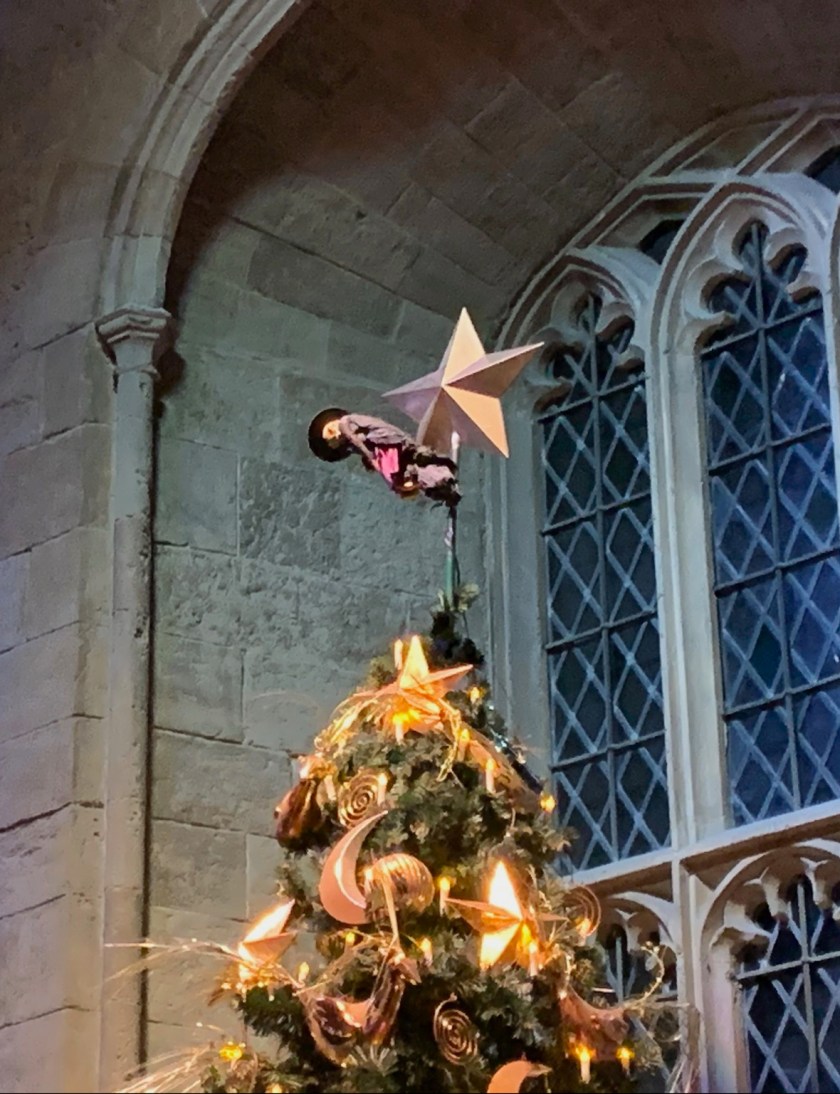
HP XMas tree-topper

and the wreath around the crest on the fireplace.
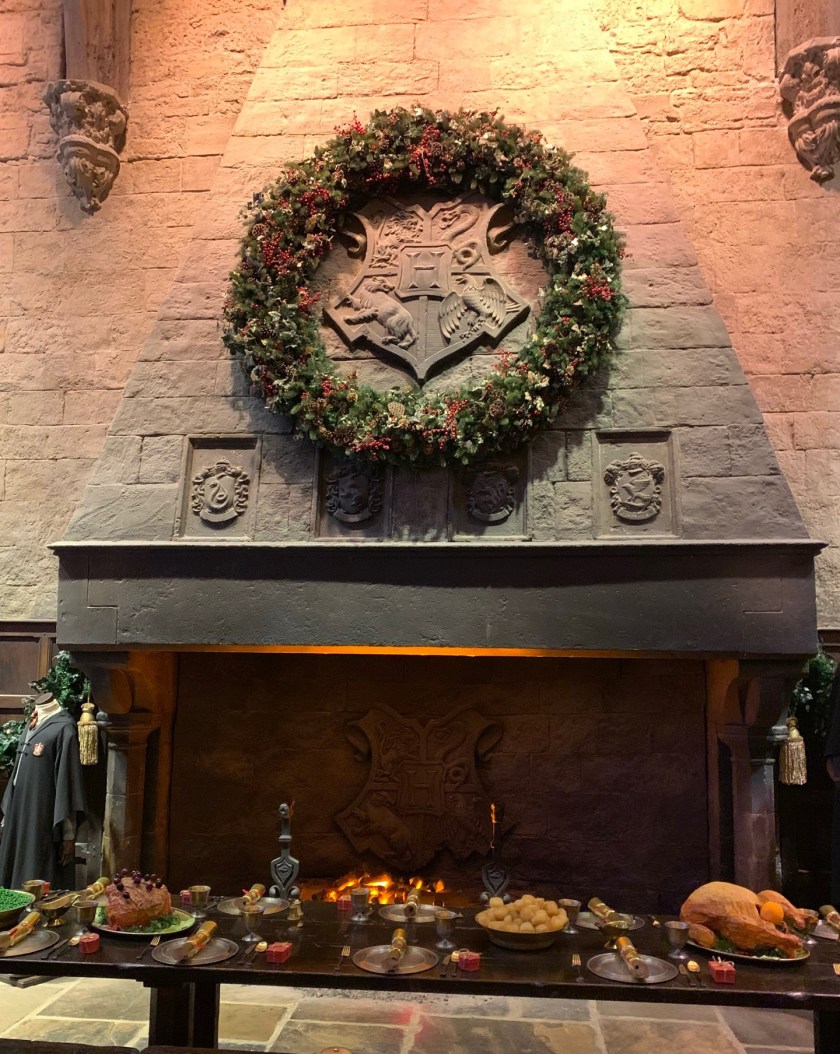
Great Hall fireplace

After the Great Hall, the rest of the tour is self-guided, laid out in a uni-directional way. There are lots of sets, like Harry’s Gryffindor bedroom,
Harry's bedroom

costumes, like these from the Yule Ball,
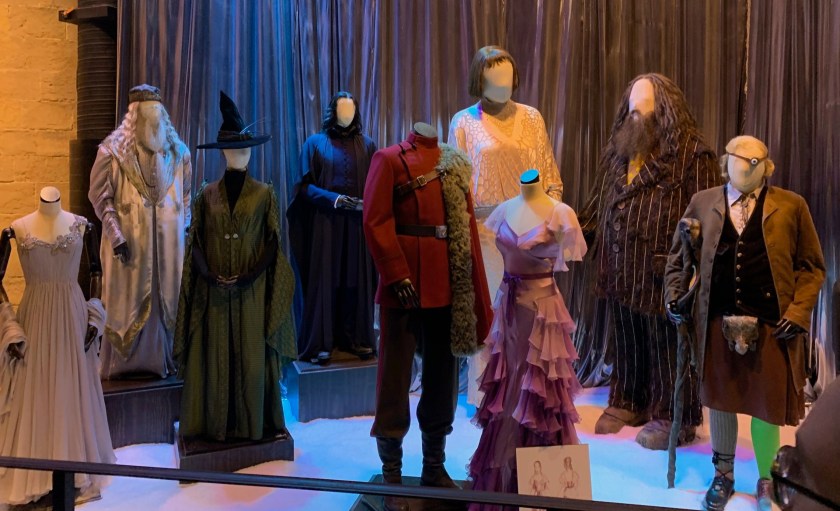
HP costumes Yule Ball

and props, like this display of wands.
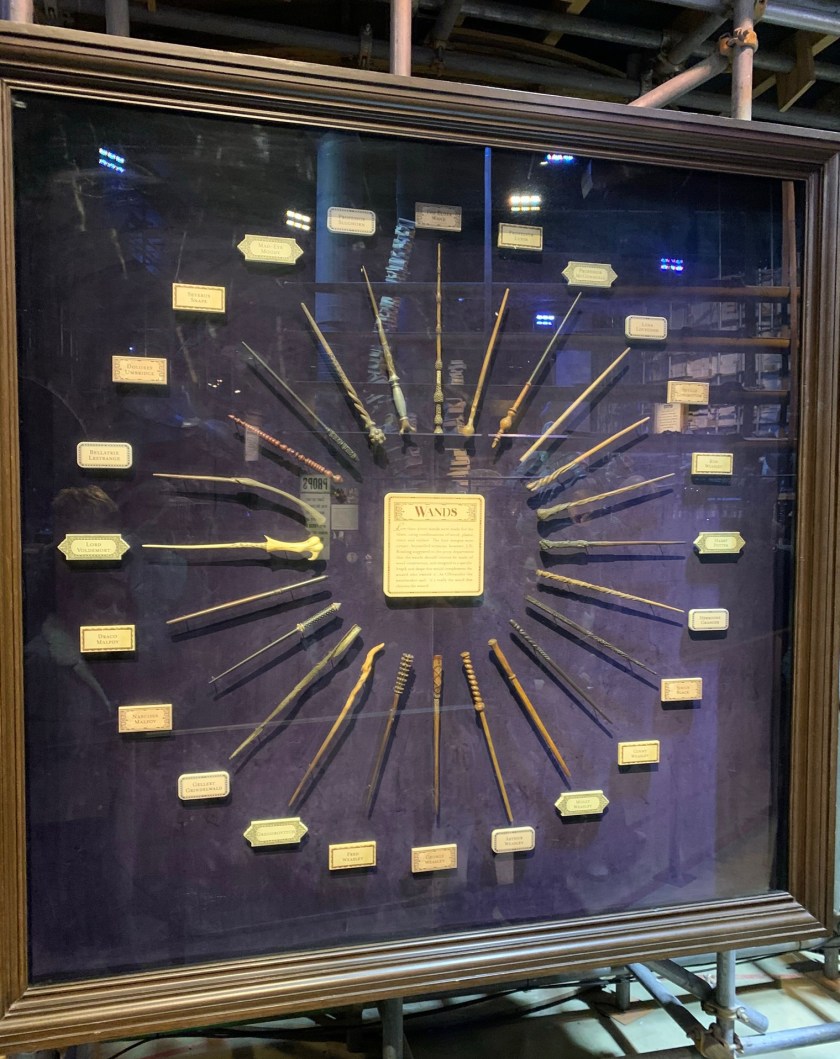
HP wands

There were certain displays that ABC did not like, such as these disembodied hairpieces.
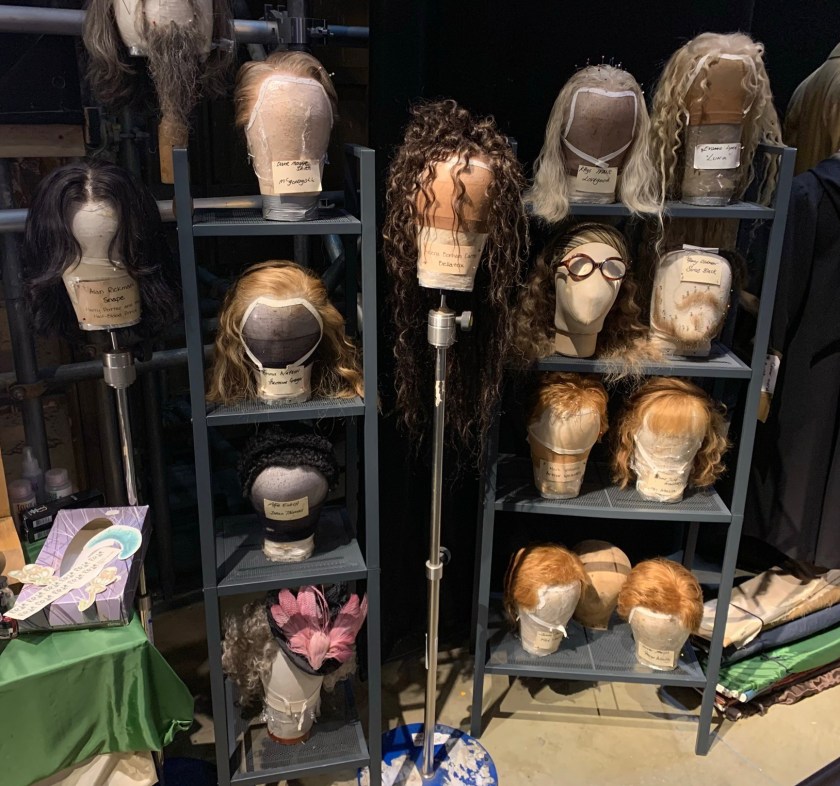
HP wigs

Sometimes, context mattered. For example, we rushed ABC out of the dark Forbidden Forest Set with its spiders because she was not a fan, but, later, when we saw the huge model of Aragog, Hagrid’s former pet giant spider, which was several meters wide, mounted on a wall, ABC decided to sing “The Eensy, Weensy Spider” to it.

As a big fan of trains, ABC enjoyed the Hogwarts Express.
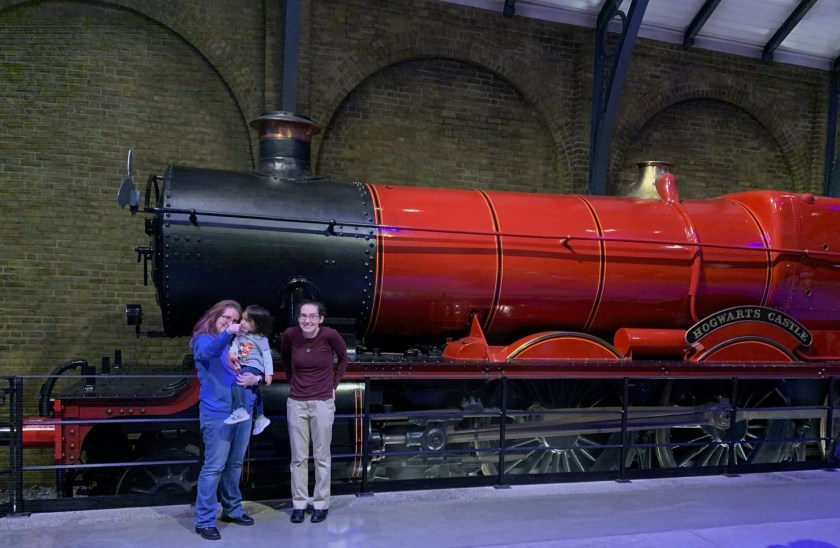
Hogwart's Express

Even better, we got to walk through the train cars!
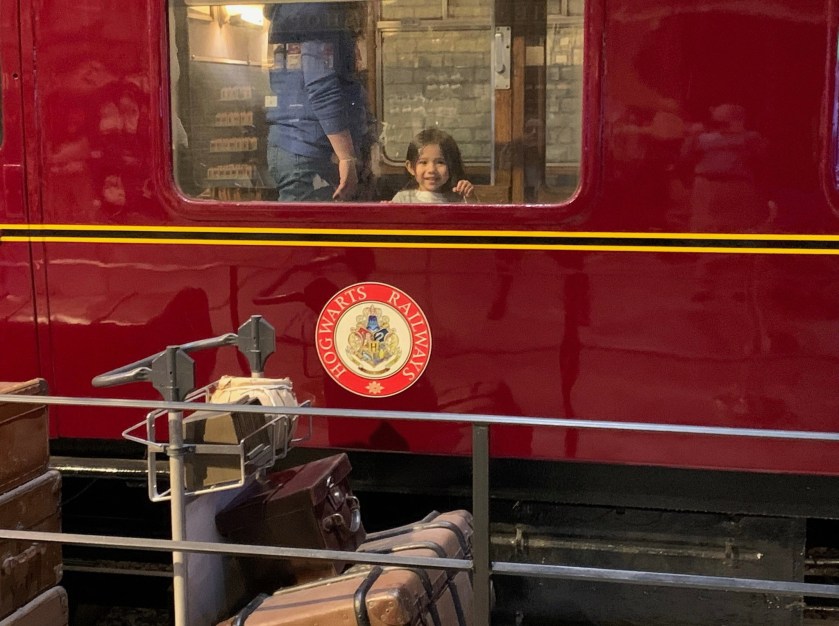
Ada on the Hogwart's Express

For some reason, I had to rush ABC through the grand Gringotts Bank set, because she did not approve.
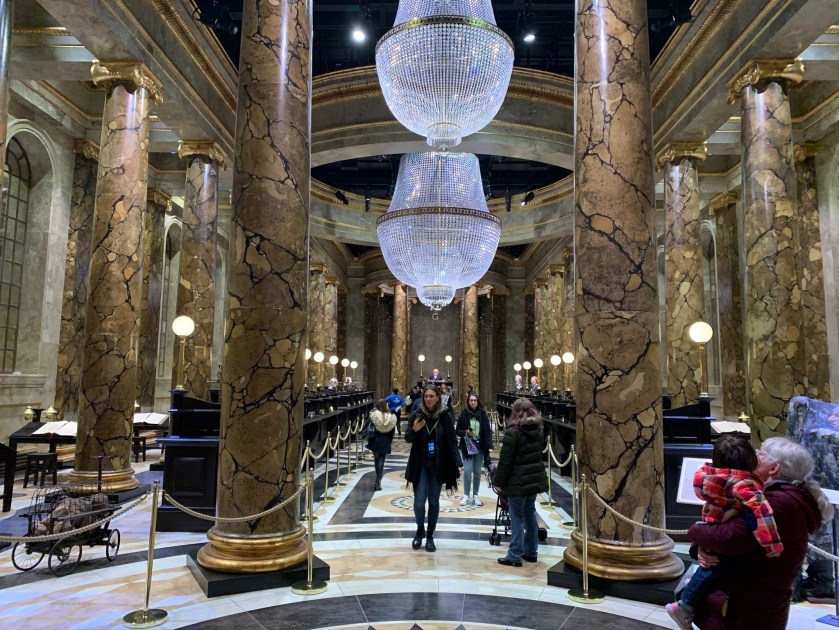
Gringotts

The destroyed Gringotts was much more to her liking! She insisted on watching the scene multiple times. It must have been the attraction of the dragon…

The last part of the display before the obligatory exit-through-the giftshop was the model of Hogwarts used for the external shots. ABC was a big fan!
J and Ada at Hogwarts model

It was a beautiful model. Because it was winter, we got to see it with snow which made it look even more magical!

Hogwarts model

We all had a lovely time. I hope we will be able to visit again in the coming years. It will be fun to see how ABC reacts over time. Warner Brothers also continues to add new displays, as well as having various limited time features, so there will be new things to see each time.

Eventually, ABC – and any future siblings – will be able to read the Harry Potter books and see the films. Perhaps, E and L will embark on our family tradition of reading each book aloud as a family.

Maybe, B and I will be able to join in via videochat…

today’s changes

When I wrote about covid-19 over the weekend, I assumed that things would continue to change.

I was correct.

Today, I learned the following:

  1. While visitors are still allowed in Paco’s independent living apartment building, they are no longer allowed in public areas, including the dining room. This means that our usual Sunday morning breakfast together won’t be possible, unless we order ahead and Paco goes to pick it up from the dining room.
  2. My hopes that the panic buying for groceries, medications, and household goods was just for Friday and over the weekend were dashed. It took three stores today to find a short list of items that Paco or my household needed. None of it was hoarding or earth-shatteringly necessary, but it was so strange to still see entire categories of foods unavailable.
  3. Stores are adjusting to the circumstances as best they can. Wegmans, where I usually do most of my shopping, has instituted limits on certain items, hoping to keep staples available for as much of the day as they can. They are usually open 24 hours a day, but are now closing between midnight and 6 AM to allow for more extensive re-stocking. Even with that, there was almost no fresh meat this morning and there were signs up saying they wouldn’t be getting a shipment until tomorrow afternoon.
  4. People must rely a lot on peanut butter, because it is very hard to find.
  5. France is reporting that over-the-counter anti-inflammatories may worsen covid-19 symptoms. They recommend other fever-reducing medications, such as acetaminophen.
  6. Starting at 8 PM today, all restaurants in New York, New Jersey, and Connecticut will be open only for takeout and delivery. Also, the new definition of allowable gathering size is 50. This will effectively close lots of businesses and organizations.
  7. Many of the closures are scheduled until end of March or mid-April, but many of us assume they will go on longer.
  8. I had thought that the United States national government had the most haphazard response to covid-19, but it appears the United Kingdom is also in the running for this dubious distinction. Because my daughter and her family are in London, we often exchange news. The UK is not even using social distancing as a strategy for the population at large. It’s mind-boggling and scary. [Update:  Right after I published this post, my daughter sent me a link showing that someone finally got through to Boris Johnson that he needs to change his strategy for the UK.]

Who knows what tomorrow will bring?

(I will try to make my next post be about something cheerier.)

charting a pandemic path

Around the world, most of us are sharing in the battle to limit the damage from COVID-19 to the extent possible.

In some places, the path is proscribed by local or national government and there are not a lot of personal decisions to make.

Here in my county in upstate New York (USA), things are not laid out as clearly. I have been trying to prepare and make plans, but circumstances keep changing – and so must the plans. Our state and local governments and community organizations have been much more proactive than the federal government, but, as more and more cases are diagnosed closer and closer to where I live, additional measures continue to roll out.

Over a week ago, I started the general preparedness guidelines to have a couple of weeks of food and medications available in case we had to self-isolate. This was not a big deal for our house, but I have been much more concerned about preparing things for my dad, known here as Paco. He lives in a senior community in an independent living apartment, so he has a number of services available in-house, but I visit every day to check on him, make sure his medications are all organized and his schedule is laid out, etc. Early last week, a sign went up that people who were having any symptoms of illness should not visit. This is practical and a commonsense precaution that I would follow anyway, but, later in the week, the health care part of the center was closed to all visitors, except those whose loved one is in very grave condition. This meant that Paco could no longer go over to concerts and singalongs held in the health care facility. At the same time, they cancelled activities in independent living that involved outside performers or volunteers. For example, the Irish dancers would not be able to come for a scheduled pre-St. Patrick’s Day performance.

At this point, I had to face the probability that even healthy visitors might not be able to visit independent living at some point, so I started making contingency plans that could be carried out reasonably well without me. Sadly, we’ve had to cancel a planned visit from my sisters and their families to celebrate Paco’s 95th birthday later this month. They all live in areas where the virus is more prevalent and we didn’t want to risk them bringing it with them, given that they might not have obvious symptoms.

Thursday night into Friday, several large employers announced that they would be having most of their employees work from home starting on Monday. The universities had also announced that they were moving most of their instruction online for several weeks or the rest of the semester. Professional sports leagues announced they were suspending or delaying their seasons. Some combination of these functioned as a trigger that caused some people who hadn’t been taking the virus very seriously to spring into action – or, at least, into shopping. I went to my favorite grocery store to pick up a few things for Paco and for my household and was surprised to find that there was almost no peanut butter, canned legumes, frozen vegetables, etc. in the store. And I hadn’t even checked the cleaning supplies and paper goods aisles. The evidence of panic-buying took me by surprise. Given that I had been in concern and preparation mode for days, I had obviously underestimated the number of people who were suddenly paying attention and freaking out a bit.

On Saturday, the county executive announced that all primary and secondary schools will close through mid-April. Now, people are even more upset.

It appears that there are some people who still think that fears of the virus are overblown, given that we have no known cases in our county, even though our neighboring counties do have confirmed cases; they don’t want their personal and family routines disrupted. Others have been following the news and the advice of medical experts and realize that, while we can’t stop the virus completely, there will be fewer deaths and more treatment available to those with severe illness if we can spread out the number of cases over a longer period of time, so as not to overwhelm our medical system. The way to do that is to reduce the number of people who are in close contact and in large groups, also known as social distancing.

There are a number of different opinions about how much distance is required and how many is considered too many to be in a crowd. This leaves some situations to personal discretion. I admit that I had a difficult time figuring out what to do about church attendance this weekend. Our diocese has dispensed with our obligation to attend mass, but services are still being held. I am not especially concerned about my getting seriously ill, but I am concerned with the possibility of bringing the virus into Paco’s community, so I’ve decided to participate in a mass on television. At least for now, I plan to still shop. occasionally eat at restaurants, and attend small gatherings with friends. If we start seeing community spread in my town, though, I’d cut back further. If we get to that point, I’m sure I wouldn’t be able to visit Paco; it’s likely that only residents and staff would be allowed in the building.

I admit that it is disconcerting to know that, despite our best efforts, people are going to continue to get sick, some of them severely sick, and some of them will die. I hope that our communities will face up to this challenge and do as much as we can to protect people, especially the most vulnerable.

Be well. Be kind. Be thoughtful. Be considerate.

SoCS: barbed wire

When daughter T was working in Clinton, Missouri, we visited the local museum. The collection was very eclectic with unexpected things around every corner.

One of the exhibits was a barbed wire collection. I hadn’t realized there were so many different styles.

Having grown up in rural areas, both my spouse B and I were familiar with barbed wire fences. B had grown up maintaining a barbed wire fence around the pasture. I grew up with a barbed wire fence that ran along the edge of the reservoir behind my house.

Both of those were meant for protection. It saddens me to think of barbed wire being used to keep people away, though. It especially hurts to think of people who are fleeing war and violence being encountered with barbed wire and other barriers. Instead of finding protection, they find exclusion.

Barbed wire fences never seem to have gates.
*****
Linda’s prompt for Stream of Consciousness Saturday this week is “wire.”  Join us! Find out more here:  https://lindaghill.com/2020/03/13/the-friday-reminder-and-prompt-for-socs-march-14-2020/

2019-2020 SoCS Badge by Shelley!
https://www.quaintrevival.com/

A timely poem from Anne Harding Woodworth

As we are all dealing with COVID-19 in some way, I wanted to share a topical poem with you.

Anne Harding Woodworth is an accomplished poet who I met through the Smith College Alumnae Chorus. We have sung together for several concerts, including three performances of Mozart Requiem on tour in Sicily. This poem brilliantly references the Requiem in the context of an audience-less performance held recently due to COVID-19 caution.

The site where it appears is New Verse News, which publishes poems on current topics of interest. I appreciate that they make it possible for poets to publish work about recent or ongoing situations without having to wait months for journal publications.

You can find “Mozart Requiem Streamed in a Time of COVID-19” here:  https://newversenews.blogspot.com/2020/03/mozart-requiem-streamed-in-time-of.html

One-Liner Wednesday: the artist

“One who wants to leave behind a gift”
~~~  Otto Rank’s definition of the artist
*****
Join us for Linda’s One-Liner Wednesday! Find out how here:  https://lindaghill.com/2020/03/11/one-liner-wednesday-just-sayin/

Badge by Laura @ riddlefromthemiddle.com

SoCS: a “hidden figure”

Over these last days, we have been hearing a lot in the media about Katherine Johnson, who recently died at the age of 101.

She was one of the women portrayed in the film Hidden Figures. She worked for NASA (the US space agency) as a human computer. Before the advent of the digital age, being a computer was a job, not a piece of equipment, and Katherine Johnson and her colleagues were the ones doing the computations involved to figure out trajectories for missions for satellites and manned spacecraft.

The women in Katherine Johnson’s computation department were, like her, African-American. And they were all women. Men, predominantly if not exclusively, worked in other departments where they were considered professional and paid more. The women who worked as human computers were not considered as professional by the government standards in place at the time and earned much less.

Katherine was a very accomplished mathematician. Her skills were noticed and she had the opportunity to work with the professional men on the first attempts to put astronauts into orbit. The work was going on in Virginia, which, at that time still had segregation laws in effect. One of the scenes in the movie that drove home what this meant was showing Katherine running across swaths of the NASA campus to get back to the building in which she had originally worked in order to use the “colored women” bathroom. She was eventually allowed to use a restroom close to her new workspace, but it was a stark reminder to me that this kind of discrimination was so overt during my lifetime.

Katherine encountered lots of sexist and racist discrimination, but persevered and triumphed. John Glenn trusted her work so much that he would not board his capsule for the first attempt at going into orbit by a US astronaut until she had personally verified all the figures.

After a long and distinguished career at NASA, Katherine Johnson was honored in a number of ways. There were NASA buildings named in her honor. President Obama awarded her the Presidential Medal of Freedom, which is the highest civilian honor in the country. At the time of the Hidden Figures movie, she appeared on stage with the stars of the film during the award season.

I’m grateful that her story has received more notice so that she is no longer a “hidden figure” but an inspiration to new generations of women and of people of color to reach for the stars in their own lives, despite the racist and sexist attitudes that still, unfortunately, plague us.

Rest in peace, Katherine Johnson.
*****
Linda’s prompt for Stream of Consciousness Saturday this week is “figure.”  Join us! Find out how here: https://lindaghill.com/2020/03/06/the-friday-reminder-and-prompt-for-socs-march-7-2020

2019-2020 SoCS Badge by Shelley! https://www.quaintrevival.com/

Warren emotions

Yesterday, Senator Elizabeth Warren of Massachusetts suspended her campaign for the presidential nomination of the Democratic party and I am sad.

Sen. Warren was my favorite of all the candidates. She is intelligent, forthright, articulate, and principled. Her broad life experiences give her perspective on the impacts of government policy on everyday folks, as well as the ability to make personal connections with people in a wide range of circumstances. She can take complicated topics and explain them in terms that voters can understand. Like many women in leadership, she works well collaboratively and incorporates ideas from other candidates, with their permission and cooperation, into her own plans.

She has the makings of a good president and a trailblazer as the first female president of the United States.

I’m sad that she is unlikely to have the chance to serve in that capacity.

I’m also discouraged and disappointed with the way she was sometimes characterized. Some of these characterizations are common among women in the public sphere. Women candidates face a lot more scrutiny about what they wear, their hairstyle/color, their makeup, etc. I know you hear occasional comments about male candidates in this regard, like Bernie’s hair or Tom Steyer’s ties, but women face comments about their appearance much more frequently. Women also tend to get negative comments about their voices. I have heard men say their voices are too shrill, when they are not shrill at all, just higher-pitched as women’s voices usually are. I’ve also heard men say that women candidates sound like their wives’ haranguing them, which I find insulting to both the women candidates and the men’s spouses. I have even heard both men and women say that they didn’t think women should be president and that being president is a “man’s job.”

I also observed that Warren was being held to a different standard than her male colleagues, a phenomenon that also occurred with Hillary Clinton in 2016. Both Warren and Clinton were famous for having detailed plans in a broad range of policy areas. Warren was challenged on details of her plans while other candidates did not even offer plans to back up their promises. Women, along with other historically disadvantaged groups, often have to be hyper-competent to be noticed, although sometimes this leads to accusations of being an elitist or know-it-all.

Elizabeth also tended to get lumped in with the other candidates in their seventies. She is the youngest of that group, which also included Biden, Bloomberg, Sanders, and Trump. She is probably also the healthiest and most energetic. As a woman, she also has a longer life expectancy. One of my favorite comments from Warren when someone pointed out that she would be the oldest president ever elected was that she would be the youngest woman president. With her leaving the race, it looks like the winner of the presidency will be the oldest person elected, as Trump, Biden, and Sanders are all older than she.

I’m assuming that the Democratic nominee, whether Sanders or Biden, will choose a much younger running mate, which will leave Elizabeth off their list. This is unfortunate, as she would be best positioned to ascend to the presidency if needed.

I am glad that Warren will be back in the Senate, where she will represent not only the state of Massachusetts but also the regular folks who make up the vast majority of the US. I know that she will have many opportunities to continue to serve the American people.

I’m just sorry that it won’t be as president in 2021.

Update March 8, 2020:  I was just reading this article that highlighted that women in political leadership are losing ground around the world. Instead of moving toward more acceptance of women in political office, in many places, we are seeing less.

JC’s Confessions #10

On The Late Show, Stephen Colbert does a recurring skit, now a best-selling book, called Midnight Confessions, in which he “confesses” to his audience with the disclaimer that he isn’t sure these things are really sins but that he does “feel bad about them.” While Stephen and his writers are famously funny, I am not, so my JC’s Confessions will be somewhat more serious reflections, but they will be things that I feel bad about. Stephen’s audience always forgives him at the end of the segment; I’m not expecting that – and these aren’t really sins – but comments are always welcome.
~ JC

I don’t feel like a musician anymore.

I started playing piano at seven. I began studying organ as a preteen and was the organist of my rural Catholic church at fourteen. I majored in music at Smith College, where organ was my main instrument, I played often at chapel, I sang in choirs, learned that I could compose, and was named the Presser Scholar in my senior year.

After I graduated, married B, and moved to the Binghamton NY area, I continued with church music until I took a few years away when my children were young.  Realizing that it wouldn’t work for our family for B and I to never have a common day off, I volunteered with the music ministry at my church, accompanying the youth and junior choirs and subbing when our music director needed to be away. When tendon problems in my elbow eventually made it impossible for me to play for very long at a time, our music director would play and I would conduct.

When our parish disintegrated in 2005 and my church music volunteering evaporated, except for occasional special celebrations, I still had my long-time affiliation with University Chorus to keep me musically active. After the retirement of our long-time director, though, University Chorus, which used to sing a major concert every semester, has cut back to only singing at one concert a year, at most. This academic year, we have not met at all and I am not sure we will ever re-convene. Due to uncertainty and personal scheduling complications, I haven’t been able to join another group.

With my last steady musical commitment gone, I don’t feel that I am still a musician, which leaves an empty space in my identity. In a period of my life when there has been so much loss, losing that piece of myself is especially difficult because music has long served as a vehicle to express emotion and to find community and comfort.

I don’t know if I will ever recover the musician part of my identity. Theoretically, I could be singing on my own every day and working on sight reading so that I would be ready to audition if there is an opportunity, but it feels too futile, not helped by the fact that I am a very anxious and not particularly good auditioner.

It is likely that I will sing again with the Smith Alumnae Chorus, either on campus or on tour, but those choral experiences would only be a few days a year. Not an identity-affirming amount of time.

Maybe what I should say is that, for many years, I was a musician.

SoCS: a disconcerting disconnect

There is a major disconnect between the president of the United States and public health regarding covid-19, the form of coronavirus that is causing illness and death around the world and which may soon cross the line to become a pandemic.

From its start in China, there are now major outbreaks in Japan, South Korea, Italy, and Iran, with cases in lots of countries in both hemispheres. Some of the countries have tested thousands of people, ramped up medical care, imposed quarantines, even closing schools for weeks as was just announced in Japan in the last few days.

Meanwhile, the United States has only tested a few hundred people. There are under a hundred confirmed cases, but most likely there are more cases that only had mild symptoms or no symptoms. This is dangerous because those people can spread the virus unknowingly.

Ordinary Americans have been watching the news of the spread of covid-19, first in China and then into other countries. Some doctors and public health specialists were speaking in the media about the epidemic – and preparedness and cases in the US. Earlier this week, some federal government officials who work in agencies like the Centers for Disease Control and Prevention had spoken publicly about the virus in the United States.

The stock market in the United States went down – a lot – this week, the steepest decline since the financial crisis of 2008. This finally got the president’s attention and there was an evening news conference about the virus in the US. Unfortunately, the president made mistakes in his remarks, including saying there were only 15 cases in the US when there were actually 60 confirmed cases. He also put the vice-president in charge of the US efforts against the virus, which is disconcerting because, as governor of Indiana, he botched an early intervention effort against HIV. It’s also disconcerting that all communication from the federal government has to be approved by him first, including public statements by Dr. Anthony Fauci, longtime director of the infectious disease department for the country.

Late this week, there was the announcement of the first covid-19 case that couldn’t be traced to someone who had contracted it abroad. This is an important development because it could mean that there would be community spread here in the US, which would also bring the world closer to declaring a pandemic. It’s scary because it brings to mind the flu pandemic of 1918, which infected millions worldwide and had a mortality rate of almost two percent. Early statistics from China show that covid-19 has a mortality rate of a little over two percent, which is beyond the ability of even large modern health systems to combat. There would be shortages of needed equipment like respirators and of appropriate hospital facilities that can isolate the patients so that no one catches the virus in the hospital.

Yesterday evening, I was watching a news station. Several times throughout the evening, the stories they were covering were interrupted by news of several new confirmed cases in different locations that appeared to be the result of community spread, instead of direct transmission from abroad or from being in the household of someone who contracted it abroad. This bring some communities in the US close to needing to impose states of emergency and doing things like prohibiting public gatherings, including school and work and church.

The most chilling thing for me was that, at the same time, the president was speaking to a rally in South Carolina, telling them that covid-19 in the US was a hoax perpetrated by Democrats.

This is disconcerting and irresponsible and shows how disconnected the president is from the reality that the country is facing.

To be clear, I am not a paranoid person regarding disease. I’m not running around in a mask and gloves in fear of covid-19. I am, however, vigilantly watching the public health news and, as recommended, making plans for possible cases and restrictions on travel and being out in public in my region.

While I hope and pray for safety and good health around the world, I want to be prepared to stay as safe as possible if this epidemic does become a pandemic. In the US, I hope that people will make sure that the information they get comes from a reliable source.

Sadly, our president is not a reliable source.
*****
Linda’s prompt for Stream of Consciousness Saturday this week is base the post on a word that contains “ect”. Join us! Find out how here:  https://lindaghill.com/2020/02/28/the-friday-reminder-and-prompt-for-socs-feb-29-2020/

2019-2020 SoCS Badge by Shelley!
https://www.quaintrevival.com/