Saying good-bye to a friend

Today was Peter’s memorial service.  I had written about Peter here and, this afternoon, we were all able to say our final good-byes and to celebrate his life among us and the eternal life to which he has been called.

Although Peter’s final illness was short, he was able to participate in the planning of the memorial, both musically and liturgically. The service was one of the most meaningful I have ever experienced and included some favorite Scripture passages, including 1 Corinthians 13.

The choir was made up of past and current members of the Trinity Episcopal choir and of Harpur Chorale, the most select choral group at Binghamton University which Peter had conducted since 1998. He had been organist/choirmaster at Trinity Church since 1981.  Also participating were the remaining members of Early On, a quintet that Peter helped form several years ago

Tellingly, the organ was silent for most of the service. The program explained:

 “In tribute to Peter’s many years as Church Musician at Trinity the organ will not be used during the first part of the service. The return of the organ at the end of the service symbolizes the enduring nature of music.”

The organ first played after communion for the commendation anthem, which was “The King of Love My Shepherd Is”, an arrangement that Peter had done of the tune St. Columba for choir and organ. It was so moving for all of us. You could tell that some of the choir members were struggling to go on, but together, they were able to continue.

We all sat and listened to the postlude, which was Olivier Messiaen’s “Dieu Parmi Nous” (God Among Us), the last movement of The Nativity of Our Lord.  The organ professor from the University played, but I couldn’t help thinking about how Peter played it. While the professor played it well technically, Peter played with more feeling and nuance and with a profound understanding of how to coax subtle shadings of sound from the 1960 Casavant organ. I thought about how often I had stood next to the console, observing Peter playing and turning pages for him, absorbing everything I could about service playing from him.

After the last reverberations of Messiaen died away, there was a profound silence in the full church. I believe we were all giving thanks for Peter’s years with us and feeling his absence.

Requiem æternam dona eis, Domine : et lux perpetua luceat eis.  Grant them eternal rest, Lord, and let perpetual light shine upon them.

Sunday morning thanksgivings

The word Eucharist means “thanksgiving.” Here are a few things for which I am thankful this Sunday.

* I got to attend Mass with my parents. This has been a common practice over the last five years, after they moved into their senior residential community, but it has been a rarity lately. My mom has had a string of health issues, the most recent of which I wrote about here, so she hasn’t been able to get out to church many times this year.  This spring, Dad turned 90 and Mom turned 83 yesterday. I am also thankful to still have them with us and doing comparatively well. While they have had challenges, they are in better shape than so many other folks their age – and so many others were not blessed with this many years on earth.

* We prayed for those affected by the earthquakes in Nepal and took up a collection to aid them.  I was grateful for the opportunity to help.

* During the intercessory prayers, we prayed for Sister Rose Margaret on what would have been her 80th jubilee as a Sister of Saint Joseph of Carondelet. Rose Margaret died just before Christmas. She was an amazing person – bright, knowledgeable, an expert in Scripture and theology, skilled in pastoral care, an excellent preacher, kind, generous, loving, and Christ-like – with an Irish twinkle always in her eyes. Called to the ministerial priesthood by God, she was not able to be ordained under current Catholic doctrine, but she lived out priesthood every moment of her life as a sister. She had been an inspiration to Sarah’s Circle. At her sixtieth jubilee, Sarah’s Circle members attended along with the sisters in her order, so she had two circles of women with whom to celebrate her special anniversary. Today, I gave thanks for her time among us and her lasting legacy.

* When I arrived at Mass this morning, my mother told me that the memorial service for our friend Peter had been set. After Mass, Nancy, the music director and a longtime friend, and I had a long conversation about Peter, who had been her colleague for decades. Peter was the organist/choirmaster at Trinity Episcopal in Binghamton NY for many years, as well as the director of Harpur Chorale, the most select choral ensemble at Binghamton University. As accompanist for University Chorus, he was one of my first friends when I moved to the area and became one of the few people for whom I have ever worked when I served for two years as his assistant at Trinity. (Technically, my title was organist-in-training, which didn’t fit very well as I had been playing for over ten years by that point.) Peter was one of the few people left he knew me as a professional church musician.

Peter had incredible range as a musician. He could play organ repertoire across a range of styles well. He had a profound understanding of liturgy and service playing. He could teach choral music to children, teens, college students, and adults through the age spectrum up to seniors. He composed – choral arrangements, hymn introductions and harmonizations for organ, piano pieces. He taught piano and organ; he was my older daughter’s piano teacher for almost ten years. He could play jazz piano. He was a great accompanist, even managing the nearly impossible orchestral reductions for University Chorus rehearsals. He sang bass, although we didn’t get to hear him much as he usually had to conduct or play.

Peter was also generous, as a musician and as a friend. He collaborated well and managed to keep his cool, even in tense situations. He was a good storyteller and had led an interesting life. His sense of humor was gentle, rather than biting. While he spent most of his time on music, he also loved the outdoors, especially if whitewater canoeing was involved.

Peter’s death was quite sudden and we are still all a bit shocked and holding his wife, daughter, mother, and the rest of his family in prayer. We are also giving thanks for his life among us, doing what he loved, and sharing his gifts with us all.

Interspirituality on Sunday

Following up on my prior post about the Interspirituality Conference, I wanted to add what happened on Sunday morning.

I attend 7:30 Mass at Our Lady of Good Counsel where we were observing the Fourth Sunday of Easter, which is Good Shepherd Sunday.  Because of the conference, I was especially attuned to the references to Jesus saying that there were other sheep “not of this fold” who also follow the shepherd’s voice, which correlates so well with interspirituality and the core beliefs of religious, philosophical, and humanist traditions toward love, peace, connection, and unity. There were so many other moments during our sung and spoken prayer that spoke of “all” in the universal sense, rather than as all the assembly or all Catholics or all Christians. I am thankful to be here at this time, instead of in the pre-Vatican II days when Catholics regularly condemned those who were not (strongly observant) Catholics. I am also thankful that Pope Francis regularly holds meetings with those of many different spiritual beliefs, as well as those who are atheists, humanists, agnostics, etc., giving public witness to the dignity of each person.

I arrived early at First Congregational for the 10:00 service which was the official conclusion of the Interspirituality conference and was pleased when Jamie came to sit with me. With my daughters no longer at home and my mom dealing with a string of health issues, I most often attend without a companion, so it was nice to have a friend next to me.

The congregation, under the leadership of Rev. Dr. Art Suggs, is very progressive, open, and inclusive. I had not seen such an enthusiastic – and mobile – greeting of one another during the opening of the service since the Ecumenical Christian Church at Smith College when I was a student in the late 1970s-early 1980s.  The hymns and prayers were expansive and filled with light and love. The Scripture passage from chapter 10 of John’s gospel was a continuation of the small section that had been proclaimed at mass and referred back to the good shepherd, which was a beautiful connection for me.  In the passage, Jesus quotes Psalm 82 which says “You are gods.” This passage had come up during the weekend sessions as a millennia-old reference to the indwelling of the Divine in human beings, so it was a natural transition to Kurt Johnson’s sermon, “The Coming Interspiritual Age,” which synopsized the insights shared during the conference and gave hope that many around the world are moving beyond the rigid boundaries separating people from one another and into an emerging Second Tier Consciousness which unifies across religions, philosophies, nationalities, and all else that separates us. I again regret my inability to convey this adequately and hope that people who want to learn more will look for resources such as this website.

I wrote in my prior post about anticipating hearing the organ at First Congregational again. One of the lovely things about the structure of the service is that it incorporated the prelude and postlude within the service itself, so that one can actually listen, avoiding the “accompanied pep rally” experience that especially postludes can become. I appreciated that the postlude registration included some of the reed stops, because I so appreciate the Skinner-style reeds that are full and rich rather than thin and piercing. I managed to only tear up a little as I remembered being at the organ with Searle Wright. Had the repertoire included Franck or Dupré or one of Searle’s compositions I’m sure I would have been sobbing.

In a final Spirit-led moment, at the coffee hour after the service, I joined a conversation that Jamie was having with Heidi, one of the women of the church who had been such a great help to us during the conference. The conversation turned to the organ and I had a chance to share with her some of my experiences with Searle and the instrument. I must have had my poet hat perched invisibly on my head as I was going on about how organs breathe, but, fortunately, Jamie and Heidi were receptive listeners. As it turns out, Heidi’s husband had just been speaking about the need to invest in the upkeep of the organ, so it was particularly meaningful to her to hear me speak about Searle, the instrument, and their place in the history of the church and its ongoing legacy.  I am not sure what work needs to be done, but I am hopeful that the organ will be restored and preserved, not altered, or worse, abandoned. I believe that the Spirit moves and speaks through the organ’s pipes as surely as it does through our human voices and through all of creation.

theater organ

I just saw a piece on the Today Show about the only remaining theater organ in Seattle, which in the 1920s had fifty in silent film and stage theaters. The organ in the piece was a Wurlitzer, which was one of the most common manufacturers of the day.

It reminded me of the Roberson Museum in Binghamton, New York, which housed a Link theater organ, built by the firm of a local family. Edwin Link went on to found Link Flight Simulation, which used the technology of the organ business to craft the first mass-produced flight simulators, the Blue Boxes that trained many pilots in World War II.

When we moved here in the 1980s, I studied organ with M. Searle Wright, who was an enormously talented classical organist, teacher, and composer, and, at an age when most people are retired, then the Link Organ Professor at the State University of New York-Binghamton. He also was one of the few remaining masters of theater organ, able to sit at the console and accompany silent films, bringing to life the sounds of the world and the moods of the characters.  It was an amazing experience to hear him accompany a film!  Talented younger organists would travel up from New York CIty to study theater organ techniques from him.

We more often heard Searle’s theater organ talents when he played a 45 minute prelude of classic American songbook and Broadway tunes before each Binghamton Pops concert on the Morton theater organ at the Forum. On the music stand, he would have only a list of the pieces (perhaps with the key structure, he planned to include that day and would weave those songs together, showing off the fun aspects of theater organs, the literal bells and whistles.

A magical art, which is, thankfully, still being kept alive by those to whom an older generation of organist like Searle Wright passed on to them.

Bach fugue

Early this morning, I was driving to 7:30 Mass at a church that was a bit further afield than usual, so I put the car radio on and caught the cadence of an organ prelude. I immediately thought it was J.S. Bach, although I did then think, perhaps it would be prudent to withhold a conclusion until I had more than two measures to go on.

As soon as the fugue began, though, I knew it was Bach – and one of the preludes and fugues I had learned while I was at Smith. (For the other organ geeks out there, it was a Prelude and Fugue in G major, although I am not sure of the BWV.) Next, they spoke about how composers often borrowed themes from their own work or others’ work and played a choral movement that used the fugue theme, transformed into a minor key. (Maybe the US court system needs to hear a bit more about this long-time compositional practice.)

It was odd for me to think about my playing Bach on the organ. There is even a bit of wonder that I ever could. It’s been almost ten years since I have played on even a limited basis and even longer since I played such complex repertoire. Long-standing tendon problems in my right elbow led to years of physical therapy and finally surgery which we had hoped would fix the problem. However, I developed calcifications that caused the symptoms to recur, so I could only play for short amounts of time, not nearly enough to practice Bach fugues.

I had been still doing some accompanying for the choirs at our church, but almost ten years ago, we lost our church home, and I have barely so much as touched an organ since.

This spring and summer will be the tenth anniversary of a string of really painful life events, the aftermath of each still present in my life and the life of my loved ones in different ways. I have the feeling that these upcoming tenth anniversaries will be as complicated as a Bach fugue, but not nearly so organized.

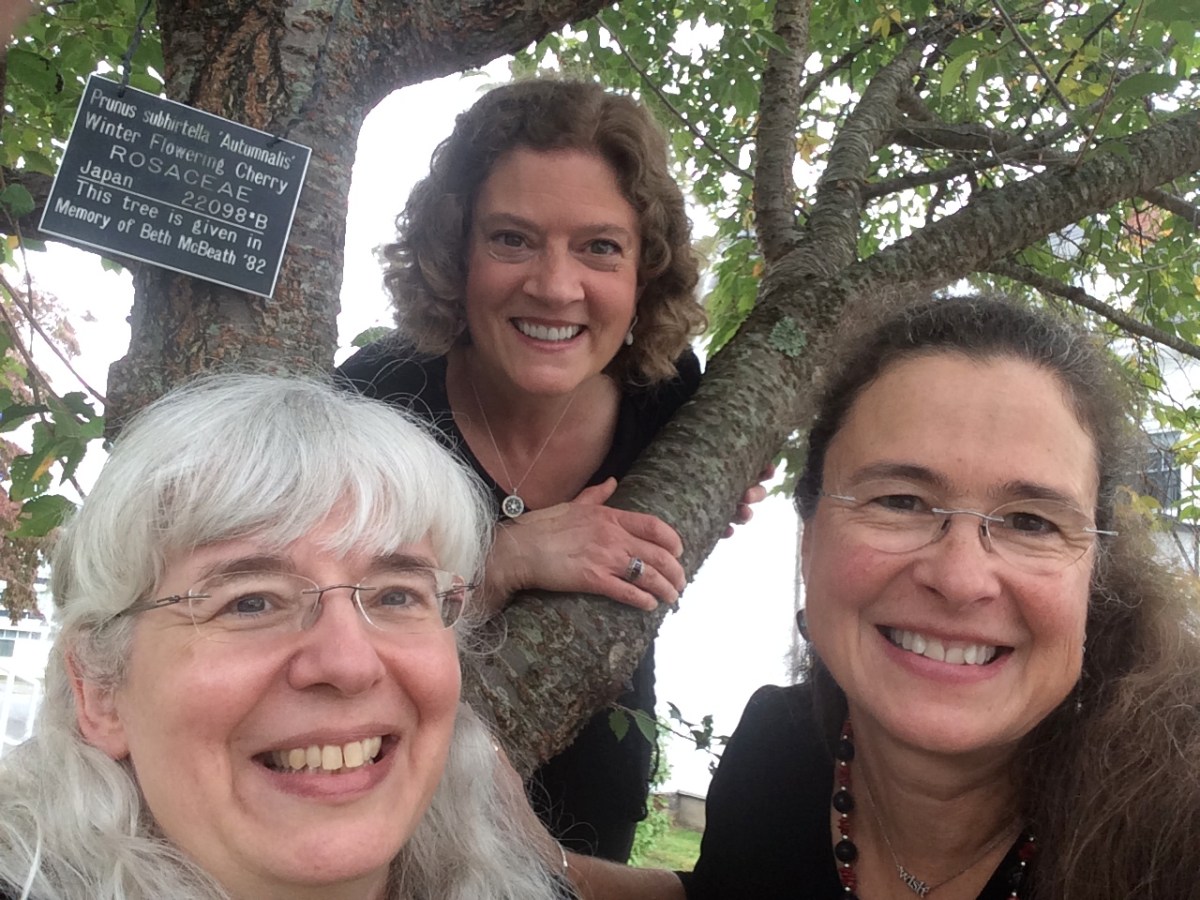
Visiting chapel and Beth’s tree

Mary, Tricia, and I with Beth's tree next to Helen Hills Hills Chapel, Smith College
Mary, Tricia, and I with Beth’s tree next to Helen Hills Hills Chapel, Smith College

After the Alice Parker concert at Sage Hall, Mary, Tricia and I proceeded up the hill near Paradise Pond to Helen Hills Hills Chapel.

Our first priority was to visit the winter-flowering cherry tree planted beside the chapel that is dedicated to the memory of Beth McBeath, another class of ’82 Glee Club member, who died as the result of an airplane fire during October break of our senior year.  Her funeral was held at the chapel and Glee Club sang Bach’s setting of “Jesu, Joy of Man’s Desiring” through our tears during the service.  Later, I attended the planting of the memorial tree, although the tree in the photo is not the original tree but a replacement for the one we planted that day, a weeping cherry that was unrecoverably damaged in an ice storm years later.

Beth was a light-filled, infectiously joyous person. She served the Ecumenical Christian Church (ECC) at Smith as a deacon and liturgist.  She participated in the Smith choral program in all her years there, serving as an officer as well as lending her alto voice to our choirs.  In the best tradition of the liberal arts, she studied with both breadth and depth, including taking a course in the art department on bookmaking.  She was always friendly and interested in other people.  Like me, as we entered our senior year, she was engaged to be married.

Her loss, along with another classmate who died from lung cancer later in our senior year, taught us not to take time for granted.  Her memorial tree is something that I try to visit every time I get back to campus. I make donations to the Smith Fund in her memory, which puts me in touch with her mom, who still survives.  Mary sent the photo, which we took with her phone, to Beth’s mom.  I hope it made her smile.

After visiting the tree, we went into the chapel.  None of us had seen it since the pews were removed, although we had seen a photo in the Smith Alumnae Quarterly.  Despite that, it still was a bit of a shock to walk through the front doors of the chapel, which was modeled after a traditional New England Congregational style church, and not see the rows of white-painted wooden pews with the red center aisle carpet down which I had walked as a June bride a few weeks after our commencement.  Instead, there were heavy, boxy wooden chairs, arranged in circles over a wood floor.  Given that there are no longer regular worship services in the chapel, a fact that still makes me sad, I do understand the impetus to remove the pews to make the space more versatile for concerts and other events, but I wish that the wood floor had been a traditional New England hardwood and the chairs had been more elegant and in keeping the architecture.

Still it was better than the last time I had visited chapel in May 2012, when I wrote this poem that touches on both the chapel and Beth’s tree. chapel at reunion  (Sorry for the pdf embedding, but I didn’t have time to fiddle with the editing settings to get the indents and spacing to work correctly.)

After walking through the main body of the chapel, we went upstairs to the gallery and visited the organ, which was a memorial gift in honor of Helen Hills Hills’ husband James. I spent so many hours on that bench, practicing, having lessons, accompanying for Choir Alpha, playing for Mass, prepping for my junior recital with Mary and Natalie, preparing for and playing preludes or postludes for ECC services, and additional hours standing beside the bench turning pages for other organists.  It’s moments like this when it feels odd that I haven’t played for years…

We also walked to the basement where the offices are. Almost every room has a different occupant or purpose than when we were there.  I thought about the series of Marc Chagall prints that used to hang in the hallway.  I think the art museum took custody of them so that they are in a better protected environment, but it used to be so cool to have original artworks in an everyday space. The Bodman Lounge is still there, with shelves of spiritual and religious books and couches and comfy chairs.  Mary had given me a bridal shower there and it was the room in which I dressed for my wedding.

I felt reluctant to leave. Even with all the changes, the richness of the memories will always draw me back.

The rest of the Triduum

In the Catholic liturgical year, there is no starker contrast than the juxtaposition of the Commemoration of the Lord’s Passion on Good Friday and the Great Vigil of Easter on Holy Saturday night.

Good Friday is the only day all year when Mass is not celebrated. The commemoration service is traditionally held mid-afternoon and begins with the clergy processing in and lying prostrate before the altar. It continues with readings, including the reading of the passion narrative from the gospel of John and then moves on to the veneration of the cross, in which all present process to a plain wooden cross and venerate it in some way, according to local tradition. At Holy Family, we bowed before the cross; other parishes genuflect or touch or kiss the cross. Then, after praying the Lord’s Prayer, communion is distributed from hosts that were consecrated on Holy Thursday night. The church is unadorned – no flowers, only the simplest altar cloth, which is removed after the service concludes, and the empty tabernacle with its door left open.

When we arrive at Holy Family for Easter Vigil, although the church is only dimly lighted, it is bursting with color – long bolts of cloth, each a different hue, radiate from a central point high in the sanctuary out over the congregation – flowers banked in several locations, not only the traditional white Easter lilies but also red and blue hydrangeas, orange lilies, pink azaleas, and light green mums – the altar draped in white, which is the color of Easter. The tabernacle, still empty with its door open, is the only visual reminder of the first two days of the Triduum.

We begin with the service of light, where a new fire is kindled and used to light a new Easter candle, whose light is spread to the candles that the congregation holds. After the Easter Proclamation is sung, we extinguish our candles and proceed with an extended liturgy of the word, including the singing of the Gloria and Alleluia, which are not used in Lent. Speaking to my daughter’s and my heart, the homilist chose to concentrate on Mary Magdelene’s place as the first witness of the resurrection, in a time and culture when women were not allowed to testify in court, chosen by God to go and tell, which is the apostolic mission.  In place of the creed, after new holy water is blessed, we renew our baptismal promises and are blessed with the new water. We continue on with the liturgy of the Eucharist and, after communion, the tabernacle is finally filled and the door closed.

One of the most powerful elements in these liturgies is the music, which is not only enhanced by the participation of our choir, cantors, and instrumentalists but also by the participation of the people. Because none of the liturgies of the Triduum are obligatory, the people who choose to participate are those who are steadfast in their commitment to celebrating as a community. On Good Friday, I was especially moved by people joining in with the choir singing the spiritual “Were You There?” and the Taize prayer “Jesus, Remember Me” during the long procession for veneration of the cross.  The Easter Vigil brings some music that is only used at that Mass. I was especially moved by the Easter Proclamation (Exsultet) and a sung form of the Exodus reading about the horses and chariots of Egypt being cast into the sea to protect the fleeing Israelites, by Rory Cooney. The elements of light and water re-appear in the much of the music, with more songs about the Resurrection appearing after the Easter gospel is read. The music was extra festive because a trumpeter joined the choir, organ, and congregation for many of the songs.

I wish a blessed Easter to all Christians, continued blessings of Passover to all Jewish people, and peace, love, and light to all people!