coming storm

Here in upstate New York, we are preparing for a few days of severe winter weather. First, cold temperatures and wind, followed by a significant snowstorm with over a foot (1/3 meter) of snow expected.

The three of us have our supplies on board and expect to be in most of the weekend. I might make it to church for vigil on Saturday or might have to do online services. I expect my Sunday afternoon rehearsal will be cancelled.

Of course, the storm could change course, but better safe than sorry.

This post is part of Linda’s Just Jot It January. Join us! Find out more here: https://lindaghill.com/2026/01/23/daily-prompt-jusjojan-the-23rd-2026/

One-Liner Wednesday: Update on Roger Wang

Update from this post about Roger Wang, local business owner and community volunteer who was taken into ICE custody on the way to get his green card: Roger has been detained at a New York State ICE detention facility for over two months; he has a local immigration lawyer assisting him, whom you can help fund through this link.

This sobering update brought to you as part of Linda’s One-Liner Wednesday series. Find out more here: https://lindaghill.com/2025/08/27/one-liner-wednesday-its-official/

No CO2 Fracking in NY!

I’m pleased to report that, over the weekend, New York Governor Kathy Hochul finally signed the bill adding carbon dioxide to the existing ban on hydraulic fracturing (fracking) in the state. We recently observed the tenth anniversary of the ban.

You can read more about the bill and how important it is to keeping us safe here.

A huge thank you to State Senator Lea Webb, sponsor of the bill in the Senate, and Assemblymember Anna Kelles, sponsor in the Assembly. Thanks also to Donna Lupardo, my Assemblymember, who was a co-sponsor. I will always be grateful to the large coalition of scientists, experts, Indigenous Nations, environmental organizations, and concerned individuals who have been at work for years on this issue for the good of our health, our environment, and our climate.

Broome County, where I live, would have been among the first targeted with this dangerous experiment to use supercritical carbon dioxide to extract methane. I’m grateful that our state will remain frack-free!

Celebrating ten years of the New York fracking ban

Ten years ago today, New York State announced an administrative ban on high-volume hydraulic fracturing (fracking) in the state. (in 2021, the legislature made it a law.)

To celebrate, Food & Water Watch, one of the lead organizations in fighting fracking, has compiled a free, commemorative e-book, which you can download here.

A large coalition of organizations, environmentalists, indigenous nations, scientists, engineers, and concerned citizens had spent years advocating for a ban, helped by many of our Pennsylvania neighbors who were suffering from the harms of fracking in their communities. There had been rallies, commentary in the press and at hearings, educational events, scientific papers and lectures, and showing up at public appearances by then-Governor Andrew Cuomo leading up to the ban, which occurred when the Dr. Howard Zucker, the Health Commissioner, said that fracking was too dangerous for New Yorkers’ health, ending what had been a very fraught battle over the SGEIS (Supplemental Generic Environmental Impact Statement) that would have allowed fracking without need for site-specific studies.

Yes, that sounds very wonky but we were lucky to have lawyers and other experts in the coalition who could break everything down for us into understandable, actionable bits.

My role in the efforts to ban fracking was as a member of the Rapid Response Team. We would receive links to articles about fracking in the media and write comments to bolster the truth and challenge misinformation. It was intense at times but it meant a lot when I would be at a rally or event and people from other parts of the state would recognize my name from comments I had written. It was good to know that my little part was helpful to the cause.

When the announcement came from Albany ten years ago, there was rejoicing from all parts of the coalition and a celebration here in Binghamton, which had been the epicenter of both the pro- and anti-fracking efforts. Unfortunately, I couldn’t attend because I was sick with shingles. I was very grateful, though, and as excited as I could manage to be.

We aren’t having a party on this tenth anniversary but we are all awaiting Governor Kathy Hochul signing a bill that will add carbon dioxide to the existing fracking ban. The bill was passed in March and we have been urging her to sign it ever since.

Many bills get signed in December so it could be any day now, although I’m hoping it will be today.

It would be a fitting tenth anniversary commemoration and a reminder to the nation that New York says NO to fracking!

Update: On Dec. 21, Governor Hochul finally signed the bill. You can read the press release from coalition members here.

Vote for Democracy #18

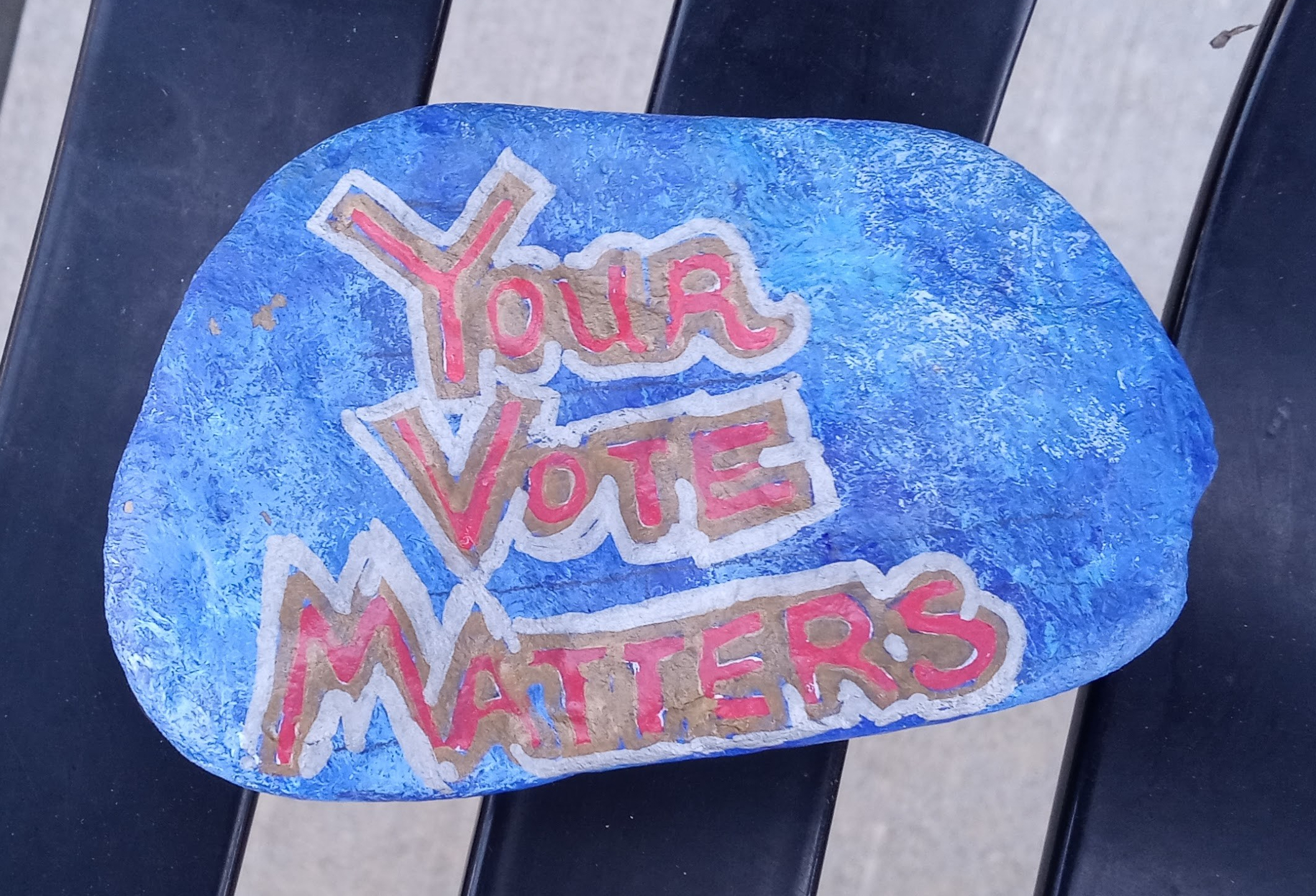
I voted!

(Photo by Lucas Sankey on Unsplash)

While I traditionally vote in person on Election Day, due to the unpredictability of my health these past months, I decided to vote this morning at a polling place in my local library.

Prior to the pandemic, New York State did not have early in-person voting available. Absentee voting was restricted to those with health problems, those who would be travelling out of the county on Election Day, or those temporarily living away from home, such as college students. One could return ballots by mail or drop them off at the county election office. The pandemic brought in early in-person voting, although in a condensed timeframe (this year, October 26-November 3), and no-excuse absentee ballots. Still, New York’s ballot access is still more restrictive than many other states.

I feel relieved to have my ballot safely cast and ready to be added to the tally that will be announced after the polls close on November 5th, Election Day. It was important to me to have my vote counted with those cast in person on Election Day. Absentee ballots in New York are not counted until days later and I prefer to have my vote included in the tally reported on election night.

I voted to uphold democratic values and the common good and hope that all eligible voters will do the same, whether they already have voted, are getting ready to vote early in-person or by mail, or are voting on Election Day.

Democracy works best when we elect serious, thoughtful, principled people to office who will enact policies that help all people to thrive. This applies to local, state, and national offices.

Vote for Democracy in 2024!

Vote for Democracy ’24 #8

34 felony convictions, 54 counts waiting for trial dates.

(Photo by Lucas Sankey on Unsplash)

Late afternoon yesterday, May 30, 2024, a former president of the United States, Donald Trump, was found guilty of 34 felony counts of falsifying business records in a case brought by the state of New York by the elected district attorney of New York County, Alvin Bragg, after a grand jury of citizens voted to bring the charges.

This is the first time a US president has been charged with felonies and found guilty. President Gerald Ford pardoned Richard Nixon before any charges could be brought.

The State of New York has jurisdiction to bring the charges because the business records in question were in the state. Falsification of business records is usually a misdemeanor but was raised to a felony here because it was being done with the intent to commit another crime, in this case, violation of New York State election law. This case relates to the 2016 election, when Donald Trump authorized paying a woman to keep her from going to the press with a story about a sexual encounter that would have been potentially damaging to his campaign in the final weeks, shortly after the release of the Access Hollywood tape, in which Donald Trump made light of his habit of sexually assaulting women. The business records were falsified in a scheme to conceal the payment.

The prosecution spent several weeks presenting documents and other evidence and testimony from twenty witnesses. Trump’s defense was much briefer, only two witnesses. The jury deliberated for about nine and a half hours over two days and returned a guilty verdict on all 34 counts.

This is the way the criminal justice system should work in the United States. It’s not the elected or appointed officials who decide the case. It’s a jury of one’s peers. Jurors are sworn to consider only the evidence presented and the law in reaching their verdict. While Trump’s followers made it seem that a New York jury would be made exclusively of Democrats with a grudge against him, we know that the jurors had a range of news sources, including one who got their news from Trump’s social media site, Truth Social. All the jurors swore, though, to set aside any preconceived notions and deliberate together to reach a unanimous verdict.

Sentencing is set for July 11. The sentence will be decided by the presiding judge, Juan Merchan. It could include up to four years in prison but could be probation, instead. After sentencing, there will likely be an appeal. The Republican party convention, which is expected to nominate Trump as their presidential choice for the November election, begins July 15.

Meanwhile, Trump is awaiting trial on 54 more felonies in three cases, a State of Georgia election interference conspiracy case, a federal case of mishandling sensitive presidential documents in Florida, and the federal case around the January 6 attack on the US Capitol in Washington, DC.

I will not vote for a convicted felon who has not served their sentence and taken responsibility for their actions.

I hope that most Americans also hold that view.

Many prominent Republicans are attacking the judicial system rather than affirming the verdict of twelve sworn jurors in New York. I also will not vote for a candidate for any office that does not respect the rule of law. Public officials are sworn to uphold and defend our Constitution and laws. The transcript of the NY trial is available and demonstrates that the law was being followed and applied. For an elected official to attack the US justice system as being worse than those in countries like Cuba is disqualifying for me as a voter.

Applying the law “without fear or favor” is a hallmark of the United States judicial system. All voters should pay attention to the views of candidates toward the rule of law when deciding for whom to vote.

eclipse thoughts

(2017 Photo by Scott Szarapka on Unsplash)

One Monday, April 8th, there was a solar eclipse over a wide swath of North America. At my home in central New York, we were close to the path of totality with 97% of the sun obscured.

We dutifully bought eclipse glasses but the afternoon was very cloudy. During the time of maximum coverage of the sun, we did notice that it became darker, darker than you expect from cloud cover, even from a thunderstorm. A few minutes after it lightened again, it began to rain.

Meanwhile, many people were expressing their awe and wonder at viewing the eclipse. Some had travelled many miles, even internationally, to see it. All were subject to the vagaries of weather, but most were lucky to have good conditions for viewing. Even people who weren’t able to see the eclipse expressed gratitude at being part of an excited crowd putting aside divisions to look up together.

As I’ve been reflecting on the eclipse experience, I find myself wondering if I would have felt the same mystical sense of awe that others have been describing. Perhaps it is my practical New England upbringing or my study of science or my overall sense of respect for creation but I have trouble separating the eclipse from other natural phenomena. Should I feel more wonder at an eclipse than I do for a broken, blue shell that recently sheltered a baby robin or a riot of forsythia blossoms or the ancient rocks worn smooth by the brook or the full moon?

While I do appreciate the effect that the eclipse had to bring people together, I had no desire to be part of a crowd. Granted, I am the type of introvert who is always uncomfortable in a crowd, however noble or friendly its purpose.

Did you experience this eclipse or one in a different time and place? Please share your thoughts in the comments section.

No to CO2 drilling in New York!

One of the things that has been occupying me over these last weeks is the unwelcome and unexpected need to return to the battle against unconventional gas drilling in my home region, New York’s Southern Tier (central NY along the border with Pennsylvania).

I was active with the coalition that successfully advocated for a ban on high-volume hydraulic fracturing in New York, which was first regulatory/executive in Dec. 2014 and made legislative in 2021.

In late summer/fall of 2023, a newly-formed, Texas-based company called Southern Tier CO2 to Clean Energy Solutions, Southern Tier Solutions or STS for short, began approaching landowners in Broome, Tioga, and Chemung counties with lease offers to use supercritical carbon dioxide to extract methane from the Marcellus and Utica shale formations thousands of feet under their land, claiming that it would also sequester the carbon. The scheme would involve thousands of miles of new CO2 and methane pipelines, plus ten or so new methane-burning power plants, which would burn the methane to produce carbon dioxide to use to extract more methane.

Mind you, this has never been done at scale anywhere in the world and does not have any solid scientific backing. The very real negative impacts of high-volume hydrofracking would be compounded by the dangers of carbon dioxide pipelines and injection, all at a time when New York State is implementing its landmark Climate Leadership and Community Protection Act to move us away from fossil fuels and toward renewable energy powering our lives efficiently.

When news of STS’s plans came to light, my New York State legislators, Assemblymember Donna Lupardo and Senator Lea Webb, began asking the Department of Environmental Conservation questions. I admit that I was alternating between fear and disbelief that the hard-won ban might be in jeopardy because it was predicated on the volume of water used and STS’s proposal plans to use supercritical carbon dioxide instead of water.

Fortunately, the coalition that had fought for years to win the hydrofracking ban quickly reconstituted and got to work. A coalition letter from over 90 organizations went out in December. Legislators got to work on legislation to add carbon dioxide to the existing ban with Dr. Anna Kelles as sponsor in the Assembly with Donna Lupardo as a prime co-sponsor and Lea Webb as sponsor in the Senate.

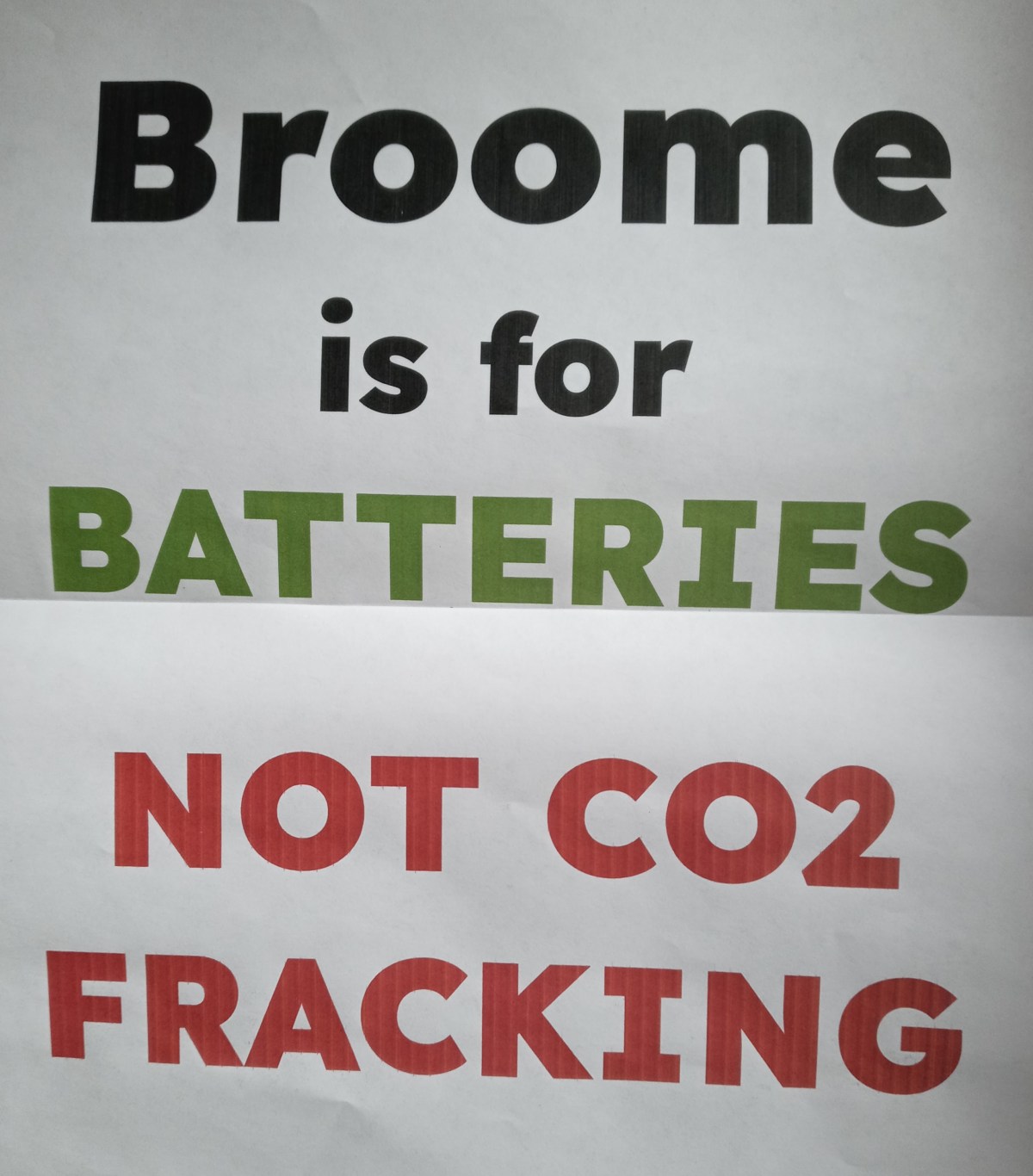
On March 5th, the coalition held a rally/lobby day in Albany. We had great speakers at the rally, including legislators, scientists, and leaders of organizations. I went local with my sign, emphasizing that the Broome County (Binghamton) area is part of the clean energy future as the center of a national technology hub for battery storage through the New Energy New York coalition and neither needs nor wants to be tied to dying fossil fuels. This was my first experience with in-person rallying and lobbying at the New York State Capitol. I was overwhelmed by the noise and busy-ness of it all but grateful to have been able to do my small part in the effort.

I’m thrilled to report that, on March 12th, the Assembly passed the bill with a vote of 97-50 and. on March 20th, the Senate followed with a vote of 45-17. Now, we are moving into the final phase, asking Governor Hochul to sign the bill quickly.

I’m shocked that the coalition was able to get this to move so quickly in Albany. As a Southern Tier resident, I’m immensely grateful to have support from around the state. In the original fight against hydrofracking, there were some very loud voices that were willing to use the Southern Tier as a sacrifice zone to get cheaper methane for their own use; this time, with the CLCPA in place, we didn’t encounter that sentiment as much. I’m also especially grateful to the Third Act Upstate NY working group, who jumped in as soon as I raised the alarm. Third Act is too new an organization to have been around for the original fracking battles but many members have extensive experience with climate activism and organizing and know how to get the word out.

While it seems that this is a local issue of a few counties in New York, the carbon dioxide drilling/sequestration scheme has global implications. Like plastics, it is an attempt by the fossil fuel industry to keep the world dependent on fossil fuels for decades to come, in defiance of the science that demonstrates the need to reduce atmospheric greenhouse gases as quickly as possible to keep the planet livable.

Part of the price to get fossil-fuel bro Joe Manchin’s vote in the US Senate on climate legislation was to include massive subsidies for carbon sequestration. It’s those subsidies that are behind STS’s proposed scheme to profit from the methane in the Marcellus and Utica shales, which is not economically viable to produce on its own. Using carbon dioxide from burning fossil fuels to extract even more fossil fuels is also inherently deleterious to environmental health and the climate. While there may be some instances where industrial carbon emissions can be collected and sequestered, the geology of the Southern Tier would not seem to support long-term sequestration. Sequestration would also be near-impossible in areas with a history of oil and gas wells because there would be too many pathways for injected carbon dioxide to escape.

My hope is that the example of New York banning this extraction/sequestration scheme will help other jurisdictions around the world see through the fossil fuels industry’s increasingly desperate attempts to keep the world burning their dirty products, even with the effects of climate change already causing damage and misery on a global scale.

Watch for news of these kinds of proposals near you. Don’t fall for the lies of the fossil fuel industry. Follow the science. Advocate for clean, renewable energy. Let elected officials know that we need and want protection from pollution and climate change. With so much damage already having been done, we need to act decisively now.

Together, we can move in a positive direction, as we are here in New York.

One-Liner Wednesday: Senate debate

This afternoon in Albany, Senator Lea Webb will lead the effort to add carbon dioxide to New York State’s existing high-volume hydraulic fracturing ban, all of which I will explain in a post at some point…

This (somewhat informative) post is part of Linda’s One-Liner Wednesdays. Join us! Find out more here: https://lindaghill.com/2024/03/20/one-liner-wednesday-technology/

One-Liner Wednesday: OM

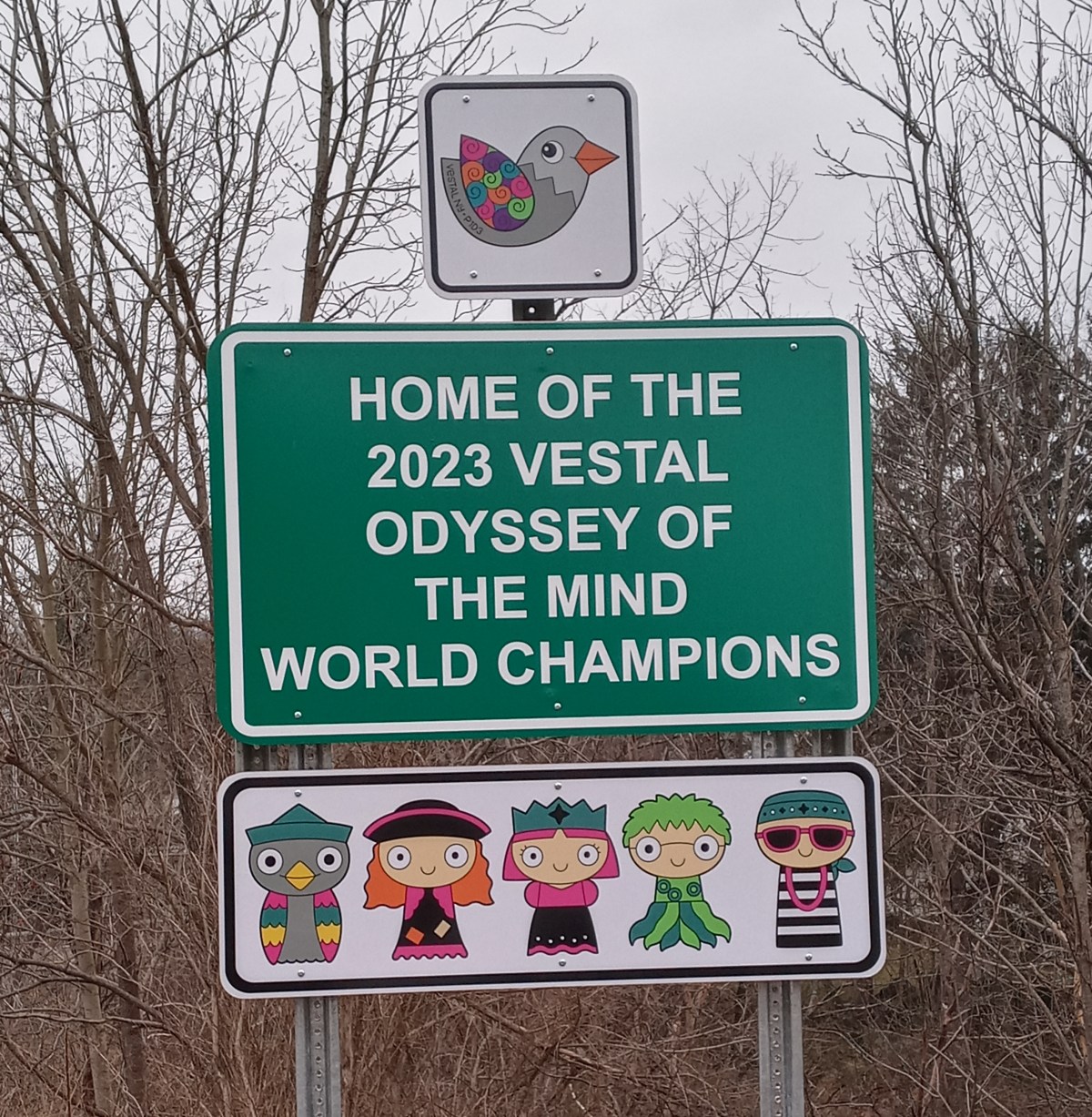
A new, celebratory sign erected near me!

Join us for Linda’s Just Jot It January and/or One-Liner Wednesday! Find out more here: https://lindaghill.com/2024/01/03/one-liner-wednesday-jusjojan24-the-3rd/