The dangers of methane emissions

I contributed the prompt “climate” for Linda’s Just Jot It January today. I actually haven’t been using the prompts other than as usual for Stream of Consciousness Saturdays, but figured I should use the one I suggested. 😉

I have written often about climate change, growing out of my commenting on the fracking battle. I have done some posts on these topics here on Top of JC’s Mind, although most of my writing has been in comment sections on articles on environmental topics.

As you may know, while we hear the most about atmospheric carbon dioxide levels, atmospheric methane has also been rising to record levels. This is especially worrisome because, over a twenty year timeframe, methane is about 86 times as potent in heat trapping potential as carbon dioxide. Given that humanity is facing a critical window to lower greenhouse gas levels to keep global warming under 2 degrees Celsius, with a goal of 1.5 degrees, methane emissions are very dangerous as they could push the earth into some tipping points, such as permafrost melting and the release of methane hydrates from cold water seas, that would accelerate rather than slow global warming.

Enter the terrible problem of the Porter Ranch methane storage well leak. Not only is this leak causing evacuations, illness, a no-fly zone, and explosion risk, but also a 21% increase in the state of California’s methane emissions. This one leak amounts to 2.3% of the total carbon footprint of the state.

I want to share a Living on Earth interview with Dr. Anthony Ingraffea which aired recently. Tony Ingraffea was one of the heroes of the battle against fracking here in New York State and helped to raise the alarm, nationally and internationally, on the dangers of methane emissions from shale oil/gas development, processing, transport, and use. He has recently retired from Cornell University. I was fortunate to have heard him speak on a number of occasions during the fracking fight in New York. Ithaca is only about an hour’s drive from here.

I hope that the enormity of the Porter Ranch leak and the damage it is causing will mobilize people, especially policymakers, in the United States to accelerate the transition away from fossil fuels and toward renewable energy.
*****
Join us for Linda’s Just Jot It January!  Visit here:  http://lindaghill.com/2016/01/19/just-jot-it-january-19th-climate/

JJJ 2016

To find the rules for Just Jot It January, click here and join in today.

common sense climate science

Although we hear news about atmospheric carbon dioxide levels often, there are several other greenhouse gases which are also affecting the global climate.

One of the most potent greenhouse gases is methane which is 86 times more potent than carbon dioxide when measured over a twenty year period. Atmospheric methane is also at record levels. After a relatively stable period, it began rising in 2007.

While no definitive science report has yet been published as to the cause of the rise, I have a common sense guess. The rise of atmospheric methane began to rise with the advent of high volume hydraulic fracturing for oil and gas in the United States. Other sources of methane, such as agriculture and waste disposal, have not seen any large expansion in this timeframe.

There have been a number of measurements that have traced atmospheric methane and other VOCs to fossil fuel sources, including well pads, compressor stations, processing equipment, and pipelines. A number of studies have been published using these data. These data show that actual methane emissions are much higher than those that the industry and the EPA had estimated.

This gives even more urgency to rapidly transitioning away from fossil fuels to renewable energy. It is critical to restrict methane emissions to avoid climate tipping points, such as large scale permafrost melting and the release of methane hydrates from the cold water seas.

I am proud that our grassroots organizing managed to hold off fracking here in New York State. There is still a long way to go, but we are making progress. We won’t stop until fracking and other unconventional fossil fuels are a thing of the past.

Defending Broome County

While it would seem that the impending fracking ban in NY would cut down on my incessant commenting on shale oil/gas issues, there has instead been a flurry of reports and editorials to answer, such as this one. Yes, I got carried away, but it really upsets me when people in other parts of the state misrepresent my home area. My (very long) comment to an editorial in the Syracuse Post-Standard:

I live in a Broome County town bordering PA and this editorial’s contention that we are looking forlornly across the border at prosperity in PA is dead wrong. Across the border in PA there is shale gas drilling going on, but a lot of negative impacts. Besides the health problems that have been documented in the peer-reviewed scientific literature, there are socioeconomic problems with high rents, increased crime rates, inability to insure, finance, or sell homes near wells, plummeting royalty payments, noise pollution, light pollution, increased rates of homelessness, increased truck traffic, accidents, liens placed on properties when drilling companies didn’t pay their subcontractors, and strains on medical and emergency services. People who wanted to live in a nice country setting are now in a noisy industrialized setting. I am grateful that these problems won’t be coming to my town.

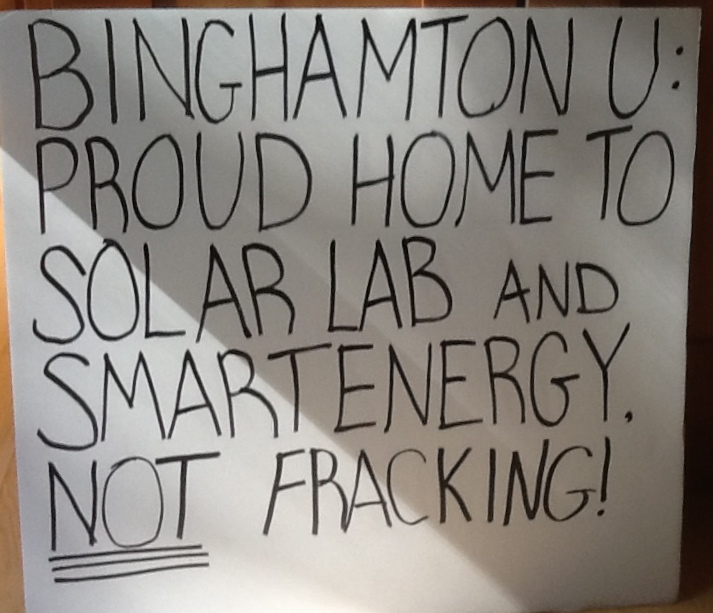
Meanwhile, I think the editors should take a trip to Greater Binghamton and look around. It is not the poverty-stricken, despairing place you seem to think it is. Two of our biggest employment sectors are medical, anchored by Lourdes and two UHS hospitals, and education, anchored by BInghamton University and SUNY-Broome, with a new graduate school of pharmacy about to be built. We still have high tech jobs, though fewer than we once had, with IBM, Link flight simulation, and BAE, among others. Our most exciting new plans in high tech are in the the area of renewable energy/energy storage. Binghamton University’s Solar Lab has been conducting research for a number of years already and has developed a thin-film solar cell that uses only common elements without any rare earth elements. Two large projects are currently being built, a High-Tech incubator in downtown BInghamton and the SmartEnergy Center on the Vestal campus. The combination of these should expand our high-tech/energy sector in the future. Meanwhile, Broome County is a state leader in energy efficiency upgrades through NYSERDA Green Jobs, Green NY and in expansion of solar for homes and small businesses. The energy projects alone have created many times more jobs than shale drilling would have, without the pollution and industrialization of residential and rural areas that would have occurred with drilling.

And about the potential of shale drilling in NY. DEC had to weigh possible economic benefit versus potential costs of drilling to the state and to residents; it’s part of its job. The economic impact section of the draft SGEIS made a number of faulty assumptions, including that shale plays are uniformly productive, that large swaths of NYS would be viable to drill, and that the wells would produce for thirty years. Data from PA and other areas with shale drilling have shown that there are distinct sweet spots in shale plays that are high-producing, with the rest of the play being much less so. Most of the shale in NYS is too thin and too shallow to contain large amounts of methane and there are not natural gas liquids, which have a better economic profile than dry methane, at all. Shale wells of all kinds have very steep decline curves, with the vast majority of the gas being produced in the first 18 months and most of the rest in the following 3-6 years, much shorter than the 30-year timeframe the SGEIS assumed. The industry has done some test wells in various parts of the Marcellus and Utica in NY – and didn’t think it was worth applying for permits. The major companies in their own maps of the play never showed the potential drilling area going much over the NY border. Production numbers in PA bear this out; once you head north from the NEPA sweet spot, production goes way down. Because HVHF wells are so expensive to drill and frack, methane prices would have to more than double to break even in southern Broome County and the figures just get worse from there. It’s time to stop pretending that fracking – or casinos – are the future of the Southern Tier and get to work on building up renewable energy and conservation, while expanding on education, medical, high-tech, agriculture, next-gen transportation, recreation, and tourism jobs.

http://www.syracuse.com/…/new_yorks_hydrofracking_ban_drape…

Dear Governor Cuomo

IMG_0083

I sent this letter to New York Governor Cuomo today on the election and shale drilling and equal protection and climate change and science and more.  I know it is overly long – although I could have written much, much more – but I am proud that I managed to get this done before the election, despite the disruption that recent family health issues have caused. I decided to write this today, even though I have 385 email messages to view, so apologies to anyone awaiting a personal email.
JC

Dear Governor Cuomo,

The election is eight days from today, but I do not think I will be able to vote for you because you are not doing enough to protect the health and safety of all New Yorkers equally.

I live in Vestal and I and my Southern Tier neighbors are at risk from the health and environmental impacts of shale gas production, processing, transport, and waste disposal, a risk from which you have not protected us.

Some of the impacts that have already occurred are road damage in Vestal from the overweight trucks transporting drilling supplies to sites in Pennsylvania, inability to get mortgages on leased land, crime associated with gas industry workers staying on the NY side of the border, leaking pipelines, increased truck traffic, light and noise pollution, airborne silica sand along rail lines and during trucking transfers, and an explosion at a Windsor compressor station.

Other impacts are probable but not being tested, such as degradation in air quality.  Some impacts are obscured by the lack of tracking of the fossil fuel industry.  For example, waste products are shipped by truck without the exact composition being known, so that if they are disposed of at a landfill the effects on the leachate are unknowable.  Given that some of this leachate is treated in Endicott, this is a local concern as well as a regional one.  Meanwhile, it is still legal to spread drilling wastewater on roadways in New York, despite the fact that we know that Marcellus wastewater is often high in radium, which is a radioactive, toxic element known to bio-accumulate and cause serious health problems, including cancer.

Other impacts are, of course, global in scope.  The latest readings of atmospheric carbon dioxide are at record highs and we know that humans burning fossil fuels have been the driving force in that.  Also, the atmospheric methane level is at a record high.  Methane is a much more potent greenhouse gas than carbon dioxide, 86 times more potent in a twenty year timeframe. After a long period of stability, atmospheric methane levels began rising in 2007, coinciding with “shale boom.”  Several new scientific studies say that replacing coal or diesel fuel with fossil methane will not help our climate situation.  Shale development will not cut the risk of the next record flood here in Vestal or the next superstorm roaring up the Atlantic coast.

I have been trying to follow the DEC’s SGEIS and regulatory process for years now.  I say “trying” because the process itself is obscure.  Besides the obvious problem of the Minerals division trying to promote fossil fuel production while also trying to regulate it, there is the larger problem that the DEC’s work has been hidden from the public for years now. Because there has been a large number of independent, peer-reviewed scientific research studies published in the last two years, the last publicly available draft of the SGEIS is totally outdated, but we have no idea whether or not the DEC has been continuing to update the SGEIS as these new scientific studies and data from other states who are drilling have become available.

The obscurity of the process has been compounded by the DOH “review” of the the health findings of the DEC’s work.  Although this has been referred to as a study, it is not.  A real health study would follow the national/international guidelines of a health impact assessment (HIA) and would be conducted as a clearly defined, public process. It would consider health impacts on different groups of people, such as children, the elderly, and pregnant women/infants. It would look at the interplay of exposures to many different substances and the interactions among them. It would look at impacts for those in close proximity to wells and related infrastructure and those further away, including air quality, possible food and water exposures, and climate impacts.  It would also consider socioeconomic changes, such as rates of crime and homelessness, property value, cost of living, stresses on community services, and gains and losses in different job categories.

The economic section of the draft SGEIS is particularly outdated and unrealistic, having been built on what we now know are totally impossible expectations, that the industry could get economically viable amounts of gas anywhere in the Marcellus and Utica.  The price of methane is so low that it is unlikely anywhere in New York can presently produce shale gas economically, with the danger that small companies would take that risk using borrowed money and leave behind wells that cause pollution that the state would need to clean up when the company goes bankrupt.  New York already has thousands of leaking, abandoned wells awaiting proper plugging; we should not compound the problem with even limited amounts of shale drilling.

Governor, you say over and over that the science must decide, but that you are not a scientist. You say that scientists disagree.  The actuality is that industry-funded science is presented and used in a way that makes it seem that shale drilling is safe, while independent science presents data and possible explanations for that data which show that there are environmental and health impacts occuring. A recent example of this is the media coverage of a recent federal Department of Energy study of a single PA deep shale well for eighteen months, which showed that fracking chemicals had not reached an aquifer 3,000 feet distant, which is being touted as “proof” that “fracking” doesn’t pollute water.  Meanwhile, a PNAS study of the official DEP records of PA wells drilled from 2000-12 which covers tens of thousands of wells and their failure rates (Abstract here: http://psehealthyenergy.org/site/view/1217 with link to full report) shows that leakage rates for new shale wells in Northeastern PA are significantly higher than those for conventional wells and for shale wells drilled in the rest of the state. Leaking wells equals methane migration into groundwater, soils, and/or through faults, wellbores, or cracks equals pollution of the water, land, air, and atmosphere. The fact that NE PA is particularly vulnerable to leaking shale wells is disturbing for those of us in the border area of New York as the Marcellus geology here is similar. Yet this much larger study is not getting the press attention of the DOE study which is much less helpful in assessing the situation in New York.

The situation is sadly reminiscent of the doctors and scientists in the employ of the tobacco industry who swore to Congress that smoking did not cause cancer, while independent doctors and scientists were raising public health alarms not only about smokers’ health but also about those exposed to second-hand smoke or in utero tobacco exposure.

For you or any governor to authorize shale gas drilling in the Southern Tier would be like deciding to lift the smoking ban here while continuing to protect other parts of the state.  Our health and well-being here in Vestal is every bit as important as your health in Albany or the health of my sister in NYC or my daughter at ESF in Syracuse.  With the current scientific literature, there is no way that the DEC and DOH can say that unconventional shale gas drilling and its attendant processes are safe. We in the Southern Tier are due protection from its risks equal to those in other regions.

Your television ads tout “Next-Gen energy” here in Broome County and we are justifiably proud of that. Do not compromise that pride by also saddling us with the outmoded 19th and 20th century fossil fuel dependence that is worsening global warming. It’s time to back up your rhetoric after Sandy about combating climate change with action.  NO to new fossil fuel development and infrastructure!  YES to renewable energy, clean energy storage, and energy efficiency initiatives!  YES to equal health and environmental protection for everyone!

Sincerely,
Joanne Corey

SoCS: two degrees

Two degrees Celsius is the threshold between what is considered impactful but manageable global warming and catastrophic global warming. Climate scientists will tell you it isn’t that clearcut. We are already seeing major impacts at only one degree-ish. At two degrees, we may get major feedback loops happening, like the melting of permafrost and the release of methane hydrates from northern seas and oceans which would accelerate warming further.

Two degrees C. has been translated into 350 ppm carbon dioxide. We have now topped 400 at times in the atmospheric readings on the Big Island of Hawai’i – I think it is Mauna Kea, but it could be Mauna Loa – and the levels keep rising.

What is disturbing me even more is that global atmospheric methane, after a long period of stability, began rising in 2007. Methane is more short-lived in the atmosphere than carbon dioxide, but is a much more powerful greenhouse gas – 86 times more powerful in a twenty year context and 106 times more powerful in a decade. Given that our timeframe to get global warming under control is now very short, methane in the atmosphere is particularly troubling as it has such a strong effect in the immediate future.

So, why do I hear the word degrees and immediately go into my global warming spiel?  I write about this a lot, as an offshoot of my commentary on the dangers of shale oil/gas aka unconventional fossil fuels aka fracking.  I have spent countless hours writing and researching and commenting on these topics.  It started as a personal thing as my state, New York, is currently under a moratorium, while our neighbor state Pennsylvania is drilling extensively. And I live in a border town.

I could literally write about this for hours, but I will spare you. I apologize if I was unclear at all in this post. It’s the whole stream of consciousness thing – no fact-checking or editing allowed…

This is part of Linda’s Stream of Consciousness Saturdays.  This week’s prompt was “degree/degrees.”  Join us! Read how here:  http://lindaghill.com/2014/10/24/the-friday-reminder-and-prompt-for-socs-october-2514/


Badge by Doobster @Mindful Digressions

If we really want to help Ukraine…

I have heard several things today through various media, including this blog post:  http://www.nofrackingway.us/2014/04/22/kerrys-shale-gas-bluff/  about the situation with Ukraine in regards to the dangers of losing access to Russian methane.

If the US really wants to help Ukraine and other European countries get out from under the thumb of Russian fossil fuel threats, it should help them quickly implement alternate energy sources, especially renewable ones. Help fund a transition to geothermal heat pumps for heating and cooling. Find appropriate sites for solar and wind electrical production. Local, distributed energy systems will increase economic well-being and alleviate the fear of Russia cutting off Ukraine and, by extension, much of the rest of Europe from methane for heating during the winter.

Earth Day bonus:  It would be a huge help to the climate as we urgently need to stop burning fossil fuels as soon as possible.

My response to EDF’s climate confession email

This message from the Environmental Defense Fund: http://support.edf.org/site/MessageViewer?dlv_id=65441&em_id=35201.0
really upset me. They have been giving cover to the oil and gas industry to keep fracking, so I took their invitation to write to them and sent the following:

I am distressed with your climate confession email because your hopeful graph isn’t telling the whole story. The graph only tells about carbon dioxide emissions from the energy sector. It ignores other sectors and, even more disturbingly, ignores the emissions of other greenhouse gases, such as methane. Methane is a much more powerful greenhouse gas than carbon dioxide and is particularly damaging in the twenty year timeframe, which is the critical time period in which we can temper climate change to make it only damaging to the planet and its inhabitants, instead of catastrophic.

It sickens me that EDF has fallen into the trap of the oil and gas industry to push ramping up unconventional fossil fuel extraction by HVHF in the name of helping the climate when what we really need to do is withdraw all support for fossil fuels and convert to renewable energy as quickly as possible.

reblog from The Marcellus Effect

reblog from The Marcellus Effect

An important critique of the recent Stanford paper by Dr. Anthony Ingraffea, reported by Sue Heavenrich.

Comment on Forbes fracking piece

Re-posting a comment I made to this Forbes piece:  www.forbes.com/sites/lorensteffy/2013/11/29/new-yorks-fracking-hypocrisy-underscores-energy-illiteracy/?fb_action_ids=10201093779532116&fb_action_types=forbessocial%3Acomment&fb_source=aggregation&fb_aggregation_id=288381481237582

It’s a lot more complicated than Mr. Steffy lets on in this piece. I live in the Southern Tier of NY right along the PA border and know that the vast majority of the Marcellus and the Utica in NY is too shallow, too thin, and/or thermally overmature to drill with the current prices for methane. (For more information, view the recordings of a recent panel at Cornell: http://www.youtube.com/playlist?list=PLJ4sBXNT-ETp0aZilXGWBikMJgNoTeW2K ) Most of the drilling now is in wet gas areas, as the liquid hydrocarbons are drawing higher prices than the dry gas (methane), which is what is in NY and northern tier PA.

Many rural folks who have wells nearby do not benefit from the methane. Most of their homes do not use natural gas and are not on distribution lines for it. The low price of methane does not benefit them but it does drive down any royalties they may get.

NYC folks who are converting to natural gas heat instead of oil are benefitting by lowered costs at the moment, although if large-scale LNG exports begin, domestic prices are sure to rise.

Meanwhile, both rural and urban folks are suffering the effects of climate change, which is caused by ALL fossil fuels. Unconventional fossil fuel extraction, processing, transport, and use are all implicated in methane emissions, which adds to the carbon footprint.

Instead of building out all the infrastructure needed to support unconventional fossil fuel drilling and use, we should build renewable energy infrastructure. It is technologically possible to go to renewable sources without a fracking “bridge”. Read more about a plan to do this in NY and elsewhere here: http://thesolutionsproject.org/